REVIEW 4 major objections 6 minor 46 references
Q-function Decomposition with Intervention Semantics with Factored Action Spaces
T0 review · 4 major / 6 minor · reviewed 2026-08-16 · deepseek-v4-flash
Pith's one-line read This paper claims that when a factored MDP's action blocks have non-interacting effects on the next state, the global Q-function can be decomposed without bias into per-block projected Q-functions, with sample-complexity and convergence…
desk verdict Definition 2 has the importance weight inverted, which makes the advertised unbiased decomposition false as written, but the algorithms sidestep the error and the separable-effects idea is worth a serious look. read the letter →
The pith
A machine-rendered reading of the paper's core claim, the machinery that carries it, and where it could break.
The reading
What carries the argument
The load-bearing object is the weighted projected Q-function $\tilde Q^{\pi_k}(s,a_k)$: a Q-function that lives on one action block $A_k$ but accounts for the other blocks by forcing them to follow the evaluation policy and reweighting next-state probabilities by the no-op propensity $\rho_{-k}(s,s')$. This object carries the argument because it turns the full action's intervention into a product of independent per-block interventions, converting joint learning over a combinatorial action space into separate per-block learning problems. In the model-based version, MB-FPI alternates per-block policy evaluation and improvement; in the deep versions, AD-DQN and AD-BCQ replace the single critic with $K$ sub-critics plus a mixer network that implements the combination rule.
What would settle it
Run MB-FPI on a small tabular MDP in which the next value of one state variable depends on actions from two different blocks, violating the non-interaction assumption; if per-block Q-functions still recover the exact optimal value with unlimited data, the assumption is unnecessary, and if they do not, the unbiasedness claim fails exactly in the regime the paper excludes.
Extended reading notes
Core claim
Under the paper's non-interacting-effects assumption, the interventional transition for a factored action $a=(a_1,\dots,a_K)$ factors as $P(S'|S,\mathrm{do}(a))=P(S'_{K+1}|S,\mathrm{Eff}(A))\prod_{k=1}^K P(S'_k|S,\mathrm{do}(a_k))$, so each action block's effect is confined to its own slice of the next state. The paper defines a projected MDP per block and proves that the global Q-function can be represented through weighted projected Q-functions $\tilde Q^{\pi_k}(s,a_k)$, each reweighted by the no-op propensity $\rho_{-k}(s,s')=\prod_{i\ne k}P(s'_i=\sigma_{A_i}(\mathrm{Pre}(A_i))|s)$. In the tabular model-based setting, MB-FPI learns these per-block pieces; Theorem 1 states that it converges to a locally optimal policy and to the globally optimal policy whenever $Q^\pi$ is monotonic, while Theorem 2 gives Hoeffding-style sample bounds that scale with factor sizes instead of the full joint action space. The authors then instantiate the same decomposition as AD-DQN and AD-BCQ, using learned projected dynamics to synthesize training samples, and report sample-efficiency improvements in continuous control and in an offline sepsis-treatment dataset.
Load-bearing premise
The decomposition stands or falls on the assumption that each action block changes only its own part of the next state, with no interaction between blocks; if two blocks' effects touch the same variable, or the reward depends on more than one block, the per-block estimates become biased.
Editorial extensions
If this is right
- Value-based RL can learn one critic per action block and still recover the full action's value, so algorithms no longer need to enumerate the combinatorial product of discrete actions.
- MB-FPI always reaches a locally optimal policy, and it reaches the global optimum when the underlying Q-function is monotonic, matching ordinary policy iteration in that case.
- Sample needs for learning dynamics shrink from the full state-action product $|S|^2|A|$ to factor-sized terms such as $|\mathrm{Eff}(A_k)||\mathrm{Pre}(A_k)|/\epsilon^2\log(2|\mathrm{Pre}(A_k)|/\delta)$.
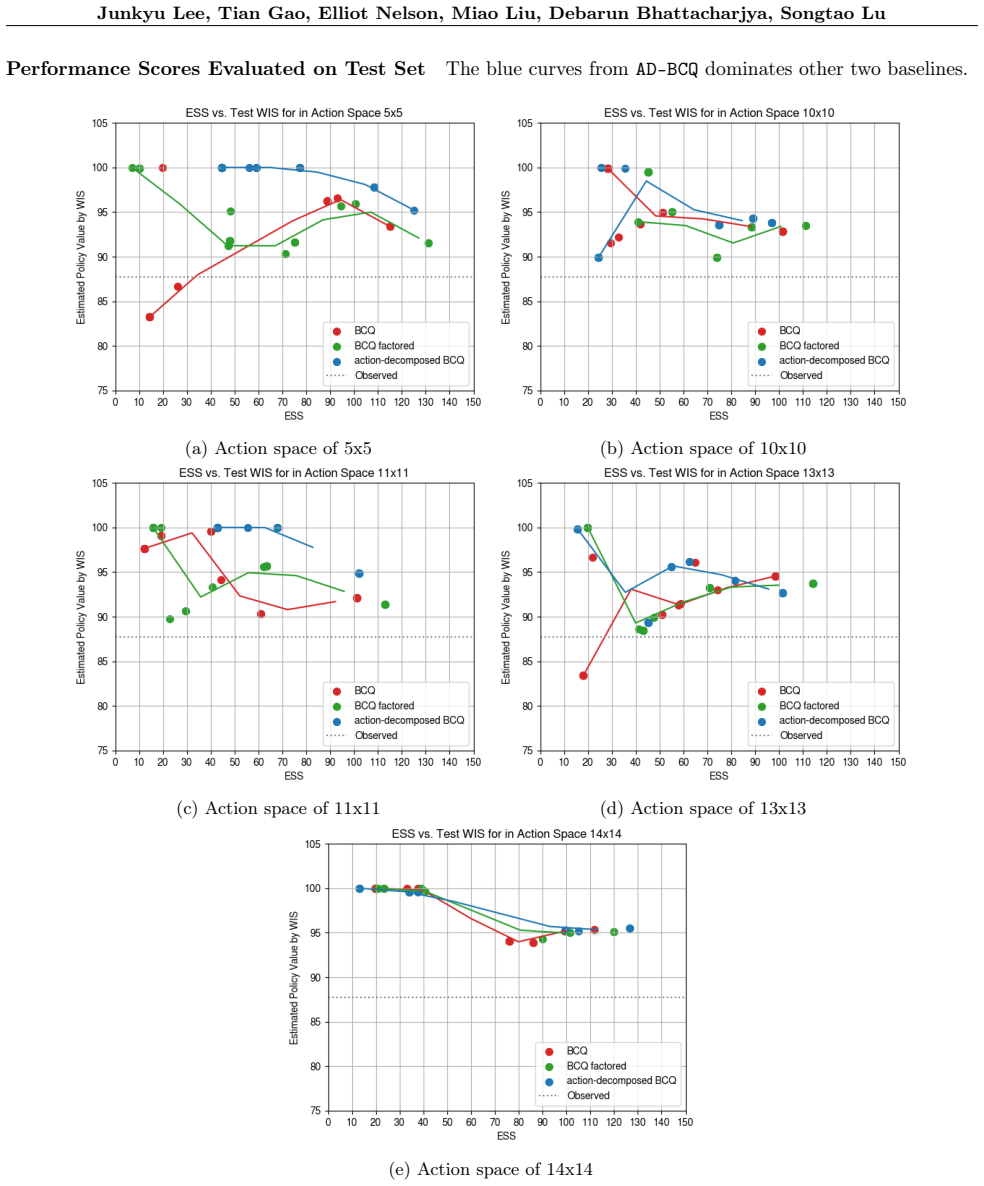
- Augmenting DQN and BCQ with per-block critics and projected-dynamics data augmentation improves sample efficiency on a 2D control task and on an offline sepsis-treatment dataset, with AD-BCQ dominating baselines in WIS/ESS across action-space sizes.
Reading between the lines
- Learning the action-effect partition from data, rather than assuming it is given, would let the decomposition apply where causal structure is unknown; the paper explicitly leaves this to future work.
- The unbiasedness guarantee is proved for the tabular model-based setting; in the deep variants, learned dynamics and reward models inject approximation error, so a sensitivity analysis of how per-block model error propagates into the global Q estimate would be a direct stress test.
- The no-op propensity view suggests a way to multiply sample reuse: any transition whose action block matches the no-op action already carries information about that block's projected dynamics, so replay can be expanded before new data arrives.
- Where monotonicity fails, per-block improvement is only local; auditing or constraining the mixer to enforce monotonicity would tell a practitioner whether the global optimality guarantee actually applies.
Signed reviews
Editorial analysis
A structured set of objections, weighed in public.
Referee Report
Summary. The paper studies Q-function decomposition for factored action spaces in reinforcement learning. It models actions as interventions in a factored MDP under a no-unobserved-confounder semantics and assumes that the effects of disjoint action blocks are non-interacting (Assumption 1). It defines a projected action-space MDP M_k for each action block A_k and a weighted projected Q-function (Definition 2, Eq. (11)) claimed to equal the full Q-function under a propensity weighting. It then presents model-based factored policy iteration (MB-FPI), with Theorem 1 (local convergence, plus global convergence under a monotonicity condition) and Theorem 2 (sample complexity growing with factor sizes rather than the joint action space), and practical algorithms AD-DQN and AD-BCQ that train per-block critics with learned dynamics and reward models. Experiments on a 2D point-mass control task and a MIMIC-III sepsis treatment environment report improved sample efficiency over DECQN and factored-BCQ baselines.
Significance. The core idea, using intervention semantics to justify per-block Q-learning in MDPs with non-interacting action effects, is timely and potentially useful; if correct, it would reduce the sample complexity from the full joint action space to the product of factor sizes. The paper explicitly states its structural assumptions, includes attempted proofs, and provides a sample-complexity analysis. However, the central unbiasedness derivation contains an inverted importance weight and an unstated reward-separability assumption, and the practical algorithms do not implement the weighting. These issues must be resolved before the theoretical claims can be accepted. The empirical results are suggestive but are not connected to the theory as written.
major comments (4)
- [Section 3.1, Definition 2, Eq. (11)] Definition 2, Eq. (11), uses the wrong importance weight. Eq. (9) shows that changing measure from P(s'|s,do(a_k)) to P(s'|s,do(A)) requires multiplying by the product over i≠k of I[S'_i=σ_{A_i}(Pre_i)] / P(S'_i=σ_{A_i}(Pre_i)|s); therefore rho_{-k}(s,s') should be the reciprocal of the product of the no-op probabilities. As printed, rho_{-k} is the product itself. For deterministic interventions, E_{s'~P(·|s,do(a_k))}[rho_{-k} I[Eff(A)=σ_A(Pre)]] = ∏_{i≠k} P(S'_i=σ_{A_i}(Pre_i)|s), which is less than 1 under Assumption 2 unless the no-op dynamics are deterministic. Hence the weighted projected Q-function in Eq. (11) does not equal Q^pi(s,a) as claimed. Algorithm 1 line 5 avoids this issue by constructing the full do(A) transition directly, but then Algorithm 1 does not implement the object analyzed in Definition 2.
- [Proposition 1, Definition 2, Algorithm 2 line 13] Proposition 1, Definition 2, and Algorithm 2 line 13 all write the reward as R(s,a_k,s'), whereas the full Q-function in Eq. (6) depends on the joint action through R(s,a,s'). Assumption 1 factorizes only the transition, not the reward. Without an explicit separability or action-block-reward condition, the projected Q-function is the value of a different MDP, and the proof of Theorem 1 in Appendix A.1 silently substitutes R(s,a,s') for R(s,a_k,s') when concluding that the projected Q equals the full Q. This missing assumption is load-bearing for both the theory and the practical reward-model training.
- [Algorithms 2 and 3] Algorithms 2 and 3 (lines 13–14 and 7–9) train the per-block critics Q^{pi_k}(s,a_k) on batches B_k that are modified to follow P(S'|S,do(A_k)), with no propensity weighting of the form in Eq. (11). The practical AD-DQN and AD-BCQ therefore do not implement the weighted projected Q-function whose unbiasedness Section 3.1 aims to establish. If the unweighted version is claimed to be valid under additional structure, that claim should be stated and proved; as presented, the experiments do not test the theoretical mechanism.
- [Theorem 1 and Appendix A.1] Theorem 1's global-convergence clause depends on a 'monotonic Q' condition that is not defined in the paper. The proof in Appendix A.1 asserts that block-wise improvement is equivalent to joint improvement under monotonicity, but this equivalence is precisely the property needed for the conclusion; no argument shows it follows from Assumption 1 or Assumptions 2–3. This makes the global-optimality result conditional on an essentially tautological assumption. The statement should be made precise, or the theorem should be weakened to local convergence.
minor comments (6)
- [Eq. (10)] Eq. (10) drops the indicator functions from Eq. (9); it should write the ratio with I[S'_i=σ_{A_i}(Pre_i)] in the numerator.
- [Algorithm 1, line 7] Algorithm 1, line 7: the right-hand side contains Q^{pi_k}(s,a_k) rather than Q^{pi_k}(s',pi_k(s')); as printed this is not a valid Bellman backup.
- [Appendix A.1, Proposition 1 proof] The proof of Proposition 1 in Eqs. (13)–(15) has inconsistent discount factors and summation indices; for example, the term prod_{j=0}^t gamma^t does not match the nested sums in the preceding line.
- [Definition 2, notation] Definition 2 switches between sigma_{A_i}(Pre(A_i)) and sigma_{a_i}(Pre(a_i)); clarify whether the intervention policy is indexed by the action variable or by its value and whether Pre may depend on the full state.
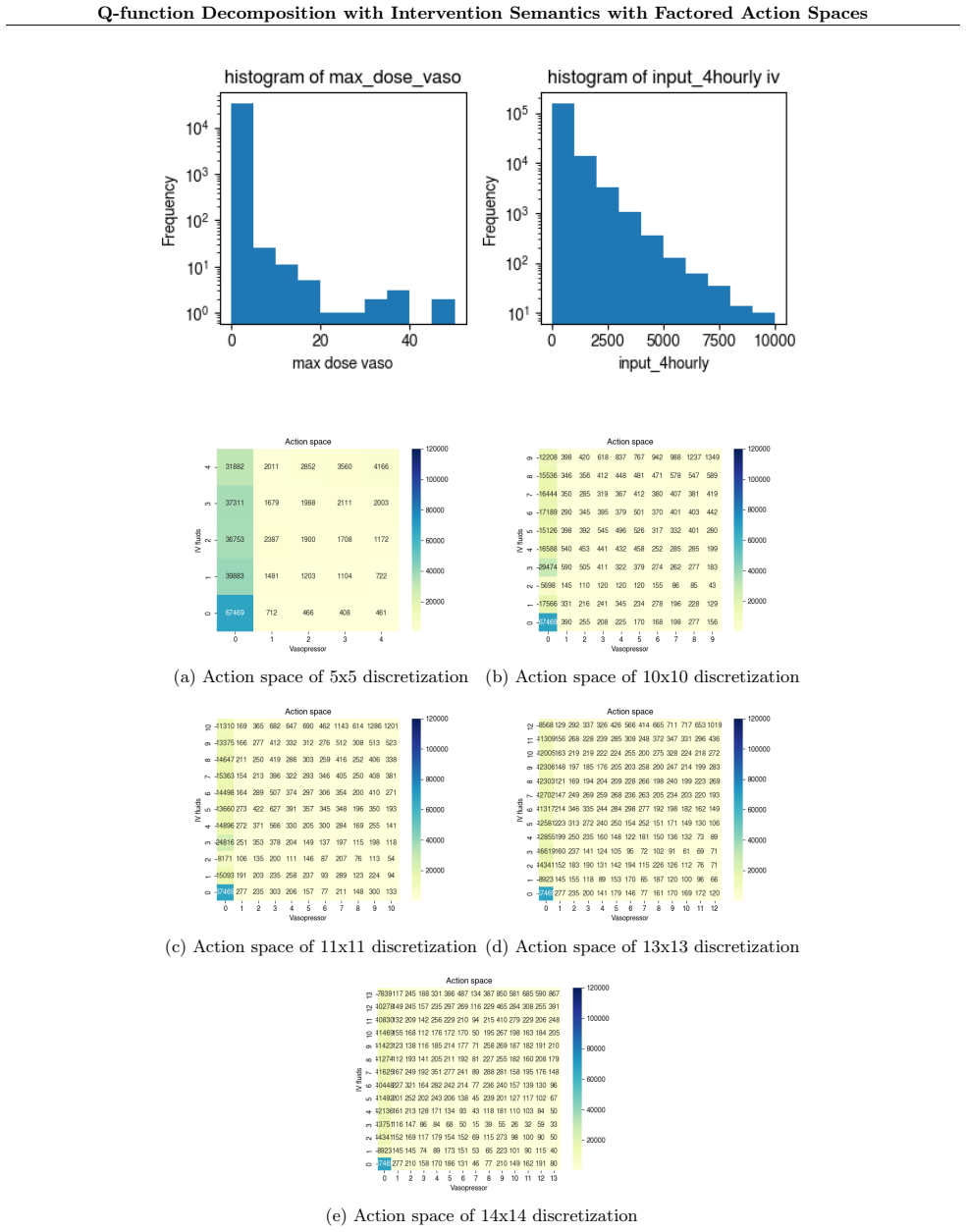
- [Section 5.2 and Figure 4] There are typos in Section 5.2: 'vassopressors' should be 'vasopressors' and Figure 4 captions say 'binds' where 'bins' is intended.
- [Theorem 2] Theorem 2 uses the expression |S\S_{K+1}| without definition; if it denotes the cardinality of the product of state variables outside block K+1, this should be stated explicitly.
Circularity Check
No significant circularity; the decomposition is a conditional change-of-measure identity under explicit structural assumptions.
full rationale
The paper's theoretical chain is conditional on explicit structural assumptions rather than on its own conclusions. Assumption 1 (Eq. 5) states a factorization of the interventional transition, and Eqs. (8)-(10) algebraically rewrite P(S'|S,do(A)) relative to P(S'|S,do(A_k)); the weighted projected Q-function in Definition 2 is then an importance-weighted Bellman object built from that ratio, not a fitted parameter renamed as a prediction. Algorithm 1's line 5 uses the full interventional transition directly, so the model-based policy-evaluation argument is a substitution identity under Assumption 1, not a circular definition. Theorem 1's global optimality clause explicitly imports monotonicity as an additional assumption from the external multi-agent-RL literature (Rashid et al., 2020), and the proof merely shows coordinate ascent reaches the joint fixed point under that assumption; this is a conditional theorem, not a self-citation or an assumed conclusion. Theorem 2 follows a standard Hoeffding/union-bound sample-complexity argument. There are no load-bearing self-citations, no fitted quantities later reported as predictions, and no imported uniqueness theorem. The apparent reciprocal misplacement of rho in Definition 2 (the importance weight is printed as the product of probabilities rather than their reciprocals) is a correctness concern about the formula as written, but it is not a circularity: even if Eq. (11) is biased as printed, that does not make the derivation equivalent to its own input. Overall, the central claim rests on stated structural assumptions and external mathematical conditions, so no circular step is exhibited.
Assumptions & free parameters
free parameters (2)
- Dynamics model noise variance =
0.0001
- No-op fraction probability =
0.1
assumptions (7)
- domain assumption No unobserved confounder setting: state S is the only confounder between action do(A) and next state S' and reward R.
- domain assumption Assumption 1: action variables can be partitioned so that each block A_k affects only its own next-state block S'_k = Eff(A_k) with no interaction.
- domain assumption Assumption 2: no-op dynamics P(S'|S) is positive.
- domain assumption Assumption 3: supports of next states induced by behavior policy pi_b and factored policy pi_b^k coincide.
- domain assumption Monotonicity of the joint Q-function for global optimality of block-wise policy improvement.
- ad hoc to paper Reward in the projected MDP can be evaluated with R(s,a_k,s') rather than the full-action R(s,a,s').
- standard math Hoeffding's inequality and union bound apply to the tabular counts.
Cite this review
Pith. "Pith review of Q-function Decomposition with Intervention Semantics with Factored Action Spaces." pith.science (2026). https://pith.science/paper/XSARQZM3
@misc{pith2026250421326,
  author       = {Pith},
  title        = {Pith review of: Q-function Decomposition with Intervention Semantics with Factored Action Spaces},
  year         = {2026},
  howpublished = {\url{https://pith.science/paper/XSARQZM3}},
  note         = {Machine review of arXiv:2504.21326}
}
read the original abstract
Many practical reinforcement learning environments have a discrete factored action space that induces a large combinatorial set of actions, thereby posing significant challenges. Existing approaches leverage the regular structure of the action space and resort to a linear decomposition of Q-functions, which avoids enumerating all combinations of factored actions. In this paper, we consider Q-functions defined over a lower dimensional projected subspace of the original action space, and study the condition for the unbiasedness of decomposed Q-functions using causal effect estimation from the no unobserved confounder setting in causal statistics. This leads to a general scheme which we call action decomposed reinforcement learning that uses the projected Q-functions to approximate the Q-function in standard model-free reinforcement learning algorithms. The proposed approach is shown to improve sample complexity in a model-based reinforcement learning setting. We demonstrate improvements in sample efficiency compared to state-of-the-art baselines in online continuous control environments and a real-world offline sepsis treatment environment.
Figures


Figures from the paper (11 more)


Reference graph
Works this paper leans on
-
[1]
Agarwal, A., Jiang, N., Kakade, S. M., and Sun, W. (2019). Reinforcement learning: Theory and algorithms. CS Dept., UW Seattle, Seattle, WA, USA, Tech. Rep , 32:96
work page 2019
-
[2]
Brehmer, J., De Haan, P., Lippe, P., and Cohen, T. S. (2022). Weakly supervised causal representation learning. In Advances in Neural Information Processing Systems
work page 2022
-
[3]
Dulac-Arnold, G., Evans, R., van Hasselt, H., Sunehag, P., Lillicrap, T., Hunt, J., Mann, T., Weber, T., Degris, T., and Coppin, B. (2015). Deep reinforcement learning in large discrete action spaces. arXiv preprint arXiv:1512.07679
arXiv 2015
-
[4]
Fujimoto, S., Meger, D., and Precup, D. (2019). Off-policy deep reinforcement learning without exploration. In International conference on machine learning , pages 2052--2062. PMLR
2019
-
[5]
Gao, C., Zheng, Y., Wang, W., Feng, F., He, X., and Li, Y. (2024). Causal inference in recommender systems: A survey and future directions. ACM Transactions on Information Systems , 42(4):1--32
work page 2024
-
[6]
L., Amaral, L
Goldberger, A. L., Amaral, L. A., Glass, L., Hausdorff, J. M., Ivanov, P. C., Mark, R. G., Mietus, J. E., Moody, G. B., Peng, C.-K., and Stanley, H. E. (2000). Physiobank, physiotoolkit, and physionet: components of a new research resource for complex physiologic signals. circulation , 101(23):e215--e220
2000
-
[7]
M., Glymour, C., Sch \"o lkopf, B., and Zhang, K
Huang, B., Lu, C., Leqi, L., Hern \'a ndez-Lobato, J. M., Glymour, C., Sch \"o lkopf, B., and Zhang, K. (2022a). Action-sufficient state representation learning for control with structural constraints. In International Conference on Machine Learning
work page 2022
-
[8]
Huang, S., Dossa, R. F. J., Ye, C., Braga, J., Chakraborty, D., Mehta, K., and Araújo, J. G. (2022b). Cleanrl: High-quality single-file implementations of deep reinforcement learning algorithms. Journal of Machine Learning Research , 23(274):1--18
work page 2022
Show all 46 references
-
[9]
D., Shalit, U., and Sontag, D
Johansson, F. D., Shalit, U., and Sontag, D. (2016). Learning representations for counterfactual inference. In 33rd International Conference on Machine Learning, ICML 2016 , pages 4407--4418. International Machine Learning Society (IMLS)
2016
-
[10]
E., Pollard, T
Johnson, A. E., Pollard, T. J., Shen, L., Lehman, L.-w. H., Feng, M., Ghassemi, M., Moody, B., Szolovits, P., Anthony Celi, L., and Mark, R. G. (2016). Mimic-iii, a freely accessible critical care database. Scientific data , 3(1):1--9
2016
-
[11]
W., Zhang, H., Subramanian, J., Fatemi, M., and Ghassemi, M
Killian, T. W., Zhang, H., Subramanian, J., Fatemi, M., and Ghassemi, M. (2020). An empirical study of representation learning for reinforcement learning in healthcare. arXiv preprint arXiv:2011.11235
2020 arXiv
-
[12]
A., Badawi, O., Gordon, A
Komorowski, M., Celi, L. A., Badawi, O., Gordon, A. C., and Faisal, A. A. (2018). The artificial intelligence clinician learns optimal treatment strategies for sepsis in intensive care. Nature medicine , 24(11):1716--1720
2018
-
[13]
Lange, S., Gabel, T., and Riedmiller, M. (2012). Batch reinforcement learning. In Reinforcement learning: State-of-the-art , pages 45--73. Springer
2012
-
[14]
Levine, S., Kumar, A., Tucker, G., and Fu, J. (2020). Offline reinforcement learning: Tutorial, review, and perspectives on open problems. arXiv preprint arXiv:2005.01643
2020 arXiv
-
[15]
Luczkow, V. (2021). Structural Causal Models for Reinforcement Learning . McGill University (Canada)
2021
-
[16]
Martino, L., Elvira, V., and Louzada, F. (2016). Alternative effective sample size measures for importance sampling. In 2016 IEEE Statistical Signal Processing Workshop (SSP) , pages 1--5. IEEE
2016
-
[17]
Mitrovic, J., McWilliams, B., Walker, J., Buesing, L., and Blundell, C. (2021). Representation learning via invariant causal mechanisms. In International Conference on Learning Representation
2021
-
[18]
A., Veness, J., Bellemare, M
Mnih, V., Kavukcuoglu, K., Silver, D., Rusu, A. A., Veness, J., Bellemare, M. G., Graves, A., Riedmiller, M., Fidjeland, A. K., Ostrovski, G., et al. (2015). Human-level control through deep reinforcement learning. Nature , 518(7540):529--533
2015
-
[19]
Pearl, J. (2009). Causality . Cambridge University Press
2009
-
[20]
Pearl, J. (2019). The seven tools of causal inference, with reflections on machine learning. Communications of the ACM , 62(3):54–60
2019
-
[21]
Pedregosa, F., Varoquaux, G., Gramfort, A., Michel, V., Thirion, B., Grisel, O., Blondel, M., Prettenhofer, P., Weiss, R., Dubourg, V., Vanderplas, J., Passos, A., Cournapeau, D., Brucher, M., Perrot, M., and Duchesnay, E. (2011). Scikit-learn: Machine learning in P ython. Jou...
2011
-
[22]
Pitis, S., Creager, E., and Garg, A. (2020). Counterfactual data augmentation using locally factored dynamics. In Advances in Neural Information Processing Systems
2020
-
[23]
Pitis, S., Creager, E., Mandlekar, A., and Garg, A. (2022). Mocoda: Model-based counterfactual data augmentation. In Advances in Neural Information Processing Systems
2022
-
[24]
S., Farquhar, G., Foerster, J., and Whiteson, S
Rashid, T., Samvelyan, M., De Witt, C. S., Farquhar, G., Foerster, J., and Whiteson, S. (2020). Monotonic value function factorisation for deep multi-agent reinforcement learning. The Journal of Machine Learning Research , 21(1):7234--7284
2020
-
[25]
P., Tang, S., Wiens, J., and Parbhoo, S
Rebello, A. P., Tang, S., Wiens, J., and Parbhoo, S. (2023). Leveraging factored action spaces for off-policy evaluation. In ICML Workshop on New Frontiers in Learning, Control, and Dynamical Systems
2023
-
[26]
Rubin, D. B. (1974). Estimating causal effects of treatments in randomized and nonrandomized studies. Journal of Educational Psychology , 66(5):688
1974
-
[27]
Rubin, D. B. (2005). Causal inference using potential outcomes: Design, modeling, decisions. Journal of the American Statistical Association , 100(469):322--331
2005
-
[28]
Russell, S. J. and Zimdars, A. (2003). Q-decomposition for reinforcement learning agents. In Proceedings of the 20th International Conference on Machine Learning (ICML-03) , pages 656--663
2003
-
[29]
Saito, Y., Ren, Q., and Joachims, T. (2023). Off-policy evaluation for large action spaces via conjunct effect modeling. In Proceedings of the 40th International Conference on Machine Learning , ICML'23. JMLR.org
2023
-
[30]
Sch \"o lkopf, B. (2022). Causality for machine learning. In Probabilistic and Causal Inference: The Works of Judea Pearl , pages 765--804
2022
-
[31]
and Poupart, P
Schulte, O. and Poupart, P. (2024). Why online reinforcement learning is causal. arXiv preprint arXiv:2403.04221
2024 arXiv
-
[32]
Seyde, T., Werner, P., Schwarting, W., Gilitschenski, I., Riedmiller, M., Rus, D., and Wulfmeier, M. (2022). Solving continuous control via Q -learning. In Proceedings of the International Conference on Learning Representations
2022
-
[33]
Silver, D., Schrittwieser, J., Simonyan, K., Antonoglou, I., Huang, A., Guez, A., Hubert, T., Baker, L., Lai, M., Bolton, A., et al. (2017). Mastering the game of Go without human knowledge. Nature , 550(7676):354--359
2017
-
[34]
J., Hostallero, D
Son, K., Kim, D., Kang, W. J., Hostallero, D. E., and Yi, Y. (2019). Qtran: Learning to factorize with transformation for cooperative multi-agent reinforcement learning. In International conference on machine learning , pages 5887--5896. PMLR
2019
-
[35]
Subramanian, J., Sinha, A., Seraj, R., and Mahajan, A. (2022). Approximate information state for approximate planning and reinforcement learning in partially observed systems. Journal of Machine Learning Research , 23(12):1--83
2022
-
[36]
M., Zambaldi, V., Jaderberg, M., Lanctot, M., Sonnerat, N., Leibo, J
Sunehag, P., Lever, G., Gruslys, A., Czarnecki, W. M., Zambaldi, V., Jaderberg, M., Lanctot, M., Sonnerat, N., Leibo, J. Z., Tuyls, K., et al. (2018). Value-decomposition networks for cooperative multi-agent learning based on team reward. In International Conference on Autonom...
2018
-
[37]
Sutton, R. S. and Barto, A. G. (2018). Reinforcement Learning: An Introduction . MIT press
2018
-
[38]
Tang, S., Makar, M., Sjoding, M., Doshi-Velez, F., and Wiens, J. (2022). Leveraging factored action spaces for efficient offline reinforcement learning in healthcare. Advances in Neural Information Processing Systems , 35:34272--34286
2022
-
[39]
and Wiens, J
Tang, S. and Wiens, J. (2021). Model selection for offline reinforcement learning: Practical considerations for healthcare settings. In Machine Learning for Healthcare Conference , pages 2--35. PMLR
2021
-
[40]
and Wiens, J
Tang, S. and Wiens, J. (2023). Counterfactual-augmented importance sampling for semi-offline policy evaluation. Advances in Neural Information Processing Systems , 36:11394--11429
2023
-
[41]
Tassa, Y., Doron, Y., Muldal, A., Erez, T., Li, Y., Casas, D. d. L., Budden, D., Abdolmaleki, A., Merel, J., Lefrancq, A., et al. (2018). Deepmind control suite. arXiv preprint arXiv:1801.00690
2018 arXiv
-
[42]
Tavakoli, A., Fatemi, M., and Kormushev, P. (2020). Learning to represent action values as a hypergraph on the action vertices. In Proceedings of the International Conference on Learning Representations
2020
-
[43]
Tavakoli, A., Pardo, F., and Kormushev, P. (2018). Action branching architectures for deep reinforcement learning. In Proceedings of the aaai conference on artificial intelligence , volume 32
2018
-
[44]
Uehara, M., Shi, C., and Kallus, N. (2022). A review of off-policy evaluation in reinforcement learning. arXiv preprint arXiv:2212.06355
2022 arXiv
-
[45]
Van Hasselt, H., Guez, A., and Silver, D. (2016). Deep reinforcement learning with double q-learning. In Proceedings of the AAAI Conference on Artificial Intelligence , volume 30
2016
-
[46]
Wang, J., Ren, Z., Liu, T., Yu, Y., and Zhang, C. (2020). Qplex: Duplex dueling multi-agent q-learning. In International Conference on Learning Representations
2020
Reviewed August 16, 2026 · model on record in the stance chip above.
Discussion (0). Continue with ORCID to comment.