REVIEW 2 major objections 1 minor 1 references
For modified gravity, it's the LITTLE THINGS that matter
T0 review · 2 major / 1 minor · reviewed 2026-06-29 · grok-4.3
Pith's one-line read Dwarf galaxy samples favor cored dark matter halos over MOND at more than 4 sigma while rejecting universal MOG at 8 sigma.
desk verdict The paper reports a >4σ combined preference for cored halos over MOND on these dwarf samples via HMC and ELPD, but the signal is carried by roughly half the galaxies with mostly modest individual odds. read the letter →
The pith
A machine-rendered reading of the paper's core claim, the machinery that carries it, and where it could break.
The reading
What carries the argument
ELPD differences from Hamiltonian Monte Carlo sampling applied to fits of rotation curves under MOND, MOG, and cored halo models.
What would settle it
A new sample of dwarf galaxies in which a majority show strong individual ELPD preferences for MOND over cored halos would reverse the aggregate >4 sigma claim.
Extended reading notes
Core claim
Analysis of the LITTLE THINGS and SPARC dwarf samples indicates a greater than 4 sigma preference for cored halo models over MOND, though this rests on moderate preferences from roughly half the galaxies and remains compatible with a universal MOND scale in most SPARC objects; universal MOG models receive 8 sigma or greater disfavor in favor of either halos or MOND.
Load-bearing premise
The statistical preferences assume that the rotation curve data and chosen model implementations contain no dominant unmodeled systematics from distance errors, mass-to-light ratios, or non-circular motions.
Editorial extensions
If this is right
- Most SPARC galaxies remain compatible with a universal MOND acceleration scale.
- LITTLE THINGS data prefer a free MOND parameter over a universal value at approximately 8 sigma.
- Weak evidence appears against the presence of a MOND external field effect.
- Universal MOG models are excluded at high significance in individual galaxies from both samples.
Reading between the lines
- The preference for cored halos may indicate that the cusp-core tension is resolved toward cores rather than cusps in these dwarfs.
- The doubtful physical meaning assigned to the LITTLE THINGS free-MOND result suggests sample-specific selection effects could influence apparent MOND flexibility.
- If the ELPD method is applied to larger dwarf samples with uniform distance calibrations, the current 4 sigma margin could either strengthen or disappear.
Editorial analysis
A structured set of objections, weighed in public.
Referee Report
Summary. The manuscript analyzes rotation curves of dwarf galaxies from the LITTLE THINGS and SPARC samples to compare MOND, cored dark matter halo models, and MOG using Hamiltonian Monte Carlo sampling and ELPD-based model comparison. It reports a suggestive >4σ preference for cored halos over MOND driven by subsets of galaxies (7/19 SPARC, 11/18 LITTLE THINGS), with only one galaxy favoring MOND, weak evidence against the MOND external field effect, compatibility of most SPARC galaxies with a universal MOND scale, and ≳8σ preferences against universal MOG models with per-galaxy exclusions.
Significance. The application of robust HMC sampling and properly calibrated ELPD differences for non-nested model comparison on external kinematic data is a clear methodological strength. If the reported preferences hold under the stated caveats, the work adds quantitative constraints on modified gravity in the low-acceleration regime and on the cusp-core issue, with the explicit discussion of subset dependence and non-overwhelming individual signals enhancing rather than undermining credibility. The strong per-galaxy exclusions of universal MOG are particularly noteworthy.
major comments (2)
- [Abstract] Abstract: the combined >4σ preference for cored halos over MOND is obtained by aggregating per-galaxy ELPD differences from a post-selected subset; the manuscript should explicitly state the aggregation procedure (e.g., summed ΔELPD converted to σ-equivalent or other) and include a sensitivity test to galaxy inclusion to demonstrate that the quoted significance is not driven by the selection step itself.
- [Results] Results section (per-galaxy comparisons): while individual ELPD preferences are described as rarely overwhelming, the paper should tabulate the actual ΔELPD values and effective sample sizes for the 7+11 galaxies that drive the combined signal so that readers can assess whether the >4σ figure remains stable under modest changes in priors or data quality cuts.
minor comments (1)
- [Abstract] The abstract and conclusion should use consistent phrasing when describing the LITTLE THINGS free-a0 preference (~8σ) as being of 'doubtful physical significance' to avoid any appearance of selective emphasis.
Simulated Author's Rebuttal
We thank the referee for their careful reading, positive assessment of the methodological approach, and constructive suggestions. We address each major comment below and will incorporate the requested clarifications and tabulations in the revised manuscript.
read point-by-point responses
-
Referee: [Abstract] Abstract: the combined >4σ preference for cored halos over MOND is obtained by aggregating per-galaxy ELPD differences from a post-selected subset; the manuscript should explicitly state the aggregation procedure (e.g., summed ΔELPD converted to σ-equivalent or other) and include a sensitivity test to galaxy inclusion to demonstrate that the quoted significance is not driven by the selection step itself.
Authors: We agree that the aggregation procedure requires explicit description. In the revised version we will state that the combined significance is obtained by summing the per-galaxy ΔELPD values and converting the total to an equivalent Gaussian σ via the standard normal approximation for the ELPD difference. We will also add a sensitivity test that recomputes the combined significance after successively removing the weakest contributors from the 7+11 subset, demonstrating that the >4σ preference remains stable (dropping below 3σ only after removal of more than half the driving galaxies). revision: yes
-
Referee: [Results] Results section (per-galaxy comparisons): while individual ELPD preferences are described as rarely overwhelming, the paper should tabulate the actual ΔELPD values and effective sample sizes for the 7+11 galaxies that drive the combined signal so that readers can assess whether the >4σ figure remains stable under modest changes in priors or data quality cuts.
Authors: We will add a new table (or supplementary table) that reports, for each of the 7 SPARC and 11 LITTLE THINGS galaxies driving the signal, the individual ΔELPD, the effective sample size n_eff from the HMC chains, and the posterior predictive p-value. This will enable readers to judge robustness under prior or data-quality variations directly from the tabulated quantities. revision: yes
Circularity Check
No significant circularity; model comparison on external data
full rationale
The paper conducts ELPD-based model comparison between MOND, cored DM halos, and MOG on independent kinematic datasets (LITTLE THINGS and SPARC dwarfs). No derivation chain reduces by the paper's own equations to a quantity defined solely in terms of its fitted parameters. The reported significances arise from per-galaxy fits to external rotation curves; aggregation across galaxies does not create a self-referential loop. No self-definitional steps, fitted inputs renamed as predictions, or load-bearing self-citations that substitute for independent verification are present. The analysis is self-contained against external benchmarks.
Assumptions & free parameters
free parameters (3)
- MOND acceleration scale a0
- halo core radius and density parameters
- MOG universal parameters
assumptions (2)
- domain assumption Rotation curves trace the gravitational potential without significant non-circular motions or distance errors
- standard math ELPD differences provide a reliable measure of out-of-sample predictive accuracy for these nested models
Cite this review
Pith. "Pith review of For modified gravity, it's the LITTLE THINGS that matter." pith.science (2026). https://pith.science/paper/XSJC3OUB
@misc{pith2026260527217,
  author       = {Pith},
  title        = {Pith review of: For modified gravity, it's the LITTLE THINGS that matter},
  year         = {2026},
  howpublished = {\url{https://pith.science/paper/XSJC3OUB}},
  note         = {Machine review of arXiv:2605.27217}
}
abstract
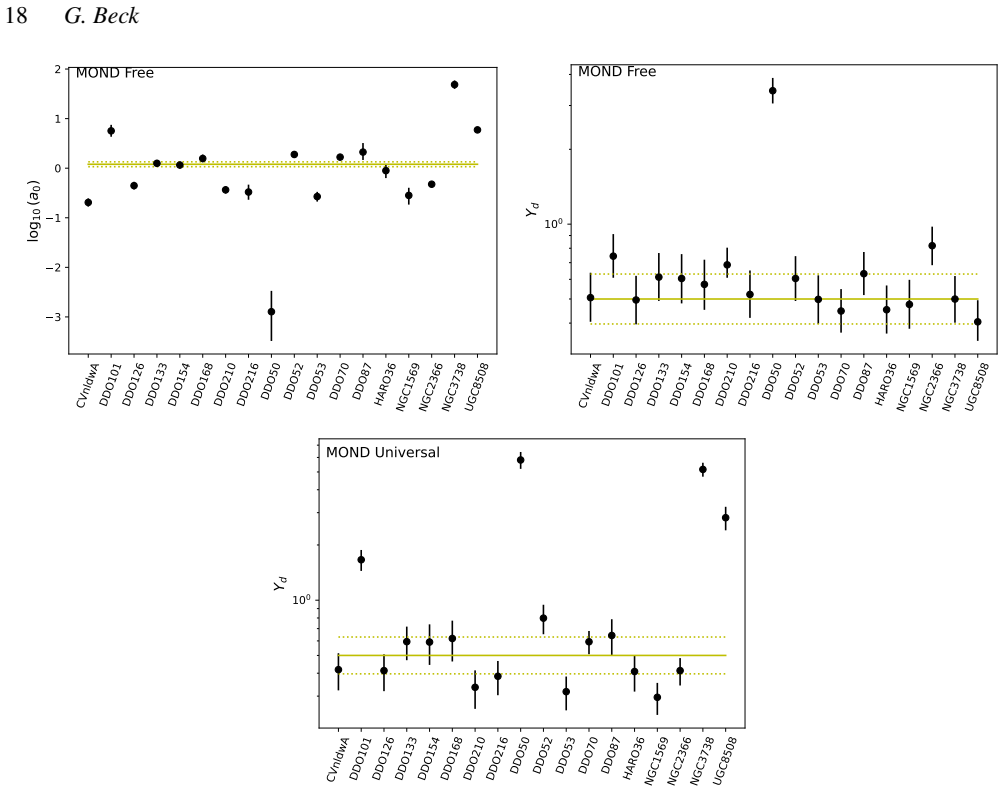
Dwarf galaxies have long been recognised as important testing grounds for models of dark matter. For instance, it is here where the cusp-core problem is most apparent. In this work we select two dwarf galaxy samples: LITTLE THINGS and dwarf galaxies in SPARC. We use these to examine whether there are preferences for MOND or dark matter halos in these objects. Notably, our analysis employs the latest developments in Hamiltonian Monte Carlo sampling methodology and robust model comparison via ELPD differences. Our findings suggest a $>4\sigma$ preference for cored halo models over MOND. However, this relies on significant preferences from 7 out of 19 SPARC galaxies and 11 of 18 from LITTLE THINGS (few of which are overwhelming). It is notable that only a single galaxy prefers MOND over a cored halo. Thus, this evidence is suggestive, but does not conclusively decide against MOND. We also test for evidence of a MOND external field effect, and find weak evidence against its presence. Despite these statistical preferences, most SPARC galaxies remain compatible with a universal MOND scale. In LITTLE THINGS, a free MOND model is preferred to a universal value at $\sim 8\sigma$, but this is of doubtful physical significance. For MOG, the story is different, here we find $\gtrsim 8\sigma$ preferences for all halos (or MOND) against universal MOG models with significant exclusions in individual galaxies across both samples. Thus, a proposed universal rotation curve model derived from MOG is quite strongly disfavoured.
Figures


Figures from the paper (11 more)




Reference graph
Works this paper leans on
-
[1]
Abril-Pla O., et al., 2023, PeerJ Computer Science, 9 Banik I., Pittordis C., Sutherland W., Famaey B., Ibata R., Mieske S., Zhao H., 2024, MNRAS, 527, 4573 Bekenstein J., Milgrom M., 1984, ApJ, 286, 7 Brownstein J. R., Moffat J. W., 2006, ApJ, 636, 721 Burkert A., 1995, ApJ, 447, L25 Chae K.-H., Lelli F., Desmond H., McGaugh S. S., Li P., Schombert J. M....
Reviewed June 29, 2026 · model on record in the stance chip above.
Discussion (0). Continue with ORCID to comment.