REVIEW 2 major objections 2 minor 2 cited by
Quenching of Nonrelativistic p-Wave Spin Splitting by c-f Decoupling in CeNiAsO
T0 review · 2 major / 2 minor · reviewed 2026-06-28 · grok-4.3
Pith's one-line read Strong correlations quench the predicted p-wave spin splitting in CeNiAsO by keeping f-electrons localized.
desk verdict ARPES on CeNiAsO finds no p-wave splitting or c-f hybridization, but the non-observation needs a resolution check before claiming correlations override symmetry predictions. read the letter →
The pith
A machine-rendered reading of the paper's core claim, the machinery that carries it, and where it could break.
The reading
What carries the argument
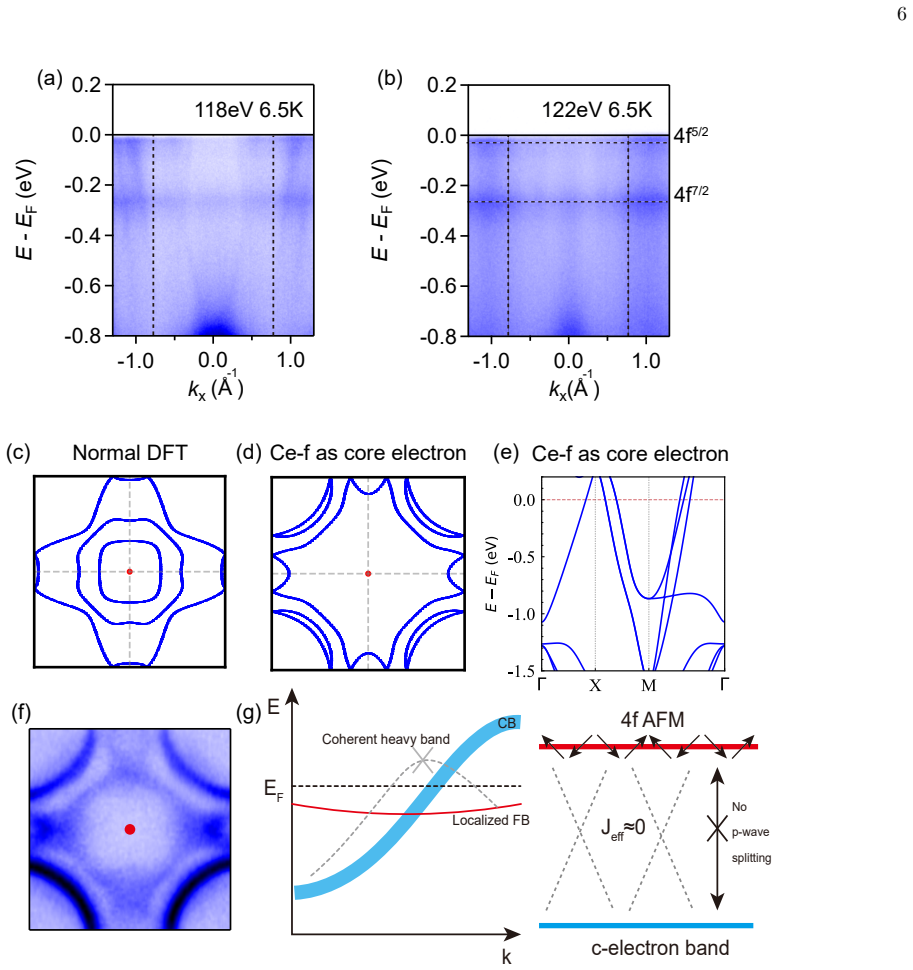
c-f decoupling, in which the absence of coherent hybridization between localized Ce 4f electrons and conduction bands prevents projection of the real-space magnetic symmetry onto the electronic bands.
What would settle it
Observation of p-wave band splitting or signatures of coherent c-f hybridization in higher-resolution ARPES or improved samples of CeNiAsO would falsify the reported absence.
Extended reading notes
Core claim
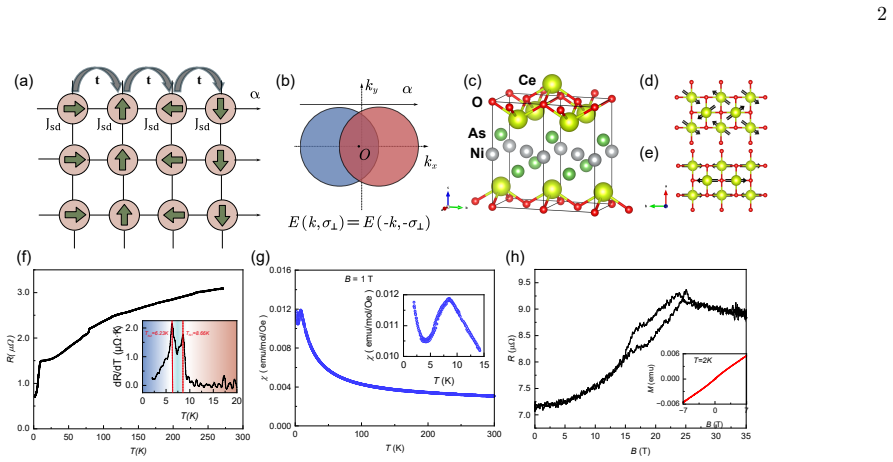
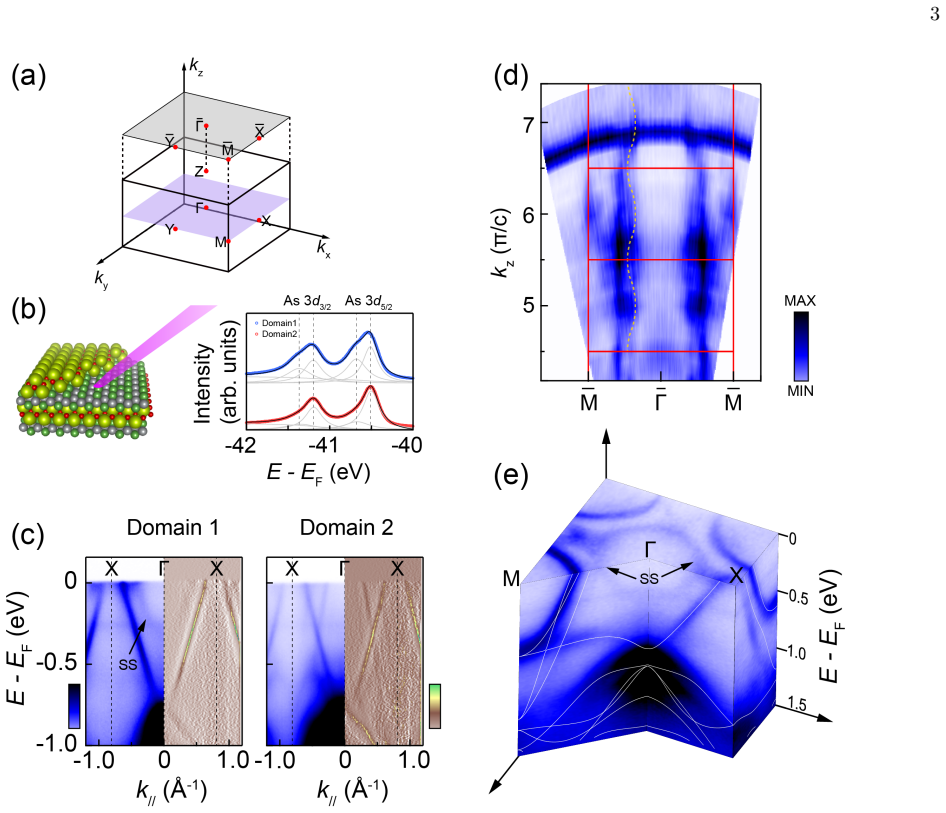
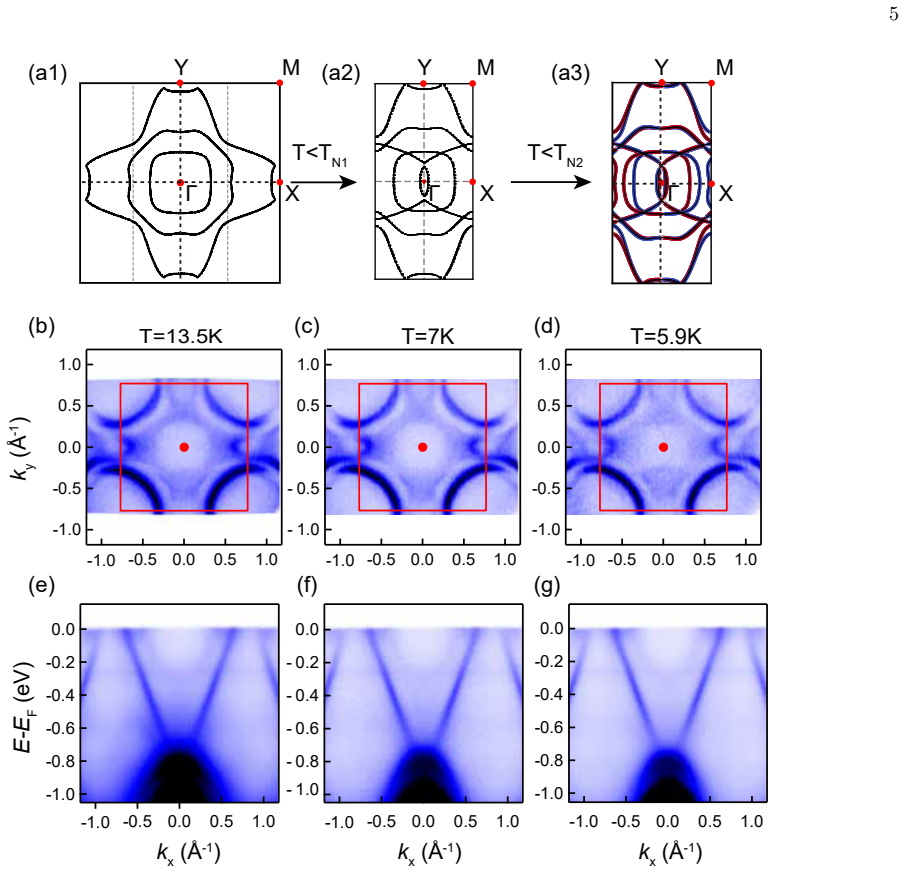
In CeNiAsO the expected p-wave band splitting arising from its commensurate coplanar magnetic configuration is absent, along with any spin-density-wave band folding, so that the conduction bands retain full Kramers degeneracy. Resonant ARPES shows no coherent c-f hybridization near the Fermi level inside the magnetically ordered states, confirming that the Ce 4f electrons remain localized. The results therefore establish a many-body constraint: geometric symmetry classifications are necessary but not sufficient for nonrelativistic spin splittings once strong electronic correlations are taken into account.
Load-bearing premise
The ultra-low-temperature high-resolution ARPES resolution and sample quality are sufficient to detect any p-wave splitting or c-f hybridization if present.
Editorial extensions
If this is right
- Conduction bands in CeNiAsO retain Kramers degeneracy across both magnetic transitions.
- Ce 4f electrons remain localized with no coherent hybridization near the Fermi level in the ordered phases.
- Geometric symmetry alone cannot guarantee nonrelativistic spin splittings in the presence of strong correlations.
- Many-body effects impose an additional constraint beyond symmetry-based classifications for p-wave magnets.
Reading between the lines
- The same quenching mechanism may appear in other heavy-fermion antiferromagnets where f-electrons stay localized.
- Theoretical predictions of nonrelativistic spin splitting should incorporate explicit correlation terms rather than relying on symmetry alone.
- Candidate materials for p-wave magnets should be screened for delocalized f or d electrons before symmetry arguments are applied.
Editorial analysis
A structured set of objections, weighed in public.
Referee Report
Summary. The manuscript reports ultra-low-temperature, high-resolution resonant ARPES measurements on single-crystal CeNiAsO across its consecutive magnetic transitions. It claims that neither the band folding expected from a spin-density wave nor the p-wave spin splitting predicted by spin-space-group symmetries for the coplanar antiferromagnetic order is observed, that the conduction bands retain full Kramers degeneracy, and that resonant ARPES shows no coherent c-f hybridization near the Fermi level. The authors conclude that the Ce 4f electrons remain localized, quenching the expected nonrelativistic spin splitting and demonstrating that geometric symmetry is necessary but insufficient in the presence of strong correlations.
Significance. If the central negative result is robust, the work supplies a concrete many-body counterexample showing that real-space magnetic symmetries do not automatically produce observable momentum-space spin splittings once f-electron localization is taken into account. This supplies a useful constraint for spintronics proposals that rely on nonrelativistic p-wave magnets in heavy-fermion or correlated platforms. The resonant-ARPES tracking of f-spectral weight is a direct experimental strength that ties the spectroscopic null result to the localized limit.
major comments (2)
- [Results section (ARPES data across magnetic transitions)] Results section (ARPES data across magnetic transitions): the central claim that any theoretically expected p-wave splitting is absent (rather than undetected) rests on non-observation, yet the manuscript supplies no quantitative comparison between the stated energy/momentum resolution, Fermi-surface broadening, and signal-to-noise and the splitting magnitude predicted by the coplanar AF order. Without this bound the data cannot distinguish quenching by localization from a splitting below the effective resolution.
- [Resonant ARPES temperature-dependence analysis] Resonant ARPES temperature-dependence analysis: the conclusion that c-f hybridization is absent near EF is used to confirm the localized limit, but the manuscript does not report an upper limit on any residual hybridization gap or coherence peak intensity relative to the experimental resolution and temperature range; this limit is load-bearing for the claim that the f electrons remain fully localized across the ordered phases.
minor comments (2)
- [Figure captions] Figure captions and main text should explicitly state the energy and momentum resolutions achieved at the measurement temperatures and compare them directly to the theoretical splitting scale cited from prior work.
- [Abstract and introduction] The abstract and introduction refer to 'ultra-low-temperature, high-resolution' conditions without numerical values; these numbers should appear in the methods or first results paragraph.
Simulated Author's Rebuttal
We thank the referee for the careful reading of our manuscript and the constructive comments. We address each major comment below and indicate the revisions that will be incorporated.
read point-by-point responses
-
Referee: [Results section (ARPES data across magnetic transitions)] Results section (ARPES data across magnetic transitions): the central claim that any theoretically expected p-wave splitting is absent (rather than undetected) rests on non-observation, yet the manuscript supplies no quantitative comparison between the stated energy/momentum resolution, Fermi-surface broadening, and signal-to-noise and the splitting magnitude predicted by the coplanar AF order. Without this bound the data cannot distinguish quenching by localization from a splitting below the effective resolution.
Authors: We agree that an explicit quantitative bound is necessary to distinguish true absence from non-detection. In the revised manuscript we will add a dedicated paragraph and supplementary figure that directly compares the p-wave splitting magnitude predicted by spin-space-group symmetry for the coplanar antiferromagnetic structure against our measured energy resolution, momentum resolution, Fermi-surface linewidth, and signal-to-noise ratio. This comparison will establish a concrete upper limit on any undetected splitting, thereby reinforcing the conclusion that the observed Kramers degeneracy results from f-electron localization rather than insufficient experimental sensitivity. revision: yes
-
Referee: [Resonant ARPES temperature-dependence analysis] Resonant ARPES temperature-dependence analysis: the conclusion that c-f hybridization is absent near EF is used to confirm the localized limit, but the manuscript does not report an upper limit on any residual hybridization gap or coherence peak intensity relative to the experimental resolution and temperature range; this limit is load-bearing for the claim that the f electrons remain fully localized across the ordered phases.
Authors: We accept that a quantitative upper bound on residual hybridization strengthens the localized-limit interpretation. In the revised manuscript we will include an analysis that places an upper limit on any hybridization gap or coherent f-peak intensity, derived from the resonant ARPES spectra, the experimental energy resolution, and the temperature range examined. This bound will be presented together with the temperature-dependent f-spectral weight data to make the evidence for the absence of coherent c-f hybridization fully quantitative. revision: yes
Circularity Check
No circularity: purely observational experimental study
full rationale
The paper reports ARPES measurements on CeNiAsO across magnetic transitions, documenting the absence of band folding, p-wave splitting, and c-f hybridization signatures. The central claim—that geometric symmetries are insufficient for nonrelativistic spin splitting under strong correlations—follows directly from these spectroscopic observations and the temperature-dependent resonant data, without any equations, fitted parameters renamed as predictions, or self-citation chains that reduce the result to its inputs by construction. No load-bearing derivations exist to inspect for circularity.
Assumptions & free parameters
assumptions (2)
- domain assumption The magnetic configuration of CeNiAsO is the commensurate coplanar structure theoretically expected to produce p-wave splitting.
- domain assumption Resonant ARPES accurately tracks the temperature dependence of Ce 4f spectral weight to determine the presence or absence of c-f hybridization.
Cite this review
Pith. "Pith review of Quenching of Nonrelativistic p-Wave Spin Splitting by c-f Decoupling in CeNiAsO." pith.science (2026). https://pith.science/paper/XSRQANB5
@misc{pith2026260602420,
  author       = {Pith},
  title        = {Pith review of: Quenching of Nonrelativistic p-Wave Spin Splitting by c-f Decoupling in CeNiAsO},
  year         = {2026},
  howpublished = {\url{https://pith.science/paper/XSRQANB5}},
  note         = {Machine review of arXiv:2606.02420}
}
abstract
The extending of spin-space group symmetries to coplanar antiferromagnets has predicted the emergence of odd-parity nonrelativistic spin splittings, making the identification of a practical $p$-wave magnet a central pursuit in spintronics. The layered heavy-fermion oxypnictide CeNiAsO has been widely regarded as the prototypical platform to verify this paradigm, as its commensurate coplanar magnetic configuration is theoretically expected to induce a robust $p$-wave band splitting. Here, we investigate the electronic structure of single-crystal CeNiAsO using ultra-low-temperature, high-resolution, and resonant angle-resolved photoemission spectroscopy (ARPES). Across the consecutive magnetic transitions into the ordered phases, our spectroscopic data reveal neither the expected band folding associated with a spin density wave nor any observable $p$-wave band splitting, demonstrating that the conduction bands retain full Kramers degeneracy. By tracking the temperature dependence of the Ce 4$f$ spectral weight via resonant ARPES, we find no evidence of coherent $c-f$ hybridization near the Fermi level within the magnetically ordered states, confirming that the Ce 4$f$ electrons operate in the localized limit. Our findings establish a clear many-body constraint on projecting real-space magnetic symmetries onto momentum-space electronic bands, demonstrating that geometric symmetry classifications constitute a necessary framework but are not a sufficient condition for nonrelativistic spin splittings in the presence of strong electronic correlations.
Figures
Figures from the paper (1 more)
Forward citations
Cited by 2 Pith papers
-
Floquet spin-group framework and its application to light-tailored spin splitting in collinear magnets
A unified Floquet spin-group framework classifies how different laser polarizations select even-, odd-, or mixed-parity spin-splitting patterns in collinear magnets, including new 3D higher-order 'h-wave' and 'k-wave'...
-
The fate of odd-parity magnetism in one dimension
Bosonization analysis of a 1D extended Hubbard-Kondo model shows p-wave magnetic order produces p-wave character in the electron spectral function only at commensurate fillings, with interactions becoming irrelevant o...
Reference graph
Works this paper leans on
-
[1]
& Sinova, J
ˇSmejkal, L., Gonz´ alez-Hern´ andez, R., Jungwirth, T. & Sinova, J. Crystal time-reversal symmetry breaking and spontaneous hall effect in collinear antiferromagnets.Sci- ence Advances6, eaaz8809 (2020)
2020
-
[2]
Yuan, L.-D., Wang, Z., Luo, J.-W., Rashba, E. I. & Zunger, A. Giant momentum-dependent spin splitting in centrosymmetric low-z antiferromagnets.Physical Re- view B102, 014422 (2020)
2020
-
[3]
& Jungwirth, T
ˇSmejkal, L., Sinova, J. & Jungwirth, T. Emerging re- search landscape of altermagnetism.Phys. Rev. X12, 040501 (2022)
2022
-
[4]
& Jungwirth, T
ˇSmejkal, L., Sinova, J. & Jungwirth, T. Beyond conven- tional ferromagnetism and antiferromagnetism: A phase with nonrelativistic spin and crystal rotation symmetry. Phys. Rev. X12, 031042 (2022)
2022
-
[5]
Zhang, X.et al.Arpes studies of spin-splitting antiferro- magnets.Chin. Phys. Lett.43, 050709 (2026)
2026
-
[6]
Liu, J.et al.Symmetry-driven spin splitting in alter- magnets: an angle-resolved photoemission spectroscopy perspective.Nano Convergence13, 6 (2026)
2026
-
[7]
Roig, M., Kreisel, A., Yu, Y., Andersen, B. M. & Agter- berg, D. F. Minimal models for altermagnetism.Phys. Rev. B110, 144412 (2024)
2024
-
[8]
Nature642, 70–76 (2025)
Song, Q.et al.Electrical switching of a p-wave magnet. Nature642, 70–76 (2025)
2025
Show all 29 references
-
[9]
& Liu, Q
Liu, P., Li, J., Han, J., Wan, X. & Liu, Q. Spin-group symmetry in magnetic materials with negligible spin- orbit coupling.Phys. Rev. X12, 021016 (2022)
2022
-
[10]
& Song, Z.-D
Xiao, Z., Zhao, J., Li, Y., Shindou, R. & Song, Z.-D. Spin space groups: Full classification and applications.Phys. Rev. X14, 031037 (2024)
2024
-
[11]
B., Comin, R
Priessnitz, J., Hellenes, A. B., Comin, R. & ˇSmejkal, L. Ferroelectric p-wave magnets (2026). Unpublished
2026
-
[12]
Chakraborty, A.et al.Highly efficient non-relativistic edelstein effect in nodal p-wave magnets.Nature Com- munications16, 7270 (2025)
2025
-
[13]
& Gonzalez, J
Leon, A., Autieri, C., Brumme, T. & Gonzalez, J. W. Hybrid d/p-wave altermagnetism in ca3ru2o7 and strain- controlled spin splitting.npj Quantum Materials10, 78 (2025)
2025
-
[14]
R.et al.Antialtermagnetic magnons and nonrelativistic thermal edelstein effect.arXiv preprint arXiv:2603.05415(2026)
Neumann, R. R.et al.Antialtermagnetic magnons and nonrelativistic thermal edelstein effect.arXiv preprint arXiv:2603.05415(2026)
2026
-
[15]
& Ruan, J
Zhu, T., Zhou, D., Wang, H. & Ruan, J. Floquet odd- parity collinear magnets (2025). Unpublished
2025
-
[16]
& Scheurer, M
Rickelt, K., Sedov, D. & Scheurer, M. S. Hatsugai- kohmoto-like models for altermagnets and odd-parity magnets (2026). Unpublished
2026
-
[17]
Odd-parity altermagnetism through sublattice currents: From haldane-hubbard model to general bipar- tite lattices.arXiv preprintarXiv:2503.09602(2025)
Lin, Y.-P. Odd-parity altermagnetism through sublattice currents: From haldane-hubbard model to general bipar- tite lattices.arXiv preprintarXiv:2503.09602(2025). 2503.09602
2025
-
[18]
& Yan, Z
Zhuang, Z.-Y., Zhu, D., Liu, D., Wu, Z. & Yan, Z. Odd- parity altermagnetism originated from orbital orders. arXiv preprintarXiv:2508.18360(2025). 2508.18360
2025
-
[19]
Mitscherling, J., Priessnitz, J., Geschner, C. K. & ˇSmejkal, L. Microscopic origin ofp-wave magnetism. arXiv preprintarXiv:2603.xxxxx(2026). 2603.xxxxx
2026
-
[20]
Yamada, R.et al.A metallic p-wave magnet with com- mensurate spin helix.Nature646, 837–842 (2025)
2025
-
[21]
& Zhong, Y
Zhao, M., Yang, W.-W., Guo, X., Luo, H.-G. & Zhong, Y. Altermagnetism in heavy-fermion systems: Mean- field study on the kondo lattice.Physical Review B111, 085145 (2025)
2025
-
[22]
G., Brekke, B
Sukhachov, P., Giil, H. G., Brekke, B. & Linder, J. Co- existence ofp-wave magnetism and superconductivity. Phys. Rev. B111, L220403 (2025)
2025
-
[23]
Out-of-plane edelstein effects: Electric field induced magnetization in p-wave magnets.Phys
Ezawa, M. Out-of-plane edelstein effects: Electric field induced magnetization in p-wave magnets.Phys. Rev. B 111, 161301 (2025)
2025
-
[24]
G., Brataas, A
Brekke, B., Sukhachov, P., Gill, H. G., Brataas, A. & Linder, J. Minimal models and transport properties of unconventionalp-wave magnets.Phys. Rev. Lett.133, 236703 (2024)
2024
-
[25]
Wu, S.et al.Incommensurate magnetism near quantum criticality in CeNiAsO.Phys. Rev. Lett.122, 197203 (2019)
2019
-
[26]
B.et al.P-wave magnets.arXiv preprint arXiv:2309.01607(2023)
Hellenes, A. B.et al.P-wave magnets.arXiv preprint arXiv:2309.01607(2023). 2309.01607
2023 arXiv
-
[27]
Yu, Y.et al.Odd-parity magnetism driven by antiferro- magnetic exchange.Phys. Rev. Lett.135, 046701 (2025)
2025
-
[28]
Kirchner, S.et al.Colloquium: Heavy-electron quantum criticality and single-particle spectroscopy.Rev. Mod. Phys.92, 011002 (2020)
2020
-
[29]
Lu, F.et al.75as nmr study of the antiferromagnetic kondo lattice compound ceniaso.Phys. Rev. B107, 045104 (2023)
2023
Reviewed June 28, 2026 · model on record in the stance chip above.
Discussion (0). Continue with ORCID to comment.