REVIEW 2 major objections 6 minor 26 references
Mitigation of the Flexing-Filtering Effect in Time-Delay Interferometry
T0 review · 2 major / 6 minor · reviewed 2026-08-07 · deepseek-v4-flash
Pith's one-line read Replacing the TDI delay operator with a filter-conjugated version suppresses flexing-filtering laser noise by over six orders of magnitude, so LISA's anti-aliasing filters no longer need to be ultra-flat.
desk verdict A genuinely new TDI delay operator that folds the filter response into the delay itself; it works in the simplified no-decimation model, and the paper deserves refereeing, but the abstract oversells it. read the letter →
The pith
A machine-rendered reading of the paper's core claim, the machinery that carries it, and where it could break.
The reading
What carries the argument
The load-bearing object is the modified delay operator $\hat D = F D F^{-1}$, which the paper implements as a time-varying finite-impulse-response filter. Its kernel is a sum of the usual interpolation kernel and a flexing-filtering correction kernel $k_H(\tau)$ scaled by the delay derivative $\dot d(t)$; $k_H$ is a cosine-sum kernel whose Fourier transform is optimized, via a weighted minimax procedure, to follow $-f\, d(\log \tilde h_F)/df$ inside the LISA band and to vanish in the stop band. This construction transfers the cancellation of filter non-flatness from the hardware filter design into the delay operation itself, so the TDI algebra of the filtered data mirrors the unfiltered algebra.
What would settle it
Run the same TDI simulation with the full on-board decimation chain (the CIC filter plus all four FIR stages at their native rates) instead of the single effective 4 Hz filter, and check whether the modified-TDI residual stays below the 0.1 pm reference and still tracks the arm-length-mismatch curve; any excess would reveal that the effective-filter assumption hides a residual flexing-filtering floor.
Extended reading notes
Core claim
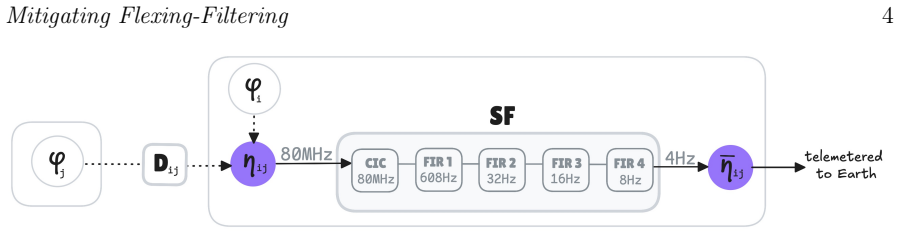
The central discovery is that the non-commutativity of the delay operation with the on-board filter, rather than the filter itself, is what generates flexing-filtering noise, and that this non-commutativity can be absorbed into the delay operator. Writing the filtered single-link measurement as $\bar\eta_{ij}=F D_{ij}\phi_j - F\phi_i$ and inserting $1=F^{-1}F$ between the delay and the laser phase gives $\bar\eta_{ij}=(F D_{ij} F^{-1})\bar\phi_j - \bar\phi_i$, which has the same algebraic structure as the unfiltered measurement if one uses the modified delay $\hat D_{ij}=F D_{ij} F^{-1}$ on the filtered phases. To first order in the delay derivative, $\hat D$ is the ordinary delay plus a correction $\dot d\,D (d/dt) G F^{-1}$, implemented as a single time-varying FIR filter whose kernel is the pure-delay kernel plus $\dot d(t)$ times a correction kernel designed to cancel the in-band filter slope. In the second-generation Michelson combination $X_2$, the residual from this correction is orders of magnitude below the flexing-filtering residual of standard TDI; in the simulations it sits below the LISA 0.1 pm reference and is dominated by the fundamental arm-length-mismatch noise, not by filter non-flatness.
Load-bearing premise
The prediction rests on treating the entire on-board filtering and decimation chain as one fixed effective filter at the final 4 Hz rate, with the correction operators treated as fixed because the delays change slowly; if the real multi-stage chain or faster delay dynamics break those assumptions, the residual floor could move.
Editorial extensions
If this is right
- The flatness requirement on LISA's anti-aliasing filters can be relaxed, leaving stop-band attenuation as the main design criterion and reducing on-board computational cost.
- Modified TDI requires no separate compensation filter and has the same kernel width as standard TDI, so it adds no extra group delay and no additional data loss around gaps.
- With the modified delay operator, the residual laser noise in the second-generation Michelson variable is dominated by the arm-length mismatch of the constellation rather than by filter non-flatness.
- The same construction extends by cyclic permutation to the companion TDI variables Y2 and Z2, since they are built from the same single-link algebra.
- The compensation-filter approach remains a viable but weaker mitigation, leaving residual flexing-filtering coupling and increasing group delay.
Reading between the lines
- If the method is validated with the full multi-stage decimation chain rather than a single effective filter, the same filter-conjugated delay idea could be applied to other on-board filter-affected measurements, such as the auxiliary interferometers used for clock-noise correction.
- The success of the correction depends on knowing the in-band filter response accurately, so an in-flight calibration of the anti-aliasing chain would become a practical requirement; the mismatch between modeled and actual filter response would set a noise floor.
- Because the correction is proportional to the delay derivative, the first-order expansion may need higher-order terms during epochs of strong flexing; extending the operator to second order is a natural stress test.
- A hardware test on a tabletop interferometer with a realistic decimation chain could separate the method's true benefit from the idealizations of the 4 Hz effective-filter simulation.
Editorial analysis
A structured set of objections, weighed in public.
Referee Report
Summary. The paper proposes a modified delay operator for time-delay interferometry (TDI) that incorporates the on-board anti-aliasing filter response, aiming to suppress the flexing-filtering effect without requiring extremely flat filters. The authors derive analytical residual models for three TDI topologies (standard, compensation, and modified), design a cosine-sum kernel for the modified delay operator, and validate the models with numerical simulations at 4 Hz. The central claim is that modified TDI reduces flexing-filtering noise by several orders of magnitude and that the residual is ultimately limited by the fundamental arm-length mismatch of the constellation. The paper also presents a detailed design of a new decimation filter chain and a compensation filter, and provides open-source code and data.
Significance. If the central claim holds, the method could relax the flatness requirement on LISA's anti-aliasing filters and reduce on-board computational load, which is a practical contribution to the LISA data-processing pipeline. The paper is generally clearly written, provides reproducible code and data, and includes a careful analytical treatment of the flexing-filtering residual, including an explicit bound on the kernel approximation error. The proposed modified delay operator is an original idea that builds on prior work on interpolation kernels and could be of interest to the LISA simulation and data-analysis community. However, the main result is not yet validated for the full multirate decimation chain that is actually present on board, because both the algebraic derivation and the numerical experiments omit the decimation operator S.
major comments (2)
- [Section 3.3, Eq. (19)] The derivation of the modified delay operator is not a valid manipulation of Eq. (13). Starting from \bar{\eta}_{ij} = S F D_{ij} \phi_j - S F \phi_i, inserting F^{-1}F after the delay gives S F D_{ij} F^{-1} F \phi_j - S F \phi_i, not F D_{ij} F^{-1} F \phi_j - F \phi_i as written in Eq. (19). The paper silently drops the decimation operator S and redefines \bar{\phi}_i = F \phi_i instead of the earlier definition \bar{\phi}_i = S F \phi_i in Eq. (14). The modified delay operator bD = F D F^{-1} is therefore only defined for a chain without decimation. Since Section 6 simulations also explicitly operate at 4 Hz with a single effective filter and no S, the claimed suppression of flexing-filtering noise is not demonstrated for the actual LISA multirate decimation chain. This is a load-bearing issue because the abstract and conclusions present the result as applicable to LISA. Please either (i) reformulate the derivation and claims as applying to the filter-only chain and discuss what changes when S is included, or (ii) extend the construction to incorporate S.
- [Section 5 and Fig. 5] The analytical model for the modified TDI correction residual, Eq. (41), is an upper bound derived under the assumptions of time-invariant H and equal arms, yet the numerical simulation shows a residual that is significantly larger than this model. The authors attribute the discrepancy to the fundamental arm-length mismatch term, Eq. (47), but they do not demonstrate that the two contributions combine to explain the simulation, e.g., by adding them in quadrature. The current presentation leaves open the possibility that the correction residual model itself underestimates the true residual due to the time-variation of the delays or unequal-arm effects. Please provide a combined model or show explicitly that the simulation is dominated by the arm-length mismatch rather than by a failure of the correction model.
minor comments (6)
- [Eq. (45)] The derivation of the Doppler-corrected modified delay operator is terse; please expand the steps between the first and second lines so that the substitution F -> F d/dt is clear.
- [Section 5, Eq. (39)] The notation \bar{\dot d} for the averaged delay derivative conflicts with the bar notation used for decimated variables elsewhere in the paper; please use a distinct notation to avoid ambiguity.
- [Eq. (30) and surrounding text] The exact and approximate responses \tilde h_H(f;d) and \tilde h_H(f;d) are visually nearly identical; please add a subscript or superscript to distinguish them clearly.
- [Fig. 5] The legend labels 'modified TDI' (light solid red) and 'correction residual noise' (dashed red) are close in color and line style; consider using distinct markers or line styles for accessibility.
- [Appendix A, Eq. (A.3)] The notation "[SF,D]" with quotation marks is informal; please define the commutator of the full decimation stage and the delay operator without quotes, or use a clear symbolic definition.
- [Abstract and Conclusions] The abstract states a reduction of 'over six orders of magnitude' while the conclusions say 'four additional orders of magnitude compared to TDI with compensation'; please state the comparison basis explicitly in both places.
Circularity Check
No significant circularity: the modified-delay construction is an algebraic conjugation identity plus an independently optimized kernel; self-citations are toolbox references, not load-bearing.
full rationale
The central construction is not a fitted prediction. Equation (19) defines bD = F D F^{-1} so that the filtered single-link expression is recast as bD bar-phi_j - bar-phi_i; this is an algebraic identity (with S omitted by explicit assumption in Section 2), not a quantity fitted to the simulation. The correction kernel k_H is designed to approximate the analytically derived response D(f) = -f d log h_F/df (Eqs. 29-32) using a weighted Chebyshev/Parks-McClellan optimization; no parameter is tuned to match the Figure 5 residuals. The residual model (Eq. 41) follows from the approximation error bound (Eq. 30), and the numerical residual is dominated by the independently computed arm-length mismatch (Eq. 47, with the average Delta d obtained from ESA orbit files). The paper's self-citations ([2] for the commutator expansion, [10] for the flexing-filtering effect, [16] for the cosine-sum kernel design) provide prior tools and benchmarks; they are not used as an unverified premise that forces the result. The explicit neglect of the decimation operator S is a stated scope limitation (Section 2: 'we do not account for the decimation operation S in this study'; Section 7: 'the full decimation chain ... has to be studied'), and should be weighed as a correctness/validation risk rather than as circularity. No reduction of the predicted suppression to a fitted input or to a self-citation chain is present.
Assumptions & free parameters
free parameters (6)
- Cosine-sum kernel coefficients a_n for flexing-filtering correction =
22 optimized coefficients
- Kernel width N =
22
- Smoothness parameter L =
2
- Weighting function constants (f_min, f_pass, f_stop, 10^3 factor) =
as in Eq. (B.3)
- Compensation filter F+ coefficients =
7 taps
- Lagrange interpolation order for delay and TDI =
62 (inner), 61 (crossing)
assumptions (7)
- domain assumption First-order expansion of the filter-delay commutator, [F, D] ≈ d(dot) D (d/dt) G F^{-1} (Eq. 24).
- domain assumption The effective 4 Hz filter, built by upsampling and convolving FIR stages, represents the in-band response of the full decimation chain.
- domain assumption The decimation operator S can be neglected for the flexing-filtering residual.
- domain assumption Analytical residual models assume equal arms, C = (1-D^4)(1-D^2).
- domain assumption The correction operators H and H are time-invariant for the residual PSD estimate.
- standard math Cosine-sum kernels of the form (31) can express the needed correction response.
- standard math Parks-McClellan/Chebyshev approximation theory yields the minimax-optimal kernel.
Cite this review
Pith. "Pith review of Mitigation of the Flexing-Filtering Effect in Time-Delay Interferometry." pith.science (2026). https://pith.science/paper/XT7QMBDA
@misc{pith2026250604316,
  author       = {Pith},
  title        = {Pith review of: Mitigation of the Flexing-Filtering Effect in Time-Delay Interferometry},
  year         = {2026},
  howpublished = {\url{https://pith.science/paper/XT7QMBDA}},
  note         = {Machine review of arXiv:2506.04316}
}
read the original abstract
In early 2024, ESA formally adopted the Laser Interferometer Space Antenna (LISA) space mission with the aim of measuring gravitational waves emitted in the millihertz range. The constellation employs three spacecraft that exchange laser beams to form interferometric measurements over a distance of 2.5 million kilometers. The measurements will then be telemetered down to Earth at a lower sampling frequency. Anti-aliasing filters will be used on board to limit spectral folding of out-of-band laser noise. The dominant noise in these measurements is laser frequency noise which does not cancel naturally in LISA's unequal-arm heterodyne interferometers. Suppression of this noise requires time-shifting of the data using delay operators to build virtual beam paths that simulate equal-arm interferometers. The non-commutativity of these delay operators and on-board filters manifests as a noise (flexing-filtering) that significantly contributes to the noise budget. This non-commutativity is a consequence of the non-flatness of the filter in-band. Attenuation of this noise requires high-order and computationally expensive filters, putting additional demands on the spacecraft. The following work studies an alternative method to reduce this flexing filtering noise via the introduction of a modified delay operator that accounts for the non-commutativity with the filter in the delay operation itself. Our approach allows us to reduce the flexing-filtering noise by over six orders of magnitude whilst reducing the dependency on the flatness of the filter. The work is supplemented by numerical simulations of the data processing chain that compare the results with those of the standard approach.
Figures


Figures from the paper (2 more)


Reference graph
Works this paper leans on
-
[1]
Colpi Met al.(LISA) 2024 LISA Definition Study Report (Preprint2402.07571)
arXiv 2024
-
[2]
StaabM,Lilley M,BayleJBandHartwigO2024Phys. Rev. D109043040(Preprint2306.11774)
-
[3]
Schwarze T S, Fernández Barranco G, Penkert D, Kaufer M, Gerberding O and Heinzel G 2019 Phys. Rev. Lett.122081104 (Preprint1810.00728)
work page Pith review arXiv 2019
-
[4]
Vidal L, Halloin H, Dam Quang N, Prat P and Petiteau A 2025 Aliased laser noise and TDI coupling with LISA On Table (in preparation)
work page 2025
-
[5]
Tinto M and Armstrong J W 1999Phys. Rev. D59102003
-
[6]
Estabrook F B, Tinto M and Armstrong J W 2000Phys. Rev. D62042002
-
[7]
Tinto M and Dhurandhar S V 2021Living Rev. Rel.241
-
[8]
Luo Jet al.(TianQin) 2016Class. Quant. Grav.33035010 (Preprint1512.02076)
Show all 26 references
-
[9]
Hu W R and Wu Y L 2017Natl. Sci. Rev.4685–686
-
[10]
BayleJB,LilleyM,PetiteauAandHalloinH2019Phys. Rev. D99084023(Preprint1811.01575)
-
[11]
thesis Gottfried Wilhelm Leibniz University Hannover xiv, 112 S
Staab M 2023Time-delay interferometric ranging for LISA: Statistical analysis of bias-free ranging using laser noise minimizationPh.D. thesis Gottfried Wilhelm Leibniz University Hannover xiv, 112 S
-
[12]
Yamamoto Ket al.2024Phys. Rev. Applied22054020 (Preprint2406.03074)
-
[13]
mitigation of the flexing-filtering effect in time-delay interferometry
Staab M and Harer S 2025 Data and scripts for the publication "mitigation of the flexing-filtering effect in time-delay interferometry" URLhttps://doi.org/10.5281/zenodo.17104997
2025 doi
-
[14]
Yamamoto K, Vorndamme C, Hartwig O, Staab M, Schwarze T S and Heinzel G 2022Phys. Rev. D105042009 (Preprint2112.12586)
-
[15]
thesis Gottfried Wilhelm Leibniz Universität
HartwigO2021Instrumental modelling and noise reduction algorithms for the Laser Interferometer Space AntennaPh.D. thesis Gottfried Wilhelm Leibniz Universität
-
[16]
Staab M, Bayle J B, Hartwig O, Hees A, Lilley M, Woan G and Wolf P 2025 Optimal design of interpolation methods for time-delay interferometry URLhttps://dx.doi.org/10.1088/ 1361-6382/add706
2025
-
[17]
Tinto M, Estabrook F B and Armstrong J W 2004Phys. Rev. D69082001 (Preprintgr-qc/ 0310017)
-
[18]
Shaddock D A, Tinto M, Estabrook F B and Armstrong J W 2003Phys. Rev. D68061303 (Preprintgr-qc/0307080)
-
[19]
Shaddock D A, Ware B, Spero R E and Vallisneri M 2004Phys. Rev. D70081101 (Preprint gr-qc/0406106) Mitigating Flexing-Filtering27
-
[20]
Bayle J B, Hartwig O and Staab M 2021Phys. Rev. D104023006 (Preprint2103.06976)
-
[21]
Astronaut
Martens W and Joffre E 2021J. Astronaut. Sci.68402–443
-
[22]
Hartwig O, Bayle J B, Staab M, Hees A, Lilley M and Wolf P 2022Phys. Rev. D105122008 (Preprint2202.01124)
-
[23]
Bayle J B, Lilley M, Petiteau A and Halloin H 2019Phys. Rev. D99084023 URLhttp: //dx.doi.org/10.1103/PhysRevD.99.084023
-
[24]
Bayle J B and Hartwig O 2023Phys. Rev. D107083019 (Preprint2212.05351)
-
[25]
Bayle J B, Hartwig O and Staab M 2024 Lisa instrument URLhttps://doi.org/10.5281/ zenodo.13809621
2024
-
[26]
Bayle J B, Hees A, Lilley M, Le Poncin-Lafitte C, Martens W and Joffre E 2022 Lisa orbits URL https://doi.org/10.5281/zenodo.7700361
2022 doi
Reviewed August 7, 2026 · model on record in the stance chip above.
Discussion (0). Sign in to comment.