REVIEW 4 major objections 4 minor 2 cited by
Evolutionary Computation, Optimization and Learning Algorithms for Data Science
T0 review · 4 major / 4 minor · reviewed 2026-08-14 · deepseek-v4-flash
Pith's one-line read A review chapter argues that the curse of dimensionality is a feature-space failure and that evolutionary algorithms, embedded in feature extraction, are the practical way to escape it.
desk verdict A review chapter that promises a formal definition of the curse of dimensionality and never delivers; the placeholder-laden pseudocode and factual errors make it unsuitable even as an educational resource. read the letter →
The pith
A machine-rendered reading of the paper's core claim, the machinery that carries it, and where it could break.
The reading
What carries the argument
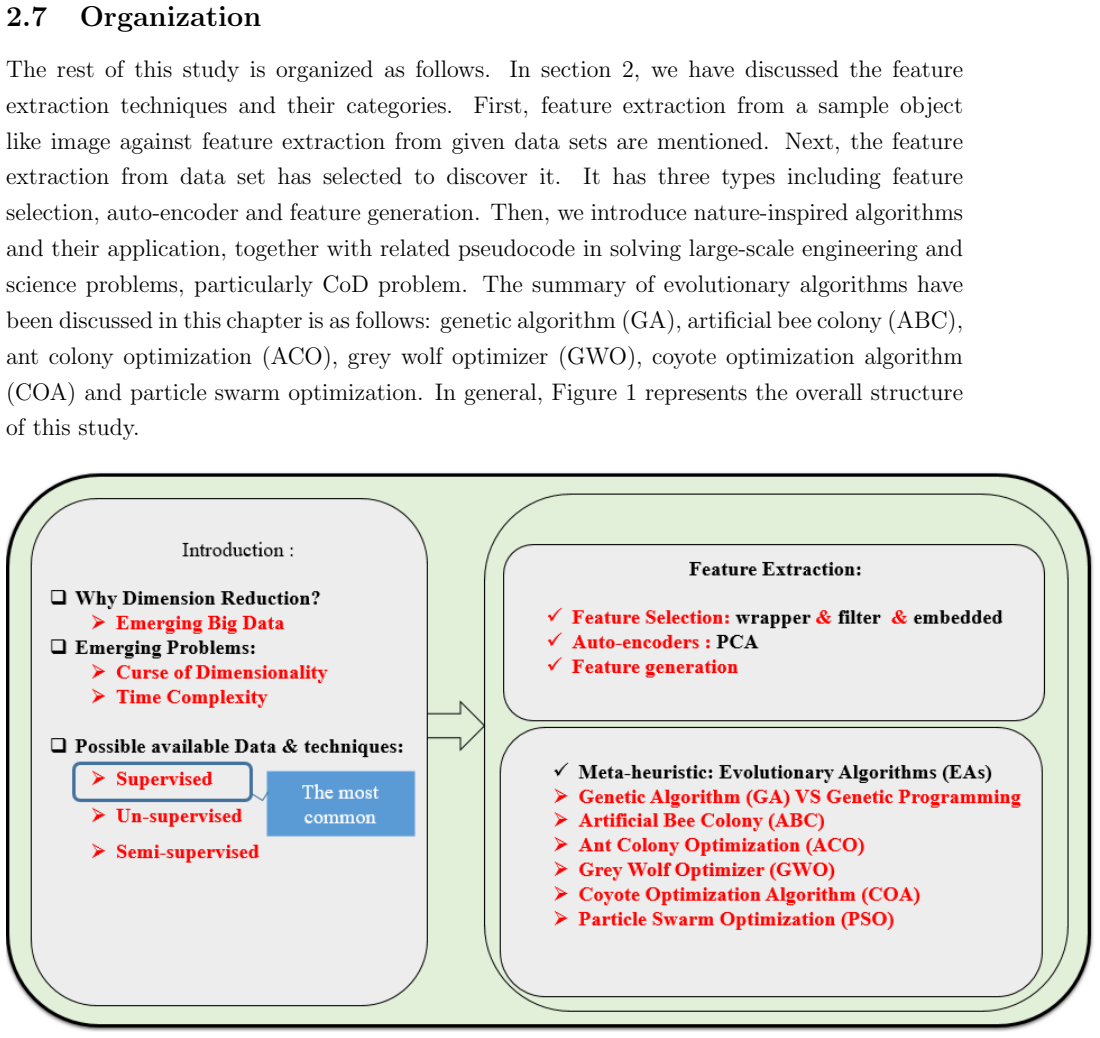
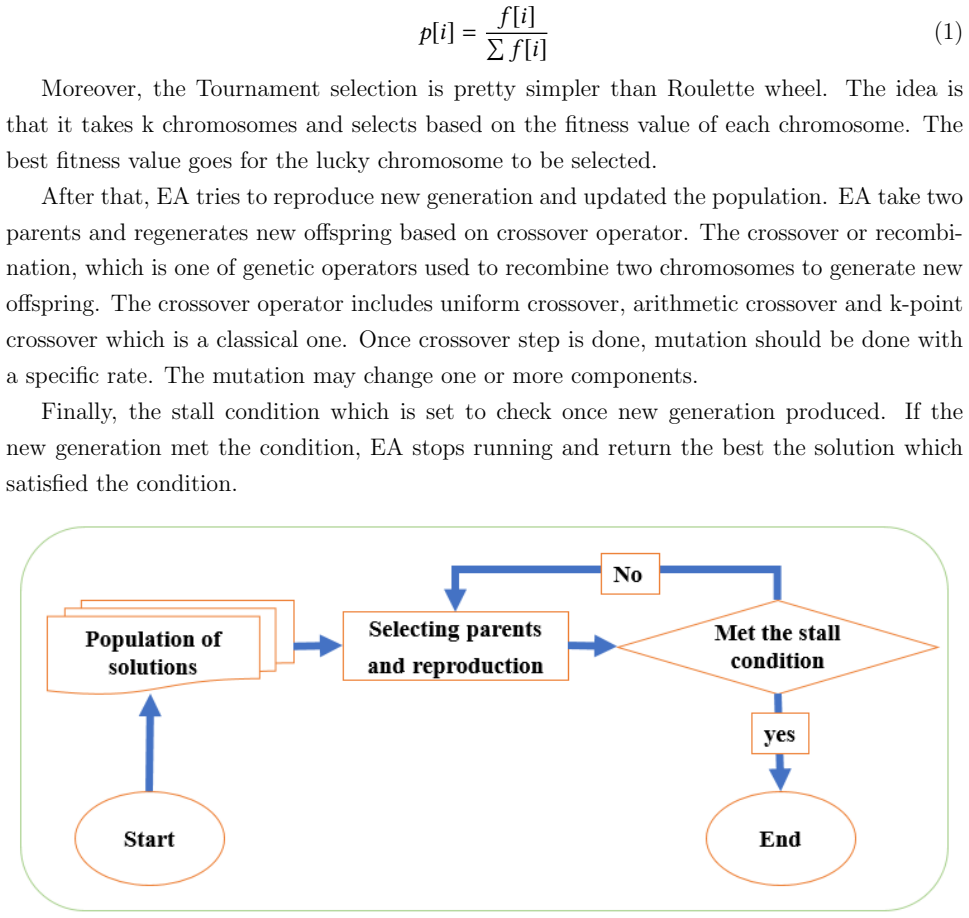
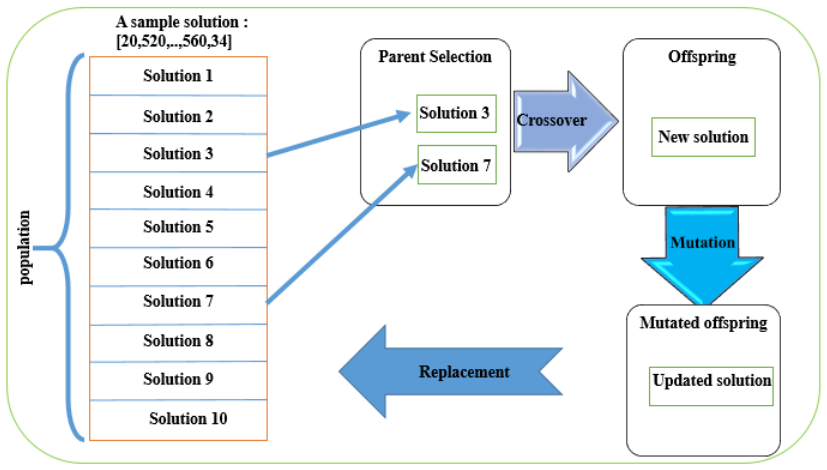
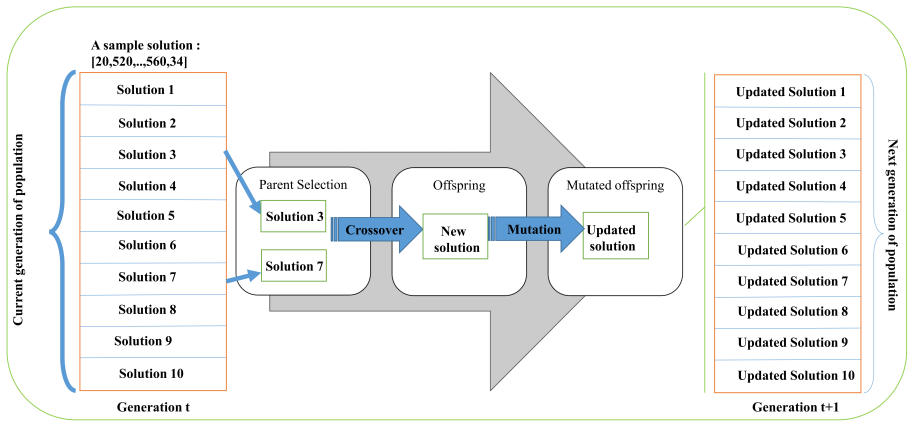
The central machinery is the generic evolutionary-algorithm loop, presented as a reusable skeleton: represent a candidate feature subset, initialize a population, evaluate a fitness function, select parents, apply crossover and mutation, replace or update the population, and stop on a stall condition. Around this loop the chapter organizes its survey, with the same skeleton appearing through species-specific update rules in genetic algorithms, artificial bee colony, particle swarm optimization, ant colony optimization, grey wolf optimizer, and coyote optimization algorithm, each supplied with pseudocode for feature selection. The other load-bearing object is the three-way taxonomy of feature extraction, namely auto-encoder dimension reduction, feature selection with filter, wrapper, and embedded variants, and feature generation, because it determines where in the pipeline the evolutionary search is inserted.
What would settle it
Re-implement each presented algorithm, especially the ACO and FSA listings whose equations contain placeholder symbols, from the pseudocode alone and run them on a benchmark dataset with a known feature-selection result; if any algorithm cannot be executed or fails to reproduce the cited method's reported behavior, the chapter's claim to provide an accurate overview is falsified.
Extended reading notes
Core claim
On the paper's own terms, the central claim is organizational and prescriptive: the curse of dimensionality in data science is best understood as a feature-extraction failure, and evolutionary algorithms are the class of optimizers suited to repair it. The chapter maintains that once data is represented by a large set of extracted features, CoD manifests as data sparsity, multiple testing, overfitting, and prohibitive time complexity; classical feature extraction such as PCA is insufficient because it assumes linear correlation and can destroy information on non-linear structures. Feature selection that keeps original feature values is therefore presented as the corrective, and wrapper-based selection in particular is said to outperform filter-based selection at the cost of time. The chapter further claims that evolutionary algorithms are adopted precisely when a problem suffers from placement in local optima rather than global ones, and that their stochastic nature is managed by running them twenty to thirty times and reporting the mean, yielding a stable near-optimal solution.
Load-bearing premise
The whole overview stands or falls on the assumption that the pseudocode and parameter descriptions in Section 4 faithfully represent the cited algorithms, because that is what a reader would use to implement them.
Editorial extensions
If this is right
- If CoD is a feature-space problem, then preprocessing, not the classifier, is the right place to apply optimization, and embedding evolutionary algorithms into feature extraction should lower time complexity while preserving or improving classifier accuracy.
- If wrapper-based feature selection consistently outperforms filter-based selection, then accuracy-critical systems should accept the higher runtime and use classifier-driven fitness evaluation, with evolutionary algorithms searching the feature-subset space.
- If the generic evolutionary-algorithm loop is reliable across species, then a practitioner can port the same representation, selection, crossover, and mutation logic to new problems by swapping the fitness function and the update rule.
- If evolutionary algorithms are adopted only when local optima are the obstruction, then their value for a given dataset is diagnostic: a problem that is not locally trapping will not benefit from evolutionary search.
- If the presented algorithms are domain-independent, then the same feature-selection machinery applies across engineering, medicine, network analysis, and image classification without redesigning the optimizer.
Reading between the lines
- The chapter does not provide detailed experimental comparisons among the surveyed algorithms, so a benchmark with identical feature-selection representation would directly test which method is best for CoD.
- The chapter's emphasis on running each algorithm twenty to thirty times and averaging implies that evolutionary results should be treated as random variables; reporting variance and confidence intervals alongside the mean is a testable extension.
- The pseudocode contains placeholder symbols and malformed equations in some listings, so a reader who wants a reliable implementation should consult the original papers, and a clean re-derivation of each algorithm from the cited sources is a natural companion.
Signed reviews
Editorial analysis
A structured set of objections, weighed in public.
Referee Report
Summary. This manuscript is a survey chapter on evolutionary algorithms (EAs) and other metaheuristics for data science, focusing on the curse of dimensionality (CoD), feature extraction and selection, and dimension reduction. The abstract and introduction promise a 'clear and formal definition' of CoD, followed by a survey of feature extraction techniques and an overview of EA families including GA, GP, EP, ABC, PSO, ACO, GWO, COA, CSO, and FSA, with pseudocode for feature selection. The paper also claims to show how nature-inspired algorithms can address CoD in large-scale engineering and science problems, and it references several applications including the authors' own prior work on image steganalysis. The manuscript appears to be an early version of a book chapter, referencing a companion chapter [67] for further details.
Significance. If the survey were accurate and self-contained, it could serve as a useful introductory reference for practitioners applying evolutionary algorithms to feature selection and dimension reduction in high-dimensional data. The authors have assembled a broad bibliography and cover a wide range of algorithms, which is potentially helpful for readers seeking an entry point. However, the paper's central advertised contribution—the formal definition of CoD—is not delivered, and the manuscript contains numerous factual errors, corrupted pseudocode, and incomplete placeholder citations. These issues are not local presentation problems; they undermine the reliability of the survey as a reference. The paper offers no new experimental results or reproducible code, and its educational value is currently limited because readers cannot trust the algorithm descriptions or the historical and technical claims.
major comments (4)
- [Section 2.3 / Abstract] The abstract promises 'a clear and formal definition of the CoD problem,' but Section 2.3 provides only informal prose, describing CoD as 'related to the fact that the input data is too huge that no human being can analyze it' and equating it with an 'overabundance of data.' No mathematical definition, complexity statement, or statistical characterization is given. Because the formal definition is the paper's primary advertised contribution, its absence is a load-bearing failure.
- [Section 4, Algorithms 2, 4, 6, 8] The pseudocode listings contain corrupted placeholder tokens from a broken font encoding, such as '/v.alt', '/afii10069.ital', and '/y.alt', as well as malformed equations, for example Algorithm 4's input line 'K}≥ 1', Algorithm 6's line 'usin/afii10069.ital Pe = 0.005· N 2c', and Algorithm 8's lines 7 and 17. These listings cannot be executed and are not faithful representations of the cited algorithms, so the overview misleads readers who rely on the pseudocode to understand or implement the methods.
- [Section 2.6 / Table 2] The claim that 'Evolutionary algorithms (EAs) is invented not more than 28 years' is historically inaccurate and is contradicted by the paper's own references, which include Fogel's 1965 work on evolutionary programming [39], Koza's 1992 genetic programming book [37], and the historical treatment in [12]. Additionally, Table 2 defines 'SVD' as 'singular value dimension' instead of 'singular value decomposition.' These factual errors reduce the survey's credibility.
- [Sections 2.2 and 2.4] The manuscript contains unfinished placeholder citations, notably 'cite all papers from 2.4 here [9, 1]', 'cite all papers from 2.5 here [10, 11]', and 'cite all papers from 2.6 here [12, 13, 14, 15, 13]'. This is direct evidence that the manuscript is not complete and has not been prepared for formal review. A published survey must not include author instructions to itself.
minor comments (4)
- [Section 2.3] The statement that CoD is 'due to the large amount of generated/sensed/collected data' is misleading; the curse of dimensionality concerns the difficulties of estimation, sampling, and optimization in high-dimensional spaces, not merely data volume.
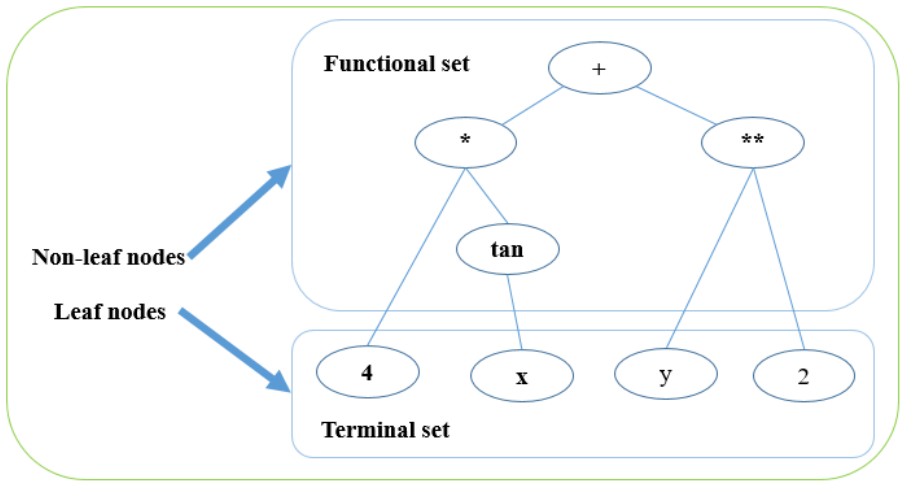
- [Section 4.2.2] The example expression '4 ∗ tan(x) +/y.alt2' contains an encoding artifact and should be written with proper mathematical notation, e.g., 4*tan(x) + y^2.
- [Section 3] The sentence 'PCA completely is used to generate a new dimension using a certain formula' is vague, and the claim that PCA fails for 'circle-based and sine or cosine-based distribution of instances' needs a concrete example or a citation to be informative.
- [Section 2.6.1] The text says 'most of research studies are accomplished using SSA' but the intended abbreviation is likely SSGA; SSA is never defined, and the surrounding discussion refers to steady-state genetic algorithms.
Circularity Check
No significant circularity: the chapter is a survey whose claims are drawn from external sources, and the authors' self-citations are contextual rather than load-bearing.
full rationale
This manuscript is a survey and overview chapter rather than a derivation of new results. It does not fit parameters to data and then rename them as predictions, nor does it define its central term (CoD) in terms of a quantity it later claims to derive. The abstract promises 'a clear and formal definition of the CoD problem,' but Section 2.3 gives only informal prose and external citations; the absence of the promised formalization is a completeness or correctness defect, not a circularity. The self-citations (e.g., [2], [14], [15], [67]) appear in motivational and bibliographic contexts, such as 'Ghareh mohammadi and Arabnia has discussed application of evolutionary algorithms on images... in this study we expanded our investigation' and the conclusion's pointer to '[67]' as related work. These citations do not supply the mathematical content of the survey, and the algorithm descriptions in Section 4 are attributed to external sources such as [13], [41], [48], [56], [59], [60], and [64]. No load-bearing step reduces by construction to a fitted parameter, a self-citation, or a definitional equivalence. Therefore, no circular step can be exhibited, and the appropriate circularity score is 0.
Assumptions & free parameters
assumptions (3)
- domain assumption Evolutionary algorithms converge to (near-)optimal solutions over multiple runs.
- domain assumption Feature selection and dimension reduction preserve classifier performance when done correctly.
- ad hoc to paper The pseudocode listings for each EA are correct representations of the cited algorithms.
Cite this review
Pith. "Pith review of Evolutionary Computation, Optimization and Learning Algorithms for Data Science." pith.science (2026). https://pith.science/paper/XTGT4XFS
@misc{pith2026190808006,
  author       = {Pith},
  title        = {Pith review of: Evolutionary Computation, Optimization and Learning Algorithms for Data Science},
  year         = {2026},
  howpublished = {\url{https://pith.science/paper/XTGT4XFS}},
  note         = {Machine review of arXiv:1908.08006}
}
read the original abstract
A large number of engineering, science and computational problems have yet to be solved in a computationally efficient way. One of the emerging challenges is how evolving technologies grow towards autonomy and intelligent decision making. This leads to collection of large amounts of data from various sensing and measurement technologies, e.g., cameras, smart phones, health sensors, smart electricity meters, and environment sensors. Hence, it is imperative to develop efficient algorithms for generation, analysis, classification, and illustration of data. Meanwhile, data is structured purposefully through different representations, such as large-scale networks and graphs. We focus on data science as a crucial area, specifically focusing on a curse of dimensionality (CoD) which is due to the large amount of generated/sensed/collected data. This motivates researchers to think about optimization and to apply nature-inspired algorithms, such as evolutionary algorithms (EAs) to solve optimization problems. Although these algorithms look un-deterministic, they are robust enough to reach an optimal solution. Researchers do not adopt evolutionary algorithms unless they face a problem which is suffering from placement in local optimal solution, rather than global optimal solution. In this chapter, we first develop a clear and formal definition of the CoD problem, next we focus on feature extraction techniques and categories, then we provide a general overview of meta-heuristic algorithms, its terminology, and desirable properties of evolutionary algorithms.
Figures
Figures from the paper (3 more)
Forward citations
Cited by 2 Pith papers
-
An Introduction to Advanced Machine Learning : Meta Learning Algorithms, Applications and Promises
A review of meta-learning algorithms with a taxonomy and a table of prior work; it contributes no new results.
-
Applications of Nature-Inspired Algorithms for Dimension Reduction: Enabling Efficient Data Analytics
A review of nature-inspired optimization algorithms applied to feature selection and dimension reduction across image, network, sentiment, and credit-scoring tasks.
Reference graph
Works this paper leans on
-
[67]
Applications of nature-inspired algorithms for dimension Reduction: Enabling efficient data analytics
Farid Ghareh Mohammadi and M Hadi Amini. Applications of nature-inspired algorithms for dimension Reduction: Enabling efficient data analytics. In Optimization, Learning and Control for Interdependent Complex Networks . Springer, 2019. 40
work page 2019
-
[39]
Artificial intelligence through a simulation of evolution
Lawrence J Fogel. Artificial intelligence through a simulation of evolution. In Proc. of the 2nd Cybernetics Science Symp., 1965 , 1965
work page 1965
-
[37]
Genetic programming: on the programming of computers by means of natural selection, volume 1
John R Koza. Genetic programming: on the programming of computers by means of natural selection, volume 1. MIT press, 1992
1992
-
[12]
Evolutionary computation 1: Basic algorithms and operators
Thomas B¨ ack, David B Fogel, and Zbigniew Michalewicz. Evolutionary computation 1: Basic algorithms and operators . CRC press, 2018. 34
work page 2018
-
[1]
P. Marrow. Nature-inspired computing technology and applications. BT Technology Jour- nal, 18(4):13–23, Oct 2000
work page 2000
-
[2]
Evolutionary Algorithms and Efficient Data Analytics for Image Processing
Farid Ghareh Mohammadi and Hamid R Arabnia. Isea: Image steganalysis using evolu- tionary algorithms. arXiv preprint arXiv:1907.12914 , 2019. 33
work page Pith review arXiv 1907
-
[3]
Guided evolutionary strategies: Augmenting random search with surrogate gradients
Niru Maheswaranathan, Luke Metz, George Tucker, and Jascha Sohl-Dickstein. Guided evolutionary strategies: escaping the curse of dimensionality in random search. arXiv preprint arXiv:1806.10230, 2018
work page Pith review arXiv 2018
-
[4]
Maarten JLF Cruyff, Ulf B¨ ockenholt, Peter GM Van Der Heijden, and Laurence E Frank. A review of regression procedures for randomized response data, including univariate and multivariate logistic regression, the proportional odds model and item response model, and self-protective responses. In Handbook of Statistics , volume 34, pages 287–315. Elsevier, 2016
work page 2016
Show all 67 references
-
[5]
Supervised representation learning: Transfer learning with deep autoencoders
Fuzhen Zhuang, Xiaohu Cheng, Ping Luo, Sinno Jialin Pan, and Qing He. Supervised representation learning: Transfer learning with deep autoencoders. In Twenty-Fourth International Joint Conference on Artificial Intelligence , 2015
2015
-
[6]
Semi-supervised learning for discrete choice models
Jie Yang, Sergey Shebalov, and Diego Klabjan. Semi-supervised learning for discrete choice models. IEEE Transactions on Intelligent Transportation Systems , 2018
2018
-
[7]
The curse (s) of dimensionality
Naomi Altman and Martin Krzywinski. The curse (s) of dimensionality. Nat Methods, 15:399–400, 2018
2018
-
[8]
A new approach for large scale mul- tiple testing with application to fdr control for graphically structured hypotheses
Wenge Guo, Gavin Lynch, and Joseph P Romano. A new approach for large scale mul- tiple testing with application to fdr control for graphically structured hypotheses. arXiv preprint arXiv:1812.00258, 2018
2018 arXiv
-
[9]
A reminiscent study of nature inspired computation
Shilpi Gupta, Shweta Bhardwaj, and Parul Kalra Bhatia. A reminiscent study of nature inspired computation. International Journal of Advances in Engineering & Technology , 1(2):117, 2011
2011
-
[10]
Stellar-mass black hole optimization for biclustering microarray gene expression data.Applied Artificial Intelligence, 29(4):353– 381, 2015
R Balamurugan, AM Natarajan, and K Premalatha. Stellar-mass black hole optimization for biclustering microarray gene expression data.Applied Artificial Intelligence, 29(4):353– 381, 2015
2015
-
[11]
Metaheuristics in combinatorial optimization: Overview and conceptual comparison
Christian Blum and Andrea Roli. Metaheuristics in combinatorial optimization: Overview and conceptual comparison. ACM computing surveys (CSUR) , 35(3):268–308, 2003
2003
-
[13]
Coyote optimization algorithm: a new metaheuristic for global optimization problems
Juliano Pierezan and Leandro Dos Santos Coelho. Coyote optimization algorithm: a new metaheuristic for global optimization problems. In 2018 IEEE Congress on Evolutionary Computation (CEC), pages 1–8. IEEE, 2018
2018
-
[14]
Image steganalysis using a bee colony based feature selection algorithm
F Ghareh Mohammadi and M Saniee Abadeh. Image steganalysis using a bee colony based feature selection algorithm. Engineering Applications of Artificial Intelligence , 31:35–43, 2014
2014
-
[15]
A new metaheuristic feature subset selection approach for image steganalysis
Farid Ghareh Mohammadi and Mohammad Saniee Abadeh. A new metaheuristic feature subset selection approach for image steganalysis. Journal of Intelligent & Fuzzy Systems , 27(3):1445–1455, 2014
2014
-
[16]
Uncertainty quan- tification in an engineering design software system
Dirk Wunsch, R´ emy Nigro, Gr´ egory Coussement, and Charles Hirsch. Uncertainty quan- tification in an engineering design software system. InUncertainty Management for Robust Industrial Design in Aeronautics , pages 747–754. Springer, 2019
2019
-
[17]
Precision medicine and the cursed dimensions
Dennis L Barbour. Precision medicine and the cursed dimensions. npj Digital Medicine , 2(1):4, 2019
2019
-
[18]
Automated diagnosis system for alzheimer disease using features selected by artificial bee colony
Shunmuga N Karpagam and Srinivasa Raghavan. Automated diagnosis system for alzheimer disease using features selected by artificial bee colony. Journal of Computa- tional and Theoretical Nanoscience, 16(2):682–686, 2019
2019
-
[19]
Do additional features help or hurt category learning? the curse of dimensionality in human learners
Wai Keen Vong, Andrew T Hendrickson, Danielle J Navarro, and Amy Perfors. Do additional features help or hurt category learning? the curse of dimensionality in human learners. Cognitive science, 43(3):e12724, 2019
2019
-
[20]
The curse of dimensionality
Niketu P Patel, Elie Sarraf, and Mitchell H Tsai. The curse of dimensionality. Anesthe- siology: The Journal of the American Society of Anesthesiologists , 129(3):614–615, 2018
2018
-
[21]
Taxonomy-aware feature engineering for microbiome classification
Mai Oudah and Andreas Henschel. Taxonomy-aware feature engineering for microbiome classification. BMC bioinformatics, 19(1):227, 2018
2018
-
[22]
Stochastic shape optimization via design-space augmented dimensionality reduction and rans computations
Andrea Serani, Matteo Diez, Jeroen Wackers, Michel Visonneau, and Frederick Stern. Stochastic shape optimization via design-space augmented dimensionality reduction and rans computations. In AIAA Scitech 2019 Forum , page 2218, 2019. 35
2019
-
[23]
Big data classification using scale-free binary particle swarm optimization
Sonu Lal Gupta, Anurag Singh Baghel, and Asif Iqbal. Big data classification using scale-free binary particle swarm optimization. In Harmony Search and Nature Inspired Optimization Algorithms, pages 1177–1187. Springer, 2019
2019
-
[24]
Svsa: a semi-vortex search algorithm for solving optimization problems
Seyedeh Fatemeh Razavi and Hedieh Sajedi. Svsa: a semi-vortex search algorithm for solving optimization problems. International Journal of Data Science and Analytics, pages 1–18, 2018
2018
-
[25]
An accelerated introduction to memetic algorithms
Pablo Moscato and Carlos Cotta. An accelerated introduction to memetic algorithms. In Handbook of Metaheuristics, pages 275–309. Springer, 2019
2019
-
[26]
An efficient feature generation approach based on deep learning and feature selection techniques for traffic classification
Hongtao Shi, Hongping Li, Dan Zhang, Chaqiu Cheng, and Xuanxuan Cao. An efficient feature generation approach based on deep learning and feature selection techniques for traffic classification. Computer Networks, 132:81–98, 2018
2018
-
[27]
Feature engineering for pre- dictive modeling using reinforcement learning
Udayan Khurana, Horst Samulowitz, and Deepak Turaga. Feature engineering for pre- dictive modeling using reinforcement learning. In Thirty-Second AAAI Conference on Artificial Intelligence, 2018
2018
-
[28]
Network representation learning: A survey
Daokun Zhang, Jie Yin, Xingquan Zhu, and Chengqi Zhang. Network representation learning: A survey. IEEE transactions on Big Data , 2018
2018
-
[29]
Novel wrapper-based feature selection for efficient clinical decision support system
R Vanaja and Saswati Mukherjee. Novel wrapper-based feature selection for efficient clinical decision support system. In International Conference on Intelligent Information Technologies, pages 113–129. Springer, 2018
2018
-
[30]
Pareto front feature selection based on artificial bee colony optimization
Emrah Hancer, Bing Xue, Mengjie Zhang, Dervis Karaboga, and Bahriye Akay. Pareto front feature selection based on artificial bee colony optimization. Information Sciences, 422:462–479, 2018
2018
-
[31]
A hybrid ge- netic algorithm with wrapper-embedded approaches for feature selection
Xiao-Ying Liu, Yong Liang, Sai Wang, Zi-Yi Yang, and Han-Shuo Ye. A hybrid ge- netic algorithm with wrapper-embedded approaches for feature selection. IEEE Access, 6:22863–22874, 2018
2018
-
[32]
Particle swarm optimization based feature selection with novel fitness function for image steganalysis
Vahid Rostami and Azar Shahmoradi Khiavi. Particle swarm optimization based feature selection with novel fitness function for image steganalysis. In 2016 Artificial Intelligence and Robotics (IRANOPEN), pages 109–114. IEEE, 2016. 36
2016
-
[33]
A steady-state and generational evolutionary algorithm for dynamic multiobjective optimization
Shouyong Jiang and Shengxiang Yang. A steady-state and generational evolutionary algorithm for dynamic multiobjective optimization. IEEE Transactions on Evolutionary Computation, 21(1):65–82, 2016
2016
-
[34]
Simultaneous allo- cation of electric vehicles’ parking lots and distributed renewable resources in smart power distribution networks
M Hadi Amini, Mohsen Parsa Moghaddam, and Orkun Karabasoglu. Simultaneous allo- cation of electric vehicles’ parking lots and distributed renewable resources in smart power distribution networks. Sustainable Cities and Society , 28:332–342, 2017
2017
-
[35]
Genetic algorithms in resource optimization of con- struction project
LY Zhang, Gang Luo, and LN Lu. Genetic algorithms in resource optimization of con- struction project. Journal of Tianjin University (Science and Technology), 34(2):188–192, 2001
2001
-
[36]
Allocation of electric vehicles’ parking lots in distribution network
M Hadi Amini and Arif Islam. Allocation of electric vehicles’ parking lots in distribution network. In ISGT 2014, pages 1–5. IEEE, 2014
2014
-
[38]
Knowledge discovery in multiobjective optimization problems in engineering via genetic programming
Igor LS Russo, Heder S Bernardino, and Helio JC Barbosa. Knowledge discovery in multiobjective optimization problems in engineering via genetic programming. Expert Systems with Applications , 99:93–102, 2018
2018
-
[40]
A comprehen- sive survey: artificial bee colony (abc) algorithm and applications
Dervis Karaboga, Beyza Gorkemli, Celal Ozturk, and Nurhan Karaboga. A comprehen- sive survey: artificial bee colony (abc) algorithm and applications. Artificial Intelligence Review, 42(1):21–57, 2014
2014
-
[41]
An idea based on honey bee swarm for numerical optimization
Dervis Karaboga. An idea based on honey bee swarm for numerical optimization. Tech- nical report, Technical report-tr06, Erciyes university, engineering faculty, computer . . . , 2005
2005
-
[42]
A novel history-driven artificial bee colony algorithm for data clustering
Farzaneh Zabihi and Babak Nasiri. A novel history-driven artificial bee colony algorithm for data clustering. Applied Soft Computing , 71:226–241, 2018. 37
2018
-
[43]
An improved global best guided artificial bee colony algorithm for continuous optimization problems
Yongcun Cao, Yong Lu, Xiuqin Pan, and Na Sun. An improved global best guided artificial bee colony algorithm for continuous optimization problems. Cluster computing, pages 1–9, 2018
2018
-
[44]
A self-adaptive artificial bee colony algorithm based on global best for global optimization
Yu Xue, Jiongming Jiang, Binping Zhao, and Tinghuai Ma. A self-adaptive artificial bee colony algorithm based on global best for global optimization. Soft Computing , pages 1–18, 2018
2018
-
[45]
Modified multiple search cooperative foraging strategy for improved artificial bee colony optimization with robustness analysis
Fatima Harfouchi, Hacene Habbi, Celal Ozturk, and Dervis Karaboga. Modified multiple search cooperative foraging strategy for improved artificial bee colony optimization with robustness analysis. Soft Computing, 22(19):6371–6394, 2018
2018
-
[46]
An improved optimization method based on krill herd and artificial bee colony with information exchange
Heqi Wang and Jiao-Hong Yi. An improved optimization method based on krill herd and artificial bee colony with information exchange. Memetic Computing, 10(2):177–198, 2018
2018
-
[47]
Hybrid particle swarm optimization with spiral-shaped mechanism for feature selection
Ke Chen, Feng-Yu Zhou, and Xian-Feng Yuan. Hybrid particle swarm optimization with spiral-shaped mechanism for feature selection. Expert Systems with Applications , 2019
2019
-
[48]
Eberhart
JAMES Kennedy and R. Eberhart. Particle swarm optimization. In Proceedings of IEEE international conference on neural networks , volume 4, pages 1942–1948. IEEE Press, 1995
1942
-
[49]
Particle swarm optimization
James Kennedy. Particle swarm optimization. Encyclopedia of machine learning , pages 760–766, 2010
2010
-
[50]
A particle swarm optimization algorithm with crossover operator
Zhi-Feng Hao, Zhi-Gang Wang, and Han Huang. A particle swarm optimization algorithm with crossover operator. In 2007 International Conference on Machine Learning and Cybernetics, volume 2, pages 1036–1040. IEEE, 2007
2007
-
[51]
Binary pso with mutation operator for feature selection using decision tree applied to spam detection
Yudong Zhang, Shuihua Wang, Preetha Phillips, and Genlin Ji. Binary pso with mutation operator for feature selection using decision tree applied to spam detection. Knowledge- Based Systems, 64:22–31, 2014
2014
-
[52]
Particle swarm optimization with probabilistic inertia weight
Ankit Agrawal and Sarsij Tripathi. Particle swarm optimization with probabilistic inertia weight. In Harmony Search and Nature Inspired Optimization Algorithms, pages 239–248. Springer, 2019. 38
2019
-
[53]
Optimal design of power-system stabilizers using particle swarm optimization
MA Abido. Optimal design of power-system stabilizers using particle swarm optimization. IEEE transactions on energy conversion , 17(3):406–413, 2002
2002
-
[54]
Practical distri- bution state estimation using hybrid particle swarm optimization
Shigenori Naka, Takamu Genji, Toshiki Yura, and Yoshikazu Fukuyama. Practical distri- bution state estimation using hybrid particle swarm optimization. In 2001 IEEE Power Engineering Society Winter Meeting. Conference Proceedings (Cat. No. 01CH37194), vol- ume 2, pages 815–820...
2001
-
[55]
A particle swarm optimization for reactive power and voltage control consider- ing voltage security assessment
Hirotaka Yoshida, Kenichi Kawata, Yoshikazu Fukuyama, Shinichi Takayama, and Yosuke Nakanishi. A particle swarm optimization for reactive power and voltage control consider- ing voltage security assessment. IEEE Transactions on power systems , 15(4):1232–1239, 2000
2000
-
[56]
Ant colony optimization: a new meta-heuristic
Marco Dorigo and Gianni Di Caro. Ant colony optimization: a new meta-heuristic. In Pro- ceedings of the 1999 congress on evolutionary computation-CEC99 (Cat. No. 99TH8406) , volume 2, pages 1470–1477. IEEE, 1999
1999
-
[57]
Ant colony optimization for continuous domains
Krzysztof Socha and Marco Dorigo. Ant colony optimization for continuous domains. European journal of operational research, 185(3):1155–1173, 2008
2008
-
[58]
A new hybrid ant colony op- timization algorithm for feature selection
Md Monirul Kabir, Md Shahjahan, and Kazuyuki Murase. A new hybrid ant colony op- timization algorithm for feature selection. Expert Systems with Applications , 39(3):3747– 3763, 2012
2012
-
[59]
Grey wolf optimizer
Seyedali Mirjalili, Seyed Mohammad Mirjalili, and Andrew Lewis. Grey wolf optimizer. Advances in engineering software, 69:46–61, 2014
2014
-
[60]
A new bio-inspired algorithm: chicken swarm optimization
Xianbing Meng, Yu Liu, Xiaozhi Gao, and Hengzhen Zhang. A new bio-inspired algorithm: chicken swarm optimization. In International conference in swarm intelligence , pages 86–
-
[61]
Optimizing directional reader antennas deployment in uhf rfid localization system by using a mpcso algorithm
Weiguang Shi, Yang Guo, Shuxia Yan, Yang Yu, Peng Luo, and Jianxiong Li. Optimizing directional reader antennas deployment in uhf rfid localization system by using a mpcso algorithm. IEEE Sensors Journal , 18(12):5035–5048, 2018. 39
2018
-
[62]
An adaptive ap- proach for community detection based on chicken swarm optimization algorithm
Khaled Ahmed, Aboul Ella Hassanien, Ehab Ezzat, and Pei-Wei Tsai. An adaptive ap- proach for community detection based on chicken swarm optimization algorithm. In In- ternational Conference on Genetic and Evolutionary Computing, pages 281–288. Springer, 2016
2016
-
[63]
Dempster-shafer based probabilistic fuzzy logic sys- tem for wind speed prediction
Xian-Bing Meng and Han-Xiong Li. Dempster-shafer based probabilistic fuzzy logic sys- tem for wind speed prediction. In 2017 International Conference on Fuzzy Theory and Its Applications (iFUZZY), pages 1–5. IEEE, 2017
2017
-
[64]
An optimizing method based on autonomous animats: fish-swarm algorithm
Xiao-lei Li. An optimizing method based on autonomous animats: fish-swarm algorithm. Systems Engineering-Theory & Practice, 22(11):32–38, 2002
2002
-
[65]
Neighborhood rough set reduction with fish swarm algorithm
Yumin Chen, Zhiqiang Zeng, and Junwen Lu. Neighborhood rough set reduction with fish swarm algorithm. Soft Computing, 21(23):6907–6918, 2017
2017
-
[66]
Artificial fish swarm- inspired whale optimization algorithm for solving multimodal benchmark functions
Imran Rahman, Junita Mohamad-Saleh, and Noorazliza Sulaiman. Artificial fish swarm- inspired whale optimization algorithm for solving multimodal benchmark functions. In 10th International Conference on Robotics, Vision, Signal Processing and Power Applica- tions, pages 59–65. Sp...
2019
Reviewed August 14, 2026 · model on record in the stance chip above.
Discussion (0). Continue with ORCID to comment.