Quantum Black Hole Chemistry from Double Holography
Pith reviewed 2026-06-30 00:48 UTC · model grok-4.3
The pith
Quantum backreaction on the physical brane supplies a distinct color variable for the thermodynamics of quantum black holes in double holography.
A machine-rendered reading of the paper's core claim, the machinery that carries it, and where it could break.
Core claim
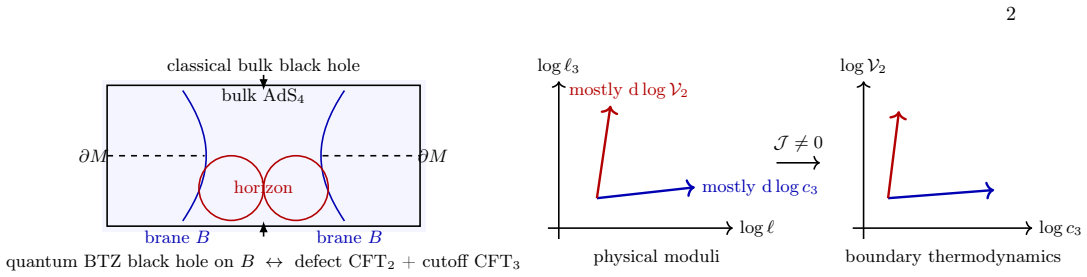
Replacing the holographic regulator surface by a physical brane induces gravity coupled to a cutoff CFT, so classical bulk black holes become lower-dimensional quantum black holes whose geometry includes the cutoff-matter stress tensor to all orders in backreaction. This backreacting matter sector supplies a color variable distinct from the defect volume. The mechanism removes the color-volume degeneracy at fixed boundary conformal frame for the quantum BTZ case in the Karch-Randall setup.
What carries the argument
the backreacting cutoff-matter stress tensor on the physical brane, which supplies the independent color variable in the first law
If this is right
- The first law for quantum black holes gains an independent color direction from the cutoff matter.
- Extended black hole thermodynamics applies in double holography without non-standard boundary moduli.
- The color-volume tension is resolved semiclassically by the physical brane setup.
- The same mechanism is available for other quantum black holes realized via Karch-Randall branes.
Where Pith is reading between the lines
- The approach may extend to higher-dimensional quantum black holes where similar degeneracies appear.
- It suggests that physical cutoffs in holographic models can systematically supply missing thermodynamic variables.
- Comparisons with other proposals for resolving the degeneracy could clarify which mechanisms are equivalent at the semiclassical level.
Load-bearing premise
The backreacting cutoff-matter stress tensor supplies a color variable that is structurally distinct from the defect volume and enters the first law independently.
What would settle it
A explicit computation of the first law for the quantum BTZ black hole in which the cutoff-matter stress tensor contributes only a term already fixed by the defect volume would falsify the resolution.
Figures
read the original abstract
Extended black hole thermodynamics exposes a sharp tension in the usual holographic dictionary: at fixed boundary conformal frame, changing the AdS radius changes both the central charge and the spatial volume of the CFT, apparently locking the color and volume sectors of the first law. We show that this degeneracy is naturally removed for quantum black holes in Karch--Randall double holography. The mechanism is intrinsically semiclassical. Replacing the holographic regulator surface by a physical brane induces gravity coupled to a cutoff CFT, so classical bulk black holes become lower-dimensional quantum black holes whose geometry includes the cutoff-matter stress tensor to all orders in backreaction. This backreacting matter sector supplies a color variable distinct from the defect volume. We demonstrate the mechanism explicitly for the quantum BTZ black hole. Thus quantum backreaction resolves the same color-volume degeneracy addressed by the recent Weyl-factor proposal, but without introducing a non-standard boundary modulus. Instead, the missing thermodynamic direction is supplied by the physical cutoff-matter sector of the doubly holographic quantum black hole.
Editorial analysis
A structured set of objections, weighed in public.
Referee Report
Summary. The paper claims that the color-volume degeneracy in extended black hole thermodynamics is resolved in Karch-Randall double holography because replacing the holographic regulator by a physical brane induces gravity plus a cutoff CFT whose backreacting stress tensor supplies a thermodynamic color variable independent of the defect volume; this is demonstrated explicitly for the quantum BTZ black hole and avoids the need for a non-standard boundary modulus.
Significance. If the central claim holds, the result supplies a semiclassical mechanism, grounded in standard double-holography ingredients, that furnishes the missing thermodynamic direction for quantum black holes without additional boundary data; this would connect quantum backreaction directly to black-hole chemistry in a controlled holographic setting.
major comments (1)
- [quantum BTZ demonstration] The load-bearing claim is that the backreacting cutoff-matter stress tensor on the KR brane supplies a color variable structurally independent of the defect volume and entering the first law as a separate conjugate pair. The manuscript must explicitly demonstrate this independence for the quantum BTZ case (e.g., by computing the first-law variations and showing that brane-tension changes do not produce linearly dependent directions), because the same embedding equations determine both the effective AdS radius (hence volume) and the induced stress tensor.
Simulated Author's Rebuttal
We thank the referee for their careful reading and for identifying the need for an explicit check of linear independence in the first law. We agree that this strengthens the central claim and will revise the manuscript to include the requested calculation.
read point-by-point responses
-
Referee: The load-bearing claim is that the backreacting cutoff-matter stress tensor on the KR brane supplies a color variable structurally independent of the defect volume and entering the first law as a separate conjugate pair. The manuscript must explicitly demonstrate this independence for the quantum BTZ case (e.g., by computing the first-law variations and showing that brane-tension changes do not produce linearly dependent directions), because the same embedding equations determine both the effective AdS radius (hence volume) and the induced stress tensor.
Authors: We agree that an explicit demonstration of linear independence is required. The current manuscript solves the embedding equations for the quantum BTZ, extracts the backreacted stress tensor, and identifies the resulting color variable, but does not tabulate the first-law variations under independent changes in brane tension. In the revised version we will add this calculation: we will vary the brane tension while holding the bulk parameters fixed, compute the induced shifts in the effective AdS radius (hence defect volume) and in the integrated stress-tensor contribution (color), and verify that the two directions in thermodynamic space remain linearly independent. This will be presented as a new subsection with explicit numerical or analytic expressions for the variation vectors. revision: yes
Circularity Check
No circularity: derivation relies on standard KR double-holography setup and explicit demonstration for quantum BTZ
full rationale
The paper's central claim is that backreacting cutoff-matter stress tensor on the KR brane supplies an independent color variable. This is presented as a direct consequence of the semiclassical double-holography construction (physical brane inducing gravity + cutoff CFT), with an explicit demonstration for quantum BTZ. No equations or steps in the abstract reduce a prediction to a fitted parameter, self-defined quantity, or load-bearing self-citation. The mechanism is framed as following from the embedding and backreaction equations rather than being tautological with the inputs. Standard external assumptions (KR setup) are invoked without the result being forced by author prior work.
Axiom & Free-Parameter Ledger
axioms (2)
- domain assumption Standard assumptions of the AdS/CFT correspondence and Karch-Randall brane construction hold.
- domain assumption Backreaction from the cutoff-matter stress tensor can be included to all orders and supplies an independent thermodynamic variable.
invented entities (1)
-
Physical brane replacing the holographic regulator
no independent evidence
Reference graph
Works this paper leans on
-
[1]
Further de- tails on the moduli-space calculation, the enlarged first law, and the comparison with Weyl-factor thermodynam- ics are given in the Appendix
where the separation between gravitational strength, graviton mass, and cutoff color is even richer. Further de- tails on the moduli-space calculation, the enlarged first law, and the comparison with Weyl-factor thermodynam- ics are given in the Appendix. 4 Appendix A: Ordinary AdS/CFT degeneracy at fixed Weyl frame For an ordinary holographic CFT dual to...
-
[2]
Holographic derivation of entanglement entropy from AdS/CFT,
S. Ryu and T. Takayanagi, “Holographic derivation of entanglement entropy from AdS/CFT,”Phys. Rev. Lett. 96(2006) 181602,arXiv:hep-th/0603001
Pith/arXiv arXiv 2006
-
[3]
Quantum Extremal Surfaces: Holographic Entanglement Entropy beyond the Classical Regime,
N. Engelhardt and A. C. Wall, “Quantum Extremal Surfaces: Holographic Entanglement Entropy beyond the Classical Regime,”JHEP01(2015) 073, arXiv:1408.3203 [hep-th]
Pith/arXiv arXiv 2015
-
[4]
Entanglement Wedge Reconstruction and the Information Paradox,
G. Penington, “Entanglement Wedge Reconstruction and the Information Paradox,”JHEP09(2020) 002, arXiv:1905.08255 [hep-th]
Pith/arXiv arXiv 2020
-
[5]
The Page curve of Hawking radiation from semiclassical geometry,
A. Almheiri, R. Mahajan, J. Maldacena, and Y. Zhao, “The Page curve of Hawking radiation from semiclassical geometry,”JHEP03(2020) 149, arXiv:1908.10996 [hep-th]
Pith/arXiv arXiv 2020
-
[6]
A. Karch and L. Randall, “Locally localized gravity,” JHEP05(2001) 008,arXiv:hep-th/0011156
Pith/arXiv arXiv 2001
-
[7]
Open and closed string interpretation of SUSY CFT’s on branes with boundaries,
A. Karch and L. Randall, “Open and closed string interpretation of SUSY CFT’s on branes with boundaries,”JHEP06(2001) 063, arXiv:hep-th/0105132
Pith/arXiv arXiv 2001
-
[8]
Enthalpy and the Mechanics of AdS Black Holes,
D. Kastor, S. Ray, and J. Traschen, “Enthalpy and the Mechanics of AdS Black Holes,”Class. Quant. Grav.26 (2009) 195011,arXiv:0904.2765 [hep-th]
Pith/arXiv arXiv 2009
-
[9]
P-V criticality of charged AdS black holes,
D. Kubiznak and R. B. Mann, “P-V criticality of charged AdS black holes,”JHEP07(2012) 033, arXiv:1205.0559 [hep-th]
Pith/arXiv arXiv 2012
-
[10]
Black hole chemistry: thermodynamics with Lambda,
D. Kubiznak, R. B. Mann, and M. Teo, “Black hole chemistry: thermodynamics with Lambda,”Class. Quant. Grav.34no. 6, (2017) 063001, arXiv:1608.06147 [hep-th]
Pith/arXiv arXiv 2017
-
[11]
The Large N limit of superconformal field theories and supergravity,
J. M. Maldacena, “The Large N limit of superconformal field theories and supergravity,”Adv. Theor. Math. Phys.2(1998) 231–252,arXiv:hep-th/9711200
Pith/arXiv arXiv 1998
-
[12]
Anti de Sitter space and holography,
E. Witten, “Anti de Sitter space and holography,”Adv. Theor. Math. Phys.2(1998) 253–291, arXiv:hep-th/9802150
Pith/arXiv arXiv 1998
-
[13]
Holographic Dual of Extended Black Hole Thermodynamics,
M. B. Ahmed, W. Cong, D. Kubizňák, R. B. Mann, and M. R. Visser, “Holographic Dual of Extended Black Hole Thermodynamics,”Phys. Rev. Lett.130no. 18, (2023) 181401,arXiv:2302.08163 [hep-th]
arXiv 2023
-
[14]
Quantum black holes as holograms in AdS braneworlds,
R. Emparan, A. Fabbri, and N. Kaloper, “Quantum black holes as holograms in AdS braneworlds,”JHEP 08(2002) 043,arXiv:hep-th/0206155
Pith/arXiv arXiv 2002
-
[15]
R. Emparan, A. M. Frassino, and B. Way, “Quantum BTZ black hole,”JHEP11(2020) 137, arXiv:2007.15999 [hep-th]
arXiv 2020
-
[16]
Higher-Dimensional Origin of Extended Black Hole Thermodynamics,
A. M. Frassino, J. F. Pedraza, A. Svesko, and M. R. Visser, “Higher-Dimensional Origin of Extended Black Hole Thermodynamics,”Phys. Rev. Lett.130no. 16, (2023) 161501,arXiv:2212.14055 [hep-th]
arXiv 2023
-
[17]
Exact description of black holes on branes,
R. Emparan, G. T. Horowitz, and R. C. Myers, “Exact description of black holes on branes,”JHEP01(2000) 007,arXiv:hep-th/9911043
Pith/arXiv arXiv 2000
-
[18]
Exact description of black holes on branes. 2. Comparison with BTZ black holes and black strings,
R. Emparan, G. T. Horowitz, and R. C. Myers, “Exact description of black holes on branes. 2. Comparison with BTZ black holes and black strings,”JHEP01 (2000) 021,arXiv:hep-th/9912135
Pith/arXiv arXiv 2000
-
[19]
Y. Feng, H. Ma, R. B. Mann, Y. Xue, and M. Zhang, “Quantum charged black holes,”JHEP08(2024) 184, arXiv:2404.07192 [hep-th]
arXiv 2024
-
[20]
Criticality and thermodynamic geometry of quantum BTZ black holes,
S. A. Hosseini Mansoori, J. F. Pedraza, and M. Rafiee, “Criticality and thermodynamic geometry of quantum BTZ black holes,”Phys. Rev. D111no. 2, (2025) 024012,arXiv:2403.13063 [hep-th]
arXiv 2025
-
[21]
4-D gravity on a brane in 5-D Minkowski space,
G. R. Dvali, G. Gabadadze, and M. Porrati, “4-D gravity on a brane in 5-D Minkowski space,”Phys. Lett. B485(2000) 208–214,arXiv:hep-th/0005016
Pith/arXiv arXiv 2000
discussion (0)
Sign in with ORCID, Apple, or X to comment. Anyone can read and Pith papers without signing in.