REVIEW 2 major objections 4 minor 69 references
Adapting Rule Representation With Four-Parameter Beta Distribution for Learning Classifier Systems
T0 review · 2 major / 4 minor · reviewed 2026-08-07 · deepseek-v4-flash
Pith's one-line read A four-parameter beta distribution lets each LCS rule adapt its own boundary shape and fuzziness, outperforming eight fixed representations on 25 datasets.
desk verdict Worth a serious referee: a solid LCS rule-representation paper with a real benchmark-tuning soft spot that should be fixed before the significance claim is taken at face value. read the letter →
The pith
A machine-rendered reading of the paper's core claim, the machinery that carries it, and where it could break.
The reading
What carries the argument
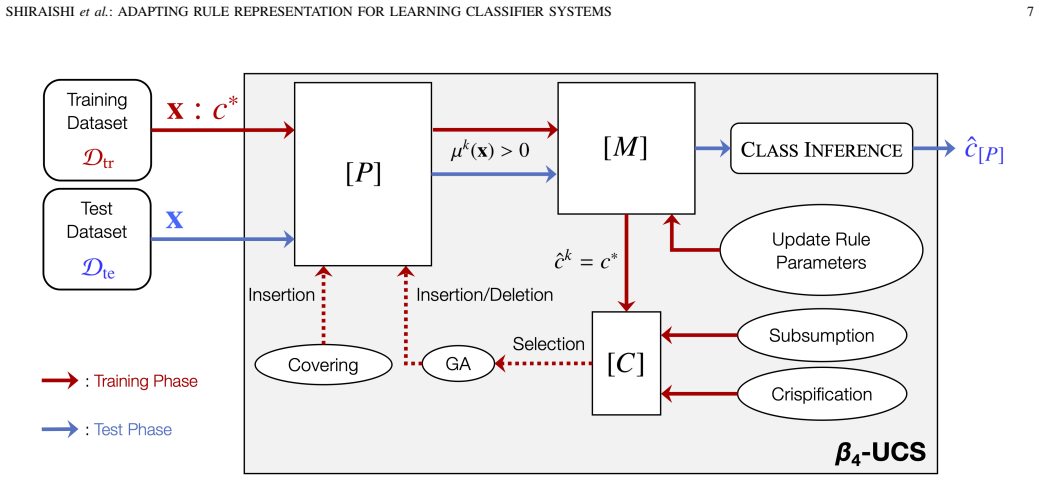
The four-parameter $\beta$ distribution B_e4($\alpha$,$\beta$,l,u), with PDF f_X(x) = (x-l)^($\alpha$-1)(u-x)^($\beta$-1) / (B($\alpha$,$\beta$)(u-l)^($\alpha$+$\beta$-1)), normalized by its mode value, serves as the membership function of each fuzzy set. Shape parameters $\alpha$ and $\beta$ control symmetry and peakedness, while l and u set the interval; the system evolves these four parameters per input dimension. Supporting machinery includes a covering operator that initializes rules as crisp rectangles, a genetic operator with relative mutation on shape parameters, a subsumption operator that declares rule k_sub more general than k_tos when the interval [l,u] of k_sub contains that of k_tos, its kurtosis is no larger, and its mode is within tolerance Tol_sub, and a crispification operator that resets $\alpha$=$\beta$=1 on a selected dimension to bias toward crisp rectangles.
What would settle it
Run beta4-UCS on an artificial problem with known oblique class boundaries (e.g., a rotated checkerboard), disable the subsumption operator or replace it with an exact geometric-inclusion check, and compare final test accuracy and population size; if accuracy drops sharply or the rule count explodes when the heuristic is removed, the compactness and accuracy claims depend on that heuristic.
Extended reading notes
Core claim
The central claim is that a four-parameter beta-distribution membership function, normalized to [0,1] and constrained to shape parameters alpha,beta >= 1, can represent crisp rectangles, symmetric and asymmetric bells, and monotonic shapes; optimizing its four parameters per dimension lets each rule independently choose the boundary style that fits its local subspace. The paper further claims this is the first LCS to adapt rule shape and fuzziness simultaneously. In experiments with 30 runs on 25 datasets, FBR with the crispification operator (FBRC) ranks first and FBR ranks second in average test accuracy among ten representations, and both produce significantly more compact populations, with the crispification operator strengthening compactness without sacrificing accuracy.
Load-bearing premise
Subsumption assumes that a rule with a wider interval, a more rounded peak, and a similar mode can safely stand in for a narrower rule, even though exact inclusion of the fuzzy matching landscape is never checked.
Editorial extensions
If this is right
- Users of LCSs would no longer need to choose a rule representation (rectangles, ellipsoids, bells, trapezoids) before seeing the data, because beta4-UCS can adapt per rule.
- Rule sets become more compact under FBRC, strengthening the interpretability case for evolutionary rule-based models.
- The co-adaptation of shape and fuzziness in a single four-parameter representation is claimed to provide robust accuracy across datasets where each fixed representation wins only on some problems.
- The design principle of starting from crisp rules and adding fuzziness only where accuracy demands it is a reusable recipe for other fuzzy rule learners.
Reading between the lines
- If FBR is as universal as claimed, it could likely replace the membership functions in other fuzzy rule-based learners beyond UCS-style systems, with the same four parameters carrying equivalent meaning across algorithms.
- A testable prediction follows from the crisp-bias design: as training proceeds, the fraction of crisp rules should rise on datasets with simple boundaries and stay low on noisy or missing-heavy datasets, and measuring this trend over epochs would confirm the adaptation mechanism.
- The subsumption operator's safety depends on kurtosis ordering; on data with sharply multimodal boundaries, a kurtosis-only comparison may delete rules whose matching-degree landscapes are not truly covered, so auditing surviving rule sets with an exact geometric-inclusion check on such data would probe the heuristic.
Editorial analysis
A structured set of objections, weighed in public.
Referee Report
Summary. This paper proposes a four-parameter beta-distribution-based rule representation (FBR) for supervised learning classifier systems, integrated into Fuzzy-UCS to form beta4-UCS. The representation can express rectangular, symmetric/asymmetric bell-shaped, and monotonic membership functions, and the system includes a new covering operator, a relative mutation operator, a mode/kurtosis-based subsumption operator, and an optional crispification operator that biases the population toward crisp rectangular rules. The authors claim that FBR, especially with crispification (FBRC), achieves significantly better test accuracy and more compact rule sets than eight existing rule representations on 25 datasets, with 30 runs per setting and statistical testing using Friedman and Holm-corrected Wilcoxon tests. The manuscript also reports training accuracy, population size, computational time, macro F1, alternative cross-validation protocols, extended training, and a comparison with Random Forest, SVM, and XGBoost.
Significance. If the claims hold, this is a useful contribution: a single representation that continuously spans crisp rectangles and flexible fuzzy shapes in an LCS, with a subsumption operator that works across these shapes, addresses a real limitation of previous adaptive representations. The paper's strengths are its breadth of comparison (25 datasets, 10 representations, 30 runs), the inclusion of multiple validation protocols and macro F1 results in the appendices, the public implementation, and a generally careful report of raw and Holm-adjusted p-values. The main significance claim is nonetheless weakened by the fact that the core hyperparameters of the proposed method are selected through sensitivity analysis on the same benchmark datasets used for the headline significance tests, while the baselines use fixed hyperparameters from the literature. The compactness claim also depends on a subsumption inclusion test whose geometric guarantees are not established.
major comments (2)
- [Section V-A, Appendices B and C, Table X] The paper should provide a nested or held-out validation for r0 and Tolsub, or reframe the significance claims as conditional on the chosen configuration. Without that, the reported p-values are optimistically biased.
- [Section IV-B3 and Appendix B] This is a secondary but load-bearing concern: an unsafe subsumption operator could degrade accuracy, and the empirical comparison does not show a clear penalty, but the claimed compactness improvement is not yet supported by a correctness argument.
minor comments (4)
- [Table IV and Section V-A] The table uses the notation FBR(C) while the text distinguishes FBR and FBRC as separate systems; the table caption should state explicitly that FBRC is FBR plus the crispification operator.
- [Section VI-B, Eq. (22)] The quantity called 'kurtosis' in Eq. (22) is an average over dimensions and rules weighted by numerosity; this is a heuristic summary statistic and should be described as such rather than as the kurtosis of a multivariate beta distribution.
- [Appendix A] The comparison with Random Forest, SVM, and XGBoost uses default hyperparameters for those methods while beta4-UCS receives representation-specific tuning; this appendix should be labeled an illustrative baseline comparison, not a controlled head-to-head evaluation.
- [Tables V and VI] The plus/minus/tilde counts in Tables V and VI summarize per-dataset significance classifications from 30-run Wilcoxon tests; the manuscript should state explicitly that these per-dataset counts are not multiplicity-corrected and that only the nine pairwise p-values in the bottom rows receive Holm correction.
Circularity Check
No circular reasoning: the proposed method is an empirical algorithm with held-out test evaluation; hyperparameter sensitivity on the same benchmark is a validation caveat, not a circular step.
full rationale
The paper's central claims are empirical: FBR/FBRC is an adaptive rule representation embedded in a Fuzzy-UCS variant, and its test accuracy and population size are measured on held-out portions of 25 datasets. I traced the derivation chain and found no step where a claimed 'prediction' reduces by construction to an input. The FBR membership function is a normalized four-parameter beta PDF; the crispification and subsumption operators are algorithmic heuristics whose safety is not formally proven but whose evaluation is external to their definition. The 'is-more-general' conditions (interval containment, kurtosis ordering, mode proximity) do not guarantee pointwise MF dominance, but that is an approximation/robustness issue, not circularity. The only validity caveat is that Tolsub and r0 sensitivity analyses (Appendices B and C) are run on the same 25 datasets used in the headline comparison; choosing r0=1.0 partly for its smaller population size on these datasets means the compactness significance is not fully independent of model selection. However, this is a benchmark-tuning/statistical-independence concern, not a logical circularity: the paper does not define accuracy or compactness in terms of the fitted parameters, and it reports no significant accuracy differences across Tolsub or r0. Self-citations to [8], [15] are used for literature positioning and operator inspiration, not as the sole justification of the proposed mechanism. No uniqueness theorem or ansatz is imported from the authors' prior work; the method is described with explicit equations and compared against external held-out test data. Therefore the circularity score is 0.
Assumptions & free parameters
free parameters (4)
- r0 (covering interval range) =
1.0
- m0 (interval mutation range) =
0.1
- Tolsub (subsumption mode tolerance) =
0.01
- s0 (covering shape parameter) =
1.0
assumptions (5)
- standard math Four-parameter beta PDF with alpha,beta >= 1 is finite and can be normalized to a [0,1] membership function via (13).
- domain assumption Inputs are normalized to [0,1]^d and test values are clipped to that range.
- domain assumption The is-more-general operator's three conditions correctly identify a safe subsumption relation.
- domain assumption Resetting experience and accuracy after crispification is beneficial or at least not harmful.
- domain assumption The Fuzzy-UCS update rules (experience, correct matching, fitness) are appropriate for the new representation.
Cite this review
Pith. "Pith review of Adapting Rule Representation With Four-Parameter Beta Distribution for Learning Classifier Systems." pith.science (2026). https://pith.science/paper/XV7IRTVT
@misc{pith2026250603602,
  author       = {Pith},
  title        = {Pith review of: Adapting Rule Representation With Four-Parameter Beta Distribution for Learning Classifier Systems},
  year         = {2026},
  howpublished = {\url{https://pith.science/paper/XV7IRTVT}},
  note         = {Machine review of arXiv:2506.03602}
}
read the original abstract
Rule representations significantly influence the search capabilities and decision boundaries within the search space of Learning Classifier Systems (LCSs), a family of rule-based machine learning systems that evolve interpretable models through evolutionary processes. However, it is very difficult to choose an appropriate rule representation for each problem. Additionally, some problems benefit from using different representations for different subspaces within the input space. Thus, an adaptive mechanism is needed to choose an appropriate rule representation for each rule in LCSs. This article introduces a flexible rule representation using a four-parameter beta distribution and integrates it into a fuzzy-style LCS. The four-parameter beta distribution can form various function shapes, and this flexibility enables our LCS to automatically select appropriate representations for different subspaces. Our rule representation can represent crisp/fuzzy decision boundaries in various boundary shapes, such as rectangles and bells, by controlling four parameters, compared to the standard representations such as trapezoidal ones. Leveraging this flexibility, our LCS is designed to adapt the appropriate rule representation for each subspace. Moreover, our LCS incorporates a generalization bias favoring crisp rules where feasible, enhancing model interpretability without compromising accuracy. Experimental results on real-world classification tasks show that our LCS achieves significantly superior test accuracy and produces more compact rule sets. Our implementation is available at https://github.com/YNU-NakataLab/Beta4-UCS. An extended abstract related to this work is available at https://doi.org/10.36227/techrxiv.174900805.59801248/v1.
Figures


Figures from the paper (7 more)


Reference graph
Works this paper leans on
-
[1]
Evolutionary co-optimization of rule shape and fuzzi- ness in rule-based machine learning,
H. Shiraishi, Y . Hayamizu, T. Hashiyama, K. Takadama, H. Ishibuchi, and M. Nakata, “Evolutionary co-optimization of rule shape and fuzzi- ness in rule-based machine learning,” Authorea Preprints, 2025
work page 2025
-
[2]
R. J. Urbanowicz and W. N. Browne, Introduction to Learning Classifier Systems, 1st ed. Springer Publishing Company, Incorporated, 2017
work page 2017
-
[3]
M. V . Butz, Rule-based evolutionary online learning systems. Springer, 2006. TABLE XIX PROPORTION OF CRISP AND FUZZY RULES GENERATED BY 𝛽4-UCS WITH FBRC AT THE END OF TRAINING (I.E., 50 TH EPOCH ). T HE BAR CHART SHOWS THE PROPORTION OF CRISP (■) AND FUZZY RULES (■). ID. Proportional Bar Chart Crisp (■) Fuzzy ( ■) cae 52.26% 47.74% can 66.30% 33.70% car ...
work page 2006
-
[4]
T. Kovacs, “XCS classifier system reliably evolves accurate, complete, and minimal representations for Boolean functions,” in Soft computing in engineering design and manufacturing . Springer, 1998, pp. 59–68
work page 1998
-
[5]
Autoencoding with a classifier system,
R. J. Preen, S. W. Wilson, and L. Bull, “Autoencoding with a classifier system,” IEEE Trans. Evol. Comput. , vol. 25, no. 6, pp. 1079–1090, 2021
work page 2021
-
[6]
E. Bernad ´o-Mansilla and J. M. Garrell-Guiu, “Accuracy-based learning classifier systems: Models, analysis and applications to classification tasks,” Evol. Comput., vol. 11, no. 3, p. 209–238, sep 2003
work page 2003
-
[7]
Survival-LCS: A rule-based machine learning approach to survival analysis,
A. Woodward, H. Bandhey, J. H. Moore, and R. J. Urbanowicz, “Survival-LCS: A rule-based machine learning approach to survival analysis,” in Proc. Genet. Evol. Comput. Conf. , 2024, pp. 431–439
work page 2024
-
[8]
H. Shiraishi, Y . Hayamizu, H. Sato, and K. Takadama, “Can the same rule representation change its matching area? enhancing representation in XCS for continuous space by probability distribution in multiple dimension,” in Proc. Genet. Evol. Comput. Conf. , 2022, p. 431–439
work page 2022
Show all 69 references
-
[9]
Mining oblique data with XCS,
S. W. Wilson, “Mining oblique data with XCS,” in Int. Worksh. Learn. Classif. Syst., 2000, pp. 158–174
2000
-
[10]
Kernel-based, ellipsoidal conditions in the real-valued XCS classifier system,
M. V . Butz, “Kernel-based, ellipsoidal conditions in the real-valued XCS classifier system,” in Proc. 7th Annu. Conf. Genet. Evol. Comput. , 2005, pp. 1835–1842
2005
-
[11]
Classifier conditions using gene expression program- ming,
S. W. Wilson, “Classifier conditions using gene expression program- ming,” in Learn. Classif. Syst. , 2008, pp. 206–217
2008
-
[12]
Accuracy-based neuro and neuro-fuzzy classifier systems,
L. Bull and T. O’Hara, “Accuracy-based neuro and neuro-fuzzy classifier systems,” in Proc. 4th Annu. Conf. Genet. Evol. Comput. , 2002, p. 905–911
2002
-
[13]
Fuzzy-XCS: A michigan genetic fuzzy system,
J. Casillas, B. Carse, and L. Bull, “Fuzzy-XCS: A michigan genetic fuzzy system,” IEEE Trans. Fuzzy Syst. , vol. 15, no. 4, pp. 536–550, Aug 2007
2007
-
[14]
Towards final rule set reduction in XCS: A fuzzy representation approach,
F. Shoeleh, A. Hamzeh, and S. Hashemi, “Towards final rule set reduction in XCS: A fuzzy representation approach,” in Proc. 13th Annu. Conf. Genet. Evol. Comput. , 2011, pp. 1211–1218
2011
-
[15]
Fuzzy-UCS revisited: Self-adaptation of rule representations in michigan-style learning fuzzy- classifier systems,
H. Shiraishi, Y . Hayamizu, and T. Hashiyama, “Fuzzy-UCS revisited: Self-adaptation of rule representations in michigan-style learning fuzzy- classifier systems,” in Proc. Genet. Evol. Comput. Conf. , 2023, p. 548–557
2023
-
[16]
Fuzzy-UCS: A michigan-style learning fuzzy-classifier system for supervised learning,
A. Orriols-Puig, J. Casillas, and E. Bernad ´o-Mansilla, “Fuzzy-UCS: A michigan-style learning fuzzy-classifier system for supervised learning,” IEEE Trans. Evol. Comput. , vol. 13, no. 2, pp. 260–283, April 2009
2009
-
[17]
Generalization in the XCS classifier system,
S. W. Wilson, “Generalization in the XCS classifier system,” Proc. Genetic Programming 1998 , 1998. 28 IEEE TRANSACTIONS ON EVOLUTIONARY COMPUTATION, DOI: 10.1109/TEVC.2025.3550915, MARCH 2025
1998
-
[18]
Extracting both generalized and special- ized knowledge by XCS using attribute tracking and feedback,
K. Takadama and M. Nakata, “Extracting both generalized and special- ized knowledge by XCS using attribute tracking and feedback,” in 2015 IEEE Congr. Evol. Comput. (CEC) . IEEE, 2015, pp. 3034–3041
2015
-
[19]
Bayesian inference for a flexible class of bivariate beta distributions,
R. Crackel and J. Flegal, “Bayesian inference for a flexible class of bivariate beta distributions,” J. Stat. Comput. Simul. , vol. 87, no. 2, pp. 295–312, 2017
2017
-
[20]
Get real! XCS with continuous-valued inputs,
S. W. Wilson, “Get real! XCS with continuous-valued inputs,” in Int. Worksh. Learn. Classif. Syst. Springer, 1999, pp. 209–219
1999
-
[21]
For real! XCS with continuous-valued inputs,
C. Stone and L. Bull, “For real! XCS with continuous-valued inputs,” Evol. Comput., vol. 11, no. 3, p. 299–336, sep 2003
2003
-
[22]
Be real! XCS with continuous-valued inputs,
H. H. Dam, H. A. Abbass, and C. Lokan, “Be real! XCS with continuous-valued inputs,” in Proc. 7th Annu. Worksh. Genet. Evol. Comput., 2005, pp. 85–87
2005
-
[23]
Using convex hulls to represent classifier conditions,
P. L. Lanzi and S. W. Wilson, “Using convex hulls to represent classifier conditions,” in Proc. 8th Annu. Conf. Genet. Evol. Comput. , 2006, pp. 1481–1488
2006
-
[24]
Solving social media text classification problems using code fragment-based XCSR,
M. H. Arif, J. Li, and M. Iqbal, “Solving social media text classification problems using code fragment-based XCSR,” in 2017 IEEE 29th Int. Conf. Tools Artif. Intell. (ICTAI) , Nov 2017, pp. 485–492
2017
-
[25]
Beta distribution based XCS classifier system,
H. Shiraishi, Y . Hayamizu, H. Sato, and K. Takadama, “Beta distribution based XCS classifier system,” in 2022 IEEE Congr. Evol. Comput. (CEC), July 2022, pp. 1–8
2022
-
[26]
Coevolving different knowledge represen- tations with fine-grained parallel learning classifier systems,
X. Llora and J. M. Garrell, “Coevolving different knowledge represen- tations with fine-grained parallel learning classifier systems,” in Proc. 4th Annu. Conf. Genet. Evol. Comput. , 2002, pp. 934–941
2002
-
[27]
Evolving multiple discretizations with adaptive intervals for a pittsburgh rule-based learning classifier system,
J. Bacardit and J. M. Garrell, “Evolving multiple discretizations with adaptive intervals for a pittsburgh rule-based learning classifier system,” in Genet. Evol. Comput. Conf. Springer, 2003, pp. 1818–1831
2003
-
[28]
Approximate versus linguistic representation in Fuzzy-UCS,
A. Orriols-Puig, J. Casillas, and E. Bernad ´o-Mansilla, “Approximate versus linguistic representation in Fuzzy-UCS,” in Hybrid Artif. Intell. Syst., 2008, pp. 722–729
2008
-
[29]
XCS with weight-based matching in V AE latent space and additional learning of high- dimensional data,
M. Tadokoro, H. Sato, and K. Takadama, “XCS with weight-based matching in V AE latent space and additional learning of high- dimensional data,” in 2021 IEEE Congr. Evol. Comput. (CEC) , June 2021, pp. 304–310
2021
-
[30]
Function approximation with XCS: Hyperellipsoidal conditions, recursive least squares, and compaction,
M. V . Butz, P. L. Lanzi, and S. W. Wilson, “Function approximation with XCS: Hyperellipsoidal conditions, recursive least squares, and compaction,” IEEE Trans. Evol. Comput. , vol. 12, no. 3, pp. 355–376, June 2008
2008
-
[31]
Classifier fitness based on accuracy,
S. W. Wilson, “Classifier fitness based on accuracy,” Evol. Comput. , vol. 3, no. 2, p. 149–175, jun 1995
1995
-
[32]
Ferreira, Gene expression programming: mathematical modeling by an artificial intelligence
C. Ferreira, Gene expression programming: mathematical modeling by an artificial intelligence . Springer, 2006, vol. 21
2006
-
[33]
Reusing building blocks of extracted knowledge to solve complex, large-scale boolean problems,
M. Iqbal, W. N. Browne, and M. Zhang, “Reusing building blocks of extracted knowledge to solve complex, large-scale boolean problems,” IEEE Trans. Evol. Comput. , vol. 18, no. 4, pp. 465–480, 2014
2014
-
[34]
Comparison between fuzzy and interval partitions in evolutionary multiobjective design of rule-based classifica- tion systems,
H. Ishibuchi and Y . Nojima, “Comparison between fuzzy and interval partitions in evolutionary multiobjective design of rule-based classifica- tion systems,” in 14th IEEE Int. Conf. Fuzzy Syst. , 2005, pp. 430–435
2005
-
[35]
Fuzzy knowledge representation study for incremental learning in data streams and classification problems,
A. Orriols-Puig and J. Casillas, “Fuzzy knowledge representation study for incremental learning in data streams and classification problems,” Soft Comput., vol. 15, no. 12, pp. 2389–2414, 2011
2011
-
[36]
The beta fuzzy system: approximation of stan- dard membership functions,
A. M. Alimi, “The beta fuzzy system: approximation of stan- dard membership functions,” Proc. 17eme Journees Tunisiennes d’Electrotechnique et d’Automatique: JTEA, vol. 97, pp. 108–112, 1997
1997
-
[37]
Beta fuzzy logic systems: approximation properties in the mimo case,
A. M. Alimi, R. Hassine, and M. Selmi, “Beta fuzzy logic systems: approximation properties in the mimo case,” Int. J. Appl. Math. Comput. Sci., vol. 13, no. 2, pp. 225–238, 2003
2003
-
[38]
A hybrid learning algorithm for evolving flexible beta basis function neural tree model,
S. Bouaziz, H. Dhahri, A. M. Alimi, and A. Abraham, “A hybrid learning algorithm for evolving flexible beta basis function neural tree model,” Neurocomputing, vol. 117, pp. 107–117, 2013
2013
-
[39]
A beta basis function interval type-2 fuzzy neural network for time series applications,
N. Baklouti, A. Abraham, and A. M. Alimi, “A beta basis function interval type-2 fuzzy neural network for time series applications,” Eng. Appl. Artif. Intell. , vol. 71, pp. 259–274, 2018
2018
-
[40]
Rule weight specification in fuzzy rule- based classification systems,
H. Ishibuchi and T. Yamamoto, “Rule weight specification in fuzzy rule- based classification systems,” IEEE Trans. Fuzzy Syst. , vol. 13, no. 4, pp. 428–435, Aug 2005
2005
-
[41]
Toward a theory of generalization and learning in XCS,
M. Butz, T. Kovacs, P. Lanzi, and S. Wilson, “Toward a theory of generalization and learning in XCS,” IEEE Trans. Evol. Comput., vol. 8, no. 1, pp. 28–46, Feb 2004
2004
-
[42]
Absumption based on overgenerality and condition-clustering based specialization for XCS with continuous-valued inputs,
H. Shiraishi, Y . Hayamizu, H. Sato, and K. Takadama, “Absumption based on overgenerality and condition-clustering based specialization for XCS with continuous-valued inputs,” in Proc. Genet. Evol. Comput. Conf., 2022, p. 422–430
2022
-
[43]
Learning optimality theory for accuracy- based learning classifier systems,
M. Nakata and W. N. Browne, “Learning optimality theory for accuracy- based learning classifier systems,” IEEE Trans. Evol. Comput. , vol. 25, no. 1, pp. 61–74, Feb 2021
2021
-
[44]
To handle real valued input in XCS: using fuzzy hyper-trapezoidal membership in classifier condition,
F. Shoeleh, A. Hamzeh, and S. Hashemi, “To handle real valued input in XCS: using fuzzy hyper-trapezoidal membership in classifier condition,” in Simul. Evol. Learn. 8th Int. Conf. , 2010, pp. 55–64
2010
-
[45]
Absumption to complement sub- sumption in learning classifier systems,
Y . Liu, W. N. Browne, and B. Xue, “Absumption to complement sub- sumption in learning classifier systems,” in Proc. Genet. Evol. Comput. Conf., 2019, pp. 410–418
2019
-
[46]
Ockham’s razor in memetic computing: three stage optimal memetic exploration,
G. Iacca, F. Neri, E. Mininno, Y .-S. Ong, and M.-H. Lim, “Ockham’s razor in memetic computing: three stage optimal memetic exploration,” Inform. Sci., vol. 188, pp. 17–43, 2012
2012
-
[47]
UCI machine learning repository,
D. Dua and C. Graff, “UCI machine learning repository,” 2017. [Online]. Available: http://archive.ics.uci.edu/ml
2017
-
[48]
Minimum rule-repair algorithm for supervised learning classifier systems on real-valued classification tasks,
K. Hamasaki and M. Nakata, “Minimum rule-repair algorithm for supervised learning classifier systems on real-valued classification tasks,” in Int. Conf. Metaheur. Nat. Inspir. Comput. , 2021, pp. 137–151
2021
-
[49]
Strength-based learning classifier systems revisited: Effective rule evolution in supervised classification tasks,
F. A. Tzima and P. A. Mitkas, “Strength-based learning classifier systems revisited: Effective rule evolution in supervised classification tasks,”Eng. Appl. Artif. Intell. , vol. 26, no. 2, pp. 818–832, 2013
2013
-
[50]
ExSTraCS 2.0: description and evaluation of a scalable learning classifier system,
R. J. Urbanowicz and J. H. Moore, “ExSTraCS 2.0: description and evaluation of a scalable learning classifier system,” Evol. Intell., vol. 8, no. 2, pp. 89–116, 2015
2015
-
[51]
Classifiers that approximate functions,
S. W. Wilson, “Classifiers that approximate functions,” Natural Comput., vol. 1, no. 2, pp. 211–234, 04 2002
2002
-
[52]
Analysis and im- provement of fitness exploitation in xcs: Bounding models, tournament selection, and bilateral accuracy,
M. V . Butz, D. E. Goldberg, and K. Tharakunnel, “Analysis and im- provement of fitness exploitation in xcs: Bounding models, tournament selection, and bilateral accuracy,” Evol. Comput. , vol. 11, no. 3, pp. 239–277, 2003
2003
-
[53]
Classification of date fruits into genetic varieties using image analysis,
M. Koklu, R. Kursun, Y . S. Taspinar, and I. Cinar, “Classification of date fruits into genetic varieties using image analysis,” Math. Probl. Eng., vol. 2021, 2021
2021
-
[54]
Conversion predictors of clinically isolated syndrome to multiple sclerosis in mexican patients: a prospective study,
V . Chavarria, G. Espinosa-Ram ´ırez, J. Sotelo, J. Flores-Rivera, O. An- guiano, A. C. Hern ´andez, E. D. Guzm ´an-R´ıos, A. Salazar, G. Ordo ˜nez, and B. Pineda, “Conversion predictors of clinically isolated syndrome to multiple sclerosis in mexican patients: a prospective s...
2023
-
[55]
National poll on healthy aging (NPHA), [united states], april 2017
P. N. Malani, J. Kullgren, and E. Solway, “National poll on healthy aging (NPHA), [united states], april 2017.” 2019
2017
-
[56]
Classification and analysis of pistachio species with pre-trained deep learning models,
D. Singh, Y . S. Taspinar, R. Kursun, I. Cinar, M. Koklu, I. A. Ozkan, and H.-N. Lee, “Classification and analysis of pistachio species with pre-trained deep learning models,” Electronics, vol. 11, no. 7, 2022
2022
-
[57]
The use of machine learning methods in classification of pumpkin seeds (cucurbita pepo l.),
M. Koklu, S. Sarigil, and O. Ozbek, “The use of machine learning methods in classification of pumpkin seeds (cucurbita pepo l.),” Genet. Resour. Crop Evol., vol. 68, no. 7, pp. 2713–2726, 2021
2021
-
[58]
Classification of raisin grains using machine vision and artificial intelligence methods,
˙I. C ¸ inar, M. Koklu, and S ¸. Tas ¸demir, “Classification of raisin grains using machine vision and artificial intelligence methods,” Gazi M ¨uhendislik Bilimleri Dergisi, vol. 6, no. 3, pp. 200–209, 12 2020
2020
-
[59]
Julia: A fresh approach to numerical computing,
J. Bezanson, A. Edelman, S. Karpinski, and V . B. Shah, “Julia: A fresh approach to numerical computing,” SIAM Review , vol. 59, no. 1, pp. 65–98, 2017
2017
-
[60]
Generic approaches for parallel rule matching in learning classifier systems,
L. Rosenbauer, A. Stein, and J. H ¨ahner, “Generic approaches for parallel rule matching in learning classifier systems,” in Proc. 2020 Genet. Evol. Comput. Conf. Companion , 2020, pp. 1789–1797
2020
-
[61]
Model-based explanations of concept drift,
F. Hinder, V . Vaquet, J. Brinkrolf, and B. Hammer, “Model-based explanations of concept drift,” Neurocomput., vol. 555, p. 126640, 2023
2023
-
[62]
Fuzzy logic based control for autonomous mobile robot navigation,
H. Omrane, M. S. Masmoudi, and M. Masmoudi, “Fuzzy logic based control for autonomous mobile robot navigation,” Comput. Intell. Neu- rosci., vol. 2016, no. 1, p. 9548482, 2016
2016
-
[63]
Explainable artificial intelligence (xai)—from theory to methods and applications,
E. S. Ortigossa, T. Gonc ¸alves, and L. G. Nonato, “Explainable artificial intelligence (xai)—from theory to methods and applications,” IEEE Access, vol. 12, pp. 80 799–80 846, 2024
2024
-
[64]
Mechanisms to alleviate over- generalization in XCS for continuous-valued input spaces,
A. R. M. Wagner and A. Stein, “Mechanisms to alleviate over- generalization in XCS for continuous-valued input spaces,” SN Comput. Sci., vol. 3, no. 2, pp. 1–23, 2022
2022
-
[65]
SupRB in the context of rule-based machine learning methods: A comparative study,
M. Heider, H. Stegherr, R. Sraj, D. P ¨atzel, J. Wurth, and J. H ¨ahner, “SupRB in the context of rule-based machine learning methods: A comparative study,” Appl. Soft Comput. , p. 110706, 2023
2023
-
[66]
A variable-length fuzzy set representation for learning fuzzy-classifier systems,
H. Shiraishi, R. Ye, H. Ishibuchi, and M. Nakata, “A variable-length fuzzy set representation for learning fuzzy-classifier systems,” in Int. Conf. Parallel Problem Solving from Nature , 2024, pp. 386–402
2024
-
[67]
Prediction and outlier detection in clas- sification problems,
L. Guan and R. Tibshirani, “Prediction and outlier detection in clas- sification problems,” Journal of the Royal Statistical Society Series B: Statistical Methodology, vol. 84, no. 2, pp. 524–546, 2022
2022
-
[68]
Rapid rule compaction strategies for global knowledge discovery in a supervised learning classifier system,
J. Tan, J. Moore, and R. Urbanowicz, “Rapid rule compaction strategies for global knowledge discovery in a supervised learning classifier system,” in Proc. Artificial Life Conf. , 2013, pp. 110–117
2013
-
[69]
A comparison of learning classifier systems’ rule compaction algorithms for knowledge visualization,
Y . Liu, W. N. Browne, and B. Xue, “A comparison of learning classifier systems’ rule compaction algorithms for knowledge visualization,” ACM Trans. Evol. Learn. Optim. , vol. 1, no. 3, pp. 1–38, 2021. SHIRAISHI et al.: ADAPTING RULE REPRESENTATION FOR LEARNING CLASSIFIER SYST...
2021
Reviewed August 7, 2026 · model on record in the stance chip above.
Discussion (0). Sign in to comment.