REVIEW 3 major objections 4 minor 3 cited by
This paper argues that current multimodal LLMs, despite strong object recognition, systematically lack 'visual knowledge'—the intuitive grasp of physical and social principles—and quantifies the deficit with a new video benchmark, VKnowU.
Reviewed by Pith at T0; open to challenge. T0 means a machine referee read the full paper against a public rubric. the ladder, T0–T4 →
T0 review · deepseek-v4-flash
2026-08-03 20:18 UTC pith:XVB2T5XC
load-bearing objection Useful benchmark and a plausible training recipe, but the headline human-gap is not apples-to-apples and the main VKnowU gain is in-sample on lambda. the 3 major comments →
VKnowU: Evaluating Visual Knowledge Understanding in Multimodal LLMs
The pith
A machine-rendered reading of the paper's core claim, the machinery that carries it, and where it could break.
Core claim
On VKnowU, the paper finds that visual knowledge is a distinct, measurable capability in which current MLLMs are deficient: the best model scores 74.6% overall against 89.6% for humans, with the widest gaps in Intuitive Physics (59.0% vs 97.5%, a 38.5-point deficit) and Spatial Awareness (62.7% vs 95.4%, a 32.7-point deficit). Human-centric tasks are closer (best 81.9% vs 86.8%), which the authors attribute to abundant social supervision in pretraining. The paper further claims visual knowledge is learnable: VideoKnow+, trained on VKnowQA with a See-Think-Answer output format and a GRPO reward that verifies whether the model's visual description alone determines the answer, improves 3.7% on
What carries the argument
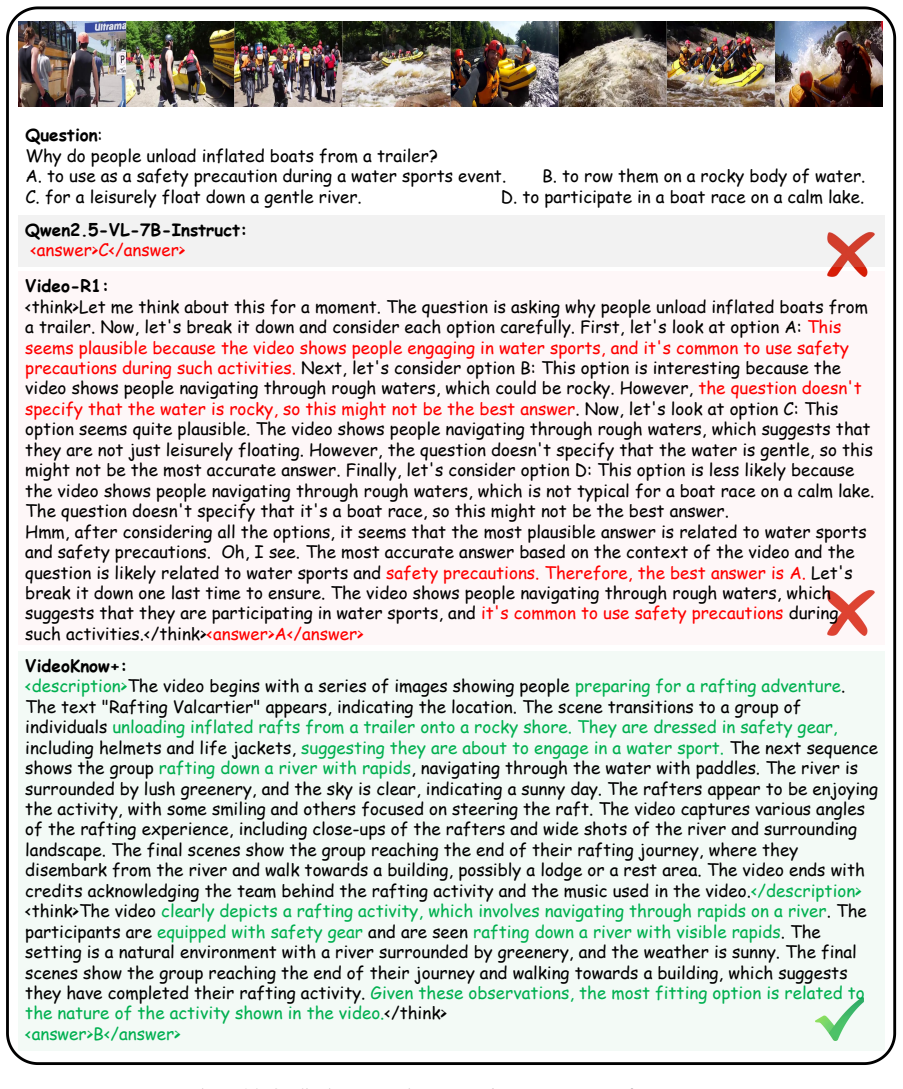
The central object is VKnowU, a video multiple-choice benchmark built to isolate visual knowledge from audio and language shortcuts. Its QA pipeline has four steps: transcribe audio with Whisper and drop questions answerable from subtitles; run three text-only LLMs in a blind-VQA setting and remove questions answered correctly by at least two; use DeepSeek-R1 to rewrite wrong options into plausible distractors; then manually verify and shuffle options. The companion mechanism is VideoKnow+, whose See-Think-Answer format forces a self-contained visual description before reasoning, and whose binary visual knowledge reward uses a frozen MLLM verifier to check that the answer follows from the de
Load-bearing premise
The claimed 15% human-performance gap rests on using human accuracy from the original annotation sources as the reference for final multiple-choice items whose wrong answers were rewritten by DeepSeek-R1 and whose options were reshuffled; if humans perform differently on those rewritten items, the headline gap is not apples-to-apples.
What would settle it
Give the released VKnowU items to a fresh human panel under the same multiple-choice format and compute accuracy per task; if aggregate human accuracy no longer hovers near 89.6%, particularly if intuitive physics or spatial awareness scores drop, the central gap claim fails. A second check: if a text-only LLM, after the distractor rewriting, answers above the blind-VQA threshold on many items, the language-bias filtering is incomplete.
If this is right
- Current MLLMs' object recognition does not entail understanding of physical laws: state-of-the-art models are near random on intuitive physics and spatial relations.
- Model rankings on VKnowU cluster into independent world-centric and human-centric competencies; improving one does not automatically improve the other.
- Visual knowledge is trainable: a relatively small RL stage on 30K questions yields consistent gains on VKnowU and transfers to several standard video benchmarks.
- Long chain-of-thought can hurt: on straightforward visual-knowledge questions, reasoning-heavy models sometimes underperform due to repetition and ungrounded speculation.
- Evaluation protocol matters: after filtering, text-only LLM blind accuracy drops to near chance on the QA pool, suggesting the remaining questions require visual evidence.
Where Pith is reading between the lines
- Editorial inference: the reported 15-point human gap should be re-verified on the final rewritten items; humans were scored on original annotations, not on the DeepSeek-R1-distractor versions, so some of the gap may be an artifact of the rewriting rather than a pure model deficit.
- Editorial inference: the polarization between proprietary and open-source models—physics-heavy strengths versus social-heavy strengths—suggests that visual-knowledge benchmarks could be used as reward data to rebalance pretraining curricula.
- Editorial inference: the scarcity of world-centric supervision in standard image-text pretraining points to synthetic simulation and world models as a testable source of data for intuitive physics and spatial awareness.
- Editorial inference: if future models are trained to maximize VKnowU with task-specific weights, the largest headroom is in world-centric tasks, so aggregated scores across the eight categories may hide uneven gains.
Editorial analysis
A structured set of objections, weighed in public.
Referee Report
Summary. The paper introduces VKnowU, a video multiple-choice benchmark of 1,680 questions across 1,249 videos, designed to evaluate eight types of visual knowledge grouped into world-centric (Intuitive Physics, Object Affordance, Object Material, Spatial Awareness) and human-centric (Event Anticipation, Mental State, Social Relation, Subjective Intention) categories. The benchmark is constructed by filtering six existing datasets through audio-reliance minimization, blind-LLM language-bias filtering, DeepSeek-R1 distractor rewriting, and human review. The authors evaluate 23 MLLMs, reporting a 15.0% overall gap relative to 'Human Performance' inherited from source annotations, with larger gaps on world-centric tasks. They also present VKnowQA (30K and 12K training sets) and a baseline model, VideoKnow+, built on Qwen2.5-VL-7B with an SFT cold start and GRPO with a visual-knowledge reward, reporting +3.7% on VKnowU and gains on MVBench, Video-MME, MMVU, and VSI-Bench.
Significance. If the benchmark and training claims hold, VKnowU would be a useful diagnostic for a relatively underexplored capability, and the See-Think-Answer + visual-knowledge-reward recipe would be a constructive baseline for future work. The paper's strengths include a thoughtful multi-stage filtering pipeline, a broad evaluation of current MLLMs, the inclusion of both open and proprietary models, and the public release of code and data. However, the headline claims rest on three load-bearing methodological decisions that currently compromise the conclusions: the human baseline is not measured on the final rewritten items, the main reward weight is tuned on the evaluation benchmark itself, and the training data overlap with the evaluation benchmark at the source-family level. These issues are fixable, but they must be addressed before the quantitative claims can be accepted.
major comments (3)
- [§3.3 (Steps III–IV), Table 1, §3.4] The human performance row in Table 1 is footnoted as 'sourced from original annotation or researchers' responses.' Because Step III rewrites distractors with DeepSeek-R1 to make them more plausible and Step IV shuffles options, the human scores were obtained on different, likely easier, items than the final VKnowU questions. The 15.0% overall gap and the per-task deficits (IP −38.5%, SA −32.7%) are therefore not apples-to-apples comparisons. No human-rater protocol, sample size, or inter-annotator agreement is reported. The authors should either re-measure human accuracy on the final VKnowU items or explicitly restrict the human-comparison claim to the original annotation conditions.
- [Table 4 vs. Table 2, Eq. (1)] The visual-knowledge reward weight λ is selected by training on VKnowU itself: Table 4 sweeps λ using 1K RL steps on VKnowU, the best value (0.1) is then used for the final VideoKnow+, and Table 2 reports the resulting +3.7% improvement on the same benchmark. This makes the headline gain in-sample with respect to hyperparameter selection. The authors should hold out a validation split of VKnowU (or a disjoint development set) for λ selection and report results on a separate test split, or otherwise justify a fixed λ chosen without reference to VKnowU performance.
- [§4.1, Table 9 vs. Table 6; §5.1] VKnowQA-30K is drawn from dataset families that overlap with VKnowU's sources: VKnowU uses IntPhys2, VSI-Bench, Social-IQ-2.0, PACS, VLEP, and RexTime, while VKnowQA-30K includes Intphys, VSI-100K, and Social-IQ, among others. Deduplication prevents exact item overlap but does not prevent the model from learning family-specific regularities that transfer to VKnowU. The claimed +3.7% improvement on VKnowU may therefore partly reflect training on the same distributions rather than general visual-knowledge learning. The authors should demonstrate transfer to evaluation tasks whose source families are entirely absent from VKnowQA, or ablate VKnowQA sources to show the gain survives when family-overlapping sources are removed.
minor comments (4)
- [Abstract vs. §3.4] The abstract says '28 SOTA MLLMs,' while Section 3.4 and Table 1 evaluate 23 models. Please reconcile.
- [§3.3 Step IV] The human verification step is described only as 'comprehensive human review.' Provide details: number of annotators, instructions, whether disagreements were adjudicated, and agreement statistics.
- [Tables 1, 2, 3] Some table cells are malformed in the text (e.g., 'LLaV A-OV-7B' spacing, Table 3 rows lacking labels). Please check the compiled tables for typographical errors.
- [§5.2] The ablation in Table 3 is informative, but the text states that GRPO alone repeats descriptions in SA; consider showing a quantitative measure (e.g., output length or repetition rate) to support this claim.
Circularity Check
VideoKnow+'s +3.7% VKnowU gain is selected on VKnowU itself; the human-gap baseline is carried over from pre-rewrite annotations, though the core benchmark construction is otherwise independent.
specific steps
-
fitted input called prediction
[Section 5.2, Table 4; Table 5; Table 2; Eq. (1)]
"Choice of Visual Knowledge Reward Ratio λ. We study the impact of varying λ, which controls the weight of the visual knowledge reward rv, by training 1K RL steps for rapid exploration. As shown in Table 4, VideoKnow+’s performance on VKnowU is sensitive to this parameter. The best performance 66.79 is achieved at λ=0.1..."
λ is tuned by VKnowU accuracy, and the verifier model in Table 5 is also chosen by VKnowU accuracy; Table 2 then reports VideoKnow+’s VKnowU score (67.7, +3.7%) for that tuned configuration. The benchmark is thus used both to select the configuration and to claim the improvement, so the reported gain is not a held-out result; it is the same quantity that was optimized, not an independent prediction.
full rationale
The load-bearing VKnowU benchmark construction is not circular: the QA pipeline (Whisper audio filtering, blind-LLM language-bias filtering, DeepSeek-R1 distractor rewriting, human review) is a curation procedure, and the 23-model evaluation is an external measurement against curated items. Appendix A's Bayes decomposition is standard conditioning and is not used to derive any fitted number. The circular element is confined to the VideoKnow+ validation: λ in Eq. (1) and the verifier model are selected by accuracy on VKnowU itself (Tables 4 and 5), and the same VKnowU set is then used to report the final '+3.7%' gain (Table 2). That makes the gain an in-sample, selection-optimized figure, not an independent estimate of VKnowU performance. Separately, I flag a missing-measurement limitation in Table 1: the human-performance row is 'sourced from original annotation or researchers' responses', but Step III rewrote distractors and Step IV shuffled options before evaluation, so the 15.0% human gap is not re-measured on the final items; this is a validity risk for the headline comparison, not a construction-level circularity. No load-bearing self-citation chain appears; the authors' prior video-model citations are contextual.
Axiom & Free-Parameter Ledger
free parameters (4)
- lambda (visual knowledge reward weight) =
0.1
- audio-similarity threshold =
0.3
- blind-VQA answerability threshold =
>5 of 10 correct, flagged by at least 2 of 3 LLMs
- training frame count and resolution =
16 frames at 128x28x28 for training; 32 frames at 256x28x28 for evaluation
axioms (5)
- domain assumption Visual knowledge is a coherent, separable construct with eight categories.
- domain assumption Human labels from original source datasets remain valid after DeepSeek-R1 rewrites options and shuffles order.
- domain assumption If blind text-only LLMs cannot answer a question, it is not language-answerable.
- domain assumption The frozen MLLM verifier's judgment that a description is sufficient to derive the answer is a valid reward signal.
- standard math Bayes decomposition P(T_a | V, T_q) proportional to P(V | T_a, T_q) * P(T_a | T_q).
read the original abstract
While Multimodal Large Language Models (MLLMs) have become adept at recognizing objects, they often lack the intuitive, human-like understanding of the world's underlying physical and social principles. This high-level vision-grounded semantics, which we term visual knowledge, forms a bridge between perception and reasoning, yet remains an underexplored area in current MLLMs. To systematically evaluate this capability, we present VKnowU, a comprehensive benchmark featuring 1,680 questions in 1,249 videos, covering 8 core types of visual knowledge spanning both world-centric (e.g., intuitive physics) and human-centric (e.g., subjective intentions). Evaluation of 28 SOTA MLLMs reveals that leading models still fall short of human performance, with particularly notable gaps in the world-centric. To bridge this gap, we introduce a new dataset, VKnowQA, and VideoKnow+, a baseline model that explicitly incorporates visual knowledge into MLLMs. VideoKnow+ follows a structured See-Think-Answer paradigm and adopts reinforcement learning with visual knowledge reward, achieving a +3.7% improvement on VKnowU and consistent gains on MVBench (+5.4%), Video-MME (+7.0%), and MMVU (+5.7%). Our work highlights visual knowledge as a missing cornerstone for developing more generalizable MLLMs that can not only see but also truly understand our worlds.
Figures






Forward citations
Cited by 3 Pith papers
-
Imagine Before You Predict: Interleaved Latent Visual Reasoning for Video Event Prediction
Future-L1 interleaves latent visual spans with text in MLLM decoding, trained on a custom Future-L1-50K dataset via LA-DAPO RL, and reports SOTA gains on FutureBench (61.0 to 85.4) and TwiFF-Bench (2.44 to 3.04).
-
Temporal and Cross-Modal Alignment for Enhanced Audiovisual Video Captioning
TCA-Captioner introduces an Observer-Checker-Corrector refinement loop and TCA-Bench to address modality detachment and temporal incoherence in audiovisual video captioning.
-
InternVideo3: Agentify Foundation Models with Multimodal Contextual Reasoning
InternVideo3 introduces Multimodal Contextual Reasoning and M^2LA attention to enable closed-loop evidence accumulation in long-video understanding and agentic tool use, reporting strong benchmark results.
Reference graph
Works this paper leans on
-
[1]
Gpt-4 technical report.arXiv preprint arXiv:2303.08774, 2023
Josh Achiam, Steven Adler, Sandhini Agarwal, Lama Ahmad, Ilge Akkaya, Florencia Leoni Aleman, Diogo Almeida, Janko Altenschmidt, Sam Altman, Shyamal Anadkat, et al. Gpt-4 technical report.arXiv preprint arXiv:2303.08774, 2023. 2
Pith/arXiv arXiv 2023
-
[2]
On seeing stuff: The perception of materials by humans and machines
Edward H Adelson. On seeing stuff: The perception of materials by humans and machines. InHuman vision and electronic imaging VI, pages 1–12. SPIE, 2001. 20
2001
-
[3]
Vqa: Visual question answering
Stanislaw Antol, Aishwarya Agrawal, Jiasen Lu, Margaret Mitchell, Dhruv Batra, C Lawrence Zitnick, and Devi Parikh. Vqa: Visual question answering. InProceedings of the IEEE international conference on computer vision, pages 2425–2433, 2015. 2
2015
-
[4]
Eye-contact, distance and affiliation.Sociometry, pages 289–304, 1965
Michael Argyle and Janet Dean. Eye-contact, distance and affiliation.Sociometry, pages 289–304, 1965. 20
1965
-
[5]
Shuai Bai, Keqin Chen, Xuejing Liu, Jialin Wang, Wenbin Ge, Sibo Song, Kai Dang, Peng Wang, Shijie Wang, Jun Tang, et al. Qwen2. 5-vl technical report.arXiv preprint arXiv:2502.13923, 2025. 2, 5, 7, 21
Pith/arXiv arXiv 2025
-
[6]
Representing the existence and the lo- cation of hidden objects: Object permanence in 6-and 8- month-old infants.Cognition, 23(1):21–41, 1986
Ren ´ee Baillargeon. Representing the existence and the lo- cation of hidden objects: Object permanence in 6-and 8- month-old infants.Cognition, 23(1):21–41, 1986. 20
1986
-
[7]
theory of mind
Simon Baron-Cohen, Alan M Leslie, and Uta Frith. Does the autistic child have a “theory of mind”?Cognition, 21 (1):37–46, 1985. 20
1985
-
[8]
Gilad Baruch, Zhuoyuan Chen, Afshin Dehghan, Tal Dimry, Yuri Feigin, Peter Fu, Thomas Gebauer, Brandon Joffe, Daniel Kurz, Arik Schwartz, et al. Arkitscenes: A di- verse real-world dataset for 3d indoor scene understanding using mobile rgb-d data.arXiv preprint arXiv:2111.08897,
-
[9]
Florian Bordes, Quentin Garrido, Justine T Kao, Ad- ina Williams, Michael Rabbat, and Emmanuel Dupoux. Intphys 2: Benchmarking intuitive physics understand- ing in complex synthetic environments.arXiv preprint arXiv:2506.09849, 2025. 4, 14
Pith/arXiv arXiv 2025
-
[10]
Routledge, 1995
Franz Brentano.Psychology from an empirical standpoint. Routledge, 1995. Original work published 1874. 21
1995
-
[11]
Activitynet: A large-scale video benchmark for human activity understanding
Fabian Caba Heilbron, Victor Escorcia, Bernard Ghanem, and Juan Carlos Niebles. Activitynet: A large-scale video benchmark for human activity understanding. InProceed- ings of the ieee conference on computer vision and pattern recognition, pages 961–970, 2015. 14
2015
-
[12]
Rextime: A benchmark suite for reasoning-across-time in videos.Advances in Neural In- formation Processing Systems, 37:28662–28673, 2024
Jr-Jen Chen, Yu-Chien Liao, Hsi-Che Lin, Yu-Chu Yu, Yen- Chun Chen, and Frank Wang. Rextime: A benchmark suite for reasoning-across-time in videos.Advances in Neural In- formation Processing Systems, 37:28662–28673, 2024. 4, 14
2024
-
[13]
Are we on the right way for evaluating large vision-language models?Advances in Neural Infor- mation Processing Systems, 37:27056–27087, 2024
Lin Chen, Jinsong Li, Xiaoyi Dong, Pan Zhang, Yuhang Zang, Zehui Chen, Haodong Duan, Jiaqi Wang, Yu Qiao, Dahua Lin, et al. Are we on the right way for evaluating large vision-language models?Advances in Neural Infor- mation Processing Systems, 37:27056–27087, 2024. 15
2024
-
[14]
Video-holmes: Can mllm think like holmes for complex video reasoning?, 2025
Junhao Cheng, Yuying Ge, Teng Wang, Yixiao Ge, Jing Liao, and Ying Shan. Video-holmes: Can mllm think like holmes for complex video reasoning?, 2025. 2
2025
-
[15]
Videollama 2: Advancing spatial- temporal modeling and audio understanding in video-llms
Zesen Cheng, Sicong Leng, Hang Zhang, Yifei Xin, Xin Li, Guanzheng Chen, Yongxin Zhu, Wenqi Zhang, Ziyang Luo, Deli Zhao, et al. Videollama 2: Advancing spatial- temporal modeling and audio understanding in video-llms. arXiv preprint arXiv:2406.07476, 2024. 5
Pith/arXiv arXiv 2024
-
[16]
Le, Sergey Levine, and Yi Ma
Tianzhe Chu, Yuexiang Zhai, Jihan Yang, Shengbang Tong, Saining Xie, Dale Schuurmans, Quoc V . Le, Sergey Levine, and Yi Ma. Sft memorizes, rl generalizes: A comparative study of foundation model post-training, 2025. 8
2025
-
[17]
Whatever next? predictive brains, situated agents, and the future of cognitive science.Behavioral and brain sciences, 36(3):181–204, 2013
Andy Clark. Whatever next? predictive brains, situated agents, and the future of cognitive science.Behavioral and brain sciences, 36(3):181–204, 2013. 20
2013
-
[18]
Gheorghe Comanici, Eric Bieber, Mike Schaekermann, Ice Pasupat, Noveen Sachdeva, Inderjit Dhillon, Marcel Blis- tein, Ori Ram, Dan Zhang, Evan Rosen, et al. Gemini 2.5: Pushing the frontier with advanced reasoning, multimodal- ity, long context, and next generation agentic capabilities. arXiv preprint arXiv:2507.06261, 2025. 5
Pith/arXiv arXiv 2025
-
[19]
Instructblip: Towards general- purpose vision-language models with instruction tuning
Wenliang Dai, Junnan Li, Dongxu Li, Anthony Tiong, Junqi Zhao, Weisheng Wang, Boyang Li, Pascale N Fung, and Steven Hoi. Instructblip: Towards general- purpose vision-language models with instruction tuning. Advances in neural information processing systems, 36: 49250–49267, 2023. 2
2023
-
[20]
MIT press, 1987
Daniel C Dennett.The intentional stance. MIT press, 1987. 20
1987
-
[21]
The llama 3 herd of models.arXiv e-prints, pages arXiv–2407,
Abhimanyu Dubey, Abhinav Jauhri, Abhinav Pandey, Ab- hishek Kadian, Ahmad Al-Dahle, Aiesha Letman, Akhil Mathur, Alan Schelten, Amy Yang, Angela Fan, et al. The llama 3 herd of models.arXiv e-prints, pages arXiv–2407,
-
[22]
An argument for basic emotions.Cognition & emotion, 6(3-4):169–200, 1992
Paul Ekman. An argument for basic emotions.Cognition & emotion, 6(3-4):169–200, 1992. 20
1992
-
[23]
Unreal engine.https : / / www
Epic Games. Unreal engine.https : / / www . unrealengine.com, 2019. Version 4.22.1. 14
2019
-
[24]
Video-r1: Reinforcing video reasoning in mllms.arXiv preprint arXiv:2503.21776, 2025
Kaituo Feng, Kaixiong Gong, Bohao Li, Zonghao Guo, Yibing Wang, Tianshuo Peng, Junfei Wu, Xiaoying Zhang, Benyou Wang, and Xiangyu Yue. Video-r1: Reinforcing video reasoning in mllms.arXiv preprint arXiv:2503.21776, 2025. 2, 8, 14, 17, 18, 21
Pith/arXiv arXiv 2025
-
[25]
Material perception.Annual review of vision science, 3:365–388, 2017
Roland W Fleming. Material perception.Annual review of vision science, 3:365–388, 2017. 20
2017
-
[26]
The free-energy principle: a unified brain the- ory?Nature reviews neuroscience, 11(2):127–138, 2010
Karl Friston. The free-energy principle: a unified brain the- ory?Nature reviews neuroscience, 11(2):127–138, 2010. 20 9
2010
-
[27]
Video-mme: The first-ever comprehensive evaluation benchmark of multi-modal llms in video analysis
Chaoyou Fu, Yuhan Dai, Yongdong Luo, Lei Li, Shuhuai Ren, Renrui Zhang, Zihan Wang, Chenyu Zhou, Yunhang Shen, Mengdan Zhang, et al. Video-mme: The first-ever comprehensive evaluation benchmark of multi-modal llms in video analysis. InProceedings of the Computer Vision and Pattern Recognition Conference, pages 24108–24118,
-
[28]
Blink: Multimodal large language models can see but not perceive
Xingyu Fu, Yushi Hu, Bangzheng Li, Yu Feng, Haoyu Wang, Xudong Lin, Dan Roth, Noah A Smith, Wei-Chiu Ma, and Ranjay Krishna. Blink: Multimodal large language models can see but not perceive. InEuropean Conference on Computer Vision, pages 148–166. Springer, 2024. 2
2024
-
[29]
Yiyang Fu, Yusheng Dai, Zilin Zhang, Zihao Chen, Xin Zhang, Yike Wang, Zhen Zhang, Jun Zhu, and Yongxin Wu. Mme: A comprehensive evaluation benchmark for multimodal large language models.arXiv preprint arXiv:2309.05656, 2023. 2, 15
Pith/arXiv arXiv 2023
-
[30]
Houghton Mifflin, 1979
James J Gibson.The ecological approach to visual percep- tion. Houghton Mifflin, 1979. 20
1979
-
[31]
The” something something” video database for learning and evaluating visual common sense
Raghav Goyal, Samira Ebrahimi Kahou, Vincent Michal- ski, Joanna Materzynska, Susanne Westphal, Heuna Kim, Valentin Haenel, Ingo Fruend, Peter Yianilos, Moritz Mueller-Freitag, et al. The” something something” video database for learning and evaluating visual common sense. InProceedings of the IEEE international conference on computer vision, pages 5842–5...
2017
-
[32]
The llama 3 herd of models.arXiv preprint arXiv:2407.21783, 2024
Aaron Grattafiori, Abhimanyu Dubey, Abhinav Jauhri, Ab- hinav Pandey, Abhishek Kadian, Ahmad Al-Dahle, Aiesha Letman, Akhil Mathur, Alan Schelten, Alex Vaughan, et al. The llama 3 herd of models.arXiv preprint arXiv:2407.21783, 2024. 4
Pith/arXiv arXiv 2024
-
[33]
Hallusionbench: an advanced diagnostic suite for entangled language halluci- nation and visual illusion in large vision-language models
Tianrui Guan, Fuxiao Liu, Xiyang Wu, Ruiqi Xian, Zongxia Li, Xiaoyu Liu, Xijun Wang, Lichang Chen, Furong Huang, Yaser Yacoob, et al. Hallusionbench: an advanced diagnostic suite for entangled language halluci- nation and visual illusion in large vision-language models. InProceedings of the IEEE/CVF Conference on Computer Vision and Pattern Recognition, p...
2024
-
[34]
Daya Guo, Dejian Yang, Haowei Zhang, Junxiao Song, Ruoyu Zhang, Runxin Xu, Qihao Zhu, Shirong Ma, Peiyi Wang, Xiao Bi, et al. Deepseek-r1: Incentivizing reason- ing capability in llms via reinforcement learning.arXiv preprint arXiv:2501.12948, 2025. 2, 4, 8, 19
Pith/arXiv arXiv 2025
-
[35]
Doubleday, 1966
Edward T Hall.The hidden dimension. Doubleday, 1966. 20
1966
-
[36]
Glm-4.1 v-thinking: Towards versatile multimodal reasoning with scalable reinforcement learning
Wenyi Hong, Wenmeng Yu, Xiaotao Gu, Guo Wang, Guob- ing Gan, Haomiao Tang, Jiale Cheng, Ji Qi, Junhui Ji, Li- hang Pan, et al. Glm-4.1 v-thinking: Towards versatile multimodal reasoning with scalable reinforcement learning. arXiv e-prints, pages arXiv–2507, 2025. 5
2025
-
[37]
Wenxuan Huang, Bohan Jia, Zijie Zhai, Shaosheng Cao, Zheyu Ye, Fei Zhao, Zhe Xu, Yao Hu, and Shaohui Lin. Vision-r1: Incentivizing reasoning capability in multimodal large language models.arXiv preprint arXiv:2503.06749,
-
[38]
Gpt-4o system card.arXiv preprint arXiv:2410.21276, 2024
Aaron Hurst, Adam Lerer, Adam P Goucher, Adam Perel- man, Aditya Ramesh, Aidan Clark, AJ Ostrow, Akila Weli- hinda, Alan Hayes, Alec Radford, et al. Gpt-4o system card.arXiv preprint arXiv:2410.21276, 2024. 5
Pith/arXiv arXiv 2024
-
[39]
Albert Q. Jiang, Alexandre Sablayrolles, Arthur Mensch, Chris Bamford, Devendra Singh Chaplot, Diego de las Casas, Florian Bressand, Gianna Lengyel, Guillaume Lam- ple, Lucile Saulnier, L ´elio Renard Lavaud, Marie-Anne Lachaux, Pierre Stock, Teven Le Scao, Thibaut Lavril, Thomas Wang, Timoth ´ee Lacroix, and William El Sayed. Mistral 7b, 2023. 2
2023
-
[40]
Dongsheng Jiang, Yuchen Liu, Songlin Liu, Jin’e Zhao, Hao Zhang, Zhen Gao, Xiaopeng Zhang, Jin Li, and Hongkai Xiong. From clip to dino: Visual encoders shout in multi-modal large language models.arXiv preprint arXiv:2310.08825, 2023. 2
Pith/arXiv arXiv 2023
-
[41]
Towards social ai: A survey on understand- ing social interactions.arXiv preprint arXiv:2409.15316,
Sangmin Lee, Minzhi Li, Bolin Lai, Wenqi Jia, Fiona Ryan, Xu Cao, Ozgur Kara, Bikram Boote, Weiyan Shi, Diyi Yang, et al. Towards social ai: A survey on understand- ing social interactions.arXiv preprint arXiv:2409.15316,
-
[42]
Jie Lei, Licheng Yu, Tamara L Berg, and Mohit Bansal. What is more likely to happen next? video-and-language future event prediction.arXiv preprint arXiv:2010.07999,
Pith/arXiv arXiv 2010
-
[43]
Detecting mo- ments and highlights in videos via natural language queries
Jie Lei, Tamara L Berg, and Mohit Bansal. Detecting mo- ments and highlights in videos via natural language queries. Advances in Neural Information Processing Systems, 34: 11846–11858, 2021. 14
2021
-
[44]
Bohao Li, Rui Wang, Guangzhi Wang, Yuying Liu, Rui Wang, Ziyang Zhang, Yutong Zhou, Ji Zhang, Hang Gao, Jun Han, et al. Seed-bench: Evaluating multimodal llms with generative and discriminative tasks.arXiv preprint arXiv:2401.15536, 2024. 2
Pith/arXiv arXiv 2024
-
[45]
Llava-onevision: Easy visual task transfer
Bo Li, Yuanhan Zhang, Dong Guo, Renrui Zhang, Feng Li, Hao Zhang, Kaichen Zhang, Peiyuan Zhang, Yanwei Li, Ziwei Liu, et al. Llava-onevision: Easy visual task transfer. arXiv preprint arXiv:2408.03326, 2024. 5, 8
Pith/arXiv arXiv 2024
-
[46]
From represen- tation to reasoning: Towards both evidence and common- sense reasoning for video question-answering
Jiangtong Li, Li Niu, and Liqing Zhang. From represen- tation to reasoning: Towards both evidence and common- sense reasoning for video question-answering. InProceed- ings of the IEEE/CVF Conference on Computer Vision and Pattern Recognition (CVPR), 2022. 3, 17
2022
-
[47]
Mvbench: A comprehensive multi-modal video under- standing benchmark
Kunchang Li, Yali Wang, Yinan He, Yizhuo Li, Yi Wang, Yi Liu, Zun Wang, Jilan Xu, Guo Chen, Ping Luo, et al. Mvbench: A comprehensive multi-modal video under- standing benchmark. InProceedings of the IEEE/CVF Con- ference on Computer Vision and Pattern Recognition, pages 22195–22206, 2024. 2
2024
-
[48]
Pope: A simple method to hallucination eval- uation in visual question answering
Xinyu Li, Xiaofeng Zhang, Zhen Wang, Jing Liu, and Dahua Li. Pope: A simple method to hallucination eval- uation in visual question answering. InProceedings of the IEEE/CVF Conference on Computer Vision and Pattern Recognition Workshops, 2023. 2
2023
-
[49]
Xinhao Li, Ziang Yan, Desen Meng, Lu Dong, Xiangyu Zeng, Yinan He, Yali Wang, Yu Qiao, Yi Wang, and Limin Wang. Videochat-r1: Enhancing spatio-temporal perception via reinforcement fine-tuning.arXiv preprint arXiv:2504.06958, 2025. 2 10
Pith/arXiv arXiv 2025
-
[50]
Core knowledge deficits in multi-modal language models.arXiv preprint arXiv:2410.10855, 2024
Yijiang Li, Qingying Gao, Tianwei Zhao, Bingyang Wang, Haoran Sun, Haiyun Lyu, Robert D Hawkins, Nuno Vas- concelos, Tal Golan, Dezhi Luo, et al. Core knowledge deficits in multi-modal language models.arXiv preprint arXiv:2410.10855, 2024. 3
Pith/arXiv arXiv 2024
-
[51]
Zongxia Li, Wenhao Yu, Chengsong Huang, Rui Liu, Zhenwen Liang, Fuxiao Liu, Jingxi Che, Dian Yu, Jor- dan Boyd-Graber, Haitao Mi, et al. Self-rewarding vision- language model via reasoning decomposition.arXiv preprint arXiv:2508.19652, 2025. 2
Pith/arXiv arXiv 2025
-
[52]
Explainable multimodal emotion recognition
Zheng Lian, Haiyang Sun, Licai Sun, Hao Gu, Zhuofan Wen, Siyuan Zhang, Shun Chen, Mingyu Xu, Ke Xu, Kang Chen, et al. Explainable multimodal emotion recognition. arXiv preprint arXiv:2306.15401, 2023. 17
Pith/arXiv arXiv 2023
-
[53]
Improved visual-spatial reasoning via r1-zero-like training.arXiv preprint arXiv:2504.00883, 2025
Zhenyi Liao, Qingsong Xie, Yanhao Zhang, Zijian Kong, Haonan Lu, Zhenyu Yang, and Zhijie Deng. Improved visual-spatial reasoning via r1-zero-like training.arXiv preprint arXiv:2504.00883, 2025. 17
Pith/arXiv arXiv 2025
-
[54]
Microsoft coco: Common objects in context
Tsung-Yi Lin, Michael Maire, Serge Belongie, James Hays, Pietro Perona, Deva Ramanan, Piotr Doll ´ar, and C Lawrence Zitnick. Microsoft coco: Common objects in context. InEuropean conference on computer vision, pages 740–755. Springer, 2014. 2
2014
-
[55]
Dongyang Liu, Renrui Zhang, Longtian Qiu, Siyuan Huang, Weifeng Lin, Shitian Zhao, Shijie Geng, Ziyi Lin, Peng Jin, Kaipeng Zhang, et al. Sphinx-x: Scaling data and parameters for a family of multi-modal large language models.arXiv preprint arXiv:2402.05935, 2024. 2
Pith/arXiv arXiv 2024
-
[56]
Generative physical ai in vision: A survey.arXiv preprint arXiv:2501.10928, 2025
Daochang Liu, Junyu Zhang, Anh-Dung Dinh, Eunbyung Park, Shichao Zhang, Ajmal Mian, Mubarak Shah, and Chang Xu. Generative physical ai in vision: A survey.arXiv preprint arXiv:2501.10928, 2025. 2
Pith/arXiv arXiv 2025
-
[57]
Visual instruction tuning.Advances in neural infor- mation processing systems, 36:34892–34916, 2023
Haotian Liu, Chunyuan Li, Qingyang Wu, and Yong Jae Lee. Visual instruction tuning.Advances in neural infor- mation processing systems, 36:34892–34916, 2023. 2
2023
-
[58]
Improved baselines with visual instruction tuning
Haotian Liu, Chunyuan Li, Yuheng Li, and Yong Jae Lee. Improved baselines with visual instruction tuning. InPro- ceedings of the IEEE/CVF conference on computer vision and pattern recognition, pages 26296–26306, 2024. 2
2024
-
[59]
Mafw: A large-scale, multi-modal, compound affective database for dynamic facial expression recognition in the wild
Yuanyuan Liu, Wei Dai, Chuanxu Feng, Wenbin Wang, Guanghao Yin, Jiabei Zeng, and Shiguang Shan. Mafw: A large-scale, multi-modal, compound affective database for dynamic facial expression recognition in the wild. In Proceedings of the 30th ACM international conference on multimedia, pages 24–32, 2022. 17
2022
-
[60]
Mmbench: Is your multi- modal model an all-around player? InEuropean conference on computer vision, pages 216–233
Yuan Liu, Haodong Duan, Yuanhan Zhang, Bo Li, Songyang Zhang, Wangbo Zhao, Yike Yuan, Jiaqi Wang, Conghui He, Ziwei Liu, et al. Mmbench: Is your multi- modal model an all-around player? InEuropean conference on computer vision, pages 216–233. Springer, 2024. 15
2024
-
[61]
Temp- compass: Do video llms really understand videos?arXiv preprint arXiv:2403.00476, 2024
Yuanxin Liu, Shicheng Li, Yi Liu, Yuxiang Wang, Shuhuai Ren, Lei Li, Sishuo Chen, Xu Sun, and Lu Hou. Temp- compass: Do video llms really understand videos?arXiv preprint arXiv:2403.00476, 2024. 2
Pith/arXiv arXiv 2024
-
[62]
Yuanxin Liu, Kun Ouyang, Haoning Wu, Yi Liu, Lin Sui, Xinhao Li, Yan Zhong, Y Charles, Xinyu Zhou, and Xu Sun. Videoreasonbench: Can mllms perform vision-centric complex video reasoning?arXiv preprint arXiv:2505.23359, 2025. 2
arXiv 2025
-
[63]
Mi Luo, Zihui Xue, Alex Dimakis, and Kristen Grauman. When thinking drifts: Evidential grounding for robust video reasoning.arXiv preprint arXiv:2510.06077, 2025. 6
arXiv 2025
-
[64]
MIT press, 2010
David Marr.Vision: A computational investigation into the human representation and processing of visual information. MIT press, 2010. 2
2010
-
[65]
Ba- sic books, 1988
Donald A Norman.The psychology of everyday things. Ba- sic books, 1988. 20
1988
-
[66]
Clarendon Press, 1978
John O’keefe and Lynn Nadel.The hippocampus as a cog- nitive map. Clarendon Press, 1978. 20
1978
-
[67]
On visual knowledge.Frontiers of Information Technology & Electronic Engineering, 20(8):1021–1025,
Yun-he Pan. On visual knowledge.Frontiers of Information Technology & Electronic Engineering, 20(8):1021–1025,
-
[68]
Basic Books, 1954
Jean Piaget.The construction of reality in the child. Basic Books, 1954. 20
1954
-
[69]
Free Press,
Jean Piaget.The moral judgment of the child. Free Press,
-
[70]
Does the chimpanzee have a theory of mind?Behavioral and brain sciences, 1 (4):515–526, 1978
David Premack and Guy Woodruff. Does the chimpanzee have a theory of mind?Behavioral and brain sciences, 1 (4):515–526, 1978. 20
1978
-
[71]
Learn- ing transferable visual models from natural language super- vision
Alec Radford, Jong Wook Kim, Chris Hallacy, Aditya Ramesh, Gabriel Goh, Sandhini Agarwal, Girish Sastry, Amanda Askell, Pamela Mishkin, Jack Clark, et al. Learn- ing transferable visual models from natural language super- vision. InInternational conference on machine learning, pages 8748–8763. PmLR, 2021. 2
2021
-
[72]
Robust speech recognition via large-scale weak supervision, 2022
Alec Radford, Jong Wook Kim, Tao Xu, Greg Brockman, Christine McLeavey, and Ilya Sutskever. Robust speech recognition via large-scale weak supervision, 2022. 4
2022
-
[73]
Reka flash 3, 2025
RekaAI. Reka flash 3, 2025. https://huggingface.co/RekaAI/reka-flash-3. 4
2025
-
[74]
Ronan Riochet, Mario Ynocente Castro, Mathieu Bernard, Adam Lerer, Rob Fergus, V ´eronique Izard, and Em- manuel Dupoux. Intphys: A framework and benchmark for visual intuitive physics reasoning.arXiv preprint arXiv:1803.07616, 2018. 17
Pith/arXiv arXiv 2018
-
[75]
Wellness Insti- tute, Inc., 2001
Andrew Salter.Conditioned reflex therapy. Wellness Insti- tute, Inc., 2001. 3
2001
-
[76]
Lawrence Erlbaum Associates, 1977
Roger C Schank and Robert P Abelson.Scripts, plans, goals, and understanding: An inquiry into human knowl- edge structures. Lawrence Erlbaum Associates, 1977. 20
1977
-
[77]
Core dimensions of human material perception.Proceedings of the National Academy of Sci- ences, 2025
Filipp Schmidt, Martin N Hebart, Alexandra C Schmid, and Roland W Fleming. Core dimensions of human material perception.Proceedings of the National Academy of Sci- ences, 2025. Note: Year based on available publication data which may be prospective. 20
2025
-
[78]
Zhihong Shao, Peiyi Wang, Qihao Zhu, Runxin Xu, Junx- iao Song, Xiao Bi, Haowei Zhang, Mingchuan Zhang, YK Li, Yang Wu, et al. Deepseekmath: Pushing the limits of mathematical reasoning in open language models.arXiv preprint arXiv:2402.03300, 2024. 14
Pith/arXiv arXiv 2024
-
[79]
Towards vqa models that can read
Amanpreet Singh, Vivek Natarajan, Meet Shah, Yu Jiang, Xinlei Chen, Dhruv Batra, Devi Parikh, and Marcus Rohrbach. Towards vqa models that can read. InProceed- ings of the IEEE/CVF conference on computer vision and pattern recognition, pages 8317–8326, 2019. 2 11
2019
-
[80]
Xiujie Song, Mengyue Wu, Kenny Q Zhu, Chunhao Zhang, and Yanyi Chen. A cognitive evaluation benchmark of image reasoning and description for large vision-language models.arXiv preprint arXiv:2402.18409, 2024. 2
Pith/arXiv arXiv 2024
discussion (0)
Sign in with ORCID, Apple, or X to comment. Anyone can read and Pith papers without signing in.