REVIEW 3 major objections 6 minor 35 references
Superconducting Josephson-based metamaterials for quantum-limited parametric amplification: a review
T0 review · 3 major / 6 minor · reviewed 2026-08-14 · deepseek-v4-flash
Pith's one-line read Under the degenerate undepleted pump assumption, three distinct theoretical treatments of a Josephson traveling-wave parametric amplifier yield comparable output-field gain predictions.
desk verdict A useful review that compares three TWJPA models, but the time-to-space bridge (Eq. 63) is asserted, not derived, and should be fully justified before the comparison is taken at face value. read the letter →
The pith
A machine-rendered reading of the paper's core claim, the machinery that carries it, and where it could break.
The reading
What carries the argument
The load-bearing object is the coupled-mode equation set for the pump, signal, and idler amplitudes in the co-rotating frame, together with the exponential gain factor that follows from it. Each treatment produces a solution of the form $A_{\mathrm{out}} = [\cosh(g z) - i(\Psi/2g)\sinh(g z)] A_{\mathrm{in}} + \dots$, with $g = \sqrt{|\chi|^2 |A_p|^4 - (\Psi/2)^2}$, where $\Psi$ is the total phase mismatch combining chromatic dispersion with self- and cross-phase modulation. The discrete-mode quantum model is brought into the comparison by Eq. (63), which rescales its time-evolution via $\omega_n/|k_n|$, the phase velocity of each tone, so that its $\Psi_3$ and $g_3$ can be compared directly with the classical and continuous-mode results.
What would settle it
Recompute the gain factors and phase mismatches for frequencies within one gigahertz of the plasma frequency, or for pump currents approaching the critical current, and check whether the differences between the three models stay as small as in Fig. 3; if any pair of predictions diverges sharply, the claimed comparability fails outside the narrow tested window.
Extended reading notes
Core claim
Working under the degenerate undepleted pump approximation, the paper derives and compares the signal evolution in three treatments: a classical model based on current conservation, a quantum model built from continuous-mode field operators, and a quantum model built from discrete-mode operators. In each case the signal amplitude (or the annihilation operator) obeys a coupled-mode equation with the same form, solved in a co-rotating frame. The paper's demonstration is that the three exponential gain factors $g_1,g_2,g_3$ and total phase mismatches $\Psi_1,\Psi_2,\Psi_3$ are analytically different but numerically comparable, as plotted in its Fig. 3 for typical circuit parameters ($a=50\,\mu\mathrm{m}$, $I_c=5\,\mu\mathrm{A}$, $C_J=300\,\mathrm{fF}$, $C_0=35\,\mathrm{fF}$, $\omega_p/2\pi=6\,\mathrm{GHz}$, $I_p=I_c/2$). The equality of structure is made explicit by Eq. (63), which converts the discrete-mode model's time evolution into spatial propagation through the phase velocity $\omega_n/|k_n|$ of each tone.
Load-bearing premise
The whole comparison rests on assuming that the three models describe the same device and that converting the discrete-mode model's time evolution into spatial propagation using each tone's phase velocity is an exact correspondence; if that conversion is only approximate, the numerical agreement between the models could be specific to the parameter values chosen for the figure.
Editorial extensions
If this is right
- In the degenerate undepleted pump regime, the three formalisms give interchangeable predictions for signal gain, so a designer can choose the simplest model for a given calculation.
- The quantum models reduce to the classical coupled-mode structure in this limit, which means classical gain estimates are not invalidated by the choice of quantization method.
- The analytical formulas for the gain factor and phase mismatch still differ between models; the agreement is numerical, not exact, and is shown for a particular set of device parameters.
- When the initial idler amplitude is zero and phase matching is perfect ($\Psi_i=0$), all three models predict exponential gain with line length; with nonzero phase mismatch, the gain factor becomes imaginary and the gain grows only quadratically.
Reading between the lines
- Near the junction plasma frequency, where the dispersion relation bends sharply, the phase-velocity mapping in Eq. (63) is the least secure; the three gain predictions would likely diverge there. That is a testable consequence not explored in the review.
- The same comparison could be extended to three-wave mixing, where pump, signal, and idler are more separated in frequency; nothing in the review guarantees that the equivalence carries over.
- Experimental validation would be direct: fabricate a single traveling-wave Josephson parametric amplifier and compare its measured gain curve against the three predictions over frequency and pump power. If one model tracks the data and the others do not, the claimed equivalence holds only where all three happen to coincide.
Signed reviews
Editorial analysis
A structured set of objections, weighed in public.
Referee Report
Summary. The manuscript is a review of three theoretical models for Josephson traveling-wave parametric amplifiers in the four-wave-mixing regime, all considered under the degenerate undepleted pump approximation. It presents the classical coupled-mode model of Yaakobi and O'Brien, the continuous-mode quantum treatment of Grimsmo and Blais, and the discrete-mode quantum model of van der Reep. The central claim is that, under the stated assumptions, the three gain formulas and phase-mismatch expressions are comparable and give numerically similar amplification predictions; the supporting evidence is the structurally identical hyperbolic solutions in Eqs. (17), (41), and (61), together with the numerical comparison in Fig. 3.
Significance. If the equivalence claim is correct, the review is a useful dictionary between a spatial classical formulation, a spatial continuous-mode quantum formulation, and a temporal discrete-mode quantum formulation, and it would let practitioners use any of the three models for gain predictions in the degenerate-pump regime. The paper does not introduce new theory or new experimental data, but for a review this is acceptable. The authors should be credited for using three external benchmark models without fitting parameters; the only free parameters are the illustrative device parameters of Fig. 3. The main weakness is that the conversion making the temporal model comparable to the spatial models is asserted rather than derived, so the central claim is not yet established.
major comments (3)
- [§3.3, Eq. (63)] The bridge between the temporal van der Reep equations and the spatial models is introduced with "It turns out that" and is not derived. The conversion divides frequency-domain quantities by the phase velocity, i.e. it rescales by \(\omega_n/|k_n|\). For a traveling-wave interaction the relevant transit time through the amplifier is \(L/v_g\), not \(L/v_p\). A standard reduction of Eqs. (57)–(58) with right-moving envelopes \(\hat a_n(x,t)=\tilde a_n(x,t)e^{i(k_n x-\omega_n t)}\) produces factors \(1/v_{g,n}=dk/d\omega\), not \(k/\omega\). With the dispersion law of Eq. (10), \(v_g/v_p = 1-\omega^2/\omega_J^2\), which for the parameters of Fig. 3 is about 0.97 at 6 GHz and about 0.89 at 12 GHz, so the conversion can introduce a frequency-dependent error of order 10% in the converted coefficients. The additive \(\Delta k\) term in Eq. (63) is also not derived from the discrete-mode phase-matching factors in Eq. (52). The authors should either derive the mapping from Eqs. (57)–(58) explicitly or weaken the central claim; the numerical similarity in Fig. 3 is not yet evidence for the abstract's assertion.
- [Fig. 3] The numerical comparison is performed for a single, hand-picked parameter set (\(a=50\,\mu\text{m}\), \(I_c=5\,\mu\text{A}\), \(C_J=300\,\text{fF}\), \(C_0=35\,\text{fF}\), \(\omega_p/2\pi=6\,\text{GHz}\), \(I_p=I_c/2\)). No sensitivity analysis is given. If the purpose is to demonstrate that the three models are comparable in general, the authors should show that the agreement persists over a relevant range of device parameters or provide an analytic argument that the effective coupling constants and phase mismatches coincide after the correct variable change. As it stands, the agreement in Fig. 3 could be coincidental.
- [§3.1–§3.3, Eqs. (17), (41), (61)] The statement that the three gain expressions are "formally identical" is true but weak: any solution of a two-mode coupled-mode system with a hyperbolic ansatz has this form. The substantive content of the comparison lies in the coefficient mapping \((\vartheta_p, X_{s,i}) \leftrightarrow (\beta_p, k_\omega, \Psi_2) \leftrightarrow (\xi_n, \chi, \Psi_3)\). The authors should state this explicitly and present the coefficient mapping in a table or in an equation block, rather than leaving the reader to infer it from Fig. 3.
minor comments (6)
- [Throughout] There are several typos: "stat-of-the-art" in the Introduction, "reppresente" in the Fig. 2 caption, "TJWPA" in Section 4, and "Samilov" for "Samolov" in Ref. [26] and the surrounding text.
- [Eq. (24)] The Hamiltonian contains \((\partial \Phi/\partial \Phi_t)^2\), which should presumably be \((\partial \Phi/\partial t)^2\); please correct this typo.
- [§3.3, after Eq. (58)] In the sentence introducing the co-rotating frame, the authors write \(\hat a_{s(i)} \to \hat a_{s(i)} e^{i\xi_{s(i)}|A_{p0}|^2 z}\); since the Heisenberg equations of this subsection are in the time domain, the variable should be \(t\), not \(z\).
- [Eqs. (61)–(63)] The gain factor is denoted \(g'_3\) in Eqs. (61)–(62) and \(g_3\) in Eq. (63); the notation should be made consistent.
- [§3.3, Eq. (52)] The attribution of the discrete-mode operator adaptation may be inaccurate: the text credits Ref. [34] (Loudon), but the discrete-mode Hamiltonian appears to be from Ref. [32] (van der Reep). Please verify and cite the more direct source.
- [Fig. 3] The insets are small and the logarithmic scale can obscure the size of the deviations; consider plotting relative differences or differences in dB for the gain and phase mismatch.
Circularity Check
No significant circularity: the three compared models are external benchmarks, and the Eq. (63) time-to-space bridge is an unproven modeling assumption, not a redefinition that forces agreement.
full rationale
This paper is a review whose load-bearing claim is that three independently published theories give comparable gain and phase-mismatch predictions under the degenerate undepleted-pump assumption. The three models are external benchmarks (Yaakobi/O'Brien, Grimsmo/Blais, van der Reep), not results fitted in this paper, and the authors introduce no free parameters calibrated to data. Each model is derived from circuit equations or Hamiltonians, and the comparison is made by rewriting the van der Reep temporal equations with Eq. (63). Eq. (63) is introduced by assertion ('It turns out that'), and the use of phase velocity rather than group velocity is a legitimate physical-correctness concern; however, it is not circular, because the conversion does not rebuild the classical or Grimsmo results from Eq. (63), and the numerical similarity in Fig. 3 is not forced by any fitted parameter. There is no self-citation chain: references [11], [24], [31], and [32] are external, and no uniqueness theorem from the authors is invoked. The paper also states its own limitation that the undepleted-pump approximation is difficult to realize experimentally, which shows that it does not overstate the regime of validity. Therefore the derivation chain is self-contained for the comparison it claims, and the circularity score is 0. The skeptical objection about Eq. (63) should be handled as a correctness or derivation-completeness issue, not as circularity.
Assumptions & free parameters
free parameters (1)
- Illustrative device parameters for Fig. 3 =
a=50 µm, Ic=5 µA, CJ=300 fF, C0=35 fF, ωp/2π=6 GHz, Ip=Ic/2
assumptions (6)
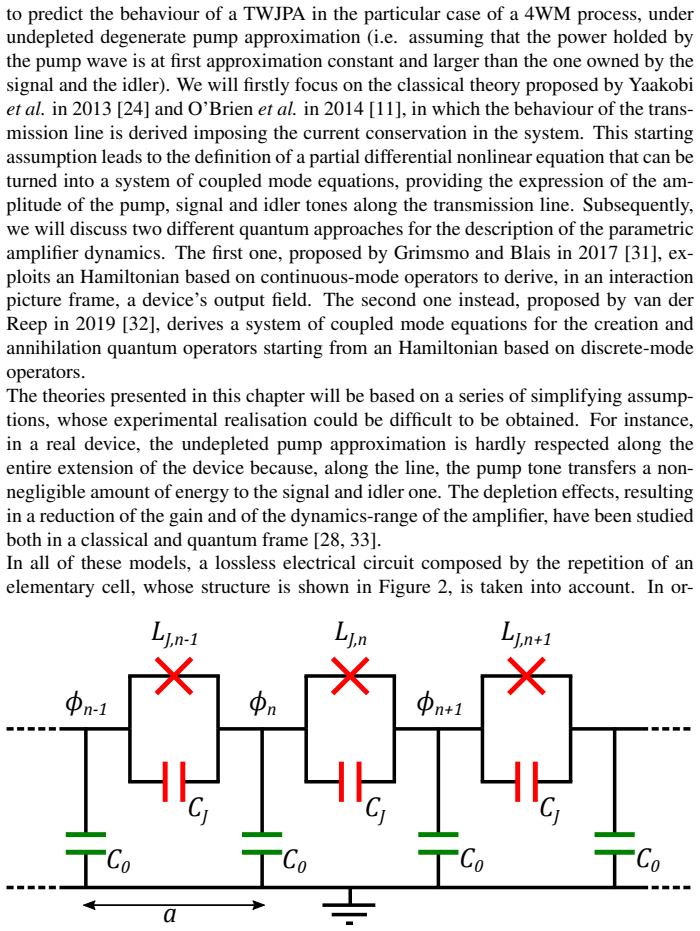
- domain assumption Lossless transmission line with identical Josephson junctions and coupling capacitances.
- domain assumption Continuous limit a/λ << 1 replacing discrete indices with a continuous position.
- domain assumption Undepleted degenerate classical pump, |Ap| >> |As,i|.
- domain assumption Slowly varying envelope approximation |∂²A/∂x²| << k|∂A/∂x| << k²|A|.
- domain assumption First-order weak nonlinear expansion of the Josephson energy keeping only the quartic term.
- domain assumption For quantum models, quantization via continuous- or discrete-mode operators and a classical treatment of the pump.
Cite this review
Pith. "Pith review of Superconducting Josephson-based metamaterials for quantum-limited parametric amplification: a review." pith.science (2026). https://pith.science/paper/XVOFYSX5
@misc{pith2026190806889,
  author       = {Pith},
  title        = {Pith review of: Superconducting Josephson-based metamaterials for quantum-limited parametric amplification: a review},
  year         = {2026},
  howpublished = {\url{https://pith.science/paper/XVOFYSX5}},
  note         = {Machine review of arXiv:1908.06889}
}
read the original abstract
In the last few years, several groups have proposed and developed their own platforms demonstrating quantum-limited linear parametric amplification, with evident applications in quantum information and computation, electrical and optical metrology, radio astronomy and basic physics concerning axion detection. Here we propose a short review on the physics behind parametric amplification via metamaterials composed by coplanar wave-guides embedding several Josephson junctions. We present and compare different schemes that exploit the nonlinearity of the Josephson current-phase relation to mix the so-called signal, idler and pump tones. The chapter then presents and compares three different theoretical models, developed in the last few years, to predict the dynamics of these nonlinear systems in the particular case of a 4-Wave Mixing process and under the degenerate undepleted pump assumption. We will demonstrate that, under the same assumption, all the results are comparable in terms of amplification of the output fields.
Figures


Reference graph
Works this paper leans on
-
[1]
Superconducting Circuits for Quantum Information: An Outlook
Devoret MH, Schoelkopf RJ. Superconducting Circuits for Quantum Information: An Outlook. Science 2013:339,1169. DOI: 10.1126/science.1231930
-
[2]
Possible new Effects in Superconductive Tunneling
Josephson BD. Possible new Effects in Superconductive Tunneling. Physics Let- ters. 1962;1,7:251-253. DOI: 10.1016/0031-9163(62)91369-0
-
[3]
Circuit quantum electrodynamics in the ultrastrong-coupling regime
Niemczyk T, et al. Circuit quantum electrodynamics in the ultrastrong-coupling regime. Nat. Phys. 2010:6,772776. DOI: 10.1038/NPHYS1730
-
[4]
Fine Structure of the Hydrogen Atom by a Mi- crowave Method
Lamb WE, and Retherford RC. Fine Structure of the Hydrogen Atom by a Mi- crowave Method. Phys. Rev. 1947:72,241. DOI: 10.1103/PhysRev.72.241
-
[5]
Resolving Vacuum Fluctuations in an Electrical Circuit by Measuring the Lamb Shift
Fragner A, Goppl M, Fink JM, Baur M, Bianchetti R, Leek PJ, Blais A, and Wallraff A. Resolving Vacuum Fluctuations in an Electrical Circuit by Measuring the Lamb Shift. Science 2008:322, 1357. DOI: 10.1126/science.1164482
-
[6]
Quantum theory of the electromagnetic field in a variable-length one- dimensional cavity
Moore GT. Quantum theory of the electromagnetic field in a variable-length one- dimensional cavity. J. Math. Phys. 1970:11,2679. DOI: 10.1063/1.1665432 17
-
[7]
Radiation from a Moving Mirror in Two Dimen- sional Space-Time: Conformal Anomaly
Fulling SA, Davies PCW. Radiation from a Moving Mirror in Two Dimen- sional Space-Time: Conformal Anomaly. Proc. R. Soc. A 1976:348,393. DOI: 10.1098/rspa.1976.0045
arXiv 1976
-
[8]
Observation of the dynamical casimir effect in a superconducting circuit
Wilson C, et al. Observation of the dynamical casimir effect in a superconducting circuit. Nature 2011:479,376379. DOI: 10.1038/nature10561
Show all 35 references
-
[9]
Subm, planarized, NbAlOxNb Josephson process for 125 mm wafers developed in partnership with Si technology
Ketchen MB, et al. Subm, planarized, NbAlOxNb Josephson process for 125 mm wafers developed in partnership with Si technology. Appl. Phys. Lett. 1991;59,2609. DOI: 10.1063/1.106405
1991 doi
-
[10]
White TC, et. al. Traveling wave parametric amplifier with Josephson junctions using minimal resonator phase matching. Appl. Phys. Lett. 2015;106,242601. DOI: 10.1063/1.4922348
2015 doi
-
[11]
Resonant Phase Matching of Josephson Junction Traveling Wave Parametric Amplifiers
O’Brien K, Macklin C, Siddiqi I, Zhang X. Resonant Phase Matching of Josephson Junction Traveling Wave Parametric Amplifiers. Phys. Rev. Lett. 2014;113,157001. DOI: 10.1103/PhysRevLett.113.157001
2014 doi
-
[12]
Theory of the Travelling-Wave Parametric Amplifier
Cullen AL. Theory of the Travelling-Wave Parametric Amplifier. In: Proceed- ing of the IEE - Part B: Electronic and Communication Engineering; Aug. 1959;32,107, p. 101-107. DOI: 10.1049/pi-b-2.1960.0085
1959
-
[13]
A travelling-wave parametric amplifier utilizing Joseph- son junctions
Sweeny M, Mahler R. A travelling-wave parametric amplifier utilizing Joseph- son junctions. IEEE Transactions on Magnetics. 1985;21,2:654-655. DOI: 10.1109/TMAG.1985.1063777
1985
-
[14]
A nearquantum-limited Josephson traveling-wave parametric am- plifier
Macklin C, OBrien K, Hover D, Schwartz ME, Bolkhovsky V , Zhang X, Oliver WD, Siddiqi I. A nearquantum-limited Josephson traveling-wave parametric am- plifier. Science. 2015;350,6258:307-310. DOI: 10.1126/science.aaa8525
2015 doi
-
[15]
Quantum Optics, 2nd ed
Walls DF, and Milburn GJ. Quantum Optics, 2nd ed. (Springer, Berlin, 2008)
2008
-
[16]
Can Quantum- Mechanical Description of Physical Reality Be Considered Complete? Phys
Einstein A, Podolsky B, and Rosen N. Can Quantum- Mechanical Description of Physical Reality Be Considered Complete? Phys. Rev. 1935:47,777. DOI: 10.1103/PhysRev.47.777
1935 doi
-
[18]
Parametric resonance in a linear oscillator at square-wave mod- ulation
Eugene I Butikov. Parametric resonance in a linear oscillator at square-wave mod- ulation. Eur. J. Phys. 26 (2005) 157174, DOI:10.1088/0143-0807/26/1/016
2005 doi
-
[19]
Investigation of an Experimental Travelling-Wave Para- metric Amplifier
Mavaddat R, Hyde FJ. Investigation of an Experimental Travelling-Wave Para- metric Amplifier. Proceedings of the IEE Part B: Electronic and Communication Engineering; Sept. 1962; 109,(47):405 DOI: 10.1049/pi-b-2.1962.0225
1962
-
[20]
A lownoise seriesarray Josephson junction parametric amplifier
Yurke B, Roukes ML, Movshovich R, Pargellis AN. A lownoise seriesarray Josephson junction parametric amplifier. Appl. Phys. Lett. 1996;69,3078. DOI: 10.1063/1.116845 18
1996 doi
-
[22]
Fluxon dynamics in discrete Josephson transmission lines with stacked junctions
Caputo P, Darula M, Ustinov A V , and Kohlstedt H. Fluxon dynamics in discrete Josephson transmission lines with stacked junctions. J. Appl. Phys. 1997;81,309 DOI: 10.1063/1.364110
1997 doi
-
[23]
Analysis of Series-Connected Dis- crete Josephson Transmission Line
Hamid Reza Mohebbi, Hamed Majedi A. Analysis of Series-Connected Dis- crete Josephson Transmission Line. IEEE Transactions on Microwave Theory and Techniques. 2009;57,8. DOI: 10.1109/TMTT.2009.2025413
2009
-
[24]
Parametric amplification in Joseph- son junction embedded transmission lines
Yaakobi O, Friedland L, Macklin C, Siddiqi I. Parametric amplification in Joseph- son junction embedded transmission lines. Phys. Rev. B. 2013;87,144301. DOI: 10.1103/PhysRevB.87.144301
2013 doi
-
[25]
Design of a Uniplanar Resonance Phase-Matched Josephson Travelling-Wave Parametric Amplifier
Tan BK, Yassin G. Design of a Uniplanar Resonance Phase-Matched Josephson Travelling-Wave Parametric Amplifier. In: 10th UK-Europe-China Workshop on Millimetre Waves and Terahertz Technologies (UCMMT); 11-13 Sept. 2017; Liv- erpool. New York: IEEE; 2017. p. 1-4
2017
-
[26]
Traveling-Wave Parametric Amplifier Based on a Chain of Coupled Asymmetric SQUIDs
Bell MT, Samolov A. Traveling-Wave Parametric Amplifier Based on a Chain of Coupled Asymmetric SQUIDs. Phys. Rev. Appl. 2015;4,024014. DOI: 10.1103/PhysRevApplied.4.024014
2015 doi
-
[27]
Josephson Metamaterial with a Widely Tunable Positive or Negative Kerr Constant
Wenyuan Zhang, Huang W, Gershenson ME, Bell MT. Josephson Metamaterial with a Widely Tunable Positive or Negative Kerr Constant. Phys. Rev. Appl. 2017;8,051001 DOI: 10.1103/PhysRevApplied.8.051001
2017 doi
-
[28]
Josephson Traveling-Wave Parametric Amplifier with Three- Wave Mixing
Zorin AB. Josephson Traveling-Wave Parametric Amplifier with Three- Wave Mixing. Phys. Rev. Appl. 2016;6,034006 DOI: 10.1103/PhysRevAp- plied.6.034006
2016 doi
-
[29]
Traveling-Wave Parametric Ampli- fier Based on Three-Wave Mixing in a Josephson Metamaterial
Zorin AB, Khabipov M, Dietel J, Dolata R. Traveling-Wave Parametric Ampli- fier Based on Three-Wave Mixing in a Josephson Metamaterial. In: 2017 16th International Superconductive Electronics Conference (ISEC); 12-16 June 2017; Naples. New Yourk: IEEE; 2017. p. 1-3
2017
-
[30]
Symmetric Traveling Wave Parametric Am- plifier
Miano A, Mukhanov OA. Symmetric Traveling Wave Parametric Am- plifier. IEEE Transactions on Applied Superconductivity. 2019;29,5. DOI: 10.1109/TASC.2019.2904699
2019
-
[31]
Squeezing and quantum state engineering with Joseph- son travelling wave amplifiers
Grimsmo AL, Blais A. Squeezing and quantum state engineering with Joseph- son travelling wave amplifiers. npj Quantum Information. 2017;3,20. DOI: 10.1038/s41534-017-0020-8
2017 doi
-
[32]
Mesoscopic Hamiltonian for Josephson traveling-wave parametric amplifiers
van der Reep THA. Mesoscopic Hamiltonian for Josephson traveling-wave parametric amplifiers. Phys. Rev. A. 2019;99,063838. DOI: 10.1103/Phys- RevA.99.063838 19
2019 doi
-
[33]
Quantum-limited parametric amplification with Josephson circuits in the regime of pump depletion Ananda Roy and Michel Devoret Phys. Rev. B 98, 045405 Published 5 July 2018 DOI: 10.1103/PhysRevB.98.045405
2018 doi
-
[34]
The Quantum Theory of Light, 3rd ed
Loudon R. The Quantum Theory of Light, 3rd ed. (Oxford University Press, Ox- ford, UK, 2000)
2000
-
[35]
Introduction to quantum electromagnetic circuits
V ool U, Devoret M. Introduction to quantum electromagnetic circuits. In- ternational Journal of Circuit Theory and Applications. 2017;45,897. DOI: 10.1002/cta.2359
2017 doi
-
[36]
Electromagnetic-field quantization in inhomogeneous and dispersive one-dimensional systems
Santos DJ, Loudon R. Electromagnetic-field quantization in inhomogeneous and dispersive one-dimensional systems. Phys. Rev. A. 1995;52,1538. DOI: 10.1103/PhysRevA.52.1538
1995 doi
-
[37]
Microwave Engineering, 4th ed
Pozar DM. Microwave Engineering, 4th ed. (Wiley, Hoboken, NJ, 2012) 20
2012
Reviewed August 14, 2026 · model on record in the stance chip above.
Discussion (0). Continue with ORCID to comment.