REVIEW 3 major objections 4 minor 42 references
Why Bonds Fail Differently? Explainable Multimodal Learning for Multi-Class Default Prediction
T0 review · 3 major / 4 minor · reviewed 2026-08-04 · deepseek-v4-flash
Pith's one-line read EMDLOT, a multimodal deep-learning framework, sets out to make three-class bond default prediction both more accurate and intrinsically interpretable, and reports higher recall, F1, and mAP than LSTM and XGBoost on Chinese bond data.
desk verdict Genuinely new application of prospectus text to three-class bond default prediction, but the evaluation is too fragile to support the claimed performance gains. read the letter →
The pith
A machine-rendered reading of the paper's core claim, the machinery that carries it, and where it could break.
The reading
What carries the argument
The central mechanism is the Time-Aware LSTM, whose decay gate down-weights the previous memory cell by a learnable function of the elapsed time between disclosures, letting the model treat delayed or missing quarterly reports appropriately instead of assuming fixed intervals. Around it sit three components that carry both accuracy and interpretability: soft clustering, which mixes cluster-specific classifiers so different firm subgroups can follow different default pathways; multi-level attention over prospectus chapters, numerical features, and modalities, which supplies the claimed transparency; and a composite loss combining cross-entropy with cluster-distribution and cluster-separation
What would settle it
Reproduce the comparison on the same data with a fixed, pre-registered test split and report macro-recall and F1 over all runs, including runs that fail to predict all three classes; if EMDLOT's advantage over LSTM shrinks below one standard deviation or reverses, the central performance claim fails. A second check: the paper's ablation claims imply removing prospectus text should lower recall by roughly twelve percentage points, so a matched text-free model with identical hyperparameters should show a comparable drop for that explanation to remain credible.
Extended reading notes
Core claim
EMDLOT is an architecture that handles irregularly spaced quarterly financial and macroeconomic observations with a Time-Aware LSTM that decays old memory states according to elapsed time. It fuses those numerical signals with embeddings of two prospectus chapters—Risk Factor and Important Notice—then passes the fused representation through a probabilistic soft-clustering module in which each cluster has its own prediction head, producing the final three-class prediction as a weighted mixture. Multi-level attention at chapter, feature, and modality level makes the decision inspectable. On 1,994 Chinese bond issuers from 2015–2024, with 38 default-related events and SMOTE-balanced training, t
Load-bearing premise
The load-bearing premise is that the evaluation protocol is statistically valid: with only a handful of extended and defaulted firms in the 20% holdout, and with averages computed only over runs that predict all three classes, the claimed 8-to-17-point advantages over LSTM and XGBoost are credible only if this protocol is unbiased and sufficiently powered.
Editorial extensions
If this is right
- If the reported results hold, bond default prediction should be evaluated as a three-class problem rather than a binary one, because 'extended' is a distinct early-warning state that calls for different intervention than full default.
- The ablation evidence implies bond prospectuses—legally required pre-issuance risk disclosures—are a materially valuable text input for default models, not a marginal supplement to financial ratios.
- The attention analysis implies default pathways are heterogeneous: some firms fail from liquidity shocks near repayment, while others deteriorate through sustained leverage; a single rule-based risk model would miss this diversity.
- Because the model's interpretability is intrinsic rather than post hoc, its attention weights and cluster assignments can be audited directly, which matters for regulatory acceptance of deep credit-risk models.
- The high recall on minority classes, if reproducible, would support deploying EMDLOT-style models as screening tools that flag firms for closer human review rather than as final automated decisions.
Reading between the lines
- My inference: the strongest test of these claims would be temporal walk-forward validation—fit on quarters through t and test on t+1 to t+4—which the paper does not report and which would show whether the recall advantage persists in the actual forecasting use case.
- My inference: the interpretability claims could be tested behaviorally, by checking whether human analysts who see the attention-highlighted indicators make better default predictions than analysts who see only the raw data.
- My inference: the architecture is generic enough that its components—time-decay encoding, soft clustered experts, and multi-level attention—could transfer to other rare-event financial tasks, such as delisting prediction, stablecoin run detection, or greenwashing flags, where the positive class is tiny and explanations are required.
- My inference: the performance edge should be read with caution because the holdout contains only about five extended and three defaulted issuers, so macro-averaged recall and F1 gaps are noisy; the paper's run-selection rule, which keeps only runs that predict all three classes, may further inflate reported averages.
Editorial analysis
A structured set of objections, weighed in public.
Referee Report
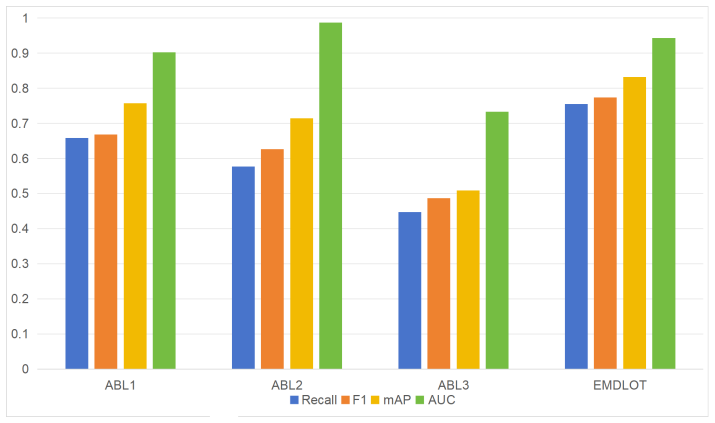
Summary. The paper proposes EMDLOT, a multimodal deep learning framework for three-class bond default prediction on 1994 Chinese bond issuers (2015–2024). It combines a Time-Aware LSTM on 32 financial and 36 macroeconomic indicators with BERT embeddings of two bond prospectus sections, adds soft clustering, multi-level attention, and a composite loss. The authors report that EMDLOT attains Recall 0.7547, F1 0.7734, mAP 0.8323, and AUC 0.9435, outperforming XGBoost and LSTM, and use attention weights and cluster analyses to claim interpretable default drivers. The main contributions are the multi-class formulation, prospectus-based textual modality, and intrinsic interpretability.
Significance. If the empirical claims held, the paper would make a useful contribution to credit-risk modeling, especially the three-class 'extended vs defaulted' distinction and the use of legally mandated prospectus text. The architecture is thoughtfully assembled, and the ablation study is a reasonable first check. However, the central performance claim is not supported by the evidence as reported: the test set contains only about 5 Extended and 3 Defaulted firms, the evaluation protocol discards runs that do not predict all three classes, and the hyperparameter objective already contains the evaluation metrics. The reported gains are the same order of magnitude as the swing caused by one minority example. The interpretability findings are also post-hoc descriptions of attention weights rather than validated explanations. Because the main claims rest on this evaluation, the manuscript in its current form does not meet the standard for publication.
major comments (3)
- [§5.2 and Table 6] The superiority claim is statistically moot. Table 4 implies the 20% holdout contains approximately 399 firms, with about 5 Extended and 3 Defaulted (24-19=5 and 14-11=3). Macro-averaged recall on this test set changes by 0.2/3 ≈ 0.067 per additional correctly caught Extended firm and by 0.1/3 ≈ 0.111 per Defaulted firm. The headline Recall lead over LSTM (0.7547 vs 0.6703, Δ=0.0844) is smaller than the effect of one minority example. In addition, Section 5.2 accepts a run only if the model 'successfully predicts all three categories,' which removes high-variance, worst-case outcomes and biases every reported mean upward. No confidence intervals, bootstrap estimates, or per-class confusion matrices are supplied, so there is no way to tell whether EMDLOT's 8–17 percentage-point advantages are distinguishable from noise.
- [Appendix C, Eqs. (C.1)–(C.3)] The Optuna objective is itself a weighted average of Recall, F1, AUC, and mAP, with a penalty when the number of predicted classes is not three. Thus the evaluation metrics are used both for model selection and for run filtering. This makes the final numbers selection-biased; they are not a clean estimate of out-of-sample performance. The hyperparameter space also has many free parameters (hidden size, learning rate, dropout, weight decay, cluster count, two loss weights, three temperatures, SMOTE/PCA choices), and no sensitivity analysis is reported.
- [§5.3.3] The interpretability conclusions are post-hoc. Attention weights of the fitted model on the same data are described as evidence that 'defaults often stem from liquidity shocks' or that 'GDP are negatively associated with default rates.' No held-out validation, no comparison to external benchmarks, and no statistical test of association are provided. Attention does not estimate a marginal effect or causal direction, so these statements are descriptive pattern summaries rather than validated explanations. Since intrinsic interpretability is a core contribution, these claims need out-of-sample or quasi-experimental support.
minor comments (4)
- [Table 7] The XGBoost row appears garbled ('4 5 5' followed by '13.8'), making the ranking comparison hard to read. Please reformat and double-check the AUC rank and average rank entries.
- [§5.2] The statement that SVM was excluded after 'numerous experiments' should be quantified. How many runs were attempted, and what fractions of runs were discarded as invalid for each model? This would help readers assess the severity of the run-filtering bias.
- [§5.3.2] Ablation results are reported as means with standard deviations, but no significance tests are given. Given the small test set and overlapping standard deviations, the authors should state whether the ablations differ from EMDLOT at any conventional significance level.
- [§4] The paper uses PCA on text embeddings and reports a cumulative explained variance ratio of 0.7678, but does not state the sensitivity of the downstream results to the number of retained components. A one-line robustness check would be useful.
Circularity Check
No significant circularity: the central performance and ablation claims are empirical comparisons on a held-out test split, and the attention/clustering interpretations are post-hoc descriptions rather than inputs that predetermine the conclusions.
full rationale
The paper's main claim—EMDLOT outperforms benchmarks in Recall/F1/mAP—is an empirical result obtained by training on an 80% split and testing on a disjoint 20% split with identical metrics applied to all models; it does not reduce to the model's inputs or to a fitted parameter renamed as a prediction. The architecture components (T-LSTM, soft clustering, multi-level attention) are standard externally cited modules, and the ablations directly measure the effect of removing them, which is not circular. The interpretability section reports attention weights learned on the same data and describes them in economic terms; while this is post-hoc and not externally validated, it is a description of the fitted model rather than a derivation whose conclusion is equivalent to its input by construction. Concerns about the tiny minority-class test counts (~5 extended, ~3 defaulted), the run-filtering rule, and the metric-aware Optuna objective are threats to statistical validity and generalizability, not to circularity in the derivation chain. No load-bearing self-citation or imported uniqueness theorem is present. Therefore no specific circular step can be exhibited.
Assumptions & free parameters
free parameters (8)
- hidden_size =
512
- learning_rate =
0.0006175651418191845
- dropout =
0.3
- weight_decay =
1.0162398945608497e-06
- num_clusters =
8
- cluster_loss_weight / dist_loss_weight =
0.004 / 0.035
- attention temperatures =
modal 2.6, numeric 0.9, text 0.55
- SMOTE balance ratio / PCA dimension =
1:1:1 balance; PCA 80 dims (76.78% variance)
assumptions (5)
- domain assumption Quarterly financial and macroeconomic indicators (32 + 36 series) from Wind for 2015-2024 capture the information needed to distinguish Performing, Extended, and Defaulted firms.
- domain assumption Bond prospectus 'Important Notice' and 'Risk Factor' sections, after LLM extraction and BERT embedding, contain predictive default signals.
- domain assumption Time-Aware LSTM decays outdated memory appropriately for irregular quarterly observations.
- domain assumption Attention weights are faithful explanations of prediction drivers.
- domain assumption The labels Extended vs Defaulted form a meaningful ordered multi-class target.
Cite this review
Pith. "Pith review of Why Bonds Fail Differently? Explainable Multimodal Learning for Multi-Class Default Prediction." pith.science (2026). https://pith.science/paper/XVRKFTU6
@misc{pith2026250910802,
  author       = {Pith},
  title        = {Pith review of: Why Bonds Fail Differently? Explainable Multimodal Learning for Multi-Class Default Prediction},
  year         = {2026},
  howpublished = {\url{https://pith.science/paper/XVRKFTU6}},
  note         = {Machine review of arXiv:2509.10802}
}
read the original abstract
In recent years, China's bond market has seen a surge in defaults amid regulatory reforms and macroeconomic volatility. Traditional machine learning models struggle to capture financial data's irregularity and temporal dependencies, while most deep learning models lack interpretability-critical for financial decision-making. To tackle these issues, we propose EMDLOT (Explainable Multimodal Deep Learning for Time-series), a novel framework for multi-class bond default prediction. EMDLOT integrates numerical time-series (financial/macroeconomic indicators) and unstructured textual data (bond prospectuses), uses Time-Aware LSTM to handle irregular sequences, and adopts soft clustering and multi-level attention to boost interpretability. Experiments on 1994 Chinese firms (2015-2024) show EMDLOT outperforms traditional (e.g., XGBoost) and deep learning (e.g., LSTM) benchmarks in recall, F1-score, and mAP, especially in identifying default/extended firms. Ablation studies validate each component's value, and attention analyses reveal economically intuitive default drivers. This work provides a practical tool and a trustworthy framework for transparent financial risk modeling.
Figures


Figures from the paper (6 more)




Reference graph
Works this paper leans on
-
[1]
(2022), Learning of cluster-based feature importance for electronic health record time-series , International Conference on Machine Learning, PMLR, pages 161--179
Aguiar, H., Santos, M., et al. (2022), Learning of cluster-based feature importance for electronic health record time-series , International Conference on Machine Learning, PMLR, pages 161--179
2022
-
[2]
(1968), Financial ratios, discriminant analysis and the prediction of corporate bankruptcy , Journal of Finance, 23(4), 589--609
Altman, E.I. (1968), Financial ratios, discriminant analysis and the prediction of corporate bankruptcy , Journal of Finance, 23(4), 589--609
1968
-
[3]
(2022), Has the Evergrande debt crisis rattled Chinese capital markets? A series of event studies and their implications , Finance Research Letters, 50, 103247
Altman, E.I., Hu, X., et al. (2022), Has the Evergrande debt crisis rattled Chinese capital markets? A series of event studies and their implications , Finance Research Letters, 50, 103247
2022
-
[4]
(2023), Does foreign competition affect corporate debt maturity structure? Evidence from import penetration , International Review of Financial Analysis, 86, 102539
Atawnah, N., Zaman, R., et al. (2023), Does foreign competition affect corporate debt maturity structure? Evidence from import penetration , International Review of Financial Analysis, 86, 102539
2023
-
[5]
(2023), Systematic default and return predictability in the stock and bond markets , Journal of Financial Economics, 149(3), 349--377
Bao, J., Hou, K., et al. (2023), Systematic default and return predictability in the stock and bond markets , Journal of Financial Economics, 149(3), 349--377
2023
-
[6]
(2017), Patient subtyping via time-aware LSTM networks , Proceedings of the 23rd ACM SIGKDD International Conference on Knowledge Discovery and Data Mining, pages 65--74
Baytas, I.M., Xiao, C., et al. (2017), Patient subtyping via time-aware LSTM networks , Proceedings of the 23rd ACM SIGKDD International Conference on Knowledge Discovery and Data Mining, pages 65--74
2017
-
[7]
(2024), Predicting financial distress using multimodal data: An attentive and regularized deep learning method , Information Processing & Management, 61(4), 103703
Che, W., Wang, Z., et al. (2024), Predicting financial distress using multimodal data: An attentive and regularized deep learning method , Information Processing & Management, 61(4), 103703
2024
-
[8]
(2025), US Treasury market default risk and global interbank liquidity risk , Borsa Istanbul Review, 25(1), 66--78
Cottrell, S., Lei, J., et al. (2025), US Treasury market default risk and global interbank liquidity risk , Borsa Istanbul Review, 25(1), 66--78
2025
Show all 42 references
-
[9]
(2025), Bond defaults in China: Using machine learning to make predictions , International Review of Finance, 25(1), e70010
Cui, B., Ge, L., et al. (2025), Bond defaults in China: Using machine learning to make predictions , International Review of Finance, 25(1), e70010
2025
-
[10]
(2025), Deep learning for economists , Journal of Economic Literature, 63(1), 5--58
Dell, M. (2025), Deep learning for economists , Journal of Economic Literature, 63(1), 5--58
2025
-
[11]
Devlin, J., Chang, M.W., et al. (2019), Bert: Pre-training of deep bidirectional transformers for language understanding , Proceedings of the 2019 Conference of the North American Chapter of the Association for Computational Linguistics: Human Language Technologies, volume 1, ...
2019
-
[12]
(2012), Multiperiod corporate default prediction—A forward intensity approach , Journal of Econometrics, 170(1), 191--209
Duan, J.C., Sun, J., et al. (2012), Multiperiod corporate default prediction—A forward intensity approach , Journal of Econometrics, 170(1), 191--209
2012
-
[13]
(2023), Prediction of corporate credit ratings with machine learning: Simple interpretative models , Finance Research Letters, 58, 104648
Galil, K., Hauptman, A., et al. (2023), Prediction of corporate credit ratings with machine learning: Simple interpretative models , Finance Research Letters, 58, 104648
2023
-
[14]
(2011), Corporate bond default risk: A 150-year perspective , Journal of Financial Economics, 102(2), 233--250
Giesecke, K., Longstaff, F.A., et al. (2011), Corporate bond default risk: A 150-year perspective , Journal of Financial Economics, 102(2), 233--250
2011
-
[15]
(2024), Analyzing credit spread changes using explainable artificial intelligence , International Review of Financial Analysis, 94, 103315
Heger, J., Min, A., et al. (2024), Analyzing credit spread changes using explainable artificial intelligence , International Review of Financial Analysis, 94, 103315
2024
-
[16]
and Stitz, L
Kriebel, J. and Stitz, L. (2022), Credit default prediction from user-generated text in peer-to-peer lending using deep learning , European Journal of Operational Research, 302(1), 309--323
2022
-
[17]
(2023), Does prospectus readability matter for bond issuance pricing? Evidence from China , Pacific-Basin Finance Journal, 80, 102074
Li, F., Yang, M., et al. (2023), Does prospectus readability matter for bond issuance pricing? Evidence from China , Pacific-Basin Finance Journal, 80, 102074
2023
-
[18]
(2024), Corporate bond default prediction using bilateral topic information of credit rating reports , International Journal of Financial Engineering, 11(03), 2443002
Lu, W., Chen, B., et al. (2024), Corporate bond default prediction using bilateral topic information of credit rating reports , International Journal of Financial Engineering, 11(03), 2443002
2024
-
[19]
(2019), Deep learning models for bankruptcy prediction using textual disclosures , European journal of operational research, 274(2), 743--758
Mai, F., Tian, S., et al. (2019), Deep learning models for bankruptcy prediction using textual disclosures , European journal of operational research, 274(2), 743--758
2019
-
[20]
(2024), A novel URP-CNN model for bond credit risk evaluation of Chinese listed companies , Expert Systems with Applications, 255, 124861
Meng, B., Sun, J., et al. (2024), A novel URP-CNN model for bond credit risk evaluation of Chinese listed companies , Expert Systems with Applications, 255, 124861
2024
-
[21]
(2021), China's no-bailout reform: Impact on bond yields and rating standards , Journal of Banking & Finance, 133, 106282
Mo, G., Gao, Z., et al. (2021), China's no-bailout reform: Impact on bond yields and rating standards , Journal of Banking & Finance, 133, 106282
2021
-
[22]
and Nasim, N.B
Mohsin, M.T. and Nasim, N.B. (2025), Explaining the unexplainable: A systematic review of explainable AI in finance , arXiv preprint arXiv:2503.05966
2025
-
[23]
and Fabozzi, F.J
Nazemi, A. and Fabozzi, F.J. (2024), Interpretable machine learning for creditor recovery rates , Journal of Banking & Finance, 164, 107187
2024
-
[24]
(2023), Optimal GDP-indexed bonds , Review of Economic Dynamics, 51, 747--777
\"O nder, Y.K. (2023), Optimal GDP-indexed bonds , Review of Economic Dynamics, 51, 747--777
2023
-
[25]
(2025), Explainable natural language processing for corporate sustainability analysis , Information Fusion, 115, 102726
Ong, K., Mao, R., et al. (2025), Explainable natural language processing for corporate sustainability analysis , Information Fusion, 115, 102726
2025
-
[26]
(2025), Forecasting China bond default with severe class-imbalanced data: A simple learning model with causal inference , Economic Modelling, 144, 106985
Peng, M., Stern, E.R., et al. (2025), Forecasting China bond default with severe class-imbalanced data: A simple learning model with causal inference , Economic Modelling, 144, 106985
2025
-
[27]
(2023), Study on intelligent forecasting of credit bond default risk , arXiv preprint arXiv:2305.12142
Ren, K. (2023), Study on intelligent forecasting of credit bond default risk , arXiv preprint arXiv:2305.12142
2023 arXiv
-
[28]
and Olafsson, S
Segal, M. and Olafsson, S. (2023), Overview of an alternative trigger for DCL , Finance Research Letters, 58, 104281
2023
-
[29]
(2021), The value of text for small business default prediction: A deep learning approach , European Journal of Operational Research, 295(2), 758--771
Stevenson, M., Mues, C., et al. (2021), The value of text for small business default prediction: A deep learning approach , European Journal of Operational Research, 295(2), 758--771
2021
-
[30]
(2023), A survey of sentiment analysis: Approaches, datasets, and future research , Applied Sciences, 13(7), 4550
Tan, K.L., Lee, C.P., et al. (2023), A survey of sentiment analysis: Approaches, datasets, and future research , Applied Sciences, 13(7), 4550
2023
-
[31]
(2024 a ), Predicting systemic financial risk with interpretable machine learning , The North American Journal of Economics and Finance, 71, 102088
Tang, P., Tang, T., et al. (2024 a ), Predicting systemic financial risk with interpretable machine learning , The North American Journal of Economics and Finance, 71, 102088
2024
-
[32]
(2024 b ), Unlocking the power of the topic content in news headlines: BERTopic for predicting Chinese corporate bond defaults , Finance Research Letters, 62, 105062
Tang, W., Bu, H., et al. (2024 b ), Unlocking the power of the topic content in news headlines: BERTopic for predicting Chinese corporate bond defaults , Finance Research Letters, 62, 105062
2024
-
[33]
and Shater, A
Tatsat, H. and Shater, A. (2025), Beyond the black box: Interpretability of LLMs in finance , arXiv preprint arXiv:2505.24650
2025 arXiv
-
[34]
(2025), Multi-modal deep learning for credit rating prediction using text and numerical data streams , Applied Soft Computing, 171, 112771
Tavakoli, M., Chandra, R., et al. (2025), Multi-modal deep learning for credit rating prediction using text and numerical data streams , Applied Soft Computing, 171, 112771
2025
-
[35]
(2017), Attention is all you need , Advances in Neural Information Processing Systems, Curran Associates, Inc., volume 30, pages 5998--6008
Vaswani, A., Shazeer, N., et al. (2017), Attention is all you need , Advances in Neural Information Processing Systems, Curran Associates, Inc., volume 30, pages 5998--6008
2017
-
[36]
and Ma, X
Wang, Z. and Ma, X. (2023), Financial mismatch on corporate debt default risk: Evidence from China , Pacific-Basin Finance Journal, 80, 102077
2023
-
[37]
(2025), Measuring cross-modal interactions in multimodal models , Proceedings of the AAAI Conference on Artificial Intelligence, volume 39, pages 21501--21509
Wenderoth, L., Hemker, K., et al. (2025), Measuring cross-modal interactions in multimodal models , Proceedings of the AAAI Conference on Artificial Intelligence, volume 39, pages 21501--21509
2025
-
[38]
(2024), The impact of readability of risk disclosures in bond prospectuses on credit risk premium , Research in International Business and Finance, 70, 102310
Yao, Y., Wei, L., et al. (2024), The impact of readability of risk disclosures in bond prospectuses on credit risk premium , Research in International Business and Finance, 70, 102310
2024
-
[39]
(2025), A method for evaluating the interpretability of machine learning models in predicting bond default risk based on LIME and SHAP , arXiv preprint arXiv:2502.19615
Zhang, Y., Chen, L., et al. (2025), A method for evaluating the interpretability of machine learning models in predicting bond default risk based on LIME and SHAP , arXiv preprint arXiv:2502.19615
2025 arXiv
-
[40]
and Wei, X
Zhou, Y. and Wei, X. (2023), Bond liquidity, debt maturity and bond risk premium , Finance Research Letters, 54, 103716
2023
-
[41]
, " * write output.state after.block = add.period write newline
ENTRY address author booktitle chapter edition editor eid howpublished institution journal key month note number organization pages publisher school series title type volume year label extra.label sort.label short.list INTEGERS output.state before.all mid.sentence after.senten...
-
[42]
write newline
" write newline "" before.all 'output.state := FUNCTION n.dashify 't := "" t empty not t #1 #1 substring "-" = t #1 #2 substring "--" = not "--" * t #2 global.max substring 't := t #1 #1 substring "-" = "-" * t #2 global.max substring 't := while if t #1 #1 substring * t #2 gl...
Reviewed August 4, 2026 · model on record in the stance chip above.
Discussion (0). Continue with ORCID to comment.