REVIEW 4 major objections 5 minor 39 references
Higher-Order Kuramoto Oscillator Network for Dense Associative Memory
T0 review · 4 major / 5 minor · reviewed 2026-08-06 · deepseek-v4-flash
Pith's one-line read A Kuramoto network with pairwise plus four-body Hebbian couplings stores phase patterns in numbers that grow faster than linearly with network size, with retrieval switching from continuous to discontinuous at K=3J.
desk verdict The clean mean-field analysis with a tricritical point at K=3J is solid, but the central superlinear capacity claim is unsupported by the paper's own finite-load theory and rests on weak numerical fits. read the letter →
The pith
A machine-rendered reading of the paper's core claim, the machinery that carries it, and where it could break.
The reading
What carries the argument
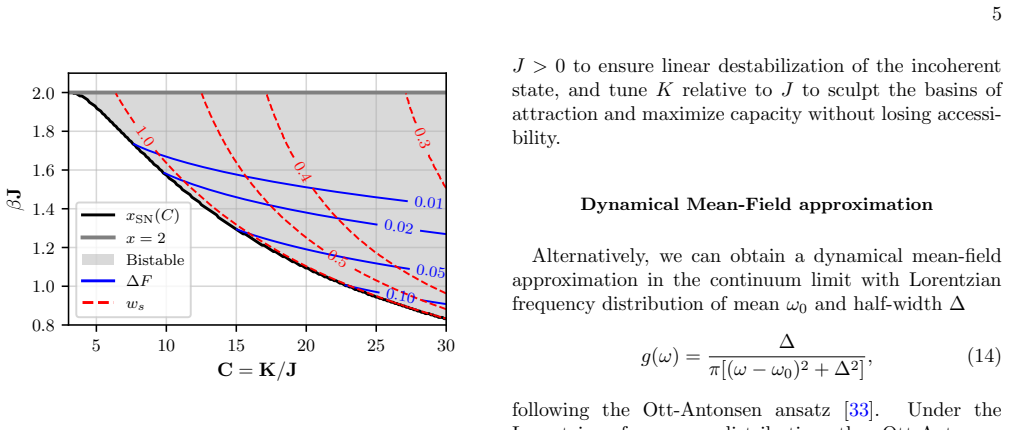
The central object is the $J$-$K$ Kuramoto model, $\dot{\theta}_i = \omega_i + \frac{J}{N}\sum_j J_{ij}\sin(\theta_j-\theta_i) + \frac{K}{6N^3}\sum_{j,k,\ell} K_{ijk\ell}\sin(\theta_j+\theta_k-\theta_\ell-\theta_i)$, with Hebbian couplings $J_{ij} = \frac{1}{P}\sum_{\mu=1}^{P} \xi_i^{\mu}\xi_j^{\mu}$ and $K_{ijk\ell} = \frac{1}{P}\sum_{\mu=1}^{P} \xi_i^{\mu}\xi_j^{\mu}\xi_k^{\mu}\xi_\ell^{\mu}$. The argument is carried by the static mean-field free energy and its Landau expansion, which locate the tricritical point $K=3J$; by the Ott-Antonsen reduction, which gives the closed-form order-parameter equation $\dot{r} = -\Delta r + \frac{J}{2}r(1-r^2) + \frac{K}{12}r^3(1-r^2)$; and by the hyper-Catalan series for the unstable branch, which makes the barrier height analytically computable through the bistable strip. The Kramers escape formula then converts the intensive barrier $\Delta F$ into the extensive retention time $\exp(\beta N \Delta F)$.
What would settle it
Run the paper's capacity protocol with explicit $1/P$ Hebbian couplings at fixed $\beta$, $J$, and $K$ for several $N$ and $P$, and compare the largest $P$ with retrieval rate at least 0.85 to the predicted $\alpha_c = 2(\beta J - 1)/K$; if the threshold deviates systematically or the empirical capacity exponent stays at $\approx 1$ for $K/J \gg 3$, the superlinear-capacity claim is refuted.
Extended reading notes
Core claim
The paper's central claim is that adding a quartic Hebbian interaction term to phase-oscillator dynamics turns a Kuramoto network into a dense associative memory. In the $J$-$K$ model, mean-field theory gives the free energy $F(r) = \frac{\beta J}{2} r^2 + \frac{\beta K}{8} r^4 - \ln I_0\!\left(\beta\left(Jr + \frac{K}{6} r^3\right)\right)$, whose Landau expansion has a tricritical point at $K = 3J$. For $K < 3J$ the incoherent-to-memory transition is a supercritical pitchfork; for $K > 3J$ it is first order, with a bistable strip between the saddle-node line and the spinodal $x = 2$ in which coherent memory and incoherent states coexist. Within this strip the Kramers escape time grows as $\exp(\beta N \Delta F)$ with $\Delta F \propto K r^4$, so retention is exponentially robust in system size. Extending the mean-field theory to finite pattern load and running large-scale simulations, the paper finds that the quartic-dominated model stores $P$ patterns growing superlinearly with $N$, empirically as $P \propto N^{1.3}$ to $N^{1.4}$ at finite temperature and $P \propto N^{2.18}$ for the purely quartic zero-temperature case, while pairwise and resonant second-harmonic models remain linear or $N/\log N$.
Load-bearing premise
The superlinear-capacity conclusion rests on the assumption that the $1/P$ factor in the Hebbian couplings can be absorbed into an effective temperature, so the couplings can be treated as $O(1)$ while the pattern load grows; if that rescaling is not valid, the finite-load free energy, the critical load $\alpha_c$, and the capacity scaling lose their foundation.
Editorial extensions
If this is right
- Networks with $K > 3J$ can be operated as latch-like memories: retrieval is triggered by a finite cue, and once locked, the memory state is protected by a barrier that grows with $N$.
- Tuning $K/J$ across the tricritical value 3 switches the same hardware between soft, continuous recall, suitable for graded pattern completion, and explosive, hysteretic recall, suitable for robust storage.
- The quartic channel suppresses thermal escape far more effectively than the pairwise model, whose barrier is $O(r^2)$; retention times can therefore be extended by orders of magnitude at fixed $N$.
- Finite-load mean-field theory gives the critical load $\alpha_c = 2(\beta J - 1)/K$, so at fixed $J$ the storable pattern count grows with quartic coupling, and simulations show superlinear capacity scaling for $K/J \gg 3$.
- Because the required fourth-order couplings are already available in photonic, polaritonic, and superconducting Kerr-parametric platforms, small-scale experimental tests of the predicted phase diagram are within reach.
Reading between the lines
- Inference: the measured finite-temperature capacity exponents ($\approx 1.3$--$1.4$) lie well below the dense-Hopfield bound $O(N^{p-1}) = O(N^3)$ for $p=4$, so noise and the retrieval protocol are the likely limiting factors; lowering temperature or raising $K/J$ should move the exponent upward, which is testable.
- Inference: a natural numerical test of the finite-load theory is to simulate Eq. (6) with explicit $1/P$ Hebbian couplings and compare the measured retrieval threshold with $\alpha_c = 2(\beta J - 1)/K$, separating genuine pattern interference from the effective-temperature rescaling.
- Inference: the asymptotic result that the saddle-node overlap approaches $r_{\mathrm{SN}} \approx 0.777$ as $K/J \to \infty$ means that even an arbitrarily strong quartic channel still requires a finite seed overlap near 0.78, so hardware designs must supply a minimum cue amplitude.
Editorial analysis
A structured set of objections, weighed in public.
Referee Report
Summary. The manuscript introduces a generalized Kuramoto model with combined pairwise (second-harmonic) and quartic (fourth-harmonic) Hebbian couplings, Eq. (6), and analyzes it as an associative memory. The authors derive an equilibrium mean-field free energy, a Landau expansion, and obtain a tricritical point at K = 3J: retrieval onset is continuous for K < 3J and discontinuous with hysteresis for K > 3J. They further construct the saddle-node line analytically, study Kramers escape times in the bistable region, and propose a finite-load mean-field theory with pattern interference. Numerical simulations with P = 1 confirm the continuous-to-discontinuous transition and hysteresis. The central further claim is that higher-order coupling gives superlinear scaling of memory capacity with system size, as supported by finite-load simulations in Figs. 6 and 7.
Significance. If substantiated, the model would be a significant advance for analog oscillator-based associative memories, connecting Kuramoto dynamics to dense Hopfield networks and suggesting a physically realizable device with polynomial-in-N pattern storage. The paper has clear strengths: the P = 1 mean-field analysis is self-contained and parameter-free, the tricritical point at K = 3J follows from the Landau coefficients, the saddle-node line and hyper-Catalan expansion provide explicit analytic control, and the P = 1 simulations reproduce the predicted bifurcation structure. However, the finite-load theory, which underpins the superlinear capacity claim, contains an internal scaling inconsistency, and the capacity measurements are not quantitatively supported. The central claim therefore remains unsubstantiated as written.
major comments (4)
- [Mean-Field Theory with Pattern Interference, Eq. (38)] Equation (38) is internally inconsistent. With α = P/N, the prefactor αN/P equals 1, so the printed expression reduces to σ² = (1/P)E[(Jr_μ + (K/6)r_μ³)²] ≈ J²/(PN) = J²/(αN). Thus, for fixed load α, the crosstalk variance vanishes as N → ∞, and it cannot produce the α-dependent flattening of the free energy shown in Fig. 3 or the α-dependent critical load in Eq. (41). If, instead, one follows the stated prescription and drops the explicit 1/P by rescaling the couplings by P, the noise variance must be rescaled in the same way; under neither reading does Eq. (41), αc = 2(βJ − 1)/K, follow from Eq. (39). Moreover, Eq. (41) predicts αc ∝ 1/K, which would mean larger K reduces the tolerable load, in tension with the numerical result that larger K increases capacity. The finite-load calculation must be rederived with a consistent scaling, or validated directly against simulations of the original unscaled equation (6).
- [Capacity Scaling, Figs. 6 and 7] The empirical capacity exponents in Figs. 6 and 7 do not substantiate the superlinear claim. The fits are performed over a small range of network sizes (approximately N = 20–60), with no error bars, no confidence intervals, and no sensitivity analysis for the retrieval thresholds χ ≥ 0.85 and χ ≥ 0.95. The initial overlap values are quoted as percentages ("0.95%" and "0.9%") and are not clearly defined. The analytic finite-load result, even taken at face value, gives Pmax = αcN, i.e., linear scaling in N, so there is no analytic basis for the fitted exponents N^1.29–N^2.18. The paper should either derive the capacity scaling from the mean-field theory or provide a statistically quantitative measurement of the scaling exponent, including threshold dependence and error bars.
- [Mean-Field Theory with Pattern Interference, text before Eq. (39)] The absorption of the 1/P factor into an effective temperature is an ad hoc modeling step, not a derivation: the text states "we absorb the 1/P scaling into the effective temperature... fix the effective temperature β and drop the explicit 1/P factor in the couplings" without justification. This replacement changes the dynamical system defined by Eq. (6), because the original couplings have strength 1/P while the rescaled theory uses O(1) couplings plus an effective noise. The validity of this replacement should be tested by comparing the free energy Eq. (39) or the finite-load simulations against simulations of the original unscaled dynamics at the same P and N. Without such a test, Eq. (39) and the resulting Eq. (41) are not connected to the actual model.
- [Fig. 5] The finite-load comparison in Fig. 5 is based on a single smoothed run with no error bars, yet the caption and text describe it as validating the noisy mean-field theory. This is insufficient for a quantitative claim, especially because the transition from the target pattern occurs well before the noiseless mean-field instability and the overlap with the leading-order prediction is not quantified. The authors should provide trial-averaged data and a quantitative measure of agreement, or temper the validation claim.
minor comments (5)
- [Kramer Escape Time section] "Kramer" should be "Kramers" throughout the manuscript, including the section heading and the text around Eq. (31).
- [Efficient Simulation, Eq. (43)] In Eq. (43), S^µ_− is written as equal to S^µ_+, but it should be the complex conjugate, S^µ_− = (S^µ_+)*, for the expression in Eq. (44) to be correct.
- [Figs. 6 and 7 captions] The captions state "0.95% overlap" and "0.9% overlap"; these are almost certainly intended as overlap values 0.95 and 0.9 rather than percentages, and the wording should be corrected.
- [Kramer Escape Time section] There is a typo "one-imensional" in the sentence describing the coarse-grained free-energy landscape.
- [Capacity Scaling section] The retrieval threshold χc is introduced as a free parameter, but its value is neither defined nor varied; a short sensitivity analysis would be useful, particularly because the reported exponents depend on the thresholds used.
Circularity Check
No significant circularity: the analytic phase diagram, tricritical point, saddle-node line, and Kramers barriers are derived self-contained from the model, and the simulation capacity exponents are empirical fits rather than predictions from fitted parameters.
full rationale
The paper's central analytic results—the mean-field free energy Eq. (10), Landau coefficients Eq. (13), tricritical point K=3J, saddle-node line Eqs. (21) and (25), and Kramers escape time Eq. (31)—are derived from the stated Hamiltonian Eq. (9), the Ott-Antonsen reduction Eq. (15), and standard Bessel-function expansions. No fitted parameter or author-derived uniqueness theorem is inserted to force those outcomes. The finite-load section introduces a Gaussian crosstalk approximation, Eqs. (38)-(40), and obtains a closed-form critical load Eq. (41) by expanding its own free energy; this is an internal calculation, not a fitted prediction. The superlinear capacity exponents in Figs. 6-7 are empirical power-law fits to simulation data, so they are measurements of the model rather than predictions obtained by substituting fitted constants into the theory. The only caveat is the ad hoc absorption of the 1/P coupling factor into an effective temperature in the finite-load section, which is a modeling assumption that may be quantitatively unsupported, but it is not a circular step because no quantity is defined in terms of the claim it is used to establish. Self-citations to the authors' earlier hardware work, [9], [11], and [17], support physical realizability but are not load-bearing for the mathematical derivations. No specific reduction of a prediction to its inputs was found.
Assumptions & free parameters
free parameters (2)
- retrieval threshold χc =
0.85 or 0.95
- initial cue overlap =
0.90 or 0.95
assumptions (4)
- domain assumption Near the attractor states, the effective couplings Jij and Kijkl take approximately uniform values, Jij, Kijkl ≈ 1.
- domain assumption The crosstalk noise ηi is Gaussian with moments E[r_μ^2]=1/N, E[r_μ^4]=2/N^2, E[r_μ^6]=15/N^3.
- ad hoc to paper The 1/P scaling in the couplings can be absorbed into an effective temperature, fixing β and dropping the explicit 1/P factor.
- domain assumption The Lorentzian frequency spread Δ can be identified with the thermal temperature T = 1/β.
Cite this review
Pith. "Pith review of Higher-Order Kuramoto Oscillator Network for Dense Associative Memory." pith.science (2026). https://pith.science/paper/XVXTFX6A
@misc{pith2026250721984,
  author       = {Pith},
  title        = {Pith review of: Higher-Order Kuramoto Oscillator Network for Dense Associative Memory},
  year         = {2026},
  howpublished = {\url{https://pith.science/paper/XVXTFX6A}},
  note         = {Machine review of arXiv:2507.21984}
}
read the original abstract
Networks of phase oscillators can serve as dense associative memories if they incorporate higher-order coupling beyond the classical Kuramoto model's pairwise interactions. Here we introduce a generalized Kuramoto model with combined second-harmonic (pairwise) and fourth-harmonic (quartic) coupling, inspired by dense Hopfield memory theory. Using mean-field theory and its dynamical approximation, we obtain a phase diagram for dense associative memory model that exhibits a tricritical point at which the continuous onset of memory retrieval is supplanted by a discontinuous, hysteretic transition. In the quartic-dominated regime, the system supports bistable phase-locked states corresponding to stored memory patterns, with a sizable energy barrier between memory and incoherent states. We analytically determine this bistable region and show that the escape time from a memory state (due to noise) grows exponentially with network size, indicating robust storage. Extending the theory to finite memory load, we show that higher-order couplings achieve superlinear scaling of memory capacity with system size, far exceeding the limit of pairwise-only oscillators. Large-scale simulations of the oscillator network confirm our theoretical predictions, demonstrating rapid pattern retrieval and robust storage of many phase patterns. These results bridge the Kuramoto synchronization with modern Hopfield memories, pointing toward experimental realization of high-capacity, analog associative memory in oscillator systems.
Figures


Figures from the paper (4 more)


Reference graph
Works this paper leans on
-
[1]
Because x = κ/C the x term is negligible and one ob- tains g′(X∞) C 2 xr2 ∞ = 1, i.e. g′(X∞) κr2 ∞/2 = 1. Using the Bessel identity g′(X) = 1 2 (1 − g(X)2) and the fixed- point relation g(X∞) = r∞ gives 1 2 1 − r2 ∞ κr2 ∞ 2 = 1 = ⇒ κ = 6 r2∞(1 − r2∞) . (23) Equations (22) and (23) form the closed system r∞ = g X∞ , X ∞ = κ 6 r3 ∞, κ = 6 r2∞(1−r2∞) , (24) ...
-
[2]
D. Krotov and J. J. Hopfield, Dense associative memory for pattern recognition, Advances in Neural Information Processing Systems 29 (2016)
work page 2016
-
[3]
J. J. Hopfield, Neural networks and physical systems with emergent collective computational abilities, Proceedings of the National Academy of Sciences 79, 2554 (1982)
work page 1982
- [4]
-
[5]
M. Demircigil, J. Heusel, M. L¨ owe, S. Upgang, and F. Vermet, On a model of associative memory with huge storage capacity, Journal of Statistical Physics 168, 288 (2017), dOI: 10.1007/s10955-017-1808-4
-
[6]
T. Nishikawa, F. C. Hoppensteadt, and Y.-C. Lai, Oscil- latory associative memory network with perfect retrieval, Physica D: Nonlinear Phenomena 197, 134 (2004)
work page 2004
-
[7]
J. A. Acebr´ on, L. L. Bonilla, C. J. P´ erez Vicente, F. Ri- tort, and R. Spigler, The kuramoto model: A simple paradigm for synchronization phenomena, Reviews of Modern Physics 77, 137 (2005)
work page 2005
-
[8]
L. V. Gambuzza, F. Di Patti, L. Gallo, S. Lepri, M. Ro- mance, R. Criado, M. Frasca, V. Latora, and S. Boc- caletti, Stability of synchronization in simplicial com- plexes, Nature Communications 12, 1255 (2021)
work page 2021
Show all 39 references
-
[9]
P. S. Skardal and A. Arenas, Higher order interactions in complex networks of phase oscillators promote abrupt synchronization switching, Communications Physics 3, 218 (2020)
2020
-
[10]
Q. Wang, C. C. Wanjura, and F. Marquardt, Training coupled phase oscillators as a neuromorphic platform us- ing equilibrium propagation, Neuromorphic Computing and Engineering 4, 034014 (2024)
2024
-
[11]
Stroev and N
N. Stroev and N. G. Berloff, Discrete polynomial opti- mization with coherent networks of condensates and com- plex coupling switching, Physical Review Letters 126, 050504 (2021)
2021
-
[12]
Kumar, H
S. Kumar, H. Zhang, and Y.-P. Huang, Large-scale ising emulation with four body interaction and all-to-all con- nections, Communications Physics 3, 108 (2020)
2020
-
[13]
Stroev and N
N. Stroev and N. G. Berloff, Analog photonics computing for information processing, inference, and optimization, Advanced Quantum Technologies 6, 2300055 (2023)
2023
-
[14]
W. Min, S. Lu, M. Rueckel, G. R. Holtom, and X. S. Xie, Near-degenerate four-wave-mixing microscopy, Nano Letters 9, 2423 (2009)
2009
-
[15]
Salem, M
R. Salem, M. A. Foster, A. C. Turner, D. F. Geraghty, M. Lipson, and A. L. Gaeta, Signal regeneration using low-power four-wave mixing on silicon chip, Nature Pho- tonics 2, 35 (2008)
2008
-
[16]
J. E. Sharping, M. Fiorentino, P. Kumar, and R. S. Windeler, Optical parametric oscillator based on four- wave mixing in microstructure fiber, Optics letters 27, 1675 (2002)
2002
-
[17]
A. Rose, D. A. Powell, I. V. Shadrivov, D. R. Smith, and Y. S. Kivshar, Circular dichroism of four-wave mixing in nonlinear metamaterials, Physical Review B 88, 195148 (2013)
2013
-
[18]
Kanao and H
T. Kanao and H. Goto, High-accuracy ising machine using kerr-nonlinear parametric oscillators with local four-body interactions, npj Quantum Information 7, 18 (2021)
2021
-
[19]
K. P. Kalinin and N. G. Berloff, Polaritonic network as a paradigm for dynamics of coupled oscillators, Physical Review B 100, 245306 (2019)
2019
-
[20]
M. K. Bashar, Z. Lin, and N. Shukla, Oscillator-inspired dynamical systems to solve boolean satisfiability, IEEE Journal on Exploratory Solid-State Computational De- vices and Circuits 9, 12 (2023)
2023
-
[21]
M. K. Bashar and N. Shukla, Designing ising machines with higher order spin interactions and their application in solving combinatorial optimization, Scientific Reports 13, 9558 (2023)
2023
-
[22]
Makinwa, K
T. Makinwa, K. Inaba, T. Inagaki, Y. Yamada, T. Leleu, T. Honjo, T. Ikuta, K. Enbutsu, T. Umeki, R. Kasa- hara, et al., Experimental observation of chimera states in spiking neural networks based on degenerate optical parametric oscillators, Communications Physics 6, 121 (2023)
2023
-
[23]
Pedretti, F
G. Pedretti, F. B¨ ohm, T. Bhattacharya, A. Heittmann, X. Zhang, M. Hizzani, G. Hutchinson, D. Kwon, J. Moon, E. Valiante, et al., Solving boolean satisfiability problems with resistive content addressable memories, npj Uncon- ventional Computing 2, 7 (2025)
2025
-
[24]
B¨ ohnert, Y
T. B¨ ohnert, Y. Rezaeiyan, M. Claro, L. Benetti, A. Jenk- ins, H. Farkhani, F. Moradi, and R. Ferreira, Weighted spin torque nano-oscillator system for neuromorphic computing, Communications Engineering 2, 65 (2023)
2023
-
[25]
Martins, A
L. Martins, A. S. Jenkins, J. Borme, J. Ventura, P. P. Fre- itas, and R. Ferreira, Second harmonic injection locking of coupled spin torque vortex oscillators with an individ- ual phase access, Communications Physics 6, 72 (2023)
2023
-
[26]
V. H. Gonz´ alez, A. Litvinenko, A. Kumar, R. Khymyn, and J. ˚Akerman, Spintronic devices as next-generation computation accelerators, Current Opinion in Solid State and Materials Science 31, 101173 (2024)
2024
-
[27]
W. A. Borders, A. Z. Pervaiz, S. Fukami, K. Y. Cam- sari, H. Ohno, and S. Datta, Integer factorization using stochastic magnetic tunnel junctions, Nature 573, 390 (2019)
2019
-
[28]
I. S. Aranson and L. Kramer, The world of the complex ginzburg-landau equation, Reviews of Modern Physics 74, 99 (2002)
2002
-
[29]
R. G. Melko and A. W. Sandvik, Stochastic series expan- sion algorithm for the s= 1/ 2 xy model with four-site ring exchange, Physical Review E 72, 026702 (2005)
2005
-
[30]
Zhang, M
Y. Zhang, M. Lucas, and F. Battiston, Higher-order in- teractions shape collective dynamics differently in hy- pergraphs and simplicial complexes, Nature Communi- cations 14, 1605 (2023)
2023
-
[31]
Angelani and G
L. Angelani and G. Ruocco, Phase transitions and topol- ogy in 2+ k xy mean-field models, Physical Review E—Statistical, Nonlinear, and Soft Matter Physics 76, 051119 (2007)
2007
-
[32]
Nikhar, S
S. Nikhar, S. Kannan, N. A. Aadit, S. Chowdhury, and K. Y. Camsari, All-to-all reconfigurability with sparse and higher-order ising machines, Nature Communica- tions 15, 8977 (2024)
2024
-
[33]
Mallick, M
A. Mallick, M. K. Bashar, Z. Lin, and N. Shukla, Com- putational models based on synchronized oscillators for solving combinatorial optimization problems, Physical Review Applied 17, 064064 (2022)
2022
-
[34]
Parastesh, M
F. Parastesh, M. Mehrabbeik, K. Rajagopal, S. Jafari, and M. Perc, Synchronization in hindmarsh–rose neurons subject to higher-order interactions, Chaos: An Interdis- ciplinary Journal of Nonlinear Science 32 (2022)
2022
-
[35]
as solutions to Eq. (20). The notation α = l0r2 brings Eq. (20) into the standard form of the cubic equa- tion in α used in [35] 0 = 1 − α + t2α2 + t3α3, (26) with t2 = 12x(x − 2)(x2 − 3C) (4C − 3x2)2 , (27) t3 = 3(x − 2)2 96C 2 − 160Cx 2 + 33x4 2 4C − 3x2 3 . (28) The unstabl...
-
[36]
Ott and T
E. Ott and T. M. Antonsen, Low dimensional behavior of large systems of globally coupled oscillators, Chaos: An Interdisciplinary Journal of Nonlinear Science 18 (2008)
2008
-
[37]
Wildberger and D
N. Wildberger and D. Rubine, A hyper-catalan series solution to polynomial equations, and the geode, The American Mathematical Monthly 132, 383 (2025)
2025
-
[38]
H. A. Kramers, Brownian motion in a field of force and the diffusion model of chemical reactions, Physica 7, 284 (1940)
1940
-
[39]
R. B. Griffiths, C.-Y. Weng, and J. S. Langer, Relaxation times for metastable states in the mean-field model of a ferromagnet, Physical Review 149, 301 (1966)
1966
Reviewed August 6, 2026 · model on record in the stance chip above.
Discussion (0). Sign in to comment.