REVIEW 5 major objections 5 minor 2 cited by
What Makes a Good Reasoning Chain? Uncovering Structural Patterns in Long Chain-of-Thought Reasoning
T0 review · 5 major / 5 minor · reviewed 2026-08-07 · deepseek-v4-flash
Pith's one-line read The paper claims that the internal structure of a long chain-of-thought, represented as a hierarchical tree, predicts answer correctness better than the chain's length.
desk verdict A genuinely new pipeline for structural analysis of long CoT, but the central predictive claim is unsafe because of a problematic evaluation split and a weak length baseline. read the letter →
The pith
A machine-rendered reading of the paper's core claim, the machinery that carries it, and where it could break.
The reading
What carries the argument
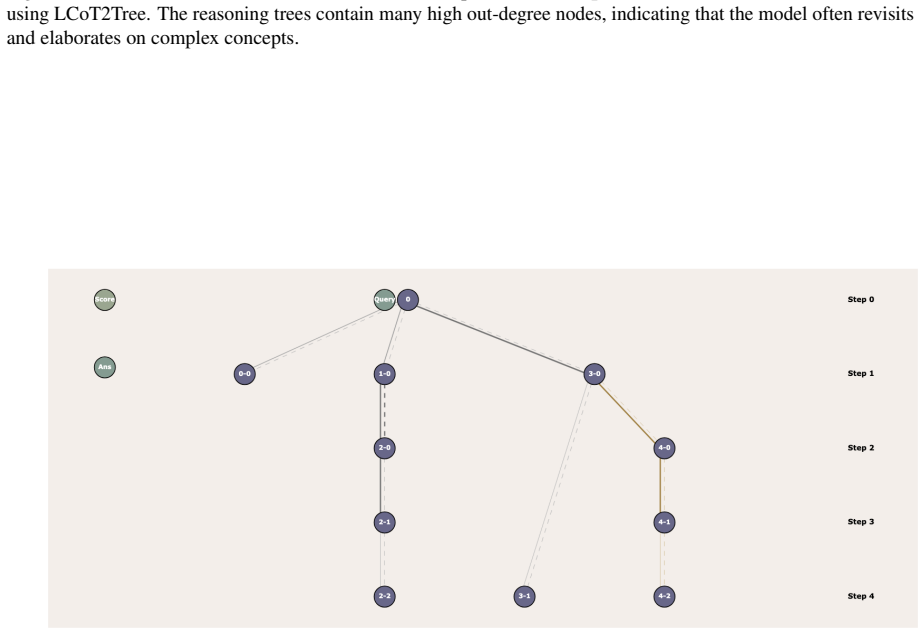
The load-bearing object is the reasoning tree produced by LCoT2Tree, an automated pipeline that converts a sequential long chain-of-thought into a hierarchical tree. Each thought in the chain becomes one or more nodes placed at the reasoning step or steps it engages; edges between nodes are typed by the thought's function: continuous logic, exploration, backtracking, or verification. The tree is assembled through five automated stages: an off-the-shelf LLM (DeepSeek-v3) extracts a reasoning sketch, linguistic cues split the chain into thoughts, the same LLM assigns thoughts to steps and labels their functions, and a fixed insertion rule builds the hierarchy. The argument then runs through a GATv2 graph neural network that learns to classify correctness from these trees, and GNNExplainer, which highlights which edges drive the classification.
What would settle it
Re-run the correctness classification with trees built by a different annotator, such as a different LLM or human-labeled thoughts, on the same 2,000-response sets; if the average 5.63% gain over length-based classification shrinks or disappears, the structural signal is an artifact of the annotator rather than of the reasoning itself.
Extended reading notes
Core claim
The central discovery is that structural patterns in long chain-of-thought reasoning, made explicit as a tree whose nodes are thoughts, whose depth corresponds to reasoning steps, and whose edges are typed as continuous logic, exploration, backtracking, or verification, are stronger predictors of final answer correctness than response length. The paper reports that LCoT2Tree improves binary classification of answer correctness by an average of 5.63% over a length-based logistic regression baseline, with the largest gains on MMLU-Pro (up to +14.58%) and the strongest model-level gain on Grok-3-mini-beta (+8.27%). Using a graph explainability technique, the paper identifies four error-associated substructures: over-branching, step redundancy, direct reasoning, and skipped thinking. It also shows that tree representations separate task types and model families with high accuracy, and that selecting Best-of-N candidates by tree-classifier score outperforms length-based, outcome-reward, and process-reward selection on LiveCodeBench and MATH.
Load-bearing premise
The trees built by LCoT2Tree faithfully reflect the structure of the model's actual reasoning; this rests on the off-the-shelf LLM's annotations and the hand-written insertion rules, with no human validation or robustness check reported.
Editorial extensions
If this is right
- If tree structure carries the signal, reasoning quality can be judged without reading the semantics: a classifier trained on tree shape predicts correctness better than length across tasks and models.
- The same structural signal can be used at decoding time: scoring Best-of-N candidates by the tree classifier beats length, outcome-reward, and process-reward selection on LiveCodeBench and MATH.
- Structural error patterns (over-branching, step redundancy, direct reasoning, skipped thinking) give concrete targets for training or prompting interventions aimed at reducing failed reasoning.
- Tree representations distinguish task types and model families, so structural analysis can serve as a diagnostic for comparing reasoning styles across benchmarks and model variants.
- Structural analysis alone is not enough: the paper's own limitation section notes cases with correct structure but wrong answers, and flawed structure but correct answers, so semantic signals remain complementary.
Reading between the lines
- If the structural signal survives annotation noise, length-penalty training for overthinking could be replaced or augmented by structure-aware penalties, such as penalizing over-branching subtrees rather than raw token counts; the paper tests classification and decoding, not training.
- The pipeline's reliance on an expensive off-the-shelf annotator suggests a natural extension: distill the annotation process into a lightweight parser so structural scoring could run inside the decoding loop without extra LLM calls; the paper notes the cost but does not propose this.
- The high model-pair separability, for example 93% between two model variants, hints that reasoning-tree fingerprints could serve as a model identity or provenance signal, a use the paper does not pursue.
- Since the paper finds both too much and too little branching accompany errors, a testable hypothesis for future work is that correctness depends on matching branching to task difficulty: math problems want layered backtracking, while knowledge-based questions want minimal branching.
Editorial analysis
A structured set of objections, weighed in public.
Referee Report
Summary. The paper proposes LCoT2Tree, an automated five-stage pipeline that converts long chain-of-thought (LCoT) outputs into hierarchical reasoning trees, using DeepSeek-v3 for sketch extraction, thought segmentation, step assignment, and function labeling. The resulting trees are fed to a GATv2 graph classifier to predict answer correctness, and the paper reports an average +5.63% accuracy gain over a length-only logistic-regression baseline across five reasoning models and four benchmarks. The authors further use GNNExplainer to identify error patterns such as over-branching, analyze task- and model-specific structural differences, and apply the tree classifier to Best-of-N decoding, reporting gains over ORM, PRM, and length-based selection on LiveCodeBench and MATH.
Significance. The question of what makes a long reasoning chain successful is timely and important, and the idea of making reasoning structure explicit through trees is a plausible and potentially useful direction. The breadth of the evaluation—five models and four benchmarks—is a strength, as is the attempt to move beyond length heuristics toward interpretable structural diagnostics. If the central comparison were clean, the proposed tool could be valuable for diagnosing reasoning failures and for improving output selection in decoding. However, the quantitative claims are not yet established: the evaluation split is contaminated by problem-level leakage, the structural signal is not separated from richer length-related node features, the tree extraction is not validated, and the Best-of-N results contain a direct numerical inconsistency. The paper does not provide released code or machine-checked analyses, so the empirical evidence must stand on its own; in its current form it does not.
major comments (5)
- [Section 3.1 and Appendix B.1] The train/test split is at the response level, not the problem level. Appendix B.1 states that LiveCodeBench has only 167 unique problems and that 16 responses are generated per problem, and Section 3.1 reports a 4:1 random split of responses. With a response-level split, many responses from the same problem appear in both training and test sets. The GNN never sees problem text, but its node features—cumulative token counts, thought indices, reasoning depth, and branching patterns—are strongly problem-specific, so the model can effectively memorize problem identity and exploit per-problem correctness tendencies at test time. The length-only baseline is far less able to encode problem identity in this way. The reported average +5.63% gain in Table 1, and especially the large MMLU-Pro gains, may therefore be inflated by this contamination. A grouped split, leave-one-problem-out evaluation, or per-problem cross-validation is required before the central predictability claim can be trusted.
- [Appendix B.3] The comparison between tree-based and length-based classification does not isolate the structural signal. The node features include cumulative number of tokens used up to each node, cumulative number of nodes at the same reasoning depth, thought index, and reasoning depth, while the length baseline in Section 3.1 uses only the total response length. The tree-based model thus receives much richer length-related information, so the gain over the baseline may reflect finer-grained token-count features rather than tree topology or edge-function labels. The paper should include ablations that remove token-count-based node features, and ideally test a model using only connectivity and edge types, to support the claim that structural patterns are the source of the improvement.
- [Section 3.2 and Appendix A] The entire tree construction depends on DeepSeek-v3 annotations (reasoning sketch extraction, step assignment, and thought-function labeling) plus hand-designed insertion rules in Stage 5. No human validation, inter-annotator agreement, or robustness check with a different annotation model is reported. Without such validation, the extracted trees—and all structural findings derived from them—could be artifacts of DeepSeek-v3's particular reasoning style rather than faithful representations of the target model's reasoning. The authors should validate a sample of trees against human annotation and test sensitivity to the annotation model.
- [Table 6 and Figure 5] There is a direct inconsistency in the Best-of-N results. For DeepSeek-32B on LiveCodeBench, Table 6 reports PRM-Best as 62.89%, but Figure 5 shows a PRM value of 55.38%, and the text in Section 5 states that the tree-based method exceeds PRM-Best by +6.16%, which also corresponds to 55.38% (61.54% − 6.16%). These numbers cannot all be correct. This contradiction undermines the reliability of the Best-of-N comparison and must be resolved.
- [Section 4.1] The four 'error patterns' in Figure 4 are extracted by applying GNNExplainer to a GNN trained with answer correctness as the label. The explanations therefore summarize the classifier's own decision surface rather than providing an independent characterization of incorrect reasoning. The frequency counts reported in Figure 4 should be validated on held-out trees or against independently annotated structural error types before the interpretability conclusions are treated as evidence about actual reasoning failures.
minor comments (5)
- [Section 1] The sentence introducing critical substructures contains a duplicated word: 'that that explain answer correctness' should read 'that explain answer correctness.'
- [Table 6] The column header 'V ote' contains a spacing artifact and should read 'Vote'; the same issue appears in Appendix C.3.
- [Figure 1] The caption contains a broken glyph in 'Positive samples /glyph1197egative samples'; it should read 'Positive samples / Negative samples.'
- [Appendix D.2] The phrase 'pinpiont the disparate behaviors' contains a typo; it should be 'pinpoint the disparate behaviors.'
- [Appendix C.3] The term MATH500 is used without definition; it should be introduced or cited explicitly, and the relationship between MATH500 and the MATH Level5 split described in Section 3.1 should be clarified.
Circularity Check
Error-pattern 'discoveries' are read back from the correctness-trained GNN via GNNExplainer; the headline tree-over-length gain is held-out and not circular.
-
fitted input called prediction
[Section 4, 'Explainability Method'; contributions bullet (Interpretability)]
"To interpret the model's predictions on reasoning quality and uncover the influential reasoning patterns, we adapt a graph explainability method called GNNExplainer ... This method uncovers important subgraphs by maximizing the mutual information between the GNN's output and the distribution of possible subgraph structures. These extracted subgraphs also correspond to critical thought patterns within the reasoning chain. For example, in models trained to predict incorrect answers, the highlighted subgraphs often reflect flawed reasoning behaviors that lead to poor performance."
The GNN being explained is the classifier trained in Section 3.3 on answer-correctness labels, and GNNExplainer selects subgraphs by maximizing mutual information with that classifier's output. The 'critical thought patterns' are therefore defined as whatever the fitted model finds important; presenting them as patterns that 'oftentimes lead to errors' (contributions bullet) or that 'account for failures' (Section 4.1) re-labels the model's learned decision surface as an independent empirical discovery.
full rationale
No self-citation chain, uniqueness theorem, or ansatz-smuggling is load-bearing: LCoT2Tree construction uses the external DeepSeek-v3 model, and the length baseline, ORM, PRM, and Best-of-N baselines are external. The headline predictability claim (an average +5.63% over length) is a held-out test-set comparison and does not reduce to a definition or to the training fit; the Best-of-N application is evaluated on LCB-v6 with external reward-model baselines. The only substantiated circularity is in the interpretability section, where GNNExplainer extracts 'critical thought patterns' from a GNN fitted on correctness labels and the paper presents these as discovered causes of errors. That is a partial, component-level circularity rather than a defect in the central derivation, so the overall score is 3. The response-level train/test split in Appendix B.1 is a correctness/validity concern, not a circularity, and is not counted here.
Assumptions & free parameters
assumptions (4)
- domain assumption DeepSeek-v3 annotations of reasoning sketches, step assignments, and thought functions are accurate for all models and tasks.
- ad hoc to paper The hand-designed tree insertion rules in Stage 5 capture the true reasoning structure of the model.
- domain assumption The 4:1 train/test split is at response level and does not leak the same problem across splits.
- domain assumption The GNN learns structural patterns rather than length or dataset artifacts.
Cite this review
Pith. "Pith review of What Makes a Good Reasoning Chain? Uncovering Structural Patterns in Long Chain-of-Thought Reasoning." pith.science (2026). https://pith.science/paper/XVYM7ZT7
@misc{pith2026250522148,
  author       = {Pith},
  title        = {Pith review of: What Makes a Good Reasoning Chain? Uncovering Structural Patterns in Long Chain-of-Thought Reasoning},
  year         = {2026},
  howpublished = {\url{https://pith.science/paper/XVYM7ZT7}},
  note         = {Machine review of arXiv:2505.22148}
}
read the original abstract
Recent advances in reasoning with large language models (LLMs) have popularized Long Chain-of-Thought (LCoT), a strategy that encourages deliberate and step-by-step reasoning before producing a final answer. While LCoTs have enabled expert-level performance in complex tasks, how the internal structures of their reasoning chains drive, or even predict, the correctness of final answers remains a critical yet underexplored question. In this work, we present LCoT2Tree, an automated framework that converts sequential LCoTs into hierarchical tree structures and thus enables deeper structural analysis of LLM reasoning. Using graph neural networks (GNNs), we reveal that structural patterns extracted by LCoT2Tree, including exploration, backtracking, and verification, serve as stronger predictors of final performance across a wide range of tasks and models. Leveraging an explainability technique, we further identify critical thought patterns such as over-branching that account for failures. Beyond diagnostic insights, the structural patterns by LCoT2Tree support practical applications, including improving Best-of-N decoding effectiveness. Overall, our results underscore the critical role of internal structures of reasoning chains, positioning LCoT2Tree as a powerful tool for diagnosing, interpreting, and improving reasoning in LLMs.
Figures


Figures from the paper (14 more)




Forward citations
Cited by 2 Pith papers
-
Which Reasoning Trajectories Teach Students to Reason Better? A Simple Metric of Informative Alignment
Rank-Surprisal Ratio (RSR) correlates strongly (average Spearman 0.86) with post-distillation reasoning gains across five student models and trajectories from eleven teachers, outperforming existing selection metrics.
-
Towards Concise and Adaptive Thinking in Large Reasoning Models: A Survey
A comprehensive review that categorizes methods for shortening and adaptively triggering chain-of-thought reasoning in large language models.
Reference graph
Works this paper leans on
-
[1]
Find the key steps and the logical flow of reasoning
-
[2]
Each step must represent a single, indivisible logical action that directly advances the reasoning
-
[3]
5: Scaling reinforcement learning with llms.arXiv preprint arXiv:2501.12599
Kimi k1. 5: Scaling reinforcement learning with llms.arXiv preprint arXiv:2501.12599. Qwen Team. 2024. Qwq: Reflect deeply on the bound- aries of the unknown.URL https://qwenlm. github. io/blog/qwq-32b-preview. Boshi Wang, Sewon Min, Xiang Deng, Jiaming Shen, You Wu, Luke Zettlemoyer, and Huan Sun. 2023a. Towards understanding chain-of-thought prompting: ...
arXiv 2024
-
[4]
Do not skip steps. Do not merge steps. Use the original phrasing where possible
-
[5]
Tree of thoughts: Deliberate problem solving with large language models.Advances in Neural Information Processing Systems (NeurIPS). Yixin Ye, Zhen Huang, Yang Xiao, Ethan Chern, Shijie Xia, and Pengfei Liu. 2025. Limo: Less is more for reasoning.arXiv preprint arXiv:2502.03387. Zhitao Ying, Dylan Bourgeois, Jiaxuan You, Marinka Zitnik, and Jure Leskovec....
arXiv 2025
-
[6]
Organize the steps into a coherent sequence of key reasoning steps and number it sequentially (1., 2., 3., ...)
-
[7]
Output format: <reasoning_process> Step 1
Maintain strict output format. Output format: <reasoning_process> Step 1. concise statement: Detail step Step 2. concise statement: Detail step Step 3. concise statement: Detail step </reasoning_process> Please list the key reasoning steps of the provided text. Figure 6: The content of Step1 Prompt in LCoT2Tree tool to extract reasoning sketch from LCoT. ...
-
[9]
A correct step should be able to push the reasoning logic forward and have no errors in itself
Determine the correct version of the step, ignoring redundant information. A correct step should be able to push the reasoning logic forward and have no errors in itself
Show all 20 references
-
[11]
Do not include verification steps unless it introduces new constraints
-
[14]
First understand List B: - For each thought in List B, identify if it describes some specific calculation processes (mathemati- cal operation, logical transformation, or data manipulation) - Ignore the describation that only state conclusions, concepts without showing the actu...
-
[15]
Then math to List A: - For each thought from List B, find all steps in List A that: * Show the same underlying calculation (even with different numbers/words) * Represent the partial or same reasoning process - Ignore superficial wording differences - focus on logical equivalence
-
[16]
‘json {
Output requirements: - Return ALL plausible matches where computational processes align - Never return empty arrays (except for thought B0 if needed) - Multiple matches are encouraged when justified - Maintain strict JSON format Input: - List A (Detailed Steps): <list_a> {{rea...
-
[17]
Continuous Logic - Direct continuation/extension of Text1’s reasoning flow
-
[18]
Exploration - Introduces parallel/unrelated concepts from Text1, alternative reasoning paths, or new topics
-
[19]
Backtracking - Revises, corrects, or adjusts previous step
-
[20]
Text1":
Validation - Provides supporting evidence, logical justification, or examples for Text1’s claims Input:{{ "Text1": "TEXT1", "Text2": "TEXT2" }} Output Format: Return only JSON format “‘json{"Category": "Name of Category"}”’ Figure 8: The content of Step4 Prompt in LCoT2Tree to...
-
[2022]
The model comprises two GATv2 layers, each with a hidden size of 64
to model reasoning trees, leveraging its dy- namic attention mechanism and improved capabil- ity for capturing hierarchical dependencies. The model comprises two GATv2 layers, each with a hidden size of 64. After message passing, graph- level embeddings are obtained via global...
-
[2023]
InInternational Conference on Learning Representations (ICLR)
Let’s verify step by step. InInternational Conference on Learning Representations (ICLR). Zhan Ling, Yunhao Fang, Xuanlin Li, Zhiao Huang, Mingu Lee, Roland Memisevic, and Hao Su. 2023. Deductive verification of chain-of-thought reasoning. Advances in Neural Information Proces...
2023 arXiv
-
[2024]
In The Conference on Neural Information Processing Systems Datasets and Benchmarks Track
Mmlu-pro: A more robust and challenging multi-task language understanding benchmark. In The Conference on Neural Information Processing Systems Datasets and Benchmarks Track. Yue Wang, Qiuzhi Liu, Jiahao Xu, Tian Liang, Xingyu Chen, Zhiwei He, Linfeng Song, Dian Yu, Juntao Li,...
2025 arXiv
-
[2025]
Dan Hendrycks, Collin Burns, Saurav Kadavath, Akul Arora, Steven Basart, Eric Tang, Dawn Song, and Jacob Steinhardt
Can large language models detect errors in long chain-of-thought reasoning?arXiv preprint arXiv:2502.19361. Dan Hendrycks, Collin Burns, Saurav Kadavath, Akul Arora, Steven Basart, Eric Tang, Dawn Song, and Jacob Steinhardt. 2021. Measuring mathematical problem solving with th...
2021 arXiv
Reviewed August 7, 2026 · model on record in the stance chip above.
Discussion (0). Sign in to comment.