REVIEW 2 major objections 2 minor 1 cited by
High-Quality Axion Dark Matter without Isocurvature Problem
T0 review · 2 major / 2 minor · reviewed 2026-06-29 · grok-4.3
Pith's one-line read A discrete gauge symmetry protects high-quality axion dark matter from isocurvature constraints during high-scale inflation.
desk verdict Discrete gauge symmetry lets a gauge-invariant PQ-violating operator give the axion a temporary mass during inflation, suppressing isocurvature even for large domain wall numbers. read the letter →
The pith
A machine-rendered reading of the paper's core claim, the machinery that carries it, and where it could break.
The reading
What carries the argument
The discrete gauge symmetry that makes a Peccei-Quinn-violating operator gauge-invariant, allowing it to generate a large effective axion mass only during inflation.
What would settle it
Observation of axion isocurvature perturbations in the CMB above the level suppressed by the mechanism, or axion searches ruling out the entire predicted parameter space.
Extended reading notes
Core claim
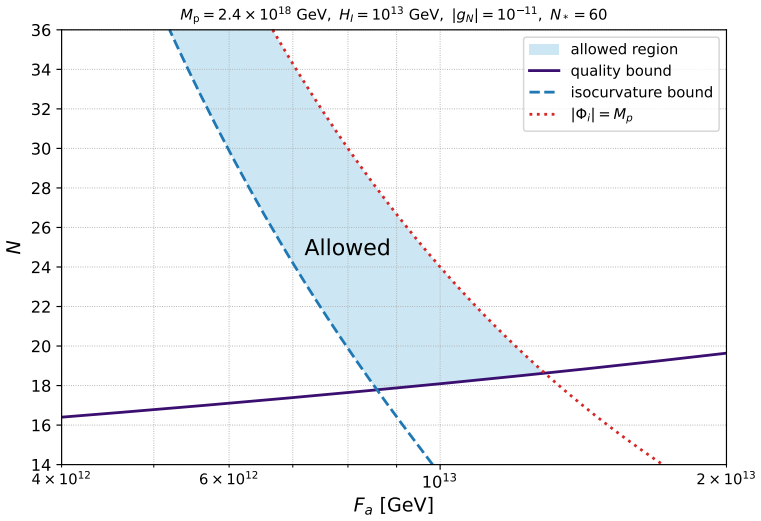
The central discovery is that a high-quality axion protected by a discrete gauge symmetry evades the isocurvature problem. A Peccei-Quinn-violating but gauge-invariant operator induces a large effective axion mass during inflation, thereby suppressing the axion fluctuation. This setup addresses both the axion quality problem and the isocurvature problem.
Load-bearing premise
The discrete gauge symmetry must exist and be chosen so that the Peccei-Quinn-violating operator is gauge-invariant without causing unwanted side effects after inflation.
Editorial extensions
If this is right
- The axion can be dark matter in high-scale inflation models without violating isocurvature bounds from the CMB.
- The mechanism works regardless of the size of the domain wall number.
- Both the quality problem and isocurvature problem are solved by the same symmetry structure.
- Future experiments can test the predicted axion parameter space.
Reading between the lines
- If the discrete symmetry is realized in a UV completion, it could constrain the possible inflationary models.
- The approach might be extended to other axion-like particles in cosmology.
- Observational bounds on axion couplings could be combined with isocurvature limits to narrow the viable space further.
Signed reviews
Editorial analysis
A structured set of objections, weighed in public.
Referee Report
Summary. The manuscript proposes a mechanism in which a discrete gauge symmetry protects a high-quality axion, permitting a Peccei-Quinn-violating but gauge-invariant operator. This operator generates a large effective axion mass during inflation (when the PQ field has a large VEV), suppressing isocurvature fluctuations even for large domain-wall number, while preserving post-inflationary axion quality and yielding testable predictions for the axion parameter space.
Significance. If the symmetry construction is internally consistent and free of unwanted side effects, the work supplies a natural route to high-quality axion dark matter in high-scale inflation without the conventional isocurvature obstruction, simultaneously addressing the quality problem and producing falsifiable predictions for future experiments.
major comments (2)
- [mechanism description (following abstract)] The central construction rests on the existence of a discrete gauge symmetry that renders the PQ-violating operator gauge-invariant while forbidding lower-dimensional quality-violating operators. The manuscript must explicitly exhibit at least one concrete charge assignment (or symmetry group) that achieves this without generating additional operators that would either spoil the post-inflationary axion potential or reintroduce isocurvature after the PQ field relaxes.
- [inflationary dynamics paragraph] The claim that the induced mass term suppresses axion fluctuations during inflation requires a quantitative estimate of the effective mass relative to the Hubble scale and a demonstration that the suppression remains effective across the relevant range of domain-wall numbers; without this, the evasion of the isocurvature bound remains qualitative.
minor comments (2)
- [abstract] Clarify the precise form of the gauge-invariant operator (e.g., its dimension and field content) already in the abstract or introduction to make the mechanism immediately reproducible.
- [discussion section] Add a brief discussion of possible UV completions or embedding into a larger gauge group to address whether the required discrete symmetry can arise naturally.
Simulated Author's Rebuttal
We thank the referee for the careful reading of our manuscript and the constructive comments. We address the two major comments point by point below. Both points identify areas where additional explicit detail will strengthen the presentation, and we will incorporate the requested material in a revised version.
read point-by-point responses
-
Referee: [mechanism description (following abstract)] The central construction rests on the existence of a discrete gauge symmetry that renders the PQ-violating operator gauge-invariant while forbidding lower-dimensional quality-violating operators. The manuscript must explicitly exhibit at least one concrete charge assignment (or symmetry group) that achieves this without generating additional operators that would either spoil the post-inflationary axion potential or reintroduce isocurvature after the PQ field relaxes.
Authors: We agree that an explicit construction is required to make the mechanism fully concrete. In the revised manuscript we will add a new subsection that presents a specific discrete gauge symmetry (a Z_6 symmetry) together with the charge assignments for the PQ scalar Φ and the relevant Standard Model fields. We will verify that the chosen charges render the desired higher-dimensional PQ-violating operator gauge invariant, forbid all lower-dimensional quality-violating operators, and generate no additional operators that would either lift the post-inflationary axion potential or produce late-time isocurvature fluctuations once the PQ field relaxes to its minimum. This explicit example directly addresses the referee’s request. revision: yes
-
Referee: [inflationary dynamics paragraph] The claim that the induced mass term suppresses axion fluctuations during inflation requires a quantitative estimate of the effective mass relative to the Hubble scale and a demonstration that the suppression remains effective across the relevant range of domain-wall numbers; without this, the evasion of the isocurvature bound remains qualitative.
Authors: We accept that the present discussion of fluctuation suppression is qualitative. In the revision we will expand the inflationary-dynamics section with explicit estimates. We will derive the effective axion mass m_eff generated by the gauge-invariant operator during inflation (when ⟨Φ⟩ ≈ Φ_inf ≫ f_a) and show that m_eff/H_inf ≫ 1 for the high-scale inflation parameters of interest. We will then compute the resulting suppression of the axion power spectrum and demonstrate numerically that the isocurvature constraint remains satisfied for domain-wall numbers up to N_DW = 10. These quantitative results will be presented in a new figure and accompanying text, rendering the evasion of the isocurvature bound rigorous rather than qualitative. revision: yes
Circularity Check
No significant circularity identified
full rationale
The paper advances a theoretical construction: a discrete gauge symmetry is chosen so that a PQ-violating operator remains gauge-invariant, generating a large effective axion mass only during inflation while preserving post-inflationary quality. The provided abstract and mechanism description contain no equations, no fitted parameters renamed as predictions, and no load-bearing self-citations; the claim is a symmetry-based proposal whose consistency is internal to the construction rather than reducing to its own inputs by definition. No step matches any of the enumerated circularity patterns.
Assumptions & free parameters
assumptions (2)
- standard math Standard assumptions of inflationary cosmology, including quantum fluctuations of light fields during inflation and the isocurvature constraint from CMB observations.
- domain assumption Existence of a discrete gauge symmetry that protects the Peccei-Quinn symmetry while permitting a gauge-invariant PQ-violating operator.
invented entities (1)
-
Discrete gauge symmetry protecting the axion
Cite this review
Pith. "Pith review of High-Quality Axion Dark Matter without Isocurvature Problem." pith.science (2026). https://pith.science/paper/XWLKSUKH
@misc{pith2026260529370,
  author       = {Pith},
  title        = {Pith review of: High-Quality Axion Dark Matter without Isocurvature Problem},
  year         = {2026},
  howpublished = {\url{https://pith.science/paper/XWLKSUKH}},
  note         = {Machine review of arXiv:2605.29370}
}
read the original abstract
Axion dark matter in high-scale inflation is subject to the isocurvature constraint, since quantum fluctuations of the axion field during inflation may exceed the current CMB bound. One conventional way to suppress these fluctuations is to assume that the Peccei-Quinn field has a large expectation value during inflation. However, this mechanism becomes ineffective when the axion domain wall number is large. In this work, we point out that a high-quality axion protected by a discrete gauge symmetry can naturally evade this problem. A Peccei-Quinn-violating but gauge-invariant operator induces a large effective axion mass during inflation, thereby suppressing the axion fluctuation. The same setup can address both the axion quality problem and the isocurvature problem, while leading to a prediction for the axion parameter space to be verified in future experiments.
Figures
Forward citations
Cited by 1 Pith paper
-
Axion isocurvature and the model-building problem of low-scale inflation
A light pre-inflationary QCD axion that is all the dark matter forces the inflationary Hubble scale below ~10^7–10^10 GeV and, for canonical slow-roll inflation, confines the inflaton to sub-10^-4 M_Pl of field motion...
Reference graph
Works this paper leans on
-
[1]
M. Cirelli, A. Strumia, and J. Zupan, “Dark Matter,” [arXiv:2406.01705[hep-ph]]
-
[2]
Constraints Imposed by CP Conservation in the Presence of Instantons,
R. D. Peccei and H. R. Quinn, “Constraints Imposed by CP Conservation in the Presence of Instantons,” Phys. Rev. D16(1977) 1791–1797
1977
-
[3]
CP Conservation in the Presence of Instantons,
R. D. Peccei and H. R. Quinn, “CP Conservation in the Presence of Instantons,” Phys. Rev. Lett.38(1977) 1440–1443
1977
-
[4]
Problem of StrongPandTInvariance in the Presence of Instantons,
F. Wilczek, “Problem of StrongPandTInvariance in the Presence of Instantons,” Phys. Rev. Lett.40(1978) 279–282
1978
-
[5]
A New Light Boson?,
S. Weinberg, “A New Light Boson?,” Phys. Rev. Lett.40(1978) 223–226
1978
-
[6]
Measurement of the permanent electric dipole moment of the neutron
C. Abel et al., “Measurement of the Permanent Electric Dipole Moment of the Neutron,” Phys. Rev. Lett.124no. 8, (2020) 081803, [arXiv:2001.11966[hep-ex]]
work page Pith review arXiv 2020
-
[7]
Cosmology of the Invisible Axion,
J. Preskill, M. B. Wise, and F. Wilczek, “Cosmology of the Invisible Axion,” Phys. Lett. B120(1983) 127–132. 15
1983
-
[8]
Three-body interactions among nucleons and pions
L. Abbott and P. Sikivie, “A cosmological bound on the invisible axion,” Physics Letters B120no. 1, (1983) 133–136. https://www.sciencedirect.com/science/article/pii/037026938390638X
Show all 62 references
-
[9]
The Not So Harmless Axion,
M. Dine and W. Fischler, “The Not So Harmless Axion,” Phys. Lett. B120(1983) 137–141
1983
-
[10]
Axion Cosmology,
D. J. E. Marsh, “Axion Cosmology,” Phys. Rept.643(2016) 1–79, [arXiv:1510.07633 [astro-ph.CO]]
2016 arXiv
-
[11]
Cosmic strings and domain walls in models with goldstone and pseudo-goldstone bosons,
A. Vilenkin and A. E. Everett, “Cosmic strings and domain walls in models with goldstone and pseudo-goldstone bosons,” Phys. Rev. Lett.48(Jun, 1982) 1867–1870. https://link.aps.org/doi/10.1103/PhysRevLett.48.1867
1982 doi
-
[12]
Long-term dynamics of cosmological axion strings,
M. Kawasaki, T. Sekiguchi, M. Yamaguchi, and J. Yokoyama, “Long-term dynamics of cosmological axion strings,” Prog. Theor. Exp. Phys.2018no. 9, (2018) 091E01, [arXiv:1806.05566[hep-ph]]
2018
-
[13]
Axions, domain walls, and the early universe,
P. Sikivie, “Axions, domain walls, and the early universe,” Phys. Rev. Lett.48(Apr,
-
[14]
1156–1159.https://link.aps.org/doi/10.1103/PhysRevLett.48.1156
-
[15]
Production of dark matter axions from collapse of string-wall systems,
T. Hiramatsu, M. Kawasaki, K. Saikawa, and T. Sekiguchi, “Production of dark matter axions from collapse of string-wall systems,” Phys. Rev. D85(2012) 105020, [arXiv:1202.5851[hep-ph]]. [Erratum: Phys.Rev.D 86, 089902 (2012)]
2012 arXiv
-
[16]
Inflation and axion cosmology,
A. D. Linde, “Inflation and axion cosmology,” Phys. Lett. B201(1988) 437–439
1988
-
[17]
A new type of isotropic cosmological models without singularity,
A. A. Starobinsky, “A new type of isotropic cosmological models without singularity,” Phys. Lett. B91no. 1, (1980) 99–102
1980
-
[18]
The standard model higgs boson as the inflaton,
F. L. Bezrukov and M. E. Shaposhnikov, “The standard model higgs boson as the inflaton,” Phys. Lett. B659(2008) 703–706, [arXiv:0710.3755[hep-th]]
2008 arXiv
-
[19]
Superconformal Inflationary a-Attractors,
R. Kallosh, A. Linde, and D. Roest, “Superconformal Inflationary a-Attractors,” JHEP 11(2013) 198, [arXiv:1311.0472[hep-th]]
2013 arXiv
-
[20]
Improved Constraints on Primordial Gravitational Waves using Planck, WMAP, and BICEP/Keck Observations through the 2018 Observing Season,
BICEP/Keck Collaboration, “Improved Constraints on Primordial Gravitational Waves using Planck, WMAP, and BICEP/Keck Observations through the 2018 Observing Season,” Phys. Rev. Lett.127no. 15, (2021) 151301, [arXiv:2110.00483[astro-ph.CO]]. [21]PlanckCollaboration, P. A. R. Ad...
2018
-
[21]
Development of Axion Perturbations in an Axion Dominated Universe,
M. Axenides, R. H. Brandenberger, and M. S. Turner, “Development of Axion Perturbations in an Axion Dominated Universe,” Phys. Lett. B126(1983) 178–182
1983
-
[22]
“isothermal
D. Seckel and M. S. Turner, ““isothermal” density perturbations in an axion-dominated inflationary universe,” Phys. Rev. D32(Dec, 1985) 3178–3183. https://link.aps.org/doi/10.1103/PhysRevD.32.3178. 16
1985 doi
-
[23]
Generation of Isothermal Density Perturbations in the Inflationary Universe,
A. D. Linde, “Generation of Isothermal Density Perturbations in the Inflationary Universe,” Phys. Lett. B158(1985) 375–380
1985
-
[24]
Axionic domain wall production during inflation,
A. D. Linde and D. H. Lyth, “Axionic domain wall production during inflation,” Phys. Lett. B246(1990) 353–358
1990
-
[25]
Inflationary axion cosmology,
M. S. Turner and F. Wilczek, “Inflationary axion cosmology,” Phys. Rev. Lett.66(Jan,
-
[26]
5–8.https://link.aps.org/doi/10.1103/PhysRevLett.66.5
-
[27]
Axions in inflationary cosmology,
A. D. Linde, “Axions in inflationary cosmology,” Phys. Lett. B259(1991) 38–47
1991
-
[28]
Topological defects formation after inflation on lattice simulation,
S. Kasuya and M. Kawasaki, “Topological defects formation after inflation on lattice simulation,” Phys. Rev. D58(1998) 083516, [arXiv:hep-ph/9804429]
1998 arXiv
-
[29]
Comments on cosmic string formation during preheating on lattice simulations,
S. Kasuya and M. Kawasaki, “Comments on cosmic string formation during preheating on lattice simulations,” Phys. Rev. D61(2000) 083510, [arXiv:hep-ph/9903324]
2000 arXiv
-
[30]
Domain wall and isocurvature perturbation problems in axion models,
M. Kawasaki, T. T. Yanagida, and K. Yoshino, “Domain wall and isocurvature perturbation problems in axion models,” JCAP11(2013) 030, [arXiv:1305.5338 [hep-ph]]
2013 arXiv
-
[31]
Cosmologically allowed regions for the axion decay constantF a,
M. Kawasaki, E. Sonomoto, and T. T. Yanagida, “Cosmologically allowed regions for the axion decay constantF a,” Phys. Lett. B782(2018) 181–184, [arXiv:1801.07409 [hep-ph]]
2018
-
[32]
Discrete gauge symmetry in continuum theories,
L. M. Krauss and F. Wilczek, “Discrete gauge symmetry in continuum theories,” Phys. Rev. Lett.62(1989) 1221
1989
-
[33]
Planck scale physics and the Peccei-Quinn mechanism,
M. Kamionkowski and J. March-Russell, “Planck scale physics and the Peccei-Quinn mechanism,” Phys. Lett. B282(1992) 137–141, [arXiv:hep-th/9202003]
1992 arXiv
-
[34]
Solutions to the strong CP problem in a world with gravity,
R. Holman, S. D. H. Hsu, T. W. Kephart, E. W. Kolb, R. Watkins, and L. M. Widrow, “Solutions to the strong CP problem in a world with gravity,” Phys. Lett. B282(1992) 132–136, [arXiv:hep-ph/9203206]
1992 arXiv
-
[35]
Planck-scale corrections to axion models,
S. M. Barr and D. Seckel, “Planck-scale corrections to axion models,” Phys. Rev. D46 (1992) 539–549
1992
-
[36]
Stabilizing the axion by discrete gauge symmetries,
K. S. Babu, I. Gogoladze, and K. Wang, “Stabilizing the axion by discrete gauge symmetries,” Phys. Lett. B560(2003) 214–222, [arXiv:hep-ph/0212339]
2003 arXiv
-
[38]
High-quality axions in solutions to theµproblem,
P. N. Bhattiprolu and S. P. Martin, “High-quality axions in solutions to theµproblem,” Phys. Rev. D104no. 5, (2021) 055014, [arXiv:2106.14964[hep-ph]]. 17
2021
-
[40]
High quality axion in supersymmetric models,
G. Choi and T. T. Yanagida, “High quality axion in supersymmetric models,” JHEP12 (2022) 067, [arXiv:2209.09290[hep-ph]]
2022
-
[41]
High quality QCD axion in the Standard Model,
J. Sheng and T. T. Yanagida, “High quality QCD axion in the Standard Model,” Phys. Rev. D113no. 5, (2026) 055010, [arXiv:2510.17370[hep-ph]]
2026
-
[42]
Testable inverse seesaw motivated from a high quality QCD axion,
Y. Georis, J. Sheng, S. Urrea, and T. T. Yanagida, “Testable inverse seesaw motivated from a high quality QCD axion,” JHEP04(2026) 004, [arXiv:2512.13158[hep-ph]]
2026
-
[43]
WIMP Dark Matter from a Natural Discrete Gauge Symmetry in the Standard Model,
J. Sheng, T. T. Yanagida, and K. Zhang, “WIMP Dark Matter from a Natural Discrete Gauge Symmetry in the Standard Model,” [arXiv:2601.15856[hep-ph]]
-
[44]
Flavor in ninths and a discrete gauge origin of the qcd axion,
V. Barger, “Flavor in ninths and a discrete gauge origin of the qcd axion,” [arXiv:2603.03631[hep-ph]]
-
[45]
Tasi lectures on inflation,
D. Baumann, “Tasi lectures on inflation,” [arXiv:0907.5424[hep-th]]
-
[46]
Unification of families based on a coset space e7/su(5) x su(3) x u(1),
T. Kugo and T. Yanagida, “Unification of families based on a coset space e7/su(5) x su(3) x u(1),” Physics Letters B134no. 5, (1984) 313–317
1984
-
[47]
Loss of incoherence and determination of coupling constants in quantum gravity,
S. B. Giddings and A. Strominger, “Loss of incoherence and determination of coupling constants in quantum gravity,” Nucl. Phys. B307(1988) 854–866
1988
-
[48]
Why There Is Nothing Rather Than Something: A Theory of the Cosmological Constant,
S. R. Coleman, “Why There Is Nothing Rather Than Something: A Theory of the Cosmological Constant,” Nucl. Phys. B310(1988) 643–668
1988
-
[49]
WORMHOLE INDUCED PROTON DECAY,
G. Gilbert, “WORMHOLE INDUCED PROTON DECAY,” Nucl. Phys. B328(1989) 159–170
1989
-
[50]
Particle Creation by Black Holes,
S. W. Hawking, “Particle Creation by Black Holes,” Commun. Math. Phys.43(1975) 199–220. [Erratum: Commun.Math.Phys. 46, 206 (1976)]
1975
-
[51]
Is there a peccei-quinn phase transition?
A. Anisimov and M. Dine, “Is there a peccei-quinn phase transition?” JCAP07(2005) 009, [arXiv:hep-ph/0405256]
2005 arXiv
-
[52]
Suppressing isocurvature perturbations of qcd axion dark matter,
K. S. Jeong and F. Takahashi, “Suppressing isocurvature perturbations of qcd axion dark matter,” Phys. Lett. B727(2013) 448–451, [arXiv:1304.8131[hep-ph]]
2013 arXiv
-
[53]
Solving the tension between high-scale inflation and axion isocurvature perturbations,
T. Higaki, K. S. Jeong, and F. Takahashi, “Solving the tension between high-scale inflation and axion isocurvature perturbations,” Phys. Lett. B734(2014) 21–26, [arXiv:1403.4186[hep-ph]]
2014 arXiv
-
[54]
Higgs inflation and suppression of axion isocurvature perturbation,
K. Nakayama and M. Takimoto, “Higgs inflation and suppression of axion isocurvature perturbation,” Phys. Lett. B748(2015) 108–112, [arXiv:1505.02119[hep-ph]]. 18
2015 arXiv
-
[55]
High-scale axions without isocurvature from inflationary dynamics,
J. Kearney, N. Orlofsky, and A. Pierce, “High-scale axions without isocurvature from inflationary dynamics,” Phys. Rev. D93no. 9, (2016) 095026, [arXiv:1601.03049 [hep-ph]]
2016 arXiv
-
[56]
Axion dark matter,
C. B. Adams et al., “Axion dark matter,” [arXiv:2203.14923[hep-ex]]
-
[57]
Axion dark matter searches above 1µev,
G. Rybka, “Axion dark matter searches above 1µev,” Nuclear Physics B1003(2024) 116481
2024
-
[58]
Enhanced Dark Matter Quantum Sensing via Geometric Phase,
X. Ma and J. Sheng, “Enhanced Dark Matter Quantum Sensing via Geometric Phase,” [arXiv:2603.23599[hep-ph]]
-
[59]
Probing cosmic inflation with the litebird cosmic microwave background polarization survey,
LiteBIRD Collaboration, “Probing cosmic inflation with the litebird cosmic microwave background polarization survey,” Progress of Theoretical and Experimental Physics2023 no. 4, (2023) 042F01, [arXiv:2202.02773[astro-ph.IM]]
2023
-
[60]
Cmb-s4: Iterative internal delensing andrconstraints,
S. Belkner, J. Carron, L. Legrand, C. Umilt` a, C. Pryke, and C. Bischoff, “Cmb-s4: Iterative internal delensing andrconstraints,” The Astrophysical Journal964(2024) 148, [arXiv:2310.06729[astro-ph.CO]]
2024
-
[61]
Weak Interaction Singlet and Strong CP Invariance,
J. E. Kim, “Weak Interaction Singlet and Strong CP Invariance,” Phys. Rev. Lett.43 (1979) 103
1979
-
[62]
Can Confinement Ensure Natural CP Invariance of Strong Interactions?,
M. A. Shifman, A. I. Vainshtein, and V. I. Zakharov, “Can Confinement Ensure Natural CP Invariance of Strong Interactions?,” Nucl. Phys. B166(1980) 493–506
1980
-
[63]
Anomaly Ratio Distributions of Hadronic Axion Models with Multiple Heavy Quarks,
V. Plakkot and S. Hoof, “Anomaly Ratio Distributions of Hadronic Axion Models with Multiple Heavy Quarks,” Phys. Rev. D104no. 7, (2021) 075017, [arXiv:2107.12378 [hep-ph]]
2021
-
[64]
Naturally Light Invisible Axion in Models with Large Local Discrete Symmetries,
A. G. Dias, V. Pleitez, and M. D. Tonasse, “Naturally Light Invisible Axion in Models with Large Local Discrete Symmetries,” Phys. Rev. D67(2003) 095008, [arXiv:hep-ph/0211107]. 19
2003 arXiv
Reviewed June 29, 2026 · model on record in the stance chip above.
Discussion (0). Continue with ORCID to comment.