Multipath Adaptive Gated Bottleneck Latent ODE with Raman Data Fusion for Cell Culture Process Forecasting
Pith reviewed 2026-06-26 05:28 UTC · model grok-4.3
The pith
Multi-path just-in-time fine-tuning of gated bottleneck latent ODEs with Raman fusion outperforms global baselines on 8 of 9 cell-culture variables across 38 bioreactor runs.
A machine-rendered reading of the paper's core claim, the machinery that carries it, and where it could break.
Core claim
MP-JIT-FT with Raman fusion produces the best average rank and outperforms a global Latent ODE baseline on 8 of 9 target variables; multi-path gains are largest when locally similar prefixes diverge, while Raman fusion helps most when early dynamics remain representative of later behaviour.
What carries the argument
Multi-Path Just-In-Time Fine Tuning (MP-JIT-FT) that retrieves similar historical trajectories, clusters the local neighbourhood into candidate regimes, and fine-tunes a separate model per regime to emit multiple plausible paths scored by reconstruction error.
If this is right
- When early trajectories are locally similar yet later diverge, generating and scoring multiple regime-specific paths yields lower error than a single averaged forecast.
- Raman-derived pseudo-observations reduce error most when the initial segment of a run already encodes the dominant later dynamics.
- Variable-wise gating and mask-aware bottlenecks allow the latent ODE to learn from high-dimensional sparse inputs without requiring complete observations at every time step.
- The framework adapts to heterogeneity across cell lines and media by maintaining a library of regime-specific models rather than one global model.
- Reconstruction-based scores provide a direct way to rank and select among the multiple forecast paths without external uncertainty estimation.
Where Pith is reading between the lines
- The same retrieval-plus-clustering step could be reused at inference time to select which regime model to deploy for real-time control adjustments once a new run's prefix is observed.
- If the divergence metric can be computed online, an early-warning rule could flag runs whose current prefix matches multiple regimes and trigger additional sampling or Raman scans.
- Extending the soft-sensor training to include future Raman spectra as auxiliary supervision might further tighten the link between early measurements and later process outcomes.
- The approach may transfer to other irregularly sampled time-series domains where similar early segments can lead to qualitatively different futures, such as patient vital-sign trajectories.
Load-bearing premise
Historical trajectories can be clustered into regimes whose separate fine-tuned models will produce accurate multi-path forecasts when locally similar prefixes diverge, and the Raman soft sensor produces pseudo-observations faithful to the underlying process dynamics.
What would settle it
A fresh collection of 38 or more fed-batch runs in which the multi-path regime models fail to beat the single global Latent ODE on at least seven of the nine target variables, or in which local-divergence metrics show no relation to performance gains.
Figures




read the original abstract
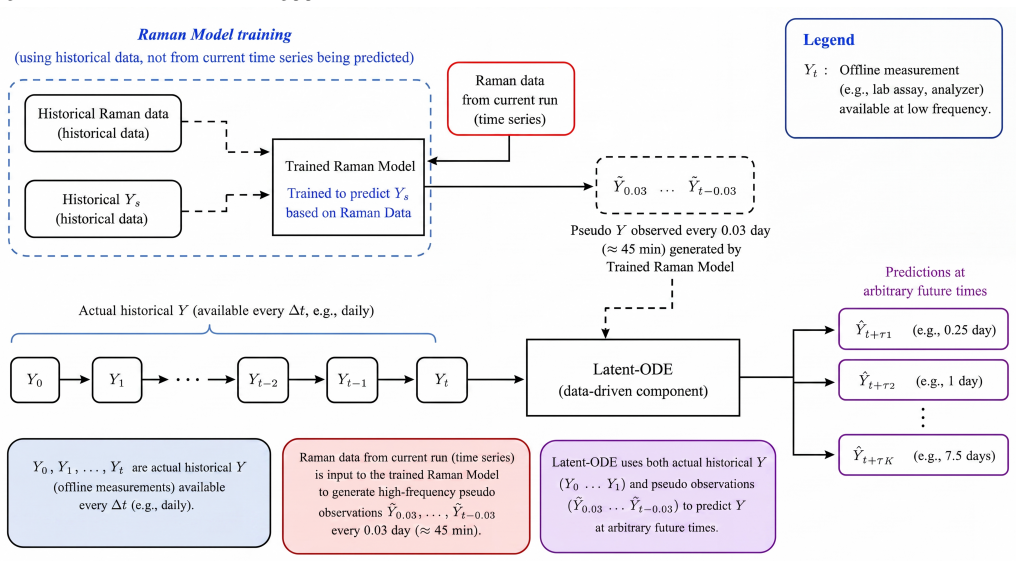
Mammalian cell-culture processes underpin the manufacture of many biopharmaceuticals, yet keeping a run on track is hard: critical process parameters drift over days, and an off-specification trend is often confirmed too late to intervene. Early-stage, multi-day forecasts could enable timely adjustment of feeding, sampling, and control, but bioprocess forecasting is challenging because measurements are sparse and irregularly sampled, operating conditions are heterogeneous across cell lines and media, and runs with near-identical early behaviour can diverge into different futures. We propose an adaptive framework combining a Gated Bottleneck Latent Ordinary Differential Equation (GB-Latent ODE) with Multi-Path Just-In-Time Fine Tuning (MP-JIT-FT). The GB-Latent ODE augments the stan dard Latent ODE with learnable variable-wise gating and a mask-aware bottleneck that compress high-dimensional sparse inputs, improving learning under limited data. Given a partially observed run, MP-JIT-FT retrieves similar historical trajectories, clusters the local neighbourhood into candidate regimes, and fine-tunes a separate model per regime to produce multiple plausible paths, each with a reconstruction-based confidence score, not a single averaged forecast. We further fuse Raman spectroscopy data: a machine-learning soft sensor turns dense Raman spectra into pseudo-observations that enrich the sparse offline measurements for more robust training. On 38 fed-batch 5L bioreactor runs spanning 14 conditions, MP-JIT-FT with Raman fusion achieves the best average rank and outperforms a global Latent ODE baseline on 8 of 9 target variables. Using local-divergence metrics, we show the multi-path gains are largest when locally similar prefixes diverge, whereas Raman fusion helps most when early dynamics are representative of later behaviour.
Editorial analysis
A structured set of objections, weighed in public.
Referee Report
Summary. The paper proposes a Multipath Adaptive Gated Bottleneck Latent ODE (GB-Latent ODE) framework augmented with Multi-Path Just-In-Time Fine Tuning (MP-JIT-FT) and Raman spectroscopy data fusion for forecasting in mammalian cell-culture bioprocesses. The GB-Latent ODE adds variable-wise gating and a mask-aware bottleneck to handle sparse, irregular measurements; MP-JIT-FT retrieves similar historical runs, clusters them into regimes, and fine-tunes per-regime models to generate multiple plausible forecast paths with reconstruction-based confidence scores. On 38 fed-batch 5L bioreactor runs spanning 14 conditions, the full method is reported to achieve the best average rank and to outperform a global Latent ODE baseline on 8 of 9 target variables, with larger gains when locally similar prefixes diverge.
Significance. If the empirical claims hold after proper validation, the work would offer a practical advance for early multi-day forecasting under data scarcity and process heterogeneity, directly relevant to biopharmaceutical manufacturing control. The combination of adaptive local fine-tuning with Raman soft-sensor fusion and explicit multi-path outputs addresses documented limitations of global latent ODEs in this domain; the local-divergence analysis provides a falsifiable way to identify when the multi-path component adds value.
major comments (3)
- [§4] §4 (Experimental Results) and Table 2: the reported outperformance (best average rank, superior on 8/9 variables) is presented without error bars, p-values, or details of the train/validation/test split and cross-validation scheme; without these the central empirical claim cannot be assessed for robustness.
- [§3.2] §3.2 (MP-JIT-FT): the procedure for retrieving similar trajectories, the similarity metric, the clustering algorithm that defines regimes, and the fine-tuning protocol are described at a high level only; these choices are load-bearing for the multi-path claim yet lack the concrete implementation or ablation that would allow reproduction or verification of the divergence-benefit result.
- [§3.3] §3.3 (Raman fusion): the machine-learning soft sensor that converts Raman spectra into pseudo-observations is introduced without reporting its training/validation split, hold-out performance, or any check that the pseudo-observations preserve the underlying dynamics rather than introducing bias; this directly affects the claimed benefit of Raman fusion when early dynamics are representative.
minor comments (3)
- [Abstract] Abstract: 'stan dard' contains an extraneous space; correct to 'standard'.
- [§3.1] Notation: the gating and bottleneck mechanisms are introduced with several new symbols whose dimensions and initialization are not stated explicitly; a small table of symbols would improve clarity.
- [Figures] Figure captions and axis labels in the results section should explicitly state the number of runs and conditions used for each panel to avoid ambiguity.
Simulated Author's Rebuttal
We thank the referee for their thorough review and constructive suggestions. We address each major comment below, agreeing that additional details are needed for robustness assessment and reproducibility. We will incorporate the requested information and analyses in the revised manuscript.
read point-by-point responses
-
Referee: [§4] §4 (Experimental Results) and Table 2: the reported outperformance (best average rank, superior on 8/9 variables) is presented without error bars, p-values, or details of the train/validation/test split and cross-validation scheme; without these the central empirical claim cannot be assessed for robustness.
Authors: We agree that the absence of error bars, statistical significance tests, and explicit details on the data splitting strategy limits the assessment of the results' robustness. In the revised manuscript, we will include error bars representing standard deviation across multiple random seeds or cross-validation folds. We will also report p-values from appropriate statistical tests (e.g., Wilcoxon signed-rank test) comparing our method to the baseline. Regarding the split, we employed a stratified split based on the 14 conditions to ensure no condition leakage, with details to be added in §4. This will strengthen the central empirical claim. revision: yes
-
Referee: [§3.2] §3.2 (MP-JIT-FT): the procedure for retrieving similar trajectories, the similarity metric, the clustering algorithm that defines regimes, and the fine-tuning protocol are described at a high level only; these choices are load-bearing for the multi-path claim yet lack the concrete implementation or ablation that would allow reproduction or verification of the divergence-benefit result.
Authors: We acknowledge that §3.2 provides a high-level overview. To enable reproducibility, we will expand this section with concrete details: the similarity metric used (dynamic time warping on normalized trajectories), the clustering algorithm (hierarchical clustering with Ward linkage on the latent representations), the number of regimes (determined by silhouette score), and the fine-tuning protocol (5 epochs at learning rate 1e-4 with early stopping). Additionally, we will include an ablation study in the supplementary material demonstrating the impact of each component on the multi-path performance, particularly the divergence-benefit result. revision: yes
-
Referee: [§3.3] §3.3 (Raman fusion): the machine-learning soft sensor that converts Raman spectra into pseudo-observations is introduced without reporting its training/validation split, hold-out performance, or any check that the pseudo-observations preserve the underlying dynamics rather than introducing bias; this directly affects the claimed benefit of Raman fusion when early dynamics are representative.
Authors: We agree that more details on the Raman soft sensor are necessary. In the revision, we will specify that the soft sensor (a random forest regressor) was trained on 80% of the Raman-offline pairs from the 38 runs, with 20% held out for validation, reporting RMSE and R² values on the hold-out set. We will also add an analysis comparing the latent dynamics learned with and without the pseudo-observations to verify that no systematic bias is introduced, supporting the claim that Raman fusion aids when early dynamics are representative. revision: yes
Circularity Check
No significant circularity identified
full rationale
The paper proposes an empirical ML framework (GB-Latent ODE + MP-JIT-FT + Raman fusion) and reports performance on 38 bioreactor runs against a global Latent ODE baseline. No derivation chain, equations, or first-principles claims are presented that reduce by construction to fitted inputs, self-citations, or renamed patterns. The central claims rest on direct experimental comparisons rather than tautological predictions, making the work self-contained against external benchmarks.
Axiom & Free-Parameter Ledger
Reference graph
Works this paper leans on
-
[1]
Applications of machine learning in antibody discovery, process de- velopment, manufacturing and formulation: Current trends, challenges, and opportunities,
T. T. Khuat, R. Bassett, E. Otte, A. Grevis-James, and B. Gabrys, “Applications of machine learning in antibody discovery, process de- velopment, manufacturing and formulation: Current trends, challenges, and opportunities,”Computers & Chemical Engineering, vol. 182, p. 108585, Mar. 2024
2024
-
[2]
Digital twins in pharmaceutical and biopharmaceutical manufacturing: A literature review,
Y . Chen, O. Yang, C. Sampat, P. Bhalode, R. Ramachandran, and M. Ierapetritou, “Digital twins in pharmaceutical and biopharmaceutical manufacturing: A literature review,”Processes, vol. 8, no. 9, 2020. [Online]. Available: https://www.mdpi.com/2227-9717/8/9/1088
2020
-
[3]
Elevated pco2 affects the lactate metabolic shift in CHO cell culture processes,
M. Brunner, P. Doppler, T. Klein, C. Herwig, and J. Fricke, “Elevated pco2 affects the lactate metabolic shift in CHO cell culture processes,” Engineering in Life Sciences, vol. 18, no. 4, pp. 204–214, 2018
2018
-
[4]
High-end ph-controlled delivery of glucose effectively suppresses lactate accumulation in CHO fed-batch cultures,
M. Gagnon, G. Hiller, Y .-T. Luan, A. Kittredge, J. DeFelice, and D. Dra- peau, “High-end ph-controlled delivery of glucose effectively suppresses lactate accumulation in CHO fed-batch cultures,”Biotechnology and Bioengineering, vol. 108, no. 6, pp. 1328–1337, 2011
2011
-
[5]
Data-driven prediction models for forecasting multistep ahead profiles of mammalian cell culture toward bioprocess digital twins,
S.-Y . Park, S.-J. Kim, C.-H. Park, J. Kim, and D.-Y . Lee, “Data-driven prediction models for forecasting multistep ahead profiles of mammalian cell culture toward bioprocess digital twins,”Biotechnol Bioeng, vol. 120, no. 9, pp. 2494–2508, Apr. 2023. 13
2023
-
[6]
Applied advanced process analytics in biopharmaceutical manufacturing: Challenges and prospects in real-time monitoring and control,
C. Undey, S. Ertunç, T. Mistretta, and M. Pathak, “Applied advanced process analytics in biopharmaceutical manufacturing: Challenges and prospects in real-time monitoring and control,”IFAC Proceedings Volumes, vol. 42, no. 11, pp. 177–182, 2009, 7th IFAC Symposium on Advanced Control of Chemical Processes. [Online]. Available: https://www.sciencedirect.co...
2009
-
[7]
Opportunities and challenges of real-time release testing in biopharmaceutical manufacturing,
M. Jiang, K. A. Severson, J. C. Love, H. Madden, P. Swann, L. Zang, and R. D. Braatz, “Opportunities and challenges of real-time release testing in biopharmaceutical manufacturing,”Biotechnol Bioeng, vol. 114, no. 11, pp. 2445–2456, Aug. 2017
2017
-
[8]
Machine learning methods for small data and upstream bioprocessing applications: A comprehensive review,
J. Peng, T. T. Khuat, K. Musial, and B. Gabrys, “Machine learning methods for small data and upstream bioprocessing applications: A comprehensive review,”Biotechnology Advances, vol. 87, p. 108749, 2026. [Online]. Available: https://www.sciencedirect.com/ science/article/pii/S0734975025002356
2026
-
[9]
Modeling kinetics of a large-scale fed-batch CHO cell culture by markov chain monte carlo method,
Z. Xing, N. Bishop, K. Leister, and Z. J. Li, “Modeling kinetics of a large-scale fed-batch CHO cell culture by markov chain monte carlo method,”Biotechnol Prog, vol. 26, no. 1, pp. 208–219, Jan. 2010
2010
-
[10]
Development and validation of a hybrid model for prediction of viable cell density, titer and cumulative glucose consumption in a mammalian cell culture system,
B. Yatipanthalawa, S. Fitzsimons, T. Horning, Y . Lee, and S. Gras, “Development and validation of a hybrid model for prediction of viable cell density, titer and cumulative glucose consumption in a mammalian cell culture system,”Computers & Chemical Engineering, vol. 184, p. 108648, 03 2024
2024
-
[11]
Data-driven soft sensing for batch processes using neural network-based deep quality-relevant representation learning,
Q. Jiang, Z. Wang, S. Yan, and Z. Cao, “Data-driven soft sensing for batch processes using neural network-based deep quality-relevant representation learning,”IEEE Transactions on Artificial Intelligence, vol. 4, no. 4, pp. 602–611, 2023
2023
-
[12]
Neu- ral ordinary differential equations,
R. T. Q. Chen, Y . Rubanova, J. Bettencourt, and D. K. Duvenaud, “Neu- ral ordinary differential equations,” inAdvances in Neural Information Processing Systems, S. Bengio, H. Wallach, H. Larochelle, K. Grauman, N. Cesa-Bianchi, and R. Garnett, Eds., vol. 31. Curran Associates, Inc., 2018. [Online]. Available: https://proceedings.neurips.cc/paper_ files/p...
2018
-
[13]
K.-C. Chiu and D. Du, “A neural ordinary differential equation model for predicting the growth of chinese hamster ovary cell in a bioreactor system,”Biotechnology and Bioprocess Engineering, vol. 30, no. 1, pp. 100–115, Feb 2025. [Online]. Available: https://doi.org/10.1007/s12257-024-00141-2
-
[14]
Latent ordinary differential equations for irregularly-sampled time series,
Y . Rubanova, R. T. Q. Chen, and D. K. Duvenaud, “Latent ordinary differential equations for irregularly-sampled time series,” inAdvances in Neural Information Processing Systems, H. Wallach, H. Larochelle, A. Beygelzimer, F. d'Alché-Buc, E. Fox, and R. Garnett, Eds., vol. 32. Curran Associates, Inc., 2019. [Online]. Available: https://proceedings.neurips...
2019
-
[15]
Review of adaptation mechanisms for data-driven soft sensors,
P. Kadlec, R. Grbi ´c, and B. Gabrys, “Review of adaptation mechanisms for data-driven soft sensors,”Computers & Chemical Engineering, vol. 35, no. 1, pp. 1–24, jan 2011
2011
-
[16]
Soft sensors: where are we and what are the current and future challenges?
P. Kadlec and B. Gabrys, “Soft sensors: where are we and what are the current and future challenges?”IFAC Proceedings Volumes, vol. 42, no. 19, pp. 572–577, 2009
2009
-
[17]
A machine-learning approach to calibrate generic raman models for real-time monitoring of cell culture processes,
A. Tulsyan, G. Schorner, H. Khodabandehlou, T. Wang, M. Coufal, and C. Undey, “A machine-learning approach to calibrate generic raman models for real-time monitoring of cell culture processes,”Biotechnol- ogy and Bioengineering, vol. 116, no. 10, pp. 2575–2586, 2019
2019
-
[18]
Automatic real-time calibration, assessment, and mainte- nance of generic raman models for online monitoring of cell culture processes,
A. Tulsyan, T. Wang, G. Schorner, H. Khodabandehlou, M. Coufal, and C. Undey, “Automatic real-time calibration, assessment, and mainte- nance of generic raman models for online monitoring of cell culture processes,”Biotechnology and Bioengineering, vol. 117, no. 2, pp. 406 – 416, 2020
2020
-
[19]
Integration of just-in-time learning with variational autoencoder for cell culture process monitoring based on raman spectroscopy,
M. Rashedi, H. Khodabandehlou, T. Wang, M. Demers, A. Tulsyan, C. Garvin, and C. Undey, “Integration of just-in-time learning with variational autoencoder for cell culture process monitoring based on raman spectroscopy,”Biotechnol Bioeng, vol. 121, no. 7, pp. 2205–2224, Apr. 2024
2024
-
[20]
Ex- tensive evaluation of machine learning models and data preprocessings for raman modeling in bioprocessing,
M. Poth, G. Magill, A. Filgertshofer, O. Popp, and T. Großkopf, “Ex- tensive evaluation of machine learning models and data preprocessings for raman modeling in bioprocessing,”Journal of Raman Spectroscopy, vol. 53, no. 9, pp. 1580–1591, 2022
2022
-
[21]
Adaptive ensemble-based hyperparameter-free just-in-time learning for robust cell culture process monitoring,
J. Peng, T. T. Khuat, E. Otte, R. Bassett, A. Grevis-James, K. Musial, and B. Gabrys, “Adaptive ensemble-based hyperparameter-free just-in-time learning for robust cell culture process monitoring,”Procedia Computer Science, vol. 264, pp. 157–166, 2025, international Neural Network Society Workshop on Deep Learning Innovations and Applications 2025
2025
-
[22]
Learning from limited data and feedback for cell culture process monitoring: A comparative study,
J. Peng, T. T. Khuat, E. Otte, K. Musial, and B. Gabrys, “Learning from limited data and feedback for cell culture process monitoring: A comparative study,”Chemical Engineering Journal, p. 175264, 2026
2026
-
[23]
T. T. Khuat, R. Bassett, E. Otte, and B. Gabrys, “Uncertainty quantifica- tion using ensemble learning and monte carlo sampling for performance prediction and monitoring in cell culture processes,”arXiv preprint arXiv:2409.02149, 2024
-
[24]
Online machine learning for real-time cell culture process mon- itoring,
——, “Online machine learning for real-time cell culture process mon- itoring,” inProceedings of the 37th Australasian Joint Conference on Artificial Intelligence. Springer, 2024, pp. 363–375
2024
-
[25]
T. T. Khuat, J. Peng, R. Bassett, E. Otte, and B. Gabrys, “Lessons learned from deploying adaptive machine learning agents with limited data for real-time cell culture process monitoring,” 2025. [Online]. Available: https://arxiv.org/abs/2509.02606
-
[26]
Multiple adaptive mechanisms for data-driven soft sensors,
R. Bakirov, B. Gabrys, and D. Fay, “Multiple adaptive mechanisms for data-driven soft sensors,”Computers & Chemical Engineering, vol. 96, pp. 42–54, jan 2017
2017
-
[27]
Feature selection using stochastic gates,
Y . Yamada, O. Lindenbaum, S. Negahban, and Y . Kluger, “Feature selection using stochastic gates,” inProceedings of the 37th International Conference on Machine Learning, ser. Proceedings of Machine Learning Research, H. D. III and A. Singh, Eds., vol
-
[28]
10 648–10 659
PMLR, 13–18 Jul 2020, pp. 10 648–10 659. [Online]. Available: https://proceedings.mlr.press/v119/yamada20a.html
2020
-
[29]
Temporal fusion transformers for interpretable multi-horizon time series forecasting,
B. Lim, S. O. Arik, N. Loeff, and T. Pfister, “Temporal fusion transformers for interpretable multi-horizon time series forecasting,” International Journal of Forecasting, vol. 37, no. 4, pp. 1748– 1764, 2021. [Online]. Available: https://www.sciencedirect.com/science/ article/pii/S0169207021000637
2021
-
[30]
Gaussian Error Linear Units (GELUs)
D. Hendrycks and K. Gimpel, “Bridging nonlinearities and stochastic regularizers with gaussian error linear units,”CoRR, vol. abs/1606.08415, 2016. [Online]. Available: http://arxiv.org/abs/ 1606.08415
work page internal anchor Pith review Pith/arXiv arXiv 2016
-
[31]
Making and evaluating point forecasts,
T. Gneiting, “Making and evaluating point forecasts,”Journal of the American Statistical Association, vol. 106, no. 494, pp. 746–762, 2011
2011
-
[33]
Available: https://arxiv.org/abs/1909.03765
[Online]. Available: https://arxiv.org/abs/1909.03765
-
[34]
Lagging inference networks and posterior collapse in variational autoencoders,
J. He, D. Spokoyny, G. Neubig, and T. Berg-Kirkpatrick, “Lagging inference networks and posterior collapse in variational autoencoders,” inInternational Conference on Learning Representations, 2019. [Online]. Available: https://openreview.net/forum?id=rylDfnCqF7
2019
-
[35]
A just-in-time fine-tuning framework for deep learning of sae in adaptive data-driven modeling of time-varying industrial processes,
Y . Wu, D. Liu, X. Yuan, and Y . Wang, “A just-in-time fine-tuning framework for deep learning of sae in adaptive data-driven modeling of time-varying industrial processes,”IEEE Sensors Journal, vol. PP, 09 2020
2020
-
[36]
Adversarial transferred data-assisted soft sensor for enhanced multigrade quality prediction,
Y . Dai, C. Yang, J. Zhu, and Y . Liu, “Adversarial transferred data-assisted soft sensor for enhanced multigrade quality prediction,” ACS Omega, vol. 8, no. 22, pp. 19 900–19 911, Jun 2023. [Online]. Available: https://doi.org/10.1021/acsomega.3c01832
-
[37]
Clustering of time series based on forecasting performance of global models,
Á. López-Oriona, P. Montero-Manso, and J. A. Vilar, “Clustering of time series based on forecasting performance of global models,” in Advanced Analytics and Learning on Temporal Data, T. Guyet, G. Ifrim, S. Malinowski, A. Bagnall, P. Shafer, and V . Lemaire, Eds. Cham: Springer International Publishing, 2023, pp. 18–33
2023
-
[38]
Ensembles of localised models for time series forecasting,
R. Godahewa, K. Bandara, G. I. Webb, S. Smyl, and C. Bergmeir, “Ensembles of localised models for time series forecasting,”Knowledge- Based Systems, vol. 233, p. 107518, 2021. [Online]. Available: https://www.sciencedirect.com/science/article/pii/S0950705121007802
2021
-
[39]
H. Abbasimehr and A. Noshad, “Localized global time series forecasting models using evolutionary neighbor-aided deep clustering method,” Journal of Forecasting, vol. 44, no. 5, pp. 1716–1733, 2025. [Online]. Available: https://onlinelibrary.wiley.com/doi/abs/10.1002/for.3263
-
[40]
Multiple futures prediction,
C. Tang and R. R. Salakhutdinov, “Multiple futures prediction,” in Advances in Neural Information Processing Systems, H. Wallach, H. Larochelle, A. Beygelzimer, F. d'Alché-Buc, E. Fox, and R. Garnett, Eds., vol. 32. Curran Associates, Inc., 2019. [Online]. Available: https://proceedings.neurips.cc/paper_files/paper/ 2019/file/86a1fa88adb5c33bd7a68ac2f9f3f...
2019
-
[41]
Soft sensor for viable cell counting by measuring dynamic oxygen uptake rate,
M. Winter, L. Achleitner, and P. Satzer, “Soft sensor for viable cell counting by measuring dynamic oxygen uptake rate,”New Biotechnol- ogy, vol. 83, pp. 16–25, 2024
2024
-
[42]
Viable cell estimation of mammalian cells using off-gas-based oxygen uptake rate and aging- specific functional,
A. Survyla, R. Urniezius, and R. Simutis, “Viable cell estimation of mammalian cells using off-gas-based oxygen uptake rate and aging- specific functional,”Talanta, vol. 254, p. 124121, 2023
2023
-
[43]
The shortcomings of accurate rate estimations in cultivation processes and a solution for precise and robust process modeling,
B. Bayer, B. Sissolak, M. Duerkop, M. von Stosch, and G. Striedner, “The shortcomings of accurate rate estimations in cultivation processes and a solution for precise and robust process modeling,”Bioprocess and Biosystems Engineering, vol. 43, pp. 169–178, 2020. 14
2020
-
[44]
A new approach to linear filtering and prediction problems,
R. E. Kalman, “A new approach to linear filtering and prediction problems,”Journal of Basic Engineering, vol. 82, no. 1, pp. 35–45, 03
-
[45]
Journal of Basic Engineering82, 35–45 (1960)
[Online]. Available: https://doi.org/10.1115/1.3662552
-
[46]
Breiman, J
L. Breiman, J. Friedman, R. A. Olshen, and C. J. Stone,Classification and Regression Trees, 1st ed. Chapman and Hall/CRC, 1984
1984
-
[47]
Cross-validation confidence intervals for test error,
P. Bayle, A. Bayle, L. Janson, and L. Mackey, “Cross-validation confidence intervals for test error,” inAdvances in Neural Information Processing Systems, H. Larochelle, M. Ranzato, R. Hadsell, M. Balcan, and H. Lin, Eds., vol. 33. Curran Associates, Inc., 2020, pp. 16 339– 16 350. [Online]. Available: https://proceedings.neurips.cc/paper_files/ paper/202...
2020
-
[48]
Scikit-learn: Machine learning in python,
F. Pedregosa, G. Varoquaux, A. Gramfort, V . Michel, B. Thirion, O. Grisel, M. Blondel, P. Prettenhofer, R. Weiss, V . Dubourg, J. Vander- plas, A. Passos, D. Cournapeau, M. Brucher, M. Perrot, and É. Duch- esnay, “Scikit-learn: Machine learning in python,”Journal of Machine Learning Research, vol. 12, pp. 2825–2830, 2011
2011
-
[49]
Pytorch: An imperative style, high-performance deep learning library,
A. Paszke, S. Gross, F. Massa, and L. Library, “Pytorch: An imperative style, high-performance deep learning library,” inAdvances in Neural Information Processing Systems, vol. 32, 2019
2019
-
[50]
torchdiffeq,
R. T. Q. Chen, “torchdiffeq,” https://github.com/rtqichen/torchdiffeq, 2018, mIT License
2018
-
[51]
Scale-down cultivation in mammalian cell bioreactors—the effect of bioreactor mixing time on the response of CHO cells to dissolved oxygen gradients,
E. Anane, I. M. Knudsen, and G. C. Wilson, “Scale-down cultivation in mammalian cell bioreactors—the effect of bioreactor mixing time on the response of CHO cells to dissolved oxygen gradients,”Biochemical Engineering Journal, vol. 166, p. 107870, 2021
2021
-
[52]
Energy metabolism in chinese hamster ovary (CHO) cells: Productivity and beyond,
J. U. Park, H.-J. Han, and J. Y . Baik, “Energy metabolism in chinese hamster ovary (CHO) cells: Productivity and beyond,”Korean Journal of Chemical Engineering, vol. 39, no. 5, pp. 1097–1106, 2022
2022
-
[53]
Investiga- tion of the interactions of critical scale-up parameters (pH, po2 and pco2) on CHO batch performance and critical quality attributes,
M. Brunner, P. Doppler, T. Klein, C. Herwig, and J. Fricke, “Investiga- tion of the interactions of critical scale-up parameters (pH, po2 and pco2) on CHO batch performance and critical quality attributes,”Bioprocess and Biosystems Engineering, vol. 40, pp. 251–263, 2017
2017
-
[54]
A practical method for calculating largest lyapunov exponents from small data sets,
M. T. Rosenstein, J. J. Collins, and C. J. De Luca, “A practical method for calculating largest lyapunov exponents from small data sets,” Physica D: Nonlinear Phenomena, vol. 65, no. 1, pp. 117–134, 1993. [Online]. Available: https://www.sciencedirect.com/science/article/pii/ 016727899390009P 15
1993
discussion (0)
Sign in with ORCID, Apple, or X to comment. Anyone can read and Pith papers without signing in.