REVIEW 2 major objections 4 minor 26 references
TF shifts make multiuser Zak-OTFS uplink channels nearly independent, so each user’s IOR can be estimated like a single-user problem with superimposed spread pilots.
Reviewed by Pith at T0; open to challenge. T0 means a machine referee read the full paper against a public rubric. the ladder, T0–T4 →
T0 review · grok-4.5
2026-07-10 10:41 UTC pith:XX22MEEY
load-bearing objection Solid multiuser Zak-OTFS extension: closed-form heterogeneous channels, quantitative IUI decoupling, and filter-dependent SE comparison of superimposed vs embedded pilots. the 2 major comments →
Multiuser Zak-OTFS on the Uplink with Superimposed Spread-Pilots
The pith
A machine-rendered reading of the paper's core claim, the machinery that carries it, and where it could break.
Core claim
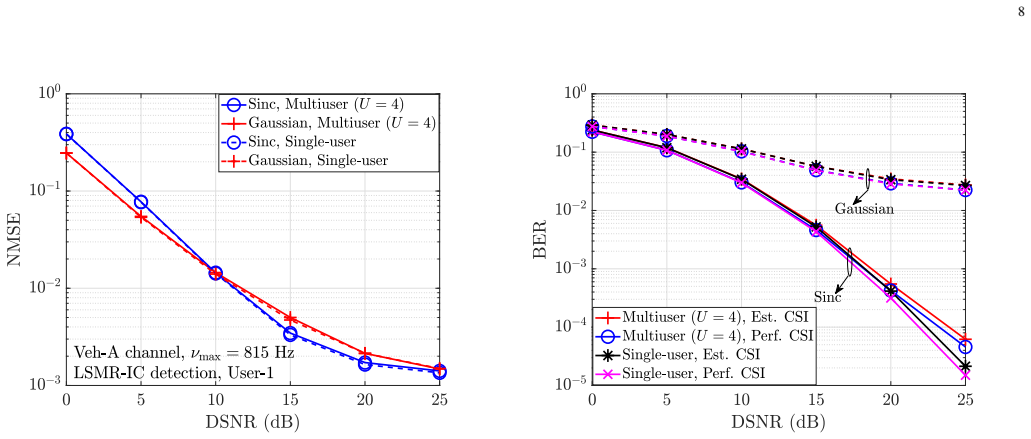
Under TF-shift multiple access the multiuser Zak-OTFS uplink decouples: residual inter-user interference is negligible, so each user’s effective channel and input-output relation can be estimated independently with a superimposed spread-pilot and a dictionary-based iterative algorithm, recovering essentially single-user NMSE and BER; for sinc pulses the same frame also yields higher spectral efficiency than the conventional embedded pilot.
What carries the argument
TF-shift multiple access together with the closed-form effective channel heff,u,v: a phase term in each user’s transmit filter places users in non-overlapping TF supports; the resulting heff,u,v expressions prove that the off-user terms are strongly attenuated, reducing the multiuser estimation problem to independent single-user subproblems that are solved by an iterative DD-dictionary algorithm driven by an FFT-of-Zadoff-Chu spread pilot.
Load-bearing premise
That the TF supports stay sufficiently non-overlapping after realistic pulse shaping and channel dispersion so residual inter-user interference remains small enough for the dictionary estimator to ignore it.
What would settle it
Measure the actual SIR at one user’s receiver when another user transmits at ten times the power under the same TF-shift allocation and pulse shapes; if SIR falls well below the reported 15 dB (Gaussian) / 28 dB (sinc) levels, or if multiuser NMSE diverges from single-user NMSE, the decoupling claim fails.
Editorial analysis
A structured set of objections, weighed in public.
Referee Report
Summary. The paper studies the uplink of a multiuser Zak-OTFS system with heterogeneous DD periods/frame sizes. Multiple access is realized by TF shifts that place users in non-overlapping TF regions. Closed-form expressions are derived for the effective DD-domain channel heff,u,v and the noise covariance under both sinc and Gaussian pulse shaping (Eqs. 17–20 and Appendices A–B). These expressions are used to show that IUI is negligible, decoupling multiuser IOR estimation into independent single-user problems. A superimposed spread-pilot (FFT of a reshaped Zadoff–Chu sequence) is employed together with a DD-dictionary iterative estimator that alternates between path-gain estimation and data detection (Algorithm 1). Simulations for a four-user heterogeneous allocation demonstrate that multiuser NMSE and BER essentially match the corresponding single-user baselines, that the superimposed frame yields higher spectral efficiency than an embedded-pilot frame for the sinc pulse across a wide range of inter-user power ratios, and that the reverse holds for the Gaussian pulse because of residual IUI plus pilot-data interference. Robustness to Veh-A/TDL-A/TDL-C profiles and to maximum Doppler is also reported.
Significance. If the claims hold, the work supplies a concrete, low-overhead multiuser extension of Zak-OTFS that preserves the crystalline-regime predictability of the single-user IOR while accommodating heterogeneous numerology—an important practical requirement for high-mobility 6G scenarios. The closed-form multiuser channel and noise expressions (which correctly specialize to the known single-user formulas of [17]) and the quantitative SIR evidence for IUI negligibility are reusable building blocks. The spectral-efficiency comparison between superimposed and embedded pilots, together with the explicit explanation of the Gaussian-filter reversal, gives clear design guidance. The iterative dictionary estimator is shown to approach perfect-CSI performance with modest complexity that scales linearly with the number of users because of the decoupling.
major comments (2)
- [Sec. IV-B and Fig. 4] The central decoupling claim rests on residual IUI remaining negligible after realistic pulse shaping and multipath dispersion. While Fig. 4 (noise-free SIR) and the multiuser-versus-single-user overlays in Figs. 6–7 support the claim for the specific four-user TF allocation of Table I / Fig. 5 and the Veh-A/TDL channels of Sec. V, the manuscript does not quantify how close the TF supports may approach each other before the SIR falls below the level needed for the dictionary estimator to remain accurate. A short additional experiment (or analytic bound derived from Eqs. 17–18) that varies the guard gap between TF supports would make the operating region of the claim fully explicit.
- [Sec. V-C, Eq. (34)] Spectral-efficiency comparisons (Fig. 8 and Fig. 9) fix PDR = 0 dB and use a particular guard-region size for the embedded pilot. Because both the pilot-data interference of the superimposed frame and the residual IUI of the Gaussian filter depend on these parameters, a brief sensitivity sweep (or an explicit statement that the reported crossover is robust for PDR in a stated interval) would strengthen the design recommendation that “sinc prefers superimposed, Gaussian prefers embedded.”
minor comments (4)
- [Sec. V] The definition of data SNR (DSNR = Ed/(N0 MN)) appears only in the text of Sec. V; placing it in a notation table or early in Sec. V would aid readability.
- [Sec. IV-A] Fig. 3 shows PAPR CCDF for a single user; a multiuser PAPR comparison (or a short remark that the PAPR advantage survives the TF-shift superposition) would complete the practical-advantage discussion begun in Remark 2.
- [Throughout] Typographical inconsistencies appear in a few places (e.g., “spetral efficiency”, “V eh-A”, occasional missing spaces around operators). A careful proof-reading pass is recommended.
- [Sec. V, Algorithm 1] The convergence threshold η = 10^{-3} and Tmax = 15 are stated without a short justification or plot of residual versus iteration; a single sentence or inset would suffice.
Circularity Check
No significant circularity; closed-form multiuser IOR expressions, IUI negligibility, and SE comparisons are independently derived and simulated rather than forced by prior self-citations.
full rationale
The paper generalizes single-user closed-forms from the authors' prior work [17] to the multiuser heterogeneous setting (Eqs. 17–18 and Appendices A–B), re-derives the effective channels under TF shifts, and then uses those expressions plus new Monte-Carlo experiments (Figs. 4, 6–11) to establish IUI negligibility and the SE ranking of superimposed versus embedded pilots. The TF-shift multiple-access construction itself is taken from the authors' concurrent arXiv [23], but the present claims (decoupling, NMSE/BER matching single-user, filter-dependent SE reversal) do not reduce by construction to any equation or uniqueness statement in [23]; they are new calculations and measurements. Free parameters (ατ = αν = 1.584, sτ = sν = 2, PDR = 0 dB) are stated design choices held fixed, never fitted and then re-presented as predictions. No self-definitional loop, no fitted-input-as-prediction, and no load-bearing uniqueness theorem imported from the authors appear. The modest self-citation footprint therefore does not elevate the circularity score above 1.
Axiom & Free-Parameter Ledger
free parameters (4)
- α_τ = α_ν =
1.584
- PDR (pilot-to-data power ratio) =
0 dB
- s_τ,u = s_ν,u (dictionary discretization) =
2
- T_max, η (iteration limits) =
15 / 1e-3
axioms (4)
- standard math Zak transform and twisted convolution identities that convert DD-domain filtering into the continuous-time signal model
- domain assumption Crystallization condition (delay period > delay spread, Doppler period > Doppler spread) guaranteeing a predictable non-fading IOR
- domain assumption Doubly-dispersive channel as a finite sum of discrete paths with gains, delays and Dopplers drawn from Veh-A / TDL profiles
- domain assumption TF-shift phase term places users in non-overlapping TF support regions so that heff,u,v for v≠u is strongly attenuated
read the original abstract
In this paper, we consider the uplink of a multiuser Zak-OTFS system comprising users with heterogeneous delay-Doppler (DD) periods/frame sizes. Multiple access is achieved through time-frequency (TF) shifts that place the users in non-overlapping regions of the TF plane. Closed-form expressions for the effective DD domain channel between each user and the base station are derived for sinc and Gaussian pulse shaping filters. The inter-user interference (IUI) is shown to be negligible under the TF-shift-based multiple access, thereby decoupling the multiuser input-output relation (IOR) estimation problem into independent single-user estimation problems. For IOR estimation, a superimposed spread-pilot framework is employed. The spread-pilot sequence is obtained by applying FFT to a reshaped Zadoff-Chu sequence. To mitigate the pilot-data interference introduced by the superimposed spread-pilot, a DD dictionary-based IOR estimation scheme that iterates between IOR estimation and data detection is employed. Simulation results for a multiuser Zak-OTFS system demonstrate that the resulting IOR estimates achieve normalized mean-square error (NMSE) and bit error rate (BER) performances that closely match those of the corresponding single-user system. Furthermore, for sinc pulse shaping, the superimposed spread-pilot frame achieves higher spectral-efficiency compared to embedded pilot frame across a wide range of inter-user power ratios. For Gaussian pulse shaping, however, the embedded pilot frame achieves a higher spectral efficiency due to the combined effects of residual IUI and significant pilot-data interference in the case of superimposed spread-pilot. The robustness of the estimation framework to variations in channel power-delay profile and maximum Doppler shift is also demonstrated.
Figures




Reference graph
Works this paper leans on
-
[1]
Framework and overall objectives of the future develop ment of IMT for 2030 and beyond,
“Framework and overall objectives of the future develop ment of IMT for 2030 and beyond,” ITU-R M.2160-0, Nov. 2023. https://www.itu.int/rec/R-REC-M.2160/en
work page 2030
-
[2]
Orthogonal time frequency space modul ation,
R. Hadani et al., “Orthogonal time frequency space modul ation,” Proc. IEEE WCNC’2017 , pp. 1-6, Mar. 2017
work page 2017
-
[3]
Does 6G need a new waveform: Comparing Z ak- OTFS with CP-OFDM,
I. A. Khan et al., “Does 6G need a new waveform: Comparing Z ak- OTFS with CP-OFDM,” arXiv:2601.15602, Jan. 2026
-
[4]
OTFS – A mathematical foundation for communication and rad ar sensing in the delay-Doppler domain,
S. K. Mohammed, R. Hadani, A. Chockalingam, and R. Calder bank, “OTFS – A mathematical foundation for communication and rad ar sensing in the delay-Doppler domain,” IEEE BITS Inf. Theory Mag. , vol. 2, no. 2, pp. 36-55, 1 Nov. 2022
work page 2022
-
[5]
OTFS – Predictability in the delay-Doppler domain and its v alue in communication and radar sensing,
S. K. Mohammed, R. Hadani, A. Chockalingam, and R. Calder bank, “OTFS – Predictability in the delay-Doppler domain and its v alue in communication and radar sensing,” IEEE BITS Inf. Theory Mag. , vol. 3, no. 2, pp. 7-31, Jun. 2023
work page 2023
-
[6]
On OTFS modulation for high- Doppler fading channels,
K. R. Murali and A. Chockalingam, “On OTFS modulation for high- Doppler fading channels,” Proc. ITA’2018 , pp. 1-10, Feb. 2018
work page 2018
-
[7]
P . Raviteja, K. T. Phan, Y . Hong, and E. Viterbo, “Interfe rence can- cellation and iterative detection for orthogonal time freq uency space modulation,” IEEE Trans. Wireless Commun., vol. 17, no. 10, pp. 6501- 6515, Oct. 2018
work page 2018
-
[8]
OTFS-based multipl e-access in high Doppler and delay spread wireless channels,
V . Khammammetti and S. K. Mohammed, “OTFS-based multipl e-access in high Doppler and delay spread wireless channels,” IEEE Wireless Commun. Lett. , vol. 8, no. 2, pp. 528-531, Apr. 2019
work page 2019
-
[9]
Spectral efficiency of OTFS based orthogonal multiple access with rectangular pulses,
V . Khammammetti and S. K. Mohammed, “Spectral efficiency of OTFS based orthogonal multiple access with rectangular pulses, ” IEEE Trans. V eh. Tech., vol. 71, no. 12, pp. 12989-13006, Dec. 2022
work page 2022
-
[10]
Multiple access in wireless tel ecommunica- tions system for high-mobility applications,
S. Rakib and R. Hadani, “Multiple access in wireless tel ecommunica- tions system for high-mobility applications,” U.S. Patent 9 722 741 B1, Aug. 2017
work page 2017
-
[11]
R. M. Augustine and A. Chockalingam, “Interleaved time -frequency multiple access using OTFS modulation,“ Proc. IEEE VTC’2019-Fall , pp. 1–5, Sep. 2019
work page 2019
-
[12]
O. K. Rasheed, G. D. Surabhi, and A. Chockalingam, “Spar se delay- Doppler channel estimation in rapidly time-varying channe ls for mul- tiuser OTFS on the uplink,” Proc. IEEE VTC’2020-Spring , May 2020
work page 2020
-
[13]
Multiple access for massive MIMO-OTFS networks over angle-delay-Doppler domain,
M. Li, S. Zhang, P . Fan, and O. A. Dobre, “Multiple access for massive MIMO-OTFS networks over angle-delay-Doppler domain,” Proc. IEEE GLOBECOM’2020, pp. 1–6, Dec. 2020
work page 2020
-
[14]
A new path division multiple access for the massive MIMO-OTFS networks,
M. Li, S. Zhang, F. Gao, P . Fan and, O. A. Dobre, “A new path division multiple access for the massive MIMO-OTFS networks,” IEEE J. Sel. Areas Commun. , vol. 39, no. 4, pp. 903–918, Apr. 2021
work page 2021
-
[15]
Bargmann transform, Zak transform , and coherent states,
A. J. E. M. Janssen, “Bargmann transform, Zak transform , and coherent states,” J. Math. Phys. 23, 720–731 (1982)
work page 1982
-
[16]
The Zak transform: a signal transfo rm for sampled time-continuous signals,
A. J. E. M. Janssen, “The Zak transform: a signal transfo rm for sampled time-continuous signals,” Philips J. Res. , 43, pp. 23-69, 1988
work page 1988
-
[17]
Closed-form ex pressions for I/O relation in Zak-OTFS with different delay-Doppler filte rs,
A. Das, F. Jesbin, and A. Chockalingam, “Closed-form ex pressions for I/O relation in Zak-OTFS with different delay-Doppler filte rs,” IEEE Trans. V eh. Tech.., vol. 74, no. 9, pp. 14250–14266, Sep. 2025
work page 2025
-
[18]
A Gaussian-sin c pulse shaping filter for Zak-OTFS,
A. Das, F. Jesbin, and A. Chockalingam, “A Gaussian-sin c pulse shaping filter for Zak-OTFS,” IEEE Trans. V eh. Tech., vol. 75, no. 3, pp. 4307- 4322, Mar. 2026
work page 2026
-
[19]
Zak-OTFS to Integrate Sensing the I/O Relation and Data Communication
M. Ubadah, S. K. Mohammed, R. Hadani, S. Kons, A. Chockal ingam, and R. Calderbank, “Zak-OTFS to integrate sensing the I/O re lation and data communication,” arXiv:2404.04182, Jun. 2025. 14
work page internal anchor Pith review Pith/arXiv arXiv 2025
-
[20]
Delay-Doppler Signal Processing with Zadoff-Chu Sequences
S. R. Mattu, I. A. Khan, V . Khammammetti, B. Dabak, S. K. M o- hammed, K. Narayanan, and R. Calderbank, “Delay-Doppler si gnal processing with Zadoff-Chu sequences,” arXiv:2412.04295 , Dec. 2024
work page internal anchor Pith review Pith/arXiv arXiv 2024
-
[21]
Diversi ty and BER performance of Zak-OTFS modulation,
F. Jesbin, J. Bodempudi, and A. Chockalingam, “Diversi ty and BER performance of Zak-OTFS modulation,” Proc. IEEE VTC2025-Spring , pp. 1-6, Jun. 2025
work page 2025
-
[22]
Goldsmith, Wireless Communications, Cambridge Univ
A. Goldsmith, Wireless Communications, Cambridge Univ. Press, 2005
work page 2005
-
[23]
Zak-OTFS based Multiuser Uplink in Doubly-Spread Channels
I. A. Khan, S. K. Mohammed, R. Hadani, A. Chockalingam, a nd R. Calderbank, “Zak-OTFS based multiuser uplink in doubly- spread channels,” arXiv:2507.15621, Jul. 2025
work page internal anchor Pith review Pith/arXiv arXiv 2025
-
[24]
Guidelines for evaluation of radio tran smission tech- nologies for IMT-2000,
ITU-R M.1225, “Guidelines for evaluation of radio tran smission tech- nologies for IMT-2000,” Int. Telecom. Union Radio Commun., 1997
work page 2000
-
[25]
Study on channel model for frequencies from 0.5 to 100 GHz,
3GPP TR 38.901, “Study on channel model for frequencies from 0.5 to 100 GHz,” version 16.1.0, Release 16
-
[26]
Low-comp lexity symbol detection and interference cancellation for OTFS sy stem,
H. Qu, G. Liu, L. Zhang, S. Wen, and M. A. Imran, “Low-comp lexity symbol detection and interference cancellation for OTFS sy stem,” IEEE Trans. Commun., vol. 69, no. 3, pp. 1524-1537, Mar. 2021
work page 2021
discussion (0)
Sign in with ORCID, Apple, or X to comment. Anyone can read and Pith papers without signing in.