REVIEW 2 major objections 6 minor 32 references
Learning elementary structures for 3D shape generation and matching
T0 review · 2 major / 6 minor · reviewed 2026-08-14 · deepseek-v4-flash
Pith's one-line read The paper argues that learning the elementary structures used to deform and combine into 3D shapes, rather than fixing them by hand, improves shape reconstruction and correspondence, with 16% and 6% relative gains in its experiments.
desk verdict The FAUST matching result is the real evidence; the ShapeNet 16% claim is an apples-to-oranges comparison that needs a missing baseline. read the letter →
The pith
A machine-rendered reading of the paper's core claim, the machinery that carries it, and where it could break.
The reading
What carries the argument
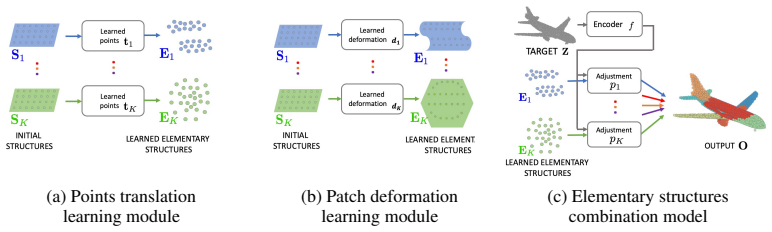
The load-bearing object is the set of learned elementary structures $E_k$, shared by all shapes in the training collection, together with the choice of how they are learned. Patch deformation learning computes $e_{k,i}=d_k(s_{k,i})$ as the continuous image of a surface, so the output can be densely sampled and meshed; point translation learning computes $e_{k,i}=t_{k,i}+s_{k,i}$ independently per point, giving topology flexibility at the cost of losing the continuous surface. At test time the structures are fixed and only the adjustment modules $p_k$ depend on the input shape, so the extra parameters for learning structures are less than 1% of the full network and inference cost is unchanged.
What would settle it
Train the same point-translation architecture with fixed unit-square primitives and compare Chamfer distance to the learned-structure version on ShapeNet; if the fixed-primitive result matches the learned one, the reported gain comes from the representation change rather than from learning structures. Likewise, compare patch-deformation learning with fixed versus learned primitives to check whether the 16% improvement survives when the output remains a continuous surface.
Extended reading notes
Core claim
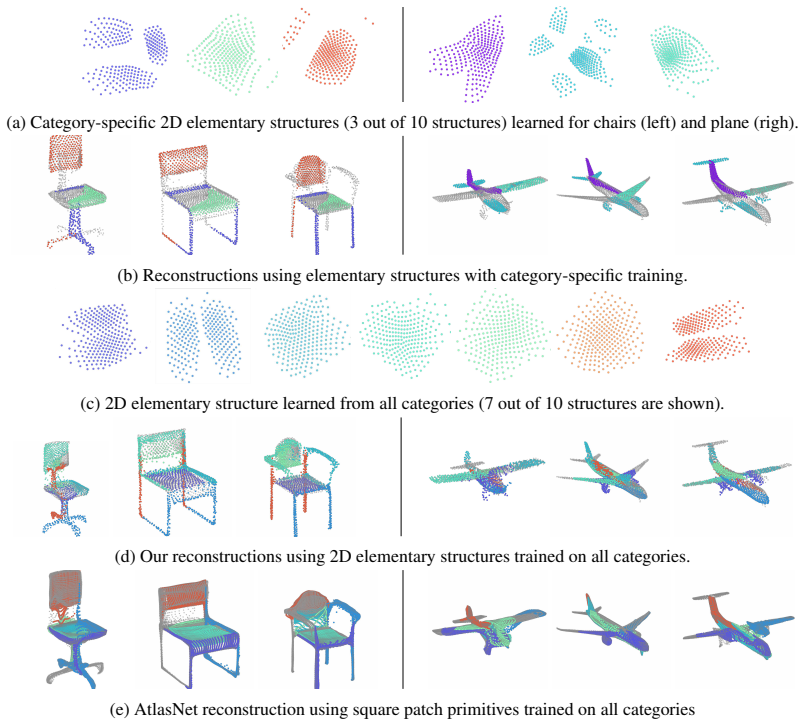
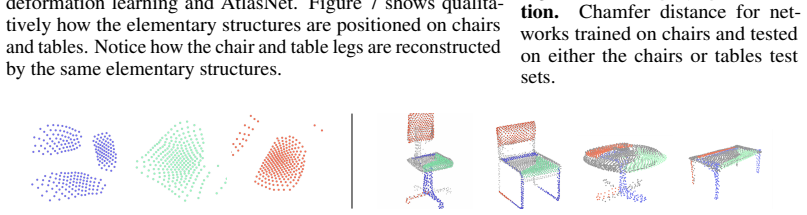
The central claim is that a shape can be represented as the union of a small number of shared elementary structures, learned over the training collection, each deformed by a shape-dependent adjustment module, and that this representation improves both generation and matching relative to fixed hand-chosen primitives. Formally, the output shape is $O = p(Z) = \bigcup_{k=1}^K \bigcup_{e\in E_k} p_k(e, f(Z))$, where $E_k$ are the learned elementary structures, $f(Z)$ is an encoder feature of the input, and $p_k$ are the adjustment modules. The structures $E_k$ are produced from initial surfaces either by patch deformation learning, which learns a continuous mapping $d_k$ and preserves the ability to densely sample and mesh the surface, or by point translation learning, which learns independent per-point translations and allows topology changes but outputs only a point cloud. The paper shows learned structures are consistent across shapes, often correspond to meaningful parts, transfer across related categories, and improve results as their dimension increases from 2D to 3D to 10D.
Load-bearing premise
The paper assumes its comparisons to AtlasNet and 3D-CODED isolate the effect of learning elementary structures, but the point-translation variant also changes the output from a continuous deformed surface to a freely translated point cloud, and no fixed-primitive point-translation baseline is reported.
Editorial extensions
If this is right
- If the paper is right, reconstruction systems can adopt learned primitives as a drop-in replacement for hand-chosen patches, improving accuracy without increasing inference cost or appreciably increasing parameters.
- Point translation learning should be preferred when reconstruction accuracy is the goal, while patch deformation learning should be preferred when dense surface output and correspondence quality matter.
- Raising the dimension of elementary structures from 2D to 3D to 10D improves both reconstruction and matching, so structure learning can trade interpretability for accuracy.
- Because learned structures generalize across related categories (trained on chairs, tested on tables), they can serve as a consistent part representation rather than a per-shape fit.
- For human shapes, learning a single template from SURREAL data improves FAUST inter correspondence over the fixed 3D-CODED template, suggesting template choice is a learnable component of correspondence pipelines.
Reading between the lines
- The reported 16% gain conflates two changes: the primitives become learned, and in the point-translation variant the output changes from a continuous deformed surface to a freely translated point cloud. A fixed-primitive point-translation baseline would be needed to attribute the gain specifically to structure learning; the paper does not report one.
- Because higher-dimensional structures improve results even though they are less interpretable, part of the benefit may come from a richer latent parametrization rather than from semantically meaningful primitives; an experiment that randomizes structure initialization while fixing dimension would test this.
- The consistency of learned structures across shapes suggests a natural testable extension: cluster output points by the elementary structure that generated them and check whether the resulting segmentation matches human part labels without supervision.
Signed reviews
Editorial analysis
A structured set of objections, weighed in public.
Referee Report
Summary. The paper proposes to replace hand-chosen shape primitives (unit squares in AtlasNet, a fixed human template in 3D-CODED) with "elementary structures" learned from a collection of shapes. Two modules are introduced: patch deformation, which learns continuous mappings from initial surfaces, and point translation, which independently translates sampled points. These structures are combined with adjustment networks (linear or MLP) to reconstruct shapes and predict correspondences. The paper reports a 16% relative improvement over AtlasNet on ShapeNet reconstruction and a 6% improvement over 3D-CODED on the FAUST inter challenge, and claims state-of-the-art correspondence results.
Significance. The idea of learning the primitives themselves is timely and could be influential for shape generation and matching. The paper provides a clear formulation, ablations over adjustment type, module type, dimensionality, and parameter count, and it improves the AtlasNet baseline with a learning rate schedule before comparing, which is good practice. The FAUST experiment (Deformation vs 3D-CODED, Table 2) is a clean controlled comparison and supports the central idea. However, the headline reconstruction claim is weakened by a confound in Table 1, and the lack of variance estimates limits confidence in the small improvements.
major comments (2)
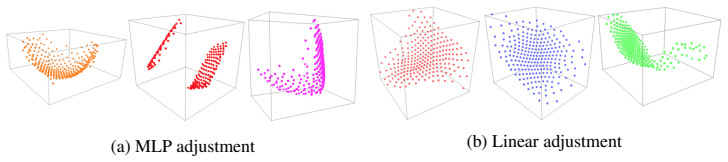
- [Section 4.1, Table 1 (MLP adjustment rows)] The reported 16% reconstruction improvement (Chamfer 1.45 to 1.22) is not an isolated effect of learning elementary structures. The Deformation row, which keeps the same continuous-surface output as AtlasNet and changes only the fixed unit squares to learned structures, improves from 1.45 to 1.43 (1.4% relative). The Points row changes the output representation (from a continuously sampled surface to a fixed set of points) and the input coordinates to the adjustment MLP (from 2D to 3D) in addition to learning the structures. Since no baseline with fixed, non-learned point structures is reported, the 16% cannot be attributed to elementary structure learning. The abstract's claim of "16% improvement over surface deformation approaches" is therefore not supported as stated; the authors should either report the headline claim as relative to point-translation methods with fixed primitives, or add a fixed-primitive point-translation baseline (e.g., with the translation modules psi_k disabled) to isolate the effect of learning the structures.
- [Tables 1 and 2 (all experiments)] All reported numbers are from single runs, without variance estimates or significance tests. Given that the clean surface-to-surface comparison is only 1.4% (1.45 vs 1.43 in Table 1) and the FAUST improvement is 6% (2.96 vs 2.76 in Table 2), run-to-run variability could alter the conclusions. The authors should provide mean and standard deviation over multiple seeds, or at least a significance test, for the headline comparisons in both tables.
minor comments (6)
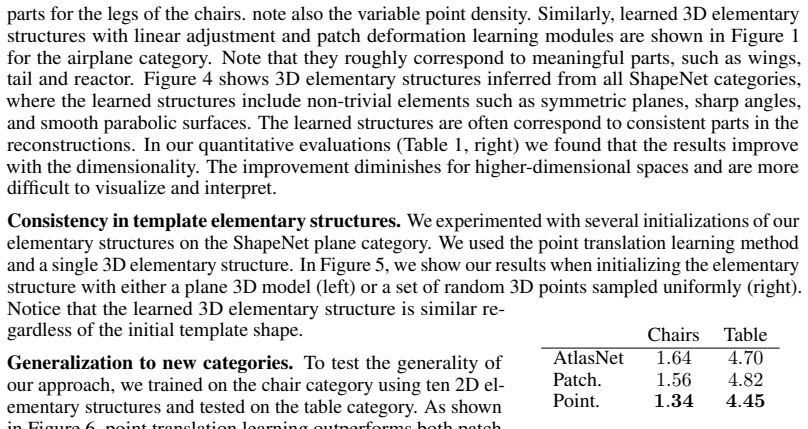
- [Figure 8] The parameter table reports total parameter counts, while the text says the elementary structures add less than 1% parameters; clarify that the counts for Patch and Point include the negligible structure-learning parameters, and make clear that the extra parameters for structure learning are 2.0e6 and 2.5e3, respectively.
- [Section 2, Related Work] The phrase "categorie specifique morphable model" appears to be a typo; it should likely be "category-specific morphable model."
- [Table 2] The right subtable's two-level header mixing "Points" and "Deform." under both "SURREAL" and "FAUST" is confusing; label the columns explicitly so the reader can tell which module each column refers to.
- [Section 3.3, Training details] The sentence "In all of our experiments, we used K = 10" is clear in context, but it would be helpful to state explicitly that the correspondence scenario uses K = 1, to avoid confusion with the reconstruction experiments.
- [Figure 3 caption] The word "plane" in the caption should likely be "airplane" to match the ShapeNet category name used elsewhere in the paper.
- [Section 4.1, Multi-class shape reconstruction] The sentence "note also the variable point density" starts with a lowercase letter; fix the capitalization.
Circularity Check
No circular derivation found: the learned elementary structures are trained on one split and evaluated on held-out data against fixed-primitive baselines.
full rationale
The paper's derivation chain is empirical and self-contained. Elementary structures are optimized on ShapeNet and SURREAL training sets and evaluated on held-out ShapeNet splits and on FAUST, with the only training signal being reconstruction losses (the corresponding-point squared loss in Eq. 2 and the symmetric Chamfer loss in Eq. 3). The central comparison varies the template (AtlasNet's fixed unit squares, 3D-CODED's fixed human mesh, versus the proposed learned shared structures) while keeping the same encoder and adjustment architectures adopted from [10, 11], so the reported improvement is not forced by construction. No fitted parameter is renamed as a prediction, no load-bearing argument reduces to a self-citation, and no equation is equivalent to its own input by definition. The main caveat—that the 'Points' variant changes both primitive learning and the output representation (a sampled continuous surface versus a finite translated point set)—is an attribution confound rather than circularity, and the paper does report the Deformation row as a more controlled comparison that changes only the primitive. The FAUST correspondence improvement over 3D-CODED uses the same single-template deformation pipeline with only the elementary structure learned, which further supports the central claim without circular reduction.
Assumptions & free parameters
free parameters (3)
- Number of elementary structures K =
10 for generic objects, 1 for humans
- Dimensionality of elementary structures =
2D, 3D, and 10D explored; 3D used for main results
- Initial structures S_k =
Unit 2D squares for ShapeNet; a SURREAL mesh template for humans
assumptions (5)
- domain assumption Multi-layer perceptrons with ReLU activations can represent the deformation fields needed to map initial surfaces to elementary structures and then to target shapes.
- domain assumption The symmetric Chamfer distance in Eq. 3 is an adequate training objective and evaluation metric for 3D shape reconstruction.
- domain assumption The PointNet-style global feature vector produced by the encoder retains enough information for the adjustment modules to position all K elementary structures.
- domain assumption In the correspondence setting, the initial template mesh provides a consistent ordering with all SURREAL training shapes, and the learned template transfers to FAUST scans.
- domain assumption The re-trained AtlasNet baseline with learning rate schedule is a fair and representative implementation of AtlasNet.
Cite this review
Pith. "Pith review of Learning elementary structures for 3D shape generation and matching." pith.science (2026). https://pith.science/paper/XX5IYDXC
@misc{pith2026190804725,
  author       = {Pith},
  title        = {Pith review of: Learning elementary structures for 3D shape generation and matching},
  year         = {2026},
  howpublished = {\url{https://pith.science/paper/XX5IYDXC}},
  note         = {Machine review of arXiv:1908.04725}
}
read the original abstract
We propose to represent shapes as the deformation and combination of learnable elementary 3D structures, which are primitives resulting from training over a collection of shape. We demonstrate that the learned elementary 3D structures lead to clear improvements in 3D shape generation and matching. More precisely, we present two complementary approaches for learning elementary structures: (i) patch deformation learning and (ii) point translation learning. Both approaches can be extended to abstract structures of higher dimensions for improved results. We evaluate our method on two tasks: reconstructing ShapeNet objects and estimating dense correspondences between human scans (FAUST inter challenge). We show 16% improvement over surface deformation approaches for shape reconstruction and outperform FAUST inter challenge state of the art by 6%.
Figures

Figures from the paper (6 more)



Reference graph
Works this paper leans on
- [1]
- [2]
- [3]
-
[4]
I. Binford. Visual perception by computer. In IEEE Conference of Systems and Control, 1971. 1, 2
work page 1971
-
[5]
F. Bogo, J. Romero, M. Loper, and M. J. Black. Faust: Dataset and evaluation for 3d mesh registration. In CVPR, 2014. 2, 8, 9
work page 2014
-
[6]
A. X. Chang, T. A. Funkhouser, L. J. Guibas, P. Hanrahan, Q. Huang, Z. Li, S. Savarese, M. Savva, S. Song, H. Su, J. Xiao, L. Yi, and F. Yu. Shapenet: An information-rich 3d model repository. CoRR, abs/1512.03012, 2015. 6
arXiv 2015
-
[7]
H. Fan, H. Su, and L. J. Guibas. A point set generation network for 3d object reconstruction from a single image. In Proceedings of the IEEE conference on computer vision and pattern recognition, pages 605–613, 2017. 4, 5
work page 2017
-
[8]
Learning Shape Templates with Structured Implicit Functions
K. Genova, F. Cole, D. Vlasic, A. Sarna, W. T. Freeman, and T. A. Funkhouser. Learning shape templates with structured implicit functions. CoRR, abs/1904.06447, 2019. 2
work page Pith review arXiv 1904
Show all 32 references
-
[9]
Golovinskiy and T
A. Golovinskiy and T. Funkhouser. Learning Consistent Segmentation of 3D Models. Computers and Graphics (Shape Modeling International), 2009. 2
2009
-
[10]
Groueix, M
T. Groueix, M. Fisher, V . G. Kim, B. Russell, and M. Aubry. 3d-coded : 3d correspondences by deep deformation. In ECCV, 2018. 1, 2, 3, 4, 5, 8, 9
2018
-
[11]
Groueix, M
T. Groueix, M. Fisher, V . G. Kim, B. Russell, and M. Aubry. AtlasNet: A Papier-Mâché Approach to Learning 3D Surface Generation. In Proceedings IEEE Conf. on Computer Vision and Pattern Recognition (CVPR), 2018. 1, 2, 3, 4, 5, 7
2018
-
[12]
Huang, V
Q. Huang, V . Koltun, and L. Guibas. Joint-Shape Segmentation with Linear Programming. ACM Transactions on Graphics (Proc. SIGGRAPH Asia), 2011. 2
2011
-
[13]
Kaiser, J
A. Kaiser, J. A. Ybanez Zepeda, and T. Boubekeur. A survey of simple geometric primitives detection methods for captured 3d data. In Computer Graphics Forum. Wiley Online Library,
-
[14]
Kanazawa, S
A. Kanazawa, S. Tulsiani, A. A. Efros, and J. Malik. Learning category-specific mesh recon- struction from image collections. In ECCV, 2018. 2
2018
-
[15]
V . G. Kim, W. Li, N. J. Mitra, S. Chaudhuri, S. DiVerdi, and T. Funkhouser. Learning Part- based Templates from Large Collections of 3D Shapes. Transactions on Graphics (Proc. of SIGGRAPH), 32(4), 2013. 2
2013
-
[16]
J. Li, K. Xu, S. Chaudhuri, E. Yumer, H. Zhang, and L. Guibas. Grass: Generative recursive autoencoders for shape structures. ACM Transactions on Graphics (TOG), 36(4):52, 2017. 1
2017
-
[17]
L. Li, M. Sung, A. Dubrovina, L. Yi, and L. Guibas. Supervised fitting of geometric primitives to 3d point clouds. arXiv preprint arXiv:1811.08988, 2018. 2
2018 arXiv
-
[18]
Y . Li, X. Wu, Y . Chrysanthou, A. Sharf, D. Cohen-Or, and N. J. Mitra. Globfit: Consistently fitting primitives by discovering global relations. ACM Transactions on Graphics, 30(4):52:1– 52:12, 2011. 2
2011
-
[19]
Loper, N
M. Loper, N. Mahmood, J. Romero, Pons-Moll, and M. J. G., Black. Smpl: A skinned multi-person linear model. SIGGRAPH Asia, 2015. 2
2015
-
[20]
Paschalidou, A
D. Paschalidou, A. O. Ulusoy, and A. Geiger. Superquadrics revisited: Learning 3d shape parsing beyond cuboids. In Proceedings IEEE Conf. on Computer Vision and Pattern Recognition (CVPR), June 2019. 2
2019
-
[21]
C. R. Qi, H. Su, K. Mo, and L. J. Guibas. Pointnet: Deep learning on point sets for 3d classification and segmentation. In Proceedings of the IEEE Conference on Computer Vision and Pattern Recognition, pages 652–660, 2017. 4
2017
-
[22]
L. G. Roberts. Machine perception of three-dimensional solids. PhD thesis, Massachusetts Institute of Technology, 1963. 1, 2 10
1963
-
[23]
Rosenblatt
F. Rosenblatt. The perceptron: a probabilistic model for information storage and organization in the brain. Psychological review, 65(6):386, 1958. 1
1958
-
[24]
Schnabel, P
R. Schnabel, P. Degener, and R. Klein. Completion and reconstruction with primitive shapes. Computer Graphics Forum (Proc. of Eurographics), 28(2):503–512, Mar. 2009. 2
2009
-
[25]
Schnabel, R
R. Schnabel, R. Wahl, and R. Klein. Efficient ransac for point-cloud shape detection. In Computer graphics forum, volume 26, pages 214–226. Wiley Online Library, 2007. 2
2007
-
[26]
Sharma, R
G. Sharma, R. Goyal, D. Liu, E. Kalogerakis, and S. Maji. Csgnet: Neural shape parser for constructive solid geometry. In Proceedings of the IEEE Conference on Computer Vision and Pattern Recognition, pages 5515–5523, 2018. 1, 2
2018
-
[27]
O. Sidi, O. van Kaick, Y . Kleiman, H. Zhang, and D. Cohen-Or. Unsupervised co-segmentation of a set of shapes via descriptor-space spectral clustering. In Transactions on Graphics (Proc. of SIGGRAPH Asia), pages 126:1–126:10, 2011. 2
2011
-
[28]
Tulsiani, H
S. Tulsiani, H. Su, L. J. Guibas, A. A. Efros, and J. Malik. Learning shape abstractions by assembling volumetric primitives. In Computer Vision and Pattern Recognition (CVPR), 2017. 1, 2, 7
2017
-
[29]
Varol, J
G. Varol, J. Romero, X. Martin, N. Mahmood, M. J. Black, I. Laptev, and C. Schmid. Learning from synthetic humans. In CVPR, 2017. 8, 9
2017
-
[30]
Y . Yang, C. Feng, Y . Shen, and D. Tian. Foldingnet: Point cloud auto-encoder via deep grid deformation. 2018 IEEE/CVF Conference on Computer Vision and Pattern Recognition, Jun
2018
-
[31]
C. Zou, E. Yumer, J. Yang, D. Ceylan, and D. Hoiem. 3d-prnn: Generating shape primitives with recurrent neural networks. In Proceedings of the IEEE International Conference on Computer Vision, pages 900–909, 2017. 2
2017
-
[32]
Zuffi and M
S. Zuffi and M. J. Black. The stitched puppet: A graphical model of 3d human shape and pose. Proceedings IEEE Conf. on Computer Vision and Pattern Recognition (CVPR), 2015. 2 11
2015
Reviewed August 14, 2026 · model on record in the stance chip above.
Discussion (0). Continue with ORCID to comment.