REVIEW 3 major objections 4 minor 1 cited by
Towards Instance-wise Personalized Federated Learning via Semi-Implicit Bayesian Prompt Tuning
T0 review · 3 major / 4 minor · reviewed 2026-08-05 · deepseek-v4-flash
Pith's one-line read By generating a personalized Bayesian prompt for every input image, pFedBayesPT claims to consistently beat existing personalized federated learning methods on both feature-shift and label-shift benchmarks.
desk verdict A plausible instance-wise Bayesian prompt-tuning method for pFL, but the training objective is underspecified as written because the prior p(p|x) in Eq. 14 is never defined. read the letter →
The pith
A machine-rendered reading of the paper's core claim, the machinery that carries it, and where it could break.
The reading
What carries the argument
The central object is the semi-implicit variational prompt posterior: p ~ q(p|ψ) with ψ ~ q_φ(ψ|x), so the marginal over prompts is an implicit distribution rather than a Gaussian. The randomness in ψ comes from Bernoulli-masked image features passed through layer-wise MLP encoders; the prompt is sampled with the reparameterization trick. This hierarchical setup is what lets a single model produce diverse instance-specific prompts without extra variational parameters. The training objective is the SIVI lower bound of Eq. 24, with the KL term regularizing the prompt distribution and the A_S term preventing the mixing distribution from collapsing to a point mass.
What would settle it
Retrain pFedBayesPT with the KL term in Eq. 24 replaced by a fixed L2 penalty on prompt magnitudes (or removed entirely) on DomainNet (m=6) and CIFAR-100 (s=50). If accuracy does not drop materially, the Bayesian regularizer is not carrying the reported gains. Also compare pFedBayesPT against pFedBayesPT-G using identical encoder capacity and mask sampling: if the gap vanishes, the benefit attributed to the implicit posterior could be due to stochastic feature masking alone.
Extended reading notes
Core claim
pFedBayesPT's central claim is that personalization in federated learning should happen per instance, not per client, and that Bayesian visual prompt tuning is a workable way to do it. For each input, the model extracts layer-wise token features from a frozen ViT, applies random binary masks to those features, and runs the masked features through per-layer MLPs that output the mean and variance of a Gaussian prompt distribution. Sampling a prompt via reparameterization and concatenating it with a shared global prompt gives the prompt used by the transformer. The paper derives a semi-implicit variational lower bound—Eq. 24—whose first term is the classification log-likelihood and whose second
Load-bearing premise
The training objective contains a term that compares the prompt distribution with a prior distribution over prompts that the paper never defines, so the regularization meant to prevent overfitting—and to justify the Bayesian interpretation—is underspecified.
Editorial extensions
If this is right
- Instance-wise prompt generation lets a client whose data spans several domains be served by one model, without storing multiple client-level models.
- Because prompts are generated from input features, the trained prompt encoder can personalize for clients that never participated in federated training.
- The frozen backbone plus prompt/head/encoder exchange keeps communication and trainable parameters close to lightweight prompt-tuning baselines.
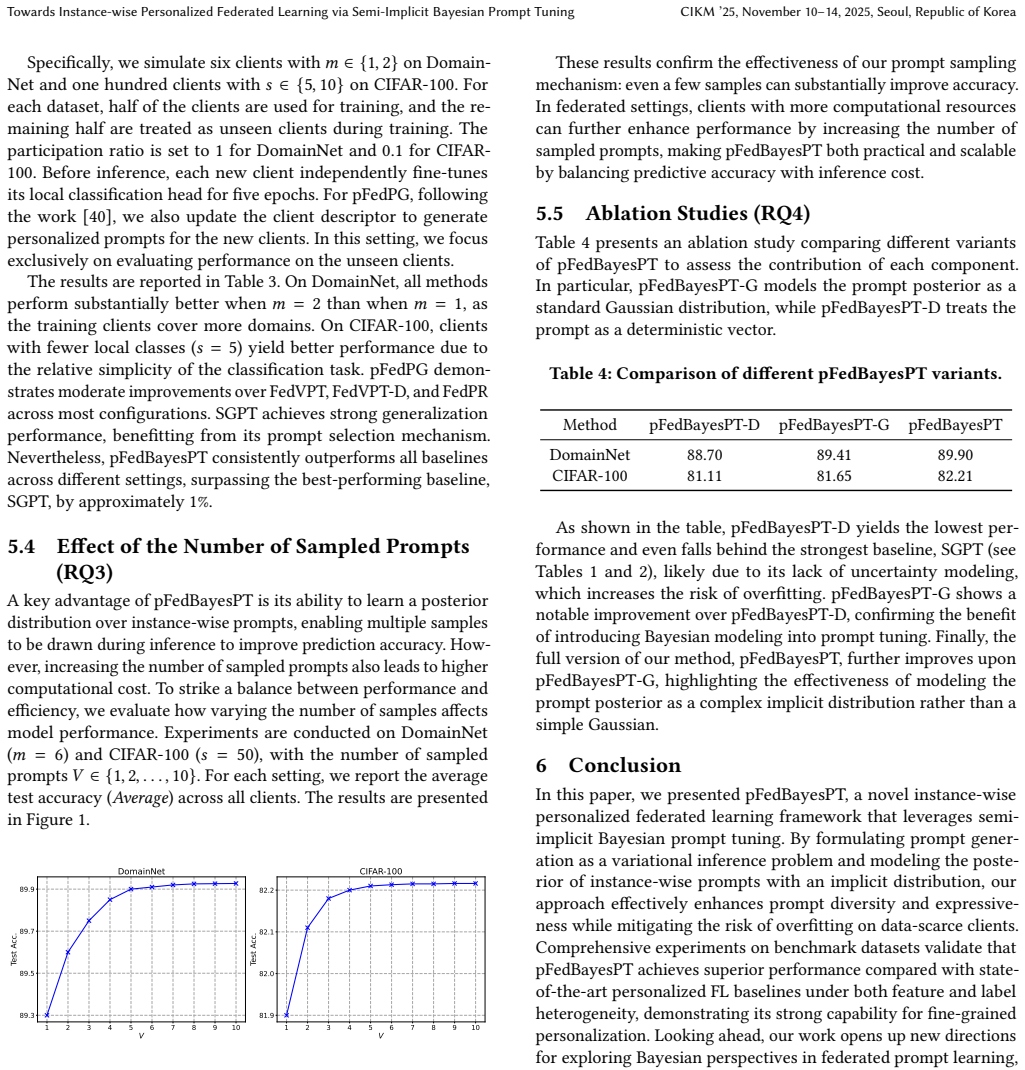
- Sampling several prompts at inference gives a tunable accuracy/compute trade-off, with more samples helping until diminishing returns.
- The ablation results indicate that both Bayesian uncertainty and the implicit (non-Gaussian) posterior contribute to the gains over deterministic prompt tuning.
Reading between the lines
- The unspecified prior p(p|x) leaves room for the method to actually be a conditional VAE-style regularizer; varying or removing the KL term would reveal how much of the gain is Bayesian regularization versus the stochastic prompt generator itself.
- Because the prompt encoder is purely input-conditioned and the backbone is frozen, the same mechanism could be lifted out of federated learning and used as a test-time adaptation module for a pretrained vision transformer on a new domain; the paper does not explore this.
- Bernoulli feature masking is a form of stochastic regularization; a head-to-head against ordinary dropout with a Gaussian posterior would isolate whether the implicit posterior or simply feature noise drives the improvement.
- The roughly 1% margin over SGPT is measured on two benchmarks; whether it survives stricter privacy constraints, larger client populations, or heterogeneous device compute budgets is left open.
Editorial analysis
A structured set of objections, weighed in public.
Referee Report
Summary. The paper proposes pFedBayesPT, an instance-wise personalized federated learning framework based on visual prompt tuning. Prompts are treated as latent variables with a semi-implicit variational posterior: a prompt distribution q(p|ψ) is mixed over stochastic encoder outputs ψ, which are produced by randomly masking image features. The authors derive a variational lower bound under the SIVI framework, add a regularization term to avoid posterior collapse, and use an importance-weighted objective as the training loss. They evaluate on DomainNet (feature shift) and CIFAR-100 (label shift) against several pFL baselines, reporting consistent improvements of roughly 1% over the strongest baseline, SGPT, as well as experiments on unseen clients, the number of inference-time prompt samples, and ablations comparing deterministic, Gaussian, and implicit posterior variants.
Significance. If the training objective were fully specified, the paper would be a useful contribution to personalized federated learning: it targets intra-client heterogeneity at the instance level, keeps communication costs low by tuning prompts only, and imports SIVI to obtain an expressive posterior without introducing many new parameters. The experimental design is broad and the ablations are informative; the pseudo-code and hyperparameter details are also helpful. The principal weakness is that the prior p(p|x) appearing in the central variational objective is never defined, so the exact algorithm is not determined by the text. This blocks independent verification of the reported results, which is the key obstacle to accepting the empirical claims.
major comments (3)
- [Eq. (14), Eq. (24), Sec. 4.1] The training objective is not fully specified. Eq. (14) defines the KL regularizer as KL(q(p|ψ) || p(p|x)), and Eq. (24) computes importance weights using p(y,p_j|x), which factorizes as p(y|p_j,x) p(p_j|x). Nowhere in Sec. 4 or Sec. 5.1.3 is the functional form of p(p|x) given. If the prior is meant to be a standard normal independent of x, the conditioning on x is unexplained and the Bayesian interpretation is unclear; if it is data-dependent, its exact form and parameters are undisclosed. Because this term enters every gradient update of J in Eq. (26), the algorithm cannot be reconstructed or reproduced. Please specify p(p|x), justify the conditioning on x, and update the derivation and implementation description accordingly.
- [Tables 1-3, Sec. 5.2] The central empirical claim is a consistent ~1% advantage over SGPT, but only the mean over three random seeds is reported. No standard deviations, confidence intervals, or per-seed results are given. With a margin this small, the reader cannot assess whether the advantage is statistically reliable or within run-to-run variability. Please report variance information for the main tables, or explain why it is not applicable.
- [Eq. (24), Sec. 4.3] The transition from L_S (Eq. 14 with A_S, Eq. 22) to the final importance-weighted objective L_S^J (Eq. 24) is not derived. In particular, the denominator Ω_j mixes q(p_j|ψ_j) with S additional samples q(p_j|ψ̃_s), and it is not obvious that the resulting expression is a valid lower bound for general J. Since the implementation fixes S=J=1, this may reduce to L+A_S, but the text should make that connection explicit and state the conditions under which Eq. (24) is a valid surrogate ELBO.
minor comments (4)
- [Sec. 5.1.3] Typo: 'whihc' should be 'which' in the description of the Worst Local metric.
- [Sec. 4.2] The symbol p is used both for the per-layer prompt and, after concatenation, for [p̄, p]. The text says 'For notational simplicity...' but this switch should be flagged more prominently to avoid confusion with the prior p(p|x).
- [Sec. 4.3] The derivation of Eq. (24) should include a sentence connecting A_S to the denominator Ω_j, since the current text jumps from Eq. (22) to the final objective.
- [Fig. 1] The effect of the number of prompt samples V is shown without error bars; adding them would make the plateau behavior more convincing.
Circularity Check
No significant circularity: the variational derivation is self-contained and the empirical claims are measured against external baselines; the undefined prior p(p|x) is a reproducibility gap, not a circular reduction.
full rationale
pFedBayesPT's derivation chain is self-contained in the relevant sense. Eqs. (11)-(14) are standard variational algebra: Jensen's inequality produces an ELBO, convexity of KL is used to lower-bound it à la SIVI, and Eq. (14) expands the joint p(y,p|x) as p(y|p,x)p(p|x). The final objectives (24) and (26) are the corresponding SIVI/importance-weighted surrogate applied to the paper's own encoder q_phi(psi|x) and Gaussian conditional q(p|psi); no claimed output (e.g., 'consistently best accuracy') appears as an input to the loss, and no fitted parameter is renamed as a prediction. The empirical claims are comparisons against external baselines (FedVPT, FedVPT-D, pFedPG, FedPR, SGPT) measured on DomainNet/CIFAR-100, not consequences of the variational equations. The citations that carry the derivation ([49] SIVI, [22] VPT, [9] SGPT) are external; the only author self-citations ([42], [48]) are background references in related work and are not load-bearing. One genuine gap should be flagged but it is not circularity: the 'prior' p(p|x) in Eq. (14), and hence in Eq. (24), is never defined. This leaves the exact objective under-specified and blocks exact reproduction, but no equation identifies p(p|x) with the variational distribution or with the fitted encoder, so it is a missing prior specification rather than a definitional loop. Accordingly, no circular step is established.
Assumptions & free parameters
free parameters (6)
- Bernoulli mask probability pi =
0.9
- Inference prompt sample count V =
5
- SIVI sample counts S, J =
1, 1
- Prompt insertion depth =
tuned 1..12
- Encoder learning rate rho =
tuned over {0.0001,...,0.01}
- Prompt lengths K, nu =
10, 1
assumptions (6)
- standard math SIVI theoretical properties from Yin and Zhou 2018, including the augmented objective A_S and the inequality KL(E[Q]||P) <= E[KL(Q||P)], are correct.
- ad hoc to paper The prior p(p|x) in Eq. 14 is a well-defined distribution, although its form is never stated.
- domain assumption Frozen ViT-B/16 pretrained features provide a sufficient representation for instance-wise prompt generation under federated fine-tuning.
- domain assumption Bernoulli-masked features, with the CLS token always preserved, generate a mixing distribution q_phi(psi|x) whose marginal h_phi(p|x) is a useful implicit posterior.
- domain assumption The true posterior p(p|x,y) is close enough to the variational family h_phi(p|x) for the derived ELBO to be practically useful.
- domain assumption Concatenating a global prompt and an instance-wise prompt at each layer is a valid input representation for the frozen ViT.
Cite this review
Pith. "Pith review of Towards Instance-wise Personalized Federated Learning via Semi-Implicit Bayesian Prompt Tuning." pith.science (2026). https://pith.science/paper/XXEVZS6N
@misc{pith2026250819621,
  author       = {Pith},
  title        = {Pith review of: Towards Instance-wise Personalized Federated Learning via Semi-Implicit Bayesian Prompt Tuning},
  year         = {2026},
  howpublished = {\url{https://pith.science/paper/XXEVZS6N}},
  note         = {Machine review of arXiv:2508.19621}
}
read the original abstract
Federated learning (FL) is a privacy-preserving machine learning paradigm that enables collaborative model training across multiple distributed clients without disclosing their raw data. Personalized federated learning (pFL) has gained increasing attention for its ability to address data heterogeneity. However, most existing pFL methods assume that each client's data follows a single distribution and learn one client-level personalized model for each client. This assumption often fails in practice, where a single client may possess data from multiple sources or domains, resulting in significant intra-client heterogeneity and suboptimal performance. To tackle this challenge, we propose pFedBayesPT, a fine-grained instance-wise pFL framework based on visual prompt tuning. Specifically, we formulate instance-wise prompt generation from a Bayesian perspective and model the prompt posterior as an implicit distribution to capture diverse visual semantics. We derive a variational training objective under the semi-implicit variational inference framework. Extensive experiments on benchmark datasets demonstrate that pFedBayesPT consistently outperforms existing pFL methods under both feature and label heterogeneity settings.
Figures
Forward citations
Cited by 1 Pith paper
-
Variational Adapter for Cross-modal Similarity Representation
VACSR reformulates cross-modal similarity learning as variational inference with regularization to mitigate binary annotation compression in image-text tasks.
Reference graph
Works this paper leans on
-
[1]
Durmus Alp Emre Acar, Yue Zhao, Ramon Matas, Matthew Mattina, Paul What- mough, and Venkatesh Saligrama. 2020. Federated Learning Based on Dynamic Regularization. In International Conference on Learning Representations
work page 2020
-
[2]
Manoj Ghuhan Arivazhagan, Vinay Aggarwal, Aaditya Kumar Singh, and Sunav Choudhary. 2019. Federated learning with personalization layers. arXiv preprint arXiv:1912.00818 (2019)
arXiv 2019
-
[3]
Jimmy Lei Ba, Jamie Ryan Kiros, and Geoffrey E Hinton. 2016. Layer normaliza- tion. arXiv preprint arXiv:1607.06450 (2016)
arXiv 2016
-
[4]
Yuri Burda, Roger Grosse, and Ruslan Salakhutdinov. 2015. Importance weighted autoencoders. arXiv preprint arXiv:1509.00519 (2015)
arXiv 2015
-
[5]
Guangyi Chen, Weiran Yao, Xiangchen Song, Xinyue Li, Yongming Rao, and Kun Zhang. 2022. PLOT: Prompt Learning with Optimal Transport for Vision- Language Models. In The Eleventh International Conference on Learning Represen- tations
work page 2022
-
[6]
Hong-You Chen and Wei-Lun Chao. 2022. On Bridging Generic and Personal- ized Federated Learning for Image Classification. In International Conference on Learning Representations
work page 2022
-
[7]
Ziliang Chen, Jingyu Zhuang, Xiaodan Liang, and Liang Lin. 2019. Blending-target domain adaptation by adversarial meta-adaptation networks. In Proceedings of the IEEE/CVF conference on computer vision and pattern recognition . 2248–2257
work page 2019
-
[8]
Liam Collins, Hamed Hassani, Aryan Mokhtari, and Sanjay Shakkottai. 2021. Exploiting shared representations for personalized federated learning. In Inter- national conference on machine learning . PMLR, 2089–2099
work page 2021
Show all 54 references
-
[9]
Wenlong Deng, Christos Thrampoulidis, and Xiaoxiao Li. 2024. Unlocking the Potential of Prompt-Tuning in Bridging Generalized and Personalized Federated Learning. In Proceedings of the IEEE/CVF Conference on Computer Vision and Pattern Recognition. 6087–6097
2024
-
[10]
Mohammad Mahdi Derakhshani, Enrique Sanchez, Adrian Bulat, Victor G Turrisi da Costa, Cees GM Snoek, Georgios Tzimiropoulos, and Brais Martinez. 2023. Bayesian prompt learning for image-language model generalization. In Proceed- ings of the IEEE/CVF International Conference on...
2023
-
[11]
Alexey Dosovitskiy, Lucas Beyer, Alexander Kolesnikov, Dirk Weissenborn, Xi- aohua Zhai, Thomas Unterthiner, Mostafa Dehghani, Matthias Minderer, Georg Heigold, Sylvain Gelly, et al . 2020. An Image is Worth 16x16 Words: Trans- formers for Image Recognition at Scale. In Intern...
2020
-
[12]
Alireza Fallah, Aryan Mokhtari, and Asuman Ozdaglar. 2020. Personalized fed- erated learning with theoretical guarantees: A model-agnostic meta-learning approach. Advances in Neural Information Processing Systems 33 (2020), 3557– 3568
2020
-
[13]
Chun-Mei Feng, Bangjun Li, Xinxing Xu, Yong Liu, Huazhu Fu, and Wangmeng Zuo. 2023. Learning federated visual prompt in null space for mri reconstruc- tion. In Proceedings of the IEEE/CVF Conference on Computer Vision and Pattern Recognition. 8064–8073
2023
-
[14]
Chun-Mei Feng, Kai Yu, Nian Liu, Xinxing Xu, Salman Khan, and Wangmeng Zuo
-
[15]
Chelsea Finn, Pieter Abbeel, and Sergey Levine. 2017. Model-agnostic meta- learning for fast adaptation of deep networks. In International conference on machine learning. PMLR, 1126–1135
2017
-
[16]
Avishek Ghosh, Jichan Chung, Dong Yin, and Kannan Ramchandran. 2020. An Efficient Framework for Clustered Federated Learning. In Advances in Neural Information Processing Systems (NeurIPS) , Vol. 33. 19586–19597
2020
-
[17]
Tao Guo, Song Guo, and Junxiao Wang. 2023. Pfedprompt: Learning personalized prompt for vision-language models in federated learning. In Proceedings of the ACM Web Conference 2023. 1364–1374
2023
-
[18]
Tao Guo, Song Guo, Junxiao Wang, Xueyang Tang, and Wenchao Xu. 2023. Promptfl: Let federated participants cooperatively learn prompts instead of models-federated learning in age of foundation model. IEEE Transactions on Mobile Computing (2023)
2023
-
[19]
Dai, and Quoc V
David Ha, Andrew M. Dai, and Quoc V. Le. 2017. HyperNetworks. In Interna- tional Conference on Learning Representations . https://openreview.net/forum?id= rkpACe1lx
2017
-
[20]
Andrew Hard, Kanishka Rao, Rajiv Mathews, Swaroop Ramaswamy, Françoise Beaufays, Sean Augenstein, Hubert Eichner, Chloé Kiddon, and Daniel Ram- age. 2018. Federated learning for mobile keyboard prediction. arXiv preprint arXiv:1811.03604 (2018)
2018 arXiv
-
[21]
Johan Ludwig William Valdemar Jensen. 1906. Sur les fonctions convexes et les inégalités entre les valeurs moyennes. Acta mathematica 30, 1 (1906), 175–193
1906
-
[22]
Menglin Jia, Luming Tang, Bor-Chun Chen, Claire Cardie, Serge Belongie, Bharath Hariharan, and Ser-Nam Lim. 2022. Visual prompt tuning. In Euro- pean Conference on Computer Vision . Springer, 709–727
2022
-
[23]
Sai Praneeth Karimireddy, Satyen Kale, Mehryar Mohri, Sashank Reddi, Sebas- tian Stich, and Ananda Theertha Suresh. 2020. Scaffold: Stochastic controlled averaging for federated learning. In International conference on machine learning . PMLR, 5132–5143
2020
-
[24]
Kingma and Max Welling
Diederik P. Kingma and Max Welling. 2013. Auto-Encoding Variational Bayes. In ICLR
2013
-
[25]
Nikita Kotelevskii, Maxime Vono, Alain Durmus, and Eric Moulines. 2022. Fedpop: A bayesian approach for personalised federated learning. Advances in Neural Information Processing Systems 35 (2022), 8687–8701
2022
-
[26]
Brian Lester, Rami Al-Rfou, and Noah Constant. 2021. The Power of Scale for Parameter-Efficient Prompt Tuning. In Proceedings of the 2021 Conference on Empirical Methods in Natural Language Processing . 3045–3059
2021
-
[27]
Guanghao Li, Wansen Wu, Yan Sun, Li Shen, Baoyuan Wu, and Dacheng Tao
-
[28]
Hongxia Li, Wei Huang, Jingya Wang, and Ye Shi. 2024. Global and Local Prompts Cooperation via Optimal Transport for Federated Learning. arXiv preprint arXiv:2403.00041 (2024)
2024 arXiv
-
[29]
Transactions on Machine Learning Research (2023)
Visual Prompt Based Personalized Federated Learning. Transactions on Machine Learning Research (2023)
2023
-
[30]
Tian Li, Anit Kumar Sahu, Manzil Zaheer, Maziar Sanjabi, Ameet Talwalkar, and Virginia Smith. 2020. Federated optimization in heterogeneous networks. Proceedings of Machine learning and systems 2 (2020), 429–450
2020
-
[31]
Tian Li, Shengyuan Hu, Ahmad Beirami, and Virginia Smith. 2021. Ditto: Fair and robust federated learning through personalization. In International Conference on Machine Learning (ICML), Vol. 139. 6357–6368
2021
-
[32]
Dongze Lian, Daquan Zhou, Jiashi Feng, and Xinchao Wang. 2022. Scaling & shifting your features: A new baseline for efficient model tuning. Advances in Neural Information Processing Systems 35 (2022), 109–123
2022
-
[33]
Xiang Li, Kaixuan Huang, Wenhao Yang, Shusen Wang, and Zhihua Zhang. 2019. On the Convergence of FedAvg on Non-IID Data. In International Conference on Learning Representations
2019
-
[34]
Brendan McMahan, Eider Moore, Daniel Ramage, Seth Hampson, and Blaise Aguera y Arcas. 2017. Communication-efficient learning of deep net- works from decentralized data. In Artificial intelligence and statistics . PMLR, 1273–1282
2017
-
[35]
Yuning Lu, Jianzhuang Liu, Yonggang Zhang, Yajing Liu, and Xinmei Tian. 2022. Prompt distribution learning. In Proceedings of the IEEE/CVF Conference on Com- puter Vision and Pattern Recognition . 5206–5215
2022
-
[36]
Jaehoon Oh, SangMook Kim, and Se-Young Yun. 2021. FedBABU: Toward En- hanced Representation for Federated Image Classification. In International Con- ference on Learning Representations
2021
-
[37]
John Nguyen, Jianyu Wang, Kshitiz Malik, Maziar Sanjabi, and Michael Rab- bat. 2022. Where to Begin? On the Impact of Pre-Training and Initialization in Federated Learning. In The Eleventh International Conference on Learning Representations
2022
-
[38]
Nicola Rieke, Jonny Hancox, Wenqi Li, Fausto Milletari, Holger R Roth, Shadi Albarqouni, Spyridon Bakas, Mathieu N Galtier, Bennett A Landman, Klaus Maier- Hein, et al. 2020. The future of digital health with federated learning. NPJ digital medicine 3, 1 (2020), 1–7
2020
-
[39]
Kunjal Panchal, Sunav Choudhary, Nisarg Parikh, Lijun Zhang, and Hui Guan
-
[40]
Aviv Shamsian, Aviv Navon, Ethan Fetaya, and Gal Chechik. 2021. Personalized federated learning using hypernetworks. In International Conference on Machine Learning. PMLR, 9489–9502
2021
-
[41]
Virginia Smith, Chao-Kai Chiang, Maziar Sanjabi, and Ameet S Talwalkar. 2017. Federated multi-task learning. Advances in neural information processing systems 30 (2017)
2017
-
[42]
Felix Sattler, Klaus-Robert MUller, and Wojciech Samek. 2020. Clustered feder- ated learning: Model-agnostic distributed multitask optimization under privacy constraints. IEEE Transactions on Neural Networks and Learning Systems (TNNLS) 32, 8 (2020), 3710–3722
2020
-
[43]
Guangyu Sun, Matias Mendieta, Taojiannan Yang, and Chen Chen. 2022. Explor- ing parameter-efficient fine-tuning for improving communication efficiency in federated learning. (2022)
2022
-
[44]
Alysa Ziying Tan, Han Yu, Lizhen Cui, and Qiang Yang. 2022. Towards person- alized federated learning. IEEE Transactions on Neural Networks and Learning Systems (2022)
2022
-
[45]
Shangchao Su, Mingzhao Yang, Bin Li, and Xiangyang Xue. 2024. Federated Adaptive Prompt Tuning for Multi-Domain Collaborative Learning. InProceedings of the AAAI Conference on Artificial Intelligence , Vol. 38. 15117–15125
2024
-
[46]
Chengyi Yang, Wentao Liu, Shisong Chen, Jiayin Qi, and Aimin Zhou. 2024. Generating Prompts in Latent Space for Rehearsal-free Continual Learning. In Proceedings of the 32nd ACM International Conference on Multimedia . 8913–8922
2024
-
[47]
Fu-En Yang, Chien-Yi Wang, and Yu-Chiang Frank Wang. 2023. Efficient model personalization in federated learning via client-specific prompt generation. In Proceedings of the IEEE/CVF International Conference on Computer Vision . 19159– 19168
2023
-
[48]
Guoyizhe Wei, Feng Wang, Anshul Shah, and Rama Chellappa. 2023. Dual Prompt Tuning for Domain-Aware Federated Learning. arXiv preprint arXiv:2310.03103 Towards Instance-wise Personalized Federated Learning via Semi-Implicit Bayesian Prompt Tuning CIKM ’25, November 10–14, 2025...
2023 arXiv
-
[49]
Mingzhang Yin and Mingyuan Zhou. 2018. Semi-implicit variational inference. In International conference on machine learning . PMLR, 5660–5669
2018
-
[50]
Mikhail Yurochkin, Mayank Agarwal, Soumya Ghosh, Kristjan Greenewald, Nghia Hoang, and Yasaman Khazaeni. 2019. Bayesian nonparametric federated learning of neural networks. In International conference on machine learning . PMLR, 7252–7261
2019
-
[51]
Tiandi Ye, Senhui Wei, Jamie Cui, Cen Chen, Yingnan Fu, and Ming Gao. 2023. Robust clustered federated learning. In International Conference on Database Systems for Advanced Applications. Springer, 677–692
2023
-
[54]
Xu Zhang, Yinchuan Li, Wenpeng Li, Kaiyang Guo, and Yunfeng Shao. 2022. Per- sonalized federated learning via variational bayesian inference. In International Conference on Machine Learning . PMLR, 26293–26310
2022
-
[2023]
InProceedings of the IEEE/CVF International Conference on Computer Vision
Towards Instance-adaptive Inference for Federated Learning. InProceedings of the IEEE/CVF International Conference on Computer Vision . 23287–23296
-
[2024]
Advances in Neural Information Processing Systems 36 (2024)
Flow: Per-instance Personalized Federated Learning. Advances in Neural Information Processing Systems 36 (2024)
2024
Reviewed August 5, 2026 · model on record in the stance chip above.
Discussion (0). Sign in to comment.