REVIEW 5 major objections 5 minor 37 references
Multi-Modal Recognition of Worker Activity for Human-Centered Intelligent Manufacturing
T0 review · 5 major / 5 minor · reviewed 2026-08-14 · deepseek-v4-flash
Pith's one-line read The paper claims that fusing an armband's inertial signals with two visual representations—each turned into images and classified by CNNs—recognizes six assembly activities with 97–100% accuracy.
desk verdict Leave-one-out is believable; the 100% half-half accuracy is a leakage artifact and the paper needs revision before I'd trust its headline claims. read the letter →
The pith
A machine-rendered reading of the paper's core claim, the machinery that carries it, and where it could break.
The reading
What carries the argument
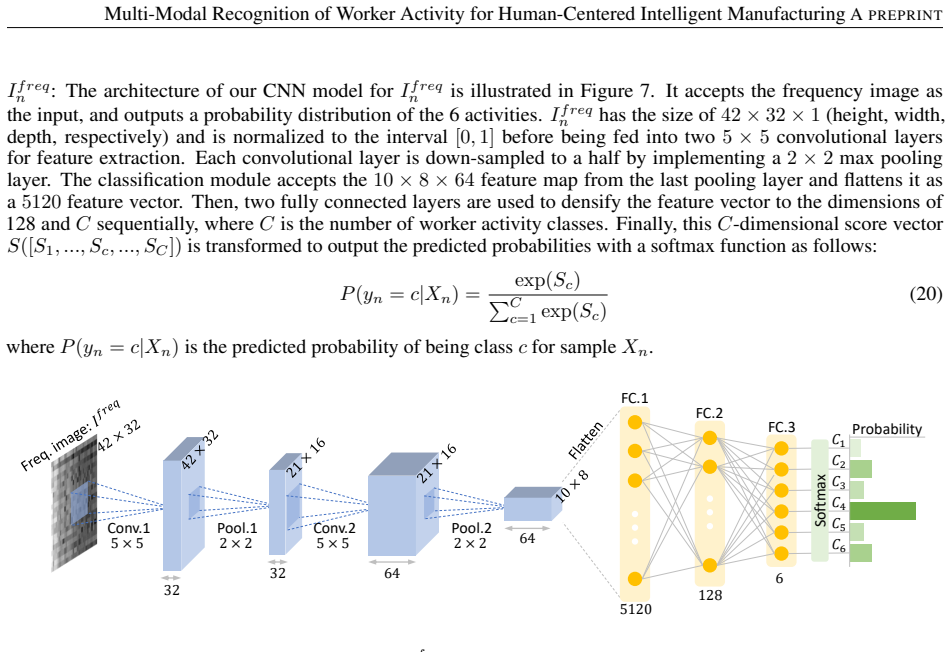
The load-bearing objects are two IMU-to-image transforms. The frequency feature transform stacks the 10 signal channels row-wise, expands them with a channel-shuffling algorithm so every pair of channels can appear as neighbors, applies a 2D discrete Fourier transform, and keeps one half of the logarithmic magnitude to exploit conjugate symmetry. The spatial transform rotates a reference unit vector by each quaternion sample, connects the resulting points on the unit sphere, projects the curve onto three orthogonal planes, and stacks the projections as a three-channel orientation-changing-history image. These images, together with a single middle video frame and a fixed-length video clip, are fed to four CNN classifiers—a small custom CNN, a pretrained VGG network, and a pretrained C3D network—and the four softmax probability vectors are averaged for the final label.
What would settle it
Re-annotate a subset of the recorded videos with a second annotator, or shift every sliding-window start by ±5 timestamp units, and rerun the leave-one-out evaluation; if accuracy drops by more than a couple of points, the reported 97.2% depends on annotation precision rather than the method itself.
Extended reading notes
Core claim
The paper's central claim is that fusing an inertial armband with a camera improves worker activity recognition beyond either sensor alone, and that this fusion can be achieved by turning both sensor streams into image-like inputs for convolutional networks. Concretely, on the authors' own six-activity assembly dataset, the four-modality model reaches 97.2% accuracy under leave-one-subject-out evaluation and 100% under a half-half split, with every multi-modality combination outperforming its constituent single-modality models. The paper also claims that a kinematics-based augmentation—spatial rotation and mirroring applied to the orientation quaternions—is more effective than conventional image jittering, raising the spatial-orientation modality from 63.6% to 77.3% accuracy. On the public PAMAP2 dataset, the two IMU-based modalities reach 94.16% accuracy, the best among the deep models compared.
Load-bearing premise
The method's reported accuracies assume the manually marked start and end times of each activity segment are exact enough that every 1.3-second sliding window inherits the correct one-activity label, and the paper reports no check of that annotation quality.
Editorial extensions
If this is right
- Adding modalities helps monotonically: leave-one-out accuracy rises from 90.2% for the best single IMU-frequency modality to 94.8% for frequency plus frame, and 97.2% for all four modalities.
- The frequency-domain IMU image is the strongest single modality (90.2% leave-one-out), beating both visual modalities, so inertial sensing remains valuable even when cameras are available.
- The IMU-to-image transforms transfer to a public dataset: on PAMAP2 the two IMU modalities reach 94.16% accuracy, ahead of all compared deep models.
- Kinematics-based augmentation outperforms jittering on both IMU modalities, with its largest benefit on the spatial-orientation image (63.6% to 77.3% leave-one-out).
- Simple average fusion beats maximum, weighted-maximum, and weighted-average fusion on this dataset, so the chosen inference strategy is the most direct combination of the four modalities.
Reading between the lines
- Because the half-half split mixes training and test samples from the same subjects and the same fixed workbench, the 100% figure is best read as an upper bound; the leave-one-out 97.2% is the more realistic estimate for a new worker, and a stricter test would also move the camera to a new viewpoint.
- The frame-level visual modality alone reaches 86.8% leave-one-out accuracy despite using only a single middle frame, which suggests static scene cues such as which tool is in hand do much of the work; one could test this by blurring the tool region and measuring how much the fusion depends on motion.
- The kinematics augmentation only rotates and mirrors orientation channels, leaving acceleration and angular velocity untouched; extending it to rotate acceleration vectors against gravity is a natural next experiment that might push the IMU modalities further.
Signed reviews
Editorial analysis
A structured set of objections, weighed in public.
Referee Report
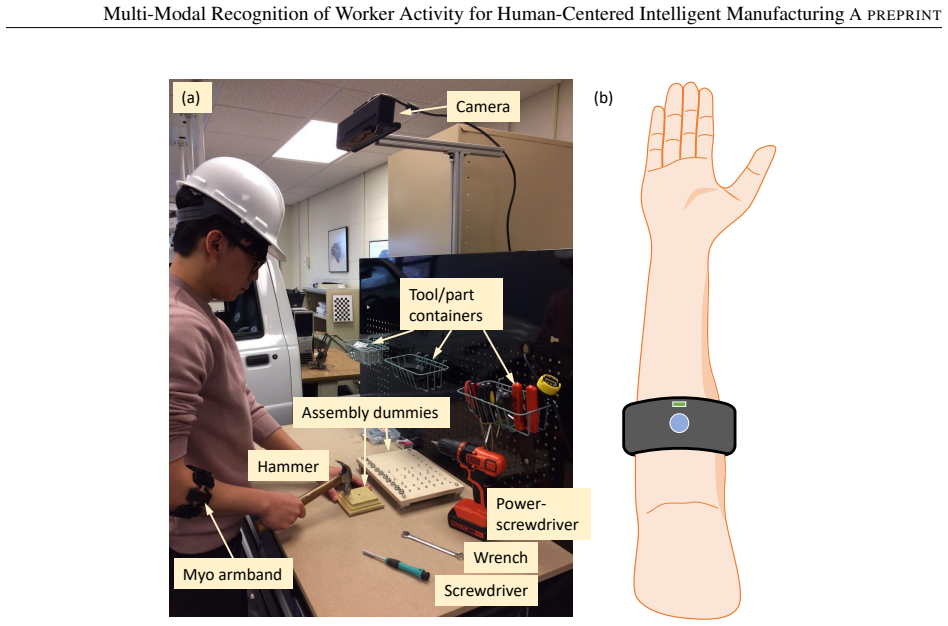
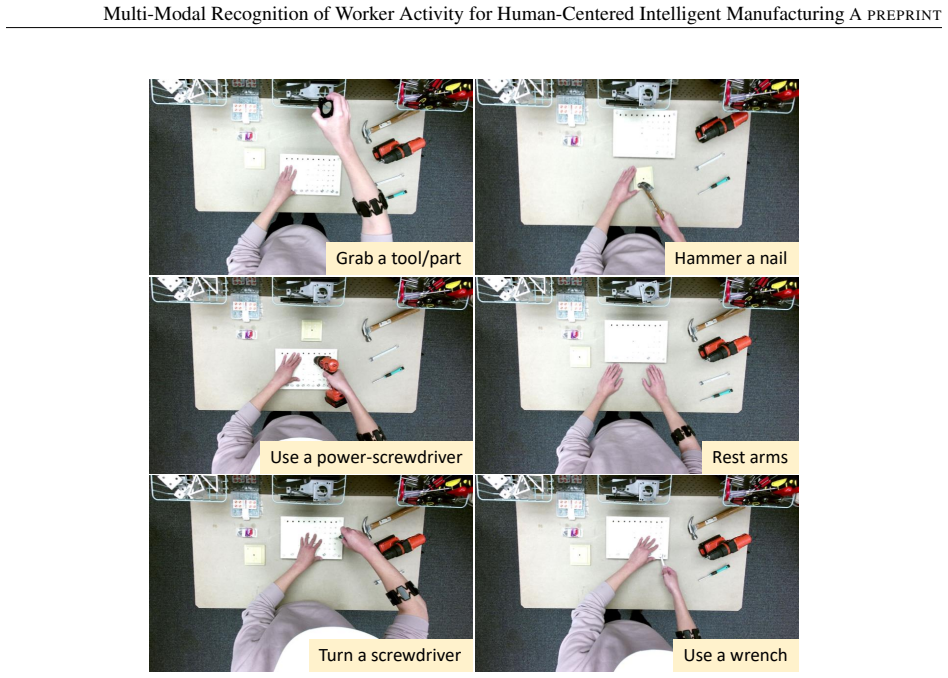
Summary. The paper proposes a multi-modal activity recognition framework for manufacturing workers. Two sensors are used: a wearable IMU armband and an overhead camera. The IMU signals are converted into two image-like representations (frequency-domain and spatial orientation-changing-history), and the video is represented at both the frame level and the clip level, giving four modalities. Each modality is classified by a CNN (with VGG and C3D transfer learning for the visual modalities), and the per-modality probability outputs are fused. A dataset of six assembly activities from eight subjects is collected, and experiments report leave-one-out and half-half accuracies, an ablation over modality combinations, a comparison of fusion methods, an evaluation of a kinematics-based augmentation approach, and a comparison on the public PAMAP2 dataset.
Significance. If the reported results are reproducible, the paper makes a useful engineering contribution: the IMU-to-image transforms are simple and lend themselves to standard CNN pipelines, the kinematics-based augmentation is physically motivated, and the four-modality fusion with average scoring is straightforward to implement. The strongest evidence is the leave-one-out accuracy of 97.2% for the quad-modal system (Table 5) and the 94.16% on PAMAP2 (Table 6), which provides external grounding. The systematic ablation across modality combinations is a strength. However, the headline 100% half-half result is not a valid generalization claim because of temporal leakage from heavily overlapping sliding windows, and the paper lacks error bars or repeated-run statistics, so several quantitative comparisons may not be significant.
major comments (5)
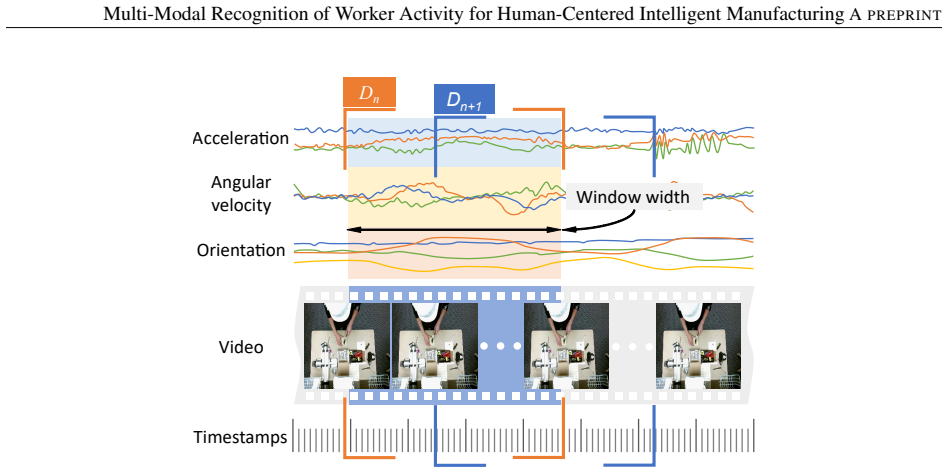
- [Section 5.2, Table 5, with Section 3.1] The half-half protocol as described is confounded by temporal leakage. Section 3.1 samples IMU windows with T=64 timestamps and 75% overlap, so consecutive windows share 48 of 64 raw timestamps. Section 5.2 then randomly shuffles the windowed samples and assigns one half to training and the other half to testing. Under this design, most test windows have heavily overlapping counterparts in the training set, and a CNN can memorize near-identical snippets rather than learn the activity. This explains the 100.0% accuracies in Table 5 and means the abstract's 100% claim is unsupported. I request an evaluation that avoids leakage, e.g., a segment-level split, non-overlapping windows, or a subject-wise split for the half-half protocol, together with variance over several random splits.
- [Section 4.2, Equation (21)] The cross-entropy loss in Eq. (21) defines y_nc as 0 when the ground-truth label of X_n is class c and 1 otherwise, which is the reverse of the standard one-hot encoding. As written, minimizing L(w) would push the model to assign low probability to the correct class. This is almost certainly a typo in the write-up rather than the implemented loss, but the definition must be corrected because it is load-bearing for the training description.
- [Section 5.2 and Tables 3-6] No error bars, confidence intervals, or repeated runs are reported for any accuracy number. CNN training has stochasticity from initialization, data shuffling, and augmentation sampling, and the half-half split is itself random. Without repeated runs, differences such as the 90.18% vs. 88.71% for KA vs. JA in Table 3, or the weighted vs. unweighted fusion differences in Table 4, cannot be distinguished from noise. I request at least three to five repeats with mean and standard deviation for the main comparisons.
- [Section 6.4, Table 6] The PAMAP2 comparison is under-specified. The paper does not state which subjects are used for training and testing, how the sliding window is configured for this dataset, whether overlapping windows are used, how the 12 classes are handled, or how many runs are averaged. Since the comparison to Hammerla et al., Murahari et al., and others depends on the protocol, the claim that the method achieves the best accuracy (94.16%) is not yet interpretable; the evaluation protocol needs to be documented in enough detail to be reproduced.
- [Section 3.1 and Tables 4-5] The accuracy results rest on manual annotation of activity boundaries, but the paper provides no annotation quality check, no inter-rater agreement, and no sensitivity analysis with respect to window placement or boundary noise. Because every sliding window inherits the label of its parent segment, even a small number of misaligned boundaries can directly corrupt the training and test labels. I request either a description of the annotation procedure with quality metrics, or an experiment that shifts the boundaries and reports the effect on accuracy.
minor comments (5)
- [Equation (24)] Equation (24) defines gamma_m, but the surrounding text and the following sentence refer to I_m; please unify the notation and also clarify whether the denominator should be log(K) rather than log(K)+1 for the stated range [0,1].
- [Section 6.3] In the sentence about triple-modal cases, "duel-modal" should be "dual-modal."
- [Section 6.5] In the CAM visualization paragraph, "heapmaps" should be "heatmaps."
- [Table 5] The row labeled "Previous [31]" is not discussed in the text; please explain the baseline and why it is included in the ablation table.
- [Section 6.1] The statement that I_och has a more complex architecture than I_freq is not supported by the architecture description; please either justify it or reword the explanation for why JA+KA does not help I_och.
Circularity Check
No significant circularity: the reported accuracies come from held-out evaluations and an external benchmark, and the self-citations are not load-bearing.
full rationale
No circular step was found. The central accuracy claims are empirical results from held-out evaluation: leave-one-out trains on seven subjects and tests on the eighth, half-half randomly shuffles the sampled windows before splitting, and the PAMAP2 comparison is an external public benchmark. The IMU feature transforms are deterministic preprocessing choices (stacking, expansion, DFT, orientation projections) that are not fitted to test labels. The kinematics-based augmentation is a data-generation rule (Eqs. 12-15) applied before feature transforms and is itself evaluated by comparing augmented versus non-augmented training, rather than being a hidden fit to the test set. The self-citations, [19], [30], and [31], are used for a shuffling technique, a fusion-behavior comparison, and a baseline in Table 5, respectively; none of them supplies a load-bearing derivation step or a uniqueness argument that forces the reported outcome. The manual annotation assumption and the possibility of temporal leakage in the half-half protocol are experimental-validity concerns, not circularity, because the predictions are not equivalent to the inputs by construction.
Assumptions & free parameters
free parameters (6)
- Temporal window width T =
64 timestamps (about 1.3 s)
- Sliding window overlap =
75%
- KA rotation angles =
{±π/8, ±π/4}
- KA mirroring planes =
yz-plane and xz-plane
- Augmentation noise range =
±5% uniform
- Training hyperparameters =
lr=0.001, momentum=0.9, weight decay=1e-5, epochs 1000/100, batch sizes 512/64/64/512
assumptions (5)
- domain assumption Manual video annotation is accurate (Section 3.1).
- domain assumption IMU and video are precisely synchronized by timestamps (Section 3.1).
- domain assumption The six chosen activities cover representative assembly tasks (Table 1).
- standard math Quaternion rotation and DFT mathematics (Section 3.2).
- domain assumption Pretrained VGG and C3D networks transfer to this domain (Section 4.1).
Cite this review
Pith. "Pith review of Multi-Modal Recognition of Worker Activity for Human-Centered Intelligent Manufacturing." pith.science (2026). https://pith.science/paper/XYLVEG3H
@misc{pith2026190807519,
  author       = {Pith},
  title        = {Pith review of: Multi-Modal Recognition of Worker Activity for Human-Centered Intelligent Manufacturing},
  year         = {2026},
  howpublished = {\url{https://pith.science/paper/XYLVEG3H}},
  note         = {Machine review of arXiv:1908.07519}
}
read the original abstract
In a human-centered intelligent manufacturing system, sensing and understanding of the worker's activity are the primary tasks. In this paper, we propose a novel multi-modal approach for worker activity recognition by leveraging information from different sensors and in different modalities. Specifically, a smart armband and a visual camera are applied to capture Inertial Measurement Unit (IMU) signals and videos, respectively. For the IMU signals, we design two novel feature transform mechanisms, in both frequency and spatial domains, to assemble the captured IMU signals as images, which allow using convolutional neural networks to learn the most discriminative features. Along with the above two modalities, we propose two other modalities for the video data, at the video frame and video clip levels, respectively. Each of the four modalities returns a probability distribution on activity prediction. Then, these probability distributions are fused to output the worker activity classification result. A worker activity dataset of 6 activities is established, which at present contains 6 common activities in assembly tasks, i.e., grab a tool/part, hammer a nail, use a power-screwdriver, rest arms, turn a screwdriver, and use a wrench. The developed multi-modal approach is evaluated on this dataset and achieves recognition accuracies as high as 97% and 100% in the leave-one-out and half-half experiments, respectively.
Figures

Figures from the paper (5 more)



Reference graph
Works this paper leans on
-
[1]
S. Jeschke, C. Brecher, T. Meisen, D. Özdemir, T. Eschert, Industrial internet of things and cyber manufacturing systems, in: Industrial Internet of Things, Springer, 2017, pp. 3–19
work page 2017
-
[2]
J. Lee, H. D. Ardakani, S. Yang, B. Bagheri, Industrial big data analytics and cyber-physical systems for future maintenance & service innovation, Procedia CIRP 38 (2015) 3–7. 15 Multi-Modal Recognition of Worker Activity for Human-Centered Intelligent ManufacturingA PREPRINT
work page 2015
-
[3]
K. Nagorny, P. Lima-Monteiro, J. Barata, A. W. Colombo, Big data analysis in smart manufacturing: A review, International Journal of Communications, Network and System Sciences 10 (03) (2017) 31
work page 2017
-
[4]
LeCun, Y
Y . LeCun, Y . Bengio, G. Hinton, Deep learning, Nature 521 (7553) (2015) 436–444
2015
-
[5]
Kober, J
J. Kober, J. A. Bagnell, J. Peters, Reinforcement learning in robotics: A survey, The International Journal of Robotics Research 32 (11) (2013) 1238–1274
2013
-
[6]
S. Ji, W. Xu, M. Yang, K. Yu, 3d convolutional neural networks for human action recognition, IEEE transactions on pattern analysis and machine intelligence 35 (1) (2013) 221–231
work page 2013
-
[7]
J. Carreira, A. Zisserman, Quo vadis, action recognition? a new model and the kinetics dataset, in: Computer Vision and Pattern Recognition (CVPR), 2017 IEEE Conference on, IEEE, 2017, pp. 4724–4733
work page 2017
-
[8]
T. Stiefmeier, G. Ogris, H. Junker, P. Lukowicz, G. Troster, Combining motion sensors and ultrasonic hands tracking for continuous activity recognition in a maintenance scenario, in: Wearable Computers, 2006 10th IEEE International Symposium on, IEEE, 2006, pp. 97–104
work page 2006
Show all 37 references
-
[9]
Stiefmeier, D
T. Stiefmeier, D. Roggen, G. Troster, Fusion of string-matched templates for continuous activity recognition, in: Wearable Computers, 2007 11th IEEE International Symposium on, IEEE, 2007, pp. 41–44
2007
-
[10]
Stiefmeier, D
T. Stiefmeier, D. Roggen, G. Ogris, P. Lukowicz, G. Tröster, Wearable activity tracking in car manufacturing, IEEE Pervasive Computing 7 (2)
-
[11]
Koskimaki, V
H. Koskimaki, V . Huikari, P. Siirtola, P. Laurinen, J. Roning, Activity recognition using a wrist-worn inertial measurement unit: A case study for industrial assembly lines, in: Control and Automation, 2009. MED’09. 17th Mediterranean Conference on, IEEE, 2009, pp. 401–405
2009
-
[12]
Maekawa, D
T. Maekawa, D. Nakai, K. Ohara, Y . Namioka, Toward practical factory activity recognition: unsupervised understanding of repetitive assembly work in a factory, in: Proceedings of the 2016 ACM International Joint Conference on Pervasive and Ubiquitous Computing, ACM, 2016, pp....
2016
-
[13]
P. Wang, H. Liu, L. Wang, R. X. Gao, Deep learning-based human motion recognition for predictive context-aware human-robot collaboration, CIRP Annals
-
[14]
Petruck, A
H. Petruck, A. Mertens, Using convolutional neural networks for assembly activity recognition in robot assisted manual production, in: International Conference on Human-Computer Interaction, Springer, 2018, pp. 381–397
2018
-
[15]
Anguita, A
D. Anguita, A. Ghio, L. Oneto, X. Parra, J. L. Reyes-Ortiz, A public domain dataset for human activity recognition using smartphones., in: ESANN, 2013
2013
-
[16]
Peterek, M
T. Peterek, M. Penhaker, P. Gajdoš, P. Dohnálek, Comparison of classification algorithms for physical activity recognition, in: Innovations in Bio-inspired Computing and Applications, Springer, 2014, pp. 123–131
2014
-
[17]
Chang, L
W. Chang, L. Dai, S. Sheng, J. T. C. Tan, C. Zhu, F. Duan, A hierarchical hand motions recognition method based on imu and semg sensors, in: Robotics and Biomimetics (ROBIO), 2015 IEEE International Conference on, IEEE, 2015, pp. 1024–1029
2015
-
[18]
C. A. Ronao, S.-B. Cho, Human activity recognition using smartphone sensors with two-stage continuous hidden markov models, in: Natural Computation (ICNC), 2014 10th International Conference on, IEEE, 2014, pp. 681–686
2014
-
[19]
Jiang, Z
W. Jiang, Z. Yin, Human activity recognition using wearable sensors by deep convolutional neural networks, in: Proceedings of the 23rd ACM international conference on Multimedia, ACM, 2015, pp. 1307–1310
2015
-
[20]
URL https://support.getmyo.com
Thalmic Labs Inc., Myo armband, [Online; accessed 17-August-2019] (2019). URL https://support.getmyo.com
2019
-
[21]
Simonyan, A
K. Simonyan, A. Zisserman, Very deep convolutional networks for large-scale image recognition, arXiv preprint arXiv:1409.1556
-
[22]
J. Deng, W. Dong, R. Socher, L.-J. Li, K. Li, L. Fei-Fei, ImageNet: A Large-Scale Hierarchical Image Database, in: CVPR09, 2009
2009
-
[23]
D. Tran, L. Bourdev, R. Fergus, L. Torresani, M. Paluri, Learning spatiotemporal features with 3d convolutional networks, in: Proceedings of the IEEE international conference on computer vision, 2015, pp. 4489–4497
2015
-
[24]
Y . Jia, E. Shelhamer, J. Donahue, S. Karayev, J. Long, R. Girshick, S. Guadarrama, T. Darrell, Caffe: Convolutional architecture for fast feature embedding, in: Proceedings of the 22nd ACM international conference on Multimedia, ACM, 2014, pp. 675–678
2014
-
[25]
Karpathy, G
A. Karpathy, G. Toderici, S. Shetty, T. Leung, R. Sukthankar, L. Fei-Fei, Large-scale video classification with convolutional neural networks, in: Proceedings of the IEEE conference on Computer Vision and Pattern Recognition, 2014, pp. 1725–1732. 16 Multi-Modal Recognition of W...
2014
-
[26]
Goodfellow, Y
I. Goodfellow, Y . Bengio, A. Courville, Deep Learning, MIT Press, 2016,http://www.deeplearningbook. org
2016
-
[27]
Srivastava, G
N. Srivastava, G. E. Hinton, A. Krizhevsky, I. Sutskever, R. Salakhutdinov, Dropout: a simple way to prevent neural networks from overfitting., Journal of machine learning research 15 (1) (2014) 1929–1958
2014
-
[28]
Abadi, A
M. Abadi, A. Agarwal, P. Barham, E. Brevdo, Z. Chen, C. Citro, G. S. Corrado, A. Davis, J. Dean, M. Devin, S. Ghemawat, I. Goodfellow, A. Harp, G. Irving, M. Isard, Y . Jia, R. Jozefowicz, L. Kaiser, M. Kudlur, J. Lev- enberg, D. Mané, R. Monga, S. Moore, D. Murray, C. Olah, M...
2015
-
[29]
Sermanet, Y
P. Sermanet, Y . LeCun, Traffic sign recognition with multi-scale convolutional networks, in: Neural Networks (IJCNN), The 2011 International Joint Conference on, IEEE, 2011, pp. 2809–2813
2011
-
[30]
W. Tao, M. C. Leu, Z. Yin, American sign language alphabet recognition using convolutional neural networks with multiview augmentation and inference fusion, Engineering Applications of Artificial Intelligence 76 (2018) 202–213
2018
-
[31]
Tao, Z.-H
W. Tao, Z.-H. Lai, M. C. Leu, Z. Yin, Worker activity recognition in smart manufacturing using imu and semg signals with convolutional neural networks, Procedia Manufacturing 26 (2018) 1159–1166
2018
-
[32]
Reiss, D
A. Reiss, D. Stricker, Introducing a new benchmarked dataset for activity monitoring, in: 2012 16th International Symposium on Wearable Computers, IEEE, 2012, pp. 108–109
2012
-
[33]
N. Y . Hammerla, S. Halloran, T. Plötz, Deep, convolutional, and recurrent models for human activity recognition using wearables, arXiv preprint arXiv:1604.08880
-
[34]
V . S. Murahari, T. Plötz, On attention models for human activity recognition, in: Proceedings of the 2018 ACM International Symposium on Wearable Computers, ACM, 2018, pp. 100–103
2018
-
[35]
M. Zeng, H. Gao, T. Yu, O. J. Mengshoel, H. Langseth, I. Lane, X. Liu, Understanding and improving recurrent networks for human activity recognition by continuous attention, in: Proceedings of the 2018 ACM International Symposium on Wearable Computers, ACM, 2018, pp. 56–63
2018
-
[36]
R. Xi, M. Li, M. Hou, M. Fu, H. Qu, D. Liu, C. R. Haruna, Deep dilation on multimodality time series for human activity recognition, IEEE Access 6 (2018) 53381–53396
2018
-
[37]
C. Xu, D. Chai, J. He, X. Zhang, S. Duan, Innohar: A deep neural network for complex human activity recognition, IEEE Access 7 (2019) 9893–9902. 17
2019
Reviewed August 14, 2026 · model on record in the stance chip above.
Discussion (0). Continue with ORCID to comment.