REVIEW 3 major objections 6 minor 59 references
Multi-View Fuzzy Clustering with The Alternative Learning between Shared Hidden Space and Partition
T0 review · 3 major / 6 minor · reviewed 2026-08-14 · deepseek-v4-flash
Pith's one-line read Cluster in a shared hidden space learned jointly with the fuzzy partition, and multi-view clustering improves on ten existing methods across six datasets.
desk verdict A plausible incremental multi-view clustering method whose empirical claim is weakened by test-set parameter selection and a weight-update mismatch with the stated objective. read the letter →
The pith
A machine-rendered reading of the paper's core claim, the machinery that carries it, and where it could break.
The reading
What carries the argument
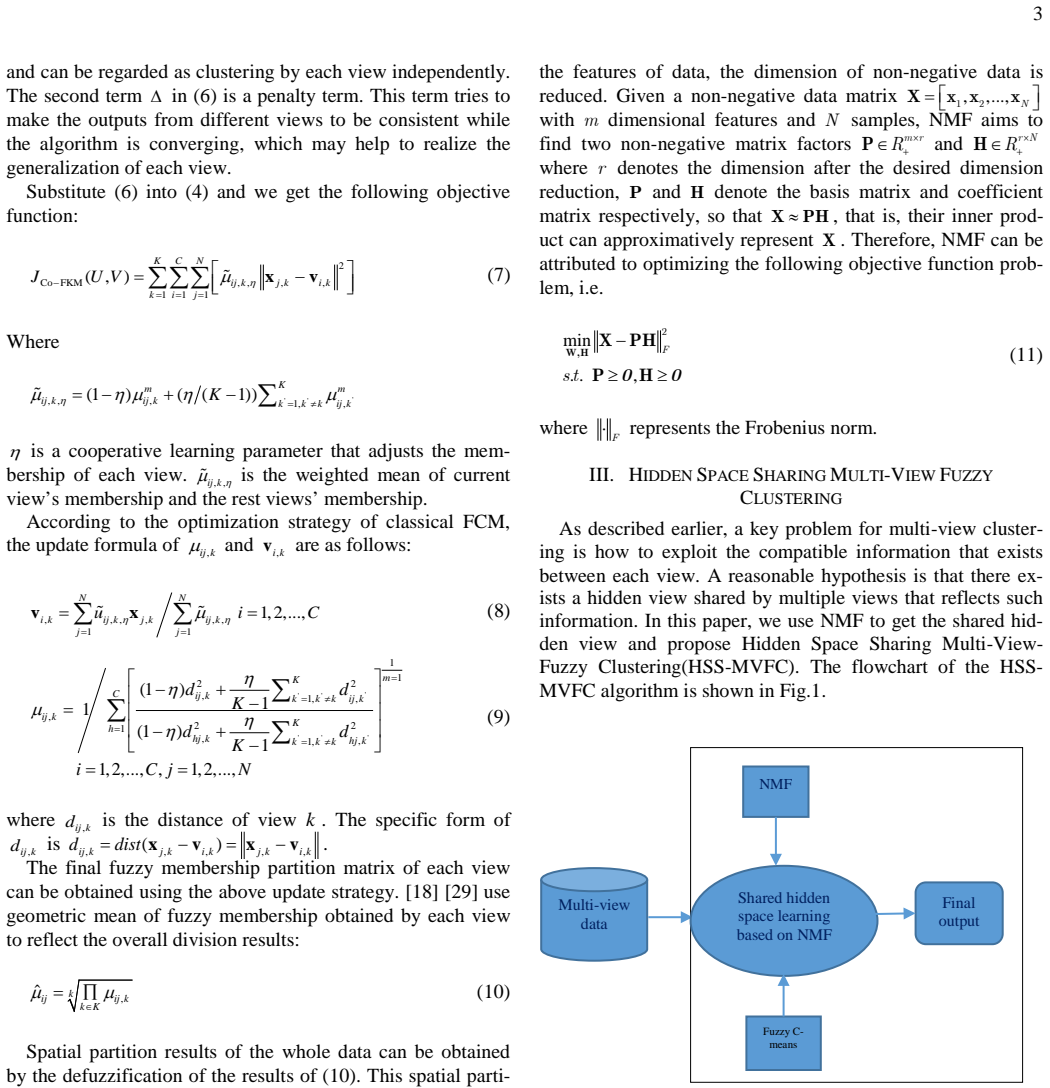
The load-bearing object is the shared hidden space $\mathbf{H}$ obtained by factorizing every view as $\mathbf{X}_k \approx \mathbf{P}_k \mathbf{H}$, so that the same low-dimensional coefficient matrix represents all views and clustering operates on this common space. The updates for $\mathbf{U}$ and $\mathbf{V}$ are the standard FCM ones applied inside that space; $\mathbf{P}_k$ uses the multiplicative NMF update; $\mathbf{H}$ is updated by a gradient step with a step size chosen to keep the iterate nonnegative; and the view weights take the closed form $w_k \propto \exp(-D_k/\eta)$, where $D_k = \lVert \mathbf{X}_k - \mathbf{P}_k \mathbf{H} \rVert_F^2$, so weights fall exponentially with reconstruction error. A maximum-entropy term with parameter $\eta$ controls how evenly the views are weighted, interpolating between equal weights ($\eta \to \infty$) and winner-take-most ($\eta \to 0$).
What would settle it
Run HSS-MVFC on a small multi-view dataset and record the objective value (15) after every iteration; if the weight formula is the exact minimizer, the sequence must be non-increasing. Equivalently, fix $\mathbf{U}$, $\mathbf{V}$, $\mathbf{P}_k$, and $\mathbf{H}$, solve the $\mathbf{w}$-subproblem by numerical optimization for a case with $\lambda \neq 1$, and compare with Eq. (20d): any mismatch means the algorithm optimizes a different objective than claimed.
Extended reading notes
Core claim
The central claim is that a single objective can jointly learn a shared hidden representation of multi-view data and a fuzzy partition of it, and that doing so improves clustering. The objective minimizes FCM distortion in the hidden space, a weighted NMF reconstruction error that forces all views to share one coefficient matrix $\mathbf{H}$, and a negative Shannon-entropy term that adaptively balances view weights. The authors solve it by cycling through five subproblems: updating memberships, cluster centers, per-view basis matrices, the shared hidden matrix, and view weights, so that the hidden space and the partition are refined against each other. Their experiments report mean RI of 0.8322 and mean NMI of 0.5308 across the six datasets, the highest in both tables.
Load-bearing premise
The result rests on the assumption that the simple update formula for each view's weight is the exact solution of the weight subproblem, but the derivation is only valid if the reconstruction error appears linearly in the weight, while the objective as written raises the weight to the power $\lambda$.
Editorial extensions
If this is right
- Multi-view clustering can be treated as one coupled optimization problem, so improvements in the shared representation directly improve the partition and vice versa.
- View weights do not need to be specified in advance; they emerge from each view's reconstruction quality under an entropy-controlled distribution.
- A single parameter $\eta$ lets practitioners trade off between democratic weighting and dominance by the most informative view.
- The alternating scheme gives a concrete recipe for adding a shared latent space to other prototype-based clustering models.
- The reported mean RI and NMI rankings suggest the benefit is consistent across datasets, not limited to one domain.
Reading between the lines
- Because the stated objective raises each view weight to the power $\lambda$ in the reconstruction term while the derived update treats the term as linear in $w_k$, the implemented algorithm may be minimizing a slightly different objective when $\lambda \neq 1$; a numerical comparison against direct optimization of the weight subproblem would settle this.
- The shared hidden matrix $\mathbf{H}$ could let the method handle partially missing views: once $\mathbf{H}$ is learned from complete views, the per-view basis matrices can reconstruct or impute absent views, although the paper does not test this.
- The entropy parameter $\eta$ could double as a diagnostic: shrinking $\eta$ reveals which views carry the most clustering signal, since their weights dominate.
- The same joint objective idea could be transferred to other prototype-based learners, such as possibilistic or noise-robust fuzzy clustering, by swapping the FCM distortion term while keeping the shared hidden space and entropy weighting.
Signed reviews
Editorial analysis
A structured set of objections, weighed in public.
Referee Report
Summary. This paper proposes HSS-MVFC, a multi-view fuzzy c-means variant in which each view is projected through a view-specific nonnegative basis matrix into a common low-dimensional hidden space H, a shared fuzzy partition U and cluster centers V are learned on H, and view weights w are learned by minimizing an entropy-regularized objective. The authors derive alternating updates for U, V, P_k, H, and w, give a complexity analysis, and compare against ten methods on six real datasets using RI and NMI together with Friedman and Holm tests. The central claim is that HSS-MVFC achieves better clustering performance than many related multi-view methods.
Significance. The modeling idea is coherent and potentially valuable: coupling NMF-based hidden-space discovery with fuzzy partition learning in a single objective is a natural extension of existing NMF-based multi-view clustering, and the maximum-entropy weighting is a sensible mechanism to avoid degenerate view weights. The paper provides explicit update rules and an experimental study with statistical tests on six datasets, which are strengths. However, the derivation of the weight update does not match the stated objective, and the experimental protocol appears to select parameters on the test sets, so the claimed superiority over baselines is not currently established. If the technical mismatch is resolved and the evaluation is made unbiased and reproducible, the method could be a useful contribution.
major comments (3)
- [Section III-D, Eqs. (15), (20a)-(20d)] The closed-form weight update (20d) is not the minimizer of subproblem P5 for the objective stated in (15). The second term of (15) contains w_k^λ D_k, where D_k = ||X_k - P_k H||_F^2, but the Lagrangian in (20a) and the derivation leading to (20b)-(20d) treat that term as w_k D_k. With the exponent λ present, stationarity gives λ w_k^{λ-1} D_k + η(ln w_k + 1) + γ = 0, which does not have the closed form shown in (20d); the update in (20d) is exact only for λ = 1 and no exponent on D_k. Consequently the iterates optimize a different objective than (15) whenever λ ≠ 1, and the parameter λ listed in Table II does not play the role attributed to it in the algorithm. Please either remove the exponent from (15) or re-derive the weight update (and check the corresponding H update in Eq. (19)) for the w_k^λ form.
- [Section IV-A/C, Tables II, IV, V] The empirical comparison is weakened by test-set model selection. Section IV-A says that parameters are set by grid search over the ranges in Table II, but no validation split or independent model-selection procedure is described; the means reported in Tables IV and V are computed on the same datasets used to select the parameters. This is especially problematic for HSS-MVFC, which has four free parameters (m, λ, η, r), more than most baselines, so its rank advantage may partly reflect overfitting to the test sets. In addition, the paper's own Holm post-hoc tests (Tables VIII-IX) fail to reject equality with MV-Co-FCM, Co-FKM, TW-K-means, and MVKKM on both RI and NMI, so the support for 'better than many related methods' is narrower than the abstract claims. Please report a proper model-selection protocol (e.g., inner cross-validation) and the selected parameter values per dataset, and temper the conclusions accordingly.
- [Section III-E, Table I] The algorithm description is not reproducible as written. Step 9 of Table I says 'Until (7) reaches a minimum', but Eq. (7) is the Co-FKM objective from Section II-B, not the HSS-MVFC objective (15); the stopping criterion should refer to (15). The initialization of P_k and H is never specified, no stopping tolerance is given, and the convergence evidence in Fig. 3 is empirical only, with no convergence proof for the alternating scheme. These omissions matter because the reported numbers in Tables IV and V depend on initializations and stopping rules.
minor comments (6)
- [Section III-C, Eq. (15)] The displayed objective (15) is typeset incorrectly, with superscripts, subscripts, and constraints scrambled; please provide a clean display of the objective and all constraints.
- [Table II] The grid for λ in HSS-MVFC is printed as '{2-3,2-2,...,2,29,210,211,...,214}'; it should use superscripts (e.g., 2^{-3}, ..., 2^9, 2^{10}) to be unambiguous.
- [Table VII] The ranking of MVSpec is printed as '61667' and should be 6.1667.
- [Tables IV and V] Dataset names contain typos: 'Dematology' should be 'Dermatology' and 'Retuters' should be 'Reuters'.
- [Section IV-D, Fig. 4] The figure showing convergence curves is labeled 'Fig.4' in the caption but is referenced in the text as Fig. 3; the numbering should be made consistent.
- [References] Reference [30] is incomplete (missing venue, volume, pages), and several other references have inconsistent formatting; please unify the bibliography style.
Circularity Check
No circularity: HSS-MVFC's derivation is self-contained; the empirical evaluation is external and the self-citations are background only.
full rationale
The paper's objective function (15) is stated independently of the reported clustering results, and the update rules (16), (17), (18), (19), and (20d) are derived from that objective by Lagrange multipliers or gradient descent. None of these formulas is defined in terms of the reported RI/NMI values, and the shared hidden space is not defined as the thing that makes the partition score high; rather, the hidden space and partition are optimized alternately from a fixed objective. The experimental section compares the method against eight external multi-view algorithms and two single-view baselines on six datasets, so the claimed superiority is measured against external benchmarks rather than being forced by the construction. Self-citations appear only in background or reference roles: [11] is cited for maximum-entropy clustering, but the entropy weighting is stated directly in Eq. (14); [34] is cited as an evaluation/reference item, not as the source of the central derivation. The grid-search parameter selection on the same datasets used for Tables IV and V is a legitimate concern about test-set overfitting and comparability, but it is not circularity in the mathematical derivation. There is also an apparent algebraic mismatch between the w_k^lambda term in Eq. (15) and the linear-in-w_k Lagrangian used in Eqs. (20a)-(20d); that is a correctness or consistency issue, not a circularity issue. Therefore no circular step is identified.
Assumptions & free parameters
free parameters (4)
- fuzzy index m =
chosen from {1,1.1,...,7} via grid search
- regularization parameter λ =
chosen from {2^-3,...,2^14} via grid search
- regularization parameter η =
chosen from {1e-7,...,1e7} via grid search
- low-rank dimension r =
chosen from {10,20,...,100} via grid search
assumptions (4)
- domain assumption All views share a nonnegative hidden space H such that X_k ≈ P_k H for each view k.
- domain assumption The nonnegativity constraint on P and H is valid for all datasets.
- domain assumption The alternating optimization over the nonconvex objective reaches a useful local minimum.
- standard math The fuzzy membership and center update rules (16)-(17) are valid for the first term of the objective.
Cite this review
Pith. "Pith review of Multi-View Fuzzy Clustering with The Alternative Learning between Shared Hidden Space and Partition." pith.science (2026). https://pith.science/paper/XYMKHT6K
@misc{pith2026190804771,
  author       = {Pith},
  title        = {Pith review of: Multi-View Fuzzy Clustering with The Alternative Learning between Shared Hidden Space and Partition},
  year         = {2026},
  howpublished = {\url{https://pith.science/paper/XYMKHT6K}},
  note         = {Machine review of arXiv:1908.04771}
}
read the original abstract
As the multi-view data grows in the real world, multi-view clus-tering has become a prominent technique in data mining, pattern recognition, and machine learning. How to exploit the relation-ship between different views effectively using the characteristic of multi-view data has become a crucial challenge. Aiming at this, a hidden space sharing multi-view fuzzy clustering (HSS-MVFC) method is proposed in the present study. This method is based on the classical fuzzy c-means clustering model, and obtains associ-ated information between different views by introducing shared hidden space. Especially, the shared hidden space and the fuzzy partition can be learned alternatively and contribute to each other. Meanwhile, the proposed method uses maximum entropy strategy to control the weights of different views while learning the shared hidden space. The experimental result shows that the proposed multi-view clustering method has better performance than many related clustering methods.
Figures
Reference graph
Works this paper leans on
-
[1]
An approach to extr act shared hidden information among the visible views using non-negative matrix factorization
-
[2]
A hidden space sharing multi -view fuzzy clustering method based on FCM
-
[3]
Introduction of maximum entropy to adjust the weight of each view
-
[4]
Section II briefly reviews the concepts and principles of classical FCM and NMF
Validation of the proposed HSS -MVFC using extensive experiments The rest of this paper is organized as follows. Section II briefly reviews the concepts and principles of classical FCM and NMF. Section III proposes a strategy of hidden space sharing multi -view fuzzy clu stering. Section IV presents the experimental results. Finally, Section V draws concl...
-
[5]
1 1. K FKM k k C ij k ij k i k JJ st jn kKµ η µ = = = ∈ = ≤≤ + ≤ ∆ ≤ ∑ ∑ Co-FKM (4) where, 2 ,, , 11 (,) [ ] CN m F K M k k i jk jk ik ij J µ = = = −∑∑UV x v (5) ' ' 2 ,, ,, 111, ' 1= () 1 K CN mm i jk jk ikij k ijk kkK µµ = == ≠ ∆ −−− ∑ ∑∑ xv (6) K denotes the number of views and η is a cooperative learn- ing parameter which controls the membership divis...
-
[6]
Problem 1P : Fix ˆ=VV , ˆk =PP , ˆ=HH , ˆ=ww and solve 1 ˆ ˆ ˆ ˆ() (, ,, , )=PJU UVPHw
-
[7]
Problem 2P : Fix ˆ=UU , ˆkk=PP , ˆ=HH , ˆ=ww and solve 2 ˆ ˆ ˆ ˆ() (,, , ,)= kPPV UVP Hw
-
[8]
Problem 3P :Fix ˆ=UU , ˆ=VV , ˆ=HH , ˆ=ww and solve 3 ˆ ˆ ˆ ˆ( ) (,, , ,)=kkPPP UVP Hw
Show all 59 references
-
[9]
Problem 4P : Fix ˆ=UU , ˆ=VV , ˆkk=PP , ˆ=ww and solve 4 ˆ ˆ ˆ ˆ() (,, , , ) kPP =H UVP HW Shared hidden space MVC based on NMF Data View 1 View 2 View K − 211 F X PH − 222 F X PH − 2KK F X PH = = = − +− ∑ ∑∑ 2 1 2 11 K kk k Fk cn li j l lj w X PH uh v 5
-
[10]
Problem 5P : Fix ˆ=UU , ˆ=VV , ˆkk=PP , ˆ=HH and solve 5 ˆ ˆ ˆ() (,, , ,)=PPw UVWHw The solving process of each sub -optimization problem can be described as follows:
-
[11]
sub -optimization problem 1P and 2P can be regarded as solving classical FCM, and the solution of 1P and 2P are as follows: 11= = =∑∑ nn mm l li i li ii uuvh (16) ' ' 22 1 2 1 || ||1 ( ) , 1|| || c il m li l i l u in− = −= ≤≤−∑ hv hv (17)
-
[12]
Based on the strategy used in [31], the following update rule can be used: ,( 1) ( ) ,, () , ()() ()(( ) ) kT ijkt kt ij ijkt T ij + ← XHPP P HH (18)
Sup-optimization problem 3P is a nonnegative quadratic problem and is similar to classical NMF model. Based on the strategy used in [31], the following update rule can be used: ,( 1) ( ) ,, () , ()() ()(( ) ) kT ijkt kt ij ijkt T ij + ← XHPP P HH (18)
-
[13]
The approach is to initialize (0)H and let () ,() t ijH represent the element o f ith row j th column, where t is the number of iteration update times
Sup-optimization problem 4P can use gradient descent to optimize H . The approach is to initialize (0)H and let () ,() t ijH represent the element o f ith row j th column, where t is the number of iteration update times. The following formula is used to update H : () , ( 1) ( ...
-
[14]
Set 2|| || kk kFD −X PH= Sup-optimization problem 5P can be optimized by Lagrangian multiplier strategy and we obtain the solution of kw , the Lagrangian function is as follows: 1 2 , ,{ } , , 11 1 1 11 min || || ln ( 1) ( 1) kK k cn K m li i l k k li k K CK k k li k k lk L u ...
-
[15]
An ensemble framework for clustering protein–protein interaction networks
S. Asur, D. Ucar, S. Parthasarathy, “An ensemble framework for clustering protein–protein interaction networks”. Bioinformatics , vol. 23, no. 13, pp. i29, 2007
2007
-
[16]
Normalized Mutual Information (NMI) [8, 34]: ,,11 11 log / NMI log / log / cc ij ij i jij cc ii j jij n nn n n n nn n n n = = = = ⋅⋅ = ⋅ ∑∑ ∑∑ (21) where ,ijn represents the number of samples matching the ith cluster with the real j class, in represents the number of samples c...
-
[17]
11f is the num- ber of samples that has the same class labels and belong to the same cluster
Rand Index (RI) [8]: 00+ 11RI= ( -1)/2 ff NN (22) where 00f is the number of samples that has diff erent real class labels and belongs to different clusters. 11f is the num- ber of samples that has the same class labels and belong to the same cluster. N is the number of sample...
2000
-
[18]
Multi -view clustering
S. Bickel, T. Scheffer, “Multi -view clustering”. in Proc. IEEE International Conference on Data Mining, pp. 19-26, 2004
2004
-
[19]
Multi-view K-means clustering on big data
X. Cai, F. Nie, H. Huang, “Multi-view K-means clustering on big data”. in Proc. International Joint Conference on Artificial Intelligence pp. 2598-2604, 2013
2013
-
[20]
Co-regularized multi-view spectral clustering
A. Kumar, P. Rai, “Co-regularized multi-view spectral clustering”. in Proc. International Conference on Neural Information Processing Systems , pp. 1413-1421, 2011
2011
-
[21]
A co -training approach for multi -view spectral clustering
A. Kumar, H.D . Iii, “A co -training approach for multi -view spectral clustering”. in Proc. International Conference on International Conference on Machine Learning pp. 393-400, 2011
2011
-
[22]
Spectral clustering and transductive learning with multiple views
D. Zhou, C.J.C. Burges, “Spectral clustering and transductive learning with multiple views”. in Proc. Machine Learning, Proceedings of the Twenty- Fourth International Conference pp. 1159-1166, 2007
2007
-
[23]
Collaborative fuzzy clustering from multiple weighted views
Y . Jiang, F.L. Chung, S. Wang, et al. “Collaborative fuzzy clustering from multiple weighted views”. IEEE Transactions on Cybernation , vol. 45, no. 3, pp. 688-701, 2015
2015
-
[24]
Optimized data fusion for kernel k- means clustering
S. Y u, L.C. Tranchevent, X. Liu, et al. “Optimized data fusion for kernel k- means clustering”. IEEE Transactions on Pattern Analysis & Machine Intelligence, vol. 34, no. 5, pp. 1031-1039, 2012
2012
-
[25]
An Entropy Weighting k-Means Algorithm for Subspace Clustering of High -Dimensional Sparse Data
L. Jing, M.K. Ng, J.Z. Huang, “An Entropy Weighting k-Means Algorithm for Subspace Clustering of High -Dimensional Sparse Data”. IEEE Transactions on Knowledge & Data Engineering,vol. 19, no. 8, pp. 1026-1041, 2007
2007
-
[26]
Generalized Fuzzy C -Means Cluste ring Algorithm With Improved Fuzzy Partitions
L. Zhu, F.L. Chung, S. Wang, “Generalized Fuzzy C -Means Cluste ring Algorithm With Improved Fuzzy Partitions”. IEEE Transactions on Systems Man & Cybernetics Part B Cybernetics A Publication of the IEEE Systems Man & Cybernetics Society, vol. 39, no. 3, pp. 578-591, 2009
2009
-
[27]
Convergence of t he Single-Pass and Online Fuzzy C-Means Algorithms
L.O. Hall, D.B. Goldgof, “Convergence of t he Single-Pass and Online Fuzzy C-Means Algorithms”. IEEE Transactions on Fuzzy Systems , vol. 19, no. 4, pp. 792-794, 2011
2011
-
[28]
Robust Maximum Entropy Clustering Algorithm RMEC and Its Outlier Labeling
Z. Deng, S. Wang, X. Wu, et al. “Robust Maximum Entropy Clustering Algorithm RMEC and Its Outlier Labeling”. Engineering Science , vol. 6, no. 9, pp. 38-45, 2004
2004
-
[29]
MECA: maximum entropy clustering algorithm
N.B. Karayiannis, “MECA: maximum entropy clustering algorithm”. in Proc. IEEE World Congress on Computational Intelligence, vol.631, pp. 630- 635, 1994
1994
-
[30]
A possibilistic approach to clu stering
R. Krishnapuram, J.M. Keller, “A possibilistic approach to clu stering”. IEEE Transactions on Fuzzy Systems, vol. 1, no. 2, pp. 98-110, 2002
2002
-
[31]
The possibilistic C -means algorithm: insights and recommendations
R. Krishnapuram, J.M. Keller, “The possibilistic C -means algorithm: insights and recommendations”. IEEE Transactions on Fuzzy Systems, vol.4, no.3, pp. 385-393, 2002
2002
-
[32]
Kernel-Based Weighted Multi-view Clustering
G . Tzortzis, A. Likas, “Kernel-Based Weighted Multi-view Clustering”. in Proc. IEEE International Conference on Data Mining, pp. 675-684, 2012
2012
-
[33]
Bayesian cluster ensembles
H. Wang, H. Shan, A. Banerjee, “Bayesian cluster ensembles”. Statistical Analysis & Data Mini ng the Asa Data Science Journal , vol. 4, no. 1, pp. 54 - 70, 2011
2011
-
[34]
Correlational spectral clustering
M.B. Blaschko, C.H. Lampert, “Correlational spectral clustering”. in Proc. Computer Vision and Pattern Recognition, pp. 1-8, 2008
2008
-
[35]
Multiview clustering : a late fusion approach using latent models
E. Bruno, S. Marchand -Maillet, “Multiview clustering : a late fusion approach using latent models”. in Proc. International ACM SIGIR Conference on Research and Development in Information Retrieval pp. 736-737, 2009
2009
-
[36]
Multiview Partitioning via Tensor Methods
X. Liu, S. Ji, W. Glänzel, et al. “Multiview Partitioning via Tensor Methods”. IEEE Transactions on Knowledge & Data Engineering, vol. 25, no. 5, pp. 1056-1069, 2013
2013
-
[37]
Low-Rank Tensor Constrained Multiview Subspace Clustering
C. Zhang, H. Fu, S. Liu, et al. “Low-Rank Tensor Constrained Multiview Subspace Clustering”. in Proc. IEEE International Conference on Computer Vision pp. 1582-1590, 2015
2015
-
[38]
Large-scale multi-view spectral clustering via bipartite graph
Y . Li, F. Nie, H. Huang, et al. “Large-scale multi-view spectral clustering via bipartite graph”. in Proc. Twenty- Ninth AAAI Conference on Artificial Intelligence pp. 2750-2756, 2015
2015
-
[39]
Partial multi -view clustering
S.Y . Li, Y . Jiang, Z.H. Zhou, “Partial multi -view clustering”. in Proc. AAAI Conference on Artificial Intelligence, 2010
2010
-
[40]
Multi-view clustering and feature learning via structured sparsity
H. Wang, F. Nie, H. Huang, “Multi-view clustering and feature learning via structured sparsity”. in Proc. International Conference on Machine Learning pp. 352-360, 2013
2013
-
[41]
For single-view clustering algorithms, we constructed a single-view dataset by combining features from all visible views
and two single -view clustering algorithms: K -means and FCM. For single-view clustering algorithms, we constructed a single-view dataset by combining features from all visible views. Two evaluation indices are used in this paper to evaluate the proposed algorithm
-
[42]
Multi-view clustering ensembles
X. Xie, S. Sun, “Multi-view clustering ensembles”. in Proc. International Conference on Machine Learning and Cybernetics, pp. 51-56, 2014
2014
-
[43]
Multiview cluster ensembles for multimodal MRI segmentation
P. Summers, G . Menegaz, “Multiview cluster ensembles for multimodal MRI segmentation” International Journal of Imaging Systems & Techno logy, vol.25, no. 1, pp.56-67, 2015
2015
-
[44]
Multi -view document clustering via ensemble method
S.F. Hussain, M. Mushtaq, Z. Halim, “Multi -view document clustering via ensemble method” Journal of Intelligent Information Systems , vol.43, no. 1, pp 81-99, 2014
2014
-
[45]
Co FKM: A Centralized Method for Multiple -View Clustering
G . Cleuziou, M. Exbrayat, L. Martin, et al. “Co FKM: A Centralized Method for Multiple -View Clustering”. in Proc. Ninth IEEE International Conference on Data Mining pp. 752-757, 2009
2009
-
[46]
Collaborative fuzzy clustering
W. Pedrycz, “Collaborative fuzzy clustering”. Pattern Recognition Letters, vol.23, no. 14, pp. 1675-1686, 2002
2002
-
[47]
Multi -view Regression Via Canonical Correlation Analysis
S.M. Kakade, D.P. Foster, “Multi -view Regression Via Canonical Correlation Analysis”. Lecture Notes in Computer Science , 4539, pp. 82 -96, 2007
2007
-
[48]
Non-negative matrix factorization for clustering: A survey, 2013
Li, T.,Ding, C. Non-negative matrix factorization for clustering: A survey, 2013
2013
-
[49]
Multi -view Clustering via Multi - manifold Regularized Nonnegative Matrix Factorization
X. Zhang, L. Zhao, L. Zong, et al. “Multi -view Clustering via Multi - manifold Regularized Nonnegative Matrix Factorization”. Neural networks : the official journal of the International Neural Network Society , 88: pp. 74, 2017
2017
-
[50]
TW -k-means: Automated two -level variable weighting clustering algorithm for multiview data
X. Chen, X. Xu, J.Z. Huang, et al. “TW -k-means: Automated two -level variable weighting clustering algorithm for multiview data”. IEEE Transactions on Knowledge & Data Engineering, vol. 25, no. 4, pp. 932 -944, 2013
2013
-
[51]
Enhanced soft subspace clustering integrating within -cluster and between -cluster information
Z. Deng, K.S. Choi, F.L. Chung, et al. “Enhanced soft subspace clustering integrating within -cluster and between -cluster information”. Pattern Recognition, vol. 43, no.3, pp. 767-781, 2010
2010
-
[52]
Statistical comparisons of classifiers over multiple data sets
J. Demšar, “Statistical comparisons of classifiers over multiple data sets”. Journal of Machine Learning Research, vol.7, no.1, pp. 1-30, 2006
2006
-
[53]
Multi -view clustering via joint nonnegative matrix factorization[C]
Gao J, Han J, Liu J, et al. Multi -view clustering via joint nonnegative matrix factorization[C]. siam inter national conference on data mining, 2013: 252-260
2013
-
[54]
Multiple Incomplete Views Clustering via Weighted Nonnegative Matrix Factorization with L2,1 Regularization[C]// ECML/PKDD
Shao W , He L , Yu P S . Multiple Incomplete Views Clustering via Weighted Nonnegative Matrix Factorization with L2,1 Regularization[C]// ECML/PKDD. Springer, 2015
2015
-
[55]
Multi -view clustering via multi - manifold regularized non -negative matrix factorization[J]
Zong L , Zhang X , Zhao L , et al. Multi -view clustering via multi - manifold regularized non -negative matrix factorization[J]. Neural Networks, 2017, 88:74-89
2017
-
[56]
Zhang, X., Gao, H., Li, G ., Zhao, J., Huo, J., Yin, J., … Zheng, L. (2018). Multi-view clustering based on graph -regularized nonnegative matrix factorization for object recognition. Information Sciences, 432, 463–478. 11
2018
-
[57]
Multi -view Clustering via Co-regularized Nonnegative Matrix Factorization with Correlation Constraint[C] International Conference on Cloud Computing & Big Data
Tan Y , Ou W , Long F , et al. Multi -view Clustering via Co-regularized Nonnegative Matrix Factorization with Correlation Constraint[C] International Conference on Cloud Computing & Big Data. IEEE, 2017
2017
-
[58]
Multi -View Kernel Spectral Clustering[J]
Houthuys L , Langone R , Suykens J A K . Multi -View Kernel Spectral Clustering[J]. Information Fusion, 2018, 44:46-56
2018
-
[59]
García, A
S. García, A. Fernández, Luengo J , et al. A study of statistical techniques and performance measures for genetics-based machine learning: accuracy and interpretability[J]. Soft Computing, 2009, 13(10):959 -977
2009
Reviewed August 14, 2026 · model on record in the stance chip above.
Discussion (0). Continue with ORCID to comment.