REVIEW 3 major objections 7 minor 52 references
Predicting Dynamic Embedding Trajectory in Temporal Interaction Networks
T0 review · 3 major / 7 minor · reviewed 2026-08-14 · deepseek-v4-flash
Pith's one-line read The paper claims that a pair of coupled recurrent networks plus a learned projection operator can predict future user embeddings, and that these predicted trajectories improve next-item and state-change prediction by large margins.
desk verdict Well-executed empirical paper with a genuine practical contribution, but the trajectory-projection mechanism is oversold and the state-change comparison is skewed. read the letter →
The pith
A machine-rendered reading of the paper's core claim, the machinery that carries it, and where it could break.
The reading
What carries the argument
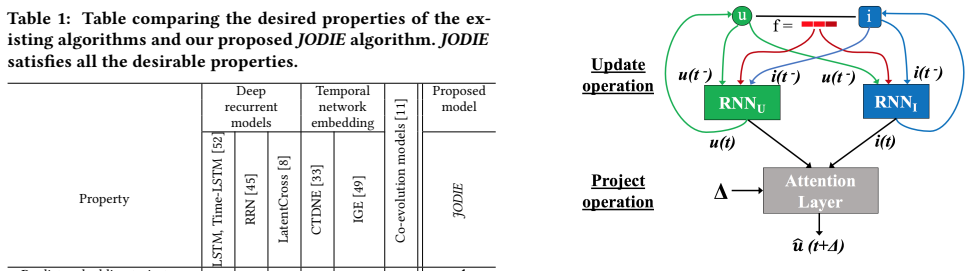
The load-bearing object is the projection operator $\hat{\mathbf{u}}(t+\Delta) = (1 + W_p\Delta) * \mathbf{u}(t)$, where $\Delta$ is the time since the last interaction and $W_p$ is a learned linear map from elapsed time to a per-coordinate scaling vector. This converts a discrete sequence of observed embeddings into a continuous trajectory that can be evaluated at any future time. The update operation consists of two mutually-recursive RNNs, one for users and one for items, whose hidden states are the dynamic embeddings and which feed each other's latest states into their updates. The t-Batch algorithm supports the claim by constructing batches in which each user and item appears at most once, so batches can be processed in parallel while preserving temporal order. The projection supplies the predictive signal; the coupled updates supply the state that is projected; t-Batch makes the combined model trainable at scale.
What would settle it
Take a trained JODIE model and, for held-out interactions, compare the projected embedding $\hat{\mathbf{u}}(t+\Delta)$ evaluated at the next interaction time with the actual updated embedding $\mathbf{u}(t+\Delta)$ computed by the update RNN. If the average distance from the projection to the actual embedding is no smaller than reusing $\mathbf{u}(t)$ without projection, the trajectory mechanism is not doing the work attributed to it.
Extended reading notes
Core claim
On the paper's own terms, the discovery is that future embedding trajectories are predictable and useful: a user's dynamic embedding at time $t+\Delta$ can be estimated from the embedding at $t$ by an elementwise linear scaling $\hat{\mathbf{u}}(t+\Delta) = (1 + W_p\Delta) * \mathbf{u}(t)$, and the estimated trajectory is accurate enough to lift downstream prediction. JODIE couples two recurrent networks so that the user update consumes the current item embedding and the item update consumes the current user embedding; the projection operation then turns elapsed time into a multiplicative attention vector. The model is trained to output the embedding of the next item directly, rather than a score over all items, which makes recommendation near-constant time. Alongside this, t-Batch groups interactions into independent, temporally ordered batches so the coupled RNNs can be trained in parallel without breaking time dependencies.
Load-bearing premise
The paper's central mechanism rests on the assumption that a user's future embedding is an elementwise linear scaling of the last observed embedding by a learned vector that grows linearly with elapsed time; the text reports no direct validation of this projection against observed future embeddings.
Editorial extensions
If this is right
- Directly outputting a predicted item embedding instead of interaction scores makes inference near-constant time using locality sensitive hashing, so recommendation scales to millions of items.
- t-Batch makes mutually-recursive RNN training parallelizable while preserving temporal order, giving a 9.2x speed-up over the closest comparable method.
- State-change prediction, such as predicting bans and student dropout, improves by at least 12% on average in AUC, supporting early intervention applications.
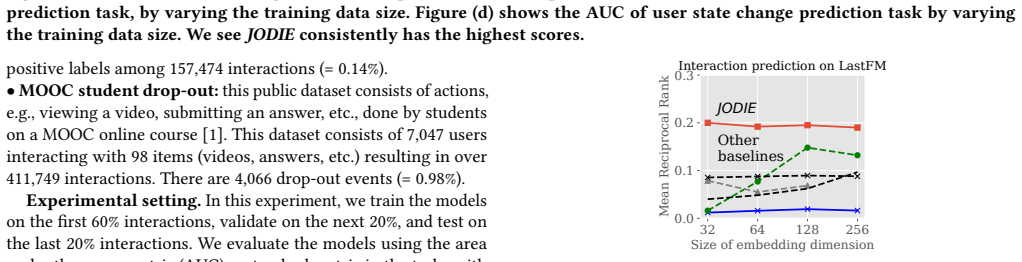
- Performance stays stable across different training-data percentages and embedding sizes, suggesting the gains come from the model design rather than from more data or larger embeddings.
- Because the model uses both static and dynamic embeddings, predictions retain long-term user identity while also capturing short-term drift.
Reading between the lines
- Beyond the paper: the projection ansatz could be tested directly against observed trajectories, and if the true drift is curved in embedding space, a second-order or nonlinear time transform should outperform the linear $W_p\Delta$ scaling.
- Beyond the paper: because JODIE outputs an item embedding rather than a score, the same architecture could be applied to temporal knowledge graphs by treating relation types as item-like entities and retrieving predicted tail entities by nearest neighbor.
- Beyond the paper: the projection operator turns the last interaction time into a query-time feature, so an online recommender could serve different recommendations depending on how much time has passed since a user's last action, a property not present in the baselines tested, which keep embeddings frozen between interactions.
Signed reviews
Editorial analysis
A structured set of objections, weighed in public.
Referee Report
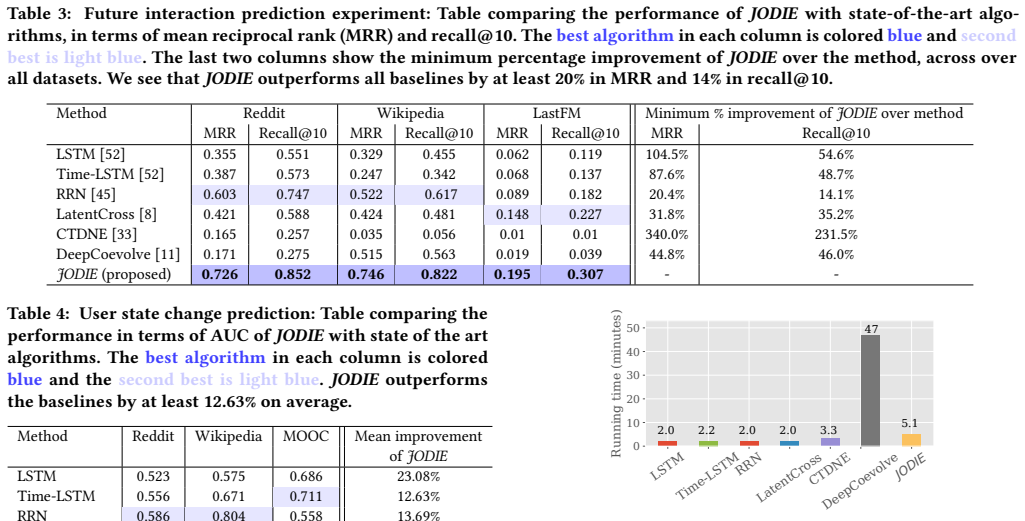
Summary. The paper proposes JODIE, a coupled recurrent neural network model for temporal user-item interaction networks. Each user and item is assigned a static embedding and a dynamic embedding; at each interaction, two mutually-recursive RNNs update the dynamic embeddings of the interacting user and item. The paper's main novelty is an embedding projection operator that linearly scales a user's last dynamic embedding by a learned time-context vector to estimate the user's embedding at a future time. The projected embedding is fed into a linear prediction layer that outputs the embedding of the predicted next item, enabling near-constant-time inference via locality-sensitive hashing. The paper also introduces t-Batch, a batching algorithm for training the mutually-recursive RNNs in parallel while maintaining temporal consistency. Experiments on Reddit, Wikipedia, LastFM, and MOOC datasets report that JODIE outperforms six baselines by at least 20% in mean reciprocal rank for future interaction prediction and by at least 12% in AUC for user state-change prediction, along with a 9.2x speed-up over the closest baseline and robustness experiments.
Significance. If the empirical claims hold, JODIE represents a substantial advance in dynamic embedding recommender systems: it explicitly forecasts future user embeddings, directly predicts item embeddings rather than interaction probabilities, and introduces a principled batching scheme for mutually-recursive RNNs. The t-Batch algorithm is a practical contribution to scaling such models, and the release of code and datasets supports reproducibility. However, the central mechanistic claim in the title and abstract—that JODIE learns and predicts embedding trajectories—is not directly validated, and the user state-change comparison is confounded by an auxiliary supervision signal available only to JODIE. These issues are load-bearing for assessing the paper's contribution, and they require additional experiments or re-analysis before the significance of the reported gains can be fully evaluated.
major comments (3)
- [Section 3.2 and Section 4] The projection operator is never directly validated against observed future embeddings. Section 3.2 defines the projected embedding b_u(t+Δ) = (1 + Wp Δ) * u(t), but no experiment compares this projection with the actual embedding u(t+Δ) that is produced when the user's next interaction is observed, and no ablation isolates the projection's contribution from the coupled RNN updates or from the direct use of the previous item's embedding i(t+Δ−) in the prediction layer (Section 3.3). Consequently, the paper's claim of 'predicting dynamic embedding trajectory' is unsupported; the reported gains could be driven by other components. Please add a direct trajectory evaluation (e.g., L2 or cosine distance between projected and observed embeddings as a function of Δ) and an ablation that removes or replaces the projection with an identity or time-independent baseline.
- [Section 4.2 and Section 3.3] The user state-change comparison is unfair because JODIE receives additional label supervision during training. Section 3.3 ('Extending the loss for categorical prediction') describes adding a cross-entropy loss on state-change labels to JODIE's total loss, whereas Section 4.2 states that the baselines are trained only on interaction data and then fitted with a logistic regression classifier on the dynamic user embedding. This gives JODIE access to the state-change labels during training, which the baselines do not receive, potentially inflating the reported 12% AUC improvement. To support the claim, the baselines should be given the same auxiliary label signal (e.g., fine-tuned with state-change supervision) or JODIE should be evaluated in this experiment without the auxiliary loss.
- [Tables 3 and 4, Sections 4.1 and 4.2] The headline performance claims ('at least 20% in MRR, 12% in AUC') are based on single runs with no error bars, standard deviations, or significance tests. Given that the paper's central contribution is empirical, the lack of uncertainty quantification is a load-bearing issue. Please report means and standard deviations over multiple random seeds and include a significance test (e.g., paired bootstrap or Wilcoxon signed-rank) for the key comparisons against the strongest baselines.
minor comments (7)
- [Section 3.3 and Eq. (1)] The notation for the training loss is inconsistent with the preceding derivation: the text uses the previous item i and next item j (with target [j, j(t+Δ−)]), while Eq. (1) sums over interactions (u,i,t,f) with target [i, i(t−)]. This ambiguity makes the exact training objective difficult to reconstruct and should be clarified.
- [Section 3.2] The statement that a linear projection layer 'works the best' and that adding non-linearity 'reduce[s] the prediction performance' is made without any supporting ablation or figure. Please provide the ablation or temper the claim accordingly.
- [Section 3.4] The claim that t-Batch generates the same embeddings as sequential processing is stated as 'trivial to verify,' but no formal argument or empirical verification is provided. A brief proof sketch or an experiment comparing batched and sequential training outputs would strengthen the reproducibility of the method.
- [Abstract and Section 3.2] The abstract refers to the 'future embedding trajectory of a user/item,' but the projection operation is defined only for users; item embeddings are updated solely at interaction times. Please align the abstract and title wording with the actual model or extend the projection to items.
- [Figure 6 and Section 4.5] The legend for Figure 6 refers to the legend in Figure 5, which is not fully self-contained; adding a direct legend to Figure 6 would improve readability.
- [Table 6 and Section 4.1] The text states that the Reddit dataset includes 1,000 subreddits as items, but Table 6 reports 984 items. Please reconcile this discrepancy.
- [Section 4.3] The runtime comparison reports the 9.2x speed-up over DeepCoevolve and an 8.4x speed-up from t-Batch alone, but the difference between these two numbers is not explained; clarifying the relationship would be helpful.
Circularity Check
No significant circularity: JODIE's claims are evaluated on time-held-out data with a supervised loss, and no prediction reduces to a fitted input by construction.
full rationale
The core derivation chain is self-contained and empirically falsifiable. The projection operator b_u(t+Δ) = (1 + W_p Δ) * u(t) is trained through the L2 objective in Eq. (1), which compares the predicted next-item embedding to the observed item embedding at the held-out future interaction; no parameter is fit to the test labels and no reported metric is the direct output of a fitted quantity. The update equations in Section 3.1 and the projection in Section 3.2 are learned from the same temporally split objective, but this is standard supervised training rather than circularity. The paper's comparison against six baselines on held-out MRR, recall@10, AUC, and runtime provides external evidence. Self-citations to Kumar, Leskovec, and coauthors appear in related work and are not load-bearing for the model's derivation. Although the trajectory projection mechanism is not directly validated against observed future embeddings, that is a correctness or scope concern, not a circularity concern under the stated criteria.
Assumptions & free parameters
free parameters (5)
- Projection weight vector Wp =
learned from data, value not reported
- Prediction layer weights W1..W4 and bias B =
learned from data
- User and item RNN weight matrices W^u_1..W^u_4, W^i_1..W^i_4 =
learned from data
- Loss scaling parameters λ_U and λ_I =
not reported
- Training hyperparameters =
lr=1e-3, weight decay=1e-5, dim=128, epochs=50
assumptions (5)
- ad hoc to paper The user's future embedding is a linear elementwise scaling of its last observed embedding: b_u(t+Δ) = (1 + Wp Δ) * u(t).
- domain assumption Coupled mutual recursion: user embedding is updated using the item's previous embedding and vice versa.
- domain assumption The interaction sequence is a complete, correctly ordered record of all user-item events.
- domain assumption One-hot static embeddings capture long-term stationary properties of users and items.
- domain assumption Locality sensitive hashing returns nearest item embeddings with negligible accuracy loss, enabling near-constant-time recommendation.
Cite this review
Pith. "Pith review of Predicting Dynamic Embedding Trajectory in Temporal Interaction Networks." pith.science (2026). https://pith.science/paper/XYWXOWYL
@misc{pith2026190801207,
  author       = {Pith},
  title        = {Pith review of: Predicting Dynamic Embedding Trajectory in Temporal Interaction Networks},
  year         = {2026},
  howpublished = {\url{https://pith.science/paper/XYWXOWYL}},
  note         = {Machine review of arXiv:1908.01207}
}
read the original abstract
Modeling sequential interactions between users and items/products is crucial in domains such as e-commerce, social networking, and education. Representation learning presents an attractive opportunity to model the dynamic evolution of users and items, where each user/item can be embedded in a Euclidean space and its evolution can be modeled by an embedding trajectory in this space. However, existing dynamic embedding methods generate embeddings only when users take actions and do not explicitly model the future trajectory of the user/item in the embedding space. Here we propose JODIE, a coupled recurrent neural network model that learns the embedding trajectories of users and items. JODIE employs two recurrent neural networks to update the embedding of a user and an item at every interaction. Crucially, JODIE also models the future embedding trajectory of a user/item. To this end, it introduces a novel projection operator that learns to estimate the embedding of the user at any time in the future. These estimated embeddings are then used to predict future user-item interactions. To make the method scalable, we develop a t-Batch algorithm that creates time-consistent batches and leads to 9x faster training. We conduct six experiments to validate JODIE on two prediction tasks---future interaction prediction and state change prediction---using four real-world datasets. We show that JODIE outperforms six state-of-the-art algorithms in these tasks by at least 20% in predicting future interactions and 12% in state change prediction.
Figures


Figures from the paper (3 more)

Reference graph
Works this paper leans on
-
[1]
https://biendata.com/competition/kddcup2015/data/
Kdd cup 2015. https://biendata.com/competition/kddcup2015/data/
work page 2015
- [2]
-
[3]
https://meta.wikimedia.org/wiki/Data_dumps
Wikipedia edit history dump. https://meta.wikimedia.org/wiki/Data_dumps
-
[4]
D. Agrawal, C. Budak, A. El Abbadi, T. Georgiou, and X. Yan. Big data in on- line social networks: user interaction analysis to model user behavior in social networks. In DNIS, 2014
work page 2014
- [5]
- [6]
-
[7]
I. M. Baytas, C. Xiao, X. Zhang, F. Wang, A. K. Jain, and J. Zhou. Patient subtyping via time-aware lstm networks. In KDD, 2017
work page 2017
- [8]
Show all 52 references
-
[9]
Cheng, M
J. Cheng, M. Bernstein, C. Danescu-Niculescu-Mizil, and J. Leskovec. Anyone can become a troll: Causes of trolling behavior in online discussions. In CSCW, 2017
2017
-
[10]
Cheng, C
J. Cheng, C. Lo, and J. Leskovec. Predicting intent using activity logs: How goal specificity and temporal range affect user behavior. In WWW, 2017
2017
-
[11]
H. Dai, Y. Wang, R. Trivedi, and L. Song. Deep coevolutionary network: Embed- ding user and item features for recommendation. arXiv:1609.03675, 2016
2016 arXiv
-
[12]
N. Du, H. Dai, R. Trivedi, U. Upadhyay, M. Gomez-Rodriguez, and L. Song. Re- current marked temporal point processes: Embedding event history to vector. In KDD, 2016
2016
-
[13]
Farajtabar, Y
M. Farajtabar, Y. Wang, M. Gomez-Rodriguez, S. Li, H. Zha, and L. Song. CO- EVOLVE: A joint point process model for information diffusion and network co-evolution. In NeurIPS, 2015
2015
-
[14]
Goyal and E
P. Goyal and E. Ferrara. Graph embedding techniques, applications, and perfor- mance: A survey. Knowledge Based Systems, 151:78–94, 2018
2018
-
[15]
Goyal, N
P. Goyal, N. Kamra, X. He, and Y. Liu. Dyngem: Deep embedding method for dynamic graphs. arXiv:1805.11273, 2018
2018 arXiv
-
[16]
Grover and J
A. Grover and J. Leskovec. node2vec: Scalable feature learning for networks. In KDD, 2016
2016
-
[17]
W. L. Hamilton, R. Ying, and J. Leskovec. Representation learning on graphs: Methods and applications. IEEE Data Engineering Bulletin , 40(3):52–74, 2017
2017
-
[18]
Hidasi and D
B. Hidasi and D. Tikk. Fast als-based tensor factorization for context-aware recommendation from implicit feedback. In ECML, 2012
2012
-
[19]
T. Iba, K. Nemoto, B. Peters, and P. A. Gloor. Analyzing the creative editing be- havior of wikipedia editors: Through dynamic social network analysis. Procedia- Social and Behavioral Sciences , 2(4):6441–6456, 2010
2010
-
[20]
S. J. Julier and J. K. Uhlmann. New extension of the kalman filter to nonlinear systems. In Signal processing, sensor fusion, and target recognition VI , volume 3068, pages 182–194, 1997
1997
-
[21]
R. R. Junuthula, M. Haghdan, K. S. Xu, and V. K. Devabhaktuni. The block point process model for continuous-time event-based dynamic networks. CoRR, 2017
2017
-
[22]
R. R. Junuthula, K. S. Xu, and V. K. Devabhaktuni. Leveraging friendship networks for dynamic link prediction in social interaction networks. In ICWSM, 2018
2018
-
[23]
Kloft, F
M. Kloft, F. Stiehler, Z. Zheng, and N. Pinkwart. Predicting mooc dropout over weeks using machine learning methods. In EMNLP, 2014
2014
-
[24]
Kumar, W
S. Kumar, W. L. Hamilton, J. Leskovec, and D. Jurafsky. Community interaction and conflict on the web. In The World Wide Web Conference, 2018
2018
-
[25]
Kumar, B
S. Kumar, B. Hooi, D. Makhija, M. Kumar, C. Faloutsos, and V. Subrahmanian. Rev2: Fraudulent user prediction in rating platforms. In WSDM, 2018
2018
-
[26]
Kumar, F
S. Kumar, F. Spezzano, and V. Subrahmanian. Vews: A wikipedia vandal early warning system. In KDD, 2015
2015
-
[27]
Leskovec, A
J. Leskovec, A. Rajaraman, and J. D. Ullman. Mining of massive datasets . Cam- bridge university press, 2014
2014
-
[28]
J. Li, H. Dani, X. Hu, J. Tang, Y. Chang, and H. Liu. Attributed network embedding for learning in a dynamic environment. In CIKM, 2017
2017
-
[29]
T. Li, J. Zhang, P. S. Yu, Y. Zhang, and Y. Yan. Deep dynamic network embedding for link prediction. IEEE Access, 6:29219–29230, 2018
2018
-
[30]
X. Li, N. Du, H. Li, K. Li, J. Gao, and A. Zhang. A deep learning approach to link prediction in dynamic networks. In SDM, 2014
2014
-
[31]
T. R. Liyanagunawardena, A. A. Adams, and S. A. Williams. Moocs: A systematic study of the published literature 2008-2012. The International Review of Research in Open and Distributed Learning , 14(3):202–227, 2013
2008
-
[32]
Y. Ma, Z. Guo, Z. Ren, Y. E. Zhao, J. Tang, and D. Yin. Dynamic graph neural networks. CoRR, abs/1810.10627, 2018
2018 arXiv
-
[33]
G. H. Nguyen, J. B. Lee, R. A. Rossi, N. K. Ahmed, E. Koh, and S. Kim. Continuous- time dynamic network embeddings. In WWW BigNet workshop , 2018
2018
-
[34]
Pálovics, A
R. Pálovics, A. A. Benczúr, L. Kocsis, T. Kiss, and E. Frigó. Exploiting temporal influence in online recommendation. In RecSys, 2014
2014
-
[35]
J. W. Pennebaker, M. E. Francis, and R. J. Booth. Linguistic inquiry and word count: Liwc 2001. Mahway: Lawrence Erlbaum Associates , 71(2001):2001, 2001
2001
-
[36]
J. Qiu, Y. Dong, H. Ma, J. Li, K. Wang, and J. Tang. Network embedding as matrix factorization: Unifying deepwalk, line, pte, and node2vec. In WSDM, 2018
2018
-
[37]
Raghavan, G
V. Raghavan, G. Ver Steeg, A. Galstyan, and A. G. Tartakovsky. Modeling temporal activity patterns in dynamic social networks. IEEE TCSS, 1(1):89–107, 2014
2014
-
[38]
Rahman, T
M. Rahman, T. K. Saha, M. A. Hasan, K. S. Xu, and C. K. Reddy. Dylink2vec: Effective feature representation for link prediction in dynamic networks. CoRR, 2018
2018
-
[39]
Sajadmanesh, J
S. Sajadmanesh, J. Zhang, and H. R. Rabiee. Continuous-time relationship predic- tion in dynamic heterogeneous information networks. CoRR, 2017
2017
-
[40]
Sedhain, S
S. Sedhain, S. Sanner, L. Xie, R. Kidd, K. Tran, and P. Christen. Social affinity filtering: recommendation through fine-grained analysis of user interactions and activities. In COSN, 2013
2013
-
[41]
Trivedi, H
R. Trivedi, H. Dai, Y. Wang, and L. Song. Know-evolve: Deep temporal reasoning for dynamic knowledge graphs. In ICML, 2017
2017
-
[42]
Trivedi, M
R. Trivedi, M. Farajtbar, P. Biswal, and H. Zha. Representation learning over dynamic graphs. arXiv:1803.04051, 2018
2018 arXiv
-
[43]
P. B. Walker, S. G. Fooshee, and I. Davidson. Complex interactions in social and event network analysis. In SBP-BRiMS, 2015
2015
-
[44]
Y. Wang, N. Du, R. Trivedi, and L. Song. Coevolutionary latent feature processes for continuous-time user-item interactions. In NeurIPS, 2016
2016
-
[45]
C.-Y. Wu, A. Ahmed, A. Beutel, A. J. Smola, and H. Jing. Recurrent recommender networks. In WSDM, 2017
2017
-
[46]
D. Yang, T. Sinha, D. Adamson, and C. P. Rosé. Turn on, tune in, drop out: Anticipating student dropouts in massive open online courses. In NeurIPS Data- driven education workshop, 2013
2013
-
[47]
J. You, Y. Wang, A. Pal, P. Eksombatchai, C. Rosenburg, and J. Leskovec. Hierar- chical temporal convolutional networks for dynamic recommender systems. In The World Wide Web Conference, 2019
2019
-
[48]
Zhang, L
S. Zhang, L. Yao, and A. Sun. Deep learning based recommender system: A survey and new perspectives. arXiv:1707.07435, 2017
2017 arXiv
-
[49]
Zhang, Y
Y. Zhang, Y. Xiong, X. Kong, and Y. Zhu. Learning node embeddings in interaction graphs. In CIKM, 2017
2017
-
[50]
L.-k. Zhou, Y. Yang, X. Ren, F. Wu, and Y. Zhuang. Dynamic network embedding by modeling triadic closure process. In AAAI, 2018
2018
-
[51]
L. Zhu, D. Guo, J. Yin, G. Ver Steeg, and A. Galstyan. Scalable temporal latent space inference for link prediction in dynamic social networks. IEEE TKDE , 28(10):2765–2777, 2016
2016
-
[52]
Y. Zhu, H. Li, Y. Liao, B. Wang, Z. Guan, H. Liu, and D. Cai. What to do next: modeling user behaviors by time-lstm. In IJCAI, 2017. Table 5: Table with model parameters. Parameter Value Optimizer Adam Learning rate 1e-3 Model weight decay 1e-5 Dynamic embedding size 128 Numbe...
2017
Reviewed August 14, 2026 · model on record in the stance chip above.
Discussion (0). Continue with ORCID to comment.