REVIEW 3 major objections 4 minor 61 references
This paper argues that discrete diffusion, properly adapted, can deliver photo-realistic super-resolution with only a handful of parallel decoding steps, matching or improving on continuous-diffusion baselines in perceptual and distribution
Reviewed by Pith at T0; open to challenge. T0 means a machine referee read the full paper against a public rubric. the ladder, T0–T4 →
T0 review · deepseek-v4-flash
2026-08-01 17:29 UTC pith:XZ2ZEDM6
load-bearing objection A well-executed discrete-diffusion SR paper with two plausible, novel components (IFS and SCR); the perceptual gains are real but unverified without error bars, and it deserves a fair peer review. the 3 major comments →
Rarity-Aware Discrete Diffusion with Spatially Consistent Decoding for Photo-Realistic Image Super-Resolution
The pith
A machine-rendered reading of the paper's core claim, the machinery that carries it, and where it could break.
Core claim
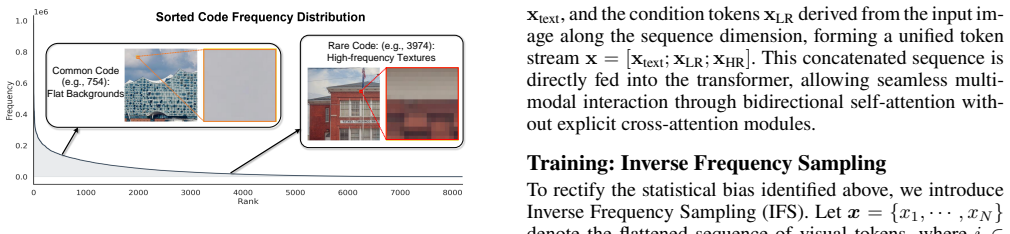
DiMOO-SR demonstrates that directly transplanting standard masked-token diffusion to super-resolution is suboptimal, and that two task-specific fixes are sufficient to make it competitive. The paper establishes that visual codebook usage is severely long-tailed, that statistical rarity tracks structural complexity (rare tokens carry high self-information), and that uniform masking under-trains these texture tokens. IFS reweights the masking distribution toward high-information tokens during training, while SCR re-ranks low-confidence predictions by agreement with retained spatial anchors during decoding. On real-world SR benchmarks, the full system reduces FID and DISTS relative to both cont
What carries the argument
Two mechanisms carry the argument. (1) Inverse Frequency Sampling (IFS): an importance-sampling masking distribution P_IFS(i) ∝ exp(α·I(x_i)), where I(x_i) = -log p(k) is the token's self-information under an empirical codebook distribution; it is blended 50/50 with uniform masking so every token keeps nonzero sampling probability and importance weights stay bounded. (2) Spatial Consistency Ranking (SCR): during parallel decoding, each masked position's confidence is refined as (1−λ)c_i + λ·(local average confidence of retained anchors) only for predictions below a trust threshold τ; high-confidence tokens are left unchanged. The long-tailed codebook statistics supply the premise that connec
Load-bearing premise
The load-bearing premise is that the token-frequency distribution measured on the training patches transfers to the test images and correctly tells the model which tokens are perceptually critical; if that transfer fails, IFS's masking priorities become wrong and the reported gains may not generalize.
What would settle it
Recompute the codebook token frequencies p(k) on the RealSR/DRealSR test patches and rerun training and decoding with IFS using this test-derived p(k). If FID and DISTS do not improve over uniform masking, or if the training-derived p(k) and test-derived p(k) diverge sharply while the gains shrink, the rarity-importance assumption is falsified.
If this is right
- Discrete diffusion becomes a viable decoder for multimodal super-resolution, avoiding the sequential bottleneck of autoregressive token models.
- Training budget shifts toward rare, texture-bearing tokens, improving FID, DISTS, and MUSIQ without adding parameters.
- Parallel decoding no longer needs full context before refining; local-anchor re-ranking suppresses isolated artifacts at the cost of a fixed-window average.
- Only five refinement steps suffice for competitive perceptual quality, making the pipeline roughly an order of magnitude faster than autoregressive token super-resolution.
- Dense textual captions measurably help the non-causal decoder, suggesting text-conditioned SR benefits from fine-grained semantic prompts.
Where Pith is reading between the lines
- The rarity-as-importance principle is not SR-specific: any discrete image-generation task with a long-tailed codebook, such as inpainting, editing, or compression, might benefit from inverse-frequency masking with the same hybrid-stability argument.
- Because p(k) is estimated from facial and restoration training patches, a domain shift in test images could weaken IFS; recomputing or adapting p(k) on the target benchmark is a concrete way to test how much of the gain depends on the exact distribution.
- SCR acts like a cheap spatial prior injected at decision time; combining it with uncertainty calibration or a learned confidence map could push further than fixed λ and τ.
- The fixed VQ codebook caps texture granularity; if the paper is right, hierarchical or adaptive codebooks, mentioned as future work, should multiply the gains rather than replace the mechanism.
Editorial analysis
A structured set of objections, weighed in public.
Referee Report
Summary. The paper introduces DiMOO-SR, a discrete-diffusion framework for photo-realistic image super-resolution built on the Lumina-DiMOO multimodal backbone. Two contributions are proposed: Inverse Frequency Sampling (IFS), a training-time masking strategy that assigns higher masking probability to rare visual tokens, and Spatial Consistency Ranking (SCR), an inference-time confidence-refinement rule that re-ranks uncertain token predictions based on local neighborhood agreement. The method is evaluated on RealSR and DRealSR, reporting improved FID, DISTS, MUSIQ, and NIQE over continuous-diffusion baselines (e.g., SeeSR) and token-based baselines (e.g., PURE, ITER, Lumina-DiMOO) with only 5 parallel decoding steps and ~1.63 s per 512×512 image.
Significance. If the reported gains are robust, the paper makes a meaningful contribution by showing that a discrete token-based diffusion model can achieve competitive perceptual quality in real-world SR while avoiding the sequential bottleneck of autoregressive models. The internal ablations (Table 2a) give a plausible decomposition: IFS improves FID and MUSIQ, SCR improves NIQE and MUSIQ, and the combination yields the best overall metrics. The paper also includes a useful analysis of token rarity, a hybrid-sampling stabilization argument (Eq. 5–6), and an honest limitations section. The main weakness is that the central empirical claims rest on single-run metric differences without uncertainty quantification, and some technical details of IFS (zero-frequency tokens) are unspecified. The paper does not release code, and the 'parameter-free' description of SCR is contradicted by the existence of λ, τ, and neighborhood-size hyperparameters.
major comments (3)
- [Tables 1 and 2(a); Eq. (7)] The central claim of improved perceptual quality is supported exclusively by single-run metrics on fixed patch lists. No confidence intervals, multiple seeds, or bootstrap estimates are reported, although decoding is stochastic (Eq. 7) and FID on 512×512 patches is known to be high-variance. Several headline differences are small (FID 123.78 vs. 125.55 for SeeSR on RealSR; LPIPS 0.3053 vs. 0.3098 for SCR vs. Gaussian in Table 2b). Without uncertainty quantification, the claimed complementary gains of IFS and SCR are not statistically established. Please provide at least multi-seed runs with mean±std, or bootstrap CIs, for the key configurations in Tables 1 and 2.
- [Eq. (2)–(3), 'Training: Inverse Frequency Sampling'] The IFS probability P_IFS(i) depends on I(x_i) = -log p(k). The empirical p(k) is computed from ~310k patches over an 8192-entry codebook, so some codewords are likely to have zero or near-zero counts. For zero counts, -log p(k) is undefined; for extremely small counts, I can become very large, making P_IFS degenerate. The paper does not specify any smoothing, floor, or renormalization. Please state the exact estimator (e.g., Laplace smoothing, count threshold) and show sensitivity to that choice.
- [Table 2(a) and 'Implementation Details'] The ablation row 'Lumina-DiMOO' is the baseline for the component analysis, but it is unclear whether this row corresponds to the same model fine-tuned on the same SR data with the same number of iterations, using only uniform masking and pointwise confidence ranking. If the baseline is the original pre-trained Lumina-DiMOO without any SR fine-tuning, then the gains attributed to IFS/SCR are confounded by fine-tuning itself. Please clarify explicitly, and if the baseline was not fine-tuned, add a properly matched ablation.
minor comments (4)
- [Contributions and Figure 2 caption] SCR is described as 'parameter-free' in the contribution list and in the Figure 2 caption, yet Implementation Details sets λ=0.7, τ=0.5, and a 5×5 neighborhood. Suggest rewording to 'no additional learned parameters' and, ideally, include a sensitivity study for λ and τ.
- [Eq. (2)–(3)] The computation of p(k) is described as a 'global statistical sweep' but no details are given on patch sizes, overlap, or whether the count is computed over the full codebook with any smoothing. Please add a precise description.
- [Figure 4] The caption 'Semantic Tail (GT) Mask Tail (α=0.0) Mask Tail (α=0.4)' is ambiguous. Define 'semantic tail' and clarify what is being visualized in each panel.
- [General] The paper states that the code will be released upon publication. Given the reproducibility concerns (no code, no seeds), consider making the code and evaluation scripts available with the revision, or at least provide exact random seeds and the patch sampling protocol.
Circularity Check
Central SR gains are externally measured; only a non-load-bearing self-consistency diagnostic has a definitional flavor.
specific steps
-
other
[Section 'Analysis of IFS', Figure 4]
"We evaluate the effectiveness of our masking strategy using two complementary metrics: Precision (the proportion of masked tokens belonging to the semantic tail) and Semantic Recall (the proportion of tail tokens successfully masked)."
The diagnostic defines 'semantic tail' by the same token rarity p(k) used to build P_IFS in Eq. 3, so the reported +52.3% precision gain of IFS over random masking is true by construction rather than an independent test. This is not load-bearing for the paper's central claims: Table 1 and Table 2(a) report FID, DISTS, MUSIQ, and NIQE on external RealSR/DRealSR patches, which do not reduce to the rare-token definition.
full rationale
DiMOO-SR's main quantitative claims are established by fine-tuning a public discrete-diffusion backbone (Lumina-DiMOO) and evaluating on held-out real-world SR benchmarks relative to external baselines; no fitted parameter is renamed as a prediction, and no uniqueness theorem or load-bearing self-citation is used. Self-citations to Lumina-DiMOO/Lumina-mGPT serve only as backbone and baseline. The only mild definitional flavor is the IFS diagnostic in Figure 4, which measures masking against the same rarity notion used to define IFS; this is a mechanism check rather than the evidence for the FID/DISTS improvements. The lack of confidence intervals is a statistical robustness concern, not circularity.
Axiom & Free-Parameter Ledger
free parameters (7)
- information temperature α =
0.4
- hybrid Bernoulli probability p =
0.5
- IFS mask ratio range =
γ ∼ U(0, 0.6)
- SCR fusion weight λ =
0.7
- SCR trust threshold τ =
0.5
- SCR neighborhood size =
5×5
- number of decoding steps T =
5
axioms (6)
- domain assumption Lumina-DiMOO bidirectional transformer with VQ-GAN codebook (K=8192) is a valid generative backbone for SR fine-tuning.
- domain assumption Empirical token frequencies p(k) estimated on ~310k FFHQ/LSDIR patches generalize to RealSR/DRealSR test images.
- domain assumption Per-token gradients are bounded, making the importance-weight bound in Eq. (6) control variance.
- domain assumption Pointwise confidence pθ(x̂_i | x_obs, x_LR, x_text) is a valid basis for re-ranking token reliability.
- domain assumption FID, LPIPS, DISTS, NIQE, and MUSIQ are meaningful proxies for perceptual quality in SR.
- domain assumption Qwen3-VL captions are accurate dense descriptions of the image content.
Cite this review
Pith. "Pith review of Rarity-Aware Discrete Diffusion with Spatially Consistent Decoding for Photo-Realistic Image Super-Resolution." pith.science (2026). https://pith.science/paper/XZ2ZEDM6
@misc{pith2026260717612,
  author       = {Pith},
  title        = {Pith review of: Rarity-Aware Discrete Diffusion with Spatially Consistent Decoding for Photo-Realistic Image Super-Resolution},
  year         = {2026},
  howpublished = {\url{https://pith.science/paper/XZ2ZEDM6}},
  note         = {Machine review of arXiv:2607.17612}
}
read the original abstract
Continuous diffusion models have become the dominant paradigm for photo-realistic image Super-Resolution (SR), but they typically formulate reconstruction as continuous signal-level denoising and incorporate semantic priors through external conditioning modules. This makes it less direct to exploit the unified token-based scaling paradigm of modern multimodal models. Autoregressive models provide a more native semantic representation by modeling images as discrete visual tokens, yet their causal decoding is inefficient for high-resolution reconstruction. Discrete diffusion offers a promising middle ground by enabling non-causal, parallel prediction over visual tokens. However, directly adapting discrete diffusion to SR remains non-trivial due to two task-specific challenges: (1) the long-tailed distribution of visual tokens, which under-represents rare but perceptually critical textures; and (2) spatially inconsistent parallel decoding, which may introduce isolated artifacts. To address these issues, we propose DiMOO-SR, a rarity-aware multimodal discrete diffusion framework for photo-realistic image SR. During training, Inverse Frequency Sampling (IFS) prioritizes under-represented but information-rich tokens. During inference, Spatial Consistency Ranking (SCR) refines token confidence using local neighborhood agreement to improve structural coherence. Extensive experiments on widely used real-world SR benchmarks demonstrate that DiMOO-SR achieves competitive perceptual quality with only a few parallel decoding steps, highlighting the potential of discrete diffusion for generative image super-resolution. The code will be released upon publication.
Figures


Reference graph
Works this paper leans on
-
[1]
Langley , title =
P. Langley , title =. Proceedings of the 17th International Conference on Machine Learning (ICML 2000) , address =. 2000 , pages =
2000
-
[2]
T. M. Mitchell. The Need for Biases in Learning Generalizations. 1980
1980
-
[3]
M. J. Kearns , title =
-
[4]
Machine Learning: An Artificial Intelligence Approach, Vol. I. 1983
1983
-
[5]
R. O. Duda and P. E. Hart and D. G. Stork. Pattern Classification. 2000
2000
-
[6]
Suppressed for Anonymity , author=
-
[7]
Newell and P
A. Newell and P. S. Rosenbloom. Mechanisms of Skill Acquisition and the Law of Practice. Cognitive Skills and Their Acquisition. 1981
1981
-
[8]
A. L. Samuel. Some Studies in Machine Learning Using the Game of Checkers. IBM Journal of Research and Development. 1959
1959
-
[9]
Large Language Diffusion Models , author=
-
[10]
arXiv preprint arXiv:2507.17801 , year=
Lumina-mgpt 2.0: Stand-alone autoregressive image modeling , author=. arXiv preprint arXiv:2507.17801 , year=
-
[11]
Ling Yang and Ye Tian and Bowen Li and Xinchen Zhang and Ke Shen and Yunhai Tong and Mengdi Wang , booktitle=NIPS, year=
-
[12]
2026 , publisher=
Lumina-mGPT: Flexible photorealistic autoregressive text-to-image generation , author=. 2026 , publisher=
2026
-
[13]
Proceedings of the AAAI conference on artificial intelligence , pages=
Iterative token evaluation and refinement for real-world super-resolution , author=. Proceedings of the AAAI conference on artificial intelligence , pages=
-
[14]
FirstName Alpher and FirstName Gamow , title =
-
[15]
Scaling up to excellence: Practicing model scaling for photo-realistic image restoration in the wild , author=
-
[16]
Taming transformers for high-resolution image synthesis , author=
-
[17]
High-resolution image synthesis with latent diffusion models , author=
-
[18]
Maskgit: Masked generative image transformer , author=
-
[19]
Muse: Text-to-image generation via masked generative transformers , author=
-
[20]
A style-based generator architecture for generative adversarial networks , author=
-
[21]
Lsdir: A large scale dataset for image restoration , author=
-
[22]
arXiv preprint arXiv:2510.06308 , year=
Lumina-dimoo: An omni diffusion large language model for multi-modal generation and understanding , author=. arXiv preprint arXiv:2510.06308 , year=
-
[23]
2024 , publisher=
Exploiting diffusion prior for real-world image super-resolution , author=. 2024 , publisher=
2024
-
[24]
Ntire 2017 challenge on single image super-resolution: Dataset and study , author=
2017
-
[25]
Toward real-world single image super-resolution: A new benchmark and a new model , author=
-
[26]
Component divide-and-conquer for real-world image super-resolution , author=
-
[27]
The unreasonable effectiveness of deep features as a perceptual metric , author=
-
[28]
Gans trained by a two time-scale update rule converge to a local nash equilibrium , author=
-
[29]
Image quality assessment: Unifying structure and texture similarity , author=
-
[30]
A feature-enriched completely blind image quality evaluator , author=
-
[31]
Maniqa: Multi-dimension attention network for no-reference image quality assessment , author=
-
[32]
Musiq: Multi-scale image quality transformer , author=
-
[33]
Exploring clip for assessing the look and feel of images , author=
-
[34]
Resshift: Efficient diffusion model for image super-resolution by residual shifting , author=
-
[35]
Pixel-aware stable diffusion for realistic image super-resolution and personalized stylization , author=
-
[36]
2024 , booktitle = ECCV, pages =
Lin, Xinqi and He, Jingwen and Chen, Ziyan and Lyu, Zhaoyang and Dai, Bo and Yu, Fanghua and Qiao, Yu and Ouyang, Wanli and Dong, Chao , title =. 2024 , booktitle = ECCV, pages =
2024
-
[37]
Seesr: Towards semantics-aware real-world image super-resolution , author=
-
[38]
Learning transferable visual models from natural language supervision , author=
-
[39]
Sinsr: diffusion-based image super-resolution in a single step , author=
-
[40]
Image super-resolution via iterative refinement , author=
-
[41]
Enhanced deep residual networks for single image super-resolution , author=
-
[42]
Esrgan: Enhanced super-resolution generative adversarial networks , author=
-
[43]
Neural discrete representation learning , author=
-
[44]
Generative pretraining from pixels , author=
-
[45]
Bert: Pre-training of deep bidirectional transformers for language understanding , author=
-
[46]
Curriculum learning , author=
-
[47]
One-step effective diffusion network for real-world image super-resolution , author=
-
[48]
Dustin Podell and Zion English and Kyle Lacey and Andreas Blattmann and Tim Dockhorn and Jonas M
-
[49]
and Kaiser,
Vaswani, Ashish and Shazeer, Noam and Parmar, Niki and Uszkoreit, Jakob and Jones, Llion and Gomez, Aidan N. and Kaiser,. Attention is all you need , year =
-
[50]
2025 , pages =
Wei, Hongyang and Liu, Shuaizheng and Yuan, Chun and Zhang, Lei , title =. 2025 , pages =
2025
-
[51]
Designing a practical degradation model for deep blind image super-resolution , author=
-
[52]
Real-esrgan: Training real-world blind super-resolution with pure synthetic data , author=
-
[53]
Swinir: Image restoration using swin transformer , author=
-
[54]
Visual Autoregressive Modeling for Image Super-Resolution , author=
-
[55]
Transactions on Machine Learning Research , issn=
Scaling Autoregressive Models for Content-Rich Text-to-Image Generation , author=. Transactions on Machine Learning Research , issn=
-
[56]
2026 , volume=
Chen, Xiangyu and Wang, Xintao and Zhang, Wenlong and Kong, Xiangtao and Qiao, Yu and Zhou, Jiantao and Dong, Chao , journal=PAMI, title=. 2026 , volume=
2026
-
[57]
Visual Autoregressive Modeling: Scalable Image Generation via Next-Scale Prediction , author=
-
[58]
Focal loss for dense object detection , author=
-
[59]
Large language models struggle to learn long-tail knowledge , author=
-
[60]
2025 , volume=
Exploring frequency-inspired optimization in transformer for efficient single image super-resolution , author=. 2025 , volume=
2025
-
[61]
Srformer: Permuted self-attention for single image super-resolution , author=
discussion (0)
Sign in with ORCID, Apple, or X to comment. Anyone can read and Pith papers without signing in.