REVIEW 5 major objections 5 minor 50 references
Spacecraft Safe Robust Control Using Implicit Neural Representation for Geometrically Complex Targets in Proximity Operations
T0 review · 5 major / 5 minor · reviewed 2026-08-06 · deepseek-v4-flash
Pith's one-line read A two-layer safety filter built on an over-approximating neural signed distance function can prove collision avoidance for a chaser near a geometrically complex target, even under external disturbances.
desk verdict A practically motivated integration of neural SDF and CBF for spacecraft proximity ops, but the central safety proofs don't hold as written. read the letter →
The pith
A machine-rendered reading of the paper's core claim, the machinery that carries it, and where it could break.
The reading
What carries the argument
The load-bearing object is a neural signed distance function $\tilde f_{\mathrm{sdf}}$ learned from point clouds with an asymmetric loss that pushes the zero-level set outward, so the learned surface is a conservative outer envelope of the target. The control layer uses two pieces: a control-barrier-function-constrained second-order cone program (CCBF-SOCP) velocity generator that enforces $\nabla \tilde f_{\mathrm{sdf}}(r) v_s + \alpha_0(\tilde f_{\mathrm{sdf}}(r) - e_h) \ge \|v_s\| e_{\nabla h}$ plus a circulation inequality to escape local minima, and a smooth safety filter built from the modified control barrier function $h_1 = h - \frac{1}{2\mu_h}(v-v_s)^\top(v-v_s) - \beta V_{e_d}$, which folds in disturbance-observer estimation error. The proof of forward invariance proceeds by worst-case bounding of the approximation errors $e_1$ and $e_2$ over the whole region, so those error bounds are what turn a learned approximation into a formal safety certificate.
What would settle it
Sample a dense grid of points outside the training set around the target surface, compute the true SDF and gradient from the known CAD model, and measure $\max |\tilde f_{\mathrm{sdf}}(p) - f_{\mathrm{sdf}}(p)|$ over points where $\tilde f_{\mathrm{sdf}} < f_{\mathrm{sdf}}$, plus $\max \|\nabla \tilde f_{\mathrm{sdf}}(p) - \nabla f_{\mathrm{sdf}}(p)\|$. If either exceeds $e_h$ or $e_{\nabla h}$ at any point reachable by the simulated trajectories, the worst-case step in Theorem 3's proof fails; a still more direct test is to run the closed-loop simulation with an adversarial disturbance chosen to point along the largest observed gradient error direction and check whether $h_1$ dips below zero.
Extended reading notes
Core claim
The central claim of the paper is Theorem 3: the smooth safe robust control law in Eq. (35), combined with the disturbance observer in Eq. (28), keeps the safe set $\mathcal{C}_1$ defined in Eq. (34) forward invariant, meaning a chaser starting inside the set can never be driven into the target. The safe set is built from the learned over-approximating signed distance function, the worst-case SDF value error $e_h$ and gradient error $e_{\nabla h}$, the velocity tracking error, and the disturbance-observer estimation error. The same machinery returns the vehicle to the desired position once the safe velocity equals the nominal reference velocity, as stated in Theorem 4; safety and convergence can trade off, and safety is given priority.
Load-bearing premise
The entire safety proof assumes that the learned signed distance function's under-approximation error never exceeds the bounds $|e_1| \le e_h$ and $\|e_2\| \le e_{\nabla h}$ anywhere in the operational region; the training loss encourages but does not mathematically guarantee these bounds, and the gradient bound $e_{\nabla h}$ is never computed or reported in the simulations.
Editorial extensions
If this is right
- The learned over-approximating envelope replaces ellipsoid and capsule bounds, so proximity operations around stations and satellites with solar panels and antennas can use much tighter exclusion zones.
- Because the zero velocity $v_s = 0$ is always feasible for the SOCP (Theorem 2), the chaser always has a safe standstill option, which is a useful last-resort behavior during unexpected events.
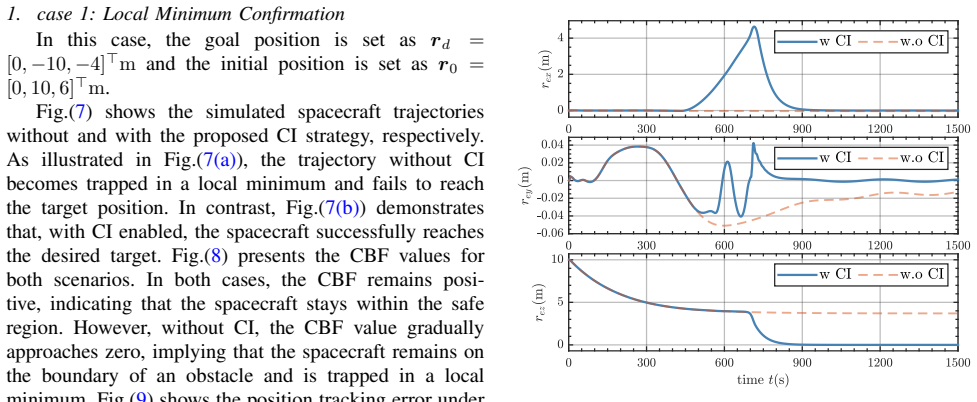
- With the circulation inequality, the chaser avoids the local-minimum traps that stall standard CBF filters; in the paper's Monte Carlo runs, all 1000 sampled initial conditions reached the goal.
- The disturbance observer removes the need for a known worst-case disturbance bound in the safety filter, reducing conservatism while preserving the forward-invariance claim.
- Per-step computation, including neural SDF inference and SOCP solving, stays below 10 ms in simulation, suggesting the algorithm can run in real time on current onboard processors.
Reading between the lines
- Editorial inference: the same representation could be updated online from streaming point clouds, which would extend the framework to non-cooperative targets whose geometry is only observed in flight; the paper names this as future work.
- Editorial inference: the missing piece for a truly certified guarantee is a validation procedure that computes $e_{\nabla h}$ and certifies the bound over the reachable region; adding such a certificate would make the over-approximation heuristic a hard guarantee.
- Editorial inference: the over-approximation strength $\kappa$ is a dial that trades safety margin against reachable workspace; missions could adapt $\kappa$ during approach, using a loose envelope far away and a tighter one near docking.
- Editorial inference: because the velocity constraint is soft, trajectories may briefly exceed $v_{\max}$ even though safety is maintained; missions with strict plume-impingement or structural-load limits would need a hard velocity cap in the SOCP.
Editorial analysis
A structured set of objections, weighed in public.
Referee Report
Summary. The paper proposes a two-layer safe robust control framework for spacecraft proximity operations around complex-geometry targets. An MLP is trained to approximate the signed distance function (SDF) of the target with an asymmetric loss intended to produce a conservative, over-approximating surface. A second-order cone program (CCBF-SOCP) generates a safe reference velocity, using the learned SDF and a circulation inequality to avoid local minima. A disturbance observer and a smooth safety filter are then designed to render the closed-loop system safe under disturbances, with a claim of forward invariance of a modified safe set. The paper reports simulations and Monte Carlo studies for several spacecraft models.
Significance. The paper addresses a practically important problem—collision avoidance for proximity operations around targets with complex, non-convex geometry—and the idea of combining a learned neural SDF with CBF-based safety filtering is timely and potentially useful. The authors provide a full control architecture, report extensive simulations including Monte Carlo campaigns, and explicitly discuss the need to account for approximation error in the learned SDF. If the safety guarantees were correct, the paper would be a meaningful step toward learning-based safe proximity operations. However, as detailed below, the central safety proof contains load-bearing algebraic errors, and the training loss appears to encourage the opposite of the claimed over-approximation; these issues prevent the stated guarantees from being accepted.
major comments (5)
- [VI.C, Eq. (39)] The completing-square step in the proof of Theorem 3 is algebraically invalid. Expanding the proposed square yields a cross-term coefficient of sqrt((β_e+β_c)/(2β_e−β_c)) rather than the required coefficient of 1; the identity would require β_c = β_e/2, which is not assumed anywhere. Moreover, with the simulation parameters β_e=0.1 and β_c=10 reported in Section VII.A.2, the quantity 2β(2β_e−β_c) is negative, so the square root appearing in the completed-square expression is not real and the inequality (39) is not justified. Since Eq. (38) and Eq. (43) are derived from this step, the forward-invariance conclusion of Theorem 3 is unsupported.
- [VI.A, Theorem 2] The claim that v_s = 0 is always feasible for the CCBF-SOCP (23) is false. The CBF constraint (24) requires α0(ef_sdf(r) − e_h) ≥ 0, which holds only if ef_sdf(r) ≥ e_h. However, points in the safe set C defined by h = ef_sdf + e_1 ≥ 0 may have ef_sdf(r) < e_h when the under-approximation error e_1 is sufficiently positive. For such states, v_s = 0 does not satisfy the CBF constraint, so Remark 2 and the claimed feasibility guarantee fail.
- [V.B, Eq. (10)] The loss function L_P is inconsistent with the stated over-approximation goal. With κ > 1 (and κ = 2 in the simulations), the term (κ−1)/2(ef_sdf − d) + (κ−1)/2|ef_sdf − d| is positive for positive errors ef_sdf − d > 0 and zero for negative errors. Minimizing this loss therefore encourages the predicted SDF to be smaller than the true SDF, i.e., under-approximation, which would push the zero-level set inward rather than outward. This contradicts the paper's claim that the loss promotes a conservative over-approximating envelope and undermines the safety rationale of the representation.
- [V.D, Eq. (13)] The error bounds |e_1| ≤ e_h and ‖e_2‖ ≤ e∇h are assumed to hold globally over the operational region, but the paper provides no method to certify these bounds and does not report e∇h in the simulations. The loss function (10) only encourages unit-gradient behavior at training points and does not guarantee the pointwise bounds used in Theorems 1 and 3. The safety guarantees are therefore conditional on an unverified property of the learned model, even setting aside the algebraic issues in the proofs.
- [VI.C, Eqs. (41)-(42)] The min/max operations in Eqs. (41) and (42) interchange the error variables: Eq. (41) minimizes over |e_1| ≤ e_h although the expression depends on e_2, and Eq. (42) maximizes over ‖e_2‖ ≤ e∇h although the expression depends on e_1. The displayed result also drops the term ‖(1/(mμh))(v−v_s)‖^2/(2β(2β_e−β_c)) from the right-hand side of Eq. (41), even though it is retained in the subsequent expression (43). These formal errors further call into question the derivation of the smooth safety filter.
minor comments (5)
- [Abstract and Title] There are several typos and misspellings, such as 'apporximation' in the abstract and 'hierarchcial' in the introduction, which should be corrected.
- [VI.C, Eq. (39)] The notation 'ββ_e' and 'ββ_c' in Eq. (39) is ambiguous and should be written as ββ_e and ββ_c, respectively, with clear multiplication.
- [VII.C.2 (Fig. 16)] The text near Fig. 16 refers to solving the 'SCOP problem,' which appears to be a typo for 'SOCP problem.'
- [References] References [29] and [34] are the same paper (Molnar and Ames, 'Composing control barrier functions for complex safety specifications') and should be merged or cited only once.
- [VI.B, Remark 4] Remark 4 states that the approach 'operates without such knowledge' of disturbance estimation error bounds, but the design still requires the exponential decay rate β_e from Lemma 1; the remark should clarify what knowledge is actually assumed.
Circularity Check
No significant circularity: the safety guarantees are conditional on explicitly stated approximation-error bounds, not on fitting the conclusion into the inputs.
full rationale
The paper's derivation chain is not circular. The learned neural SDF is an independently trained representation, and the under-approximation error bounds in Eq. (13), |e1| <= e_h and ||e2|| <= e_gradh, are explicitly stated as assumptions/inputs to the safety filter design; they are not reverse-engineered from the claimed safety outcome. The controller then uses these bounds to construct a conservative safe set, which is a standard conditional guarantee: if the bounds hold, forward invariance follows (modulo any algebraic errors in the proof, which are correctness issues, not circularity). The paper even acknowledges that the loss 'does not strictly guarantee an over-approximation' and that the worst-case bound must be analyzed separately, so the bound is not definitionally identical to the safety claim. The velocity-generation SOCP, disturbance observer, and smooth safety filter all follow from external standard results ([40], [44], [45], [46]) rather than from a self-citation chain. The authors' self-citations in references [31]-[33] are background literature on prior CBF-based spacecraft control and are not load-bearing for the proof of Theorem 3. The Monte Carlo simulations are an independent validation against conventional CBF baselines, not a relabeling of the design constraints. Therefore, despite possible correctness gaps in the proof of Theorem 3, no circular step can be exhibited: no fitted parameter is renamed as a prediction, no result is assumed via self-citation, and no known result is merely renamed.
Assumptions & free parameters
free parameters (4)
- e_h =
0.019 (ISS), 0.012 (CSS), 0.031 (Intersat-30)
- e∇h =
not reported
- κ =
2
- η =
0.1
assumptions (4)
- ad hoc to paper The learned SDF satisfies the Eikonal equation ∥∇f^∥≈1 after training, and the error bounds Eq.(13) hold pointwise.
- domain assumption The disturbance d is generated by the exosystem Eq.(27) with known A and C.
- domain assumption The target geometry is known a priori and a point cloud of the target is available for offline training.
- domain assumption The velocity of the system is measurable and the relative orbital dynamics Eq.(5) accurately describe the motion.
Cite this review
Pith. "Pith review of Spacecraft Safe Robust Control Using Implicit Neural Representation for Geometrically Complex Targets in Proximity Operations." pith.science (2026). https://pith.science/paper/XZ4IVFI5
@misc{pith2026250713672,
  author       = {Pith},
  title        = {Pith review of: Spacecraft Safe Robust Control Using Implicit Neural Representation for Geometrically Complex Targets in Proximity Operations},
  year         = {2026},
  howpublished = {\url{https://pith.science/paper/XZ4IVFI5}},
  note         = {Machine review of arXiv:2507.13672}
}
read the original abstract
This study addresses the challenge of ensuring safe spacecraft proximity operations, focusing on collision avoidance between a chaser spacecraft and a complex-geometry target spacecraft under disturbances. To ensure safety in such scenarios, a safe robust control framework is proposed that leverages implicit neural representations. To handle arbitrary target geometries without explicit modeling, a neural signed distance function (SDF) is learned from point cloud data via a enhanced implicit geometric regularization method, which incorporates an over-apporximation strategy to create a conservative, safety-prioritized boundary. The target's surface is implicitly defined by the zero-level set of the learned neural SDF, while the values and gradients provide critical information for safety controller design. This neural SDF representation underpins a two-layer hierarchcial safe robust control framework: a safe velocity generation layer and a safe robust controller layer. In the first layer, a second-order cone program is formulated to generate safety-guaranteed reference velocity by explicitly incorporating the under-approximation error bound. Furthermore, a circulation inequality is introduced to mitigate the local minimum issues commonly encountered in control barrier function (CBF) methods. The second layer features an integrated disturbance observer and a smooth safety filter explicitly compensating for estimation error, bolstering robustness to external disturbances. Extensive numerical simulations and Monte Carlo analysis validate the proposed framework, demonstrating significantly improved safety margins and avoidance of local minima compared to conventional CBF approaches.
Figures


Figures from the paper (11 more)




Reference graph
Works this paper leans on
-
[1]
On-orbit service (OOS) of spacecraft: A review of engineering developments,
W.-J. Li, D.-Y . Cheng, X.-G. Liu, Y .-B. Wang, W.-H. Shi, Z.-X. Tang, F. Gao, F.-M. Zeng, H.-Y . Chai, W.-B. Luo, Q. Cong, and Z.-L. Gao, “On-orbit service (OOS) of spacecraft: A review of engineering developments,” Progress in Aerospace Sciences , vol. 108, pp. 32–120, July 2019
work page 2019
-
[2]
N. T. Redd, “Bringing satellites back from the dead: Mission extension vehicles give defunct spacecraft a new lease on life - [news],” IEEE Spectrum, vol. 57, no. 8, pp. 6–7, 2020
work page 2020
-
[3]
Two-fault tolerant cold gas propulsion system for spacecraft-inspection cubesat,
J. W. Day and S. K. Robinson, “Two-fault tolerant cold gas propulsion system for spacecraft-inspection cubesat,” in AIAA Scitech 2020 Forum, 2020, p. 1665
work page 2020
-
[4]
J. Bohan, S. Qinbo, H. Hongyu, and D. Zhaohui, “A parametric design method of nanosatellite close-range formation for on-orbit Zhou ET AL.: Preprint Submitted To IEEE Transactions On Aerospace and Electronic Systems 13 target inspection,” Chinese Journal of Aeronautics, vol. 36, no. 10, pp. 194–209, 2023
work page 2023
-
[5]
S. Faghihi, S. Tavana, and A. H. de Ruiter, “Multiple spacecraft coordination and motion planning for full-coverage inspection of large complex space structures,” Acta Astronautica, vol. 202, pp. 119–129, 2023
work page 2023
-
[6]
Final payload test results for the removedebris active debris removal mission,
J. L. Forshaw, G. S. Aglietti, T. Salmon, I. Retat, M. Roe, C. Burgess, T. Chabot, A. Pisseloup, A. Phipps, C. Bernal et al., “Final payload test results for the removedebris active debris removal mission,” Acta Astronautica, vol. 138, pp. 326–342, 2017
work page 2017
-
[7]
Removedebris: An in-orbit active debris removal demon- stration mission,
J. L. Forshaw, G. S. Aglietti, N. Navarathinam, H. Kadhem, T. Salmon, A. Pisseloup, E. Joffre, T. Chabot, I. Retat, R. Axthelm et al. , “Removedebris: An in-orbit active debris removal demon- stration mission,” Acta Astronautica, vol. 127, pp. 448–463, 2016
work page 2016
-
[8]
Fehse, Automated rendezvous and docking of spacecraft
W. Fehse, Automated rendezvous and docking of spacecraft. Cam- bridge university press, 2003, vol. 16
work page 2003
Show all 50 references
-
[9]
Constrained spacecraft relative motion planning exploiting periodic natural motion trajectories and invariance,
G. R. Frey, C. D. Petersen, F. A. Leve, I. V . Kolmanovsky, and A. R. Girard, “Constrained spacecraft relative motion planning exploiting periodic natural motion trajectories and invariance,” Journal of Guidance, Control, and Dynamics , vol. 40, no. 12, pp. 3100–3115, 2017
2017
-
[10]
Sampling-based algorithms for optimal motion planning,
S. Karaman and E. Frazzoli, “Sampling-based algorithms for optimal motion planning,” The international journal of robotics research, vol. 30, no. 7, pp. 846–894, 2011
2011
-
[11]
Astrodynamics-informed kinodynamic sampling-based motion planning for relative spacecraft motion,
T. Deka and J. McMahon, “Astrodynamics-informed kinodynamic sampling-based motion planning for relative spacecraft motion,” Journal of Guidance, Control, and Dynamics , vol. 46, no. 12, pp. 2330–2345, 2023
2023
-
[12]
Stochastic trajectory optimization for 6-dof spacecraft autonomous rendezvous and docking with nonlinear chance constraints,
Y . Zhang, M. Cheng, B. Nan, and S. Li, “Stochastic trajectory optimization for 6-dof spacecraft autonomous rendezvous and docking with nonlinear chance constraints,” Acta Astronautica , vol. 208, pp. 62–73, 2023
2023
-
[13]
Spacecraft close-range trajectory planning via convex optimization and multi-resolution technique,
B. Li, H. Zhang, W. Zheng, and L. Wang, “Spacecraft close-range trajectory planning via convex optimization and multi-resolution technique,” Acta Astronautica, vol. 175, pp. 421–437, 2020
2020
-
[14]
Model predictive control for spacecraft rendezvous and docking: Strate- gies for handling constraints and case studies,
A. Weiss, M. Baldwin, R. S. Erwin, and I. Kolmanovsky, “Model predictive control for spacecraft rendezvous and docking: Strate- gies for handling constraints and case studies,” IEEE Transactions on Control Systems Technology , vol. 23, no. 4, pp. 1638–1647, 2015
2015
-
[15]
Fast model predictive control for spacecraft rendezvous and docking with obstacle avoidance,
C. Bashnick and S. Ulrich, “Fast model predictive control for spacecraft rendezvous and docking with obstacle avoidance,” Journal of Guidance, Control, and Dynamics , vol. 46, no. 5, pp. 998–1007, 2023
2023
-
[16]
Model predictive control for close-proximity maneuvering of spacecraft with adaptive convexification of collision avoidance constraints,
X. Wang, Y . Li, X. Zhang, R. Zhang, and D. Yang, “Model predictive control for close-proximity maneuvering of spacecraft with adaptive convexification of collision avoidance constraints,” Advances in Space Research , vol. 71, no. 1, pp. 477–491, 2023
2023
-
[17]
Collision-free control of a nano satellite in the vicinity of china space station using lorentz augmented composite artificial potential field,
H. Zhou, Z. Dang, Y . Zhang, and J. Yuan, “Collision-free control of a nano satellite in the vicinity of china space station using lorentz augmented composite artificial potential field,” Acta As- tronautica, vol. 203, pp. 88–102, 2023
2023
-
[18]
Artificial potential function based spacecraft proximity maneuver 6-dof control under multiple pyramid-type constraints,
L. Wang, Y . Guo, G. Ma, and H. Zhang, “Artificial potential function based spacecraft proximity maneuver 6-dof control under multiple pyramid-type constraints,” ISA transactions, vol. 126, pp. 316–325, 2022
2022
-
[19]
Velocity-free saturated control for spacecraft proximity operations with guaranteed safety,
Q. Hu, Y . Liu, and Y . Zhang, “Velocity-free saturated control for spacecraft proximity operations with guaranteed safety,” IEEE Transactions on Systems, Man, and Cybernetics: Systems , vol. 52, no. 4, pp. 2501–2513, 2021
2021
-
[20]
Collision avoidance control for formation flying of multiple spacecraft using artificial potential field,
J. Hwang, J. Lee, and C. Park, “Collision avoidance control for formation flying of multiple spacecraft using artificial potential field,” Advances in Space Research, vol. 69, no. 5, pp. 2197–2209, 2022
2022
-
[21]
Prescribed performance-based robust inverse optimal control for spacecraft proximity operations with safety concern,
Q. Li, D. Gao, C. Sun, S. Song, Z. Niu, and Y . Yang, “Prescribed performance-based robust inverse optimal control for spacecraft proximity operations with safety concern,” Aerospace Science and Technology, vol. 136, p. 108229, 2023
2023
-
[22]
Adaptive appointed-time formation tracking control for multiple spacecraft with collision avoidance under a dynamic event-triggered mechanism,
X. Wu, S. Luo, S. Yang, and C. Wei, “Adaptive appointed-time formation tracking control for multiple spacecraft with collision avoidance under a dynamic event-triggered mechanism,” Advances in Space Research , vol. 70, no. 11, pp. 3552–3567, 2022
2022
-
[23]
Barrier lyapunov functions for the control of output-constrained nonlinear systems,
K. P. Tee, S. S. Ge, and E. H. Tay, “Barrier lyapunov functions for the control of output-constrained nonlinear systems,” Automatica, vol. 45, no. 4, pp. 918–927, 2009
2009
-
[24]
Adaptive finite-time 6-dof tracking control for spacecraft fly around with input saturation and state con- straints,
Y . Huang and Y . Jia, “Adaptive finite-time 6-dof tracking control for spacecraft fly around with input saturation and state con- straints,” IEEE Transactions on Aerospace and Electronic Systems, vol. 55, no. 6, pp. 3259–3272, 2019
2019
-
[25]
Reference governor for constrained nonlinear systems,
A. Bemporad, “Reference governor for constrained nonlinear systems,” IEEE Transactions on Automatic Control, vol. 43, no. 3, pp. 415–419, 2002
2002
-
[26]
Nonlinear tracking control in the presence of state and control constraints: a generalized reference governor,
E. Gilbert and I. Kolmanovsky, “Nonlinear tracking control in the presence of state and control constraints: a generalized reference governor,” Automatica, vol. 38, no. 12, pp. 2063–2073, 2002
2002
-
[27]
Spacecraft rendezvous and docking using the explicit reference governor approach,
Q. Hu and B. Chi, “Spacecraft rendezvous and docking using the explicit reference governor approach,” IEEE Transactions on Systems, Man, and Cybernetics: Systems, vol. 53, no. 7, pp. 4131– 4141, 2023
2023
-
[28]
Control barrier functions: Theory and applica- tions,
A. D. Ames, S. Coogan, M. Egerstedt, G. Notomista, K. Sreenath, and P. Tabuada, “Control barrier functions: Theory and applica- tions,” in 2019 18th European control conference (ECC) . IEEE, 2019, pp. 3420–3431
2019
-
[30]
Compositions of Multiple Control Barrier Functions Under Input Constraints,
J. Breeden and D. Panagou, “Compositions of Multiple Control Barrier Functions Under Input Constraints,” in 2023 American Control Conference (ACC), May 2023, pp. 3688–3695
2023
-
[31]
Safe tracking control for free-flying space robots via control barrier functions,
C. Shi, T. Meng, K. Wang, J. Lei, W. Wang, and R. Mao, “Safe tracking control for free-flying space robots via control barrier functions,” Robotics and Autonomous Systems , vol. 184, p. 104865, 2025
2025
-
[32]
Control barrier function based trajectory generation and tracking control for spacecraft inspection mission under multiple safety constraints,
K. Wang, T. Meng, W. Wang, and J. Lei, “Control barrier function based trajectory generation and tracking control for spacecraft inspection mission under multiple safety constraints,” Advances in Space Research, vol. 73, no. 3, pp. 2080–2097, February 2024
2024
-
[33]
Safe inspection tracking control for a tumbling target under full state constraints and limited thrust,
K. Wang, J. Qiao, E. Wang, J. Lei, W. Wang, and T. Meng, “Safe inspection tracking control for a tumbling target under full state constraints and limited thrust,” IEEE Transactions on Aerospace and Electronic Systems , 2025
2025
-
[34]
Composing control barrier functions for complex safety specifications,
T. G. Molnar and A. D. Ames, “Composing control barrier functions for complex safety specifications,”IEEE Control Systems Letters, vol. 7, pp. 3615–3620, 2023
2023
-
[35]
The signed distance function: A new tool for binary classification,
E. M. Boczko and T. R. Young, “The signed distance function: A new tool for binary classification,” 2005
2005
-
[36]
Deepsdf: Learning continuous signed distance functions for shape representation,
J. J. Park, P. Florence, J. Straub, R. Newcombe, and S. Lovegrove, “Deepsdf: Learning continuous signed distance functions for shape representation,” in Proceedings of the IEEE/CVF Conference on Computer Vision and Pattern Recognition (CVPR) , June 2019
2019
-
[37]
Sdf-srn: Learning signed distance 3d object reconstruction from static images,
C.-H. Lin, C. Wang, and S. Lucey, “Sdf-srn: Learning signed distance 3d object reconstruction from static images,” Advances in Neural Information Processing Systems , vol. 33, pp. 11 453– 11 464, 2020
2020
-
[38]
Occupancy networks: Learning 3d reconstruction in function space,
L. Mescheder, M. Oechsle, M. Niemeyer, S. Nowozin, and A. Geiger, “Occupancy networks: Learning 3d reconstruction in function space,” in Proceedings of the IEEE/CVF conference on computer vision and pattern recognition , 2019, pp. 4460–4470
2019
-
[39]
Im- plicit geometric regularization for learning shapes,
A. Gropp, L. Yariv, N. Haim, M. Atzmon, and Y . Lipman, “Im- plicit geometric regularization for learning shapes,” arXiv preprint arXiv:2002.10099, 2020
2002 arXiv
-
[40]
Control Barrier Function Based Quadratic Programs for Safety Critical Systems,
A. D. Ames, X. Xu, J. W. Grizzle, and P. Tabuada, “Control Barrier Function Based Quadratic Programs for Safety Critical Systems,” IEEE Transactions on Automatic Control, vol. 62, no. 8, pp. 3861– 3876, August 2017
2017
-
[41]
Input to state stabilizing control lyapunov functions for robust bipedal 14 IEEE TRANSACTIONS ON AEROSPACE AND ELECTRONIC SYSTEMS VOL. XX, No. XX XXXXX 2025 robotic locomotion,
S. Kolathaya, J. Reher, A. Hereid, and A. D. Ames, “Input to state stabilizing control lyapunov functions for robust bipedal 14 IEEE TRANSACTIONS ON AEROSPACE AND ELECTRONIC SYSTEMS VOL. XX, No. XX XXXXX 2025 robotic locomotion,” in 2018 Annual American Control Confer- ence (A...
2025
-
[42]
New state transition matrix for relative motion on an arbitrary elliptical orbit,
K. Yamanaka and F. Ankersen, “New state transition matrix for relative motion on an arbitrary elliptical orbit,” Journal of guidance, control, and dynamics , vol. 25, no. 1, pp. 60–66, 2002
2002
-
[43]
DeepSDF: Learning Continuous Signed Distance Functions for Shape Representation,
J. J. Park, P. Florence, J. Straub, R. Newcombe, and S. Lovegrove, “DeepSDF: Learning Continuous Signed Distance Functions for Shape Representation,” in Proceedings of the IEEE/CVF Confer- ence on Computer Vision and Pattern Recognition, 2019, pp. 165– 174
2019
-
[44]
Control barrier functions with circulation inequalities,
V . M. Gonc ¸alves, P. Krishnamurthy, A. Tzes, and F. Khorrami, “Control barrier functions with circulation inequalities,” IEEE Transactions on Control Systems Technology , vol. 32, no. 4, pp. 1426–1441, 2024
2024
-
[45]
Disturbance observer based control for nonlinear systems,
W.-H. Chen, “Disturbance observer based control for nonlinear systems,” IEEE/ASME transactions on mechatronics, vol. 9, no. 4, pp. 706–710, 2004
2004
-
[46]
Characterizing smooth safety filters via the implicit function theorem,
M. H. Cohen, P. Ong, G. Bahati, and A. D. Ames, “Characterizing smooth safety filters via the implicit function theorem,” IEEE Control Systems Letters , vol. 7, pp. 3890–3895, 2023
2023
-
[47]
A method for stochastic optimization,
K. D. B. J. Adam et al., “A method for stochastic optimization,” arXiv preprint arXiv:1412.6980 , vol. 1412, no. 6, 2014
2014 arXiv
-
[48]
CVXPY: A Python-embedded mod- eling language for convex optimization,
S. Diamond and S. Boyd, “CVXPY: A Python-embedded mod- eling language for convex optimization,” Journal of Machine Learning Research, vol. 17, no. 83, pp. 1–5, 2016
2016
-
[49]
A rewriting system for convex optimization problems,
A. Agrawal, R. Verschueren, S. Diamond, and S. Boyd, “A rewriting system for convex optimization problems,” Journal of Control and Decision , vol. 5, no. 1, pp. 42–60, 2018
2018
-
[50]
Marching cubes: A high res- olution 3d surface construction algorithm,
W. E. Lorensen and H. E. Cline, “Marching cubes: A high res- olution 3d surface construction algorithm,” SIGGRAPH Comput. Graph., vol. 21, no. 4, pp. 163–169, Aug. 1987. Hang Zhou received the B.S. dgree from the School of Information Engineering of Zhejiang University of Tech...
1987
-
[2009]
Her research interest includes attitude control, orbital con- trol, and constellation formation control of micro-satellite
She is currently a Professor at the School of Aeronautics and Astronautics. Her research interest includes attitude control, orbital con- trol, and constellation formation control of micro-satellite. Kun Wang received the B.S. degree from Col- lege of Control Science and Engin...
2019
Reviewed August 6, 2026 · model on record in the stance chip above.
Discussion (0). Sign in to comment.