REVIEW 4 major objections 4 minor 47 references
MASH: Cooperative-Heterogeneous Multi-Agent Reinforcement Learning for Single Humanoid Robot Locomotion
T0 review · 4 major / 4 minor · reviewed 2026-08-05 · deepseek-v4-flash
Pith's one-line read Treating each limb as an independent learning agent produces faster, smoother humanoid walking than training the whole body as one agent.
desk verdict Plausible extension of limb-as-agent MARL to humanoids, with a nice hardware demo, but the central comparison to single-agent PPO is confounded by an unspecified baseline and a privileged critic. read the letter →
The pith
A machine-rendered reading of the paper's core claim, the machinery that carries it, and where it could break.
The reading
What carries the argument
The load-bearing object is the decPOMDP reformulation of a single body: each limb is an agent, with shared-parameter actor networks across symmetric limbs, a global critic under centralized training with decentralized execution (CTDE), and a temporal director that injects gait phase $T_i(t) = \sin(2\pi(kt + \Delta_i))$. The shared actors exploit left–right symmetry; the global critic provides a cooperative value signal; the phase offsets synchronize stepping and arm swing.
What would settle it
Train the single-agent PPO baseline with the same 106-dimensional privileged observations used by MASH's critic (and the same reward), then compare convergence and deployment metrics; if the gap collapses, the multi-agent design is not the cause. A second check is to strip MASH's global critic down to per-limb local critics and see whether the coordination metrics hold.
Extended reading notes
Core claim
The central claim is that the MDP for a single humanoid can be reformulated as a decPOMDP whose agents are the limbs, and that MAPPO with a shared global critic learns a better walking policy than single-agent PPO. Each leg agent observes joint positions, velocities, previous action, timing phase, torso orientation, and its own one-hot ID (32 dimensions); each arm agent observes a 26-dimensional analogue; and the critic sees a 106-dimensional global state including forces, friction, mass, and contact masks. Two shared-parameter actors—one for legs, one for arms—are trained with a shared reward and a temporal director $T_i(t) = \sin(2\pi(kt + \Delta_i))$ that encodes gait phase. Experiments r
Load-bearing premise
The single-agent PPO baseline is given the same reward and equivalent information, so the reported gains come from the multi-agent decomposition rather than from MASH's critic seeing privileged global state.
Editorial extensions
If this is right
- MARL becomes a viable paradigm for single-robot control, not just multi-robot teams.
- Shared-parameter actors with a phase-offset temporal director can encode gait symmetry and inter-limb coordination directly into the policy architecture.
- Domain randomization combined with MAPPO supports sim-to-real transfer for humanoid walking.
- Faster convergence means lower sample complexity for high-dimensional humanoid control tasks.
- The same decomposition could apply to other robot configurations, as the paper states as future work.
Reading between the lines
- The reported advantage may partly reflect information asymmetry: the single-agent PPO baseline likely lacked the global critic's privileged state, so the gain could come from extra observations rather than from multi-agent credit assignment.
- A cleaner test of the cooperation story is to ablate the global critic: if per-limb local critics perform as well, the symmetry and parameter sharing may be doing the work, not the centralized value function.
- The temporal director is effectively a gait rhythm prior; with more limbs or DOF, learning the phase offsets rather than hand-setting them could be a natural extension.
- If the limb-decomposition result holds across robots, it suggests whole-body loco-manipulation—where arms already have distinct roles—could inherit the same architecture without retraining from scratch.
Editorial analysis
A structured set of objections, weighed in public.
Referee Report
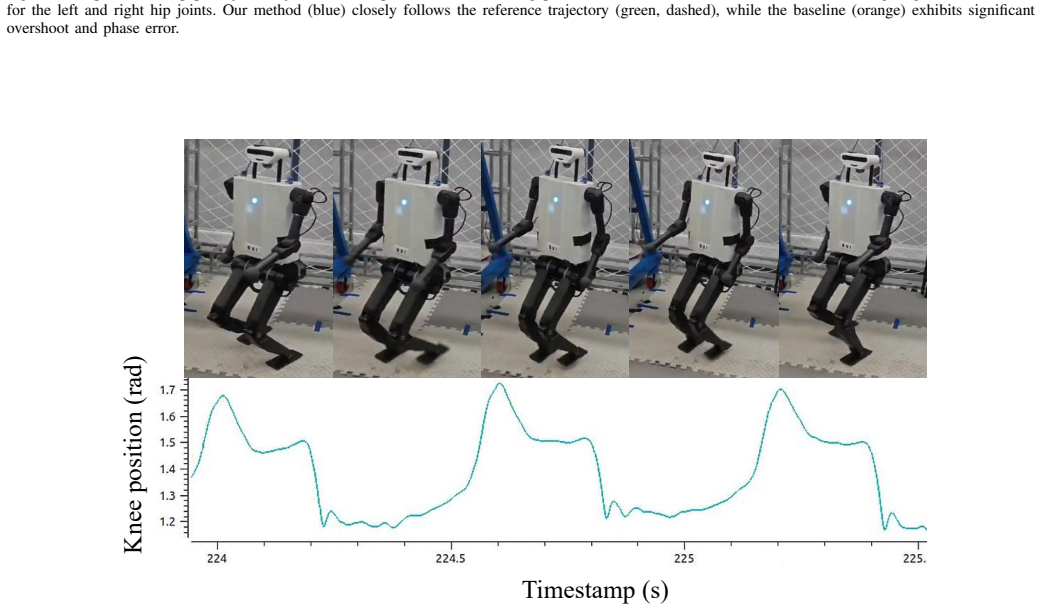
Summary. The paper proposes MASH, a cooperative-heterogeneous MARL framework for a single humanoid robot. Each limb (two legs, two arms) is treated as an independent agent, with parameter sharing across symmetric limbs and a centralized global critic under the CTDE paradigm. The method is evaluated in Isaac Gym against a single-agent PPO baseline on bipedal and arm-swing walking, with metrics for convergence time, action smoothness, torso stability, and limb coordination, followed by a real-world deployment demonstrating a periodic knee trajectory. The central claim is that modeling the locomotion problem as cooperative MARL accelerates training convergence and improves whole-body coordination relative to conventional single-agent RL.
Significance. If the empirical comparison were clean, the paper would make a useful contribution by extending the recent idea of applying MARL to a single legged robot from quadrupeds (MASQ) to humanoids, with hardware validation. The real-world deployment with domain randomization is a concrete strength. However, the current evidence does not yet support the central claim: the single-agent PPO baseline is underspecified and likely lacks the privileged global information available to MASH's critic, the results are single-seed, and several evaluation metrics overlap with the reward terms used for training. These are fixable within the scope of a revision, so the paper is worth pursuing, but the comparison must be made rigorous before the claimed advantage can be accepted.
major comments (4)
- [§V-A3 and §IV-A] The single-agent PPO baseline is described only as 'conventional single-agent PPO'; its observation space, critic inputs, network architecture, and hyperparameters are not given. Meanwhile, MASH's critic takes a 106-dimensional privileged global state that includes external disturbance forces f_t, external torques τ_t, friction coefficient μ_t, body mass m_t, and stance/contact masks. If the baseline uses actor-only observations and a critic without these privileged quantities, the improvements in Fig. 4 and Table II may be entirely due to information asymmetry rather than the MARL decomposition. This is the load-bearing comparison for the paper's central claim. Please specify the baseline completely and add an ablation: single-agent PPO with the same privileged critic input and the same observation preprocessing as MASH's actor, plus full hyperparameter tables for both methods.
- [§V-B, Fig. 4, Table II] All results appear to come from a single training run per condition. RL locomotion is high-variance, and the reported convergence-time differences (~1306 vs ~1661 and ~1017 vs ~1238 iterations) are modest; without multiple seeds and error bars these differences cannot be distinguished from stochasticity. Report at least five independent seeds with mean ± std (or box plots) for convergence time and deployment metrics, and state the number of seeds in the figure captions and table notes.
- [§V-A2 and Table I] The evaluation metrics are not independent of the training objective. T_conv is defined directly from the training reward curve, S_action matches the 'Action Smoothness 1' reward term (Table I), S_torso combines quantities penalized by the Orientation and Base Height rewards, and C_limb is shaped by the temporal director of Eq. (12). Table II may therefore be measuring reward-shaping effects rather than genuine behavioral superiority. Please report task-level metrics that are not directly part of the reward, such as forward walking speed versus command, energy consumption, push-recovery success rate, or a holdout validation curve, and define convergence using such a validation measure rather than the training return.
- [§IV-A and §IV-B] The agent decomposition is not fully specified. The text states that each limb is an independent agent, but the actor network receives concatenated observations from 'two agents' for the legs and 'two agents' for the arms, and the critic outputs a value V_t ∈ R^4. Equations (10)–(11) show shared policies across left/right limbs, so it is unclear whether there are four agents with two shared policies, or two groups. This matters for interpreting the MARL contribution and for reproducing the baseline comparison. Clarify the exact number of policies, how agent IDs are used, and what the four value outputs represent. Also state how the single-agent PPO baseline's action space and actor/critic sizes were matched.
minor comments (4)
- [§IV-C] The sentence 'To enhance sim-to-real transfer, we employ domain randomization.' is duplicated verbatim in the same paragraph.
- [§V-A2, Eq. (13)] The text says S_action is the squared L2 norm of the second-order difference, but Eq. (13) uses (a_{i,t+1} - a_{i,t})^2, which is a first-order difference. Please align the definition and formula.
- [Fig. 5] The y-axis label 'Referece position' is misspelled; also clarify the units and time/step axis for the hip pitch trajectory.
- [§V-A3] The episode length is stated as 48 steps; please state the control frequency and physical time per episode, since 48 steps may be less than one full stride and affects the interpretation of the gait metrics.
Circularity Check
No significant circularity: MASH's derivation and comparisons are self-contained; the baseline information-asymmetry concern is an experimental fairness issue, not a circular reduction.
full rationale
The paper's central claim is that reformulating single-humanoid locomotion as cooperative-heterogeneous MARL (decPOMDP in Sec. IV-A) accelerates convergence and improves coordination relative to single-agent PPO. No derivation step reduces by construction to its own inputs. The MAPPO objective (Eq. 7) is the standard multi-agent PPO objective, and the policy parameterization (Eqs. 10-11) is a factored shared-parameter actor; neither equation is defined in terms of the reported outcomes. The evaluation metrics (TConv, Saction, Storso, Climb) overlap with reward terms in Table I, but the single-agent baseline is trained with the same reward, so this is not a circularity—it is at most a reward-overfitting or metric-design concern. The definition of TConv from the training reward curve is a measure-construction issue, not a prediction fitted from data and then renamed. The self-citations ([2], [23], [24], [41]) are prior related work and are not load-bearing: [24] is the quadruped MARL analogue, but the humanoid results here are newly reported and do not rely on an unverified uniqueness theorem or ansatz smuggled via citation. The strongest genuine weakness is that Section V-A3 does not specify the baseline's observation space or critic inputs, while MASH's critic uses a privileged 106-dimensional global state (Sec. IV-A); if the baseline lacks this information, the speedups in Fig. 4 and Table II could stem from information asymmetry rather than from the MARL decomposition. That is an experimental fairness and correctness concern, not a circular derivation, and therefore does not raise the circularity score.
Assumptions & free parameters
free parameters (3)
- Reward scaling coefficients (16 terms, Table I) =
e.g., 3.5, 1.5, 1.4, -2e-3, -5e-4, -1e-7, 2.0, 2.0, 1.2, 1.0, -1.0, -5e-2, 0.2, -0.1, -0.1, -2e-4
- Temporal director parameters k and phase offsets Delta_i =
not reported
- Evaluation metric weights w_h, w_theta =
not reported
assumptions (4)
- domain assumption Dec-POMDP modeling of a single humanoid robot with each limb as an independent agent is a valid abstraction.
- domain assumption The shared-parameter actor network with concatenated per-limb observations implements independent agents rather than a single monolithic policy.
- domain assumption The single-agent PPO baseline is trained with comparable information and thus provides a fair control condition.
- domain assumption Isaac Gym with the listed domain randomization is an adequate proxy for the physical BanXing robot.
Cite this review
Pith. "Pith review of MASH: Cooperative-Heterogeneous Multi-Agent Reinforcement Learning for Single Humanoid Robot Locomotion." pith.science (2026). https://pith.science/paper/XZRHKSZS
@misc{pith2026250810423,
  author       = {Pith},
  title        = {Pith review of: MASH: Cooperative-Heterogeneous Multi-Agent Reinforcement Learning for Single Humanoid Robot Locomotion},
  year         = {2026},
  howpublished = {\url{https://pith.science/paper/XZRHKSZS}},
  note         = {Machine review of arXiv:2508.10423}
}
read the original abstract
This paper proposes a novel method to enhance locomotion for a single humanoid robot through cooperative-heterogeneous multi-agent deep reinforcement learning (MARL). While most existing methods typically employ single-agent reinforcement learning algorithms for a single humanoid robot or MARL algorithms for multi-robot system tasks, we propose a distinct paradigm: applying cooperative-heterogeneous MARL to optimize locomotion for a single humanoid robot. The proposed method, multi-agent reinforcement learning for single humanoid locomotion (MASH), treats each limb (legs and arms) as an independent agent that explores the robot's action space while sharing a global critic for cooperative learning. Experiments demonstrate that MASH accelerates training convergence and improves whole-body cooperation ability, outperforming conventional single-agent reinforcement learning methods. This work advances the integration of MARL into single-humanoid-robot control, offering new insights into efficient locomotion strategies.
Figures


Figures from the paper (3 more)


Reference graph
Works this paper leans on
-
[24]
MASQ: Multi-Agent Reinforcement Learning for Single Quadruped Robot Locomotion
Q. Liu, J. Guo, S. Lin, S. Ma, J. Zhu, and Y . Li, “Masq: Multi-agent reinforcement learning for single quadruped robot locomotion,” arXiv preprint arXiv:2408.13759, 2024
work page Pith review arXiv 2024
-
[1]
HOVER: Versatile neural whole-body controller for humanoid robots,
T. He, W. Xiao, T. Lin, Z. Luo, Z. Xu, Z. Jiang, J. Kautz, C. Liu, G. Shi, X. Wang et al. , “HOVER: Versatile neural whole-body controller for humanoid robots,” in 2025 IEEE International Conference on Robotics and Automation (ICRA) , 2025
work page 2025
-
[2]
Distributional policy gradient with distributional value function,
Q. Liu, Y . Li, X. Shi, K. Lin, Y . Liu, and Y . Lou, “Distributional policy gradient with distributional value function,”IEEE Transactions on Neural Networks and Learning Systems , vol. 36, no. 4, pp. 6556–6568, 2025
work page 2025
-
[3]
Walk these ways: Tuning robot control for generalization with multiplicity of behavior,
G. B. Margolis and P. Agrawal, “Walk these ways: Tuning robot control for generalization with multiplicity of behavior,” in Conference on Robot Learning. PMLR, 2023, pp. 22–31
work page 2023
-
[4]
I. M. Aswin Nahrendra, B. Yu, and H. Myung, “Dreamwaq: Learning robust quadrupedal locomotion with implicit terrain imagination via deep reinforcement learning,” in 2023 IEEE International Conference on Robotics and Automation (ICRA) , 2023, pp. 5078–5084
work page 2023
-
[5]
Biped dynamic walking using reinforcement learning,
H. Benbrahim and J. A. Franklin, “Biped dynamic walking using reinforcement learning,” Robotics and Autonomous Systems, vol. 22, no. 3-4, pp. 283–302, 1997
work page 1997
-
[6]
Learning vision-based bipedal locomotion for challeng- ing terrain,
H. Duan, B. Pandit, M. S. Gadde, B. Van Marum, J. Dao, C. Kim, and A. Fern, “Learning vision-based bipedal locomotion for challeng- ing terrain,” in 2024 IEEE International Conference on Robotics and Automation (ICRA), 2024, pp. 56–62
work page 2024
-
[7]
Motor anomaly detection for unmanned aerial vehicles using reinforcement learning,
H. Lu, Y . Li, S. Mu, D. Wang, H. Kim, and S. Serikawa, “Motor anomaly detection for unmanned aerial vehicles using reinforcement learning,” IEEE Internet of Things Journal , vol. 5, no. 4, pp. 2315–2322, 2018
work page 2018
Show all 47 references
-
[8]
Optimization-based control for dynamic legged robots,
P. M. Wensing, M. Posa, Y . Hu, A. Escande, N. Mansard, and A. D. Prete, “Optimization-based control for dynamic legged robots,” IEEE Transactions on Robotics , vol. 40, pp. 43–63, 2024
2024
-
[9]
Versatile multicontact planning and control for legged loco-manipulation,
J.-P. Sleiman, F. Farshidian, and M. Hutter, “Versatile multicontact planning and control for legged loco-manipulation,” Science Robotics , vol. 8, no. 81, p. eadg5014, 2023
2023
-
[10]
Combining trajectory optimization, supervised machine learning, and model structure for mitigating the curse of dimensionality in the control of bipedal robots,
X. Da and J. Grizzle, “Combining trajectory optimization, supervised machine learning, and model structure for mitigating the curse of dimensionality in the control of bipedal robots,” The International Journal of Robotics Research , vol. 38, no. 9, pp. 1063–1097, 2019
2019
-
[11]
Real-world humanoid locomotion with reinforcement learning,
I. Radosavovic, T. Xiao, B. Zhang, T. Darrell, J. Malik, and K. Sreenath, “Real-world humanoid locomotion with reinforcement learning,” Sci- ence Robotics, vol. 9, no. 89, p. eadi9579, 2024
2024
-
[12]
Not only rewards but also constraints: Applications on legged robot locomotion,
Y . Kim, H. Oh, J. Lee, J. Choi, G. Ji, M. Jung, D. Youm, and J. Hwangbo, “Not only rewards but also constraints: Applications on legged robot locomotion,” IEEE Transactions on Robotics , 2024
2024
-
[13]
Diffusion policy: Visuomotor policy learning via ac- tion diffusion,
C. Chi, Z. Xu, S. Feng, E. Cousineau, Y . Du, B. Burchfiel, R. Tedrake, and S. Song, “Diffusion policy: Visuomotor policy learning via ac- tion diffusion,” The International Journal of Robotics Research , p. 02783649241273668, 2023
2023
-
[14]
Learning-based legged locomotion: State of the art and future perspectives,
S. Ha, J. Lee, M. van de Panne, Z. Xie, W. Yu, and M. Khadiv, “Learning-based legged locomotion: State of the art and future perspectives,” The International Journal of Robotics Research , p. 02783649241312698, 2024
2024
-
[15]
Learning whole-body loco-manipulation for omni-directional task space pose tracking with a wheeled-quadrupedal-manipulator,
K. Jiang, Z. Fu, J. Guo, W. Zhang, and H. Chen, “Learning whole-body loco-manipulation for omni-directional task space pose tracking with a wheeled-quadrupedal-manipulator,” IEEE Robotics and Automation Letters, 2024
2024
-
[16]
Learning agile soccer skills for a bipedal robot with deep reinforcement learning,
T. Haarnoja, B. Moran, G. Lever, S. H. Huang, D. Tirumala, J. Humplik, M. Wulfmeier, S. Tunyasuvunakool, N. Y . Siegel, R. Hafner et al. , “Learning agile soccer skills for a bipedal robot with deep reinforcement learning,” Science Robotics, vol. 9, no. 89, p. eadi8022, 2024
2024
-
[17]
Visual whole-body control for legged loco-manipulation,
M. Liu, Z. Chen, X. Cheng, Y . Ji, R. Qiu, R. Yang, and X. Wang, “Visual whole-body control for legged loco-manipulation,” in Conference on Robot Learning, 2024
2024
-
[18]
Teleoperation of humanoid robots: A survey,
K. Darvish, L. Penco, J. Ramos, R. Cisneros, J. Pratt, E. Yoshida, S. Ivaldi, and D. Pucci, “Teleoperation of humanoid robots: A survey,” IEEE Transactions on Robotics , vol. 39, no. 3, pp. 1706–1727, 2023
2023
-
[19]
Sim-to-real robotic sketching using behavior cloning and reinforcement learning,
B. Jia and D. Manocha, “Sim-to-real robotic sketching using behavior cloning and reinforcement learning,” in 2024 IEEE International Con- ference on Robotics and Automation (ICRA) , 2024, pp. 18 272–18 278
2024
-
[20]
A composite control strategy for quadruped robot by integrating reinforcement learning and model-based control,
S. Lyu, H. Zhao, and D. Wang, “A composite control strategy for quadruped robot by integrating reinforcement learning and model-based control,” in 2023 IEEE/RSJ International Conference on Intelligent Robots and Systems (IROS) , 2023, pp. 751–758
2023
-
[21]
Towards human-level bimanual dexterous manipulation with reinforcement learning,
Y . Chen, T. Wu, S. Wang, X. Feng, J. Jiang, Z. Lu, S. McAleer, H. Dong, S.-C. Zhu, and Y . Yang, “Towards human-level bimanual dexterous manipulation with reinforcement learning,” in Advances in Neural Information Processing Systems , vol. 35, 2022, pp. 5150–5163
2022
-
[22]
Monotonic value function factorisation for deep multi- agent reinforcement learning,
T. Rashid, M. Samvelyan, C. S. De Witt, G. Farquhar, J. Foerster, and S. Whiteson, “Monotonic value function factorisation for deep multi- agent reinforcement learning,” Journal of Machine Learning Research , vol. 21, no. 178, pp. 1–51, 2020
2020
-
[23]
Data efficient deep reinforcement learning with action-ranked temporal difference learning,
Q. Liu, Y . Li, Y . Liu, K. Lin, J. Gao, and Y . Lou, “Data efficient deep reinforcement learning with action-ranked temporal difference learning,” IEEE Transactions on Emerging Topics in Computational Intelligence , vol. 8, no. 4, pp. 2949–2961, 2024
2024
-
[25]
Expressive whole-body control for humanoid robots,
X. Cheng, Y . Ji, J. Chen, R. Yang, G. Yang, and X. Wang, “Expressive whole-body control for humanoid robots,” in Robotics Science and Systems, 2024
2024
-
[26]
Mobile-television: Predictive motion priors for hu- manoid whole-body control,
C. Lu, X. Cheng, J. Li, S. Yang, M. Ji, C. Yuan, G. Yang, S. Yi, and X. Wang, “Mobile-television: Predictive motion priors for hu- manoid whole-body control,” in 2025 IEEE International Conference on Robotics and Automation (ICRA) , 2025
2025
-
[27]
Wococo: Learning whole-body humanoid control with sequential contacts,
C. Zhang, W. Xiao, T. He, and G. Shi, “Wococo: Learning whole-body humanoid control with sequential contacts,” in Conference on Robot Learning, 2024
2024
-
[28]
Learning human-to-humanoid real-time whole-body teleoperation,
T. He, Z. Luo, W. Xiao, C. Zhang, K. Kitani, C. Liu, and G. Shi, “Learning human-to-humanoid real-time whole-body teleoperation,” in 2024 IEEE/RSJ International Conference on Intelligent Robots and Systems (IROS), 2024, pp. 8944–8951
2024
-
[29]
Humanplus: Humanoid shadowing and imitation from humans,
Z. Fu, Q. Zhao, Q. Wu, G. Wetzstein, and C. Finn, “Humanplus: Humanoid shadowing and imitation from humans,” in Conference on Robot Learning, 2024
2024
-
[30]
Okami: Teaching humanoid robots manipulation skills through single video imitation,
J. Li, Y . Zhu, Y . Xie, Z. Jiang, M. Seo, G. Pavlakos, and Y . Zhu, “Okami: Teaching humanoid robots manipulation skills through single video imitation,” in Conference on Robot Learning , 2024. 10
2024
-
[31]
OmniH2O: Universal and dexterous human-to- humanoid whole-body teleoperation and learning,
T. He, Z. Luo, X. He, W. Xiao, C. Zhang, W. Zhang, K. M. Kitani, C. Liu, and G. Shi, “OmniH2O: Universal and dexterous human-to- humanoid whole-body teleoperation and learning,” in Conference on Robot Learning, 2024
2024
-
[32]
Perpetual humanoid control for real-time simulated avatars,
Z. Luo, J. Cao, K. Kitani, W. Xu et al. , “Perpetual humanoid control for real-time simulated avatars,” in Proceedings of the IEEE/CVF International Conference on Computer Vision, 2023, pp. 10 895–10 904
2023
-
[33]
Robust and versatile bipedal jumping control through reinforcement learning,
Z. Li, X. B. Peng, P. Abbeel, S. Levine, G. Berseth, and K. Sreenath, “Robust and versatile bipedal jumping control through reinforcement learning,” in Robotics Science and Systems , 2023
2023
-
[34]
Feedback control for cassie with deep reinforcement learning,
Z. Xie, G. Berseth, P. Clary, J. Hurst, and M. Van de Panne, “Feedback control for cassie with deep reinforcement learning,” in 2018 IEEE/RSJ International Conference on Intelligent Robots and Systems (IROS) . IEEE, 2018, pp. 1241–1246
2018
-
[35]
Sim-to-real learning of all common bipedal gaits via periodic reward composition,
J. Siekmann, Y . Godse, A. Fern, and J. Hurst, “Sim-to-real learning of all common bipedal gaits via periodic reward composition,” in 2021 IEEE International Conference on Robotics and Automation (ICRA) . IEEE, 2021, pp. 7309–7315
2021
-
[36]
Amp: Adversarial motion priors for stylized physics-based character control,
X. B. Peng, Z. Ma, P. Abbeel, S. Levine, and A. Kanazawa, “Amp: Adversarial motion priors for stylized physics-based character control,” ACM Transactions on Graphics (ToG) , vol. 40, no. 4, pp. 1–20, 2021
2021
-
[37]
Advancing humanoid locomotion: Mastering challenging terrains with denoising world model learning,
X. Gu, Y .-J. Wang, X. Zhu, C. Shi, Y . Guo, Y . Liu, and J. Chen, “Advancing humanoid locomotion: Mastering challenging terrains with denoising world model learning,” arXiv e-prints, pp. arXiv–2408, 2024
2024
-
[38]
Reinforcement learning for swarm robotics: An overview of applications, algorithms and simulators,
M.-A. Blais and M. A. Akhloufi, “Reinforcement learning for swarm robotics: An overview of applications, algorithms and simulators,” Cognitive Robotics, vol. 3, pp. 226–256, 2023
2023
-
[39]
Smarts: An open-source scalable multi-agent rl training school for autonomous driving,
M. Zhou, J. Luo, J. Villella, Y . Yang, D. Rusu, J. Miao, W. Zhang, M. Alban, I. Fadakar, Z. Chen et al., “Smarts: An open-source scalable multi-agent rl training school for autonomous driving,” in Conference on robot learning . PMLR, 2021, pp. 264–285
2021
-
[40]
Optimal tethered-uav deployment in a2g communication networks: Multi-agent q-learning approach,
S. Lim, H. Yu, and H. Lee, “Optimal tethered-uav deployment in a2g communication networks: Multi-agent q-learning approach,” IEEE Internet of Things Journal , vol. 9, no. 19, pp. 18 539–18 549, 2022
2022
-
[41]
Multi- agent target assignment and path finding for intelligent warehouse: A cooperative multi-agent deep reinforcement learning perspective,
Q. Liu, J. Gao, D. Zhu, Z. Qiao, P. Chen, J. Guo, and Y . Li, “Multi- agent target assignment and path finding for intelligent warehouse: A cooperative multi-agent deep reinforcement learning perspective,” arXiv preprint arXiv:2408.13750, 2024
2024 arXiv
-
[42]
R. S. Sutton and A. G. Barto, Reinforcement learning: An introduction . MIT press, 2018
2018
-
[43]
Prox- imal policy optimization algorithms,
J. Schulman, F. Wolski, P. Dhariwal, A. Radford, and O. Klimov, “Prox- imal policy optimization algorithms,” arXiv preprint arXiv:1707.06347, 2017
2017 arXiv
-
[44]
Pomdps for robotic tasks with mixed observability
S. C. Ong, S. W. Png, D. Hsu, and W. S. Lee, “Pomdps for robotic tasks with mixed observability.” in Robotics: Science and Systems , vol. 5, 2009, p. 4
2009
-
[45]
The surprising effectiveness of ppo in cooperative multi-agent games,
C. Yu, A. Velu, E. Vinitsky, J. Gao, Y . Wang, A. Bayen, and Y . Wu, “The surprising effectiveness of ppo in cooperative multi-agent games,” in Advances in Neural Information Processing Systems , vol. 35, 2022, pp. 24 611–24 624
2022
-
[46]
Stabilising experience replay for deep multi-agent rein- forcement learning,
J. Foerster, N. Nardelli, G. Farquhar, T. Afouras, P. H. Torr, P. Kohli, and S. Whiteson, “Stabilising experience replay for deep multi-agent rein- forcement learning,” in International Conference on Machine Learning . PMLR, 2017, pp. 1146–1155
2017
-
[47]
Isaac gym: High performance gpu based physics simulation for robot learning,
V . Makoviychuk, L. Wawrzyniak, Y . Guo, M. Lu, K. Storey, M. Macklin, D. Hoeller, N. Rudin, A. Allshire, A. Handa et al. , “Isaac gym: High performance gpu based physics simulation for robot learning,” in Thirty- fifth Conference on Neural Information Processing Systems Datas...
2021
Reviewed August 5, 2026 · model on record in the stance chip above.
Discussion (0). Continue with ORCID to comment.