Quantum Mechanical Studies of Photodissociation Dynamics on Quantum Computers
Pith reviewed 2026-06-27 16:44 UTC · model grok-4.3
The pith
A quantum algorithm propagates molecular wavefunctions to compute photodissociation cross sections on quantum hardware.
A machine-rendered reading of the paper's core claim, the machinery that carries it, and where it could break.
Core claim
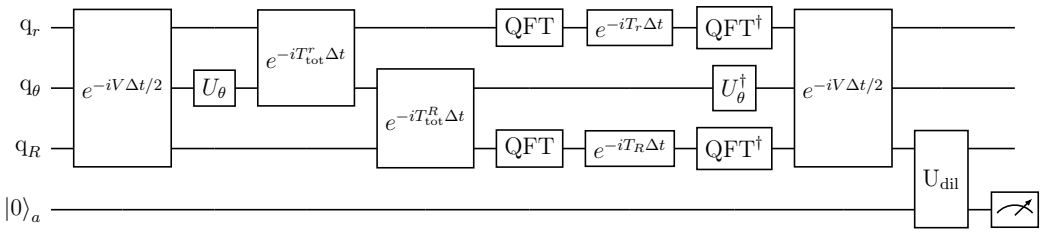
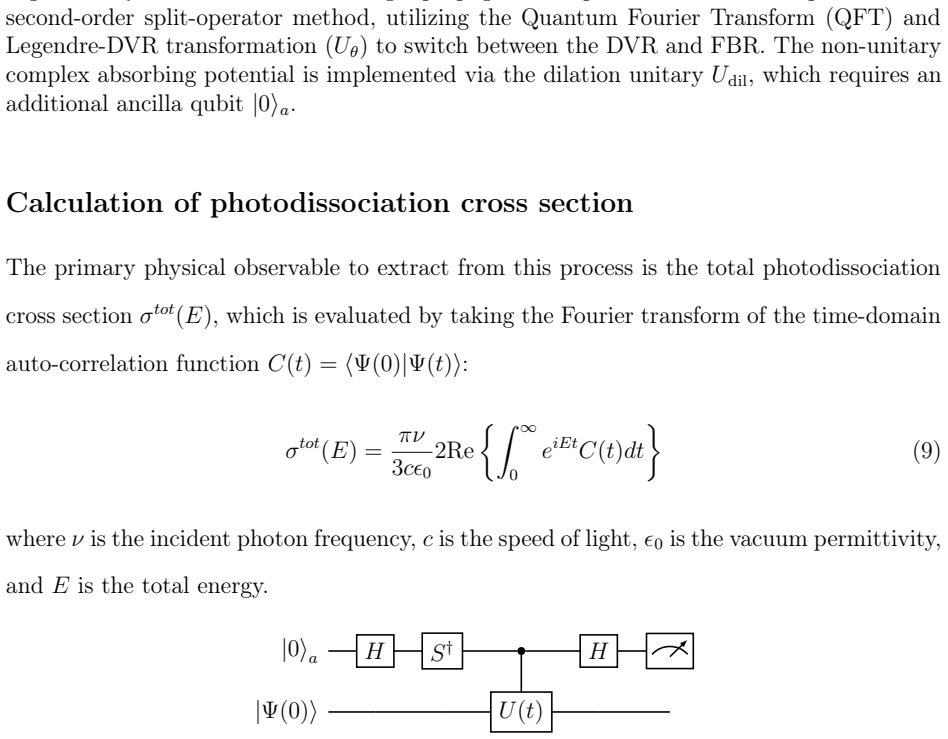
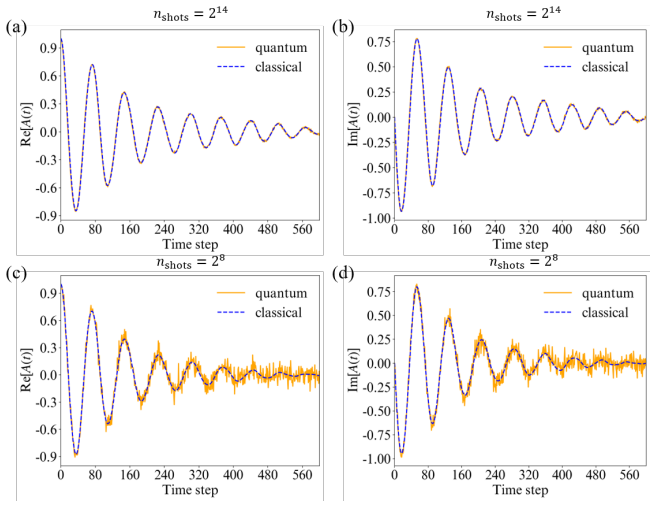
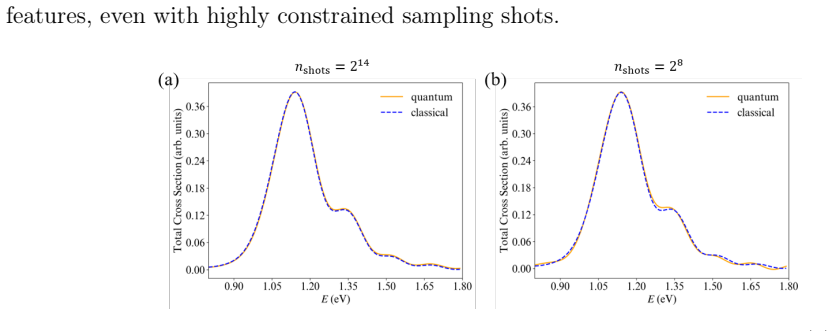
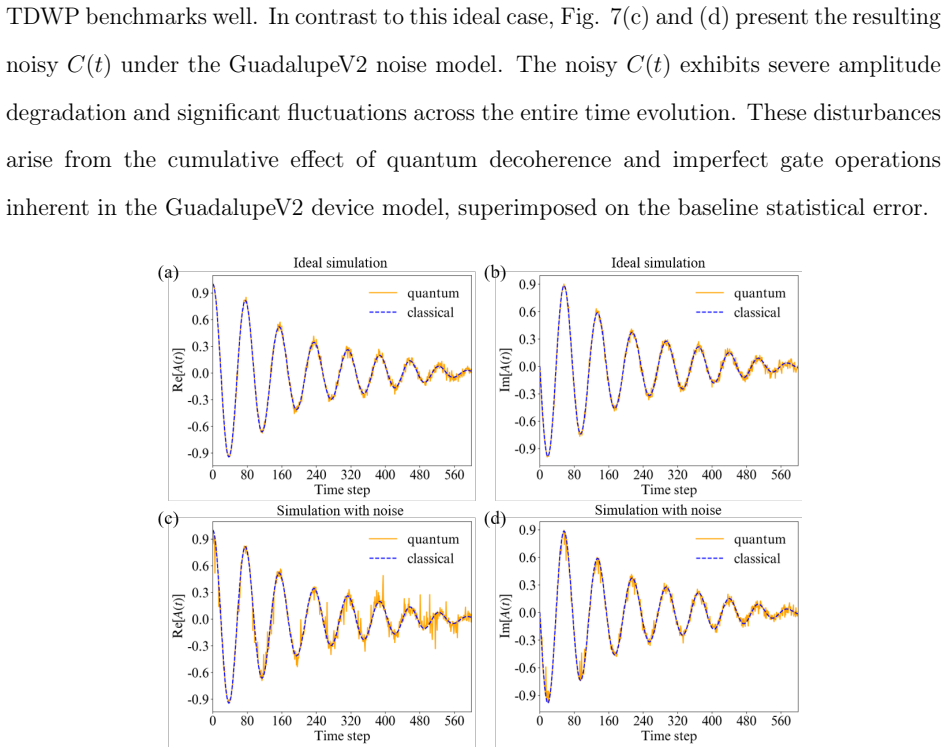
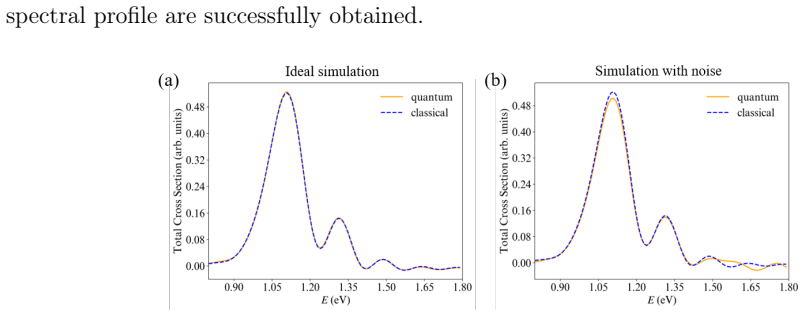
The authors present a quantum algorithm for photodissociation dynamics on quantum computers, benchmarked on the NOCl molecule. The wavefunction is propagated via a split-operator method utilizing the Quantum Fourier Transform and unitary transformation matrix to switch representations. A non-unitary absorbing potential propagator is implemented through a dilation scheme to impose outgoing boundary conditions on a truncated grid. The photodissociation cross section is calculated from the auto-correlation function extracted using the Hadamard test. Quantum computing results agree well with benchmarks under ideal conditions and remain robust to noise and statistical sampling errors.
What carries the argument
The dilation scheme that implements the non-unitary absorbing potential propagator on quantum hardware to enforce outgoing boundary conditions.
If this is right
- Photodissociation cross sections for small molecules can be obtained directly from quantum hardware rather than classical diagonalization.
- The split-operator propagation remains stable when statistical sampling errors from finite shots are present.
- Non-unitary operators required for open-boundary dynamics can be realized on quantum devices via dilation without collapsing the simulation.
- Noise levels typical of current devices do not prevent extraction of physically meaningful dynamics quantities for this class of problems.
Where Pith is reading between the lines
- The same dilation technique could be adapted to other non-unitary propagators appearing in open quantum system simulations.
- Scaling the method to larger grids or more degrees of freedom would require only additional qubits rather than exponential classical memory.
- Hybrid quantum-classical workflows could use this propagator as a subroutine inside larger variational or machine-learned dynamics pipelines.
Load-bearing premise
The dilation scheme accurately implements the non-unitary absorbing potential propagator on quantum hardware without introducing errors that distort the outgoing wavepacket or the extracted autocorrelation function.
What would settle it
A side-by-side comparison of the autocorrelation function obtained from the quantum algorithm versus exact classical propagation for the NOCl molecule, performed on actual hardware with documented noise levels, would confirm or refute agreement within statistical error bars.
Figures
read the original abstract
Theoretical quantum dynamics calculations scale deeply with system size, rendering classical calculations intractable for complex systems. While quantum computing offers a natural solution, its application to nuclear quantum dynamics remains scarce. Here, we present a quantum algorithm to study photodissociation dynamics on quantum computers, benchmarked on the NOCl molecule. The wavefunction is propagated via a split-operator method, utilizing the Quantum Fourier Transform and unitary transformation matrix to switch representations. To impose outgoing boundary conditions on a truncated grid, we use a non-unitary absorbing potential propagator, implemented through a dilation scheme. The photodissociation cross section is calculated from the auto-correlation function, which is extracted using the Hadamard test. Our quantum computing results agree well with benchmarks under ideal conditions, and we further demonstrate that the algorithm is robust to noise and statistical sampling errors, indicating the promising application of noisy devices to quantum dynamics studies.
Editorial analysis
A structured set of objections, weighed in public.
Referee Report
Summary. The paper presents a quantum algorithm for photodissociation dynamics on quantum computers, benchmarked on NOCl. It propagates the wavefunction using a split-operator method with the Quantum Fourier Transform and unitary transformations, implements outgoing boundary conditions via a non-unitary absorbing potential through a dilation scheme, and extracts the autocorrelation function (for the cross-section) via the Hadamard test. The central claims are good agreement with classical benchmarks under ideal conditions and robustness to noise and statistical sampling errors.
Significance. If the dilation scheme is shown to faithfully reproduce the target non-unitary propagator, the work would demonstrate a viable route to quantum simulation of nuclear dynamics on NISQ hardware, extending quantum computing applications beyond electronic structure to time-dependent open quantum systems. The combination of split-operator propagation, dilation, and Hadamard-test extraction is a concrete technical contribution; however, the absence of quantitative benchmarks and verification metrics limits the immediate impact.
major comments (2)
- [Abstract] Abstract: the claim of agreement with benchmarks 'under ideal conditions' and robustness to noise is stated without quantitative error bars, grid sizes, circuit depths, or explicit comparison data (e.g., L2 norms or overlap metrics between quantum and classical autocorrelation functions), which is required to substantiate the headline result.
- [Dilation scheme] Dilation scheme for non-unitary absorbing potential (Methods/Algorithm section): no operator-norm comparison, matrix-element check, or isolated propagation test is provided between the dilated implementation and the ideal non-unitary operator; any systematic deviation would directly alter the outgoing wavepacket and the extracted autocorrelation, undermining both the agreement and noise-robustness claims.
minor comments (2)
- The manuscript would benefit from an explicit statement of the grid parameters, time-step size, and number of qubits/circuit depth used in the NOCl benchmark to allow reproducibility.
- Notation for the dilation operator and post-selection probability should be clarified with a small worked example or pseudocode.
Simulated Author's Rebuttal
We thank the referee for the careful review and constructive comments. We agree that additional quantitative details and verification steps will strengthen the manuscript and address the concerns raised. We respond point-by-point below and will make the corresponding revisions.
read point-by-point responses
-
Referee: [Abstract] Abstract: the claim of agreement with benchmarks 'under ideal conditions' and robustness to noise is stated without quantitative error bars, grid sizes, circuit depths, or explicit comparison data (e.g., L2 norms or overlap metrics between quantum and classical autocorrelation functions), which is required to substantiate the headline result.
Authors: We agree that the abstract would benefit from explicit quantitative support. In the revised manuscript we will update the abstract to report the spatial grid size (128 points), the circuit depth per propagation step, the L2 norm between the quantum and classical autocorrelation functions, and statistical error bars obtained from finite-shot Hadamard-test sampling. These metrics are already computed in our simulations and will be stated directly in the abstract to substantiate the claims of agreement and noise robustness. revision: yes
-
Referee: [Dilation scheme] Dilation scheme for non-unitary absorbing potential (Methods/Algorithm section): no operator-norm comparison, matrix-element check, or isolated propagation test is provided between the dilated implementation and the ideal non-unitary operator; any systematic deviation would directly alter the outgoing wavepacket and the extracted autocorrelation, undermining both the agreement and noise-robustness claims.
Authors: We acknowledge that a direct numerical verification of the dilation scheme is necessary. Although the manuscript presents the theoretical construction and its use within the split-operator propagator, it does not contain the requested operator-norm or isolated-test comparisons. In the revision we will add these verifications to the Methods section: an operator-norm bound between the dilated unitary and the target non-unitary operator, representative matrix-element checks, and a standalone propagation test of a Gaussian wave packet under the absorber alone. These additions will confirm that the scheme reproduces the desired boundary conditions without introducing systematic errors. revision: yes
Circularity Check
No significant circularity; derivation relies on external benchmarks
full rationale
The paper describes a quantum algorithm for wavefunction propagation via split-operator with QFT, dilation for non-unitary absorbing potential, and Hadamard test for autocorrelation, with results compared to external benchmarks under ideal conditions and noise robustness tests. No equations reduce by construction to fitted inputs, no self-definitional loops, and no load-bearing self-citations or ansatzes are present in the provided text. The central claims rest on independent verification against benchmarks rather than tautological redefinitions.
Axiom & Free-Parameter Ledger
axioms (2)
- standard math Split-operator factorization of the time-evolution operator is valid for the chosen time step
- domain assumption Quantum Fourier transform and unitary matrix operations can be implemented exactly on the target hardware
Reference graph
Works this paper leans on
-
[1]
Enhanced reactivity of fluorine with para-hydrogen in cold interstellar clouds by resonance-induced quantum tunnelling , volume =. Nat. Chem. , author =. 2019 , pages =. doi:10.1038/s41557-019-0280-3 , language =
-
[2]
Observation of the geometric phase effect in the. Science , author =. 2018 , keywords =. doi:10.1126/science.aav1356 , abstract =
-
[3]
Stereodynamical control of the. Science , author =. 2023 , pages =. doi:10.1126/science.ade7471 , abstract =
-
[4]
Quantum interference in. Science , author =. 2020 , pages =. doi:10.1126/science.abb1564 , abstract =
-
[5]
Observation of. Science , author =. 2006 , pages =. doi:10.1126/science.1123452 , abstract =
-
[6]
Ab. Chem. Rev. , author =. 2018 , pages =. doi:10.1021/acs.chemrev.7b00423 , language =
-
[7]
Chemical Physics Letters , author =
The multi-configurational time-dependent. Chemical Physics Letters , author =. 1990 , keywords =. doi:10.1016/0009-2614(90)87014-I , language =
-
[8]
The multiconfiguration time-dependent. Physics Reports , author =. 2000 , pages =. doi:10.1016/S0370-1573(99)00047-2 , abstract =
-
[9]
A multilayer multiconfigurational time-dependent. J. Chem. Phys. , author =. 2008 , pages =. doi:10.1063/1.2902982 , abstract =
-
[10]
Shi, Lei and Schröder, Markus and Meyer, Hans-Dieter and Peláez, Daniel and Wodtke, Alec M. and Golibrzuch, Kai and Schönemann, Anna-Maria and Kandratsenka, Alexander and Gatti, Fabien , month = feb, year =. Full quantum dynamics study for. J. Phys. Chem. A , publisher =. doi:10.1021/acs.jpca.4c06712 , abstract =
-
[11]
and Degroote, Matthias and Johnson, Peter D
Cao, Yudong and Romero, Jonathan and Olson, Jonathan P. and Degroote, Matthias and Johnson, Peter D. and Kieferová, Mária and Kivlichan, Ian D. and Menke, Tim and Peropadre, Borja and Sawaya, Nicolas P. D. and Sim, Sukin and Veis, Libor and Aspuru-Guzik, Alán , month = oct, year =. Quantum chemistry in the age of quantum computing , volume =. Chem. Rev. ,...
-
[12]
Cracking chemistry with quantum simulations , volume =. Science , author =. 2025 , pages =. doi:10.1126/science.ado6686 , abstract =
-
[13]
Kassal, Ivan and Jordan, Stephen P. and Love, Peter J. and Mohseni, Masoud and Aspuru-Guzik, Alán , month = dec, year =. Polynomial-time quantum algorithm for the simulation of chemical dynamics , volume =. Proceedings of the National Academy of Sciences , publisher =. doi:10.1073/pnas.0808245105 , abstract =
-
[14]
Simulated quantum computation of molecular energies , volume =. Science , author =. 2005 , pages =. doi:10.1126/science.1113479 , abstract =
-
[15]
Physical Chemistry Chemical Physics , author =
Quantum algorithm for obtaining the energy spectrum of molecular systems , url =. Physical Chemistry Chemical Physics , author =. 2008 , file =. doi:10.1039/B804804E , urldate =
-
[16]
A variational eigenvalue solver on a photonic quantum processor,
A variational eigenvalue solver on a photonic quantum processor , volume =. Nat Commun , author =. 2014 , pages =. doi:10.1038/ncomms5213 , language =
-
[17]
Simulating quantum systems on a quantum computer , volume =. Proc. R. Soc. Lond. A , author =. 1998 , keywords =. doi:10.1098/rspa.1998.0162 , language =
-
[18]
A hybrid quantum-classical algorithm for multichannel quantum scattering of atoms and molecules , volume =. J. Phys. Chem. Lett. , author =. 2023 , keywords =. doi:10.1021/acs.jpclett.3c00985 , abstract =
-
[19]
Simulation of chemical reactions on a quantum computer , volume =. J. Phys. Chem. Lett. , author =. 2024 , pages =. doi:10.1021/acs.jpclett.4c01100 , abstract =
-
[20]
Wan, Lingyun and Liu, Jie and Li, Zhenyu and Yang, Jinlong , month = nov, year =. Hybrid. J. Phys. Chem. Lett. , publisher =. doi:10.1021/acs.jpclett.4c02624 , abstract =
-
[21]
Feng, Xiaoning and Chan, Hans Hon Sang and Tew, David P. , month = jul, year =. Quantum resource assay for the grid-based simulation of the photodynamics of pyrazine , url =. doi:10.48550/arXiv.2506.08609 , abstract =
-
[22]
Efficient solution of the non-unitary time-dependent. Quantum , author =. 2024 , keywords =. doi:10.22331/q-2024-04-08-1311 , abstract =
-
[23]
Javadi-Abhari, Ali and Treinish, Matthew and Krsulich, Kevin and Wood, Christopher J. and Lishman, Jake and Gacon, Julien and Martiel, Simon and Nation, Paul D. and Bishop, Lev S. and Cross, Andrew W. and Johnson, Blake R. and Gambetta, Jay M. , year=. Quantum computing with. doi:10.48550/arXiv.2405.08810 , eprint=
work page internal anchor Pith review Pith/arXiv arXiv doi:10.48550/arxiv.2405.08810
-
[24]
Journal of Molecular Spectroscopy , author =
Raman and infrared spectra of gaseous and solid nitrosyl chloride , volume =. Journal of Molecular Spectroscopy , author =. 1986 , pages =. doi:10.1016/0022-2852(86)90093-7 , abstract =
-
[25]
The Journal of Chemical Physics , author =
Wave-packet dynamics within the multiconfiguration hartree framework: general aspects and application to. The Journal of Chemical Physics , author =. 1992 , pages =. doi:10.1063/1.463007 , abstract =
-
[26]
Journal of Computational Physics , author =
Solution of the. Journal of Computational Physics , author =. 1982 , pages =. doi:10.1016/0021-9991(82)90091-2 , language =
-
[27]
Solution of the. J. Chem. Phys. , author =. 1983 , pages =. doi:10.1063/1.444501 , abstract =
-
[28]
Trotter, H. F. , year =. On the. Proceedings of the American Mathematical Society , publisher =. doi:10.2307/2033649 , number =
-
[29]
Generalized. Commun.Math. Phys. , author =. 1976 , keywords =. doi:10.1007/BF01609348 , abstract =
-
[30]
Fractal decomposition of exponential operators with applications to many-body theories and. Physics Letters A , author =. 1990 , pages =. doi:10.1016/0375-9601(90)90962-N , abstract =
-
[31]
The Journal of Chemical Physics , author =
Photodissociation of. The Journal of Chemical Physics , author =. 1990 , pages =. doi:10.1063/1.459173 , abstract =
-
[33]
A perspective on quantum computing applications in quantum chemistry using 25--100 logical qubits , author=. J. Chem. Theory Comput. , volume=. 2025 , publisher=
2025
-
[34]
Quantum tunneling of magnetization and related phenomena in molecular materials , author=. Angew. Chem. Int. Ed. , volume=. 2003 , publisher=
2003
-
[35]
Quantal phase factors accompanying adiabatic changes , author=. Proc. R. Soc. Lond. A , volume=. 1984 , publisher=
1984
-
[36]
High-fidelity first principles nonadiabaticity: diabatization, analytic representation of global diabatic potential energy matrices, and quantum dynamics , author=. Phys. Chem. Chem. Phys. , volume=. 2021 , publisher=
2021
-
[37]
A quantum algorithm for evolving open quantum dynamics on quantum computing devices , author=. Sci. Rep. , volume=. 2020 , publisher=
2020
-
[38]
Quantum simulation of open quantum systems using a unitary decomposition of operators , author=. Phys. Rev. Lett. , volume=. 2021 , publisher=
2021
-
[39]
The Journal of Chemical Physics , author =
A novel discrete variable representation for quantum mechanical reactive scattering via the. The Journal of Chemical Physics , author =. 1992 , pages =. doi:10.1063/1.462100 , abstract =
-
[40]
Chemical Physics Letters , author =
Discrete variable representations and sudden models in quantum scattering theory , volume =. Chemical Physics Letters , author =. 1982 , pages =. doi:10.1016/0009-2614(82)83051-0 , language =
-
[41]
Generalized discrete variable approximation in quantum mechanics , volume =. J. Chem. Phys. , author =. 1985 , pages =. doi:10.1063/1.448462 , abstract =
-
[42]
An iteration method for the solution of the eigenvalue problem of linear differential and integral operators , volume =. J. RES. NATL. BUR. STAN. , author =. 1950 , pages =. doi:10.6028/jres.045.026 , language =
-
[43]
Recent. Annu. Rev. Phys. Chem. , author =. 2016 , pages =. doi:10.1146/annurev-physchem-040215-112016 , abstract =
-
[44]
Li, Jun and Zhao, Bin and Xie, Daiqian and Guo, Hua , month = oct, year =. Advances and. J. Phys. Chem. Lett. , publisher =. doi:10.1021/acs.jpclett.0c02501 , abstract =
-
[45]
Schatz, George C. and Wodtke, Alec M. and Yang, Xueming , month = aug, year =. Spiers. Faraday Discuss. , publisher =. doi:10.1039/D4FD00015C , abstract =
-
[46]
Pan, Huilin and Zhao, Bin and Guo, Hua and Liu, Kopin , month = nov, year =. State-to-. J. Phys. Chem. Lett. , publisher =. doi:10.1021/acs.jpclett.3c02853 , abstract =
-
[47]
Crossed beam polyatomic reaction dynamics: recent advances and new insights , volume =. Chem. Soc. Rev. , author =. 2017 , pages =. doi:10.1039/C7CS00601B , abstract =
-
[48]
Steric. Science , author =. 2010 , pages =. doi:10.1126/science.1191751 , abstract =
-
[49]
Steric. Science , author =. 2011 , pages =. doi:10.1126/science.1199771 , abstract =
-
[50]
Quantum mechanical double slit for molecular scattering , volume =. Science , author =. 2021 , pages =. doi:10.1126/science.abl4143 , abstract =
-
[51]
Dynamical. Science , author =. 2013 , pages =. doi:10.1126/science.1246546 , abstract =
-
[52]
Extremely short-lived reaction resonances in. Science , author =. 2015 , pages =. doi:10.1126/science.1260527 , abstract =
-
[53]
Quantum and classical molecular dynamics for. J. Chem. Phys. , author =. 2023 , pages =. doi:10.1063/5.0176655 , abstract =
-
[54]
Revealing umbrella bending as a reporter mode in the. Nat Commun , author =. 2025 , pages =. doi:10.1038/s41467-025-61117-1 , language =
-
[55]
Chen, Zhen and Chen, Jun and Chen, Rongjun and Xie, Ting and Wang, Xingan and Liu, Shu and Wu, Guorong and Dai, Dongxu and Yang, Xueming and Zhang, Dong H. , month = apr, year =. Reactivity oscillation in the heavy–light–heavy. Proceedings of the National Academy of Sciences , publisher =. doi:10.1073/pnas.1917618117 , abstract =
-
[56]
Schinke, Reinhard , editor =. Photodissociation. Encyclopedia of. doi:10.1002/0470845015.cpa011 , language =
-
[57]
C.; Wodtke, A
Schatz, G. C.; Wodtke, A. M.; Yang, X. Spiers Memorial Lecture : New directions in molecular scattering. Faraday Discuss. 2024, 251, 9--62
2024
-
[58]
State-to- State Dynamics in Mode - Selective Polyatomic Reactions
Pan, H.; Zhao, B.; Guo, H.; Liu, K. State-to- State Dynamics in Mode - Selective Polyatomic Reactions . J. Phys. Chem. Lett. 2023, 14, 10412--10419
2023
-
[59]
Crossed beam polyatomic reaction dynamics: recent advances and new insights
Pan, H.; Liu, K.; Caracciolo, A.; Casavecchia, P. Crossed beam polyatomic reaction dynamics: recent advances and new insights. Chem. Soc. Rev. 2017, 46, 7517--7547
2017
-
[60]
H.; Guo, H
Zhang, D. H.; Guo, H. Recent Advances in Quantum Dynamics of Bimolecular Reactions . Annu. Rev. Phys. Chem. 2016, 67, 135--158
2016
-
[61]
Advances and New Challenges to Bimolecular Reaction Dynamics Theory
Li, J.; Zhao, B.; Xie, D.; Guo, H. Advances and New Challenges to Bimolecular Reaction Dynamics Theory . J. Phys. Chem. Lett. 2020, 11, 8844--8860
2020
-
[62]
H.; Sun, Z.; Zhang, D
Yang, T.; Huang, L.; Xiao, C.; Chen, J.; Wang, T.; Dai, D.; Lique, F.; Alexander, M. H.; Sun, Z.; Zhang, D. H.; Yang, X.; Neumark, D. M. Enhanced reactivity of fluorine with para-hydrogen in cold interstellar clouds by resonance-induced quantum tunnelling. Nat. Chem. 2019, 11, 744--749
2019
-
[63]
H.; Yang, X
Yuan, D.; Guan, Y.; Chen, W.; Zhao, H.; Yu, S.; Luo, C.; Tan, Y.; Xie, T.; Wang, X.; Sun, Z.; Zhang, D. H.; Yang, X. Observation of the geometric phase effect in the H + HD → H _ 2 + D reaction. Science 2018, 362, 1289--1293
2018
-
[64]
H.; Yang, X
Wang, Y.; Huang, J.; Wang, W.; Du, T.; Xie, Y.; Ma, Y.; Xiao, C.; Zhang, Z.; Zhang, D. H.; Yang, X. Stereodynamical control of the H + HD → H _ 2 + D reaction through HD reagent alignment. Science 2023, 379, 191--195
2023
-
[65]
L.; Bisson, R.; Beck, R
Yoder, B. L.; Bisson, R.; Beck, R. D. Steric Effects in the Chemisorption of Vibrationally Excited Methane on Ni (100). Science 2010, 329, 553--556
2010
-
[66]
Steric Control of the Reaction of CH Stretch – Excited CHD _ 3 with Chlorine Atom
Wang, F.; Lin, J.-S.; Liu, K. Steric Control of the Reaction of CH Stretch – Excited CHD _ 3 with Chlorine Atom . Science 2011, 331, 900--903
2011
-
[67]
Berry, M. V. Quantal phase factors accompanying adiabatic changes. Proc. R. Soc. Lond. A 1984, 392, 45--57
1984
-
[68]
H.; Yang, X
Xie, Y.; Zhao, H.; Wang, Y.; Huang, Y.; Wang, T.; Xu, X.; Xiao, C.; Sun, Z.; Zhang, D. H.; Yang, X. Quantum interference in H + HD → H _ 2 + D between direct abstraction and roaming insertion pathways. Science 2020, 368, 767--771
2020
-
[69]
E.; Mukherjee, N.; Zare, R
Zhou, H.; Perreault, W. E.; Mukherjee, N.; Zare, R. N. Quantum mechanical double slit for molecular scattering. Science 2021, 374, 960--964
2021
-
[70]
A.; Wang, X.; Yang, X.; Xu, C.; Xie, D.; Gustafsson, M.; Skodje, R
Qiu, M.; Ren, Z.; Che, L.; Dai, D.; Harich, S. A.; Wang, X.; Yang, X.; Xu, C.; Xie, D.; Gustafsson, M.; Skodje, R. T.; Sun, Z.; Zhang, D. H. Observation of Feshbach Resonances in the F + H _ 2 → HF + H Reaction . Science 2006, 311, 1440--1443
2006
-
[71]
Wang, T.; Chen, J.; Yang, T.; Xiao, C.; Sun, Z.; Huang, L.; Dai, D.; Yang, X.; Zhang, D. H. Dynamical Resonances Accessible Only by Reagent Vibrational Excitation in the F + HD → HF + D Reaction . Science 2013, 342, 1499--1502
2013
-
[72]
Yang, T.; Chen, J.; Huang, L.; Wang, T.; Xiao, C.; Sun, Z.; Dai, D.; Yang, X.; Zhang, D. H. Extremely short-lived reaction resonances in Cl + HD ( v = 1) → DCl + H due to chemical bond softening. Science 2015, 347, 60--63
2015
-
[73]
Curchod, B. F. E.; Martínez, T. J. Ab Initio Nonadiabatic Quantum Molecular Dynamics . Chem. Rev. 2018, 118, 3305--3336
2018
-
[74]
R.; Guo, H
Guan, Y.; Xie, C.; Yarkony, D. R.; Guo, H. High-fidelity first principles nonadiabaticity: diabatization, analytic representation of global diabatic potential energy matrices, and quantum dynamics. Phys. Chem. Chem. Phys. 2021, 23, 24962--24983
2021
-
[75]
Tan, Y. et al. Revealing umbrella bending as a reporter mode in the D + CH4 reaction. Nat Commun 2025, 16, 5893
2025
-
[76]
Chen, Z.; Chen, J.; Chen, R.; Xie, T.; Wang, X.; Liu, S.; Wu, G.; Dai, D.; Yang, X.; Zhang, D. H. Reactivity oscillation in the heavy–light–heavy Cl + CH4 reaction. Proceedings of the National Academy of Sciences 2020, 117, 9202--9207
2020
-
[77]
The multi-configurational time-dependent Hartree approach
Meyer, H.-D.; Manthe, U.; Cederbaum, L. The multi-configurational time-dependent Hartree approach. Chemical Physics Letters 1990, 165, 73--78
1990
-
[78]
The multiconfiguration time-dependent Hartree ( MCTDH ) method: a highly efficient algorithm for propagating wavepackets
Beck, M. The multiconfiguration time-dependent Hartree ( MCTDH ) method: a highly efficient algorithm for propagating wavepackets. Physics Reports 2000, 324, 1--105
2000
-
[79]
A multilayer multiconfigurational time-dependent Hartree approach for quantum dynamics on general potential energy surfaces
Manthe, U. A multilayer multiconfigurational time-dependent Hartree approach for quantum dynamics on general potential energy surfaces. J. Chem. Phys. 2008, 128, 164116
2008
-
[80]
M.; Golibrzuch, K.; Schönemann, A.-M.; Kandratsenka, A.; Gatti, F
Shi, L.; Schröder, M.; Meyer, H.-D.; Peláez, D.; Wodtke, A. M.; Golibrzuch, K.; Schönemann, A.-M.; Kandratsenka, A.; Gatti, F. Full quantum dynamics study for H atom scattering from graphene. J. Phys. Chem. A 2025, 129, 1896--1907
2025
-
[81]
M.; Golibrzuch, K.; Schönemann, A.-M.; Kandratsenka, A.; Gatti, F
Shi, L.; Schröder, M.; Meyer, H.-D.; Peláez, D.; Wodtke, A. M.; Golibrzuch, K.; Schönemann, A.-M.; Kandratsenka, A.; Gatti, F. Quantum and classical molecular dynamics for H atom scattering from graphene. J. Chem. Phys. 2023, 159, 194102
2023
discussion (0)
Sign in with ORCID, Apple, or X to comment. Anyone can read and Pith papers without signing in.