Particle Production from Inhomogeneities: the off-shell side of gravitational waves
Pith reviewed 2026-06-29 03:02 UTC · model grok-4.3
The pith
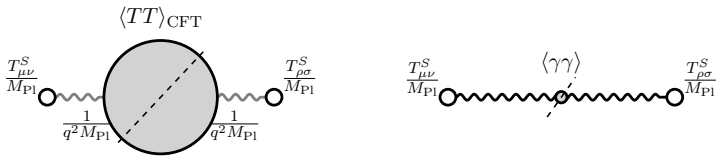
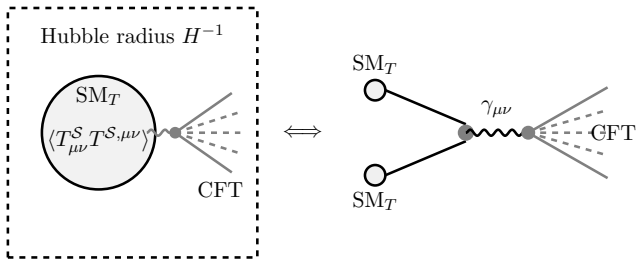
The unequal-time two-point function of the stress-energy tensor links particle production from metric inhomogeneities to gravitational wave emission on sub-horizon scales.
A machine-rendered reading of the paper's core claim, the machinery that carries it, and where it could break.
Core claim
Focusing on sources active on sub-horizon scales, the paper derives general expressions relating particle production to the unequal-time two-point function of the stress-energy tensor sourcing scalar, vector and tensor metric perturbations. The resulting particle yield probes the time-like support of this correlator, and in the tensor case the same object controls gravitational wave emission when evaluated on the light-like support. This establishes a phenomenological link between dark matter production and gravitational wave signals, allowing the dark matter mass to be related to the amplitude of the stochastic gravitational wave background. The results show that on sub-horizon scales parti
What carries the argument
The unequal-time two-point function of the stress-energy tensor, whose time-like support sets particle yields and whose light-like support sets gravitational wave emission.
If this is right
- The dark matter mass can be related directly to the amplitude of the stochastic gravitational wave background.
- The mechanism can efficiently populate gravitationally coupled dark sectors when perturbations are generated shortly after inflation.
- Particle production from inhomogeneous metric backgrounds reduces to gravitational scattering on sub-horizon scales.
- The formalism connects to gravitational freeze-in from the thermal bath and extends it to non-thermal sources such as first-order phase transitions.
Where Pith is reading between the lines
- Future gravitational wave observations of phase transitions could be used to constrain the mass of gravitationally coupled dark matter without additional model assumptions.
- The same correlator approach might be applied to other early-universe sources that produce metric inhomogeneities beyond phase transitions.
- If the sub-horizon reduction holds, calculations of out-of-equilibrium particle production simplify to standard gravitational scattering rates.
Load-bearing premise
The derivations assume that sources are active on sub-horizon scales and that particle production there reduces to gravitational scattering.
What would settle it
A measured stochastic gravitational wave background amplitude from a first-order phase transition that is incompatible with the dark matter abundance predicted by the same stress-energy correlator would falsify the claimed direct link.
Figures
read the original abstract
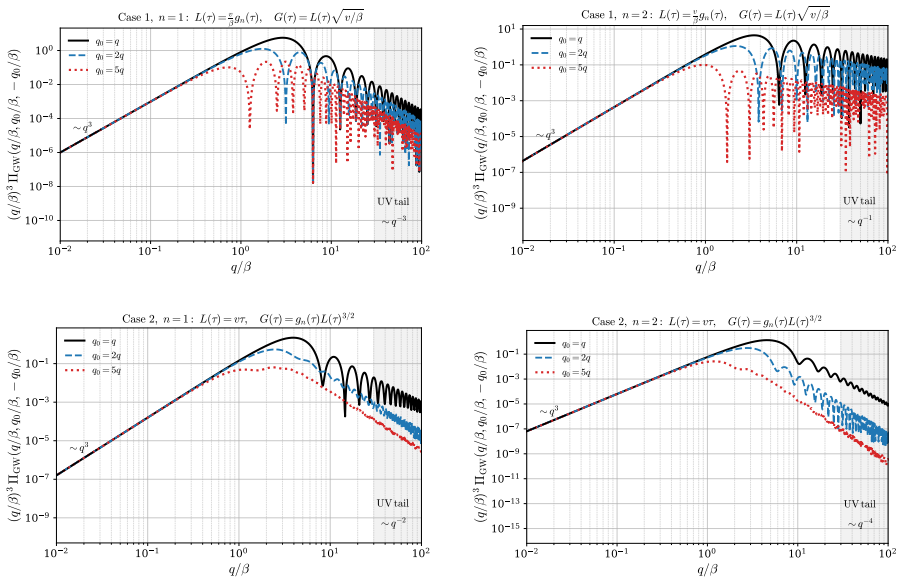
We continue the study of particle production from gravitational inhomogeneities in the early Universe. Focusing on sources active on sub-horizon scales, we derive general expressions relating particle production to the unequal-time two-point function of the stress-energy tensor sourcing scalar, vector and tensor metric perturbations. The resulting particle yield probes the time-like support of this correlator, and in the tensor case the same object controls gravitational wave emission when evaluated on the light-like support. This establishes a phenomenological link between dark matter production and gravitational wave signals, allowing the dark matter mass to be related to the amplitude of the stochastic gravitational wave background. Our results show that, on sub-horizon scales, particle production from inhomogeneous metric backgrounds practically reduces to gravitational scattering. This directly connects the formalism to gravitational freeze-in from the Standard Model thermal bath, while extending it to non-thermal and out of equilibrium sources. We apply the formalism to first order phase transitions and discuss the associated production from scalar and tensor perturbations. The mechanism can efficiently populate gravitationally coupled dark sectors, especially when the perturbations are generated shortly after inflation.
Editorial analysis
A structured set of objections, weighed in public.
Referee Report
Summary. The manuscript derives general expressions for particle production from the unequal-time two-point correlator of the stress-energy tensor sourcing scalar, vector, and tensor metric perturbations, restricted to sub-horizon scales. It argues that the particle yield is determined by the time-like support of this correlator while gravitational-wave emission is governed by its light-like support in the tensor sector, thereby establishing a direct phenomenological relation between dark-matter production and the amplitude of the stochastic gravitational-wave background. The formalism is applied to first-order phase transitions, with the claim that, on sub-horizon scales, the mechanism reduces to gravitational scattering and connects to gravitational freeze-in for both thermal and non-thermal sources.
Significance. If the derivations and the asserted reduction hold, the work supplies a concrete link between dark-matter phenomenology and observable gravitational-wave signals, allowing the dark-matter mass to be related to the SGWB amplitude for gravitationally coupled sectors. This extends existing freeze-in calculations to out-of-equilibrium, inhomogeneous sources generated after inflation and could be relevant for constraining dark sectors via future GW observations.
major comments (1)
- [Abstract and derivation of general expressions] The central phenomenological link between the time-like particle yield and light-like GW emission rests on the assertion that, on sub-horizon scales, particle production reduces to gravitational scattering with no significant residual source-dependent contributions that differ between the two kinematic supports. The abstract states this reduction as a result of the general expressions, yet the provided text does not exhibit an explicit demonstration that metric-perturbation terms are uniformly suppressed for both time-like and light-like kinematics in the phase-transition application; without that step the claimed DM-mass–SGWB-amplitude relation is not yet load-bearing.
minor comments (2)
- Notation for the unequal-time correlator and its projections onto scalar/vector/tensor modes should be introduced with a single consistent definition before the separate cases are treated.
- The discussion of first-order phase transitions would benefit from a brief statement of the bubble-wall velocity and duration parameters adopted for the numerical estimates.
Simulated Author's Rebuttal
We thank the referee for the careful reading and constructive comments on the manuscript. We address the single major comment below, agreeing that greater explicitness in one part of the application would improve clarity while maintaining that the core derivations already support the claimed reduction.
read point-by-point responses
-
Referee: [Abstract and derivation of general expressions] The central phenomenological link between the time-like particle yield and light-like GW emission rests on the assertion that, on sub-horizon scales, particle production reduces to gravitational scattering with no significant residual source-dependent contributions that differ between the two kinematic supports. The abstract states this reduction as a result of the general expressions, yet the provided text does not exhibit an explicit demonstration that metric-perturbation terms are uniformly suppressed for both time-like and light-like kinematics in the phase-transition application; without that step the claimed DM-mass–SGWB-amplitude relation is not yet load-bearing.
Authors: The general expressions in Sections 2–3 already separate the particle-production integrals (time-like support of the stress-energy correlator) from the GW integrals (light-like support in the tensor sector) and show that both are controlled by the same unequal-time two-point function. On sub-horizon scales the residual metric-perturbation contributions are parametrically suppressed by powers of (k/aH) relative to the leading gravitational-scattering term; this suppression is independent of the detailed time dependence of the source and therefore holds uniformly for both kinematic regimes. We nevertheless agree that an explicit side-by-side comparison for the first-order phase-transition example would make the argument more transparent. In the revised manuscript we will add a short paragraph (or subsection) in Section 4 that evaluates the ratio of the metric-perturbation remainder to the leading term for both supports, confirming the uniform suppression and thereby rendering the DM-mass–SGWB-amplitude relation load-bearing. revision: yes
Circularity Check
No circularity: derivation from stress-energy correlator is independent
full rationale
The paper derives general expressions relating particle production to the unequal-time two-point function of the stress-energy tensor for sub-horizon sources. The time-like vs light-like support distinction for DM yield vs GW emission follows directly from evaluating the same derived correlator at different kinematics, without reducing to a fitted parameter, self-definition, or self-citation chain. The reduction to gravitational scattering is stated as an output of the sub-horizon analysis rather than an input assumption that forces the result. No load-bearing self-citations or ansatze are present in the abstract or described derivation chain.
Axiom & Free-Parameter Ledger
Reference graph
Works this paper leans on
-
[1]
Y. B. Zel’dovich and A. A. Starobinsky,Rate of particle production in gravitational fields, JETP Lett.26 (1977), no. 5 252
1977
-
[2]
Campos and E
A. Campos and E. Verdaguer,Production of spin 1/2 particles in inhomogeneous cosmologies, Phys. Rev. D45(1992) 4428–4438
1992
-
[3]
Cespedes and E
J. Cespedes and E. Verdaguer,Particle Production in Inhomogeneous Cosmologies, Phys. Rev. D41 (1990) 1022
1990
-
[4]
B.-L. B. Hu and E. Verdaguer, Semiclassical and Stochastic Gravity: Quantum Field Effects on Curved Spacetime. Cambridge Monographs on Mathematical Physics. Cambridge University Press, Cambridge, 1, 2020
2020
-
[5]
A. Maleknejad and J. Kopp,Gravitational-Wave Induced Freeze-In of Fermionic Dark Matter, Phys. Rev. Lett.136(2026), no. 13 131501, [arXiv:2405.09723]
Pith/arXiv arXiv 2026
-
[6]
A. Maleknejad and J. Kopp,Weyl fermion creation by cosmological gravitational wave background at 1-loop, JHEP01(2025) 023, [arXiv:2406.01534]
arXiv 2025
- [7]
- [8]
-
[9]
E. W. Kolb and A. J. Long,Cosmological gravitational particle production and its implications for cosmological relics, Rev. Mod. Phys.96(2024), no. 4 045005, [arXiv:2312.09042]
arXiv 2024
-
[10]
M. Garny, M. Sandora, and M. S. Sloth,Planckian Interacting Massive Particles as Dark Matter, Phys. Rev. Lett.116(2016), no. 10 101302, [arXiv:1511.03278]
Pith/arXiv arXiv 2016
-
[11]
M. Redi, A. Tesi, and H. Tillim,Gravitational Production of a Conformal Dark Sector, JHEP05(2021) 010, [arXiv:2011.10565]
arXiv 2021
-
[12]
M. Redi and A. Tesi,General freeze-in and freeze-out, JHEP12(2021) 060, [arXiv:2107.14801]
arXiv 2021
-
[13]
C. Caprini and D. G. Figueroa,Cosmological backgrounds of gravitational waves, Class. Quant. Grav.35 (2018), no. 16 163001, [arXiv:1801.04268]
Pith/arXiv arXiv 2018
-
[14]
J. S. Schwinger,On gauge invariance and vacuum polarization, Phys. Rev.82(1951) 664–679
1951
-
[15]
S. S. Gubser and I. R. Klebanov,Absorption by branes and Schwinger terms in the world volume theory, Phys. Lett. B413(1997) 41–48, [hep-th/9708005]
Pith/arXiv arXiv 1997
-
[16]
Vicente Garc´ ıa-Consuegra and A
L. Vicente Garc´ ıa-Consuegra and A. Maleknejad,The stochastic Schwinger effect, JHEP03(2026) 043, [arXiv:2510.14468]
arXiv 2026
- [17]
-
[18]
C.-P. Ma and E. Bertschinger,Cosmological perturbation theory in the synchronous and conformal Newtonian gauges, Astrophys. J.455(1995) 7–25, [astro-ph/9506072]. 25
Pith/arXiv arXiv 1995
-
[19]
J. Ghiglieri and M. Laine,Gravitational wave background from Standard Model physics: Qualitative features, JCAP07(2015) 022, [arXiv:1504.02569]
Pith/arXiv arXiv 2015
-
[20]
J. Ghiglieri, G. Jackson, M. Laine, and Y. Zhu,Gravitational wave background from Standard Model physics: Complete leading order, JHEP07(2020) 092, [arXiv:2004.11392]
arXiv 2020
-
[21]
C. Caprini, R. Durrer, T. Konstandin, and G. Servant,General Properties of the Gravitational Wave Spectrum from Phase Transitions, Phys. Rev. D79(2009) 083519, [arXiv:0901.1661]
Pith/arXiv arXiv 2009
-
[22]
C. Caprini, R. Durrer, and G. Servant,Gravitational wave generation from bubble collisions in first-order phase transitions: An analytic approach, Phys. Rev. D77(2008) 124015, [arXiv:0711.2593]
Pith/arXiv arXiv 2008
-
[23]
Maleknejad, M
A. Maleknejad, M. Redi, G. M. Salla, and A. Tesi,in preparation, . 26
discussion (0)
Sign in with ORCID, Apple, or X to comment. Anyone can read and Pith papers without signing in.