REVIEW 3 major objections 6 minor 30 references
Algebraic structures and deformed Schr\"{o}dinger equations from groups entropies
T0 review · 3 major / 6 minor · reviewed 2026-08-14 · deepseek-v4-flash
Pith's one-line read Every group entropy $G$ produces a canonically deformed quantum mechanics with $[\hat{x}_G,\hat{p}_G]=i\hbar$, and the $q$- and $\kappa$-deformed equations emerge as special cases.
desk verdict A genuinely useful unification of the q- and kappa-deformed algebras under the group-entropy umbrella, with a clean G-calculus and a defensible but not uniquely fixed deformed Schrödinger equation; refereeable after fixing a few concrete errors. read the letter →
The pith
A machine-rendered reading of the paper's core claim, the machinery that carries it, and where it could break.
The reading
What carries the argument
The load-bearing object is the Lazard formal group law expressed through a group entropy $G$: $\Phi(x,y)=G(G^{-1}(x)+G^{-1}(y))$, which supplies deformed addition, subtraction, multiplication, division, and their neutral and inverse elements. On this the paper builds the $G$-algebra and a $G$-calculus whose $G$-derivative is $D_G=G'(G^{-1}(x))\,d/dx$. The identity that carries the quantum argument is $[\hat{x}_G,\hat{p}_G]=i\hbar$ with $\hat{x}_G=G^{-1}(\hat{x})$ and $\hat{p}_G=\tfrac12\{G'(G^{-1}(\hat{x})),\hat{p}\}$; because $A=G'(G^{-1}(x))$ controls both the deformed derivative and the mass $m_0/A^2$, the entire deformed Schrödinger dynamics is fixed once $G$ is chosen.
What would settle it
Compute the commutator for an alternative Hermitian ordering, e.g. $\hat{p}_G^{(\delta)}=\tfrac12\{[G'(G^{-1}(\hat{x}))]^{1+\delta},\hat{p}\}$ with $\delta\neq 0$. The result is not $i\hbar$ but $i\hbar [G'(G^{-1}(\hat{x}))]^{\delta}$, so the canonical-transformation claim and the paper's $G$-deformed Schrödinger equation fail for that equally natural ordering. A measurement of the predicted asymmetric probability accumulation in the infinite well, toward the high-mass region, would select which ordering is physical.
Extended reading notes
Core claim
The central claim is that the formal group law of group entropy theory, $\Phi(x,y)=G(G^{-1}(x)+G^{-1}(y))$, carries enough structure to deform both algebra and quantum mechanics coherently. Replacing $x$ by $x_G=G^{-1}(x)$ and $\hat{p}$ by the Hermitian $\hat{p}_G=\frac{1}{2}\{G'(G^{-1}(\hat{x})),\hat{p}\}$ preserves the canonical commutator, and the Hamiltonian built from $\hat{p}_G^2$ gives the $G$-deformed Schrödinger equation, whose only memory of the deformation is the factor $A(x)=G'(G^{-1}(x))$. In the deformed coordinate $x_G$, the same equation is just the constant-mass Schrödinger equation with $G$-derivative $D_G=A(x)\,d/dx$, so the physical content is a position-dependent mass $m(x)=m_0/A(x)^2$. The paper demonstrates the scheme on the infinite potential well: eigenfunctions are sines of $x_G$, energies scale with $1/[G^{-1}(L)]^2$, and the non-uniform spacing of zeros is generated by the $G$-sum, with explicit formulas for the Tsallis and Kaniadakis classes.
Load-bearing premise
The paper assumes, without derivation, that the Hermitian ordering of the deformed momentum is $\hat{p}_G=\tfrac12\{G'(G^{-1}(\hat{x})),\hat{p}\}$; a different Hermitian ordering would change the commutator and the entire deformed Schrödinger equation, and no physical principle fixes the choice beyond convenience.
Editorial extensions
If this is right
- For every group entropy $G$, the operators $\hat{x}_G=G^{-1}(\hat{x})$ and $\hat{p}_G=\tfrac12\{G'(G^{-1}(\hat{x})),\hat{p}\}$ form a canonical pair, so the $G$-deformed quantum mechanics inherits the algebraic guarantees of standard quantum mechanics.
- Choosing the Tsallis or Kaniadakis group class recovers, respectively, the $q$-algebra/$\kappa$-algebra and the $q$-deformed/$\kappa$-deformed Schrödinger equations, making the $G$-algebra the common parent structure.
- The $G$-deformed Schrödinger equation is exactly a position-dependent-mass equation with $m(x)=m_0/[G'(G^{-1}(x))]^2$; equivalently, in the $G$-deformed coordinate $x_G$ it is a constant-mass Schrödinger equation.
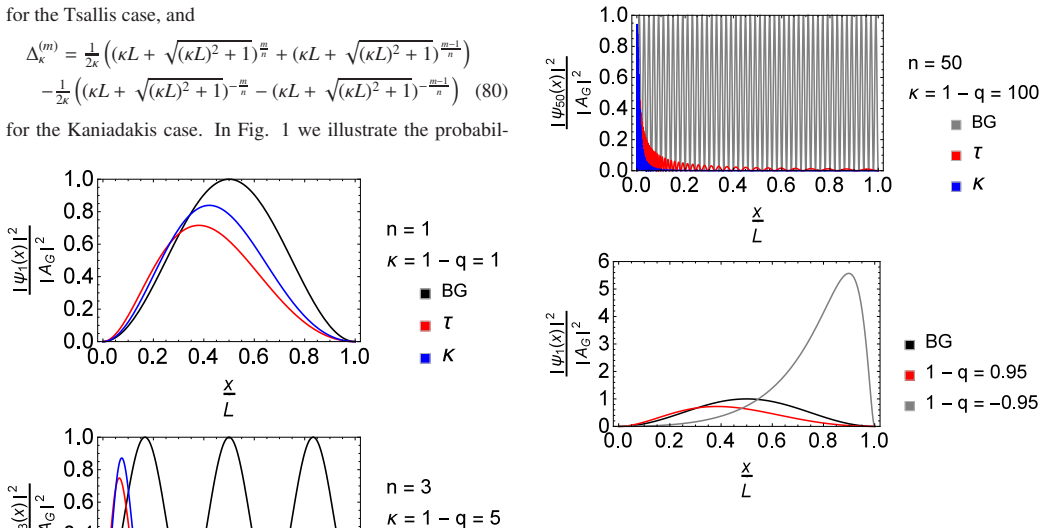
- For the infinite potential well, the eigenfunctions' zeros are spaced by the $G$-sum of the group law, and deformation breaks the density's symmetry, concentrating probability where the effective mass is largest.
- In the classical limit the deformed probability densities tend to a delta distribution near $x=0$ for the Tsallis and Kaniadakis classes, while the standard case tends to uniform.
Reading between the lines
- One could use the relation between an arbitrary group entropy $G$ and the effective-mass profile $m(x)$ to fit deformed quantum models to experimental position-dependent-mass systems; a measured $m(x)$ would then identify the group class.
- The equivalence between a constant-mass problem in $x_G$ coordinates and a deformed problem in $x$ coordinates suggests a generator of new exactly solvable position-dependent-mass potentials: choose any solvable potential in $x_G$ and any increasing group entropy $G$.
- The zeros-spacing formula could serve as a spectral fingerprint: counting and locating nodes of measured or calculated wavefunctions could discriminate between Tsallis and Kaniadakis deformations even when the probability densities look similar.
Signed reviews
Editorial analysis
A structured set of objections, weighed in public.
Referee Report
Summary. The manuscript introduces a 'G-algebra' and associated 'G-calculus' built from the formal group law (group entropy) G, with deformed sum, product, derivative, and integral operations. It then proposes deformed quantum operators x̂_G = G^{-1}(x̂) and a Hermitian p̂_G = (1/2){G'(G^{-1}(x̂)), p̂}, verifies the commutator [x̂_G, p̂_G] = iℏ, and derives a G-deformed Schrödinger equation (Eq. 54). The equation is rewritten as a constant-mass equation in G-coordinates (Eq. 63), and the infinite potential well is solved, yielding a position-dependent effective mass m_G(x) = m_0/[G'(G^{-1}(x))]^2 and non-uniform zero-spacing formulas for the Tsallis and Kaniadakis classes (Eqs. 79-80). The paper claims this is a unified framework that recovers the known q- and κ-algebras and q- and κ-deformed Schrödinger equations as special cases.
Significance. If the construction were unique and the calculations correct, the paper would provide a useful unified algebraic umbrella for deformed quantum mechanics and position-dependent mass models. The algebra/calculus part is mostly clean, the special-case reductions to q- and κ-structures are worked out in detail, and the transformation leading to Eq. (63) is algebraically consistent. However, the central quantum-mechanical claim is weakened by an operator-ordering ambiguity: the deformed momentum is not uniquely fixed by the commutator, so the G-deformed Schrödinger equation, its spectrum, and the zero-spacing predictions are not determined by the group entropy G alone. In addition, the Kaniadakis zero-spacing expression (Eq. 80) contains a sign error. These issues are load-bearing for the paper's physical conclusions and require revision.
major comments (3)
- [Section 3.3, Eqs. (46)-(54)] The deformed momentum operator is not fixed by the canonical commutation relation. For any real smooth function h, the operator p̂'_G = (1/2){G'(G^{-1}(x̂)), p̂} + h(x̂) is Hermitian and still satisfies [G^{-1}(x̂), p̂'_G] = iℏ, because h(x̂) commutes with G^{-1}(x̂). Inserting p̂'_G into the Hamiltonian changes Eq. (54) by additional terms involving h and its derivatives, and therefore changes the eigenenergies and the zero-spacing formulas (76)-(80). The paper supplies no physical ordering principle, such as minimal coupling, equivalence-principle constraints, or a derivation from a Lagrangian, that selects h = 0. Consequently the G-deformed Schrödinger equation and its physical predictions are not determined by the group entropy G alone; they are conditional on the symmetrization choice made in Eq. (46). This is load-bearing because the concluding claims about the effective mass being 'univocally determined' and about deformed spectra and probability accumulation refer to this specific h = 0 equation. The effective-mass coefficient A(x)^2 is robust, but the full equation is not.
- [Section 3.4, Eq. (80)] The Kaniadakis zero-spacing formula is incorrect. With S = κL + sqrt((κL)^2 + 1), the m-th zero is x_m = (S^{m/n} - S^{-m/n})/(2κ), so the spacing is Δ(m)_κ = x_m - x_{m-1} = (1/(2κ))[S^{m/n} - S^{(m-1)/n} - S^{-m/n} + S^{-(m-1)/n}]. The printed formula has +S^{(m-1)/n} in the first bracket and, after distributing the minus sign of the second bracket, effectively +S^{-(m-1)/n}; this does not equal the difference of consecutive zeros. The Tsallis formula (Eq. 79) is correct, but the Kaniadakis illustration and any comparison based on Eq. (80) need correction.
- [Section 3.4, Eqs. (70)-(71)] The infinite-well solution assumes that x_G = G^{-1}(x) is an increasing diffeomorphism on [0, L] and that the potential boundaries transform as stated. The paper mentions this assumption and notes it holds for the Tsallis and Kaniadakis classes, but it does not prove monotonicity of G^{-1} for a general group entropy from the defining formal power series (Eq. 2), nor does it state the required conditions on the coefficients a_k. Since the abstract and introduction claim a general G-parametrized construction, the well example and the zero-spacing formulas are not justified for arbitrary G without either a proof of monotonicity or an explicit restriction of the scope to classes for which G^{-1} is monotone on the relevant interval.
minor comments (6)
- [Section 3, item (h)] The inverse of the G-product is written as ⊘_G x = exp_G(−log_G(y)), but the argument should be x; the variable y is undefined and the intended expression is exp_G(−log_G(x)).
- [Section 3.2.2, item (fK)] The inverse of the κ-sum is given by the q-dependent formula −x/(1 + (1−q)x), which is a copy of the q-algebra result; for the Kaniadakis class the inverse element is ⊖_κ x = −x, since x ⊕_κ (−x) = 0.
- [Footnote 1] The footnote says the standard case reduces to uniform zero spacing Δ(m) = L/m, but for G(t) = t the spacing is L/n, independent of m.
- [Eq. (74)] The index n = 0 should be excluded from the eigenfunction/eigenenergy labeling; the standard infinite-well solutions begin at n = 1, and n = 0 gives a vanishing wavefunction.
- [Figure 1 caption] The caption refers to m_G(x) as Eq. (75), but Eq. (75) defines the wavefunctions; the effective mass is defined in Eq. (55).
- [Abstract and introduction] The phrase 'the q-deformed (standard) Schrödinger equation results an special case' is ungrammatical, and the terminology alternates between 'Kappa' and 'Kaniadakis' classes; please unify the naming and fix the grammar.
Circularity Check
No circularity: the G-deformed Schrödinger equation, effective mass, and zero-spacing formulas are explicit mathematical consequences of proposed operators, not fitted inputs or self-citation imports.
full rationale
Walking the derivation chain: the paper takes a formal group law Φ(x,y)=G(G^{-1}(x)+G^{-1}(y)) as input and defines the G-algebra operations, the G-derivative (Eq. 28), and the G-integral (Eq. 31). The deformed momentum operator in Eq. (46) is explicitly introduced as a Hermitian choice ("we redefine p̂G as... that is Hermitian"), and Eq. (48) is a direct verification of the canonical commutator for that choice. The G-deformed Schrödinger equation (54) is then obtained by substituting Eq. (46) into the Hamiltonian (49) and evaluating matrix elements; it is a consequence of the postulated operator, not a quantity independently measured or fitted. The effective mass (55) is a rewriting of the coefficient A(x)^2 = [G'(G^{-1}(x))]^2, and the zero positions in Eq. (76) follow from solving D_G^2 φ + α² φ = 0 in the x_G coordinate, so the represented zero-spacing is a mathematical implication of the model, not an output secretly equal to an input. The cited group-entropy uniqueness theorem [29] is by Tempesta/Enciso, not the current authors, and it is not used to force the choice of p̂G. Refs. [22-24] are self-citations but only contextualize the q-deformed case already derived in Eq. (56). The unproven Hermitian ordering and the monotonicity assumption in Section 3.4 are modeling assumptions and would be correctness risks, but they do not make the derivation circular. No fitted parameter is renamed as a prediction, and no load-bearing step reduces to a self-citation chain.
Assumptions & free parameters
free parameters (3)
- q (Tsallis class) =
free parameter; e.g., κ = 1 - q = 100 in Fig. 2
- κ (Kaniadakis class) =
free parameter
- formal group exponential G(t) (function-valued) =
power series with coefficients {a_k}, Eq. (2); unspecified except for the BG, Tsallis, Kaniadakis examples
assumptions (4)
- standard math The operations of the G-algebra are defined as x ⊕G y = G(G^{-1}(x)+G^{-1}(y)) and x ⊗G y = expG(logG x + logG y), with G(t) the formal group exponential from Lazard theory.
- domain assumption xG = G^{-1}(x) is assumed to be an increasing function of x (Section 3.4) so that the infinite well maps to a well of width LG = G^{-1}(L).
- ad hoc to paper The deformed momentum is required Hermitian, leading to the symmetrized ordering p̂G = (1/2){G'(G^{-1}(x̂)), p̂} (Eq. 46).
- standard math The formal group law satisfies commutativity, associativity and null-composability (C2-C4), and the group logarithm satisfies logG(x ⊗G y)=logG x + logG y (Eq. 6).
invented entities (2)
-
G-algebra, G-calculus (G-sum, G-product, G-derivative, G-integral)
-
G-deformed coordinate space RG and G-dual real numbers ~RG
Cite this review
Pith. "Pith review of Algebraic structures and deformed Schr\"{o}dinger equations from groups entropies." pith.science (2026). https://pith.science/paper/Y3QHGGNE
@misc{pith2026190802785,
  author       = {Pith},
  title        = {Pith review of: Algebraic structures and deformed Schr\"odinger equations from groups entropies},
  year         = {2026},
  howpublished = {\url{https://pith.science/paper/Y3QHGGNE}},
  note         = {Machine review of arXiv:1908.02785}
}
abstract
Motivated by the group entropy theory, in this work we generalize the algebra of real numbers (that we called G-algebra), from which we develop an associated G-differential calculus. Thus, the algebraic structures corresponding to the Tsallis and Kappa statistics are obtained as special cases when the Tsallis and Kappa group classes are chosen. We employ the G-algebra to formulate a generalized G-deformed Schr\"{o}dinger equation and we illustrate it with the infinite potential well, where the effective mass is related with the G-algebra structure and the $q$-deformed (standard) Schr\"{o}dinger equation results an special case for the Tsallis (Boltzmann-Gibbs) group class. The non-uniform zeros spacing of the G-deformed eigenfunctions is expressed in terms of the generalized sum of the G-algebra.
Figures

Reference graph
Works this paper leans on
-
[1]
C. Tsallis, D. J. Bukman. Anomalous di ffusion in the presence of exter- nal forces: Exact time-dependent solutions and their therm ostatistical basis, Phys. Rev. E 54, R2197(R) (1996)
work page 1996
- [2]
-
[3]
S. Guo, L. Mei, A. Sun. Nonlinear ion-acoustic structure s in a nonexten- sive electron-positron-ion-dust plasma: Modulational in stability and rogue waves, Ann. Phys. 332, 38–55 (2013)
work page 2013
-
[4]
V . Aquilanti, N. D. Coutinho, V . H. Carvalho-Silva. Kine tics of low- temperature transitions and a reaction rate theory from non equilibrium dis- tributions, Phil. Trans. R. Soc. A 375, 20160201 (2016)
work page 2016
-
[5]
P . Douglas, S. Bergamini, F. Renzoni. Tunable Tsallis Di stributions in Dis- sipative Optical Lattices, Phys. Rev. Lett. 96, 110601 (2006)
work page 2006
-
[6]
U. Tirnakli, E. P . Borges. The standard map: From Boltzma nn–Gibbs statistics to Tsallis statistics, Sci. Rep. 6 23644 (2016)
work page 2016
-
[7]
I. S. Gomez, E. P . Borges. Unified time scales for quantum c haotic regimes, J. Stat. Mech. 063105 (2018)
work page 2018
-
[8]
I. S. Gomez. A Generalized Vitali Set from Nonextensive S tatistics, Rep. Math. Phys. 83, 61–70 (2019)
work page 2019
Show all 30 references
-
[9]
C. Tsallis. Possible generalization of Boltzmann–Gibb s statistics, J. Stat. Phys. 52, 479–487 (1988)
1988
-
[10]
Tsallis, Introduction to Nonextensive Statistical Mechanics – Ap- proaching a Complex W orld, Springer, New Y ork, 2009
C. Tsallis, Introduction to Nonextensive Statistical Mechanics – Ap- proaching a Complex W orld, Springer, New Y ork, 2009
2009
-
[11]
S. Abe. A note on the q-deformation-theoretic aspect of the generalized entropies in nonextensive physics Phys. Lett. A 224, 326–330 (1998)
1998
-
[12]
Kaniadakis
G. Kaniadakis. Non-linear kinetics underlying genera lized statistics, Physica A 296 405–425 (2001)
2001
-
[13]
Kaniadakis
G. Kaniadakis. Statistical mechanics in the context of special relativity, Phys. Rev. E 66, 056125 (2002)
2002
-
[14]
Nivanen, A
L. Nivanen, A. Le Mehaute, Q. Wang. Generalized algebra within a nonextensive statistics, Rep. Math. Phys. 52, 437–444 (3) (2003)
2003
-
[15]
E. P . Borges. A possible deformed algebra and calculus i nspired in nonex- tensive thermostatistics, Physica A 340, 95–101 (1-3) (2004)
2004
-
[16]
D. O. Richstone and M. D. Potter. Galactic mass loss: a mi ld evolutionary correction to the angular size test. Astrophys. J. 254, 451 (1982). 8
1982
-
[17]
von Roos
O. von Roos. Positon-dependent e ffective masses in semiconductor the- ory, Phys. Rev. B 27 (12), 7547 (1983)
1983
-
[18]
A. D. Alhaidari. Solution of the Dirac equation with pos ition-dependent mass in the Coulomb field, Phys. Lett. A 322, 72 (2004)
2004
-
[19]
Ra˜ nada
Manuel F. Ra˜ nada. Superintegrable systems with a posi tion dependent mass: Kepler-related and oscillator-related systems. Phys. Lett. A 380, 2204 (2016)
2016
-
[20]
R. N. Costa Filho, M. P . Almeida, G. A. Farias, J. S. Andra de. Displace- ment operator for quantum systems with position-dependent mass, Phys. Rev. A 84 050102 (R) (2011)
2011
-
[21]
R. N. Costa Filho, G. Alencar, B.-S. Skagerstam, J. S. An drade Jr. Morse potential derived from first principles, Europhys. Lett. 101 10009 (2013)
2013
-
[22]
B. G. da Costa, E. P . Borges. Generalized space and linea r momentum operators in quantum mechanics, J. Math. Phys. 55 062105 (2014)
2014
-
[23]
B. G. da Costa, E. P . Borges. A position-dependent mass h armonic oscil- lator and deformed space, J. Math. Phys. 59 042101 (2018)
2018
-
[24]
B. G. da Costa, I. S. Gomez. Bohmian formalism and Fisher informa- tion from q-deformed Schrodinger equation, Phys. Lett. A 382 2605–2612 (2018)
2018
-
[25]
Tempesta
P . Tempesta. Group entropies, correlation laws, and ze ta functions, Phys. Rev. E 84, 021121 (2011)
2011
-
[26]
Tempesta
P . Tempesta. The Lazard formal group, universal congru ences and special values of zeta functions, Trans. Am. Math. Soc. 367, 7015–7028 (2015)
2015
-
[27]
Tempesta
P . Tempesta. A theorem on the existence of trace-form ge neralized en- tropies, Proc. R. Soc. A 471, 20150165 (2015)
2015
-
[28]
Tempesta
P . Tempesta. Groups, information theory, and Einstein ’s likelihood prin- ciple, Phys. Rev. E 93, 040101(R) (2016)
2016
-
[29]
Enciso, P
A. Enciso, P . Tempesta. Uniqueness and characterizati on theorems for generalized entropies, J. Stat. Mech. 123101 (2017)
2017
-
[30]
M. A. Rodr´ ıguez, A. Romaniega, P . Tempesta. A new class of entropic information measures, formal group theory and information geometry. 475. Proc. R. Soc. A http://doi.org/10.1098/rspa.2018.0633 9
2018
Reviewed August 14, 2026 · model on record in the stance chip above.
Discussion (0). Continue with ORCID to comment.