REVIEW 3 major objections 5 minor 27 references
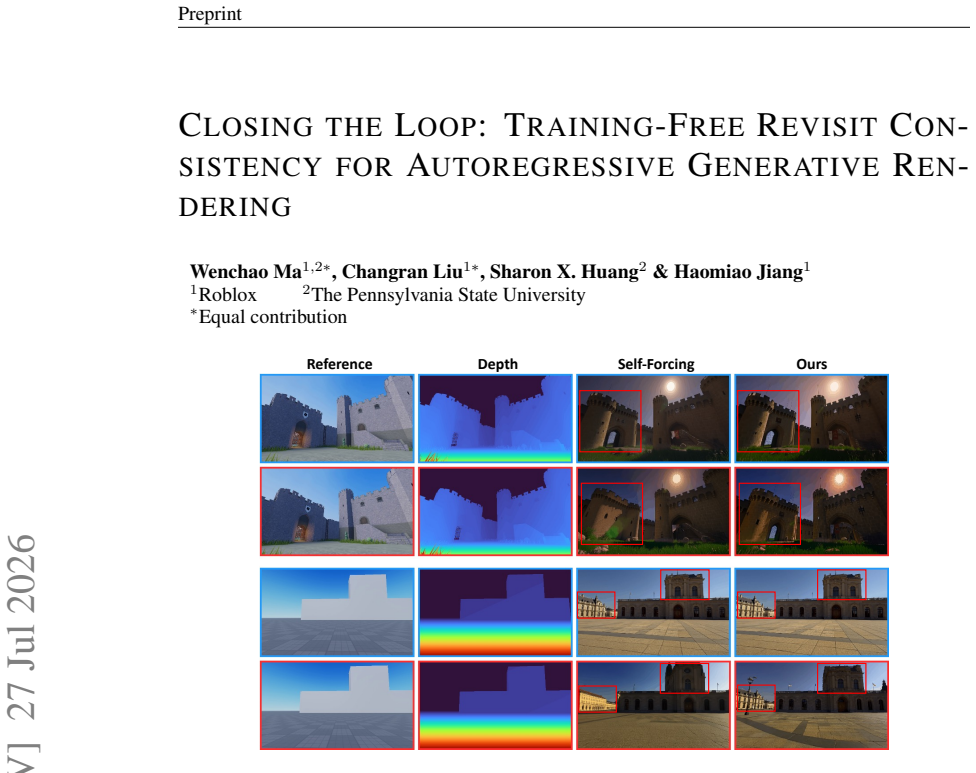
An autoregressive video generator can re-render a revisited location consistently without retraining, by retrieving the earlier view into its cache and steering attention with depth-based correspondences.
Reviewed by Pith at T0; open to challenge. T0 means a machine referee read the full paper against a public rubric. the ladder, T0–T4 →
T0 review · deepseek-v4-flash
2026-08-01 06:30 UTC pith:Y5DDL2GT
load-bearing objection Solid training-free method for revisit consistency, but the headline empirical claims need error bars and a more honest reading of VBench noise. the 3 major comments →
Closing the Loop: Training-Free Revisit Consistency for Autoregressive Generative Rendering
The pith
A machine-rendered reading of the paper's core claim, the machinery that carries it, and where it could break.
Core claim
The central claim is that the revisit inconsistency of autoregressive generative rendering is not a model-capacity problem but a memory-addressing problem: the previously generated view exists but has been evicted, and when it is reinstated the model still needs guidance to find the right tokens across a viewpoint change. The method retrieves a pose-matched historical chunk into the bounded KV cache as loop-closure memory, and converts the 3D engine's known camera poses and metric depth into a Gaussian suppression mask on attention logits, steering each query token toward the reprojected location of its corresponding key. The bias is applied only to retrieved keys, never warps cached feature
What carries the argument
The key mechanism is a two-part correspondence-guided memory: pose-retrieved loop-closure memory, which uses a pose-similarity gate (distance, view angle, and temporal gap) to select a historical latent chunk to reinstate into the clean KV cache, giving the model access to the actual earlier appearance; and a depth-reprojection Gaussian attention bias, which unprojects each query token with metric depth, reprojects it into the retrieved view, and adds a Gaussian penalty to attention logits so keys far from the predicted correspondence are exponentially suppressed. An occlusion-aware visibility test rejects invalid correspondences, and the bias never warps or blends cached features.
Load-bearing premise
The method assumes the 3D engine supplies per-frame planar metric depth and camera poses that are correctly aligned with the latent token grid; if the poses are noisy or the depth is mis-scaled, the reprojection and visibility tests produce wrong correspondences and the attention bias can steer queries to incorrect keys.
What would settle it
Run the method on a loop-closure sequence where the engine's depth is deliberately mis-scaled (e.g., multiplied by a constant while camera translations stay fixed) or where camera poses are perturbed with small jitter; if the consistency gains over the sliding-window baseline vanish or reverse, the geometric correspondence prior is the load-bearing component.
If this is right
- Streaming generative rendering in games and virtual production can maintain persistent world appearance across long camera paths with no post-training.
- The method is complementary to existing cache-management schemes and can be stacked on top of attention sinks, deep sinks, or memory tokens.
- Because the bias only modifies logits and never resamples cached features, it is designed to tolerate noise in the estimated correspondences.
- Evaluation on navigation datasets with genuine loop-closure trajectories and a live game-engine integration suggests the approach is applicable to realistic streaming scenarios.
Where Pith is reading between the lines
- The same correspondence-guided memory idea might port to other autoregressive modalities (e.g., point clouds or mesh sequences) where geometric correspondences are available, not just pixel frames.
- The logit-bias-over-warping design is a general principle: when geometry is known, shape attention rather than resample features, so errors degrade softly instead of injecting blur.
- A concrete stress test would feed deliberately mis-scaled depth or jittered poses to measure how much correspondence noise the bias tolerates before the consistency gains vanish.
- The retrieval thresholds (return distance, view angle, temporal gap) are hand-set; an adaptive variant that tunes them from the camera-trajectory distribution could make the method self-calibrating.
Editorial analysis
A structured set of objections, weighed in public.
Referee Report
Summary. The paper proposes a training-free inference-time mechanism for improving revisit consistency in autoregressive generative rendering. Given a 3D engine that supplies camera poses and metric depth, the method (i) retrieves pose-matched historical latent chunks into a bounded KV cache (loop-closure memory, Sec. 4.2) and (ii) adds a Gaussian attention bias that steers each query token toward geometrically corresponding tokens in the retrieved chunk via depth reprojection (Eqs. 2–4, Sec. 4.3). Experiments on TartanGround-Revisit and TartanAir-Revisit report gains in keypoint matches, DINO similarity, and L1 error relative to several training-free cache-management baselines, with no degradation in VBench-Long quality. The method is also demonstrated in a live game engine.
Significance. The core idea is timely and practical: long-horizon generative rendering in interactive applications is a real problem, and the paper exploits correspondences that are freely available in the intended setting. The derivations in Sec. 4 (Eqs. 1–4) are sound, the ablation in Table 3 shows that attention sink and pose retrieval contribute nontrivially, and the qualitative results are consistent with the claimed effect. The approach is training-free, which is an asset. However, the headline empirical claim—'consistently outperforms ... without degrading overall video quality'—is not supported by the reported evidence because no error bars, confidence intervals, or significance tests are provided. The VBench-Long differences are tiny (0.0006 and 0.0017), and the novel geometric-bias component (GB) changes metrics by amounts that are likely within seed-to-seed noise. Thus the paper's significance is contingent on more rigorous empirical validation.
major comments (3)
- [Sec. 5.2, Tables 1 and 2] The central claim of consistent outperformance and no quality loss is not backed by uncertainty quantification. VBench-Long mean differences vs. Deep Forcing are 0.0006 on TartanGround (0.7420 vs. 0.7414) and 0.0017 on TartanAir (0.7754 vs. 0.7737), which are far below typical seed-to-seed variance. The consistency metrics (keypoint matches, DINO, L1) have no error bars or per-clip confidence intervals despite the small number of clips (71 on TartanGround). Without multiple seeds or paired statistical tests (e.g., bootstrap over clips), 'consistently outperforms' and 'without degrading overall video quality' are not supported. Please report per-clip variance and run significance tests on the consistency metrics as well.
- [Sec. 4.3 and Table 3] The geometric attention bias (GB) is the method's most novel component, but its measured contribution is marginal and possibly not significant. In Table 3, adding GB to SF+AS+PR changes keypoint matches from 47.84 to 49.08 on TartanGround and from 283.30 to 284.92 on TartanAir, while DINO similarity slightly decreases (0.6926→0.6904 and 0.8410→0.8407) and L1 is unchanged. Given no error bars, the slight keypoint increase could be noise. Moreover, the bias in Eq. 2 directly suppresses attention to keys away from the reprojected position, so SuperPoint/LightGlue matches—the metric that improves most—are to a significant degree guaranteed by the mechanism. The paper should either show that the GB gain is statistically significant on a metric that is not mechanically aligned with the bias, or temper the claim about spatial-correspondence benefit.
- [Sec. 5.1, TartanAir-Revisit] The TartanAir benchmark is constructed by 'rendering smooth revisit trajectories directly from the dataset's 360° panoramas' rather than by re-rendering the native 3D scenes. This raises questions about whether the setup matches the assumptions of Sec. 4.1, which requires engine-supplied per-frame planar metric depth and camera poses aligned with the token grid. How is metric depth obtained for these panorama-derived trajectories, and is it consistent with the camera motion? If depth is approximate or scale-inconsistent, the Eq. 3–4 reprojection may behave differently than in the TartanGround experiments. Please clarify the depth source for TartanAir and its alignment with the synthesized trajectories.
minor comments (5)
- [Abstract / Sec. 1] Typos: 'mirror complicate real-world application scenarios' should be 'mirror complex'; the phrase 'to mirror complicate' appears in the abstract and intro.
- [Eq. (1)] The scene-scale normalizer E is not defined explicitly; state how it is computed from the scene size. Also, the temporal gap Δ is not given a value.
- [Sec. 4.3, Eq. (2)–(4)] The symbols σ, λ, and ε are introduced but their numerical values are not reported in the experimental setup. Please provide the hyperparameter settings used for Tables 1–3.
- [Sec. 5.1] The evaluation protocol says 'we follow the evaluation protocol in MilliVid' but does not specify whether the generated frames are compared at the same latent resolution or after decoding, nor how the 'macro-average over each clip's genuine loop-closure revisit pairs' handles multiple revisits in one trajectory. A precise definition would aid reproducibility.
- [General] No code is released or promised; for a method with several tuning parameters (w_v, τ_c, τ_v, Δ, σ, λ, ε, cache split), releasing code would substantially improve reproducibility.
Circularity Check
No significant circularity: the method's soft attention bias and the external consistency metrics are distinct, and no fitted parameter or self-citation drives the result.
full rationale
The paper's central claim is an empirical one about a training-free cache-management scheme, not a derivation from first principles. The method has two components: pose-retrieved loop-closure memory (Sec. 4.2) and a depth-reprojection Gaussian attention bias (Sec. 4.3). The evaluation uses external metrics (SuperPoint/LightGlue matches, DINOv2 similarity, L1, VBench-Long) that do not consume the engine depth/pose inputs that the method uses; the base model, seeds, and cache budget are shared with baselines. No parameter is fitted to the test loop-closure benchmarks, and the paper does not invoke a self-citation or uniqueness theorem to force its design. The statement in Sec. 5.3 that the geometric bias affects 'exactly the placement property the matcher-based metric measures' is an admission that the mechanism is well matched to the metric, but it is not a reduction: the bias is a soft suppression of attention logits and the paper notes it 'cannot force content into place,' leaving the actual generated pixels to the learned model. The main limitation stated in Sec. 6 (reliance on engine poses and metric depth) concerns robustness, not circularity. Statistical concerns about missing error bars are correctness/evidence issues, not circularity. Therefore no circular step is present.
Axiom & Free-Parameter Ledger
free parameters (9)
- w_v =
0.5 (specified)
- tau_c =
not reported
- tau_v =
not reported
- Delta =
not reported
- sigma =
not reported
- lambda =
not reported
- epsilon =
not reported
- E =
scene-scale normalizer
- cache budget split =
M=4F, F_anchor+F_retrieved+2F_recent
axioms (4)
- domain assumption The 3D engine supplies per-frame pinhole intrinsics, rigid camera poses, and per-frame planar metric depth aligned with the latent token grid (Sec. 4.1).
- domain assumption The frozen self-forced Causal Wan-V ACE student can effectively use KV-cache entries packed at RoPE positions adjacent to the recent window (Sec. 4.2).
- ad hoc to paper A Gaussian-shaped suppression mask on attention logits is a valid proxy for geometric correspondence (Eq. 2).
- domain assumption The pretrained diffusion model's attention is the correct injection point for geometric priors; the control branch is left untouched (Sec. 4.3).
read the original abstract
Recent conditional video generation models have shown promising potentials to transform 3D engine renderings, such as depth maps and untextured geometry, into photorealistic videos for gaming and immersive content creation. These applications require long-horizon auto-regressive generation that continuously synthesizes new frames while preserving a persistent 3D world. Auto-regressive generators synthesize video chunk by chunk with a bounded KV cache, so when the camera revisits a location after its context has been evicted, the model often regenerates inconsistent appearance, even though the conditioning renderings (e.g., depth) remain perfectly aligned with the underlying geometry. We address this revisit inconsistency without any post-training by exploiting correspondences the 3D engine already provides: temporal correspondence retrieves pose-matched historical latent chunks into the KV cache as loop-closure memory, while spatial correspondence from camera pose and depth reprojection biases token-level attention toward geometrically corresponding regions of the retrieved chunks. We demonstrate our method on loop-closure trajectories mined from TartanAir and TartanGround dataset to mirror complicate real-world application scenarios, where it outperforms existing training-free baselines on revisit consistency without losing overall video quality. Project Page: https://wenchao-m.github.io/ClosetheLoop.github.io/
Figures


Reference graph
Works this paper leans on
-
[1]
Hassan Abu Alhaija, Jose Alvarez, Maciej Bala, Tiffany Cai, Tianshi Cao, Liz Cha, Joshua Chen, Mike Chen, Francesco Ferroni, Sanja Fidler, Dieter Fox, Yunhao Ge, Jinwei Gu, Ali Hassani, Michael Isaev, Pooya Jannaty, Shiyi Lan, Tobias Lasser, Huan Ling, Ming-Yu Liu, Xian Liu, Yifan Lu, Alice Luo, Qianli Ma, Hanzi Mao, Fabio Ramos, Xuanchi Ren, Tianchang Sh...
-
[3]
Kaijin Chen, Dingkang Liang, Xin Zhou, Yikang Ding, Xiaoqiang Liu, Pengfei Wan, and Xiang Bai. Out of sight but not out of mind: Hybrid memory for dynamic video world models.arXiv preprint arXiv:2603.25716,
-
[5]
Accessed 2026-07-08. Samuel Garcin, Thomas Walker, Steven McDonagh, Tim Pearce, Hakan Bilen, Tianyu He, Kaixin Wang, and Jiang Bian. Beyond pixel histories: World models with persistent 3d state.arXiv preprint arXiv:2603.03482,
Pith/arXiv arXiv 2026
-
[6]
Coarse-to-real: Generative rendering for populated dynamic scenes.arXiv preprint arXiv:2601.22301,
Gonzalo Gomez-Nogales, Yicong Hong, Chongjian Ge, Marc Comino-Trinidad, Peiye Zhuang, Dan Casas, and Yi Zhou. Coarse-to-real: Generative rendering for populated dynamic scenes.arXiv preprint arXiv:2601.22301,
-
[7]
Ltx-video: Realtime video latent diffusion.arXiv preprint arXiv:2501.00103,
Yoav HaCohen, Nisan Chiprut, Benny Brazowski, Daniel Shalem, Dudu Moshe, Eitan Richardson, Eran Levin, Guy Shiran, Nir Zabari, Ori Gordon, Poriya Panet, Sapir Weissbuch, Victor Kulikov, Yaki Bitterman, Zeev Melumian, and Ofir Bibi. Ltx-video: Realtime video latent diffusion.arXiv preprint arXiv:2501.00103,
-
[9]
Qixin Hu, Shuai Yang, Wei Huang, Song Han, and Yukang Chen. Longlive-rag: A general retrieval- augmented framework for long video generation.arXiv preprint arXiv:2606.02553,
-
[10]
Xun Huang, Zhengqi Li, Guande He, Mingyuan Zhou, and Eli Shechtman. Self forcing: Bridging the train-test gap in autoregressive video diffusion.arXiv preprint arXiv:2506.08009, 2025a. Ziqi Huang, Yinan He, Jiashuo Yu, Fan Zhang, Chenyang Si, Yuming Jiang, Yuanhan Zhang, Tianx- ing Wu, Qingyang Jin, Nattapol Chanpaisit, Yaohui Wang, Xinyuan Chen, Limin Wan...
-
[11]
Ziqi Huang, Fan Zhang, Xiaojie Xu, Yinan He, Jiashuo Yu, Ziyue Dong, Qianli Ma, Nattapol Chan- paisit, Chenyang Si, Yuming Jiang, Yaohui Wang, Xinyuan Chen, Ying-Cong Chen, Limin Wang, Dahua Lin, Yu Qiao, and Ziwei Liu. VBench++: Comprehensive and versatile benchmark suite for video generative models.IEEE Transactions on Pattern Analysis and Machine Intel...
arXiv 2025
-
[12]
Youngrae Kim, Qixin Hu, C.-C. Jay Kuo, and Peter A. Beerel. MemRoPE: Training-free infinite video generation via evolving memory tokens.arXiv preprint arXiv:2603.12513,
-
[15]
Joonghyuk Shin, Zhengqi Li, Richard Zhang, Jun-Yan Zhu, Jaesik Park, Eli Shechtman, and Xun Huang. Motionstream: Real-time video generation with interactive motion controls.arXiv preprint arXiv:2511.01266,
-
[16]
Wan: Open and advanced large-scale video generative models.arXiv preprint arXiv:2503.20314,
Wan Team. Wan: Open and advanced large-scale video generative models.arXiv preprint arXiv:2503.20314,
-
[17]
Zile Wang, Zexiang Liu, Jaixing Li, Kaichen Huang, Baixin Xu, Fei Kang, Mengyin An, Peiyu Wang, Biao Jiang, Yichen Wei, et al. Matrix-game 3.0: Real-time and streaming interactive world model with long-horizon memory.arXiv preprint arXiv:2604.08995, 2026b. 12 Preprint Guangxuan Xiao, Yuandong Tian, Beidi Chen, Song Han, and Mike Lewis. Efficient streaming...
-
[18]
Longlive: Real-time interactive long video generation.arXiv preprint arXiv:2509.22622,
Shuai Yang, Wei Huang, Ruihang Chu, Yicheng Xiao, Yuyang Zhao, Xianbang Wang, Muyang Li, Enze Xie, Yingcong Chen, Yao Lu, Song Han, and Yukang Chen. Longlive: Real-time interactive long video generation.arXiv preprint arXiv:2509.22622,
-
[19]
Hidir Yesiltepe, Tuna Han Salih Meral, Adil Kaan Akan, Kaan Oktay, and Pinar Yanardag. Infinity- rope: Action-controllable infinite video generation emerges from autoregressive self-rollout. arXiv preprint arXiv:2511.20649,
-
[20]
Jung Yi, Wooseok Jang, Paul Hyunbin Cho, Jisu Nam, Heeji Yoon, and Seungryong Kim. Deep forcing: Training-free long video generation with deep sink and participative compression.arXiv preprint arXiv:2512.05081,
-
[21]
Memlearner: Learning to query context memory for video world models.arXiv preprint arXiv:2606.31734,
Jiwen Yu, Jianxiong Gao, Jianhong Bai, Yiran Qin, Kaiyi Huang, Quande Liu, Xintao Wang, Pengfei Wan, Kun Gai, and Xihui Liu. Memlearner: Learning to query context memory for video world models.arXiv preprint arXiv:2606.31734,
-
[22]
Yifei Yu, Xiaoshan Wu, Xinting Hu, Tao Hu, Yangtian Sun, Xiaoyang Lyu, Bo Wang, Lin Ma, Yuewen Ma, Zhongrui Wang, and Xiaojuan Qi. Videossm: Autoregressive long video generation with hybrid state-space memory.arXiv preprint arXiv:2512.04519,
-
[23]
Helios: Real real-time long video generation model.arXiv preprint arXiv:2603.04379,
Shenghai Yuan, Yuanyang Yin, Zongjian Li, Xinwei Huang, Xiao Yang, and Li Yuan. Helios: Real real-time long video generation model.arXiv preprint arXiv:2603.04379,
-
[25]
Dian Zheng, Ziqi Huang, Hongbo Liu, Kai Zou, Yinan He, Fan Zhang, Yuanhan Zhang, Jingwen He, Wei-Shi Zheng, Yu Qiao, and Ziwei Liu. VBench-2.0: Advancing video generation benchmark suite for intrinsic faithfulness.arXiv preprint arXiv:2503.21755,
-
[26]
Hongzhou Zhu, Min Zhao, Guande He, Hang Su, Chongxuan Li, and Jun Zhu. Causal forcing: Autoregressive diffusion distillation done right for high-quality real-time interactive video gener- ation.arXiv preprint arXiv:2602.02214,
-
[27]
Tianrui Zhu, Shiyi Zhang, Zhirui Sun, Jingqi Tian, and Yansong Tang. Memorize-and-generate: Towards long-term consistency in real-time video generation.arXiv preprint arXiv:2512.18741,
-
[2020]
World simulation with video foundation models for physical ai.arXiv preprint arXiv:2511.00062,
11 Preprint NVIDIA. World simulation with video foundation models for physical ai.arXiv preprint arXiv:2511.00062,
-
[2022]
Grounding world simulation models in a real-world metropolis.arXiv preprint arXiv:2603.15583,
Junyoung Seo, Hyunwook Choi, Minkyung Kwon, Jinhyeok Choi, Siyoon Jin, Gayoung Lee, Junho Kim, JoungBin Lee, Geonmo Gu, Dongyoon Han, Sangdoo Yun, Seungryong Kim, and Jin- Hwa Kim. Grounding world simulation models in a real-world metropolis.arXiv preprint arXiv:2603.15583,
-
[2023]
Min Zhao, Hongzhou Zhu, Kaiwen Zheng, Zihan Zhou, Bokai Yan, Xinyuan Li, Xiao Yang, Chongxuan Li, and Jun Zhu. Causal forcing++: Scalable few-step autoregressive diffusion distil- lation for real-time interactive video generation.arXiv preprint arXiv:2605.15141,
-
[2024]
Ishaan Preetam Chandratreya, David Charatan, Basile Van Hoorick, Sergey Zakharov, Vitor Guizilini, Phillip Isola, and Vincent Sitzmann. Millivid: Hierarchical latents for long-range con- sistency in video generation.arXiv preprint arXiv:2606.09056,
-
[2025]
Relic: Interactive video world model with long-horizon memory.arXiv preprint arXiv:2512.04040,
Yicong Hong, Yiqun Mei, Chongjian Ge, Yiran Xu, Yang Zhou, Sai Bi, Yannick Hold-Geoffroy, Mike Roberts, Matthew Fisher, Eli Shechtman, Kalyan Sunkavalli, Feng Liu, Zhengqi Li, and Hao Tan. Relic: Interactive video world model with long-horizon memory.arXiv preprint arXiv:2512.04040,
-
[2026]
Realmaster: Lifting rendered scenes into photorealistic video.arXiv preprint arXiv:2603.23462,
Dana Cohen-Bar, Ido Sobol, Raphael Bensadoun, Shelly Sheynin, Oran Gafni, Or Patashnik, Daniel Cohen-Or, and Amit Zohar. Realmaster: Lifting rendered scenes into photorealistic video.arXiv preprint arXiv:2603.23462,
discussion (0)
Sign in with ORCID, Apple, or X to comment. Anyone can read and Pith papers without signing in.