REVIEW 2 major objections 4 minor 1 cited by
First-order methods for stochastic and finite-sum convex optimization with deterministic constraints
T0 review · 2 major / 4 minor · reviewed 2026-08-06 · deepseek-v4-flash
Pith's one-line read Stochastic solutions can meet hard constraints surely at no extra cost
desk verdict A genuinely useful strengthening of the feasibility guarantee, with careful proofs; the infinite-sample result is conditional on a strong uniform gradient bound, and the numerical section is light. read the letter →
The pith
A machine-rendered reading of the paper's core claim, the machinery that carries it, and where it could break.
The reading
What carries the argument
The load-bearing object is the quadratic penalty subproblem $F_\rho(x)=F(x)+\tfrac{\rho}{2}\|[c(x)]_+\|^2$ together with Lemma 1's bound $\|[c(x)]_+\| \le 2\Lambda/\rho + \sqrt{2(F_\rho(x)-F^*_\rho)/\rho}$. This inequality shows that controlling the penalty suboptimality $F_\rho(x)-F^*_\rho$ and choosing a large enough $\rho$ yields a deterministic bound on the original constraint violation, and the paper selects $\rho$ as a power of the horizon $K$ so that the two terms balance. Algorithm 1 applies an accelerated stochastic gradient scheme once to a sequence of these penalty problems, while Algorithm 2 runs a modified variance-reduced accelerated scheme in which the stochastic estimator approximates only the finite-sum objective and the penalty gradient is computed exactly, keeping the noise confined to the objective component.
What would settle it
Run Algorithm 1 on a constrained stochastic convex problem satisfying all assumptions except the uniform bound $\max_{\xi\in\Xi}\|\nabla\tilde f(x,\xi)\|\le G$, for example $\tilde f(x,\xi)=\xi^\top x$ with $\xi$ standard normal so the stochastic gradient is unbounded, and check whether $\|[c(x_K)]_+\|\le\epsilon$ holds with probability one at the claimed $O(\epsilon^{-2})$ gradient budget; a single output with positive-probability violation above $\epsilon$ falsifies the SFSO claim.
Extended reading notes
Core claim
The paper establishes that an $\epsilon$-surely feasible stochastic optimal ($\epsilon$-SFSO) solution, meaning a point $x$ with $\|[c(x)]_+\| \le \epsilon$ and $E[|F(x)-F^*|] \le \epsilon$, can be computed by a single loop of accelerated stochastic gradient steps applied to the quadratic penalty problems $F_\rho(x)=E[\tilde f(x,\xi)]+\psi(x)+\tfrac{\rho}{2}\|[c(x)]_+\|^2$ with suitably chosen penalty parameters $\rho$. For infinite sample spaces, Algorithm 1 achieves first-order oracle complexity $O(\epsilon^{-2})$ with constant penalty $\rho=K^{3/2}$ and $\tilde O(\epsilon^{-2})$ with dynamic penalties, where the oracle counts gradient evaluations during a single pass. For finite sums of size $s$, Algorithm 2 uses a variance-reduced estimator for the average of the $f_i$ and an exact gradient for the penalty term, and under $m=O(1)$ finds an $\epsilon$-SFSO solution in $O(s\log s + \sqrt{s}\,\epsilon^{-3/2})$ gradient evaluations, with the weaker $\epsilon$-expectedly feasible variant at $O(s\log s + \sqrt{s}\,\epsilon^{-1})$. The proof transfers stochastic suboptimality of the penalty problem into a deterministic feasibility bound through Lemma 1, so the noise only enters the optimality gap while the constraint violation stays deterministic.
Load-bearing premise
The deterministic constraint-violation guarantee depends on a uniform almost-sure bound on the norm of the stochastic gradient over the whole feasible domain; without that bound the method's output can only be certified in expectation or with high probability, not surely.
Editorial extensions
If this is right
- Infinite-sample stochastic convex problems with deterministic constraints admit $\epsilon$-SFSO solutions at $O(\epsilon^{-2})$ gradient evaluations, the same order as the unconstrained case, so the constraints cost nothing in the epsilon-dependence.
- For finite sums with $m=O(1)$, Algorithm 2 finds $\epsilon$-SFSO solutions in $O(s\log s + \sqrt{s}\,\epsilon^{-3/2})$ evaluations and $\epsilon$-EFSO solutions in $O(s\log s + \sqrt{s}\,\epsilon^{-1})$.
- Combined with sample average approximation, the proposed solvers yield $O(\epsilon^{-2})$ for $\epsilon$-EFSO and either $O(\epsilon^{-3})$ or $O(\epsilon^{-5/2})$ for $\epsilon$-SFSO solutions of the original infinite-sample problem.
- In the deterministic special case $s=1$, Algorithm 2 becomes a single-loop first-order penalty method with optimal $O(\epsilon^{-1})$ or nearly optimal $\tilde O(\epsilon^{-1})$ complexity.
- The framework extends directly to affine equality constraints and to convex conic constraints $c(x)\in-K$ with an exactly computable projection, covering conic programs beyond ordinary inequalities.
Reading between the lines
- One can infer that the deterministic certificate depends on the uniform almost-sure gradient bound in Assumption 2; under heavy-tailed or unbounded noise, the randomness would leak into the constraint violation, and recovering a usable certificate would require a probabilistic analogue of that assumption.
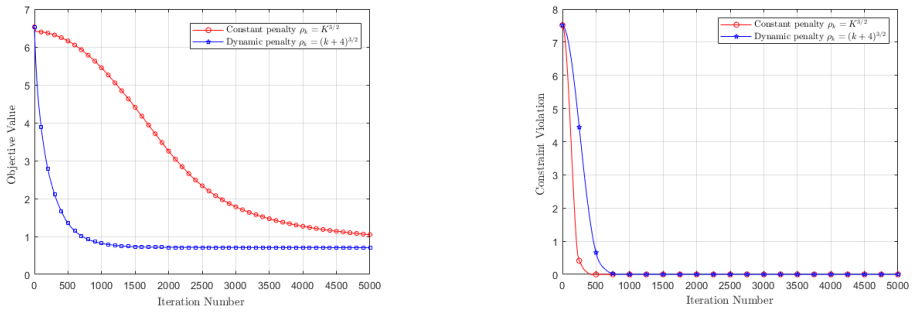
- The penalty parameter recipes $\rho=K^{3/2}$ and $\rho=s^{2/3}K^{4/3}$ instantiate a general balance between constraint violation and objective gap, and the same trade-off could govern penalty-based stochastic and augmented Lagrangian methods beyond the two algorithms analyzed here.
- A direct stress test is to replace the uniform bound with a bounded-variance or sub-Gaussian assumption and measure how the deterministic feasibility certificate degrades, which would show when 'surely feasible' claims are genuinely available.
Editorial analysis
A structured set of objections, weighed in public.
Referee Report
Summary. The paper proposes first-order methods for convex stochastic or finite-sum optimization with deterministic convex constraints, targeting ε-surely feasible stochastic optimal (ε-SFSO) solutions, i.e., deterministic constraint violation at most ε and expected optimality gap at most ε. For infinite sample spaces, Algorithm 1 applies an accelerated stochastic gradient scheme once to a sequence of quadratic penalty problems; under Assumptions 1–2 it is claimed to compute an ε-SFSO solution with FO complexity O(ε^{-2}) for constant penalty parameters and Õ(ε^{-2}) for dynamic ones. For finite-sum problems, Algorithm 2 uses a modified variance-reduced accelerated scheme with exact penalty gradients, obtaining O(s log s + √s ε^{-3/2}) for ε-SFSO and O(s log s + √s ε^{-1}) for ε-EFSO when m=O(1). Section 4 analyzes SAA, yielding O(ε^{-2}) for ε-EFSO and O(ε^{-5/2}) for ε-SFSO. The proofs are detailed, with explicit constants and lemmas leading to Theorems 1–4.
Significance. The deterministic feasibility guarantee is stronger than the commonly studied expected-feasibility notion, and the claimed infinite-sample complexity O(ε^{-2}) matches the unconstrained stochastic oracle bound. The finite-sum analysis with separation of stochastic and deterministic gradient contributions is a meaningful technical contribution, and the SAA byproduct gives concrete complexity comparisons. The paper is self-contained: it proves its own Lemmas 3–10 rather than importing the central recursion, and the main rates are internally consistent. The principal caveats are the strong uniform almost-sure gradient bound required for the infinite-sample deterministic feasibility claim, and the unsupported deterministic s=1 optimal-complexity remarks.
major comments (2)
- [Assumption 2; Lemma 3; Theorem 1] The ε-SFSO guarantee of Algorithm 1 for infinite sample spaces rests essentially on the uniform almost-sure bound in Assumption 2. In Lemma 3, inequality (56) bounds the noise pathwise as ∥δ_i∥ ≤ 2G, which is the only mechanism converting the recursion for F_ρ(x_K) − F*_ρ into a deterministic bound; Lemma 1(46) then yields the deterministic constraint violation in Theorem 1. If Assumption 2 is weakened to a variance bound only, the pathwise terms γ_i∥δ_i∥ are uncontrolled, and only an in-expectation or high-probability feasibility statement follows. The abstract and Remark 1 state the O(ε^{-2}) 'surely feasible' result without flagging this restriction. I recommend adding an explicit scope-limitation statement and, if possible, a companion in-expectation feasibility result under weaker noise assumptions.
- [Remarks 3(iii), 4(iii); Theorem 3(ii); Theorem 4(ii)] The special-case deterministic O(ε^{-1}) claims are not consequences of the stated theorems. For s=1, Theorem 3(ii) with ρ = √s K = K gives the bound ∥[c(˜x_K)]_+∥ ≤ 8 L_{∇ḟ}^{1/2} D_X K^{-1/2} + ... (first displayed bound after Theorem 3(ii)), so the theorem yields O(ε^{-2}) rather than O(ε^{-1}); the K^{-1/2} term originates from the K-independent term 16 L_{∇ḟ} D_X² in Lemma 8 (80), which decays only through division by ρ. Similarly, Theorem 4(ii) bound (35) has first term 60 L_{∇ḟ}^{1/2} D_X s^{-1/4}k^{-1/2}, giving O(k^{-1/2}) for s=1. If the intended argument is that δ_t=0 in the deterministic case and the noise term vanishes, that analysis must be supplied; otherwise Remarks 3(iii) and 4(iii) should be corrected.
minor comments (4)
- [Section 6.2, after eq. (110)] There is a typo: 'togther' should be 'together'.
- [Notation, Section 1.1] In Assumption 2, the variance bound E∥∇f~(x,ξ)−∇f(x)∥² ≤ σ² is implied by the uniform almost-sure bound G via σ ≤ 2G; stating both is fine, but the redundancy could be noted.
- [Section 4, Approach 2] The equality O(s log s + √s ε^{-3/2}) = O(ε^{-5/2}) suppresses the logarithmic factor in s; writing O(ε^{-5/2} log(1/ε)) would be more precise.
- [Algorithm 2, line 11] The notation ˜x_{k+1} = Σ_{t=1}^{T_k} θ_t x_t / Σ_{t=1}^{T_k} θ_t is clear, but the dependence of θ_t on k is implicit; a subscript θ_{k,t} would aid readability.
Circularity Check
No significant circularity: the epsilon-SFSO bounds are derived from the stated assumptions via in-paper penalty and ASG/SVRG lemmas; the only self-citation is a non-load-bearing external benchmark.
full rationale
The derivation chain is self-contained. The deterministic feasibility guarantee is not assumed; it is produced by Lemma 1's penalty/Lagrange multiplier inequality and, in the infinite-sample case, by Lemmas 3 and 4, where Assumption 2's uniform bound max_{ξ∈Ξ} ||∇f˜(x,ξ)|| ≤ G is used explicitly (e.g., equation (56)) to control the noise pathwise. This is a stated assumption rather than a hidden restatement of the conclusion, so Theorem 1's “surely feasible” claim is conditional on that assumption but not circular. For the finite-sum case, Algorithm 2's SVRG estimator is analyzed in Lemmas 5–7 with the deterministic component gradient computed exactly, and the penalty parameter choices in Theorem 3 are chosen after the rates are derived, not fit to the target guarantee. The only overlap with the authors' prior work is reference [23] in Section 4, which is cited alongside [17] and [37] as one of several deterministic solvers used to convert a sample-average solution into an ε-SFSO solution. That citation is a comparison benchmark, not an input to the main derivation; removing it would not change Algorithms 1–2 or Theorems 1–4. Hence there is no circular step that reduces a prediction to its inputs by construction.
Assumptions & free parameters
assumptions (4)
- domain assumption Assumption 1: X is bounded (diameter D_X), F has bounded variation D_F on X, each c_i is Lipschitz smooth with bounded magnitude, and the set of optimal Lagrange multipliers Lambda* is nonempty.
- domain assumption Assumption 2: f(x)=E[f~(x,xi)] is L_nabla_f-smooth, E[grad f~(x,xi)]=grad f(x), E[||grad f~(x,xi)-grad f(x)||^2] <= sigma^2, and max_{xi in Xi} ||grad f~(x,xi)|| <= G for all x in X.
- domain assumption Assumption 3: each f_i is L_i-smooth on X.
- domain assumption Assumption 4: there exists V > 0 such that |f~(x,xi)-f~(x',xi')| <= V for all (x,xi), (x',xi') in X x Xi.
Cite this review
Pith. "Pith review of First-order methods for stochastic and finite-sum convex optimization with deterministic constraints." pith.science (2026). https://pith.science/paper/Y5OLNMCN
@misc{pith2026250620630,
  author       = {Pith},
  title        = {Pith review of: First-order methods for stochastic and finite-sum convex optimization with deterministic constraints},
  year         = {2026},
  howpublished = {\url{https://pith.science/paper/Y5OLNMCN}},
  note         = {Machine review of arXiv:2506.20630}
}
abstract
In this paper, we study a class of stochastic and finite-sum convex optimization problems with deterministic constraints. Existing methods typically aim to find an $\epsilon$-$expectedly\ feasible\ stochastic\ optimal$ solution, in which the expected constraint violation and expected optimality gap are both within a prescribed tolerance $\epsilon$. However, in many practical applications, constraints must be nearly satisfied with certainty, rendering such solutions potentially unsuitable due to the risk of substantial violations. To address this issue, we propose stochastic first-order methods for finding an $\epsilon$-$surely\ feasible\ stochastic\ optimal$ ($\epsilon$-SFSO) solution, where the constraint violation is deterministically bounded by $\epsilon$ and the expected optimality gap is at most $\epsilon$. Our methods apply an accelerated stochastic gradient (ASG) scheme or a modified variance-reduced ASG scheme $only\ once$ to a sequence of quadratic penalty subproblems with appropriately chosen penalty parameters. We establish first-order oracle complexity bounds for the proposed methods in computing an $\epsilon$-SFSO solution. As a byproduct, we also derive first-order oracle complexity results for sample average approximation method in computing an $\epsilon$-SFSO solution of the stochastic optimization problem using our proposed methods to solve the sample average problem.
Figures


Forward citations
Cited by 1 Pith paper
-
Exact Reformulation and Optimization for Direct Metric Optimization in Binary Imbalanced Classification
A continuous exact reformulation lets precision, recall, and F-beta metrics be optimized with gradient methods, avoiding smooth surrogate losses.
Reference graph
Works this paper leans on
-
[5]
D. Boob, Q. Deng, and G. Lan. Stochastic first-order methods for convex and nonconvex functional constrained optimization.Mathematical Programming, 197(1):215–279, 2023
work page 2023
- [1]
- [2]
-
[3]
J. T. Betts.Practical methods for optimal control and estimation using nonlinear programming. SIAM, 2010
work page 2010
-
[4]
J. R. Birge and F. Louveaux.Introduction to Stochastic Programming. Springer, New York, 2nd edition, 2011. 39
work page 2011
-
[6]
Bottou, F
L. Bottou, F. E. Curtis, and J. Nocedal. Optimization methods for large-scale machine learning. SIAM review, 60(2):223–311, 2018
2018
-
[7]
C.-C. Chang and C.-J. Lin. Libsvm: a library for support vector machines.ACM transactions on intelligent systems and technology (TIST), 2(3):1–27, 2011
work page 2011
-
[8]
P. L. Combettes and J.-C. Pesquet. Proximal splitting methods in signal processing.Fixed-point algorithms for inverse problems in science and engineering, pages 185–212, 2011
work page 2011
Show all 38 references
-
[9]
Cuomo, V
S. Cuomo, V. S. Di Cola, F. Giampaolo, G. Rozza, M. Raissi, and F. Piccialli. Scientific machine learning through physics–informed neural networks: Where we are and what’s next.Journal of Scientific Computing, 92(3):88, 2022
2022
-
[10]
Defazio, F
A. Defazio, F. Bach, and S. Lacoste-Julien. SAGA: A fast incremental gradient method with support for non-strongly convex composite objectives.Advances in neural information processing systems, 27, 2014
2014
-
[11]
Fontaine, S
X. Fontaine, S. Mannor, and V. Perchet. An adaptive stochastic optimization algorithm for resource allocation. InAlgorithmic Learning Theory, pages 319–363. PMLR, 2020
2020
-
[12]
Hendrikx, F
H. Hendrikx, F. Bach, and L. Massoulie. An optimal algorithm for decentralized finite-sum optimization.SIAM Journal on Optimization, 31(4):2753–2783, 2021
2021
-
[13]
Hoeffding
W. Hoeffding. Probability inequalities for sums of bounded random variables.Journal of the American Statistical Association, pages 13–30, 1963
1963
-
[14]
Jiang, K
Z. Jiang, K. Mukherjee, and S. Sarkar. On consensus-disagreement tradeoff in distributed optimization. In2018 Annual American Control Conference (ACC), pages 571–576. IEEE, 2018
2018
-
[15]
G. E. Karniadakis, I. G. Kevrekidis, L. Lu, P. Perdikaris, S. Wang, and L. Yang. Physics-informed machine learning.Nature Reviews Physics, 3(6):422–440, 2021
2021
-
[16]
A. J. Kleywegt, A. Shapiro, and T. Homem-de Mello. The sample average approximation method for stochastic discrete optimization.SIAM Journal on Optimization, 12(2):479–502, 2002
2002
-
[17]
Kovalev and A
D. Kovalev and A. Gasnikov. The first optimal algorithm for smooth and strongly-convex- strongly-concave minimax optimization.Advances in Neural Information Processing Systems, 35:14691–14703, 2022
2022
-
[18]
G. Lan. An optimal method for stochastic composite optimization.Mathematical Programming, 133(1):365–397, 2012
2012
-
[19]
G. Lan, Z. Li, and Y. Zhou. A unified variance-reduced accelerated gradient method for convex optimization.Advances in Neural Information Processing Systems, 32, 2019
2019
-
[20]
Lan and Y
G. Lan and Y. Zhou. An optimal randomized incremental gradient method.Mathematical Programming, 171:167–215, 2018
2018
-
[21]
Q. Lin, R. Ma, and T. Yang. Level-set methods for finite-sum constrained convex optimization. In Proceedings of the 35th International Conference on Machine Learning, pages 3112–3121. PMLR, 2018. 40
2018
-
[22]
B. Liu, M. Wang, H. Foroosh, M. Tappen, and M. Pensky. Sparse convolutional neural networks. InProceedings of the IEEE Conference on Computer Vision and Pattern Recognition, pages 806–814, 2015
2015
-
[23]
Lu and Z
Z. Lu and Z. Zhou. Iteration-complexity of first-order augmented Lagrangian methods for convex conic programming.SIAM Journal on Optimization, 33(2):1159–1190, 2023
2023
-
[24]
D. R. Luke. Proximal methods for image processing.Nanoscale Photonic Imaging, 134:165, 2020
2020
-
[25]
Maggioni, M
F. Maggioni, M. Kaut, and L. Bertazzi. Stochastic optimization models for a single-sink trans- portation problem.Computational Management Science, 6:251–267, 2009
2009
-
[26]
Nemirovski, A
A. Nemirovski, A. Juditsky, G. Lan, and A. Shapiro. Robust stochastic approximation approach to stochastic programming.SIAM Journal on optimization, 19(4):1574–1609, 2009
2009
-
[27]
T. Rees, H. S. Dollar, and A. J. Wathen. Optimal solvers for PDE-constrained optimization. SIAM Journal on Scientific Computing, 32(1):271–298, 2010
2010
-
[28]
Schmidt, N
M. Schmidt, N. Le Roux, and F. Bach. Minimizing finite sums with the stochastic average gradient.Mathematical Programming, 162:83–112, 2017
2017
-
[29]
Shabazbegian, H
V. Shabazbegian, H. Ameli, M. T. Ameli, and G. Strbac. Stochastic optimization model for coordinated operation of natural gas and electricity networks.Computers & Chemical Engineering, 142:107060, 2020
2020
-
[30]
Shalev-Shwartz and T
S. Shalev-Shwartz and T. Zhang. Stochastic dual coordinate ascent methods for regularized loss minimization.Journal of Machine Learning Research, 14(1), 2013
2013
-
[31]
A. Shapiro. Monte carlo simulation approach to stochastic programming. In A. Ruszczy´ nski and A. Shapiro, editors,Stochastic Programming, volume 10 ofHandbooks in Operations Research and Management Science, pages 353–425. Elsevier, 2003
2003
-
[32]
Shapiro, D
A. Shapiro, D. Dentcheva, and A. Ruszczy´ nski.Lectures on Stochastic Programming: Modeling and Theory. SIAM, Philadelphia, PA, 2nd edition, 2009
2009
-
[33]
Shapiro and T
A. Shapiro and T. Homem-de Mello. On the rate of convergence of optimal solutions of monte carlo approximations of stochastic programs.SIAM Journal on Optimization, 11(1):70–86, 2000
2000
-
[34]
K. S. Shehadeh and R. Padman. Stochastic optimization approaches for elective surgery scheduling with downstream capacity constraints: Models, challenges, and opportunities.Computers & Operations Research, 137:105523, 2022
2022
-
[35]
C. Song, Y. Jiang, and Y. Ma. Variance reduction via accelerated dual averaging for finite-sum optimization.Advances in Neural Information Processing Systems, 33:833–844, 2020
2020
-
[36]
Xiao and T
L. Xiao and T. Zhang. A proximal stochastic gradient method with progressive variance reduction. SIAM Journal on Optimization, 24(4):2057–2075, 2014
2014
-
[37]
Y. Xu. Iteration complexity of inexact augmented Lagrangian methods for constrained convex programming.Mathematical Programming, 185:199–244, 2021
2021
-
[38]
Zhou and Q
D. Zhou and Q. Gu. Lower bounds for smooth nonconvex finite-sum optimization. InInternational Conference on Machine Learning, pages 7574–7583. PMLR, 2019. 41
2019
Reviewed August 6, 2026 · model on record in the stance chip above.
Discussion (0). Sign in to comment.