REVIEW 3 major objections 5 minor 32 references
Polymer (imperfect) single-file diffusion: A phase diagram
T0 review · 3 major / 5 minor · reviewed 2026-08-15 · deepseek-v4-flash
Pith's one-line read Dilute polymer chains in a narrow tube move freely, then in single file, then either cooperatively or by swapping, and the paper maps which route wins as chain length and tube width change.
desk verdict A useful polymer phase diagram with a clean LD confirmation of Do→t^1/2→DR, but the switching-regime prediction is biased by a first-switch-time proxy and censored runs. read the letter →
The pith
A machine-rendered reading of the paper's core claim, the machinery that carries it, and where it could break.
The reading
What carries the argument
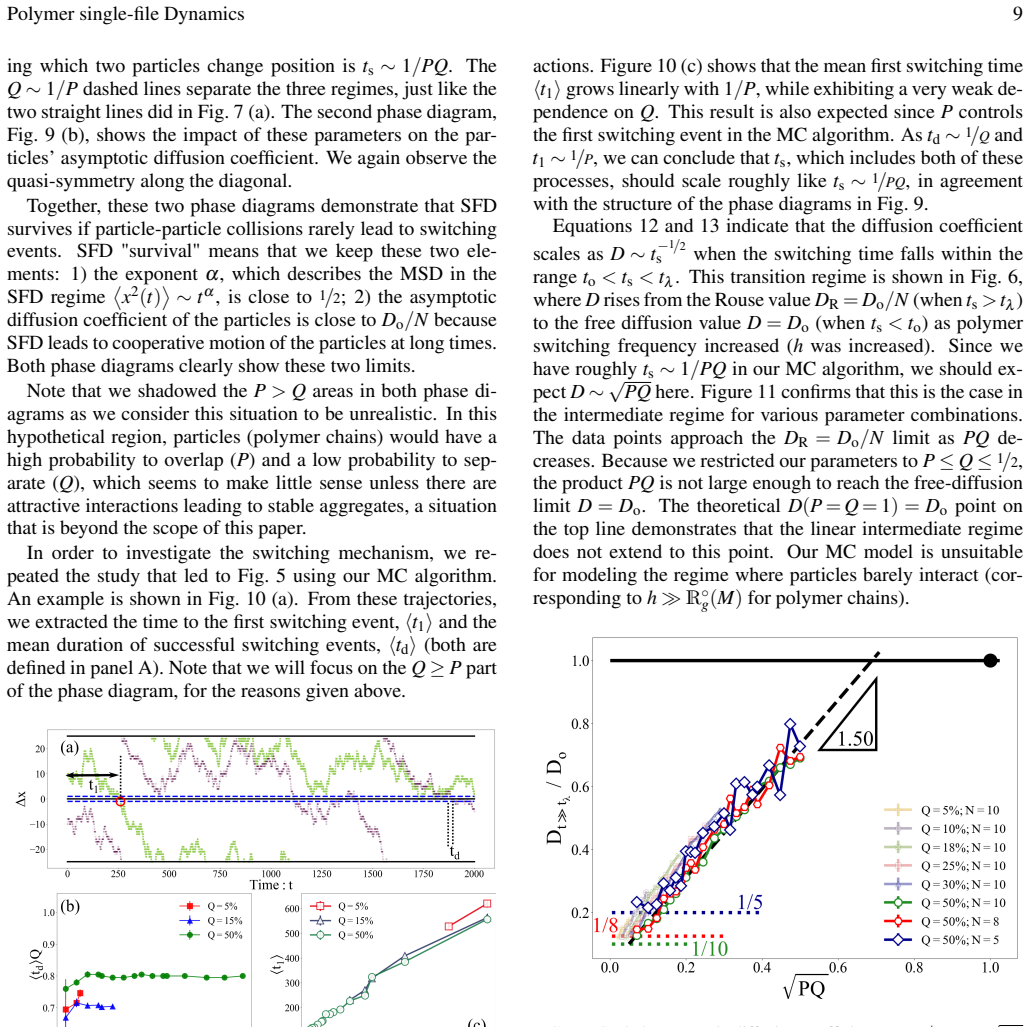
The central object is the switching time $t_s$, the mean interval between chain-exchange events, and its ratio to the cooperative time $t_\lambda$. The load-bearing identity is Eq. 12, $D_s = \sqrt{8t_o/(\pi t_s)}\,D_o = \sqrt{t_\lambda/t_s}\,D_R$, which converts a local event rate into a macroscopic diffusion coefficient. The paper estimates $t_s$ from the mean first-switching time $\langle t_1\rangle$, whose empirical fit grows exponentially as the effective tube width $h-2$ shrinks, because chain exchange requires crossing an entropic barrier set by the number of blobs $M/g(h) \sim M/(h-2)^{3/2}$. The lattice Monte Carlo model carries the same mechanism through two parameters, $P$ for overlap and $Q$ for disentanglement, giving $t_s \sim 1/(PQ)$ and hence $D \propto \sqrt{PQ}$, which matches the long-time data.
What would settle it
Measure the full waiting-time distribution between successive chain-swap events in the Langevin-dynamics model over times much longer than the current runs, without discarding no-swap trajectories; if the steady-state mean inter-swap time differs from $\langle t_1\rangle$ beyond statistical error, the estimate of $D_s(h)$ and the switching-regime boundaries need revision. A complementary check would track labeled DNA molecules in nanochannels and test whether the asymptotic diffusivity is independent of the number of chains $N$ when swapping dominates.
Extended reading notes
Core claim
The central claim is that polymer chains in narrow channels behave differently from hard particles: they can exchange order even when the channel is narrower than twice their size, because two chains can entangle, co-diffuse, and then disentangle. This single fact creates two different pathways to normal long-time diffusion. If the time $t_s$ between switching events exceeds the cooperative time $t_\lambda$, the system follows the hard-particle sequence $D_o \to F t^{1/2} \to D_R = D_o/N$. If $t_o < t_s < t_\lambda$, the chains enter a switching regime with $D_s = F/t_s^{1/2} = \sqrt{8t_o/(\pi t_s)}\,D_o = \sqrt{t_\lambda/t_s}\,D_R$, so that $D_s > D_R$ and the Rouse regime disappears. Using Langevin dynamics of Rouse chains, the paper measures the mean first-switching time $\langle t_1\rangle$, fits its exponential divergence with $(h-2)^{-1.4}$, and uses it to estimate $D_s(h)$. A lattice Monte Carlo model with overlap probability $P$ and disentanglement probability $Q$ reproduces the phase diagram and shows $D/D_o \propto \sqrt{PQ}$, independent of the number of chains $N$, exactly as the switching-time formula predicts.
Load-bearing premise
The load-bearing premise is that the average time to the first chain-swap event, measured only over simulation runs where a swap actually occurred, equals the steady-state switching timescale that controls long-time diffusion; if runs without swaps are censored or rare first events skew the mean, the predicted switching diffusivity and phase boundaries shift.
Editorial extensions
If this is right
- The intermediate-time exponent $\alpha$ in $\langle x^2\rangle \sim t^\alpha$ serves as a single scalar order parameter for the phase diagram: values near $1/2$ mark strong single-file behavior, values near $1$ mark free or wide-tube diffusion, and intermediate values mark the coexistence zone.
- When chain switching dominates, the long-time diffusion coefficient $D_s$ is predicted to be independent of the number of chains $N$, unlike the cooperative Rouse value $D_R = D_o/N$; the Monte Carlo data confirm this $N$-independence.
- The switching time diverges exponentially as the effective tube width $h-2$ decreases, so single-file behavior is robust for chains that form many blobs, and the switching regime appears only in a relatively narrow range of tube widths.
- The lattice Monte Carlo model with parameters $P$ and $Q$ reproduces the Langevin-dynamics phase diagram, and the proposed mappings $h \sim \sqrt{P}$ and $M \sim 1/(Q P^{1/6})$ suggest the two simulation approaches describe the same physical regimes.
- For a fixed molecular weight, increasing the tube width moves the system from the cooperative Rouse regime through the switching regime to free diffusion, so the asymptotic diffusion coefficient rises monotonically from $D_o/N$ to $D_o$.
Reading between the lines
- Because the paper measures the first-switching time only over runs where a swap occurs, a renewal-theory estimate using the full steady-state waiting-time distribution between swaps could replace the empirical fit and would be a natural follow-up.
- The two-pathway picture suggests a design rule for nanochannel separations: in the switching window, $\langle t_1\rangle \sim M^3$ makes the long-time mobility strongly molecular-weight dependent, which could be exploited to sort chains by size.
- For polydisperse or bimodal mixtures, chains of different lengths have different switching times, so the model points toward single-file-triggered segregation or local ordering along the tube, an extension the paper mentions but does not develop.
- The mapping between the two simulation models relies on the scaling $t_d \sim M^2 h^{2-1/\nu}$ for the disentanglement time; direct Langevin-dynamics measurements of disentanglement times would test whether that scaling actually holds for the bead-spring model.
Signed reviews
Editorial analysis
A structured set of objections, weighed in public.
Referee Report
Summary. This paper studies the crossover from single-file to normal diffusion for dilute flexible chains in a narrow toroidal tube using Langevin dynamics (LD) and a two-parameter lattice Monte Carlo (LMC) model. The theory predicts the sequence Do -> F t^{1/2} -> DR = Do/N for hard-core particles, and additionally a switching regime with Ds > DR when neighboring chains exchange positions. LD simulations confirm the Do -> F -> DR sequence through the rescaling collapses in Fig. 4 and measure an SFD exponent 0.52(1); the MC model reproduces the same phenomenology and shows D/Do proportional to sqrt(PQ) in the switching regime. The paper proposes M-h and P-Q phase diagrams and a heuristic mapping between the two models.
Significance. The paper addresses a timely and experimentally relevant question, and its core scaling scenario is well supported by internal evidence: the predicted transition times in Eqs. (21)-(22) produce good collapses in Fig. 4, the measured SFD exponent is consistent with 1/2, the displacement distributions are Gaussian, and the MC result D/Do proportional to sqrt(PQ) with no N-dependence (Fig. 11) is a clear testable prediction. The two-parameter MC model is economical, and the phase diagrams in Fig. 9 are informative. If the switching-regime analysis is made quantitative, the paper would provide a useful framework for nanochannel experiments. The main weakness is that the LD switching-regime prediction currently rests on a biased first-passage statistic.
major comments (3)
- [Sec. IV C, Eqs. (25)-(26), Fig. 6] The predicted switching-regime diffusion coefficient is built from a censored, system-wide first-passage statistic rather than the per-particle switching time defined in Sec. II A. In Sec. II A, ts is the mean time between switching events involving a given particle (text after Eq. 10), but Sec. IV C records t1, the time of the first chain-switch anywhere among N=5 chains, and runs with no switch are discarded (as noted in the text). Replacing ts by <t1> in Eq. 26 is biased in two ways: for Poisson switching with rate lambda per gap, <t1> is approximately 1/(N lambda) = (2/N) ts, so for N=5 Eq. 26 overestimates Ds by sqrt(N/2) ~ 1.58 and introduces an N-dependence that Eq. 12 asserts should not exist; and censoring no-switch runs biases <t1> downward close to the Rouse-to-switching boundary, shifting the onset of the switching regime to smaller h. Because <t1> is also fitted by Eq. 25, the dashed curve in Fig. 6 is not an independent quantitative prediction. The existence of a switching branch remains plausible from the MC data, but a direct per-particle switching-rate measurement or an extreme-statistics correction is required for the LD prediction.
- [Sec. IV D, Fig. 7(a)] The wide-tube boundary of the M-h phase diagram is set by h = 5 Rg(M), with the factor of 5 stated to be arbitrary. This line is used to separate the intermediate regime from the free-diffusion regime, so the quantitative placement of the switching region on the phase diagram is not derived. If the phase diagram is to be a predictive map, this criterion should be replaced by a measured or derived condition (for example, to ~ ts) or explicitly labelled as illustrative rather than theoretical.
- [Sec. V, Eq. (28), Fig. 12] The proposed mapping between the LD parameters (M,h) and the MC parameters (P,Q) is not validated. Equation (28) is assembled from the postulated proportionalities td ~ 1/Q, M h^{-1/nu} ~ 1/(PQ), and tau_c ~ M; the text acknowledges that the first two are assumptions. The visual similarity of Fig. 12 is not by itself evidence for the mapping, since both phase diagrams are organized by similarly monotone axes. A direct comparison of LD and MC at matched parameter values, or at least a sensitivity analysis of the assumed proportionalities, is needed before the mapping can be presented as an established connection.
minor comments (5)
- [Fig. 6 caption vs Sec. IV C] The caption of Fig. 6 states ell_o = 11 for M = 10, while the text and Eq. (26) use ell_o = 13 (= M + 3). Please reconcile; if the data were taken at ell_o = 11, the dashed line is evaluated at the wrong spacing.
- [Sec. IV C, Eq. (23)] The estimate <t1>_infinity approximately ell_o^2/(2 Do) should be reconciled with Eq. (2), which gives t_o ~ ell^2/(8 Do) for the same closing process; the factor of four and the use of ell_o versus ell = ell_o - Sx should be clarified.
- [Sec. IV C, Fig. 5(c)] Please report the fraction of runs with no switching event for each (M,h) condition; this quantifies the censoring of <t1> and lets the reader judge where the average is reliable.
- [Sec. IV E, Fig. 9] The dashed lines in Fig. 9 are derived from the linear fit in Fig. 11; the text should state explicitly that these are empirical boundaries fitted to the same data rather than independent theoretical predictions.
- [Sec. V, Eq. (28)] Writing M ~ 1/QP^{1/6} is ambiguous; M ~ 1/(Q P^{1/6}) would avoid misreading, and the choice nu = 3/5 here versus nu ~ 0.68 elsewhere should be justified.
Circularity Check
No central circularity: the SFD-to-Rouse and switching scalings are derived from standard theory and separately reproduced, but the Ds estimate in Eq. 26 imports the fitted, censored first-switching time from the same simulations it is compared against.
-
fitted input called prediction
[Sec. IV C, Fig. 5(c), Eqs. 25-26 and Fig. 6]
"We can obtain an estimate the h-dependence of the diffusion coefficient in this transition regime using Eq. 12, replacing ts with the value of ⟨t1⟩: ... In spite of all the approximations needed for this estimate, the corresponding dashed line in Fig. 6 is in decent agreement with the general trend."
The switching timescale that enters the theoretical Ds formula is not a first-principles quantity: ⟨t1⟩ is measured from the same LD simulations whose long-time MSD produces the Dt≫tλ data plotted in Fig. 6, and it is fitted by the empirical exponential Eq. 25 before substitution. In addition, ⟨t1⟩ is defined as the time of the first chain-switch anywhere in the N=5 system, with no-switch runs discarded, whereas Eq. 10's ts is the mean per-particle interval between switching events; the two differ by construction. The dashed curve is thus a self-consistency estimate rather than an independent prediction, although the relation Ds=F/√ts itself is derived from Eqs. 3 and 10 and is not forced by the fit.
full rationale
The central derivation chain is self-contained. The hard-particle sequence Do→Ft^(1/2)→DR (Eqs. 1-8) follows from standard SFD theory (Harris, Levitt) and is quantitatively reproduced by the LD simulations in Figs. 3-4. The second pathway to normal diffusion, the switching regime, is derived from the same equations (Eqs. 10-13) and its N-independence prediction is tested independently with the lattice-MC model, which uses different parameters and larger ensembles (Fig. 11). The self-cited blob-size calibration from Wang & Slater (ref 22) is an empirical input used mainly for estimates, not a load-bearing uniqueness argument. The main circularity-adjacent issue is the use of the fitted, censored first-switch time ⟨t1⟩ in Eq. 26; the Q=C/P contours in Fig. 9 are inversions of the Fig. 11 fit and are contour labels rather than independent derivations. These issues lower quantitative confidence but do not make the phase diagram itself circular.
Assumptions & free parameters
free parameters (8)
- Sx proportionality coefficient =
3.391(1)
- Rgx(M,h) scaling coefficients =
0.22(1), 1.02(2), -0.47(3)
- g(h) coefficient =
1.3 (h-2)^(3/2)
- first switching time fit =
0.23(4) exp([6.9(8)/(h-2)]^1.4(1)) in units of M^3
- Fig. 11 linear fit slope =
1.50(2)
- arbitrary factor 5 in phase boundary =
5
- effective width shift h-2 =
2 (monomer diameters)
- MC parameters P and Q =
varied (0 to 1)
assumptions (8)
- standard math Rouse chain dynamics: Do(M) = D1/M and the Rouse diffusion coefficient of an aggregate is divided by N
- standard math Gaussian displacement distribution holds in all regimes (Eq. 9)
- domain assumption Hydrodynamic interactions are screened along the tube and can be neglected
- ad hoc to paper The mean first switching time ⟨t1⟩ is a faithful proxy for the switching timescale ts
- domain assumption Blob scaling for confined chains, including Flory exponent nu ≈ 0.68 in the simulation model
- ad hoc to paper The LMC rules with P and Q capture the essential physics of polymer entanglement and disentanglement
- ad hoc to paper The parameter mapping M h^(-1/nu) ~ 1/(P Q) and the resulting Eq. 28 connect the MC and LD models
- ad hoc to paper Entropic cost of overlap scales as P^nf and disentanglement as Q
Cite this review
Pith. "Pith review of Polymer (imperfect) single-file diffusion: A phase diagram." pith.science (2026). https://pith.science/paper/Y6P4DBY3
@misc{pith2026250512164,
  author       = {Pith},
  title        = {Pith review of: Polymer (imperfect) single-file diffusion: A phase diagram},
  year         = {2026},
  howpublished = {\url{https://pith.science/paper/Y6P4DBY3}},
  note         = {Machine review of arXiv:2505.12164}
}
abstract
We use Langevin dynamics (LD) simulations to investigate single-file diffusion (SFD) in a dilute solution of flexible linear polymers inside a narrow tube with periodic boundary conditions (a torus). The transition from SFD, where the time (t) dependence of the mean-square displacement scales like $\langle x^2\rangle \sim t^{1/2}$, to normal diffusion with $\langle x^2 \rangle \sim t$, is studied as a function of the system parameters, such as the size and concentration of the polymer chains and the width of the tube. We propose a phase diagram describing different diffusion regimes. In particular, we highlight the fact that there are two different pathways to normal long-time diffusion. We also map this problem onto a one-dimensional Lattice Monte Carlo model where the diffusing object represents the polymer center of mass. Possible extensions of this work to polydisperse polymer solutions, one-dimensional electrophoresis and DNA mapping are discussed.
Figures


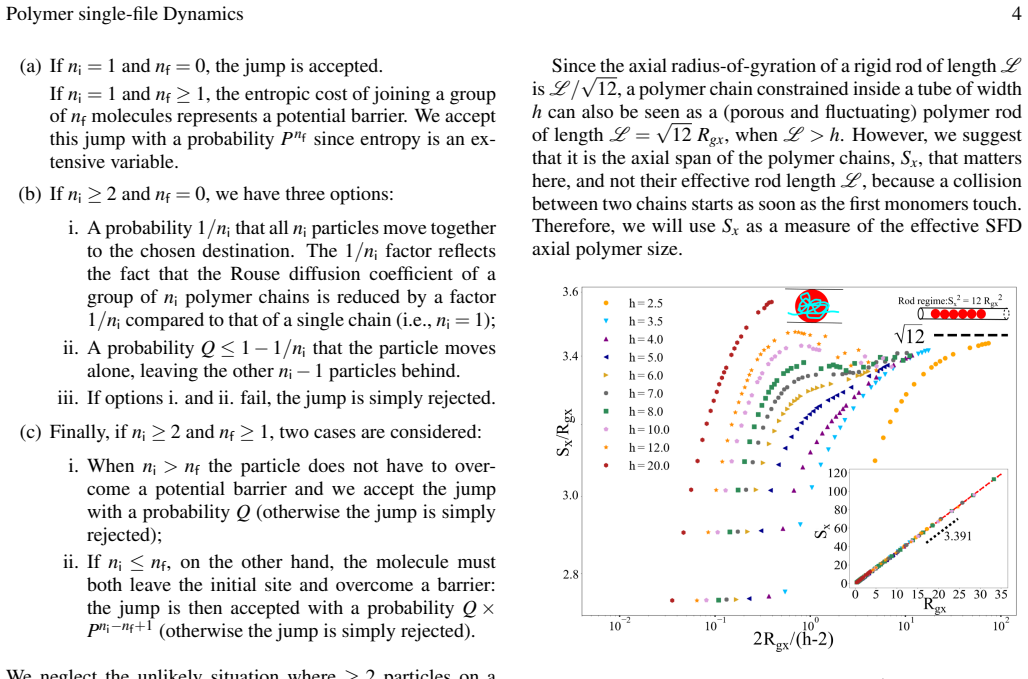
Figures from the paper (7 more)



Reference graph
Works this paper leans on
-
[1]
author author A. L. \ Hodgkin \ and\ author R. Keynes ,\ title title The potassium permeability of a giant nerve fibre , \ @noop journal journal J. Physiol \ volume 128 ,\ pages 61--88 ( year 1955 ) NoStop
work page 1955
-
[2]
author author V. Gupta , author S. Nivarthi , author D. Keffer , author A. V. \ McCormick , \ and\ author H. T. \ DaVIS ,\ title title Evidence of single-file diffusion in zeolites , \ @noop journal journal Chem. Phys. Lett \ volume 247 ,\ pages 596 ( year 1995 ) NoStop
work page 1995
-
[3]
author author J. B. \ Freund \ and\ author M. M. \ Orescanin ,\ title title Cellular flow in a small blood vessel , \ doi:10.1017/S0022112010005835 journal journal J. Fluid Mech \ volume 671 ,\ pages 466 ( year 2011 ) NoStop
-
[4]
author author S. H. \ Bryngelson \ and\ author J. B. \ Freund ,\ title title Capsule-train stability , \ 10.1103/PhysRevFluids.1.033201 journal journal Phys. Rev. Fluids \ volume 1 ,\ pages 033201 ( year 2016 ) NoStop
-
[5]
author author Y. Wang , author Y. Lu , \ and\ author J. Chen ,\ title title Spontaneous spatiotemporal ordering of single-file water flow in narrow nanotubes , \ 10.1021/acs.jpcc.4c01214 journal journal J. Phys. Chem. C \ volume 128 ,\ pages 12488--12494 ( year 2024 ) NoStop
-
[6]
author author J. Sané , author J. T. \ Padding , \ and\ author A. A. \ Louis ,\ title title The crossover from single file to fickian diffusion , \ @noop journal journal Faraday discussions \ volume 144 ,\ pages 285--299 ( year 2010 ) NoStop
work page 2010
-
[7]
author author Q. H. \ Wei , author C. Bechinger , \ and\ author P. Leiderer ,\ title title Single-file diffusion of colloids in one-dimensional channels , \ 10.1126/science.287.5453.625 journal journal Science \ volume 287 ,\ pages 625 ( year 2000 ) NoStop
-
[8]
author author A. Villada-Balbuena , author A. Ortiz-Ambriz , author P. Castro-Villarreal , author P. Tierno , author R. Casta\ neda Priego , \ and\ author J. M. \ M\'endez-Alcaraz ,\ title title Single-file dynamics of colloids in circular channels: Time scales, scaling laws and their universality , \ 10.1103/PhysRevResearch.3.033246 journal journal Phys....
Show all 32 references
-
[9]
author author K. D. \ Dorfman , author D. Gupta , author A. Jain , author A. Muralidhar , \ and\ author D. R. \ Tree ,\ title title Hydrodynamics of dna confined in nanoslits and nanochannels , \ 10.1140/epjst/e2014-02326-4 journal journal Eur. Phys. J. Special Topics \ volume...
-
[10]
author author J. J. \ Jones , author J. R. C. \ van der Maarel , \ and\ author P. S. \ Doyle ,\ title title Intrachain dynamics of large dsdna confined to slitlike channels , \ 10.1103/PhysRevLett.110.068101 journal journal Phys. Rev. Lett \ volume 110 ,\ pages 068101 ( year 2...
-
[11]
collisions
author author T. E. \ Harris ,\ title title Diffusion with “collisions” between particles , \ 10.2307/3212197 journal journal J. Appl. Probab. \ volume 2(2) ,\ pages 323--338 ( year 1965 ) NoStop
1965 doi
-
[12]
author author D. G. \ Levitt ,\ title title Dynamics of a single-file pore - non-fickian behavior , \ 10.1103/PhysRevA.8.3050 journal journal Phys. Rev. A. \ volume 8 ,\ pages 3050--3054 ( year 1973 ) NoStop
1973 doi
-
[13]
Doi \ and\ author S
author author M. Doi \ and\ author S. F. \ Edwards ,\ @noop title The Theory of Polymer Dynamics \ ( publisher Oxford Science Publications, Oxford ,\ year 1986 ) NoStop
1986
-
[14]
author author R. J. \ Rubin , author J. Mazur , \ and\ author G. H. \ Weiss ,\ title title Spans of polymer chains. \ 10.1351/pac197646020143 journal journal Pure and Appl. Chem. \ volume 46(2–4) ,\ pages 143--148 ( year 1976 ) NoStop
-
[15]
author author J. D. \ Weeks , author D. Chandler , \ and\ author H. C. \ Andersen ,\ title title Role of repulsive forces in determining the equilibrium structure of simple liquids , \ 10.1063/1.1674820 journal journal J. Chem. Phys. \ volume 54 ,\ pages 5237--5247 ( year 1971...
-
[16]
Praprotnik , author C
author author M. Praprotnik , author C. Junghans , author L. D. \ Site , \ and\ author K. Kremer ,\ title title Simulation approaches to soft matter: Generic statistical properties vs. chemical details , \ 0.1016/j.cpc.2008.01.018 journal journal Comp. Phys. Comm. \ volume 179...
2008
-
[17]
author author G. S. \ Grest \ and\ author K. Kremer ,\ title title Molecular dynamics simulation for polymers in the presence of a heat bath , \ 10.1103/PhysRevA.33.3628 journal journal Phys. Rev. A. \ volume 33 ,\ pages 3628--3631 ( year 1986 ) NoStop
-
[18]
Coffey , author Y
author author W. Coffey , author Y. P. \ Kalmykov , \ and\ author J. T. \ Waldron ,\ @noop title The Langevin Equation: with applications in physics, chemistry, and electrical engineering \ ( publisher Singapore, River Edge, World Scientific ,\ year 1996 ) NoStop
1996
-
[19]
Weik , author R
author author F. Weik , author R. Weeber , author K. Szuttor , author K. Breitsprecher , author J. de Graaf , author M. Kuron , author J. Landsgesell , author H. Menke , author D. Sean , \ and\ author C. Holm ,\ title title Espresso 4.0 -- an extensible software package for si...
-
[20]
author author M. V. \ Chubynsky \ and\ author G. W. \ Slater ,\ title title Optimizing the accuracy of lattice monte carlo algorithms for simulating diffusion , \ 10.1103/PhysRevE.85.016709 journal journal Phys. Rev. E \ volume 85 ,\ pages 016709 ( year 2012 ) NoStop
-
[21]
Daoud \ and\ author P
author author M. Daoud \ and\ author P. G. D. \ Gennes ,\ title title Statistics of macromolecular solutions trapped in small pores , \ 10.1051/jphys:0197700380108500 journal journal Journal de Physique \ volume 38 ,\ pages 85--93 ( year 1977 ) NoStop
-
[22]
author author H. Y. \ Wang \ and\ author G. W. \ Slater ,\ title title Field-driven polyelectrolyte-polymer collisions in nanochannels , \ 10.1063/5.0195302 journal journal J. Phys. Chem. \ volume 160 ,\ pages 194902 ( year 2024 ) NoStop
-
[23]
Arnold \ and\ author S
author author A. Arnold \ and\ author S. Jun ,\ title title Time scale of entropic segregation of flexible polymers in confinement: Implications for chromosome segregation in filamentous bacteria , \ 10.1103/PhysRevE.76.031901 journal journal Phys. Rev. E \ volume 76 ,\ pages ...
-
[24]
Kremer \ and\ author K
author author K. Kremer \ and\ author K. Binder ,\ title title Dynamics of polymer chains confined into tubes: Scaling theory and monte carlo simulations , \ 10.1063/1.447549 journal journal J. Chem. Phys. \ volume 81 ,\ pages 6381--6394 ( year 1984 ) NoStop
-
[25]
Qiao \ and\ author G
author author L. Qiao \ and\ author G. W. \ Slater ,\ title title Capture of rod-like molecules by a nanopore: Defining an 'orientational capture radius' , \ 10.1063/5.0002044 journal journal J. Chem. Phys. \ volume 152 ,\ pages 144902 ( year 2020 ) NoStop
-
[26]
author author P. E. \ Rouse ,\ title title A theory of the linear viscoelastic properties of dilute solutions of coiling polymers , \ 10.1063/1.1699180 journal journal J. Chem. Phys. \ volume 21 ,\ pages 1272--1280 ( year 1953 ) NoStop
-
[27]
Nikoofard , author S
author author N. Nikoofard , author S. M. \ Hoseinpoor1 , \ and\ author M. Zahedifar ,\ title title Accuracy of the blob model for single flexible polymers inside nanoslits that are a few monomer sizes wide , \ 10.1103/PhysRevE.90.062603 journal journal Phys. Rev. E. \ volume ...
-
[28]
Dai , author C
author author L. Dai , author C. B. \ Renner , \ and\ author P. S. \ Doyle ,\ title title The polymer physics of single dna confined in nanochannels , \ 10.1016/j.cis.2015.12.002 journal journal Advances in Colloid and Interface Science \ volume 232 ,\ pages 80--100 ( year 201...
2015 doi
-
[29]
author author S. W. P. \ Turner , author M. Cabodi , \ and\ author H. G. \ Craighead ,\ title title Confinement-induced entropic recoil of single dna molecules in a nanofluidic structure , \ 10.1103/PhysRevLett.88.128103 journal journal Phys. Rev. Lett. \ volume 88 ,\ pages 12...
-
[30]
author author S. W. P. \ Turner , author A. M. \ Perez , author A. Lopez , \ and\ author H. G. \ Craighead ,\ title title Monolithic nanofluid sieving structures for dna manipulation , \ 10.1116/1.590419 journal journal J. Vac. Sci. Technol. B \ volume 16 ,\ pages 3835--3840 (...
-
[31]
Wang , author D
author author Y. Wang , author D. R. \ Tree , \ and\ author K. D. \ Dorfman ,\ title title Simulation of dna extension in nanochannels , \ 10.1021/ma201277e journal journal Macromolecules \ volume 44 ,\ pages 6594--6604 ( year 2011 ) NoStop
-
[32]
Rubinstein \ and\ author R
author author M. Rubinstein \ and\ author R. Colby ,\ @noop title Polymer Physics \ ( publisher Oxford University Press ,\ year 2003 ) NoStop
2003
Reviewed August 15, 2026 · model on record in the stance chip above.
Discussion (0). Continue with ORCID to comment.