REVIEW 3 major objections 4 minor 38 references
Driving solar coronal MHD simulations on high-performance computers
T0 review · 3 major / 4 minor · reviewed 2026-08-14 · deepseek-v4-flash
Pith's one-line read This paper claims that the scalability bottleneck of observationally driven coronal MHD simulations—serialized boundary-condition transforms and data I/O—can be removed, improving scaling by more than an order of magnitude.
desk verdict Useful methods paper with a real new boundary condition, but the '>10x scalability' headline conflates FFT-only benchmarks with IO gains. read the letter →
The pith
A machine-rendered reading of the paper's core claim, the machinery that carries it, and where it could break.
The reading
What carries the argument
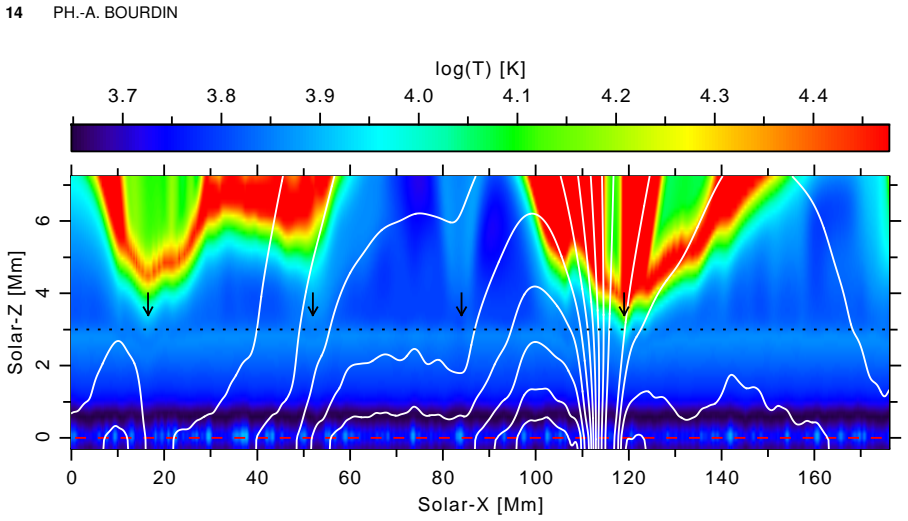
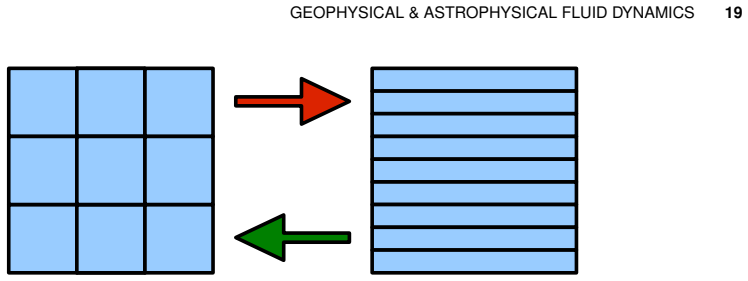
The load-bearing machinery is the parallelization of the boundary-condition FFT and of file I/O, together with the new inverted potential-field extrapolation. The FFT parallelization collects data along one horizontal direction, lets one half of the processors send while the other half receives, and then transposes with as many communication cycles as there are subdomains along x, so the Fourier transform used for the potential-field boundary condition no longer idles the majority of cores. The HDF5 and MPI-2 I/O modules write monolithic snapshots with the inner ghost cells removed, avoiding thousands of simultaneous small-file requests and reducing storage needs by roughly a third relative to fully distributed output. The inverted potential-field extrapolation prescribes horizontal magnetic-field components at and below the photosphere through an extrapolation that concentrates flux with depth, approximating the subphotospheric pressure increase while still allowing non-vertical field near the surface.
What would settle it
Run the same hard-scaling comparison on a current HPC system at a fixed global grid size, measuring CPU time per timestep per meshpoint from 16 to more than 1024 cores with the old and new boundary-condition and I/O modules; if the optimized version is not more than an order of magnitude faster at the largest core counts, the scalability claim is not general. A second check is to inspect the ghost-layer field beneath the photosphere in a test run and verify that flux bundles narrow and flux density increases with depth as the inverted potential-field extrapolation prescribes.
Extended reading notes
Core claim
The central claim, stated on the paper's own terms, is that a set of boundary conditions and input/output strategies can remove the serial bottlenecks that once kept a coronal MHD model of an active region from scaling efficiently beyond a few hundred processors. The potential-field extrapolation at the top boundary is parallelized by a two-cycle data-remapping FFT, and snapshot I/O is made collective per layer or moved to monolithic HDF5 files that omit redundant inner ghost cells. As a result, a hard-scaling test from 16 to 1024 cores shows the optimized version tracking near-ideal scaling, with the paper reporting a scalability improvement of more than one order of magnitude. The same work introduces a novel photospheric magnetic-field boundary condition: an inverted potential-field extrapolation that makes magnetic flux bundles narrow and intensify with depth below the photosphere, allowing observed horizontal granular motions to advect field-line footpoints while remaining consistent with the observed magnetograms.
Load-bearing premise
The quantitative scaling gain is measured on a single retired 2012-era supercomputer with a particular parallel file system and no repeated runs, so the claim that the gain is more than an order of magnitude assumes that benchmark reflects modern HPC hardware and typical workloads.
Editorial extensions
If this is right
- Observationally driven coronal MHD models can use more than a thousand cores efficiently, making active-region simulations with tens of millions of grid points feasible within a typical project timescale.
- Because the new photospheric boundary accepts horizontal magnetic fields, granular motions can shuffle field-line footpoints, enabling direct tests of the Parker braiding and nanoflare picture.
- Monolithic HDF5 snapshots reduce storage and allow frequent checkpointing, so long-duration runs with dense time output become practical for studying coronal heating statistics.
- The reduced artificial currents at the lower boundary allow lower magnetic diffusivity, meaning the observationally driven footpoint motions keep more of their intended effect on the coronal field.
- The parallel FFT and I/O strategies should also benefit other boundary conditions and diagnostics that rely on two-dimensional Fourier transforms in grid-based MHD codes.
Reading between the lines
- The two-cycle send-first/receive-first remapping scheme is general enough that it could be ported to other grid-based plasma simulations whose boundary conditions require global spectral transforms; the same pattern would transfer to any pencil- or block-decomposed domain.
- The order-of-magnitude scaling number was measured on a single, now-retired 2012-era system with an old parallel file system, so the quantitative gain on contemporary machines with different interconnect and I/O hardware could be larger or smaller—a modern re-benchmark would be needed to confirm the exact factor.
- The inverted potential-field extrapolation is a deliberately softened approximation of the real subphotospheric pressure stratification (contrast reduced to one fifth of the scale-height value), so its main risk is a systematic error in horizontal fields near the lower boundary; a comparison against a convection-zone model with realistic pressure stratification would quantify that error.
- Because the paper omits photospheric electric fields in the driving, a testable extension would be to include them and check whether the Poynting flux and coronal heating statistics change appreciably.
Signed reviews
Editorial analysis
A structured set of objections, weighed in public.
Referee Report
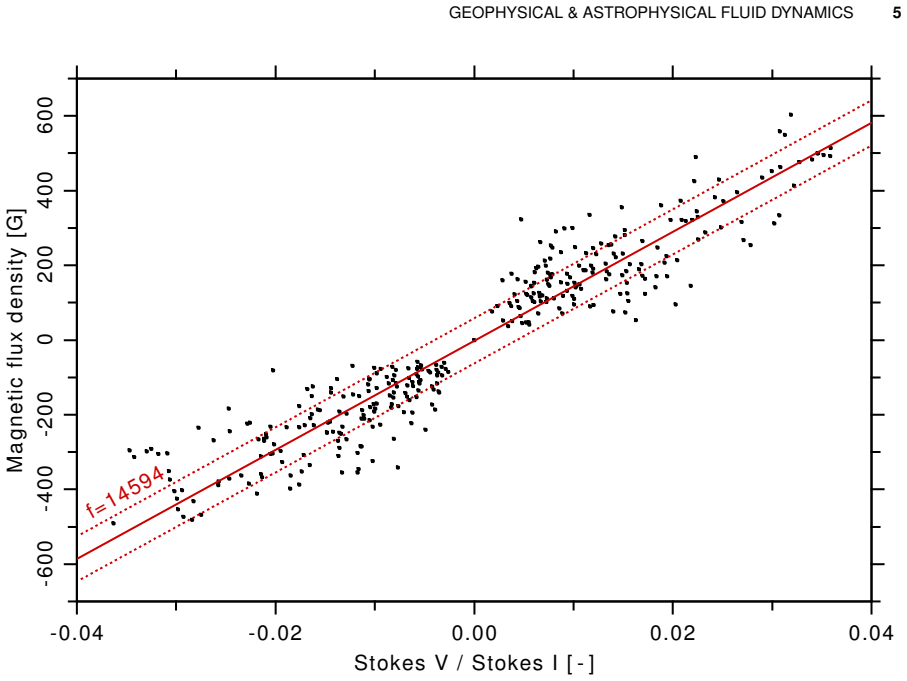
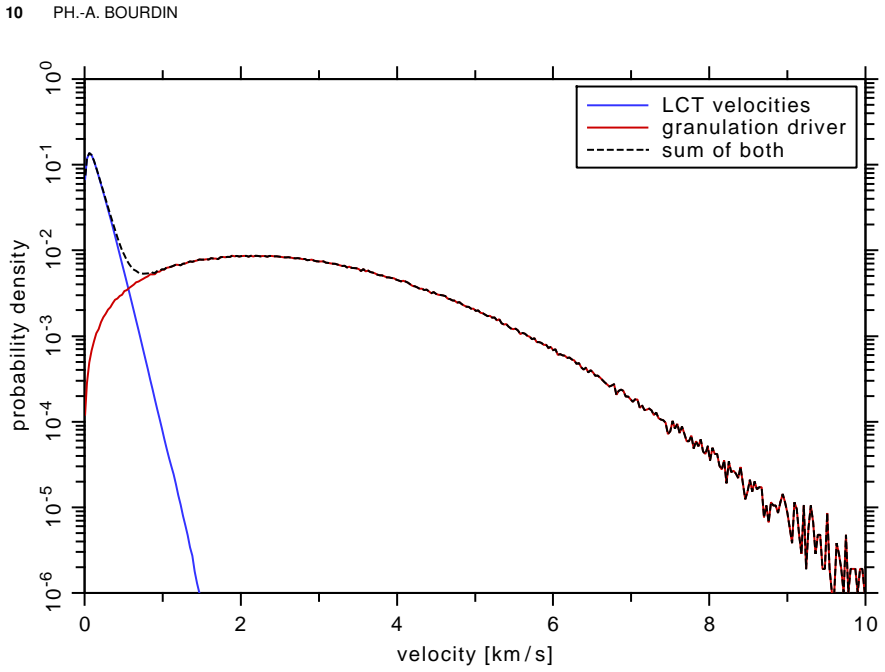
Summary. The paper describes a collection of methods for making observationally driven solar coronal MHD simulations with the Pencil Code scale to thousands of processors. The components include a photospheric granulation driver, local correlation tracking, nudging of the observed magnetic field, a new photospheric magnetic-field boundary condition based on an inverted potential-field extrapolation, chromospheric Newtonian cooling, closed upper-boundary conditions with a swamp region, a massively parallel FFT for potential-field boundary conditions, and new IO strategies including MPI-2 and parallel HDF5. The central quantitative claim is that these optimizations improve scalability by more than an order of magnitude, enabling the use of over a thousand processors more efficiently than the original code.
Significance. If the scalability claim holds, the paper provides a practical and valuable capability: coronal MHD models of active regions could be run in substantially shorter wall-clock time, making observationally driven simulations of coronal heating feasible on contemporary HPC resources. The manuscript is also useful as a code-level description of parallel FFT and IO strategies in a widely used open-source code, and the observation-driven boundary conditions are of interest to the solar physics community. The benchmark evidence, however, is narrow: a single hard-scaling test on a decommissioned system, with the headline improvement attributed in the abstract to both boundary conditions and IO while the displayed scaling curve measures only the FFT. The physical novelty of the photospheric boundary condition is also asserted without quantitative validation. The contribution is real but the central quantitative claim needs to be made commensurate with the evidence.
major comments (3)
- [Abstract; Section 6; Figure 12; Table 1] The abstract's statement that "scalability is improved by more than one order of magnitude through the HPC-friendly boundary conditions and IO strategies" is not supported by the measurements as presented. Figure 12 is a hard-scaling curve of CPU time per timestep per meshpoint, which by construction excludes snapshot IO, and its caption attributes the improvement to the massive-parallel FFT. Table 1 shows that the new IO modules (mpi2, hdf5) are not faster than the distributed module at the tested configuration (8–9 s versus 2 s for a full snapshot). Thus the evidence supports an improvement from the parallel FFT, not from IO, and the abstract's attribution should be revised or supported by end-to-end scaling measurements that include IO.
- [Figure 12; Table 1; Section 5.2] The quantitative order-of-magnitude claim rests on a single hard-scaling test on the JuRoPA system, whose hardware and Lustre filesystem are described by the paper itself as outdated and decommissioned. No repeated runs, error bars, or tests on a second system are reported. Because the claim is intended to generalize to "thousands of processors," the lack of robustness evidence is a correctness risk. At minimum, the paper should state explicitly that the quoted improvement is machine- and filesystem-specific; ideally, it should show variance across runs or a second benchmark on a modern system.
- [Section 6; Figure 12] The metric used for the scaling claim is inconsistent between text and figure. Section 6 refers to a "comparison plot for the total runtime," whereas Figure 12's y-axis is "CPU time per timestep per meshpoint." Also, the hard-scaling setup is not fully specified: the problem size, grid decomposition, number of timesteps, and whether boundary-condition FFTs are included in the timed region are not stated. Without this information, the reader cannot determine what exactly improved by an order of magnitude or how to reproduce the measurement.
minor comments (4)
- [Section 2.4] The photospheric boundary condition depends on a manually chosen reduction of the contrast increase to one fifth of the pressure-scale-height value (fbcz_bot = 0.2). The paper acknowledges a "slight error" from this choice, but provides no sensitivity test or quantitative comparison with observed photospheric/chromospheric structure; a brief sensitivity study would strengthen the physical claim.
- [Table 1] The table's "red entries" are not identifiable in the printed text; please mark the relevant cells explicitly. Also, because the "distributed" module has the lowest raw write time (2 s), the advantage of the new modules should be framed as scalability and reduced storage overhead rather than raw speed at this configuration.
- [Figure 12] The x-axis labels appear truncated ("102416" in place of "1024"), and it is not clear whether 16 cores was included. Please correct the axis labels and specify the full set of processor counts used.
- [Various locations] There are several typos and minor language issues: "consitency" (Section 2.1), "coaling" (Section 2.1), "velodity" (Section 2.3 footnote), "decomissioned" (Section 5.2), "adaptice" (Section 6), "amplitues" (Section 6), "loosing" (Section 5.3), and "There number of ghost layers" (Figure 8 caption). A careful proofread is recommended.
Circularity Check
Mild circularity only in the presentation of flux-bundle narrowing; the main HPC scaling benchmark is an independent engineering measurement.
-
self definitional
[Abstract and Section 2.4 (Magnetic-field extrapolation)]
"We present a novel boundary condition for non-vertical magnetic fields in the photosphere, where we approach the realistic pressure increase below the photosphere. With that, magnetic flux bundles become narrower with depth and the flux density increases accordingly. ... In order to mimic the increase in atmospheric and magnetic pressure in the solar interior below the photosphere, we use an inverted potential-field extrapolation that concentrates any magnetic flux bundles with depth, which leads to a reduction of the diameter and an increase of the amplitude of those flux bundles."
The abstract presents the flux-bundle narrowing as a consequence of the new boundary condition, but Section 2.4 states that the boundary condition was itself constructed to produce that narrowing: the inverted potential-field extrapolation is chosen so that flux bundles shrink with depth. Thus the reported behavior is an imposed property of the ansatz, not an independent prediction or derived result. This is a mild self-definitional presentation issue; it does not affect the paper's separate, benchmark-based scalability claims.
full rationale
The paper's central quantitative claim is a scalability improvement of more than one order of magnitude, supported by a hard-scaling comparison in Figure 12 and IO timings in Table 1. That is an engineering benchmark comparing code versions before and after optimization, not a fitted parameter or a self-referential derivation, so it does not exhibit circularity. The caveats about the decommissioned JuRoPA system and the 2012 Lustre filesystem are hardware-representativeness concerns, not circularity. The only mild circularity is in the presentation of the photospheric magnetic-field boundary condition: the abstract lists flux bundles becoming narrower with depth as an outcome, while the method section explicitly designs the inverted potential-field extrapolation to concentrate magnetic flux with depth. The narrowing is therefore built into the construction rather than derived from the MHD equations or from observation. No load-bearing self-citation chain was found: citations to Bourdin et al. (2013) and related work are used as external comparisons or prior context, not to define the present results. Overall, the main methods contribution is self-contained and independently benchmarked; the circularity score reflects only the minor definitional presentation of the boundary-condition effect.
Assumptions & free parameters
free parameters (8)
- Photospheric magnetic contrast reduction factor =
0.2 (one fifth)
- Granulation velocity amplitude v0 =
1.028 km/s
- Granule lifetime Tgran =
5 min
- Vorticity amplification factor frot =
5
- Photospheric velocity nudging rate tau_u =
0.5 s^-1
- Chromospheric Newtonian cooling rate tau_t =
0.5 s^-1
- Mass diffusivity D_rho =
8.0e6 m^2/s
- Swamp diffusivities (eta_s, chi_s, rho_s) =
not specified in text
assumptions (5)
- domain assumption Ideal MHD equations with Spitzer heat conduction and no radiative transfer in the corona adequately describe the simulated plasma.
- ad hoc to paper The magnetic field below the photosphere can be represented by an inverted potential-field extrapolation even though the plasma there is not force free.
- domain assumption The upper boundary field is nearly potential, so a potential-field extrapolation with exponential contrast smoothing is appropriate.
- domain assumption Omitting photospheric electric fields in the driving does not significantly change the coronal magnetic field and heating.
- domain assumption Flux balancing the observed magnetograms to zero net flux does not significantly change the model's field geometry.
Cite this review
Pith. "Pith review of Driving solar coronal MHD simulations on high-performance computers." pith.science (2026). https://pith.science/paper/YAHYQ5IX
@misc{pith2026190808557,
  author       = {Pith},
  title        = {Pith review of: Driving solar coronal MHD simulations on high-performance computers},
  year         = {2026},
  howpublished = {\url{https://pith.science/paper/YAHYQ5IX}},
  note         = {Machine review of arXiv:1908.08557}
}
read the original abstract
The quality of today's research is often tightly limited to the available computing power and scalability of codes to many processors. For example, tackling the problem of heating the solar corona requires a most realistic description of the plasma dynamics and the magnetic field. Numerically solving such a magneto-hydrodynamical (MHD) description of a small active region (AR) on the Sun requires millions of computation hours on current high-performance computing (HPC) hardware. The aim of this work is to describe methods for an efficient parallelization of boundary conditions and data input/output (IO) strategies that allow for a better scaling towards thousands of processors (CPUs). The Pencil Code is tested before and after optimization to compare the performance and scalability of a coronal MHD model above an AR. We present a novel boundary condition for non-vertical magnetic fields in the photosphere, where we approach the realistic pressure increase below the photosphere. With that, magnetic flux bundles become narrower with depth and the flux density increases accordingly. The scalability is improved by more than one order of magnitude through the HPC-friendly boundary conditions and IO strategies. This work describes also the necessary nudging methods to drive the MHD model with observed magnetic fields from the Sun's photosphere. In addition, we present the upper and lower atmospheric boundary conditions (photospheric and towards the outer corona), including swamp layers to diminish perturbations before they reach the boundaries. Altogether, these methods enable more realistic 3D MHD simulations than previous models regarding the coronal heating problem above an AR -- simply because of the ability to use a large amount of CPUs efficiently in parallel.
Figures


Figures from the paper (9 more)




Reference graph
Works this paper leans on
-
[1]
and Gudiksen, B., On the nature of coronal loops above the quiet sun network
Bingert, S., Zacharias, P., Peter, H. and Gudiksen, B., On the nature of coronal loops above the quiet sun network. urlcolor=magenta Adv. in Space Res. http://adsabs.harvard.edu/abs/2010AdSpR..45..310B , 2010, 45, 310--313, DOI: urlcolor=blue 10.1016/j.asr.2009.08.020 https://doi.org/10.1016/j.asr.2009.08.020
-
[2]
Bourdin , P.A., Denoising observational data . urlcolor=magenta Contr. Astron. Obs. Skalnate Pleso http://adsabs.harvard.edu/abs/2011CoSka..41..149B , 2011, 41, 149--155
work page 2011
-
[3]
Bourdin, P.A., Observationally driven 3D MHD model of the solar corona above a magnetically active region , 2014 a (uni-edition GmbH., Berlin), ISBN: 978-3-944072-03-6, DOI: urlcolor=blue 11858/00-1735-0000-0022-5F1B-D https://doi.org/11858/00-1735-0000-0022-5F1B-D
work page 2014
-
[4]
Bourdin, P.A., Standard 1D solar atmosphere as initial condition for MHD simulations and switch-on effects . urlcolor=magenta Cent. Eur. Astrophys. Bull. http://adsabs.harvard.edu/abs/2014CEAB...38....1B , 2014 b , 38, 1--10
work page 2014
-
[5]
Bourdin, P.A., Plasma Beta Stratification in the Solar Atmosphere: A Possible Explanation for the Penumbra Formation. urlcolor=magenta ApJL http://adsabs.harvard.edu/abs/2017ApJ...850L..29B , 2017, 850, L29 (5pp), DOI: urlcolor=blue 10.3847/2041-8213/aa9988 https://doi.org/10.3847/2041-8213/aa9988
-
[6]
and Peter, H., Observationally driven 3D MHD model of the solar corona above an active region
Bourdin, P.A., Bingert, S. and Peter, H., Observationally driven 3D MHD model of the solar corona above an active region . urlcolor=magenta A&A http://adsabs.harvard.edu/abs/2013A&A...555A.123B , 2013, 555, A123, DOI: urlcolor=blue 10.1051/0004-6361/201321185 https://doi.org/10.1051/0004-6361/201321185
-
[7]
and Peter, H., Coronal loops above an Active Region: Observation versus model
Bourdin, P.A., Bingert, S. and Peter, H., Coronal loops above an Active Region: Observation versus model . urlcolor=magenta PASJ http://adsabs.harvard.edu/abs/2014PASJ...66S...7B , 2014, 66, 1--8, DOI: urlcolor=blue 10.1093/pasj/psu123 https://doi.org/10.1093/pasj/psu123
-
[8]
and Peter, H., Coronal energy input and dissipation in a solar Active Region 3D MHD model
Bourdin, P.A., Bingert, S. and Peter, H., Coronal energy input and dissipation in a solar Active Region 3D MHD model . urlcolor=magenta A&A http://adsabs.harvard.edu/abs/2015A&A...580A..72B , 2015, 580, A72, DOI: urlcolor=blue 10.1051/0004-6361/201525839 https://doi.org/10.1051/0004-6361/201525839
Show all 38 references
-
[9]
and Peter, H., Scaling laws of coronal loops compared to a 3D MHD model of an active region
Bourdin, P.A., Bingert, S. and Peter, H., Scaling laws of coronal loops compared to a 3D MHD model of an active region . urlcolor=magenta A&A http://adsabs.harvard.edu/abs/2016A&A...589A..86B , 2016, 589, A86, DOI: urlcolor=blue 10.1051/0004-6361/201525840 https://doi.org/10.1...
2016 doi
-
[10]
and Brandenburg , A., Magnetic Helicity Reversal in the Corona at Small Plasma Beta
Bourdin , P.A., Singh , N. and Brandenburg , A., Magnetic Helicity Reversal in the Corona at Small Plasma Beta . urlcolor=magenta ApJ http://adsabs.harvard.edu/abs/2018ApJ...869....2B , 2018, 869, 2, DOI: urlcolor=blue 10.3847/1538-4357/aae97a https://doi.org/10.3847/1538-4357/aae97a
2018 doi
-
[11]
and Cheung , M.C.M., A model for the formation of the active region corona driven by magnetic flux emergence
Chen , F., Peter , H., Bingert , S. and Cheung , M.C.M., A model for the formation of the active region corona driven by magnetic flux emergence . urlcolor=magenta A&A http://adsabs.harvard.edu/abs/2014A&A...564A..12C , 2014, 564, A12, DOI: urlcolor=blue 10.1051/0004-6361/2013...
2014 doi
-
[12]
and Antiochos , S.K., Effect of coronal elemental abundances on the radiative loss function
Cook , J.W., Cheng , C.C., Jacobs , V.L. and Antiochos , S.K., Effect of coronal elemental abundances on the radiative loss function . urlcolor=magenta ApJ http://adsabs.harvard.edu/abs/1989ApJ...338.1176C , 1989, 338, 1176--1183, DOI: urlcolor=blue 10.1086/167268 https://doi....
1989 doi
-
[13]
and Nordlund, ., Bulk heating and slender magnetic loops in the solar corona
Gudiksen, B. and Nordlund, ., Bulk heating and slender magnetic loops in the solar corona . urlcolor=magenta ApJL http://adsabs.harvard.edu/abs/2002ApJ...572L.113G , 2002, 572, L113--116, DOI: urlcolor=blue 10.1086/341600 https://doi.org/10.1086/341600
2002 doi
-
[14]
and Nordlund, ., An ab initio approach to the solar coronal heating problem
Gudiksen, B. and Nordlund, ., An ab initio approach to the solar coronal heating problem . urlcolor=magenta ApJ http://adsabs.harvard.edu/abs/2005ApJ...618.1020G , 2005, 618, 1020--1030, DOI: urlcolor=blue 10.1086/426063 https://doi.org/10.1086/426063
2005 doi
-
[15]
and Carlsson, M., On Redshifts and Blueshifts in the Transition Region and Corona
Hansteen, V.H., Hara, H., Pontieu, B.D. and Carlsson, M., On Redshifts and Blueshifts in the Transition Region and Corona . urlcolor=magenta ApJ http://adsabs.harvard.edu/abs/2010ApJ...718.1070H , 2010, 718, 1070--1078, DOI: urlcolor=blue 10.1088/0004-637X/718/2/1070 https://d...
2010 doi
-
[16]
urlcolor=magenta Sol
Klimchuk , J.A., On Solving the Coronal Heating Problem . urlcolor=magenta Sol. Phys. http://adsabs.harvard.edu/abs/2006SoPh..234...41K , 2006, 234, 41--77, DOI: urlcolor=blue 10.1007/s11207-006-0055-z https://doi.org/10.1007/s11207-006-0055-z
2006 doi
-
[17]
and Golub , L., The Hinode (Solar-B) Mission: An Overview
Kosugi , T., Matsuzaki , K., Sakao , T., Shimizu , T., Sone , Y., Tachikawa , S., Hashimoto , T., Minesugi , K., Ohnishi , A., Yamada , T., Tsuneta , S., Hara , H., Ichimoto , K., Suematsu , Y., Shimojo , M., Watanabe , T., Shimada , S., Davis , J.M., Hill , L.D., Owens , J.K....
2007
-
[18]
and Tsuneta , S., The Hinode Spectro-Polarimeter
Lites , B.W., Akin , D.L., Card , G., Cruz , T., Duncan , D.W., Edwards , C.G., Elmore , D.F., Hoffmann , C., Katsukawa , Y., Katz , N., Kubo , M., Ichimoto , K., Shimizu , T., Shine , R.A., Streander , K.V., Suematsu , A., Tarbell , T.D., Title , A.M. and Tsuneta , S., The Hi...
2013 doi
-
[19]
and Moreno-Insertis, F., On the Origin of the Type II Spicules: Dynamic Three-dimensional MHD Simulations
Mart \' nez-Sykora, J., Hansteen, V. and Moreno-Insertis, F., On the Origin of the Type II Spicules: Dynamic Three-dimensional MHD Simulations . urlcolor=magenta ApJ http://adsabs.harvard.edu/abs/2011ApJ...736....9M , 2011, 736, 9, DOI: urlcolor=blue 10.1088/0004-637X/736/1/9 ...
2011 doi
-
[20]
urlcolor=magenta ApJ http://adsabs.harvard.edu/abs/1972ApJ...174..499P , 1972, 174, 499--510, DOI: urlcolor=blue 10.1086/151512 https://doi.org/10.1086/151512
Parker, E.N., Topological Dissipation and the Small-Scale Fields in Turbulent Gases . urlcolor=magenta ApJ http://adsabs.harvard.edu/abs/1972ApJ...174..499P , 1972, 174, 499--510, DOI: urlcolor=blue 10.1086/151512 https://doi.org/10.1086/151512
1972 doi
-
[21]
urlcolor=magenta ApJ http://adsabs.harvard.edu/abs/1988ApJ...330..474P , 1988, 330, 474--479, DOI: urlcolor=blue 10.1086/166485 https://doi.org/10.1086/166485
Parker, E.N., Nanoflares and the solar X-ray corona . urlcolor=magenta ApJ http://adsabs.harvard.edu/abs/1988ApJ...330..474P , 1988, 330, 474--479, DOI: urlcolor=blue 10.1086/166485 https://doi.org/10.1086/166485
1988 doi
-
[22]
and Bingert, S., Constant cross section of loops in the solar corona
Peter, H. and Bingert, S., Constant cross section of loops in the solar corona . urlcolor=magenta A&A http://adsabs.harvard.edu/abs/2012A&A...548A...1P , 2012, 548, A1, DOI: urlcolor=blue 10.1051/0004-6361/201219473 https://doi.org/10.1051/0004-6361/201219473
2012 doi
-
[23]
and Korreck , K.E., Structure of solar coronal loops: from miniature to large-scale
Peter , H., Bingert , S., Klimchuk , J.A., de Forest , C., Cirtain , J.W., Golub , L., Winebarger , A.R., Kobayashi , K. and Korreck , K.E., Structure of solar coronal loops: from miniature to large-scale . urlcolor=magenta A&A http://adsabs.harvard.edu/abs/2013A&A...556A.104P...
2013 doi
-
[24]
and Cameron , R.H., Limitations of force-free magnetic field extrapolations: Revisiting basic assumptions
Peter , H., Warnecke , J., Chitta , L.P. and Cameron , R.H., Limitations of force-free magnetic field extrapolations: Revisiting basic assumptions . urlcolor=magenta A&A http://adsabs.harvard.edu/abs/2015A&A...584A..68P , 2015, 584, A68, DOI: urlcolor=blue 10.1051/0004-6361/20...
2015 doi
-
[25]
and Dahlburg , R.B., Coronal Heating, Weak MHD Turbulence, and Scaling Laws
Rappazzo , A.F., Velli , M., Einaudi , G. and Dahlburg , R.B., Coronal Heating, Weak MHD Turbulence, and Scaling Laws . urlcolor=magenta ApJL http://adsabs.harvard.edu/abs/2007ApJ...657L..47R , 2007, 657, L47--L51, DOI: urlcolor=blue 10.1086/512975 https://doi.org/10.1086/512975
2007 doi
-
[26]
and Dahlburg , R.B., Nonlinear Dynamics of the Parker Scenario for Coronal Heating
Rappazzo , A.F., Velli , M., Einaudi , G. and Dahlburg , R.B., Nonlinear Dynamics of the Parker Scenario for Coronal Heating . urlcolor=magenta ApJ http://adsabs.harvard.edu/abs/2008ApJ...677.1348R , 2008, 677, 1348--1366, DOI: urlcolor=blue 10.1086/528786 https://doi.org/10.1...
2008 doi
-
[27]
urlcolor=magenta ApJ http://adsabs.harvard.edu/abs/2012ApJ...750...62R , 2012, 750, 62, DOI: urlcolor=blue 10.1088/0004-637X/750/1/62 https://doi.org/10.1088/0004-637X/750/1/62
Rempel , M., Numerical Sunspot Models: Robustness of Photospheric Velocity and Magnetic Field Structure . urlcolor=magenta ApJ http://adsabs.harvard.edu/abs/2012ApJ...750...62R , 2012, 750, 62, DOI: urlcolor=blue 10.1088/0004-637X/750/1/62 https://doi.org/10.1088/0004-637X/750/1/62
2012 doi
-
[28]
urlcolor=magenta ApJ http://esoads.eso.org/abs/2017ApJ...834...10R , 2017, 834, 10, DOI: urlcolor=blue 10.3847/1538-4357/834/1/10 https://doi.org/10.3847/1538-4357/834/1/10
Rempel , M., Extension of the MURaM Radiative MHD Code for Coronal Simulations . urlcolor=magenta ApJ http://esoads.eso.org/abs/2017ApJ...834...10R , 2017, 834, 10, DOI: urlcolor=blue 10.3847/1538-4357/834/1/10 https://doi.org/10.3847/1538-4357/834/1/10
2017 doi
-
[29]
and Sanchez Almeida , J., Empirical model of an average solar granule ; in Cool Stars, Stellar Systems, and the Sun , edited by R
Ruiz Cobo , B., del Toro Iniesta , J.C., Rodriguez Hidalgo , I., Collados , M. and Sanchez Almeida , J., Empirical model of an average solar granule ; in Cool Stars, Stellar Systems, and the Sun , edited by R. Pallavicini and A.K. Dupree , Vol. 109 of Astronomical Society of t...
1996
-
[30]
and Title, A.M., On the patterns of the solar granulation and supergranulation
Schrijver, C.J., Hagenaar, H.J. and Title, A.M., On the patterns of the solar granulation and supergranulation . urlcolor=magenta ApJ http://adsabs.harvard.edu/abs/1997ApJ...475..328S , 1997, 475, 328--337, DOI: urlcolor=blue 10.1086/303528 https://doi.org/10.1086/303528
1997 doi
-
[31]
urlcolor=magenta ApJ http://adsabs.harvard.edu/abs/1957ApJ...126..202S , 1957, 126, 202, DOI: urlcolor=blue 10.1086/146386 https://doi.org/10.1086/146386
Spiegel , E.A., The Smoothing of Temperature Fluctuations by Radiative Transfer . urlcolor=magenta ApJ http://adsabs.harvard.edu/abs/1957ApJ...126..202S , 1957, 126, 202, DOI: urlcolor=blue 10.1086/146386 https://doi.org/10.1086/146386
1957 doi
-
[32]
and H \"a rm, R., Transport phenomena in a completely ionized gas
Spitzer, L. and H \"a rm, R., Transport phenomena in a completely ionized gas . urlcolor=magenta Phys. Rev. http://adsabs.harvard.edu/abs/1953PhRv...89..977S , 1953, 89, 977--981, DOI: urlcolor=blue 10.1103/PhysRev.89.977 https://doi.org/10.1103/PhysRev.89.977
1953 doi
-
[33]
and Owens , J.K., The Solar Optical Telescope for the Hinode Mission: An Overview
Tsuneta , S., Ichimoto , K., Katsukawa , Y., Nagata , S., Otsubo , M., Shimizu , T., Suematsu , Y., Nakagiri , M., Noguchi , M., Tarbell , T., Title , A., Shine , R., Rosenberg , W., Hoffmann , C., Jurcevich , B., Kushner , G., Levay , M., Lites , B., Elmore , D., Matsushita ,...
2008
-
[34]
and Berger , M.A., On the Relationship Between Photospheric Footpoint Motions and Coronal Heating in Solar Active Regions
van Ballegooijen , A.A., Asgari-Targhi , M. and Berger , M.A., On the Relationship Between Photospheric Footpoint Motions and Coronal Heating in Solar Active Regions . urlcolor=magenta ApJ http://adsabs.harvard.edu/abs/2014ApJ...787...87V , 2014, 787, 87, DOI: urlcolor=blue 10...
2014 doi
-
[35]
and DeLuca , E.E., Heating of the Solar Chromosphere and Corona by Alfv \'e n Wave Turbulence
van Ballegooijen , A.A., Asgari-Targhi , M., Cranmer , S.R. and DeLuca , E.E., Heating of the Solar Chromosphere and Corona by Alfv \'e n Wave Turbulence . urlcolor=magenta ApJ http://adsabs.harvard.edu/abs/2011ApJ...736....3V , 2011, 736, 3, DOI: urlcolor=blue 10.1088/0004-63...
2011 doi
-
[36]
and Erd \'e lyi , R., Magnetic tornadoes as energy channels into the solar corona
Wedemeyer-B \"o hm , S., Scullion , E., Steiner , O., Rouppe van der Voort , L., de La Cruz Rodriguez , J., Fedun , V. and Erd \'e lyi , R., Magnetic tornadoes as energy channels into the solar corona . urlcolor=magenta Nature http://adsabs.harvard.edu/abs/2012Natur.486..505W ...
2012 doi
-
[37]
, " * write output.state after.block = add.period write newline
ENTRY address adsurl author booktitle chapter chaptertitle doi englishtitle edition editor eid howpublished institution isbn journal key month note number organization pages publisher location school series seriesnumber title type volume year label extra.label sort.label short...
-
[38]
write newline
" write newline "" before.all 'output.state := FUNCTION n.dashify 't := "" t empty not t #1 #1 substring "-" = t #1 #2 substring "--" = not "--" * t #2 global.max substring 't := t #1 #1 substring "-" = "-" * t #2 global.max substring 't := while if t #1 #1 substring * t #2 gl...
Reviewed August 14, 2026 · model on record in the stance chip above.
Discussion (0). Continue with ORCID to comment.