REVIEW 3 major objections 6 minor 78 references
ANNLib decouples graph-based ANNS algorithms from their data structures, and the paper claims this modularity costs no throughput: assembled applications match or beat specialized systems.
Reviewed by Pith at T0; open to challenge. T0 means a machine referee read the full paper against a public rubric. the ladder, T0–T4 →
T0 review · deepseek-v4-flash
2026-08-01 17:34 UTC pith:YATDIVZX
load-bearing objection The chrono prefix array and edge-agent decoupling are real contributions; the snapshot claim is overstated until stale-edge effects on query quality are measured. the 3 major comments →
ANNLib: A Development Framework for Efficient Approximate Nearest Neighbor Search
The pith
A machine-rendered reading of the paper's core claim, the machinery that carries it, and where it could break.
Core claim
The central claim is that ANNS algorithm logic and graph storage can be decoupled and independently optimized without a performance penalty. Concretely, ANNLib exposes collection and pruning as parameterized primitives (f_nbhs, f_dist, pred) and a graph-container interface (edge agent) so that the same code path runs across a static nested array, a functional tree with copy-on-write snapshots, and a new chrono prefix array. The paper argues this decoupling is what lets four advanced applications be implemented with minimal code, and its experiments support the claim that the modular versions match or exceed specialist baselines in construction time, query throughput, and recall.
What carries the argument
The load-bearing mechanism is the edge agent: an intermediate view of a vertex's neighbor list that lets each graph container apply its own optimizations behind a uniform interface, so algorithm code is container-agnostic. Around it sit the collect/prune primitives driven by the callables f_nbhs, f_dist, and pred, which encode beam search and robust pruning in a reusable form. For snapshots, the new chrono prefix array stores each vertex's edge versions as cursors over a shared, reference-counted buffer, appending only the increment of new edges per version; the resulting prefix-shared array compresses consecutive versions by trading exactness for compactness.
Load-bearing premise
The prefix-shared array keeps stale edges in a vertex's list across versions, and the paper assumes these extra edges are rare enough and harmless enough in beam search that recall stays intact; if updates make stale edges accumulate or hurt recall, the memory savings come at the cost of search quality.
What would settle it
Run an experiment that updates a single vertex's neighborhood many times with disjoint edge sets so each new version invalidates most old edges, then query an early snapshot: if recall drops noticeably or the prefix buffer grows without bound, the safety argument fails.
If this is right
- ANNLib's four demo applications — plain search, fully dynamic updates with deletion, filtered search, and snapshot queries — are each implemented in minimal code on top of shared primitives, so new applications can be assembled the same way.
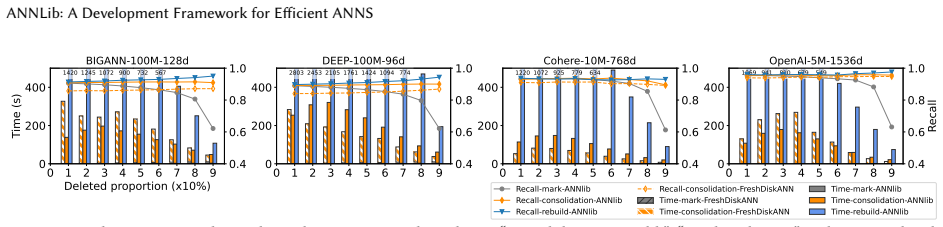
- The chrono prefix array reduces memory for historical snapshots by up to 70.4% compared with a chronological-list scheme, at modest build-time cost.
- The modular Vamana build is on average 1.58x faster than the fastest prior parallel implementation, and HNSW is comparable, showing decoupling doesn't sacrifice insertion throughput.
- Users can combine components in ways the paper didn't fully evaluate, such as filtered search on snapshots of a dynamically updated index.
Where Pith is reading between the lines
- If the decoupling claim generalizes, ANNS frameworks can become interoperable building blocks: an algorithm module from one library and a storage module from another could be mixed without rewriting search logic, accelerating research prototyping.
- The prefix-shared array's memory savings rest on the 'extra edges are harmless' heuristic; a natural stress test is to measure recall and buffer growth under high-update workloads where edge sets change dramatically between versions.
- The same prefix-sharing idea could apply to other dynamic graph workloads that need versioned adjacency views, such as temporal or streaming graph analytics, wherever stale edges are acceptable.
- Because the interface separates neighbor traversal from distance computation, it may also support heterogeneous accelerators (e.g., GPU distance kernels with CPU graph traversal) without changing algorithm code.
Editorial analysis
A structured set of objections, weighed in public.
Referee Report
Summary. The paper presents ANNLib, a C++ library/framework for graph-based ANNS that decouples algorithmic logic from graph-container data structures behind a small interface. It contributes an edge-agent abstraction, modular collect/prune primitives, built-in Vamana/HNSW/HCNNG support, and a new snapshottable container called the chrono prefix array. Four applications are assembled: plain search, batch deletion/updates, filtered search (Stitched-vamana and Filtered-vamana), and historical snapshots. Experiments compare QPS-recall, insertion time, deletion time, and snapshot memory/build time against ParlayANN, DiskANN, Milvus, and Weaviate, reporting broadly competitive or superior performance and up to 70.4% snapshot memory savings. The central claim is that decoupling and modularity do not cost performance and that advanced applications can be built with minimal code.
Significance. If the results hold, ANNLib is a useful systems contribution: it demonstrates that a modular library can match or beat specialized, heavily optimized ANNS implementations across several applications, and the edge-agent and prefix-shared-array ideas are novel and interesting. The paper ships code, uses strong external baselines, and honestly discloses the low-recall throughput gap on DEEP and OpenAI. However, the snapshot claim currently rests on an unvalidated assumption about stale edges in the chrono prefix array, and the absence of replicate-run statistics weakens the quantitative claims. With those points addressed, the paper would be a solid systems-venue candidate.
major comments (3)
- [3.3.5, Figs. 8-9] The snapshot claim is load-bearing for the paper's central claim that ANNLib achieves 'comparable or even better performance' for historical snapshots. Section 3.3.5 explicitly retains stale edges in the prefix-shared array and defends this with an assertion: 'We argue that it is usually safe to contain these extra edges...'. Section 5.5, however, reports only memory and build time; no experiment measures query recall or search latency on snapshot versions, and no experiment studies how effective degree grows under update- or delete-heavy workloads. Since beam-search routing and robustPrune are designed to control degree, stale-edge accumulation could inflate search time and distort recall. This is fixable in scope by adding snapshot query-quality measurements (recall and latency as a function of number of versions and update/delete rate).
- [Figs. 4-9 (Section 5)] None of the performance figures reports variance, error bars, or the number of replicate runs. QPS-recall curves are typically noisy, and the paper includes single-point claims such as '1.58x faster on average, up to 8.11x on the last batch of OpenAI' (Section 5.1) and 'up to 70.4% memory savings' (Section 5.5). Without repeated-run statistics, it is hard to tell whether the reported advantages are significant. Please add standard deviations or error bars, or state that curves are representative and justify with at least a sensitivity analysis.
- [Section 5.4, Fig. 4] The filtered-search comparison to Milvus and Weaviate may underestimate those baselines. The label set is stored as a comma-separated string and matched with the `like` operator, which is a substring scan rather than an exact-metadata filter path. The paper says it follows Filtered-DiskANN's settings, but this is not equivalent to how Milvus and Weaviate would be configured in production. At minimum, describe the exact baseline configuration (index type, parameter sweep, filter operator) and consider an additional comparison using a native metadata filter if the systems support one.
minor comments (6)
- [5.5, Figs. 8-9] Please define the baselines 'Naive', 'PAM', 'Chrono_array', and 'Chrono_prefix', and explain what the 'chronological-list scheme' is; otherwise the memory-savings percentages cannot be interpreted.
- [5.1] The statement that the insertion speedup 'primarily stems from copy elision' is asserted without an ablation. Since the copy-elision property of the edge-agent interface is one of the paper's distinctive contributions, please provide a microbenchmark with copy elision disabled or otherwise substantiate the causal attribution.
- [Abstract and Section 4] The 'minimal programming effort' claim is not quantified. Consider reporting lines of code or changed lines for the four applications built on ANNLib.
- [Section 5] Please state how QPS-recall curves were generated: parameter sweep over which hyperparameters, number of queries, warm-up runs, and the meaning of the specificity percentages in Fig. 4.
- [Table 1] The '#Pts.' column for label rows is ambiguous; it appears to be average labels per point rather than number of points. Please rename/clarify.
- [3.2.1] The sentence containing 'Pkd-tree' appears to be a typo; please fix.
Circularity Check
No significant circularity: ANNLib's claims are benchmark measurements over independently published modules; the stale-edge caveat is an unvalidated assumption, not a circular derivation.
full rationale
ANNLib is a systems/benchmark paper, not a derivation chain. The central claim—that decoupling algorithm and data structure yields comparable or better performance—is supported by direct experiments against external baselines (ParlayANN, DiskANN, Milvus, Weaviate, Filtered-DiskANN) and by implementing published algorithms (Vamana, HNSW, HCNNG, FreshDiskANN deletion, Filtered-DiskANN filtered search). There is no fitted parameter later reported as a prediction: insertion time, QPS-recall curves, deletion time/recall, filtered search, and snapshot memory/build time are all measured outputs. The only self-citations are to published prior systems used as infrastructure or baselines: CPAM/PaC-trees [22], ParlayANN [40], and PAM [56]. These are not invoked as uniqueness theorems or as unverified justification for the framework's central contribution; they are peer-reviewed, code-released components that ANNLib reuses and compares against. Section 3.3.5's justification for retaining stale edges ('We argue that it is usually safe to contain these extra edges...') is an unvalidated assumption and a genuine correctness risk, and the snapshot experiments indeed do not measure recall or query latency. But it is not circular: the paper does not define the chrono prefix array in terms of its claimed performance, nor does it fit parameters to snapshot quality and then 'predict' that quality. The claimed memory savings are direct measurements of the structure's layout. Therefore no step reduces to its own inputs.
Axiom & Free-Parameter Ledger
free parameters (2)
- prefix-shared array buffer size limit =
unstated; example uses limit=4 (Fig. 3)
- beam width L and degree bound r =
swept per experiment (r=32/48 in snapshot tests)
axioms (5)
- domain assumption Graph-based ANNS heuristics (beam search + robustPrune + degree-bound pruning) yield high recall as assumed by Vamana/HNSW/HCNNG.
- domain assumption The prefix-shared array's retained extra edges are few and harmless to recall.
- domain assumption FreshDiskANN's mark-and-consolidate deletion restores graph navigability.
- standard math CPAM (PaC-trees) and PAM functional trees are correct and race-free as published.
- ad hoc to paper Copy elision through the edge-agent interface is the true cause of the insertion speedup.
invented entities (1)
-
chrono prefix array (prefix-shared array with reference-counted buffer and cursors)
independent evidence
read the original abstract
Approximate Nearest Neighbor Search (ANNS) plays a pivotal role in modern deep learning pipelines. Recently, many ANNS systems have been proposed to either provide broad functionality or reach high performance. However, it is yet difficult to achieve both with minimal programming efforts. We propose ANNLib to address the gap. ANNLib is a library that provides a programming framework for achieving high performance and flexible functionality in ANNS systems, based on popular graph-based ANNS algorithms. We carefully decouple and independently optimize both the algorithm and the data structure components of an ANNS system. In addition, we integrate state-of-the-art algorithms and data structures into ANNLib as modules, along with our new designs. Users can choose combinations of components to implement sophisticated settings with high performance, such as filter search, fully dynamic updates, and historical queries on snapshots. Our experiments show that our new solution provides a simple interface for various applications and achieves comparable or even better performance than previous work, specifically for each application.
Figures




Reference graph
Works this paper leans on
-
[1]
Hnswlib - fast approximate nearest neighbor search
2019. Hnswlib - fast approximate nearest neighbor search. Web- page. Retrieved December 16, 2019 from https://github.com/ nmslib/hnswlib
2019
-
[2]
Apache Lucene
2023. Apache Lucene. https://lucene.apache.org/
2023
-
[3]
Microsoft Bing Search Engine
2023. Microsoft Bing Search Engine. https://www.bing.com/new
2023
-
[4]
Pinecone: Vector Database for Vector Search
2023. Pinecone: Vector Database for Vector Search. https: //www.pinecone.io/
2023
-
[5]
Weaviate: The AI Native Vector Database
2023. Weaviate: The AI Native Vector Database. https://weaviate. io/
2023
-
[6]
ANNlib: A Development Framework for Efficient Approx- imate Nearest Neighbor Search
2025. ANNlib: A Development Framework for Efficient Approx- imate Nearest Neighbor Search. https://github.com/ucrparlay/ ANNlib-pub
2025
-
[7]
Laurent Amsaleg and Hervé Jegou. 2010. Datasets for approx- imate nearest neighbor search. http://corpus-texmex.irisa.fr/. [Online; accessed 20-May-2018]
2010
-
[8]
Martin Aumüller, Erik Bernhardsson, and Alexander John Faith- full. 2020. ANN-Benchmarks: A benchmarking tool for approx- imate nearest neighbor algorithms.Information Systems87 (2020)
2020
-
[9]
ANN Benchmarks Authors. 2023. ANN-Benchmarks. https: //ann-benchmarks.com/index.html
2023
-
[10]
Artem Babenko and Victor Lempitsky. 2016. Efficient indexing of billion-scale datasets of deep descriptors. InProceedings of the IEEE Conference on Computer Vision and Pattern Recognition. 2055–2063
2016
-
[11]
Dmitry Baranchuk and Artem Babenko. 2021. Benchmarks for Billion-Scale Similarity Search. Webpage. Retrieved March 16, 2023 from https://research.yandex.com/blog/benchmarks-for- billion-scale-similarity-search
2021
-
[12]
Blelloch, Daniel Anderson, and Laxman Dhulipala
Guy E. Blelloch, Daniel Anderson, and Laxman Dhulipala. 2020. ParlayLib - A Toolkit for Parallel Algorithms on Shared-Memory Multicore Machines. InACM Symposium on Parallelism in Al- gorithms and Architectures (SPAA). ACM, 507–509. https: //doi.org/10.1145/3350755.3400254
arXiv 2020
-
[13]
Guy E. Blelloch and Magdalen Dobson. 2022. Parallel Nearest Neighbors in Low Dimensions with Batch Updates. InProceed- ings of the Symposium on Algorithm Engineering and Experi- ments (ALENEX). SIAM, 195–208. https://doi.org/10.1137/1. 9781611977042.16
doi:10.1137/1 2022
-
[14]
CJ Carey, Jonathan Halcrow, Rajesh Jayaram, Vahab Mirrokni, Warren Schudy, and Peilin Zhong. 2022. Stars: Tera-Scale Graph Building for Clustering and Learning. InAdvances in Neural Information Processing Systems, Vol. 35. 21470–21481
2022
-
[15]
Harrison Chase. 2023. Vector DB text generation. https://python.langchain.com/en/latest/modules/chains/ index_examples/vector_db_text_generation.html
2023
-
[16]
Cheng Chen, Chenzhe Jin, Yunan Zhang, Sasha Podolsky, Chun Wu, Szu-Po Wang, Eric Hanson, Zhou Sun, Robert Walzer, and Jianguo Wang. 2024. SingleStore-V: An Integrated Vector Data- base System in SingleStore.Proceedings of the VLDB Endowment 17, 12 (2024), 3772–3785
2024
-
[17]
Qi Chen, Xiubo Geng, Corby Rosset, Carolyn Buractaon, Jingwen Lu, Tao Shen, Kun Zhou, Chenyan Xiong, Yeyun Gong, Paul Bennett, et al . 2024. MS MARCO Web Search: a Large-scale Information-rich Web Dataset with Millions of Real Click Labels. InCompanion Proceedings of the ACM on Web Conference 2024. 292–301
2024
-
[18]
2018.SPTAG: A library for fast approximate nearest neigh- bor search
Qi Chen, Haidong Wang, Mingqin Li, Gang Ren, Scarlett Li, Jef- fery Zhu, Jason Li, Chuanjie Liu, Lintao Zhang, and Jingdong Wang. 2018.SPTAG: A library for fast approximate nearest neigh- bor search. https://github.com/Microsoft/SPTAG
2018
-
[19]
Qi Chen, Bing Zhao, Haidong Wang, Mingqin Li, Chuanjie Liu, Zengzhong Li, Mao Yang, and Jingdong Wang. 2021. SPANN: Highly-efficient Billion-scale Approximate Nearest Neighbor- hood Search. InAnnual Conference on Neural Information Pro- cessing Systems (NeurIPS). 5199–5212
2021
-
[20]
Cohere. 2023. Wikipedia (en) embedded with cohere.ai multilingual-22-12 encoder. https://huggingface.co/datasets/ Cohere/wikipedia-22-12-en-embeddings. [Online; accessed 22-January-2025]
2023
-
[21]
SpaceV Contributors. 2021. SPACEV1B: A billion-Scale vector dataset for text descriptors. Webpage. Retrieved March 16, 2023 from https://github.com/microsoft/SPTAG/tree/main/datasets/ SPACEV1B
2021
-
[22]
Blelloch, Yan Gu, and Yihan Sun
Laxman Dhulipala, Guy E. Blelloch, Yan Gu, and Yihan Sun. 2022. PaC-trees: supporting parallel and compressed purely-functional collections(PLDI 2022). Association for Computing Machinery, New York, NY, USA, 108–121. https://doi.org/10.1145/3519939. 3523733
doi:10.1145/3519939 2022
-
[23]
Blelloch, and Julian Shun
Laxman Dhulipala, Guy E. Blelloch, and Julian Shun. 2019. Low- latency graph streaming using compressed purely-functional trees(PLDI 2019). Association for Computing Machinery, 918–
2019
-
[24]
Etienne Dilocker, Bob van Luijt, Byron Voorbach, Mohd Shukri Hasan, Abdel Rodriguez, Dirk Alexander Kulawiak, Marcin Antas, and Parker Duckworth. 2024. Weaviate. Webpage. https://github.com/weaviate/weaviate
2024
-
[25]
Matthijs Douze, Alexandr Guzhva, Chengqi Deng, Jeff Johnson, Gergely Szilvasy, Pierre-Emmanuel Mazaré, Maria Lomeli, Lucas Hosseini, and Hervé Jégou. 2024. The faiss library.arXiv preprint arXiv:2401.08281(2024)
Pith/arXiv arXiv 2024
-
[26]
Magdalini Eirinaki, Jerry Gao, Iraklis Varlamis, and Konstanti- nos Tserpes. 2018. Recommender systems for large-scale social networks: A review of challenges and solutions. , 413–418 pages
2018
-
[27]
Joshua Engels, Benjamin Landrum, Shangdi Yu, Laxman Dhuli- pala, and Julian Shun. 2024. Approximate nearest neighbor search with window filters.arXiv preprint arXiv:2402.00943 (2024)
Pith/arXiv arXiv 2024
-
[28]
Cong Fu, Changxu Wang, and Deng Cai. 2022. High dimensional similarity search with satellite system graph: Efficiency, scala- bility, and unindexed query compatibility.IEEE Trans. Pattern Anal. Mach. Intell.44, 8 (2022), 4139–4150
2022
-
[29]
Cong Fu, Chao Xiang, Changxu Wang, and Deng Cai. 2019. Fast Approximate Nearest Neighbor Search With The Navigating Spreading-out Graph.Proc. VLDB Endow.12, 5 (2019), 461–474
2019
-
[30]
Siddharth Gollapudi, Neel Karia, Varun Sivashankar, Ravis- hankar Krishnaswamy, Nikit Begwani, Swapnil Raz, Yiyong Lin, Yin Zhang, Neelam Mahapatro, Premkumar Srinivasan, Amit Singh, and Harsha Vardhan Simhadri. 2023. Filtered-DiskANN: Graph Algorithms for Approximate Nearest Neighbor Search with Filters. InProceedings of the ACM Web Conference 2023 (WWW ...
2023
-
[31]
Rentong Guo, Xiaofan Luan, Long Xiang, Xiao Yan, Xiaomeng Yi, Jigao Luo, Qianya Cheng, Weizhi Xu, Jiarui Luo, Frank Liu, et al. 2022. Manu: A Cloud Native Vector Database Management System.VLDB Endowment(2022), 3548
2022
-
[32]
Jui-Ting Huang, Ashish Sharma, Shuying Sun, Li Xia, David Zhang, Philip Pronin, Janani Padmanabhan, Giuseppe Ottaviano, and Linjun Yang. 2020. Embedding-based retrieval in facebook search. InProceedings of the 26th ACM SIGKDD International 14 ANNLib: A Development Framework for Efficient ANNS Conference on Knowledge Discovery & Data Mining. 2553–2561
2020
-
[33]
Shikhar Jaiswal, Ravishankar Krishnaswamy, Ankit Garg, Har- sha Vardhan Simhadri, and Sheshansh Agrawal. 2022. OOD- DiskANN: Efficient and Scalable Graph ANNS for Out-of- Distribution Queries.CoRRabs/2211.12850 (2022). https: //doi.org/10.48550/arXiv.2211.12850
-
[34]
Jeff Johnson, Matthijs Douze, and Hervé Jégou. 2019. Billion- scale similarity search with GPUs.IEEE Transactions on Big Data 7, 3 (2019), 535–547
2019
-
[35]
Andrew Kane. 2022. pgvector. Webpage. Retrieved July, 2023 from https://github.com/pgvector/pgvector/
2022
-
[36]
Yann LeCun, Yoshua Bengio, et al. 1995. Convolutional networks for images, speech, and time series.The handbook of brain theory and neural networks3361, 10 (1995), 1995
1995
-
[37]
Jie Li, Haifeng Liu, Chuanghua Gui, Jianyu Chen, Zhenyuan Ni, Ning Wang, and Yuan Chen. 2018. The Design and Implemen- tation of a Real Time Visual Search System on JD E-commerce Platform. InProceedings of the 19th International Middleware Con- ference Industry. Association for Computing Machinery, 9–16. https://doi.org/10.1145/3284028.3284030
arXiv 2018
-
[38]
Yanjun Lin, Kai Zhang, Zhenying He, Yinan Jing, and X Sean Wang. 2025. Survey of Filtered Approximate Nearest Neigh- bor Search over the Vector-Scalar Hybrid Data.arXiv preprint arXiv:2505.06501(2025)
Pith/arXiv arXiv 2025
-
[39]
Malkov and Dmitry A
Yury A. Malkov and Dmitry A. Yashunin. 2020. Efficient and Ro- bust Approximate Nearest Neighbor Search Using Hierarchical Navigable Small World Graphs.IEEE Trans. Pattern Anal. Mach. Intell.42, 4 (2020), 824–836
2020
-
[40]
Magdalen Dobson Manohar, Zheqi Shen, Guy Blelloch, Laxman Dhulipala, Yan Gu, Harsha Vardhan Simhadri, and Yihan Sun
-
[41]
Leland McInnes. 2020. PyNNDescent for Fast Approximate Nearest Neighbors. Webpage. Retrieved December 15, 2022 from https://pynndescent.readthedocs.io/en/latest/
2020
-
[42]
Tomas Mikolov, Ilya Sutskever, Kai Chen, Greg S Corrado, and Jeff Dean. 2013. Distributed representations of words and phrases and their compositionality.Advances in neural information pro- cessing systems26 (2013)
2013
-
[43]
Javier Alvaro Vargas Muñoz, Marcos André Gonçalves, Zanoni Dias, and Ricardo da Silva Torres. 2019. Hierarchical Clustering- Based Graphs for Large Scale Approximate Nearest Neighbor Search.Pattern Recognit.96 (2019)
2019
-
[44]
Arvind Neelakantan, Tao Xu, Raul Puri, Alec Radford, Jesse Michael Han, Jerry Tworek, Qiming Yuan, Nikolas Tezak, Jong Wook Kim, Chris Hallacy, et al. 2022. Text and code embed- dings by contrastive pre-training.arXiv preprint arXiv:2201.10005 (2022)
Pith/arXiv arXiv 2022
-
[45]
Arnold Overwijk, Chenyan Xiong, and Jamie Callan. 2022. ClueWeb22: 10 billion web documents with rich information. InProceedings of the 45th international ACM SIGIR conference on research and development in information retrieval. 3360–3362
2022
-
[46]
Liana Patel, Peter Kraft, Carlos Guestrin, and Matei Zaharia
-
[47]
Ninh Pham and Tao Liu. 2022. Falconn++: A Locality-sensitive Filtering Approach for Approximate Nearest Neighbor Search. CoRRabs/2206.01382 (2022). https://doi.org/10.48550/arXiv.2206. 01382 arXiv:2206.01382
work page internal anchor Pith review Pith/arXiv arXiv doi:10.48550/arxiv.2206 2022
-
[48]
Alec Radford, Jong Wook Kim, Chris Hallacy, Aditya Ramesh, Gabriel Goh, Sandhini Agarwal, Girish Sastry, Amanda Askell, Pamela Mishkin, Jack Clark, et al. 2021. Learning transferable visual models from natural language supervision. InInternational conference on machine learning. PmLR, 8748–8763
2021
-
[49]
Acorn: Performant and predicate-agnostic search over vector embeddings and structured data.Proceedings of the ACM on Management of Data2, 3 (2024), 1–27
2024
-
[50]
Franco Scarselli, Marco Gori, Ah Chung Tsoi, Markus Hagen- buchner, and Gabriele Monfardini. 2008. The graph neural net- work model.IEEE transactions on neural networks20, 1 (2008), 61–80
2008
-
[51]
Harsha Vardhan Simhadri, Martin Aumüller, Amir Ingber, Matthijs Douze, George Williams, Magdalen Dobson Manohar, Dmitry Baranchuk, Edo Liberty, Frank Liu, Ben Landrum, et al
-
[52]
Jie Ren, Minjia Zhang, and Dong Li. 2020. HM-ANN: Efficient Billion-Point Nearest Neighbor Search on Heterogeneous Mem- ory. InAnnual Conference on Neural Information Processing Sys- tems (NeurIPS), Hugo Larochelle, Marc’Aurelio Ranzato, Raia Hadsell, Maria-Florina Balcan, and Hsuan-Tien Lin (Eds.)
2020
-
[53]
Aditi Singh, Suhas Jayaram Subramanya, Ravishankar Krish- naswamy, and Harsha Vardhan Simhadri. 2021. FreshDiskANN: A Fast and Accurate Graph-Based ANN Index for Streaming Similarity Search.CoRRabs/2105.09613 (2021). arXiv:2105.09613 https://arxiv.org/abs/2105.09613
Pith/arXiv arXiv 2021
-
[54]
Colette Stallbaumer. 2023. Introducing Microsoft 365 copilot. https://www.microsoft.com/en-us/microsoft- 365/blog/2023/03/16/introducing-microsoft-365-copilot-a- whole-new-way-to-work/
2023
-
[55]
Results of the Big ANN: NeurIPS’23 competition.arXiv preprint arXiv:2409.17424(2024)
Pith/arXiv arXiv 2024
-
[56]
Simhadri, Harsha Vardhan and Krishnaswamy, Ravishankar and Srinivasa, Gopal and Subramanya, Suhas Jayaram and An- tonijevic, Andrija and Pryce, Dax and Kaczynski, David and Williams, Shane and Gollapudi, Siddarth and Sivashankar, Varun and Karia, Neel and Singh, Aditi and Jaiswal, Shikhar and Maha- patro, Neelam and Adams, Philip and Tower, Bryan and Pate...
2023
-
[57]
Yukihiro Tagami. 2017. Annexml: Approximate nearest neighbor search for extreme multi-label classification. InProceedings of the 23rd ACM SIGKDD international conference on knowledge discovery and data mining. 455–464
2017
-
[58]
tawalke. 2023. PR: SK Vectordb Connector Work - Merging forked branch; PR from Fork to SK Branch by Tawalke·pull request 83·Microsoft/Semantic-Kernel. https://github.com/ microsoft/semantic-kernel/pull/83
2023
-
[59]
Suhas Jayaram Subramanya, Fnu Devvrit, Harsha Vardhan Simhadri, Ravishankar Krishnaswamy, and Rohan Kadekodi
-
[60]
Jianguo Wang, Xiaomeng Yi, Rentong Guo, Hai Jin, Peng Xu, Shengjun Li, Xiangyu Wang, Xiangzhou Guo, Chengming Li, Xiaohai Xu, et al . 2021. Milvus: A purpose-built vector data 15 management system. InProceedings of the 2021 International Conference on Management of Data. 2614–2627
2021
-
[61]
Blelloch
Yihan Sun, Daniel Ferizovic, and Guy E. Blelloch. 2018. PAM: Parallel Augmented Maps. InACM Symposium on Principles and Practice of Parallel Programming (PPoPP)
2018
-
[62]
Chuangxian Wei, Bin Wu, Sheng Wang, Renjie Lou, Chaoqun Zhan, Feifei Li, and Yuanzhe Cai. 2020. AnalyticDB-V: a hy- brid analytical engine towards query fusion for structured and unstructured data.Proceedings of the VLDB Endowment13, 12 (2020), 3152–3165
2020
-
[63]
Jingyi Xi, Chenghao Mo, Benjamin Karsin, Artem Chirkin, Mingqin Li, and Minjia Zhang. 2025. VecFlow: A High- Performance Vector Data Management System for Filtered- Search on GPUs.arXiv preprint arXiv:2506.00812(2025)
Pith/arXiv arXiv 2025
-
[64]
Bart Thomee, David A Shamma, Gerald Friedland, Benjamin Elizalde, Karl Ni, Douglas Poland, Damian Borth, and Li-Jia Li
-
[65]
Yuming Xu, Hengyu Liang, Jin Li, Shuotao Xu, Qi Chen, Qianxi Zhang, Cheng Li, Ziyue Yang, Fan Yang, Yuqing Yang, et al
-
[66]
Wen Yang, Tao Li, Gai Fang, and Hong Wei. 2020. PASE: Post- greSQL Ultra-High-Dimensional Approximate Nearest Neighbor Search Extension(SIGMOD ’20). 2241–2253
2020
-
[67]
Mengzhao Wang, Lingwei Lv, Xiaoliang Xu, Yuxiang Wang, Qiang Yue, and Jiongkang Ni. 2023. An efficient and robust framework for approximate nearest neighbor search with at- tribute constraint.Advances in Neural Information Processing Systems36 (2023), 15738–15751
2023
-
[68]
Jiaru Zhang, Ruhui Ma, Tao Song, Yang Hua, Zhengui Xue, Chenyang Guan, and Haibing Guan. 2022. Hierarchical Satellite System Graph for Approximate Nearest Neighbor Search on Big Data.ACM/IMS Trans. Data Sci.2, 4 (2022)
2022
-
[69]
Qianxi Zhang, Shuotao Xu, Qi Chen, Guoxin Sui, Jiadong Xie, Zhizhen Cai, Yaoqi Chen, Yinxuan He, Yuqing Yang, Fan Yang, Mao Yang, and Lidong Zhou. 2023. VBASE: Unifying Online Vector Similarity Search and Relational Queries via Relaxed Monotonicity. In17th USENIX Symposium on Operating Systems Design and Implementation (OSDI 23). USENIX Association, 377– 395
2023
-
[70]
Xiaoliang Xu, Chang Li, Yuxiang Wang, and Yixing Xia. 2020. Multiattribute approximate nearest neighbor search based on navigable small world graph.Concurrency and Computation: Practice and Experience32, 24 (2020), e5970
2020
-
[71]
Chaoji Zuo, Miao Qiao, Wenchao Zhou, Feifei Li, and Dong Deng. 2024. SeRF: segment graph for range-filtering approximate nearest neighbor search.Proceedings of the ACM on Management of Data2, 1 (2024), 1–26. 16
2024
-
[74]
Jianjin Zhang, Zheng Liu, Weihao Han, Shitao Xiao, Ruicheng Zheng, Yingxia Shao, Hao Sun, Hanqing Zhu, Premkumar Srini- vasan, Weiwei Deng, et al. 2022. Uni-retriever: Towards learning the unified embedding based retriever in bing sponsored search. InProceedings of the 28th ACM SIGKDD Conference on Knowledge Discovery and Data Mining. 4493–4501
2022
-
[77]
Yanhao Zhang, Pan Pan, Yun Zheng, Kang Zhao, Yingya Zhang, Xiaofeng Ren, and Rong Jin. 2018. Visual search at alibaba. In Proceedings of the 24th ACM SIGKDD international conference on knowledge discovery & data mining. 993–1001
2018
-
[934]
https://doi.org/10.1145/3314221.3314598
-
[2016]
ACM59, 2 (2016), 64–73
Yfcc100m: The new data in multimedia research.Commun. ACM59, 2 (2016), 64–73
2016
-
[2019]
InAnnual Conference on Neural Infor- mation Processing Systems (NeurIPS)
DiskANN: Fast Accurate Billion-point Nearest Neighbor Search on a Single Node. InAnnual Conference on Neural Infor- mation Processing Systems (NeurIPS). 13748–13758
-
[2023]
InProceedings of the 29th Symposium on Operating Systems Principles
SPFresh: Incremental In-Place Update for Billion-Scale Vector Search. InProceedings of the 29th Symposium on Operating Systems Principles. 545–561
-
[2024]
In Proceedings of the 29th ACM SIGPLAN Annual Symposium on Prin- ciples and Practice of Parallel Programming (PPoPP ’24)
ParlayANN: Scalable and Deterministic Parallel Graph- Based Approximate Nearest Neighbor Search Algorithms. In Proceedings of the 29th ACM SIGPLAN Annual Symposium on Prin- ciples and Practice of Parallel Programming (PPoPP ’24). 270–285
discussion (0)
Sign in with ORCID, Apple, or X to comment. Anyone can read and Pith papers without signing in.