REVIEW 4 major objections 4 minor 40 references
By partitioning equivariant graph neural networks according to a crystal's point group, this paper shows that most predictive power for elastic and dielectric tensors concentrates in the trivial irreducible-representation blocks, so an A1-r
Reviewed by Pith at T0; open to challenge. T0 means a machine referee read the full paper against a public rubric. the ladder, T0–T4 →
T0 review · deepseek-v4-flash
2026-08-01 19:40 UTC pith:YBFEY4CI
load-bearing objection A genuinely new architectural idea with a plausible but under-supported central claim; worth engaging, needs stronger capacity control and significance testing. the 4 major comments →
Point Group Equivariant Graph Neural Networks for Materials
The pith
A machine-rendered reading of the paper's core claim, the machinery that carries it, and where it could break.
Core claim
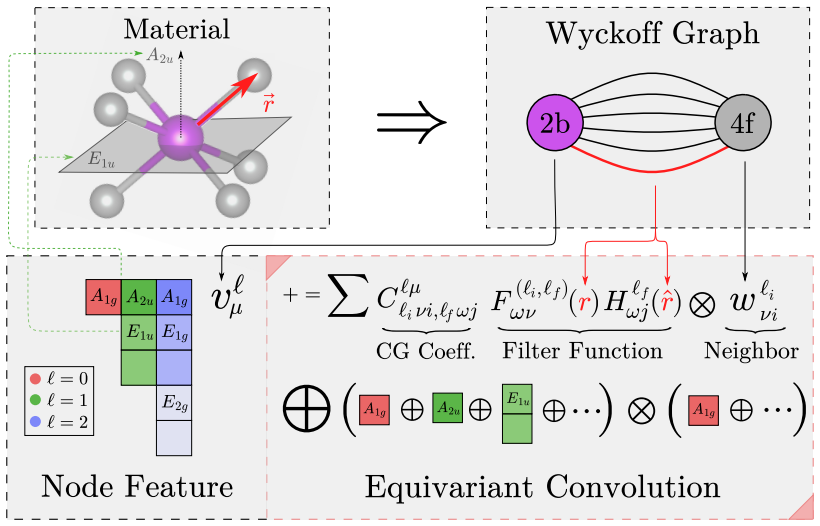
The paper's central claim is that the predictive content of equivariant graph networks for elastic and dielectric tensors concentrates in the trivial irreducible-representation blocks of a point-group-adapted basis. It constructs this basis by a unitary change from standard spherical harmonics, which block-diagonalizes every point-group operation and labels each component by an irreducible representation α of the crystal's point group in addition to its rotational order ℓ. The architecture, PGEqNN, uses this (ℓ, α) labelling to give distinct weights to components that a purely SO(3)-equivariant network must share. In a synthetic D4h classification task, the point-group-partitioned network se
What carries the argument
The central object is the point-group-adapted basis of point-group harmonics, obtained by applying a unitary matrix U_G^{(ℓ)} to the standard spherical harmonics of order ℓ. In this basis, the action of every point-group operation is block-diagonal: components belonging to different irreducible representations α are never mixed. That makes α an invariant label that can index learnable weights, so a convolution can assign distinct radial filters and self-interactions to each (ℓ, α) block, achieving sub-irrep specificity that a conventional SO(3)-equivariant layer, which must treat all 2ℓ+1 components of an ℓ block identically, cannot express. The A1-restricted variant then zeroes every filter
Load-bearing premise
The comparison relies on the assumption that two models with the same number of trainable weights have the same learning capacity, so that any accuracy difference is due to how symmetry is encoded; if that assumption is wrong, the main conclusion does not follow.
What would settle it
On the trigonal D3d dielectric dataset where the full point-group model is clearly best, retrain the A1-only variant with its parameter budget increased to the full model's budget (instead of forfeiting the budgets of non-trivial orders). If the A1-only model then matches the full model's total MAE, the paper's claim that non-trivial blocks are the source of the anisotropic-signal advantage is falsified; if the full model retains its lead, that claim survives.
If this is right
- On all four elastic datasets, the A1-only model posts the lowest total mean absolute error while using roughly half to two-thirds the active parameters of the SO(3) reference; the full point-group partition separates from SO(3) only on D2h.
- On the dielectric datasets, the three symmetry-aware partitions are statistically tied in total error for D2h, C2v, and C2h; only on D3d, where the ℓ=2 deviatoric block has strong learnable signal, does the full point-group partition clearly beat both SO(3) and A1-only.
- The invariant scalar baseline trails every symmetry-aware model on every dataset and sometimes lands above the no-skill floor, showing that invariant angular content of local environments carries information beyond interatomic distances.
- The point-group partition helps exactly when three conditions coincide: the target populates ℓ>0 subspaces, the point group resolves those subspaces into multiple irreps or repeated trivial copies, and the dataset carries anisotropic signal above its no-skill floor.
- A synthetic D4h vector-orientation task demonstrates that a purely SO(3)-equivariant model cannot distinguish components within the same rotational order that transform under different point-group irreps, while the point-group-partitioned model solves it perfectly.
Where Pith is reading between the lines
- Inference: If the concentration in trivial blocks holds for symmetry-constrained tensor targets, then the full point-group partition should show larger gains on targets that genuinely populate non-trivial irreps—electronic Hamiltonians, Berry curvature, magnetic tensors—where the extra blocks are not discarded by symmetry. The paper itself points toward Hamiltonians as the natural next test.
- Inference: The parameter-matching protocol uses binary masks to equalize active counts per rotational order. Whether this truly equalizes capacity is not established; a more direct test would sweep model width and mask budget independently to see whether the A1-only advantage survives at equal total parameter count and equal training epochs.
- Inference: The within-ℓ specificity mechanism is not limited to message-passing architectures; it could be attached to attention-based or other equivariant backbones, and to weight sharing across point groups via correlation tables, which the paper's discussion of repeated A1 copies suggests.
- Inference: The finding that full point-group models are most useful where anisotropic signal exceeds the floor suggests a practical screening rule: compute the no-skill floor of the anisotropic block, and only invest in the full partition if the floor is far enough below the target error; otherwise the leaner A1-only model is the rational choice.
Editorial analysis
A structured set of objections, weighed in public.
Referee Report
Summary. The paper introduces point-group-symmetry-aware equivariant graph neural networks (PGEqNN), which partition equivariant weights and features not only by SO(3) rotational order ℓ but also by the irreducible representations of the material's point group in a symmetry-adapted basis. The authors compare four models—an invariant scalar baseline, an SO(3)-partitioned equivariant model, a full point-group-partitioned model, and an A1-restricted variant—on elastic and dielectric tensor prediction from Materials Project data, using active parameter counts matched per rotational order through binary masks. The central claim is that predictive content concentrates in trivial-irrep (A1) blocks, so the A1-restricted variant matches or improves on the full PG and SO(3) models while training fewer active parameters. A synthetic D4h vector-orientation task demonstrates that PG partitioning can distinguish components within a single ℓ that SO(3) equivariance cannot.
Significance. If the concentration claim were firmly established, the paper would provide a practical design principle: for tensor targets governed by Neumann's principle, equivariant models can be restricted to trivial-irrep blocks, yielding leaner models of equal accuracy. The synthetic task cleanly demonstrates the architectural capability, and the use of MAD floors as no-skill references is a good practice. The paper also makes a useful conceptual contribution by connecting deterministic crystallographic canonicalization to point-group-adapted equivariant architectures. However, the central empirical conclusion is currently not supported by the reported statistics: most headline comparisons are within cross-validation scatter, no significance tests are provided, and the parameter-matching protocol is not a validated capacity control.
major comments (4)
- [Tensor Prediction (Tables 2 and 3)] The headline comparisons are within cross-validation scatter. For example, Table 2 Oh: PG 22.6±1.1, A1-only 22.1±1.0, SO(3) 22.5±1.0; D6h: 39.9±3.0 vs 40.8±2.5; D4h: 31.9±1.7 vs 32.0±2.1. In Table 3, the D2h total for A1-only (0.435±0.042) is numerically worse than PG (0.428±0.048) and SO(3) (0.428±0.042), and the C2h total is similarly tied or slightly worse. Even the one separation highlighted in the text, D3d PG 0.396±0.028 vs A1-only 0.425±0.046, is within combined fold scatter. No paired per-fold tests, multi-seed repetitions, or block-level error bars are reported. Consequently, the claims that the A1-restricted model 'matches or improves' and that predictive content 'concentrates' in trivial blocks are not supported by the reported statistics.
- [Tensor Prediction and A1-Restricted Point-Group Model] The parameter-matching protocol does not equalize capacity. Only self-interaction and radial-filter weights are masked order-by-order; normalization/scaling and readout heads are outside the matched protocol, and the A1-only variant deliberately gives each repeated A1 copy its own readout. Total active parameter counts differ substantially (e.g., Oh A1-only 133.5k vs SO(3) 287.0k in Table 2). Zeroing non-trivial blocks acts as a hard regularizer, and with L2 λ=1e-4 the observed equivalence could reflect regularization rather than trivial-irrep concentration. A control is needed: match total active parameters by width reduction, or include random block-mask ablations with identical readout structure and normalization, and compare with multi-seed runs.
- [A1-Restricted Point-Group Model and Results] The causal interpretation is weakened by architecture selection on the same datasets. The A1-restricted variant is motivated by inspecting learned filter couplings from full PG models trained on these same elastic datasets, and the same datasets are then used to 'confirm causally' that A1 content dominates. This is a selection-on-the-test-data concern. To support the claim, the A1-only restriction should be pre-registered, selected on a held-out point group, or at least the number of architecture variants tried after weight inspection should be reported.
- [Elastic Tensor Prediction (Table 2, D2h)] The 'below MAD floor' claims lack uncertainty quantification. For the D2h symmetric ℓ=2 block, the floor is 38.4 GPa and the PG variants report 37.3 and 36.4 GPa—differences of only 1–2 GPa. For symmetric ℓ=4, PG 45.9/45.4 vs floor 56.1, but no block-level error bars are given; the total cross-fold σ is ±1.2–1.9 GPa. The conclusion that PG variants 'recover a measurable signal' while SO(3) does not is therefore not established. Block-level MAE should be accompanied by uncertainties or significance tests.
minor comments (4)
- [General] There are several typographical errors: 'it’s' should be 'its' in multiple places (e.g., 'it’s corresponding tensor' in Standard Bases), and 'material’s' appears in the Abstract. The manuscript would benefit from a copyedit.
- [Standard Bases] The footnote '1These properties were one-hot encoded.' appears as a dangling footnote marker in the text. It should be integrated or placed as a proper table/figure caption.
- [Equation (3)] The notation in Eq. (3) is under-specified: the object U^γ_n_{αiβj} is introduced as a Clebsch–Gordan coefficient, but its indices and dependence on the point-group chain (and on the edge's point group) should be defined explicitly. Also, the superscript/subscript placement of γ_n, αi, βj is confusing.
- [Tables 2 and 3] Table 3 does not include MAD floor rows, although the text reports floors for each block. Including them in the table would make the comparison against no-skill references more transparent, as done in Table 2.
Circularity Check
No significant circularity: the central result is a held-out ablation comparison; self-citations are contextual, not load-bearing.
full rationale
The paper's central claim—that predictive content in the point-group partition concentrates in trivial-irrep blocks—is supported by a test-set comparison of an A1-restricted model against full PG and SO(3) baselines, not by construction. The A1-restricted model is an ablation that zeroes non-trivial blocks; it could have performed worse, so its matching or improving performance is an empirical finding rather than a tautology. Neumann's principle motivates the hypothesis but does not determine the relative performance of the architectures. The only self-citations ([5], [10]) are contextual references to prior GNN and tensor-prediction work and are not invoked to justify the paper's novel partition or to forbid alternatives. The parameter-matching protocol raises a capacity-control concern, but that is a validity issue, not circularity: no fitted parameter is renamed as a prediction, and the target tensors are external Materials Project data. Therefore no circular step is identified.
Axiom & Free-Parameter Ledger
free parameters (7)
- L2 regularization strength λ =
1e-4
- ℓ_max for edge spherical harmonics =
not stated
- convolutional block width / hidden channels =
not stated
- number of convolutional layers =
2 (implied)
- per-rank-ℓ target normalization constants =
fitted per block
- parameter-matching masks and budgets =
not fully specified
- point-group cohort selection =
Oh, D6h, D4h, D2h (elastic); D2h, D3d, C2v, C2h (dielectric)
axioms (6)
- domain assumption Neumann's principle: symmetric property tensors have non-zero components only in the trivial-irrep (A1) blocks of the point-group-adapted basis.
- domain assumption spglib/pymatgen standardization places structures in the International Tables standard setting, making IR labels physically meaningful.
- standard math MultiPie point-group-harmonic matrices U_G^(ℓ) correctly block-diagonalize point-group representations.
- standard math Clebsch-Gordan tensor products decomposed by point-group irreps are complete and correctly implemented.
- domain assumption CrystalNN edge selection produces edges that reflect site symmetry and are suitable for Wyckoff-graph message passing.
- domain assumption Materials Project DFT elastic and dielectric tensors are accurate ground truth for the masked non-zero components.
read the original abstract
Equivariant graph neural networks have proven effective tools for inference of material's properties directly from their structure. Traditionally, these have been applied such that they respect full $O(3)$ equivariance, so that any rotation or reflection of the input structure is respected in the model's output. While this works for general arrangements of atoms, additional symmetries of atomistic systems are left unleveraged. Furthermore, any symmetries of the filter functions are implicitly learned from the full dataset and not strictly enforced. In this work, we introduce point-group symmetry aware equivariant graph neural networks (PGEqNN) for materials science, with filter functions aligned with symmetry-aware indices for greater granularity in predictive tasks. With this architecture, we show that most of the predictive power of equivariant networks for tensorial elastic and dielectric datasets lies in the trivial subspaces of the point-group adapted bases. Exploiting this, an $A_1$-restricted variant matches or improves on its full point-group and $SO(3)$-partitioned counterparts while training fewer active parameters, yielding leaner models of equal accuracy.
Figures


Reference graph
Works this paper leans on
-
[1]
Machine learning in materials science
Jing Wei et al. “Machine learning in materials science”. In:InfoMat1.3 (2019), pp. 338–358
2019
-
[2]
Machine learning in materials genome initiative: A review
Yingli Liu et al. “Machine learning in materials genome initiative: A review”. In:J. Mater. Sci. Tech. 57 (2020), pp. 113–122.issn: 1005-0302.doi:https://doi.org/10.1016/j.jmst.2020.01.067.url: https://www.sciencedirect.com/science/article/pii/S1005030220303327
-
[3]
Scope of machine learning in materials research—A review
Md Hosne Mobarak et al. “Scope of machine learning in materials research—A review”. In:Appl. Surf. Sci. Adv.18 (2023), article 100523.issn: 2666-5239.doi:https://doi.org/10.1016/j.apsadv. 2023.100523.url:https://www.sciencedirect.com/science/article/pii/S2666523923001575
arXiv 2023
-
[4]
Crystal graph convolutional neural networks for an accurate and interpretable prediction of material properties
Tian Xie and Jeffrey C Grossman. “Crystal graph convolutional neural networks for an accurate and interpretable prediction of material properties”. In:PRL120.14 (2018), article 145301
2018
-
[5]
Crystal hypergraph convolutional networks
Alexander J Heilman, Weiyi Gong, and Qimin Yan. “Crystal hypergraph convolutional networks”. In: npj Computational Materials11.1 (2025), p. 336
2025
-
[6]
Graph networks as a universal machine learning framework for molecules and crystals
Chi Chen et al. “Graph networks as a universal machine learning framework for molecules and crystals”. In:Chem. Mater.31.9 (2019), pp. 3564–3572
2019
-
[7]
A universal graph deep learning interatomic potential for the periodic table
Chi Chen and Shyue Ping Ong. “A universal graph deep learning interatomic potential for the periodic table”. In:Nat. Comput. Sci.2.11 (2022), pp. 718–728
2022
-
[8]
e3nn: Euclidean neural networks
Mario Geiger and Tess Smidt. “e3nn: Euclidean neural networks”. In:arXiv preprint arXiv:2207.09453 (2022)
Pith/arXiv arXiv 2022
-
[9]
Tensor field networks: Rotation- and translation-equivariant neural networks for 3D point clouds
Nathaniel Thomas et al. “Tensor field networks: Rotation- and translation-equivariant neural networks for 3D point clouds”. In:arXiv preprint arXiv:1802.08219(2018). arXiv:1802.08219 [cs.LG].url: https://arxiv.org/abs/1802.08219
Pith/arXiv arXiv 2018
-
[10]
Alex Heilman, Claire Schlesinger, and Qimin Yan.Equivariant Graph Neural Networks for Prediction of Tensor Material Properties of Crystals. 2024. arXiv:2406.03563 [physics.comp-ph].url:https: //arxiv.org/abs/2406.03563
Pith/arXiv arXiv 2024
-
[11]
Universal Ensemble-Embedding Graph Neural Network for Direct Prediction of Optical Spectra from Crystal Structures
Nguyen Tuan Hung et al. “Universal Ensemble-Embedding Graph Neural Network for Direct Prediction of Optical Spectra from Crystal Structures”. In:Advanced Materials36.46 (2024), p. 2409175
2024
-
[12]
Equivariance with Learned Canonicalization Functions
S´ ekou-Oumar Kaba et al. “Equivariance with Learned Canonicalization Functions”. In:Proceedings of the 40th International Conference on Machine Learning (ICML). Vol. 202. Proceedings of Machine Learning Research. 2023, pp. 15546–15566
2023
-
[13]
Spatial Transformer Networks
Max Jaderberg et al. “Spatial Transformer Networks”. In:Advances in Neural Information Processing Systems (NeurIPS). Vol. 28. 2015
2015
-
[14]
Equivariant Adaptation of Large Pretrained Models
Arnab Kumar Mondal et al. “Equivariant Adaptation of Large Pretrained Models”. In:Advances in Neural Information Processing Systems (NeurIPS). Vol. 36. 2023
2023
-
[15]
Spglib: a software library for crystal symmetry search
Atsushi Togo, Kohei Shinohara, and Isao Tanaka. “Spglib: a software library for crystal symmetry search”. In:Science and Technology of Advanced Materials: Methods4.1 (2024), p. 2384822.doi: 10.1080/27660400.2024.2384822. eprint:https://doi.org/10.1080/27660400.2024.2384822. url:https://doi.org/10.1080/27660400.2024.2384822
arXiv 2024
-
[16]
Revisiting the Canonicalization for Fast and Accurate Crystal Tensor Property Prediction
Haowei Hua et al. “Revisiting the Canonicalization for Fast and Accurate Crystal Tensor Property Prediction”. In:Proceedings of the AAAI Conference on Artificial Intelligence. Vol. 40. 1. 2026, pp. 417– 425
2026
-
[17]
SchNet – A deep learning architecture for molecules and materials
K. T. Sch¨ utt et al. “SchNet – A deep learning architecture for molecules and materials”. In:J. Chem. Phys.148.24 (Mar. 2018), article 241722.issn: 0021-9606.doi:10.1063/1.5019779. eprint:https: //pubs.aip.org/aip/jcp/article-pdf/doi/10.1063/1.5019779/16655678/241722\_1\_online. pdf.url:https://doi.org/10.1063/1.5019779
-
[18]
Atomistic Line Graph Neural Network for improved materials property predictions
Kamal Choudhary and Brian DeCost. “Atomistic Line Graph Neural Network for improved materials property predictions”. In:npj Comput. Mater.7.1 (2021), pp. 1–8. 16
2021
-
[19]
Developing an improved crystal graph convolutional neu- ral network framework for accelerated materials discovery
Cheol Woo Park and Chris Wolverton. “Developing an improved crystal graph convolutional neu- ral network framework for accelerated materials discovery”. In:Phys. Rev. Mater.4.6 (2020), article 063801
2020
-
[20]
A geometric-information-enhanced crystal graph network for predicting properties of materials
Jiucheng Cheng, Chunkai Zhang, and Lifeng Dong. “A geometric-information-enhanced crystal graph network for predicting properties of materials”. In:Commun. Mater.2.1 (2021), article 92
2021
-
[21]
SE(3)-Transformers: 3D roto-translation equivariant attention networks
Fabian B. Fuchs et al. “SE(3)-Transformers: 3D roto-translation equivariant attention networks”. In: Advances in Neural Information Processing Systems (NeurIPS). Vol. 33. 2020
2020
-
[22]
Cormorant: Covariant molecular neural net- works
Brandon Anderson, Truong Son Hy, and Risi Kondor. “Cormorant: Covariant molecular neural net- works”. In:Advances in Neural Information Processing Systems (NeurIPS). Vol. 32. 2019
2019
-
[23]
E(3)-equivariant graph neural networks for data-efficient and accurate inter- atomic potentials
Simon Batzner et al. “E(3)-equivariant graph neural networks for data-efficient and accurate inter- atomic potentials”. In:Nature Communications13.1 (2022), p. 2453.doi:10 . 1038 / s41467 - 022 - 29939-5
2022
-
[24]
MACE: Higher order equivariant message passing neural networks for fast and accurate force fields
Ilyes Batatia et al. “MACE: Higher order equivariant message passing neural networks for fast and accurate force fields”. In:Advances in Neural Information Processing Systems (NeurIPS). Vol. 35. 2022
2022
-
[25]
Learning local equivariant representations for large-scale atomistic dynamics
Albert Musaelian et al. “Learning local equivariant representations for large-scale atomistic dynamics”. In:Nature Communications14.1 (2023), p. 579
2023
-
[26]
EquiformerV2: Improved Equivariant Transformer for Scaling to Higher-Degree Representations
Yi-Lun Liao et al. “EquiformerV2: Improved Equivariant Transformer for Scaling to Higher-Degree Representations”. In:International Conference on Learning Representations (ICLR). 2024.url:https: //openreview.net/forum?id=mCOBKZmrzD
2024
-
[27]
An equivariant graph neural network for the elasticity tensors of all seven crystal systems
Mingjian Wen et al. “An equivariant graph neural network for the elasticity tensors of all seven crystal systems”. In:Digital Discovery3.5 (2024), pp. 869–882
2024
-
[28]
Discovery of Highly Anisotropic Dielectric Crystals with Equiv- ariant Graph Neural Networks
Yuchen Lou and Alex M. Ganose. “Discovery of Highly Anisotropic Dielectric Crystals with Equiv- ariant Graph Neural Networks”. In:Faraday Discussions256.0 (2025), pp. 255–274.doi:10.1039/ D4FD00096J.url:https://pubs.rsc.org/en/content/articlelanding/2025/fd/d4fd00096j
2025
-
[29]
Frame averaging for invariant and equivariant network design
Omri Puny et al. “Frame averaging for invariant and equivariant network design”. In:International Conference on Learning Representations (ICLR). 2022
2022
-
[30]
Connectivity optimized nested line graph networks for crystal structures
Robin Ruff et al. “Connectivity optimized nested line graph networks for crystal structures”. In:Digit. Discov.3.3 (2024), pp. 594–601
2024
-
[31]
Remarks on Wyckoff positions
Ulrich M¨ uller. “Remarks on Wyckoff positions”. In:International Tables for Crystallography Volume A1: Symmetry relations between space groups. Springer, 2006, pp. 24–26
2006
-
[32]
Python Materials Genomics (pymatgen): A robust, open-source python library for materials analysis
Shyue Ping Ong et al. “Python Materials Genomics (pymatgen): A robust, open-source python library for materials analysis”. In:Computational Materials Science68 (2013), pp. 314–319
2013
-
[33]
Neural message passing for quantum chemistry
Justin Gilmer et al. “Neural message passing for quantum chemistry”. In:34th Int. Conf. Mach. Learn. Vol. 70. PMLR. 2017, pp. 1263–1272
2017
-
[34]
Complete and Efficient Graph Transformers for Crystal Material Property Pre- diction
Keqiang Yan et al. “Complete and Efficient Graph Transformers for Crystal Material Property Pre- diction”. In:arXiv preprint arXiv:2403.11857(2024). arXiv:2403.11857 [cs.LG].url:https:// arxiv.org/abs/2403.11857
Pith/arXiv arXiv 2024
-
[35]
Bradley and Arthur P
Christopher J. Bradley and Arthur P. Cracknell.The Mathematical Theory of Symmetry in Solids: Representation Theory for Point Groups and Space Groups. Clarendon Press, Oxford, 1972.isbn: 9780198519201
1972
-
[36]
M.-T. Suzuki et al. “Multipole expansion for magnetic structures: A generation scheme for a symmetry- adapted orthonormal basis set in the crystallographic point group”. In:Physical Review B99.17 (2019), p. 174407.doi:10.1103/PhysRevB.99.174407. 17
-
[37]
Commentary: The Materials Project: A materials genome approach to accelerating materials innovation
Anubhav Jain et al. “Commentary: The Materials Project: A materials genome approach to accelerating materials innovation”. In:APL Mater.1.1 (July 2013), article 011002.issn: 2166-532X.doi:10.1063/ 1.4812323. eprint:https://pubs.aip.org/aip/apm/article- pdf/doi/10.1063/1.4812323/ 13163869/011002\_1\_online.pdf.url:https://doi.org/10.1063/1.4812323
-
[38]
Charting the complete elastic properties of inorganic crystalline compounds
Maarten de Jong et al. “Charting the complete elastic properties of inorganic crystalline compounds”. In:Scientific Data2.1 (2015), p. 150009.issn: 2052-4463.doi:10.1038/sdata.2015.9.url:https: //doi.org/10.1038/sdata.2015.9
-
[39]
Ioannis Petousis et al. “High-throughput screening of inorganic compounds for the discovery of novel dielectric and optical materials”. In:Scientific Data4.1 (2017), p. 160134.issn: 2052-4463.doi:10. 1038/sdata.2016.134.url:https://doi.org/10.1038/sdata.2016.134
-
[40]
A database to enable discovery and design of piezoelectric materials
Maarten de Jong et al. “A database to enable discovery and design of piezoelectric materials”. In: Scientific Data2.1 (2015), p. 150053.issn: 2052-4463.doi:10.1038/sdata.2015.53.url:https: //doi.org/10.1038/sdata.2015.53. 18
discussion (0)
Sign in with ORCID, Apple, or X to comment. Anyone can read and Pith papers without signing in.