Revealing precision bounds on neutrino oscillation parameters with quantum estimation theory
Pith reviewed 2026-06-29 03:07 UTC · model grok-4.3
The pith
Quantum estimation theory derives ultimate precision bounds on neutrino oscillation parameters for reactor and accelerator experiments.
A machine-rendered reading of the paper's core claim, the machinery that carries it, and where it could break.
Core claim
The quantum Fisher information matrix computed in the flavor basis for three-flavor neutrino states yields the quantum Cramér-Rao bounds on the precision of oscillation parameters, with both diagonal elements and off-diagonal correlations taken into account; these bounds serve as the ultimate theoretical limit for typical reactor and long-baseline accelerator neutrino experiments after first resolving basis-dependence subtleties in the two-flavor example.
What carries the argument
The quantum Fisher information matrix evaluated for electron and muon neutrino states in the flavor basis, whose elements determine the quantum Cramér-Rao bounds on multiparameter estimation precision.
If this is right
- Off-diagonal elements of the quantum Fisher information matrix introduce correlations that limit simultaneous estimation of multiple parameters.
- The derived quantum Cramér-Rao bounds apply equally to both reactor and long-baseline accelerator neutrino experiments.
- Analytical expressions for the matrix elements allow the precision limits to be evaluated for any chosen set of oscillation parameters.
- The two-flavor clarification shows that basis choice must be handled consistently when parameters enter the transformation.
Where Pith is reading between the lines
- Experiment designers could use these bounds to decide whether further statistical improvements or larger statistics would be worthwhile versus fundamental quantum limits.
- The same quantum-estimation approach could be applied to sterile-neutrino searches or other oscillation channels not covered here.
- Direct comparison of current experimental sensitivities with these bounds would quantify how close existing data already come to the quantum limit.
Load-bearing premise
That the quantum Fisher information computed directly in the flavor basis still supplies the correct ultimate precision bound even when the basis transformation depends on the oscillation parameters.
What would settle it
An experiment that measures any oscillation parameter with a variance smaller than the reciprocal of the corresponding diagonal element of the computed quantum Fisher information matrix would falsify the bound.
Figures
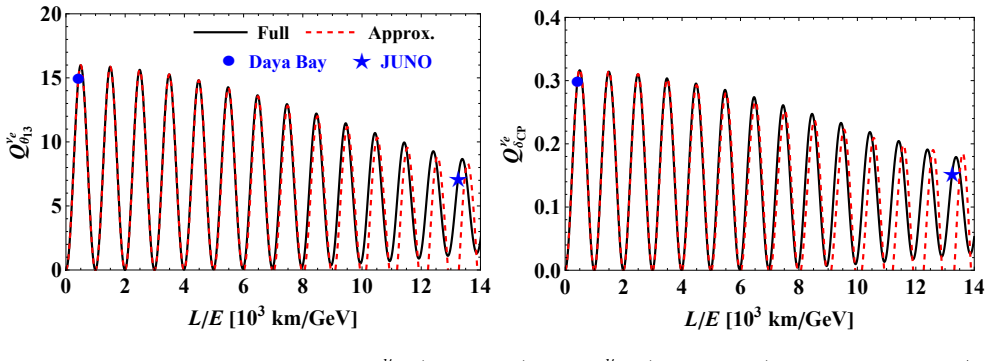
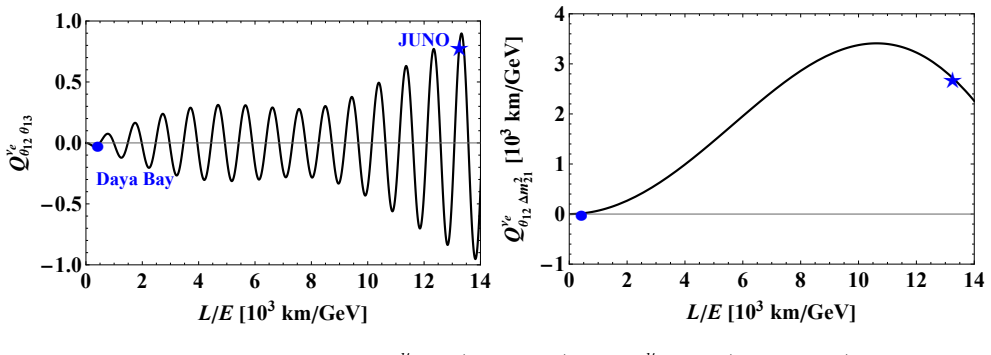
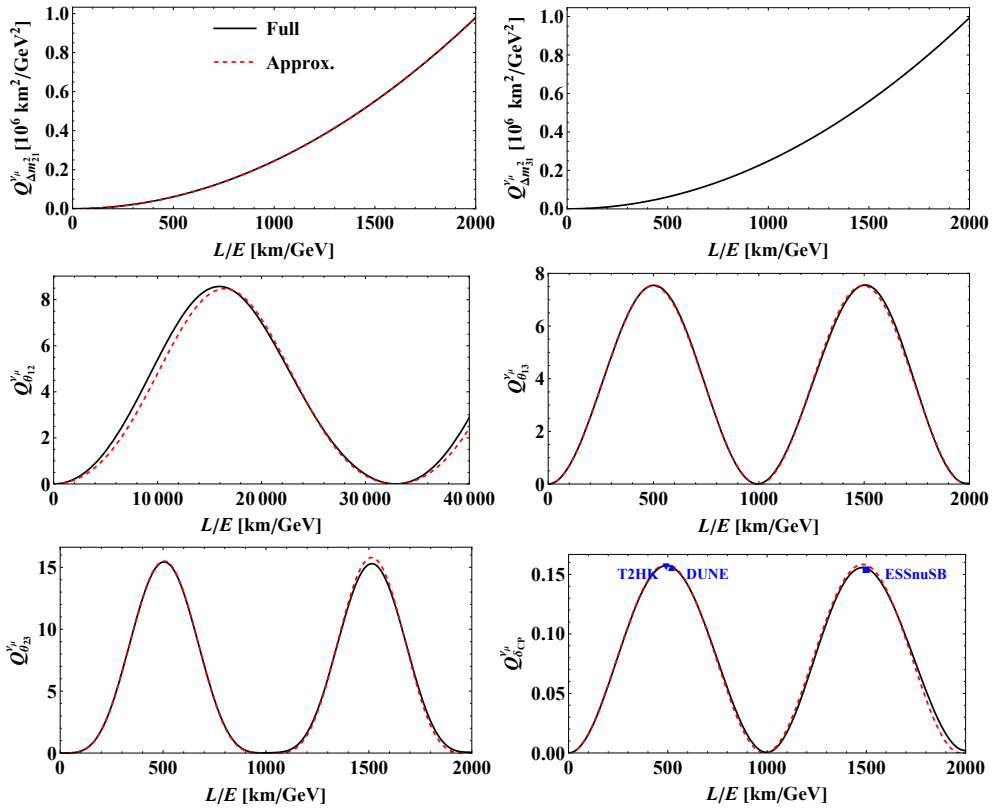
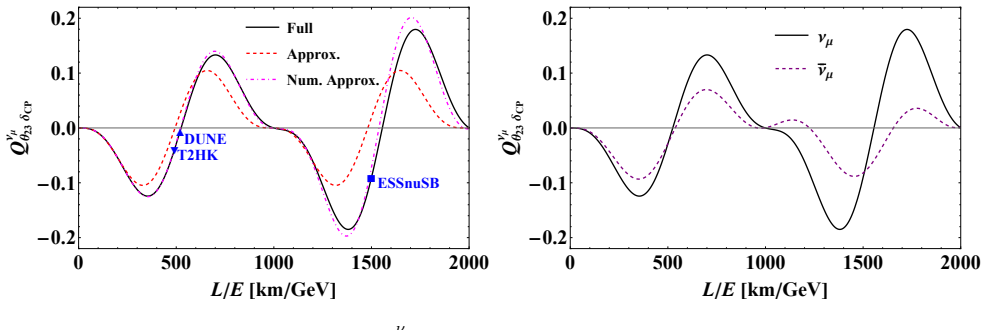
read the original abstract
Quantum estimation theory provides ultimate precision bounds on parameter estimation, independent of experimental setups. In this article, we apply this theoretical framework to neutrino oscillations, aiming to clarify some subtle issues and reveal the maximum achievable precision of oscillation parameters. First, taking the example of two-flavor oscillations, we clarify how the quantum Fisher information (QFI) depends on the choice of bases when the basis transformation itself involves the parameters in question. Then, for three-flavor oscillations, we compute the QFI matrix for electron and muon neutrino states in the flavor basis and derive analytical expressions and numerical results for both diagonal and off-diagonal elements. The implications of off-diagonal correlations for multiparameter estimation are discussed, and the quantum Cram\'{e}r-Rao bounds on the precision of oscillation parameters for typical reactor and long-baseline accelerator neutrino experiments are obtained. Our results establish a theoretical benchmark for the ultimate precision achievable in future neutrino oscillation experiments.
Editorial analysis
A structured set of objections, weighed in public.
Referee Report
Summary. The paper applies quantum estimation theory to neutrino oscillations. It clarifies how the quantum Fisher information depends on basis choice in the two-flavor case when the basis transformation depends on the estimated parameters. For three-flavor oscillations it computes the QFI matrix (both diagonal and off-diagonal elements) for electron and muon neutrino states directly in the flavor basis, derives analytical expressions, discusses the implications of parameter correlations for multiparameter estimation, and extracts quantum Cramér-Rao bounds for representative reactor and long-baseline accelerator setups.
Significance. If the QFI derivations are correct, the work supplies a useful theoretical benchmark for the ultimate precision reachable on oscillation parameters, independent of specific detector details. The explicit two-flavor clarification on basis dependence is a positive contribution that addresses a known subtlety in applying quantum estimation theory to flavor oscillations.
major comments (1)
- [Three-flavor oscillations] Three-flavor section: the manuscript computes the QFI matrix in the flavor basis but supplies no explicit verification that the same matrix (including off-diagonal correlations) is recovered when the state derivatives are recomputed in the mass basis with full differentiation through the θ-dependent PMNS matrix. Without this check the reported quantum Cramér-Rao bounds on Δm²₃₁, θ₁₃, δ_CP etc. cannot be confirmed as the ultimate multiparameter limits.
minor comments (2)
- The abstract states that analytical expressions are derived; these expressions should be written out explicitly (perhaps in an appendix) rather than left implicit.
- Numerical results for the QFI elements and the resulting bounds would benefit from a short table or figure that directly compares the diagonal-only versus full-matrix Cramér-Rao bounds for the reactor and accelerator cases.
Simulated Author's Rebuttal
We thank the referee for their careful reading of the manuscript and for highlighting this important point regarding verification of the QFI matrix. We address the comment below.
read point-by-point responses
-
Referee: Three-flavor section: the manuscript computes the QFI matrix in the flavor basis but supplies no explicit verification that the same matrix (including off-diagonal correlations) is recovered when the state derivatives are recomputed in the mass basis with full differentiation through the θ-dependent PMNS matrix. Without this check the reported quantum Cramér-Rao bounds on Δm²₃₁, θ₁₃, δ_CP etc. cannot be confirmed as the ultimate multiparameter limits.
Authors: We agree that an explicit cross-check is necessary to fully confirm the results. In the revised manuscript we will add a new subsection (or appendix) that recomputes the full QFI matrix, including all off-diagonal elements, by working in the mass basis and differentiating through the parameter-dependent PMNS matrix. We will demonstrate numerical and, where possible, analytical agreement with the flavor-basis expressions already presented, thereby verifying the reported quantum Cramér-Rao bounds. revision: yes
Circularity Check
No circularity: standard QET application with explicit two-flavor clarification
full rationale
The derivation begins from the definition of the quantum Fisher information matrix applied to neutrino flavor states, first resolving the parameter-dependent basis issue explicitly in the two-flavor case before extending to three flavors. No step reduces a claimed prediction or bound to a fitted input, self-citation, or redefinition of the target quantity. The central QCRB results are obtained by direct computation of the QFI elements (diagonal and off-diagonal) on the given states, without any renaming of known patterns or smuggling of ansatze via prior work. This is the normal non-circular outcome for a paper that imports an established framework and applies it to a new domain.
Axiom & Free-Parameter Ledger
axioms (2)
- domain assumption Quantum estimation theory supplies the ultimate precision bound via the quantum Fisher information and Cramér-Rao inequality independent of specific measurement setups.
- domain assumption Neutrino states are described in the flavor basis for the purpose of computing the QFI matrix.
Reference graph
Works this paper leans on
-
[1]
Mesonium and Antimesonium,
B. Pontecorvo, “Mesonium and Antimesonium,” Sov. Phys. JETP6(1958) 429–431
1958
-
[2]
Remarks on the unified model of elementary particles,
Z. Maki, M. Nakagawa, and S. Sakata, “Remarks on the unified model of elementary particles,” Prog. Theor. Phys.28(1962) 870–880. [4]JUNO, F. Anet al., “Neutrino Physics with JUNO,” J. Phys. G43(2016) 030401, arXiv:1507.05613. [5]Hyper-Kamiokande, K. Abeet al., “Hyper-Kamiokande Design Report,” arXiv:1805.04163. [6]DUNE, B. Abiet al., “Deep Underground Neu...
Pith/arXiv arXiv 1962
-
[3]
The European Spallation Source neutrino super-beam conceptual design report,
A. Alekouet al., “The European Spallation Source neutrino super-beam conceptual design report,” Eur. Phys. J. ST231(2022) 3779–3955,arXiv:2206.01208. [Erratum: Eur. Phys. J. ST232, 15–16 (2023)]. [8]JUNO, A. Abuslemeet al., “Sub-percent precision measurement of neutrino oscillation parameters with JUNO,” Chin. Phys. C46(2022) 123001,arXiv:2204.13249
arXiv 2022
-
[4]
Neutrino masses and mixing: Entering the era of subpercent precision,
F. Capozzi, W. Giar` e, E. Lisi, A. Marrone, A. Melchiorri, and A. Palazzo, “Neutrino masses and mixing: Entering the era of subpercent precision,” Phys. Rev. D111(2025) 093006, arXiv:2503.07752. [10]JUNO, A. Abuslemeet al., “Measurement of reactor neutrino oscillation with the first JUNO data,” Nature654(2026) 343–348,arXiv:2511.14593
arXiv 2025
-
[5]
Quantum detection and estimation theory,
C. W. Helstrom, “Quantum detection and estimation theory,” J. Stat. Phys.1(1969) 231–252
1969
-
[6]
Minimum mean-squared error of estimates in quantum statistics,
C. W. Helstrom, “Minimum mean-squared error of estimates in quantum statistics,” Phys. Lett. A25(1967) 101–102
1967
-
[7]
Cram´ er,Mathematical methods of statistics
H. Cram´ er,Mathematical methods of statistics. Princeton University Press, 1946
1946
-
[8]
Information and the Accuracy Attainable in the Estimation of Statistical Parameters,
C. R. Rao, “Information and the Accuracy Attainable in the Estimation of Statistical Parameters,” Breakthroughs in Statistics: Foundations and Basic Theory (1992) 235–247
1992
-
[9]
Quantum estimation in neutrino oscillations,
E. C. Nogueira, G. de Souza, A. D. Varizi, and M. D. Sampaio, “Quantum estimation in neutrino oscillations,” Int. J. Quant. Inf.15(2017) 1750045,arXiv:1610.05388
Pith/arXiv arXiv 2017
-
[10]
Is the large uncertainty ofδ CP fundamentally encoded in the neutrino quantum state?,
M. Ignoti, C. Frugiuele, M. G. A. Paris, and M. G. Genoni, “Is the large uncertainty ofδ CP fundamentally encoded in the neutrino quantum state?,”arXiv:2511.20148
-
[11]
Quantum Fisher Information Revealing Parameter Sensitivity in Long-Baseline Neutrino Experiments,
B. Yadav, A. Subba, and Y. Shi, “Quantum Fisher Information Revealing Parameter Sensitivity in Long-Baseline Neutrino Experiments,”arXiv:2602.05221. 18
-
[12]
Information-Theoretic Gaps in Solar and Reactor Neutrino Oscillation Measurements,
N. R. S. Chundawat and Y.-F. Li, “Information-Theoretic Gaps in Solar and Reactor Neutrino Oscillation Measurements,”arXiv:2602.07991
-
[13]
Quantum Estimation Theory Limits in Neutrino Oscillation Experiments,
C. Frugiuele, M. G. Genoni, M. Ignoti, and M. G. A. Paris, “Quantum Estimation Theory Limits in Neutrino Oscillation Experiments,”arXiv:2602.16534
-
[14]
B. W. Farooq, B. Singh Koranga, and A. Chatterjee, “Quantum Fisher Information as a Probe of Sterile Neutrino New Physics:Geometric Advantage of KM3NeT over IceCube,” arXiv:2604.01256
-
[15]
Leptonic CP Phase Determination from Fisher Information in NOνA and T2K,
N. R. S. Chundawat, L. A. Delgadillo, and Y.-F. Li, “Leptonic CP Phase Determination from Fisher Information in NOνA and T2K,”arXiv:2605.30404
-
[16]
Multiple-parameter quantum estimation and measurement of nonselfadjoint observables,
H. Yuen and M. Lax, “Multiple-parameter quantum estimation and measurement of nonselfadjoint observables,” IEEE Trans. Info. Theor.19(1973) 740–750
1973
-
[17]
Statistical distance and the geometry of quantum states,
S. L. Braunstein and C. M. Caves, “Statistical distance and the geometry of quantum states,” Phys. Rev. Lett.72(1994) 3439–3443
1994
-
[18]
Quantum Estimation for Quantum Technology,
M. G. A. Paris, “Quantum Estimation for Quantum Technology,” Int. J. Quant. Inf.07 (2009) 125–137,arXiv:0804.2981
Pith/arXiv arXiv 2009
-
[19]
Quantum Fisher information and symmetric logarithmic derivative via anti-commutators,
J. Liu, J. Chen, X.-X. Jing, and X. Wang, “Quantum Fisher information and symmetric logarithmic derivative via anti-commutators,” J. Phys. A49(2016) 275302, arXiv:1501.04290
Pith/arXiv arXiv 2016
-
[20]
Quantum Fisher information matrix and multiparameter estimation,
J. Liu, H. Yuan, X.-M. Lu, and X. Wang, “Quantum Fisher information matrix and multiparameter estimation,” J. Phys. A53(2020) 023001,arXiv:1907.08037
arXiv 2020
-
[21]
F. Albarelli, M. Barbieri, M. G. Genoni, and I. Gianani, “A perspective on multiparameter quantum metrology: From theoretical tools to applications in quantum imaging,” Phys. Lett. A384(2020) 126311,arXiv:1911.12067
arXiv 2020
-
[22]
Quantum metrology with unitary parametrization processes,
J. Liu, X.-X. Jing, and X. Wang, “Quantum metrology with unitary parametrization processes,” Sci. Rep.5(2015) 8565,arXiv:1409.4057
Pith/arXiv arXiv 2015
-
[23]
Series expansions for three flavor neutrino oscillation probabilities in matter,
E. K. Akhmedov, R. Johansson, M. Lindner, T. Ohlsson, and T. Schwetz, “Series expansions for three flavor neutrino oscillation probabilities in matter,” JHEP04(2004) 078,arXiv:hep-ph/0402175
Pith/arXiv arXiv 2004
-
[24]
NuFit-6.0: updated global analysis of three-flavor neutrino oscillations,
I. Esteban, M. C. Gonzalez-Garcia, M. Maltoni, I. Martinez-Soler, J. P. Pinheiro, and T. Schwetz, “NuFit-6.0: updated global analysis of three-flavor neutrino oscillations,” JHEP 12(2024) 216,arXiv:2410.05380
Pith/arXiv arXiv 2024
-
[25]
Lessons from the first JUNO results,
I. Esteban, M. C. Gonzalez-Garcia, M. Maltoni, I. Martinez-Soler, J. P. Pinheiro, and T. Schwetz, “Lessons from the first JUNO results,” JHEP04(2026) 089, arXiv:2601.09791. 19 [32]NuFIT, I. Estebanet al., “NuFIT 6.1.”www.nu-fit.org, 2025. [33]Daya Bay, F. P. Anet al., “Comprehensive Measurement of the Reactor Antineutrino Spectrum and Flux at Daya Bay,” P...
Pith/arXiv arXiv 2026
discussion (0)
Sign in with ORCID, Apple, or X to comment. Anyone can read and Pith papers without signing in.