REVIEW 4 major objections 6 minor 38 references
Video-Based MPAA Rating Prediction: An Attention-Driven Hybrid Architecture Using Contrastive Learning
T0 review · 4 major / 6 minor · reviewed 2026-08-04 · deepseek-v4-flash
Pith's one-line read A lightweight hybrid video model classifies MPAA ratings from short clips with 88% accuracy.
desk verdict A plausible but under-verified benchmark: the 88% result rests on an unverified assumption that short clips carry the full movie's MPAA rating. read the letter →
The pith
A machine-rendered reading of the paper's core claim, the machinery that carries it, and where it could break.
The reading
What carries the argument
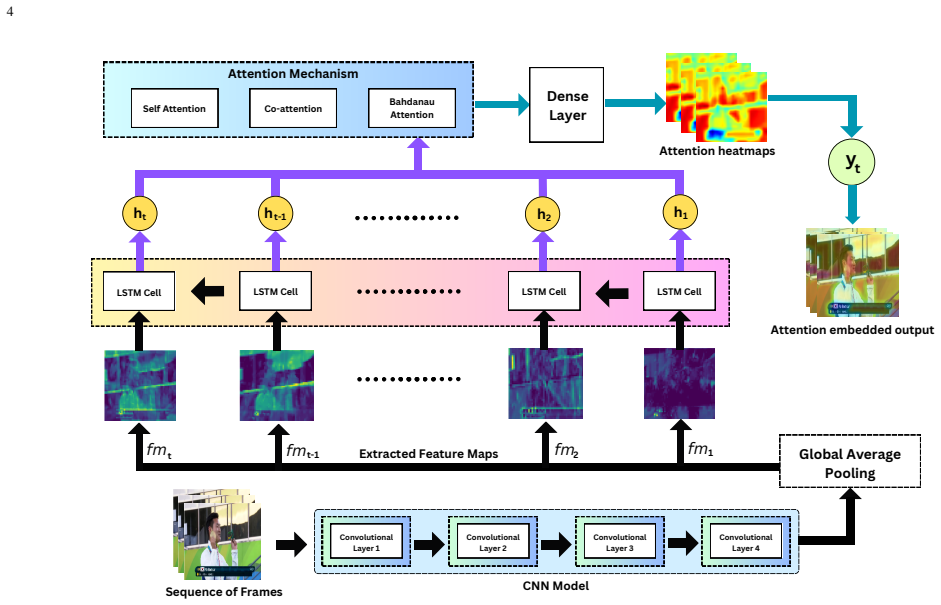
The load-bearing object is the hybrid LRCN + attention encoder trained by contrastive pre-training followed by supervised fine-tuning. LRCN means a CNN that extracts a spatial feature vector per frame, followed by an LSTM that models the frame sequence; this study adds an attention layer on top. In the best configuration the attention is Bahdanau attention, which scores each LSTM hidden state against the final hidden state and forms a weighted context vector, letting the model emphasize the most rating-relevant frames. The contrastive stage uses contextual contrastive learning: positive pairs are augmented versions of the same clip plus adjacent-frame pairs, and the NT-Logistic loss pulls th
What would settle it
Have annotators label a held-out set of clips for the presence of rating-defining content (violence, language, drug use, sexual content). If the model stays near 88% accuracy on clips with none of those elements, it is exploiting non-content cues such as studio style or color grading; the claim that it learns ratings from video content would predict a sharp accuracy drop on such clips.
Extended reading notes
Core claim
The paper's central claim is that adding an attention layer to an LRCN backbone and training it inside a contextual contrastive-learning setup yields the best published MPAA-rating classification from raw video clips. Concretely, the proposed LRCN + Bahdanau attention model, pre-trained with the NT-Logistic contrastive loss and then fine-tuned with cross-entropy, reports 88.00% accuracy, 89.33% precision, 87.01% recall, 88.15% F1, and 0.98 AUC on the unseen 25% test split. It does so with 0.5 million parameters and 7.10 seconds of execution time, beating the ResNet3D-50 baseline (14.38 million parameters) and the plain LRCN backbone across the same contrastive frameworks. The authors describ
Load-bearing premise
The MPAA labels come from the full movies, but each training example is only an 11-to-25-second clip, and the paper reports no check that the clip actually contains rating-relevant content.
Editorial extensions
If this is right
- Age ratings can be predicted from visual content alone, eliminating the need for scripts, subtitles, or metadata.
- The best model is light enough (0.5 M parameters, 7.1 s inference) to run as a real-time web service on modest hardware.
- Contextual contrastive learning with attention beats instance-discrimination and multi-view contrastive learning on this task, so the way contrastive pairs are built matters as much as the backbone.
- The reported accuracy on the close PG-13 versus R boundary suggests the same setup could be pointed at other fine-grained content-moderation decisions.
Reading between the lines
- Because the labels are full-movie MPAA ratings while the model sees only 11-to-25-second clips, a clip-level content audit could reveal how much of the signal is the rating-defining moment versus production style, studio color grading, or genre.
- Bahdanau attention assigns a weight to every frame, so the same model could be repurposed as a localization tool that highlights the frames responsible for a rating—useful for human review.
- If adjacent-frame contextual pairs drive the gain, longer clips or multi-scene sampling should improve accuracy further; that extension is directly testable.
- The paper's own stated limitations—no evaluation on large-scale action datasets, no audio/speech input, and no other video tasks—mean the benchmark claim should be read as specific to this visual-only dataset.
Editorial analysis
A structured set of objections, weighed in public.
Referee Report
Summary. The paper proposes a video-based MPAA rating classifier built on an LRCN (CNN+LSTM) backbone augmented with an attention mechanism, trained within one of three contrastive learning frameworks (Instance Discrimination, Multi-View, Contextual) using one of three contrastive losses (NT-Xent, NT-Logistic, Margin Triplet). The authors construct a custom dataset of 323 clips (11–25 s) labeled with full-movie MPAA ratings (G, PG, PG-13, R). They report that the best configuration, Contextual Contrastive Learning with Bahdanau attention and NT-Logistic loss, achieves 88% accuracy, 88.15% F1, and 0.98 AUC on a 25% held-out test set, while using only 0.5M parameters. The paper also compares param count/execution time across backbones, presents ablations over temperature and attention type, and describes a Flask-based web deployment.
Significance. If the empirical claims were fully substantiated, the paper would offer a lightweight, video-only approach to automated content rating, with a useful comparison of contrastive losses and attention mechanisms on a new task. The strengths are the breadth of the empirical comparison, the clear efficiency story (0.5M parameters, low inference time), and the demonstration of a deployable web system. However, the central claim is a 'state-of-the-art benchmark' on a custom dataset, and that claim is currently supported only by a single test-set evaluation with no error bars, no validation protocol, and no verification that the clip content actually reflects the full-movie MPAA labels. These are load-bearing gaps rather than cosmetic issues, so the significance can only be realized after the evaluation and dataset questions are addressed.
major comments (4)
- [Section III-A] The dataset is described as 323 video clips of 11–25 s collected from internet sources, with labels taken from the MPAA ratings of the full movies. The paper never reports how clips were selected, whether they were chosen to contain rating-relevant content, or whether any human verification matched clip content to the full-movie rating. MPAA ratings often depend on brief or cumulative elements (e.g., one use of strong language, sustained violence, sexual content) that may not appear in an arbitrarily selected short clip. Without this evidence, the reported 88% may reflect dataset artifacts (genre, era, studio, color grade, audio style) rather than rating-relevant visual content. Please provide clip-selection details and a per-clip label-validity analysis, or explicitly rephrase the claim as 'predicting full-movie MPAA ratings from arbitrary short clips' and add a human-baseline compariso
- [Sections IV-A and IV-C] No validation set is described. The ablation study selects the sampling temperature (Figure 8a) and the attention mechanism (Figure 8b) based on test-set performance, and the final configuration (Contextual + Bahdanau + NT-Logistic) appears to be chosen as the best of many configurations evaluated on the same held-out set. This makes the reported 88% a test-set-selected number, which risks optimistic bias. Report a nested validation protocol: use a separate validation split for model/hyperparameter selection and reserve the test set for final evaluation only, or otherwise describe the selection procedure and its effect on the reported metrics.
- [Table II and Section IV-A] All results are reported as point estimates with no error bars, confidence intervals, or significance tests. With only 323 samples and a test set of roughly 81 clips, the differences between the best configuration (88.00%) and the LRCN baseline (82.47%) may be within sampling noise. The claim that the proposed model 'consistently outperforms' alternatives needs multiple runs with different seeds, confidence intervals, and a significance test (e.g., McNemar's test on paired predictions). This is particularly important because the central contribution is a small accuracy/F1 improvement over existing backbones.
- [Section IV-B and Figure 8] There are internal inconsistencies in the reported results. In Section IV-B, observation (2) states that 'in contextual contrastive learning, the margin triplet loss has been found to be the most effective overall,' but Table II shows NT-Logistic achieving 88.00% accuracy versus 85.71% for Margin Triplet in the contextual + LRCN + Attention row. In Section IV-C, the text for Figure 8(b) first says Bahdanau attention achieves the highest performance in contextual learning, then says co-attention records the highest accuracy and F1. These contradictions must be resolved and the figure axes/legend clarified, since the choice of attention mechanism is part of the final model selection.
minor comments (6)
- [Section V, Limitations] The Limitations section does not mention the clip-label validity issue or the test-set selection issue, which are the most consequential limitations of the current study. Please address them explicitly.
- [Section II and References] Reference numbering and names are inconsistent: [7] is cited in the Introduction as 'Masha et al.' but in Related Work as 'Shafaei et al.'; [16] is also attributed to 'Masha et al.' Verify all citations and author names.
- [Section III-A] Dataset details are incomplete: no information on the distribution of clip durations, the number of distinct movies or sources, overlap between clips and movies, or the train/test split (random vs. stratified by movie). This matters for generalization claims and potential data leakage across clips from the same movie.
- [Section III-C] The sentence 'Contrastive learning is an advanced machine learning technique used primarily in unsupervised and semi-supervised settings to train models by teaching them to distinguish' appears truncated. Also, the definition of contextual pairs as 'adjacent frames (X_i, X_{i+1})' is unclear given that the dataset consists of separate clips; clarify whether adjacent pairs come from within a clip or across clips from the same video.
- [Section IV-D and Table III] Execution time is reported without hardware/software details, making the time comparison difficult to interpret. The web app description is brief; a short discussion of latency and deployment constraints would strengthen the practical-application claim.
- [Throughout] The word 'novel' is overused for a combination of well-known components (CNN + LSTM + standard attention mechanisms). Please calibrate the novelty claims and cite the original attention papers more precisely.
Circularity Check
No circularity: the headline result is an empirical benchmark measurement using standard components, with no author self-citation chain and no construction that equates output to input.
full rationale
The paper makes no a priori derivation of its headline result: Eqs. (1)-(31) define standard CNN/LSTM/attention and contrastive-loss components, none of which are parameterized by the final accuracy or F1. The reported 88% / 0.8815 is an empirical measurement on a 25% held-out split (Section IV-A: 'we conducted evaluations on a 25% unseen test set'), not the output of a curve fitted to that quantity. The dataset labels (full-movie MPAA ratings) are external ground truth; although the paper does not verify that 11-25 s clips are sufficient to justify those labels, this is a data-validity threat, not a circularity: the model is not defined in terms of its labels, and the metric is not an input to the architecture. There are no author self-citations, no imported uniqueness theorem, and no claim that an approach is forced by a prior same-author result. The Limitations section (V) is transparent about missing comparisons on large-scale datasets and unexplored contrastive variants; these are scope limitations, not circular steps. The only related concern is model-configuration selection on the same test set (e.g., choosing Bahdanau attention and NT-Logistic after comparing Table II), which can inflate reported numbers but does not make the result equivalent to its inputs by construction. Therefore no circular step is identifiable from the paper's own equations or citation chain.
Assumptions & free parameters
free parameters (4)
- Sampling temperature tau for contrastive losses =
0.1
- Margin for Margin Triplet loss =
not stated
- Sequence length =
20 frames
- Fine-tuning learning rate =
1e-5
assumptions (4)
- domain assumption Short clips inherit the MPAA rating of the full movie
- domain assumption The collected internet clips are correctly labeled and representative
- domain assumption Augmented views of the same clip form valid positive pairs for contrastive pre-training
- domain assumption A random 25% test split is an unbiased estimate of generalization
Cite this review
Pith. "Pith review of Video-Based MPAA Rating Prediction: An Attention-Driven Hybrid Architecture Using Contrastive Learning." pith.science (2026). https://pith.science/paper/YC73FM4Q
@misc{pith2026250906826,
  author       = {Pith},
  title        = {Pith review of: Video-Based MPAA Rating Prediction: An Attention-Driven Hybrid Architecture Using Contrastive Learning},
  year         = {2026},
  howpublished = {\url{https://pith.science/paper/YC73FM4Q}},
  note         = {Machine review of arXiv:2509.06826}
}
read the original abstract
The rapid growth of visual content consumption across platforms necessitates automated video classification for age-suitability standards like the MPAA rating system (G, PG, PG-13, R). Traditional methods struggle with large labeled data requirements, poor generalization, and inefficient feature learning. To address these challenges, we employ contrastive learning for improved discrimination and adaptability, exploring three frameworks: Instance Discrimination, Contextual Contrastive Learning, and Multi-View Contrastive Learning. Our hybrid architecture integrates an LRCN (CNN+LSTM) backbone with a Bahdanau attention mechanism, achieving state-of-the-art performance in the Contextual Contrastive Learning framework, with 88% accuracy and an F1 score of 0.8815. By combining CNNs for spatial features, LSTMs for temporal modeling, and attention mechanisms for dynamic frame prioritization, the model excels in fine-grained borderline distinctions, such as differentiating PG-13 and R-rated content. We evaluate the model's performance across various contrastive loss functions, including NT-Xent, NT-logistic, and Margin Triplet, demonstrating the robustness of our proposed architecture. To ensure practical application, the model is deployed as a web application for real-time MPAA rating classification, offering an efficient solution for automated content compliance across streaming platforms.
Figures


Figures from the paper (6 more)


Reference graph
Works this paper leans on
-
[1]
Netflix, amazon, and branded television content in subscription video on-demand portals,
M. L. Wayne, “Netflix, amazon, and branded television content in subscription video on-demand portals,”Media, culture & society, vol. 40, no. 5, pp. 725–741, 2018
work page 2018
-
[2]
G. Anghelcev, S. Sar, J. D. Martin, and J. L. Moultrie, “Binge-watching serial video content: exploring the subjective phenomenology of the binge-watching experience,”Mass Communication and Society, vol. 24, no. 1, pp. 130–154, 2021
work page 2021
-
[3]
Motion picture association of americ a (mpaa),
B. v. F. County and M. v. Frederick, “Motion picture association of americ a (mpaa),”ENCYCLOPEDIA OF AMERICAN CIVIL RIGHTS AND LIBERTIES, vol. 95, no. 7, p. 635
-
[4]
The mpaa ratings system: A regime of private censorship and cultural manipulation,
J. Septimus, “The mpaa ratings system: A regime of private censorship and cultural manipulation,”Colum.-VLA JL & Arts, vol. 21, p. 69, 1996
work page 1996
-
[5]
P. Falkowski-Gilski and T. Uhl, “Current trends in consumption of multimedia content using online streaming platforms: A user-centric survey,”Computer Science Review, vol. 37, p. 100268, 2020
work page 2020
-
[6]
“you need at least one picture daily, if not, you’re dead
A. Arriagada and F. Ib ´a˜nez, ““you need at least one picture daily, if not, you’re dead”: content creators and platform evolution in the social media ecology,”Social Media+ Society, vol. 6, no. 3, p. 2056305120944624, 2020
work page 2020
-
[7]
M. Shafaei, N. S. Samghabadi, S. Kar, and T. Solorio, “Rating for parents: Predicting children suitability rating for movies based on language of the movies,”arXiv preprint arXiv:1908.07819, 2019
work page Pith review arXiv 1908
-
[8]
Combining text and images for film age appropriate- ness classification,
E. Mohamedet al., “Combining text and images for film age appropriate- ness classification,”Procedia Computer Science, vol. 189, pp. 242–249, 2021
work page 2021
Show all 38 references
-
[9]
Lrcn based human activity recognition from video data,
M. S. Uzzaman, C. Debnath, M. A. Uddin, M. M. Islam, M. A. Talukder, and S. Parvez, “Lrcn based human activity recognition from video data,” SSRN Electronic Journal, 2022
2022
-
[10]
Deep learning-based human activity recognition using cnn, convlstm, and lrcn,
M. A. Uddin, M. A. Talukder, M. S. Uzzaman, C. Debnath, M. Chanda, S. Paul, M. M. Islam, A. Khraisat, A. Alazab, and S. Aryal, “Deep learning-based human activity recognition using cnn, convlstm, and lrcn,”International Journal of Cognitive Computing in Engineering, vol. 5, pp...
2024
-
[11]
A closer look at spatiotemporal convolutions for action recognition,
D. Tran, H. Wang, L. Torresani, J. Ray, Y . LeCun, and M. Paluri, “A closer look at spatiotemporal convolutions for action recognition,” in Proceedings of the IEEE conference on Computer Vision and Pattern Recognition, 2018, pp. 6450–6459
2018
-
[12]
Segregating and recognizing human actions from video footages using lrcn technique,
M. Pandya, A. Pillai, and H. Rupani, “Segregating and recognizing human actions from video footages using lrcn technique,” inAd- vanced Machine Learning Technologies and Applications: Proceedings of AMLTA 2020. Springer, 2021, pp. 3–13
2020
-
[13]
Attention is all you need,
A. Vaswani, “Attention is all you need,”Advances in Neural Information Processing Systems, 2017
2017
-
[14]
Hierarchical question-image co- attention for visual question answering,
J. Lu, J. Yang, D. Batra, and D. Parikh, “Hierarchical question-image co- attention for visual question answering,”Advances in neural information processing systems, vol. 29, 2016
2016
-
[15]
Neural machine translation by jointly learning to align and translate,
D. Bahdanau, “Neural machine translation by jointly learning to align and translate,”arXiv preprint arXiv:1409.0473, 2014
2014 arXiv
-
[16]
A case study of deep learning based multi-modal methods for predicting the age- suitability rating of movie trailers,
M. Shafaei, C. Smailis, I. A. Kakadiaris, and T. Solorio, “A case study of deep learning based multi-modal methods for predicting the age- suitability rating of movie trailers,”arXiv preprint arXiv:2101.11704, 2021
2021 arXiv
-
[17]
Spatiotemporal contrastive video representation learning,
R. Qian, T. Meng, B. Gong, M.-H. Yang, H. Wang, S. Belongie, and Y . Cui, “Spatiotemporal contrastive video representation learning,” inProceedings of the IEEE/CVF conference on computer vision and pattern recognition, 2021, pp. 6964–6974
2021
-
[18]
The kinetics human action video dataset,
W. Kay, J. Carreira, K. Simonyan, B. Zhang, C. Hillier, S. Vijaya- narasimhan, F. Viola, T. Green, T. Back, P. Natsevet al., “The kinetics human action video dataset,”arXiv preprint arXiv:1705.06950, 2017
2017 arXiv
-
[19]
Vi2clr: Video and image for visual contrastive learn- ing of representation,
A. Diba, V . Sharma, R. Safdari, D. Lotfi, S. Sarfraz, R. Stiefelhagen, and L. Van Gool, “Vi2clr: Video and image for visual contrastive learn- ing of representation,” inProceedings of the IEEE/CVF international conference on computer vision, 2021, pp. 1502–1512
2021
-
[20]
Momentum contrast for unsupervised visual representation learning,
K. He, H. Fan, Y . Wu, S. Xie, and R. Girshick, “Momentum contrast for unsupervised visual representation learning,” inProceedings of the IEEE/CVF conference on computer vision and pattern recognition, 2020, pp. 9729–9738
2020
-
[21]
A simple framework for contrastive learning of visual representations,
T. Chen, S. Kornblith, M. Norouzi, and G. Hinton, “A simple framework for contrastive learning of visual representations,” inInternational conference on machine learning. PMLR, 2020, pp. 1597–1607
2020
-
[22]
Video representation learning with visual tempo consistency,
C. Yang, Y . Xu, B. Dai, and B. Zhou, “Video representation learning with visual tempo consistency,”arXiv preprint arXiv:2006.15489, 2020
2006 arXiv
-
[23]
Ucf101: A dataset of 101 human actions classes from videos in the wild,
K. Soomro, “Ucf101: A dataset of 101 human actions classes from videos in the wild,”arXiv preprint arXiv:1212.0402, 2012
2012 arXiv
-
[24]
Vic-mae: Self-supervised representation learning from images and video with contrastive masked autoencoders,
J. Hernandez, R. Villegas, and V . Ordonez, “Vic-mae: Self-supervised representation learning from images and video with contrastive masked autoencoders,” inEuropean Conference on Computer Vision. Springer, 2025, pp. 444–463
2025
-
[25]
Audio-visual contrastive learning with temporal self-supervision,
S. Jenni, A. Black, and J. Collomosse, “Audio-visual contrastive learning with temporal self-supervision,” inProceedings of the AAAI Conference on Artificial Intelligence, vol. 37, no. 7, 2023, pp. 7996–8004
2023
-
[26]
Hmdb: a large video database for human motion recognition,
H. Kuehne, H. Jhuang, E. Garrote, T. Poggio, and T. Serre, “Hmdb: a large video database for human motion recognition,” in2011 Interna- tional conference on computer vision. IEEE, 2011, pp. 2556–2563
2011
-
[27]
Efficient multiscale multimodal bottleneck transformer for audio-video classification,
W. Zhu, “Efficient multiscale multimodal bottleneck transformer for audio-video classification,”arXiv preprint arXiv:2401.04023, 2024
2024 arXiv
-
[28]
Molo: Motion-augmented long-short contrastive learning for few-shot action recognition,
X. Wang, S. Zhang, Z. Qing, C. Gao, Y . Zhang, D. Zhao, and N. Sang, “Molo: Motion-augmented long-short contrastive learning for few-shot action recognition,” inProceedings of the IEEE/CVF Conference on Computer Vision and Pattern Recognition, 2023, pp. 18 011–18 021. 12
2023
-
[29]
Detco: Unsupervised contrastive learning for object detection,
E. Xie, J. Ding, W. Wang, X. Zhan, H. Xu, P. Sun, Z. Li, and P. Luo, “Detco: Unsupervised contrastive learning for object detection,” inProceedings of the IEEE/CVF international conference on computer vision, 2021, pp. 8392–8401
2021
-
[30]
Big self-supervised models are strong semi-supervised learners,
T. Chen, S. Kornblith, K. Swersky, M. Norouzi, and G. E. Hinton, “Big self-supervised models are strong semi-supervised learners,”Advances in neural information processing systems, vol. 33, pp. 22 243–22 255, 2020
2020
-
[31]
Contrastive multiview coding,
Y . Tian, D. Krishnan, and P. Isola, “Contrastive multiview coding,” in Computer Vision–ECCV 2020: 16th European Conference, Glasgow, UK, August 23–28, 2020, Proceedings, Part XI 16. Springer, 2020, pp. 776–794
2020
-
[32]
Contextrast: Contextual contrastive learning for semantic segmentation,
C. Sung, W. Kim, J. An, W. Lee, H. Lim, and H. Myung, “Contextrast: Contextual contrastive learning for semantic segmentation,” inPro- ceedings of the IEEE/CVF conference on computer vision and pattern recognition, 2024, pp. 3732–3742
2024
-
[33]
Dimensionality reduction by learning an invariant mapping,
R. Hadsell, S. Chopra, and Y . LeCun, “Dimensionality reduction by learning an invariant mapping,” in2006 IEEE computer society con- ference on computer vision and pattern recognition (CVPR’06), vol. 2. IEEE, 2006, pp. 1735–1742
2006
-
[34]
A deep learning approach for the motion picture content rating,
M. Gruosso, N. Capece, U. Erra, and N. Lopardo, “A deep learning approach for the motion picture content rating,” in2019 10th IEEE International Conference on Cognitive Infocommunications (CogInfo- Com), 2019, pp. 137–142
2019
-
[35]
Detecting the absence of lung sliding in ultrasound videos using 3d convolutional neural networks,
M. Kolarik, M. Sarnovsk `y, and J. Paraliˇc, “Detecting the absence of lung sliding in ultrasound videos using 3d convolutional neural networks,” Acta Polytechnica Hungarica, vol. 20, no. 6, pp. 47–60, 2023
2023
-
[36]
Recognizing 50 human action categories of web videos,
K. K. Reddy and M. Shah, “Recognizing 50 human action categories of web videos,”Machine vision and applications, vol. 24, no. 5, pp. 971–981, 2013
2013
-
[37]
Detection of stress, anxiety and depression (sad) in video surveillance using resnet-101,
A. Singh and D. Kumar, “Detection of stress, anxiety and depression (sad) in video surveillance using resnet-101,”Microprocessors and Microsystems, vol. 95, p. 104681, 2022
2022
-
[38]
Human action recognition in video using db-lstm and resnet,
A. Mihanpour, M. J. Rashti, and S. E. Alavi, “Human action recognition in video using db-lstm and resnet,” in2020 6th International Conference on Web Research (ICWR). IEEE, 2020, pp. 133–138
2020
Reviewed August 4, 2026 · model on record in the stance chip above.
Discussion (0). Continue with ORCID to comment.