REVIEW 3 major objections 5 minor 1 cited by
MADation: Face Morphing Attack Detection with Foundation Models
T0 review · 3 major / 5 minor · reviewed 2026-08-10 · deepseek-v4-flash
Pith's one-line read Adapting a pre-trained CLIP model with low-rank LoRA weights and a trained classifier yields a face morphing attack detector that outperforms from-scratch ViTs and is competitive with specialised MAD systems.
desk verdict CLIP+LoRA works for morphing detection and the paper is worth engaging with, but a Table 2 mislabel and an undertrained baseline need fixing. read the letter →
The pith
A machine-rendered reading of the paper's core claim, the machinery that carries it, and where it could break.
The reading
What carries the argument
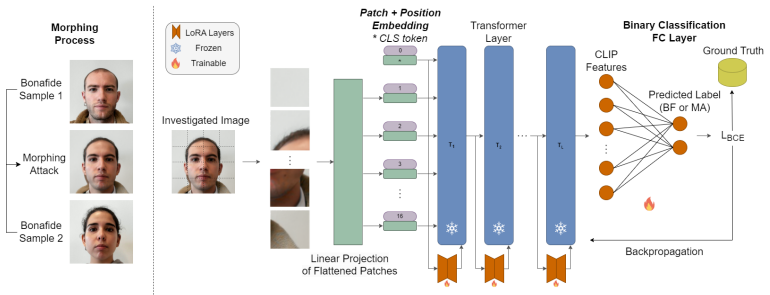
The central mechanism is Low-Rank Adaptation (LoRA) applied to a frozen CLIP image encoder, with a rank-stabilized scaling factor: for each adapted attention layer the update is $W = W_0 + \gamma_r BA$ with $B \in \mathbb{R}^{d\times r}$, $A \in \mathbb{R}^{r\times k}$, and $\gamma_r = \alpha/\sqrt{r}$ (rsLoRA), applied only to the query and value projection matrices. Alongside these trainable matrices, a two-neuron fully connected header with softmax is trained with binary cross-entropy, producing the bona-fide-versus-morph decision. Because the pre-trained weights stay frozen and only the low-rank matrices and header are updated, the method adapts the embedding space to the MAD task while preserving CLIP's pre-trained knowledge.
What would settle it
Run the same LoRA-plus-classifier training on SMDD from randomly initialized CLIP weights (no pre-training) for the same 40 epochs and compare average EER on MAD22 and MorDIFF: if the random-init model approaches MADation's roughly 11.9% average EER, the advantage over from-scratch ViTs is a product of the LoRA training procedure, not of CLIP's pre-trained knowledge.
Extended reading notes
Core claim
On its own terms, the paper's discovery is that a foundation model's pre-trained feature space can be aligned to the face-morphing-attack detection task by rank-stabilized low-rank adaptation, producing a detector that outperforms transformer baselines and prior MAD methods in several scenarios. Concretely, for a CLIP ViT-L backbone, MADation reduces the average detection equal error rate by 16.93 percentage points relative to training the same ViT from scratch and by 8.10 points relative to using the frozen CLIP encoder with only a classifier; the ViT-B variant shows the same ordering with gains of 10.24 and 9.56 points, respectively. The paper positions MADation as the first application of foundation models to MAD, and reports near-perfect detection on some morphing techniques, such as zero EER for FaceMorph with ViT-B, while remaining competitive on harder GAN-based and diffusion-based morphs.
Load-bearing premise
The load-bearing premise is that the from-scratch ViT baseline was trained well enough to represent what a non-foundation-model transformer can do, since it got only 40 epochs on a small synthetic dataset.
Editorial extensions
If this is right
- MADation is best or second-best in 23/42 (ViT-B) and 21/42 (ViT-L) of the MAD22/MorDIFF scenarios against prior solutions, and 12/20 and 9/20 on FRLL-Morphs.
- Adapting the FM with LoRA improves over both the frozen-feature extractor and the from-scratch ViT, indicating that pre-trained knowledge and task-specific fine-tuning combine productively for MAD.
- The detector generalizes across unseen morphing techniques, including GAN-based MIPGAN, diffusion-based MorDIFF, and landmark-based methods, despite training only on OpenCV-morphed synthetic images.
- Because only LoRA matrices and a classification header are trained, the approach adds minimal trainable parameters and no inference overhead, making it a computationally inexpensive MAD solution.
- The publicly released implementation allows other groups to reproduce and extend the method.
Reading between the lines
- Editorial inference: if the from-scratch ViT baseline were trained until convergence rather than for a fixed 40 epochs, part of the gap might shrink; the paper's cleanest claim is that LoRA adaptation of a frozen FM is an efficient way to reach competitive MAD performance, not that pre-training is strictly necessary.
- Editorial inference: the same LoRA-plus-header recipe could plausibly transfer to other low-data biometric sub-tasks, such as presentation attack detection or deepfake detection, where a domain-specific shift must be learned from small datasets.
- Editorial inference: the zero-shot results show CLIP's text-image prompting is weak for morph detection except on some GAN attacks with ViT-L, suggesting that a text-guided prompt-tuning variant, rather than only LoRA on the image encoder, is a natural next experiment.
Editorial analysis
A structured set of objections, weighed in public.
Referee Report
Summary. The paper proposes MADation, a face morphing attack detection (MAD) framework obtained by adapting CLIP vision encoders with rank-stabilized LoRA (rsLoRA) and a trainable binary classification header. The models are trained on the synthetic SMDD dataset and evaluated on MAD22, MorDIFF, and FRLL-Morphs. The central empirical claim is that LoRA-adapted CLIP (ViT-B and ViT-L) outperforms the paper's own transformer/FM baselines (zero-shot text-image, frozen feature extractor, and from-scratch ViT) and is competitive with or better than recent MAD methods, with reported average EER reductions of 16.93 pp over ViT-FS and 8.10 pp over FE for ViT-L. The implementation is publicly released.
Significance. If the central claims hold, the paper would be a useful demonstration that foundation-model representations can be adapted to the domain-specific MAD task with parameter-efficient fine-tuning, and it would be among the first works to apply FM adaptation to face morphing detection. The paper has several strengths: it provides public code, trains on a separate synthetic dataset rather than tuning on the test benchmarks, evaluates across three common MAD benchmarks, and includes ablations that separate the contributions of frozen features and LoRA adaptation. However, the strength of the headline claims is weakened by a concrete inconsistency in Table 2 and by a from-scratch ViT baseline that appears undertrained; these issues need to be resolved before the reported advantages can be taken as established.
major comments (3)
- [§5, Table 2] In Table 2, the ViT-L MADation rows after MIPGAN II are shifted relative to Table 1. Specifically, the row labeled OpenCV in Table 2 contains the values that Table 1 reports for MorDIFF (EER 19.26), the row labeled WebMorph contains Table 1's OpenCV values (EER 2.23), and the row labeled MorDIFF contains Table 1's WebMorph values (EER 20.40). The text in Section 5 states that "ViT-L consistently outperforms the remaining techniques in FaceMorph, MIPGAN II and WebMorph," but that WebMorph claim rests on the mislabeled row; Table 1 gives WebMorph EER 20.40 for ViT-L MADation, not 2.23. This shift also affects the reported counts of best/second-best results. The table and the associated comparative claims must be corrected.
- [§3.3 and §4 (Implementation Details)] The claim that FM pre-training is the source of MADation's advantage over ViT-FS is not well supported because the ViT-FS baseline is trained from scratch for only 40 epochs with no reported learning-rate schedule or convergence criterion. For ViT-L with roughly 300 million parameters, a batch size of 256, and about 40k SMDD training images, 40 epochs is only about 6,300 optimization steps, which is very likely insufficient to train a ViT of this size from random initialization. The reported 16.93 pp average EER gap over ViT-FS may therefore reflect an difference in effective optimization budget rather than the value of CLIP's pre-trained knowledge. The authors should either train ViT-FS to convergence with a comparable budget and schedule, or substantially temper the attribution claim.
- [§5, Table 1] All results are reported as single point estimates with no error bars, multiple seeds, or statistical significance tests. Given that some comparisons are close (e.g., ViT-B FE average EER 21.45 vs. ViT-FS 22.13, and several per-dataset differences of 1-2 pp), the claims that MADation "surpasses" baselines and is "competitive" with prior work would be more convincing with variance estimates or a reproducibility study over at least a few seeds.
minor comments (5)
- [§4 (Image Pre-Processing)] The text refers to "Alexey et al. [2]" for the tokenization/preprocessing of ViT; the reference is to Dosovitskiy et al., which should be cited correctly, and the misspelling "non-overleaping" should be corrected to "non-overlapping."
- [§4 (Model Architecture)] The notation "ViT-B and ViT-L" is clear, but the model sizes (86M and 0.3 billion parameters) are given in inconsistent units; the paper should state both values in a uniform way.
- [Table 3] Table 3 has formatting issues that affect readability: values are concatenated with dataset names (e.g., "FRLL-Style-GAN216.64" and "FRLL-Style-GAN211.37"), and the column header "EER (%)BPCER (%) @ APCER (%)" is missing a separator. These should be cleaned up in the final version.
- [Table 2] The D-FW-CDCN row in Table 2 appears malformed, with the FaceMorph entry reading "FaceMorph0.00 44.10MIPGANI" and subsequent values running together; this makes the row difficult to interpret and should be fixed.
- [Throughout] The paper alternates between "adaption" and "adaptation"; the authors should choose one spelling and apply it consistently.
Circularity Check
No significant circularity: MADation's evaluation is empirical against external benchmarks with a disjoint synthetic training set; the self-citations are motivational or design choices, not load-bearing reductions.
full rationale
The paper's derivation chain is empirical and self-contained. MADation (CLIP + LoRA + classification header) is trained on the synthetic SMDD dataset and evaluated on external benchmarks (MAD22, MorDIFF, FRLL-Morphs) that are disjoint from training. The central comparisons — against ViT-FS (same architecture trained from scratch) and FE (frozen CLIP features plus a trained header) — are ablations that isolate the contribution of pre-trained knowledge and LoRA adaptation; the reported EER values are measured, not fitted, and no test labels enter the training procedure. The choice of CLIP and LoRA hyperparameters is motivated by prior work, including the authors' own [11], but that citation is used as a design starting point, not as a uniqueness theorem or as the source of the reported performance. No equation reduces to its own input: the LoRA update W = W0 + gamma*B*A is a parameterization, and the classification head is trained with standard cross-entropy. The paper does not rename a known result; it applies an established adaptation technique to a new task and benchmarks it. One noted issue in Table 2 involves a row-label shift for the ViT-L MADation results on OpenCV/WebMorph/MorDIFF, which is a reporting or transcription inconsistency that affects the textual comparison but is not a circularity. Similarly, the concern that ViT-FS may be undertrained after 40 epochs is a training-budget confound, not a circular derivation, because the comparison with ViT-FS is an external empirical baseline rather than a fitted quantity. Overall, no load-bearing step reduces to its own input, and the score is therefore 0.
Assumptions & free parameters
free parameters (5)
- LoRA rank r =
2
- LoRA alpha =
4 (ViT-B), 8 (ViT-L)
- LoRA dropout =
0.4 (ViT-B), 0.2 (ViT-L)
- Model and header learning rates =
1e-5 and 1e-4 (MADation); 1e-2 header (FE); 1e-5/5e-5 or 1e-4/1e-4 (ViT-FS)
- Training epochs and batch size =
40 epochs, batch 256
assumptions (4)
- domain assumption CLIP's pre-trained visual features contain useful information for face morphing detection after LoRA adaptation.
- domain assumption SMDD synthetic training data is representative enough to generalize to morphing attacks from FRLL-based benchmarks.
- ad hoc to paper Training a ViT from scratch for 40 epochs is a fair baseline for measuring the value of foundation-model pre-training.
- domain assumption rsLoRA scaling prevents gradient collapse and is appropriate at low rank r=2.
Cite this review
Pith. "Pith review of MADation: Face Morphing Attack Detection with Foundation Models." pith.science (2026). https://pith.science/paper/YCITYSXG
@misc{pith2026250103800,
  author       = {Pith},
  title        = {Pith review of: MADation: Face Morphing Attack Detection with Foundation Models},
  year         = {2026},
  howpublished = {\url{https://pith.science/paper/YCITYSXG}},
  note         = {Machine review of arXiv:2501.03800}
}
read the original abstract
Despite the considerable performance improvements of face recognition algorithms in recent years, the same scientific advances responsible for this progress can also be used to create efficient ways to attack them, posing a threat to their secure deployment. Morphing attack detection (MAD) systems aim to detect a specific type of threat, morphing attacks, at an early stage, preventing them from being considered for verification in critical processes. Foundation models (FM) learn from extensive amounts of unlabelled data, achieving remarkable zero-shot generalization to unseen domains. Although this generalization capacity might be weak when dealing with domain-specific downstream tasks such as MAD, FMs can easily adapt to these settings while retaining the built-in knowledge acquired during pre-training. In this work, we recognize the potential of FMs to perform well in the MAD task when properly adapted to its specificities. To this end, we adapt FM CLIP architectures with LoRA weights while simultaneously training a classification header. The proposed framework, MADation surpasses our alternative FM and transformer-based frameworks and constitutes the first adaption of FMs to the MAD task. MADation presents competitive results with current MAD solutions in the literature and even surpasses them in several evaluation scenarios. To encourage reproducibility and facilitate further research in MAD, we publicly release the implementation of MADation at https://github.com/gurayozgur/MADation
Figures
Forward citations
Cited by 1 Pith paper
-
In-context Learning of Vision Language Models for Detection of Physical and Digital Attacks against Face Recognition Systems
An in-context learning framework with open-source vision-language models detects face presentation and morphing attacks without training, beating CLIP-based zero-shot baselines on PAD but with performance highly sensi...
Reference graph
Works this paper leans on
-
[1]
In- trinsic dimensionality explains the effectiveness of language model fine-tuning
Armen Aghajanyan, Luke Zettlemoyer, and Sonal Gupta. In- trinsic dimensionality explains the effectiveness of language model fine-tuning. arXiv preprint arXiv:2012.13255, 2020. 4
arXiv 2012
-
[2]
An image is worth 16x16 words: Trans- formers for image recognition at scale
Dosovitskiy Alexey. An image is worth 16x16 words: Trans- formers for image recognition at scale. arXiv preprint arXiv: 2010.11929, 2020. 5
arXiv 2010
-
[3]
Morphed face detection with wavelet- based co-occurrence matrices
Ismail Avcibas. Morphed face detection with wavelet- based co-occurrence matrices. IEEE Signal Process. Lett. , 31:1344–1348, 2024. 8
work page 2024
-
[4]
Rishi Bommasani, Drew A. Hudson, Ehsan Adeli, Russ B. Altman, Simran Arora, Sydney von Arx, Michael S. Bern- stein, Jeannette Bohg, Antoine Bosselut, Emma Brun- skill, Erik Brynjolfsson, Shyamal Buch, Dallas Card, Ro- drigo Castellon, Niladri S. Chatterji, Annie S. Chen, Kath- leen Creel, Jared Quincy Davis, Dorottya Demszky, Chris Donahue, Moussa Doumbou...
arXiv 2021
-
[5]
Elasticface: Elastic margin loss for deep face recognition
Fadi Boutros, Naser Damer, Florian Kirchbuchner, and Ar- jan Kuijper. Elasticface: Elastic margin loss for deep face recognition. In Proceedings of the IEEE/CVF conference on computer vision and pattern recognition, pages 1578–1587,
-
[6]
Tom B. Brown, Benjamin Mann, Nick Ryder, Melanie Sub- biah, Jared Kaplan, Prafulla Dhariwal, Arvind Neelakan- tan, Pranav Shyam, Girish Sastry, Amanda Askell, Sand- hini Agarwal, Ariel Herbert-V oss, Gretchen Krueger, Tom Henighan, Rewon Child, Aditya Ramesh, Daniel M. Ziegler, Jeffrey Wu, Clemens Winter, Christopher Hesse, Mark Chen, Eric Sigler, Mateusz...
work page 2020
-
[7]
Unveiling the two-faced truth: Disentangling morphed identities for face morphing detection
Eduarda Caldeira, Pedro C Neto, Tiago Gonc ¸alves, Naser Damer, Ana F Sequeira, and Jaime S Cardoso. Unveiling the two-faced truth: Disentangling morphed identities for face morphing detection. In 2023 31st European Signal Process- ing Conference (EUSIPCO), pages 955–959. IEEE, 2023. 1, 2, 5, 8
work page 2023
-
[8]
Adapting vision foundation models for plant pheno- typing
Feng Chen, Mario Valerio Giuffrida, and Sotirios A Tsaf- taris. Adapting vision foundation models for plant pheno- typing. In Proceedings of the IEEE/CVF International Con- ference on Computer Vision, pages 604–613, 2023. 3, 7
work page 2023
Show all 56 references
-
[9]
Adaptformer: Adapting vision transformers for scalable visual recogni- tion
Shoufa Chen, Chongjian Ge, Zhan Tong, Jiangliu Wang, Yibing Song, Jue Wang, and Ping Luo. Adaptformer: Adapting vision transformers for scalable visual recogni- tion. Advances in Neural Information Processing Systems , 35:16664–16678, 2022. 2, 4
2022
-
[10]
Vision transformer adapter for dense predictions
Zhe Chen, Yuchen Duan, Wenhai Wang, Junjun He, Tong Lu, Jifeng Dai, and Yu Qiao. Vision transformer adapter for dense predictions. arXiv preprint arXiv:2205.08534, 2022. 2, 4
2022 arXiv
-
[11]
Froun- dation: Are foundation models ready for face recognition? arXiv preprint arXiv:2410.23831, 2024
Tahar Chettaoui, Naser Damer, and Fadi Boutros. Froun- dation: Are foundation models ready for face recognition? arXiv preprint arXiv:2410.23831, 2024. 1, 2, 3, 4, 5, 6, 7
2024 arXiv
-
[12]
Detect- ing face morphing attacks by analyzing the directed distances of facial landmarks shifts
Naser Damer, Viola Boller, Yaza Wainakh, Fadi Boutros, Philipp Terh¨orst, Andreas Braun, and Arjan Kuijper. Detect- ing face morphing attacks by analyzing the directed distances of facial landmarks shifts. In Pattern Recognition: 40th Ger- man Conference, GCPR 2018, Stuttgart,...
2018
-
[13]
Mordiff: Recognition vul- nerability and attack detectability of face morphing attacks created by diffusion autoencoders
Naser Damer, Meiling Fang, Patrick Siebke, Jan Niklas Kolf, Marco Huber, and Fadi Boutros. Mordiff: Recognition vul- nerability and attack detectability of face morphing attacks created by diffusion autoencoders. In 2023 11th Interna- tional Workshop on Biometrics and Forensic...
2023
-
[14]
Privacy-friendly synthetic data for the development of face morphing attack detectors
Naser Damer, C ´esar Augusto Fontanillo L ´opez, Meiling Fang, No ´emie Spiller, Minh Vu Pham, and Fadi Boutros. Privacy-friendly synthetic data for the development of face morphing attack detectors. In CVPR Workshops , pages 1605–1616. IEEE, 2022. 5, 7, 8
2022
-
[15]
Morgan: Recognition vulnerability and attack detectability of face morphing attacks created by gen- erative adversarial network
Naser Damer, Alexandra Mosegui Saladie, Andreas Braun, and Arjan Kuijper. Morgan: Recognition vulnerability and attack detectability of face morphing attacks created by gen- erative adversarial network. In 2018 IEEE 9th international conference on biometrics theory, applicatio...
2018
-
[16]
To detect or not to detect: The right faces to morph
Naser Damer, Alexandra Mosegui Saladie, Steffen Zienert, Yaza Wainakh, Philipp Terh¨orst, Florian Kirchbuchner, and Arjan Kuijper. To detect or not to detect: The right faces to morph. In 2019 International Conference on Biometrics, ICB 2019, Crete, Greece, June 4-7, 2019, pag...
2019
-
[17]
Pw-mad: Pixel- wise supervision for generalized face morphing attack detec- tion
Naser Damer, No ´emie Spiller, Meiling Fang, Fadi Boutros, Florian Kirchbuchner, and Arjan Kuijper. Pw-mad: Pixel- wise supervision for generalized face morphing attack detec- tion. In Advances in Visual Computing: 16th International Symposium, ISVC 2021, Virtual Event, Octobe...
2021
-
[18]
debruine/webmorph: Beta release 2
Lisa DeBruine. debruine/webmorph: Beta release 2. Zenodo https://doi. org/10, 5281, 2018. 5
2018
-
[19]
Face Research Lab Lon- don Set
Lisa DeBruine and Benedict Jones. Face Research Lab Lon- don Set. 5 2017. 5
2017
-
[20]
Arcface: Additive angular margin loss for deep face recognition
Jiankang Deng, Jia Guo, Niannan Xue, and Stefanos Zafeiriou. Arcface: Additive angular margin loss for deep face recognition. In Proceedings of the IEEE/CVF con- ference on computer vision and pattern recognition , pages 4690–4699, 2019. 1
2019
-
[21]
Unsuper- vised face morphing attack detection via self-paced anomaly detection
Meiling Fang, Fadi Boutros, and Naser Damer. Unsuper- vised face morphing attack detection via self-paced anomaly detection. In 2022 IEEE International Joint Conference on Biometrics (IJCB), pages 1–11. IEEE, 2022. 1, 2
2022
-
[22]
Iris-sam: Iris seg- mentation using a foundational model
Parisa Farmanifard and Arun Ross. Iris-sam: Iris seg- mentation using a foundational model. arXiv preprint arXiv:2402.06497, 2024. 1, 2, 3
2024 arXiv
-
[23]
The magic passport
Matteo Ferrara, Annalisa Franco, and Davide Maltoni. The magic passport. In IJCB, pages 1–7. IEEE, 2014. 1
2014
-
[24]
On the effects of image alterations on face recognition accuracy
Matteo Ferrara, Annalisa Franco, and Davide Maltoni. On the effects of image alterations on face recognition accuracy. Face recognition across the imaging spectrum , pages 195– 222, 2016. 2
2016
-
[25]
Lora: Low-rank adaptation of large language models
Edward J Hu, Yelong Shen, Phillip Wallis, Zeyuan Allen- Zhu, Yuanzhi Li, Shean Wang, Lu Wang, and Weizhu Chen. Lora: Low-rank adaptation of large language models. arXiv preprint arXiv:2106.09685, 2021. 2, 3, 4
2021 arXiv
-
[26]
Adaptive transformers for robust few-shot cross-domain face anti-spoofing
Hsin-Ping Huang, Deqing Sun, Yaojie Liu, Wen-Sheng Chu, Taihong Xiao, Jinwei Yuan, Hartwig Adam, and Ming- Hsuan Yang. Adaptive transformers for robust few-shot cross-domain face anti-spoofing. In ECCV (13) , volume 13673 of Lecture Notes in Computer Science , pages 37–54. Spr...
2022
-
[27]
Syn-mad 2022: Competition on face morphing attack detec- tion based on privacy-aware synthetic training data
Marco Huber, Fadi Boutros, Anh Thi Luu, Kiran Raja, Raghavendra Ramachandra, Naser Damer, Pedro C Neto, Tiago Gonc ¸alves, Ana F Sequeira, Jaime S Cardoso, et al. Syn-mad 2022: Competition on face morphing attack detec- tion based on privacy-aware synthetic training data. In 2...
2022
-
[28]
ISO/IEC DIS 30107-3:2016: Information Technology – Biometric presen- tation attack detection – P
International Organization for Standardization. ISO/IEC DIS 30107-3:2016: Information Technology – Biometric presen- tation attack detection – P. 3: Testing and reporting, 2017. 6
2016
-
[29]
ISO/IEC DIS 20059: Information technology — Methodologies to evalu- ate the resistance of biometric recognition systems to mor- phing attacks, 2023
International Organization for Standardization. ISO/IEC DIS 20059: Information technology — Methodologies to evalu- ate the resistance of biometric recognition systems to mor- phing attacks, 2023. 3, 6
2023
-
[30]
Face morphing attack detection using privacy-aware training data
Marija Ivanovska, Andrej Kronovsek, Peter Peer, Vitomir Struc, and Borut Batagelj. Face morphing attack detection using privacy-aware training data. CoRR, abs/2207.00899,
-
[31]
Face morphing attack detection with denoising diffusion probabilistic models
Marija Ivanovska and Vitomir Struc. Face morphing attack detection with denoising diffusion probabilistic models. In 11th International Workshop on Biometrics and Forensics, IWBF 2023, Barcelona, Spain, April 19-20, 2023 , pages 1–
2023
-
[32]
A rank stabilization scaling factor for fine-tuning with lora
Damjan Kalajdzievski. A rank stabilization scaling factor for fine-tuning with lora. arXiv preprint arXiv:2312.03732,
-
[33]
Training generative adver- sarial networks with limited data
Tero Karras, Miika Aittala, Janne Hellsten, Samuli Laine, Jaakko Lehtinen, and Timo Aila. Training generative adver- sarial networks with limited data. In NeurIPS, 2020. 5
2020
-
[34]
Segment any- thing
Alexander Kirillov, Eric Mintun, Nikhila Ravi, Hanzi Mao, Chloe Rolland, Laura Gustafson, Tete Xiao, Spencer White- head, Alexander C Berg, Wan-Yen Lo, et al. Segment any- thing. In Proceedings of the IEEE/CVF International Con- ference on Computer Vision, pages 4015–4026, 202...
2023
-
[35]
Decoupled weight de- cay regularization
Ilya Loshchilov and Frank Hutter. Decoupled weight de- cay regularization. In International Conference on Learning Representations, 2019. 6
2019
-
[36]
Au- tomatic generation and detection of visually faultless fa- cial morphs
Andrey Makrushin, Tom Neubert, and Jana Dittmann. Au- tomatic generation and detection of visually faultless fa- cial morphs. In VISIGRAPP (6: VISAPP) , pages 39–50. SciTePress, 2017. 1
2017
-
[37]
Face morph using opencv — c++ / python
Satya Mallick. Face morph using opencv — c++ / python. LearnOpenCV, 1(1), 2016. 5
2016
-
[38]
Orthomad: Morph- ing attack detection through orthogonal identity disentangle- ment
Pedro C Neto, Tiago Gonc ¸alves, Marco Huber, Naser Damer, Ana F Sequeira, and Jaime S Cardoso. Orthomad: Morph- ing attack detection through orthogonal identity disentangle- ment. In 2022 International Conference of the Biometrics Special Interest Group (BIOSIG), pages 1–5. I...
2022
-
[39]
Extended stirtrace bench- marking of biometric and forensic qualities of morphed face images
Tom Neubert, Andrey Makrushin, Mario Hildebrandt, Chris- tian Kraetzer, and Jana Dittmann. Extended stirtrace bench- marking of biometric and forensic qualities of morphed face images. IET Biometrics, 7(4):325–332, 2018. 5
2018
-
[40]
Dinov2: Learning robust visual features without supervision
Maxime Oquab, Timoth ´ee Darcet, Th ´eo Moutakanni, Huy V o, Marc Szafraniec, Vasil Khalidov, Pierre Fernandez, Daniel Haziza, Francisco Massa, Alaaeldin El-Nouby, et al. Dinov2: Learning robust visual features without supervision. arXiv preprint arXiv:2304.07193, 2023. 1, 2, 3
2023 arXiv
-
[41]
Arc2face: A foundation model for id-consistent human faces
Foivos Paraperas Papantoniou, Alexandros Lattas, Stylianos Moschoglou, Jiankang Deng, Bernhard Kainz, and Stefanos Zafeiriou. Arc2face: A foundation model for id-consistent human faces. In Proceedings of the European Conference on Computer Vision (ECCV), 2024. 1, 2, 3
2024
-
[42]
Diffusion autoen- coders: Toward a meaningful and decodable representation
Konpat Preechakul, Nattanat Chatthee, Suttisak Wizad- wongsa, and Supasorn Suwajanakorn. Diffusion autoen- coders: Toward a meaningful and decodable representation. In CVPR. IEEE, 2022. 5
2022
-
[43]
Facemorpher, 2019
Alyssa Quek. Facemorpher, 2019. 5
2019
-
[44]
Depth-guided robust face morphing attack detection
Harsh Rachalwar, Meiling Fang, Naser Damer, and Abhijit Das. Depth-guided robust face morphing attack detection. In IJCB, pages 1–9. IEEE, 2023. 7, 8
2023
-
[45]
Learning transferable visual models from natural language supervi- sion
Alec Radford, Jong Wook Kim, Chris Hallacy, Aditya Ramesh, Gabriel Goh, Sandhini Agarwal, Girish Sastry, Amanda Askell, Pamela Mishkin, Jack Clark, et al. Learning transferable visual models from natural language supervi- sion. In International conference on machine learning, ...
2021
-
[46]
Detecting face morphing attacks with collaborative representation of steerable features
Raghavendra Ramachandra, Sushma Venkatesh, Kiran Raja, and Christoph Busch. Detecting face morphing attacks with collaborative representation of steerable features. In Pro- ceedings of 3rd International Conference on Computer Vi- sion and Image Processing: CVIP 2018, Volume 1 ...
2018
-
[47]
Sam 2: Segment anything in images and videos
Nikhila Ravi, Valentin Gabeur, Yuan-Ting Hu, Ronghang Hu, Chaitanya Ryali, Tengyu Ma, Haitham Khedr, Roman R¨adle, Chloe Rolland, Laura Gustafson, et al. Sam 2: Segment anything in images and videos. arXiv preprint arXiv:2408.00714, 2024. 1
2024 arXiv
-
[48]
Vulnerability analysis of face morphing attacks from landmarks and generative adversarial networks
Eklavya Sarkar, Pavel Korshunov, Laurent Colbois, and S´ebastien Marcel. Vulnerability analysis of face morphing attacks from landmarks and generative adversarial networks. CoRR, abs/2012.05344, 2020. 5, 8
2012 arXiv
-
[49]
On the vulnerability of face recognition systems to- wards morphed face attacks
Ulrich Scherhag, Ramachandra Raghavendra, Kiran B Raja, Marta Gomez-Barrero, Christian Rathgeb, and Christoph Busch. On the vulnerability of face recognition systems to- wards morphed face attacks. In 2017 5th international work- shop on biometrics and forensics (IWBF), pages ...
2017
-
[50]
Accurate and robust neural networks for face mor- phing attack detection
Clemens Seibold, Wojciech Samek, Anna Hilsmann, and Pe- ter Eisert. Accurate and robust neural networks for face mor- phing attack detection. J. Inf. Secur. Appl., 53:102526, 2020. 5
2020
-
[51]
Fixing the train-test resolution discrepancy.Advances in neural information processing systems, 32, 2019
Hugo Touvron, Andrea Vedaldi, Matthijs Douze, and Herv ´e J´egou. Fixing the train-test resolution discrepancy.Advances in neural information processing systems, 32, 2019. 5
2019
-
[52]
Raja, Naser Damer, and Christoph Busch
Sushma Venkatesh, Haoyu Zhang, Raghavendra Ramachan- dra, Kiran B. Raja, Naser Damer, and Christoph Busch. Can GAN generated morphs threaten face recognition systems equally as landmark based morphs? - vulnerability and de- tection. In IWBF, pages 1–6. IEEE, 2020. 5
2020
-
[53]
SAM meets robotic surgery: An empirical study on generalization, robustness and adaptation
An Wang, Mobarakol Islam, Mengya Xu, Yang Zhang, and Hongliang Ren. SAM meets robotic surgery: An empirical study on generalization, robustness and adaptation. CoRR, abs/2308.07156, 2023. 2
2023 arXiv
-
[54]
Learning to adapt foundation model dinov2 for capsule en- doscopy diagnosis
Bowen Zhang, Ying Chen, Long Bai, Yan Zhao, Yuxiang Sun, Yixuan Yuan, Jianhua Zhang, and Hongliang Ren. Learning to adapt foundation model dinov2 for capsule en- doscopy diagnosis. arXiv preprint arXiv:2406.10508, 2024. 3, 7
2024 arXiv
-
[55]
Generalized single-image-based morph- ing attack detection using deep representations from vision transformer
Haoyu Zhang, Raghavendra Ramachandra, Kiran Raja, and Christoph Busch. Generalized single-image-based morph- ing attack detection using deep representations from vision transformer. In Proceedings of the IEEE/CVF Conference on Computer Vision and Pattern Recognition (CVPR) Wor...
2024
-
[56]
MIPGAN - generating strong and high quality mor- phing attacks using identity prior driven GAN
Haoyu Zhang, Sushma Venkatesh, Raghavendra Ramachan- dra, Kiran Bylappa Raja, Naser Damer, and Christoph Busch. MIPGAN - generating strong and high quality mor- phing attacks using identity prior driven GAN. IEEE Trans. Biom. Behav. Identity Sci., 3(3):365–383, 2021. 1, 5
2021
Reviewed August 10, 2026 · model on record in the stance chip above.
Discussion (0). Continue with ORCID to comment.