Real-space spectral functions of three-dimensional billion-size topological non-Hermitian matter with tensor networks
Pith reviewed 2026-06-27 03:11 UTC · model grok-4.3
The pith
A tensor-network method computes real-space spectral functions for non-Hermitian 3D lattices exceeding one billion sites.
A machine-rendered reading of the paper's core claim, the machinery that carries it, and where it could break.
Core claim
The authors establish that the tensor-network framework combining quantics tensor cross interpolation with the kernel polynomial method supplies compact representations of large non-Hermitian tight-binding Hamiltonians, enabling direct calculations of real-space spectral functions for systems exceeding one billion lattice sites and thereby resolving corner-mode spectral responses in genuinely three-dimensional macroscopic non-Hermitian higher-order topological insulators across weak- and strong-loss regimes.
What carries the argument
The tensor-network framework that combines quantics tensor cross interpolation with the kernel polynomial method, which compresses the Hamiltonian and computes spectral functions on billion-site 3D lattices.
If this is right
- Corner-mode spectral responses become resolvable in genuinely three-dimensional macroscopic systems without finite-size masking.
- Distinct in-gap corner modes appear when loss strength is tuned between weak-loss and strong-loss regimes.
- Tensor-network algorithms become a practical route for real-space spectral calculations in exceptionally large non-Hermitian systems.
- The macroscopic regime is now accessible for higher-order topological phenomena in three-dimensional non-Hermitian matter.
Where Pith is reading between the lines
- The same compression strategy could be tested on non-Hermitian systems with added disorder or open boundaries to check whether corner modes survive at billion-site scales.
- Extension to time-dependent observables or response functions would follow if the kernel polynomial step can be adapted while preserving the tensor-network compression.
- The approach suggests that other higher-order topological features, such as hinge or surface modes, might be tracked in comparably large three-dimensional non-Hermitian lattices.
Load-bearing premise
The tensor-network approximation combined with quantics tensor cross interpolation and the kernel polynomial method remains accurate for non-Hermitian Hamiltonians in structured 3D geometries without uncontrolled errors that obscure corner-mode signals.
What would settle it
A direct comparison on a smaller lattice where exact diagonalization is feasible would show whether the tensor-network spectral functions around predicted corner modes deviate systematically from the exact result.
Figures
read the original abstract
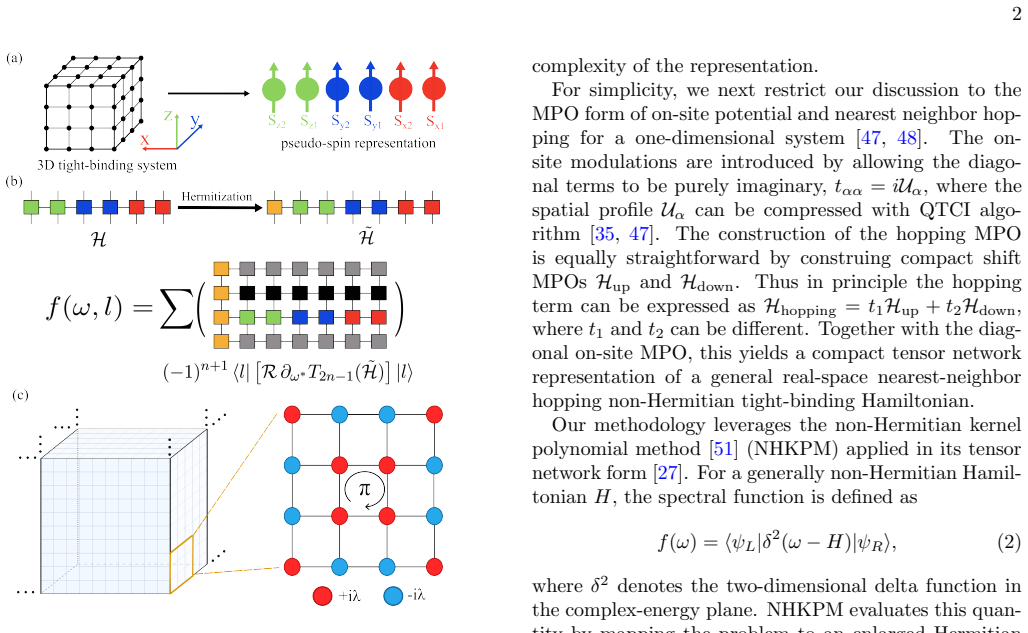
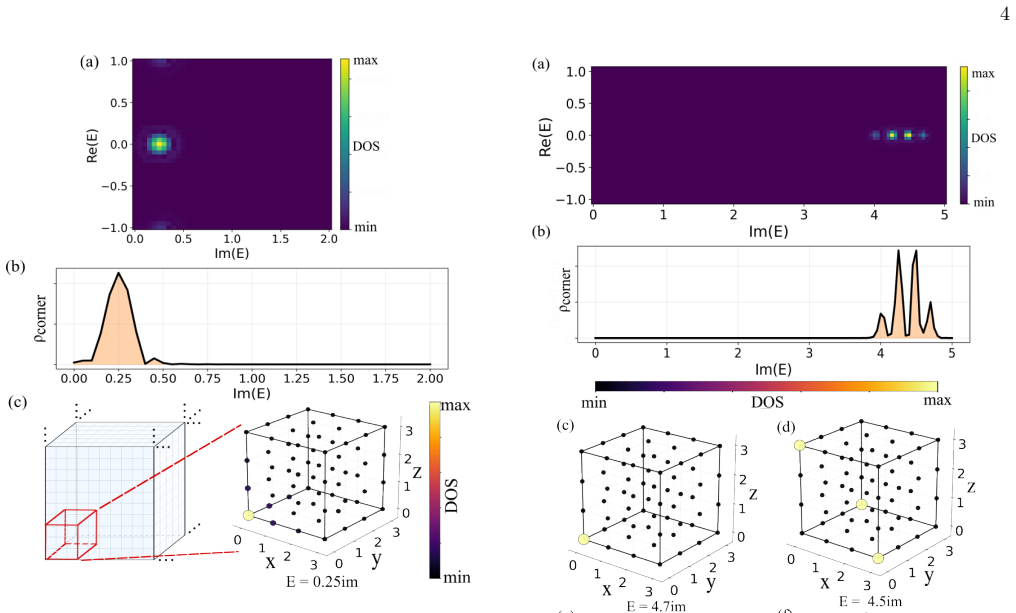
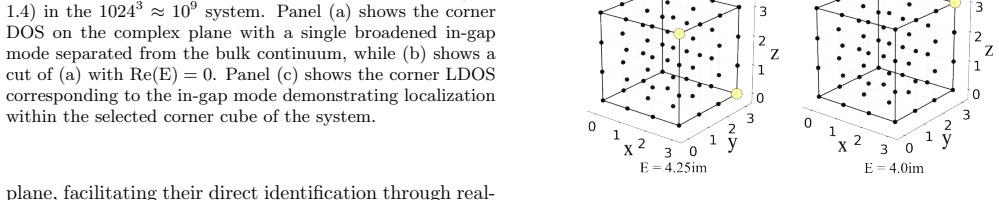
Non-Hermitian systems host a wide range of unconventional topological phenomena while large-scale simulations in finite three dimensional systems remain challenging because of the rapidly growing number of sites. In particular, higher-order topological corner modes are often studied only in small lattices, where strong finite-size effects can mask their intrinsic behavior. Here, we develop a tensor-network framework that combines quantics tensor cross interpolation with the kernel polynomial method, enabling compact representations of large non-Hermitian tight-binding Hamiltonians and direct calculations of real-space spectral functions for systems exceeding one billion lattice sites. Using this approach, we investigate three-dimensional non-Hermitian higher-order topological insulators with with structured real-space geometries. The unprecedented system size enables direct access to the macroscopic regime and allows corner-mode spectral responses to be resolved in genuinely three-dimensional systems. By tuning the loss strength, we identify distinct in-gap corner modes across weak- and strong-loss regimes. Our results establish tensor-network algorithms as a powerful strategy to perform real-space spectral calculations in exceptionally large non-Hermitian systems.
Editorial analysis
A structured set of objections, weighed in public.
Referee Report
Summary. The manuscript develops a tensor-network framework combining quantics tensor cross interpolation (QTCI) with the kernel polynomial method (KPM) to obtain compact representations of large non-Hermitian tight-binding Hamiltonians. This enables direct computation of real-space spectral functions for three-dimensional systems exceeding 10^9 lattice sites. The approach is applied to structured-geometry non-Hermitian higher-order topological insulators, where tuning the loss strength reveals distinct in-gap corner-mode responses in the weak- and strong-loss regimes, accessing the macroscopic limit free of strong finite-size effects.
Significance. If the accuracy and error control of the QTCI+KPM combination are established, the work would provide a valuable computational route to non-Hermitian topological phenomena at scales that have been inaccessible, allowing intrinsic corner-mode behavior to be isolated in genuinely three-dimensional geometries. The method's handling of structured real-space lattices and non-Hermitian spectra could find broader use in the field.
major comments (2)
- [Methods] § Methods (QTCI+KPM combination): the manuscript does not supply explicit error bounds or convergence analysis for the non-Hermitian spectral function approximation; without these, it is impossible to confirm that the reported corner-mode features are free of uncontrolled truncation artifacts.
- [Results] § Results (billion-site calculations): no benchmark comparisons against exact diagonalization or smaller-system KPM results are presented for the same non-Hermitian models, leaving the claim that the method resolves intrinsic responses at >10^9 sites without validation.
minor comments (2)
- [Abstract] Abstract, line 8: repeated word 'with with' should be corrected.
- [Notation] Notation for the loss parameter and the definition of the spectral function should be introduced consistently in the main text before the results section.
Simulated Author's Rebuttal
We thank the referee for the constructive comments. We address each major point below and outline the revisions that will be made to strengthen the manuscript.
read point-by-point responses
-
Referee: [Methods] § Methods (QTCI+KPM combination): the manuscript does not supply explicit error bounds or convergence analysis for the non-Hermitian spectral function approximation; without these, it is impossible to confirm that the reported corner-mode features are free of uncontrolled truncation artifacts.
Authors: We agree that explicit error bounds and convergence analysis for the QTCI+KPM combination applied to non-Hermitian spectral functions were not provided. In the revised manuscript we will add a dedicated subsection in Methods that derives the relevant error estimates for the non-Hermitian case, presents convergence plots versus QTCI bond dimension and KPM expansion order, and quantifies the truncation error on the spectral function. These additions will directly address the concern about possible artifacts in the reported corner-mode features. revision: yes
-
Referee: [Results] § Results (billion-site calculations): no benchmark comparisons against exact diagonalization or smaller-system KPM results are presented for the same non-Hermitian models, leaving the claim that the method resolves intrinsic responses at >10^9 sites without validation.
Authors: We acknowledge that direct benchmarks were omitted from the original submission. While exact diagonalization is infeasible at 10^9 sites, we will include in the revised Results section systematic comparisons on smaller lattices (up to 10^6–10^7 sites) against both dense KPM and exact diagonalization where possible. These benchmarks will demonstrate consistency of the QTCI-compressed spectral functions. In addition, we will show that the corner-mode signatures remain stable upon successive increases in system size within the tensor-network framework, thereby supporting the extrapolation to the macroscopic regime. revision: yes
Circularity Check
No significant circularity detected
full rationale
The paper describes a methodological framework that combines quantics tensor cross interpolation (QTCI) with the kernel polynomial method (KPM) to enable spectral calculations on billion-site non-Hermitian lattices. No derivation chain is presented in which a claimed prediction or first-principles result reduces by construction to fitted parameters, self-defined quantities, or a load-bearing self-citation chain. The central advance is the scaling capability of the combined tensor-network representation itself; accuracy for corner-mode responses is treated as an empirical validation question rather than an internal tautology. The provided abstract and context contain no equations or steps that equate outputs to inputs by definition, satisfying the criteria for a self-contained method-development result.
Axiom & Free-Parameter Ledger
Reference graph
Works this paper leans on
-
[1]
Panel (a) shows the corner LDOS on the complex plane where multiple isolated modes emerge along the imaginary-energy axis
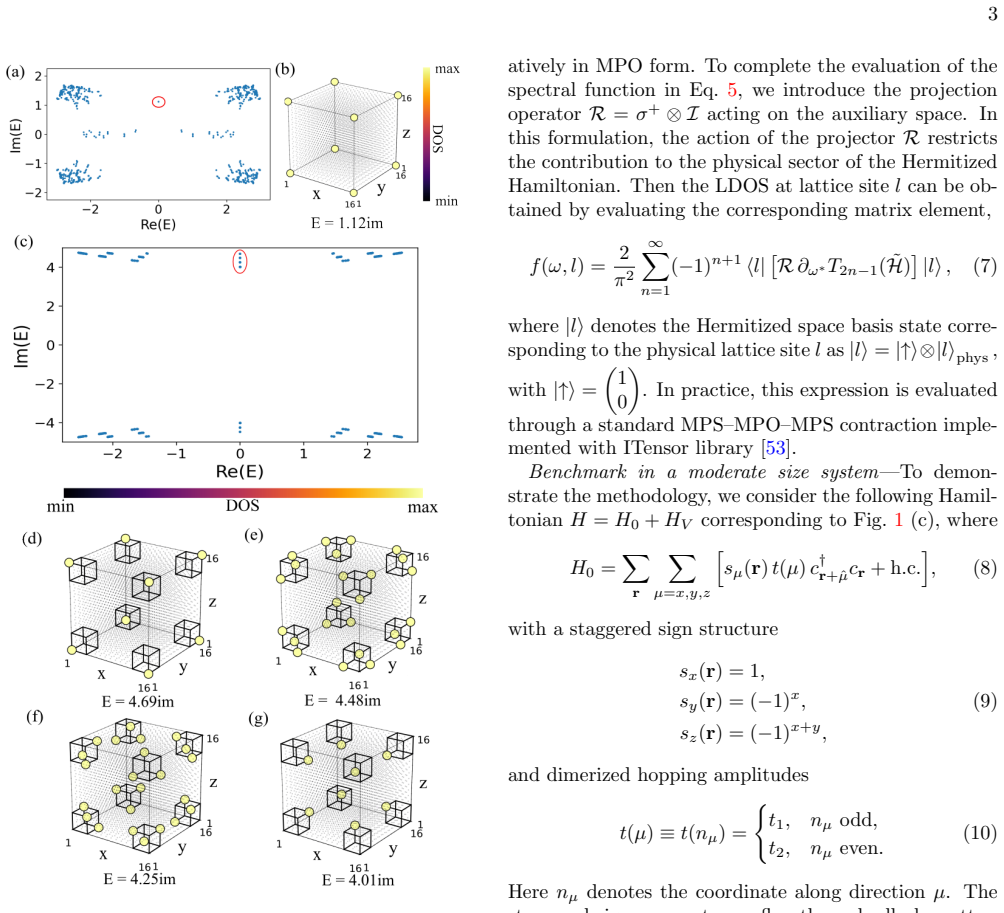
in the 1024 3 ≈10 9 system. Panel (a) shows the corner LDOS on the complex plane where multiple isolated modes emerge along the imaginary-energy axis. The spectral cut (b) at Re(E) = 0 further probes the hierarchical splitting of the corner modes. Panel (c)-(f) show the corner LDOS for the in-gap modes at different complex energies, revealing distinct loc...
2024
-
[2]
Ashida, Z
Y. Ashida, Z. Gong, and M. Ueda, Non-hermitian physics, Advances in Physics69, 249 (2020)
2020
-
[3]
E. J. Bergholtz, J. C. Budich, and F. K. Kunst, Ex- ceptional topology of non-hermitian systems, Rev. Mod. Phys.93, 015005 (2021)
2021
-
[4]
Luo and C
X.-W. Luo and C. Zhang, Higher-order topological corner states induced by gain and loss, Phys. Rev. Lett.123, 073601 (2019)
2019
-
[5]
Jiang, H
W.-C. Jiang, H. Wu, Q.-X. Li, J. Li, and J.-J. Zhu, Tun- able non-hermitian skin effect via gain and loss, Phys. Rev. B110, 155144 (2024)
2024
-
[6]
E. L. Pereira, H. Li, A. Blanco-Redondo, and J. L. Lado, Non-hermitian topology and criticality in photonic arrays with engineered losses, Phys. Rev. Res.6, 023004 (2024)
2024
-
[7]
E. L. Pereira, H. Li, A. Blanco-Redondo, and J. L. Lado, Topology and criticality in non-Hermitian multimodal optical resonators through engineered losses, arXiv e-prints , arXiv:2509.05163 (2025), arXiv:2509.05163 [physics.optics]
arXiv 2025
-
[8]
Helbig, T
T. Helbig, T. Hofmann, S. Imhof, M. Abdelghany, T. Kiessling, L. W. Molenkamp, C. H. Lee, A. Szameit, M. Greiter, and R. Thomale, Generalized bulk–boundary correspondence in non-hermitian topolectrical circuits, Nature Physics16, 747 (2020)
2020
-
[9]
P.-X. Shen, Z. Lu, J. L. Lado, and M. Trif, Non-hermitian fermi-dirac distribution in persistent current transport, Phys. Rev. Lett.133, 086301 (2024)
2024
-
[10]
Q. Yan, H. Li, Q.-F. Sun, and X. C. Xie, Transport the- ory in non-hermitian systems, Phys. Rev. B110, 045138 (2024)
2024
-
[11]
A. F. Tzortzakakis, K. G. Makris, A. Szameit, and E. N. Economou, Transport and spectral features in non-hermitian open systems, Phys. Rev. Res.3, 013208 (2021)
2021
-
[12]
Breuer and F
H. Breuer and F. Petruccione,The Theory of Open Quan- tum Systems(Oxford University Press, 2002)
2002
-
[13]
Yao and Z
S. Yao and Z. Wang, Edge states and topological in- variants of non-hermitian systems, Phys. Rev. Lett.121, 086803 (2018)
2018
-
[14]
C. H. Lee and R. Thomale, Anatomy of skin modes and topology in non-hermitian systems, Phys. Rev. B99, 201103 (2019)
2019
-
[15]
Z. Gong, Y. Ashida, K. Kawabata, K. Takasan, S. Hi- gashikawa, and M. Ueda, Topological phases of non- hermitian systems, Phys. Rev. X8, 031079 (2018)
2018
-
[16]
Okuma, K
N. Okuma, K. Kawabata, K. Shiozaki, and M. Sato, Topological origin of non-hermitian skin effects, Phys. Rev. Lett.124, 086801 (2020)
2020
-
[17]
F. K. Kunst, E. Edvardsson, J. C. Budich, and E. J. Bergholtz, Biorthogonal bulk-boundary correspondence in non-hermitian systems, Phys. Rev. Lett.121, 026808 (2018)
2018
-
[18]
L. Xiao, T. Deng, K. Wang, G. Zhu, Z. Wang, W. Yi, and 6 P. Xue, Non-hermitian bulk–boundary correspondence in quantum dynamics, Nature Physics16, 761 (2020)
2020
-
[19]
Zhang and Z
S. Zhang and Z. H. Hang, Photonic realization of non- hermitian skin effect using topological ring cavities, Re- views in Physics13, 100102 (2025)
2025
-
[20]
L. Zhang, Y. Yang, Y. Ge, Y.-J. Guan, Q. Chen, Q. Yan, F. Chen, R. Xi, Y. Li, D. Jia, S.-Q. Yuan, H.-X. Sun, H. Chen, and B. Zhang, Acoustic non-hermitian skin ef- fect from twisted winding topology, Nature Communica- tions12, 10.1038/s41467-021-26619-8 (2021)
-
[21]
L. Xiao, T. Deng, K. Wang, G. Zhu, Z. Wang, W. Yi, and P. Xue, Non-hermitian bulkboundary correspondence in quantum dynamics, Nature Physics16, 761766 (2020)
2020
-
[22]
H. Gao, W. Zhu, H. Xue, G. Ma, and Z. Su, Controlling acoustic non-hermitian skin effect via synthetic magnetic fields, Applied Physics Reviews11, 10.1063/5.0213867 (2024)
-
[23]
Hashemi, E
A. Hashemi, E. L. Pereira, H. Li, J. L. Lado, and A. Blanco-Redondo, Observation of non-hermitian topol- ogy from optical loss modulation, Nature Materials24, 13931399 (2025)
2025
-
[24]
Weimer, A
H. Weimer, A. Kshetrimayum, and R. Or´ us, Simulation methods for open quantum many-body systems, Rev. Mod. Phys.93, 015008 (2021)
2021
-
[25]
S. R. White, Density matrix formulation for quantum renormalization groups, Phys. Rev. Lett.69, 2863 (1992)
1992
-
[26]
Schollw¨ ock, The density-matrix renormalization group, Reviews of Modern Physics77, 259315 (2005)
U. Schollw¨ ock, The density-matrix renormalization group, Reviews of Modern Physics77, 259315 (2005)
2005
-
[27]
X. Waintal, C.-H. Huang, and C. W. Groth, Who can compete with quantum computers? Lecture notes on quantum inspired tensor networks computational techniques, arXiv e-prints , arXiv:2601.03035 (2026), arXiv:2601.03035 [quant-ph]
arXiv 2026
-
[28]
G. Chen, F. Song, and J. L. Lado, Topological spin ex- citations in non-hermitian spin chains with a general- ized kernel polynomial algorithm, Phys. Rev. Lett.130, 100401 (2023)
2023
-
[29]
G. Chen, J. L. Lado, and F. Song, Many-body liouvillian dynamics with a non-hermitian tensor-network kernel polynomial algorithm, Phys. Rev. Res.6, 043182 (2024)
2024
-
[30]
Lippo, E
Z. Lippo, E. L. Pereira, J. L. Lado, and G. Chen, Topo- logical zero modes and correlation pumping in an en- gineered kondo lattice, Phys. Rev. Lett.134, 116605 (2025)
2025
-
[31]
Zhong, W
P. Zhong, W. Pan, H. Lin, X. Wang, and S. Hu, Den- sity matrix renormalization group algorithm for non- hermitian systems, Phys. Rev. Lett.135, 106502 (2025)
2025
-
[32]
Wei and Z.-C
Y.-J. Wei and Z.-C. Gu, Tensor network renormalization: Application to dynamic correlation functions and non- hermitian systems, Phys. Rev. B113, 174303 (2026)
2026
-
[33]
Oseledets and E
I. Oseledets and E. Tyrtyshnikov, Tt-cross approxima- tion for multidimensional arrays, Linear Algebra and its Applications432, 7088 (2010)
2010
-
[34]
I. V. Oseledets, Tensor-train decomposition, SIAM Jour- nal on Scientific Computing33, 22952317 (2011)
2011
-
[35]
Y. N. Fernndez, M. K. Ritter, M. Jeannin, J.-W. Li, T. Kloss, T. Louvet, S. Terasaki, O. Parcollet, J. von Delft, H. Shinaoka, and X. Waintal, Learning tensor net- works with tensor cross interpolation: New algorithms and libraries, SciPost Phys.18, 104 (2025)
2025
-
[36]
M. K. Ritter, Y. N´ u˜ nez Fern´ andez, M. Wallerberger, J. von Delft, H. Shinaoka, and X. Waintal, Quantics tensor cross interpolation for high-resolution parsimo- nious representations of multivariate functions, Phys. Rev. Lett.132, 056501 (2024)
2024
-
[37]
Jolly, Y
N. Jolly, Y. N. n. Fern´ andez, and X. Waintal, Tensorized orbitals for computational chemistry, Phys. Rev. B111, 245115 (2025)
2025
-
[38]
Gourianov, P
N. Gourianov, P. Givi, D. Jaksch, and S. B. Pope, Tensor networks enable the calculation of turbulence probability distributions, Science Advances11(2025)
2025
-
[39]
Gourianov, M
N. Gourianov, M. Lubasch, S. Dolgov, Q. Y. van den Berg, H. Babaee, P. Givi, M. Kiffner, and D. Jaksch, A quantum-inspired approach to exploit turbulence struc- tures, Nature Computational Science2, 3037 (2022)
2022
-
[40]
R. D. Peddinti, S. Pisoni, A. Marini, P. Lott, H. Argen- tieri, E. Tiunov, and L. Aolita, Quantum-inspired frame- work for computational fluid dynamics, Communications Physics7(2024)
2024
-
[41]
Niedermeier, A
M. Niedermeier, A. Moulinas, T. Louvet, J. L. Lado, and X. Waintal, Solving the gross-pitaevskii equation on mul- tiple different scales using the quantics tensor train rep- resentation, Phys. Rev. Res.8, 023006 (2026)
2026
-
[42]
Shinaoka, M
H. Shinaoka, M. Wallerberger, Y. Murakami, K. Nogaki, R. Sakurai, P. Werner, and A. Kauch, Multiscale space- time ansatz for correlation functions of quantum systems based on quantics tensor trains, Phys. Rev. X13, 021015 (2023)
2023
-
[43]
Erpenbeck, W.-T
A. Erpenbeck, W.-T. Lin, T. Blommel, L. Zhang, S. Iskakov, L. Bernheimer, Y. N´ u˜ nez Fern´ andez, G. Co- hen, O. Parcollet, X. Waintal, and E. Gull, Tensor train continuous time solver for quantum impurity models, Phys. Rev. B107, 245135 (2023)
2023
-
[44]
N´ u˜ nez Fern´ andez, M
Y. N´ u˜ nez Fern´ andez, M. Jeannin, P. T. Dumitrescu, T. Kloss, J. Kaye, O. Parcollet, and X. Waintal, Learning feynman diagrams with tensor trains, Phys. Rev. X12, 041018 (2022)
2022
-
[45]
Takahashi, R
H. Takahashi, R. Sakurai, and H. Shinaoka, Com- pactness of quantics tensor train representations of lo- cal imaginary-time propagators, SciPost Phys.18, 007 (2025)
2025
-
[46]
Jeannin, Y
M. Jeannin, Y. N´ u˜ nez Fern´ andez, T. Kloss, O. Parcol- let, and X. Waintal, Cross-extrapolation reconstruction of low-rank functions and application to quantum many- body observables in the strong coupling regime, Phys. Rev. B110, 035124 (2024)
2024
-
[47]
Rohshap, M
S. Rohshap, M. K. Ritter, H. Shinaoka, J. von Delft, M. Wallerberger, and A. Kauch, Two-particle calcula- tions with quantics tensor trains: Solving the parquet equations, Phys. Rev. Res.7, 023087 (2025)
2025
-
[48]
Y. Sun, M. Niedermeier, T. V. C. Ant˜ ao, A. O. Fumega, and J. L. Lado, Self-consistent tensor network method for correlated super-moir´ e matter beyond one billion sites, Phys. Rev. Res.7, 043288 (2025)
2025
-
[49]
T. V. C. Ant˜ ao, Y. Sun, A. O. Fumega, and J. L. Lado, Tensor network method for real-space topology in qua- sicrystal chern mosaics, Phys. Rev. Lett.136, 156601 (2026)
2026
-
[50]
Moustaj, Y
A. Moustaj, Y. Sun, T. V. C. Ant˜ ao, and J. L. Lado, Tensor network approach to momentum-resolved spec- troscopy in nonperiodic super-moir´ e systems, Phys. Rev. Res.8, 023282 (2026)
2026
-
[51]
A. Moustaj, Y. Sun, T. V. C. Ant˜ ao, L. Eek, and J. L. Lado, Tensor-network methodology for super- moir´ e excitons beyond one billion sites, arXiv e-prints , arXiv:2603.02011 (2026), arXiv:2603.02011 [cond- mat.str-el]
arXiv 2026
-
[52]
Weiße, G
A. Weiße, G. Wellein, A. Alvermann, and H. Fehske, 7 The kernel polynomial method, Rev. Mod. Phys.78, 275 (2006)
2006
-
[53]
Jackson, On approximation by trigonometric sums and polynomials, Transactions of the American Math- ematical Society13, 491515 (1912)
D. Jackson, On approximation by trigonometric sums and polynomials, Transactions of the American Math- ematical Society13, 491515 (1912)
1912
-
[54]
Fishman, S
M. Fishman, S. R. White, and E. M. Stoudenmire, The ITensor Software Library for Tensor Network Calcula- tions, SciPost Phys. Codebases , 4 (2022)
2022
-
[55]
Y. Liu, Q. Zhou, and S. Chen, Localization transi- tion, spectrum structure, and winding numbers for one- dimensional non-hermitian quasicrystals, Phys. Rev. B 104, 024201 (2021)
2021
-
[56]
Q. Lin, T. Li, L. Xiao, K. Wang, W. Yi, and P. Xue, Topological phase transitions and mobility edges in non- hermitian quasicrystals, Phys. Rev. Lett.129, 113601 (2022)
2022
-
[57]
Longhi, Topological phase transition in non-hermitian quasicrystals, Phys
S. Longhi, Topological phase transition in non-hermitian quasicrystals, Phys. Rev. Lett.122, 237601 (2019)
2019
-
[58]
Zhang, S
Z. Zhang, S. Liang, I. Septembre, J. Yu, Y. Huang, M. Liu, Y. Zhang, M. Xiao, G. Malpuech, and D. Solnyshkov, Non-hermitian delocalization in a two- dimensional photonic quasicrystal, Phys. Rev. Lett.132, 263801 (2024)
2024
-
[59]
Huang, Exceptional topology in non-hermitian twisted bilayer graphene, Phys
Y. Huang, Exceptional topology in non-hermitian twisted bilayer graphene, Phys. Rev. B111, 085120 (2025)
2025
-
[60]
J. P. Esparza and V. Juriˇ ci´ c, Exceptional magic angles in non-hermitian twisted bilayer graphene, Phys. Rev. Lett. 134, 226602 (2025)
2025
-
[61]
K. Bera, D. Mondal, A. Saha, and D. Chowdhury, Non- hermitian band topology in twisted bilayer graphene aligned with hexagonal boron nitride, Phys. Rev. B112, 155411 (2025)
2025
-
[62]
J. Yuan, F. Niu, H. Zhang, C. Wu, G. Chen, L. Wang, L. Xiao, and S. Jia, Non-hermitian twisted photonic lattices, Light Manipulation and Applications 10.70401/lma.2026.0003 (2026). [62]https://github.com/YITAOSUN42/Tensor_network_NH_ tb
discussion (0)
Sign in with ORCID, Apple, or X to comment. Anyone can read and Pith papers without signing in.