REVIEW 4 major objections 6 minor 85 references
Seeing Through Deepfakes: A Human-Inspired Framework for Multi-Face Detection
T0 review · 4 major / 6 minor · reviewed 2026-08-06 · deepseek-v4-flash
Pith's one-line read This paper claims that multi-face deepfake detection improves when the detector is built around four contextual cues humans actually use: scene-motion coherence, inter-face appearance compatibility, interpersonal gaze alignment, and…
desk verdict A load-bearing fusion-rule contradiction means the headline gains are not tied to a well-defined model, but the human-study-driven framework is worth refereeing. read the letter →
The pith
A machine-rendered reading of the paper's core claim, the machinery that carries it, and where it could break.
The reading
What carries the argument
The central object is HICOM, a four-module detector whose modules mirror the four human cues. M1 infers scene-motion coherence from multi-scale face and background features over time; M2 compares faces within a frame using a Transformer trained with contrastive and cross-entropy losses; M3 trains a gaze-locking classifier on eye regions and flags off-camera faces only when most faces in the scene face the camera; M4 trains age and gender classifiers separately on face crops and body crops and flags mismatches. A final XOR fusion marks a face as fake if any module flags it, so a single working cue can still catch a manipulated face.
What would settle it
Run a controlled study in which hundreds of naive viewers are shown newly generated multi-face deepfakes not drawn from the benchmark datasets and asked to state why faces look fake; if the four cues are not the dominant reasons they give, or if a version of HICOM with the gaze and body modules ablated matches the full model on those videos, the central claim is falsified.
Extended reading notes
Core claim
The central claim is that contextual inconsistency, not individual facial artifact, is the reliable signal for catching deepfake faces in social scenes. A two-phase human study yields four dominant cues, and HICOM encodes them as four modules: scene-motion coherence, inter-face appearance comparison, interpersonal gaze alignment, and face-body age and gender consistency. The paper reports that existing methods saturate on face-level accuracy but drop on frame-level complete multi-face detection, while HICOM improves average frame-level accuracy by 3.3% across FFIW, OpenForensics, and DF-Platter, maintains an edge under unseen perturbations, and generalizes to the unseen ManualFake dataset with a 5.8% average frame-level accuracy improvement.
Load-bearing premise
The claim depends on the assumption that the cues identified by a small group of human viewers on the benchmark datasets are the stable, transferable signals that drive detection, rather than quirks of those particular videos or viewers.
Editorial extensions
If this is right
- Frame-level complete multi-face detection becomes a metric that separates methods, since face-level accuracy alone is nearly saturated across baselines.
- Human-inspired contextual cues transfer to unseen datasets and perturbations better than artifact-specific features, as shown by the 5.8% gain on the untrained ManualFake dataset.
- The modular design means a newly discovered human cue can be added as an extra module without retraining the entire system.
- XOR fusion makes detection robust in the sense that one reliable cue is sufficient to flag a fake face even when the other modules fail.
- An attached language model can turn module scores into plain-language explanations for each face, making the system's verdicts inspectable by non-experts.
Reading between the lines
- Editorial inference: if the four cues are genuinely stable across deepfake generations, detectors built on them should degrade more gracefully on future generation methods than detectors trained on pixel-level artifacts.
- Editorial inference: the gaze module's decision rule presupposes that most faces in a scene look at the camera; in candid or surveillance footage where nobody does, this cue goes silent, so the framework would need a different social baseline for such scenes.
- Editorial inference: the paper's cue-prevalence numbers could be tested against learned fusion weights, which would reveal whether the human-reported proportions (motion 34.2%, appearance 31.5%, gaze 25.0%, body 7.5%) are also the optimal ones for the model.
Editorial analysis
A structured set of objections, weighed in public.
Referee Report
Summary. The paper proposes HICOM, a multi-face deepfake detection framework whose design is motivated by a two-phase human study. The authors report four human cues (scene-motion coherence, inter-face appearance compatibility, interpersonal gaze alignment, and face-body consistency), instantiate each as a module (M1–M4), and fuse module outputs to label every face in a frame. Experiments on FFIW, OpenForensics, DF-Platter, and ManualFake report improvements in frame-level complete multi-face detection accuracy, robustness to perturbations, cross-dataset generalization, and an LLM-based explanation interface.
Significance. The paper's central idea—basing multi-face detection on cues elicited from human observers and evaluating a strict frame-level complete multi-face metric—is timely and potentially useful. Strengths include a clearly defined evaluation metric, a modular architecture with each module tied to a stated hypothesis, and comparisons against multiple single- and multi-face baselines. If the cue discovery and fusion specification are made rigorous and non-circular, the approach could make a solid contribution to the deepfake detection literature. At present, however, the reported gains rest on an internally contradictory fusion rule and on cue-selection evidence that is confounded with the evaluation benchmarks.
major comments (4)
- [§4.6] The fusion rule as written is self-contradictory. The text says the module outputs are combined 'using an XOR operation, ensuring that any detected anomaly leads to a fake face prediction,' but XOR outputs 1 only when an odd number of inputs are 1; a face flagged by exactly two modules yields 1 XOR 1 = 0, i.e., real. The stated rationale ('When M1 and M2 miss a fake face, M3 and M4 help identify these inconsistencies') and the monotone ablation in Table 4 (M1 < M1+M2 < M1+M2+M3 < M1+M2+M3+M4) both describe an OR-like rule rather than XOR. Since the fused output is the final prediction behind Tables 1–3, the reported 3.3% in-dataset and 5.8% cross-dataset gains cannot be attributed to the proposed cues unless the actual fusion rule is specified (including how each module's continuous output is binarized, any thresholds, and the exact Boolean combination) and shown to reproduce the tables. This is a load-bearing specification, not a wording issue.
- [§3.2, §5.3] The cue discovery is circular with the evaluation. The four cues were elicited on the same OpenForensics, FFIW, and DF-Platter datasets used to evaluate HICOM in Tables 1 and 2; the cross-dataset test in Table 3 uses ManualFake, which was not part of cue discovery, but the design choices (which cues to include, how to threshold them) were already informed by the evaluation distribution. As a result, the 5.8% generalization gain cannot be cleanly attributed to human-inspired cues as opposed to cues that happen to be informative on these benchmarks. Please validate the cues on a held-out split or an independent deepfake type not seen during cue discovery, and at minimum explicitly discuss this confound in the limitations.
- [§3.2, §3.3] The quantitative evidence for the four cues is thin. Phase 1 recruited only four participants, each reviewing 500 samples, and §3.3 reports prevalence percentages (34.2%, 31.5%, 25.0%, 7.5%) without per-participant variance, inter-rater reliability, or significance tests. The criterion 'Only identifications matching dataset labels were considered valid' further conditions the cue reporting on label consistency, which may suppress cues that lead to false alarms. With n=4, these percentages cannot support the claim that the four cues are the key human strategies. Please report the full distribution of cue frequencies across participants, agreement metrics, and the number of samples contributing to each percentage.
- [§4.4, Eq. (3)] The gaze module's decision rule is ad hoc and not grounded in the human study. The conditions 'n_L - n_O > 1 or n_T = 2' appear without derivation or ablation; similarly, the contrastive margin and λcomp in Eq. (2) are set empirically. Since Table 4 attributes incremental gains to M3 and M4, these hand-set thresholds could be the source of the improvement rather than the human-inspired cue itself. Please ablate these thresholds and report sensitivity, or justify them from the human-study data.
minor comments (6)
- [Table 1] The table header contains the typo 'OpenForencics'; it should read 'OpenForensics'.
- [§4.6] The text refers to a Supplementary Material for the fusion strategy, but the submitted manuscript does not appear to include that supplement; either provide it or remove the reference.
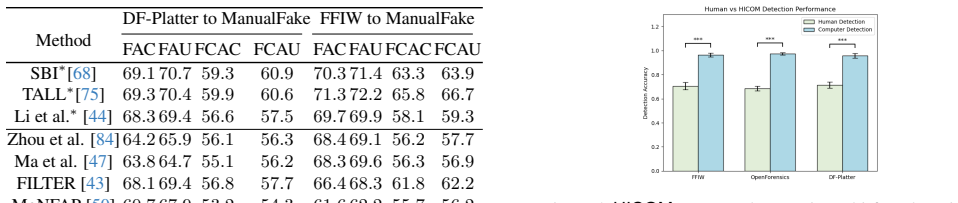
- [§5.4, Fig. 5] The human-comparison result is reported only as 'three stars'; please give the actual test statistic, p-value, and sample size.
- [Related Work] Reference [23] is cited for the 'Dual-path Actor Interaction framework with Multi-scale Actor Contrastive Loss,' which does not match the Gallagher and Chen paper; the citation appears to be incorrect.
- [Abstract / §5.2] The abstract says 'average accuracy by 3.3%,' while the body specifies 'average improvements of 3.3% in FCAC, and 3.1% in FCAU'; clarify which metric is being summarized.
- [§3.2] Phase 2 reports 20 MTurk participants but does not state the number of judgments per item, compensation, or exclusion criteria; adding these details would improve reproducibility.
Circularity Check
Human-study cues are extracted from the same three benchmarks used for in-dataset evaluation, so the headline 3.3% gain is partly circular; the ManualFake test preserves independent content.
-
fitted input called prediction
[Section 3.2 (human study) and Section 5.2 (in-dataset evaluation); cf. Limitations in Section 6]
"In the first phase, we randomly selected 2, 000 multi-face deepfake videos and images from the OpenForensics [39], FFIW [84], and DF-Platter [53]... Only identifications matching the dataset labels were considered valid."
The four cues that define HICOM's four modules were elicited from the same three datasets (OpenForensics, FFIW, DF-Platter) used for the in-dataset evaluation in Table 1, and participant reports were filtered by those datasets' labels. Therefore the claim that HICOM improves average accuracy by 3.3% in Section 5.2 measures performance on the distribution from which the cue set was selected; it is a discovery-set evaluation rather than a test of cue transfer. The conclusion's limitation, 'Our findings are based on all benchmark multi-face deepfake datasets,' concedes the benchmark-bound origin of the cues.
full rationale
Most of HICOM's engineering is self-contained: the modules are standard networks trained with cross-entropy and contrastive losses, and the comparisons to SOTA baselines are external. The human-study cue selection, however, is not distribution-independent. Phase 1 sampled 2,000 items from OpenForensics, FFIW, and DF-Platter and kept only identifications agreeing with those datasets' labels; the resulting four cues then define the four modules. Section 5.2 reports the headline 3.3% in-dataset FCAC improvement on exactly those three datasets. So the in-dataset result evaluates the model on the distribution from which its architectural cues were elicited; the paper's own limitation notes that the findings are based on all benchmark multi-face deepfake datasets. This is a partial, not total, circularity: the cue-to-module mapping still had to be implemented and trained, and the ManualFake cross-dataset experiment in Section 5.3 explicitly excludes ManualFake from the human study and training, giving independent evidence for transfer. The XOR fusion description in Section 4.6 is internally inconsistent with 'ensuring that any detected anomaly leads to a fake face prediction,' but that is a correctness/consistency defect rather than a circularity. Author self-citations ([18], [32]) appear in related-work and motivation contexts and are not load-bearing. Overall score 4.
Assumptions & free parameters
free parameters (5)
- contrastive margin =
1.0
- lambda_comp =
0.3
- gaze decision thresholds =
nL - nO > 1 or nT = 2
- module fusion rule =
XOR stated, OR described
- age/gender categories =
child, middle-aged, senior; male, female
assumptions (4)
- domain assumption Human cognitive patterns in face perception are stable and transferable to AI detection.
- domain assumption Dataset labels in OpenForensics, FFIW, DF-Platter, and ManualFake are accurate ground truth for deepfake presence.
- ad hoc to paper The four identified cues are the dominant cues and minor cues can be excluded.
- domain assumption IMDB-WIKI provides a suitable basis for age/gender classification of faces and bodies in these datasets.
Cite this review
Pith. "Pith review of Seeing Through Deepfakes: A Human-Inspired Framework for Multi-Face Detection." pith.science (2026). https://pith.science/paper/YE4CM55I
@misc{pith2026250714807,
  author       = {Pith},
  title        = {Pith review of: Seeing Through Deepfakes: A Human-Inspired Framework for Multi-Face Detection},
  year         = {2026},
  howpublished = {\url{https://pith.science/paper/YE4CM55I}},
  note         = {Machine review of arXiv:2507.14807}
}
read the original abstract
Multi-face deepfake videos are becoming increasingly prevalent, often appearing in natural social settings that challenge existing detection methods. Most current approaches excel at single-face detection but struggle in multi-face scenarios, due to a lack of awareness of crucial contextual cues. In this work, we develop a novel approach that leverages human cognition to analyze and defend against multi-face deepfake videos. Through a series of human studies, we systematically examine how people detect deepfake faces in social settings. Our quantitative analysis reveals four key cues humans rely on: scene-motion coherence, inter-face appearance compatibility, interpersonal gaze alignment, and face-body consistency. Guided by these insights, we introduce \textsf{HICOM}, a novel framework designed to detect every fake face in multi-face scenarios. Extensive experiments on benchmark datasets show that \textsf{HICOM} improves average accuracy by 3.3\% in in-dataset detection and 2.8\% under real-world perturbations. Moreover, it outperforms existing methods by 5.8\% on unseen datasets, demonstrating the generalization of human-inspired cues. \textsf{HICOM} further enhances interpretability by incorporating an LLM to provide human-readable explanations, making detection results more transparent and convincing. Our work sheds light on involving human factors to enhance defense against deepfakes.
Figures


Figures from the paper (2 more)

Reference graph
Works this paper leans on
-
[1]
Gpt-4 technical report
Josh Achiam, Steven Adler, Sandhini Agarwal, Lama Ah- mad, Ilge Akkaya, Florencia Leoni Aleman, Diogo Almeida, Janko Altenschmidt, Sam Altman, Shyamal Anadkat, et al. Gpt-4 technical report. Open AI, 2023. 8
2023
-
[2]
Mesonet: a compact facial video forgery detection network
Darius Afchar, Vincent Nozick, Junichi Yamagishi, and Isao Echizen. Mesonet: a compact facial video forgery detection network. In WIFS, pages 1–7, 2018. 3
2018
-
[3]
Limits of deepfake detection: A robust estimation viewpoint
Sakshi Agarwal and Lav R Varshney. Limits of deepfake detection: A robust estimation viewpoint. arXiv preprint arXiv:1905.03493, 2019. 3
arXiv 1905
-
[4]
Image forgery detection by trans- forming local descriptors into deep-derived features.Applied Soft Computing, 147:110730, 2023
Muhammad Aqib Anwar, Syed Fahad Tahir, Labiba Gillani Fahad, and Kashif Kifayat. Image forgery detection by trans- forming local descriptors into deep-derived features.Applied Soft Computing, 147:110730, 2023. 6
2023
-
[5]
Exposing the deception: Uncov- ering more forgery clues for deepfake detection
Zhongjie Ba, Qingyu Liu, Zhenguang Liu, Shuang Wu, Feng Lin, Li Lu, and Kui Ren. Exposing the deception: Uncov- ering more forgery clues for deepfake detection. In AAAI, pages 719–728, 2024. 2, 3
2024
-
[6]
Zelensky told to leave white house after angry spat with trump and vance
BBC. Zelensky told to leave white house after angry spat with trump and vance. https://www.bbc.com/news/ live/c625ex282zzt, 2025. Accessed: 2025-03-07. 1
2025
-
[7]
End-to-end reconstruction- classification learning for face forgery detection
Junyi Cao, Chao Ma, Taiping Yao, Shen Chen, Shouhong Ding, and Xiaokang Yang. End-to-end reconstruction- classification learning for face forgery detection. In CVPR, pages 4113–4122, 2022. 3
work page 2022
-
[8]
Unveiling the truth: Exploring human gaze patterns in fake images
Giuseppe Cartella, Vittorio Cuculo, Marcella Cornia, and Rita Cucchiara. Unveiling the truth: Exploring human gaze patterns in fake images. IEEE Signal Processing Letters ,
Show all 85 references
-
[9]
Role of human physiology and facial biomechanics towards building robust deepfake detectors: A comprehensive survey and analysis
Rajat Chakraborty and Ruchira Naskar. Role of human physiology and facial biomechanics towards building robust deepfake detectors: A comprehensive survey and analysis. Computer Science Review, 54:100677, 2024. 4
2024
-
[10]
Spar- tan: Self-supervised spatiotemporal transformers approach to group activity recognition
Naga VS Chappa, Pha Nguyen, Alexander H Nelson, Han- Seok Seo, Xin Li, Page Daniel Dobbs, and Khoa Luu. Spar- tan: Self-supervised spatiotemporal transformers approach to group activity recognition. In CVPR, pages 5158–5168,
-
[11]
Simswap: An efficient framework for high fidelity face swapping
Renwang Chen, Xuanhong Chen, Bingbing Ni, and Yanhao Ge. Simswap: An efficient framework for high fidelity face swapping. In ACM MM, pages 2003–2011, 2020. 3
2003
-
[12]
Unsupervised outlier detection in appearance-based gaze es- timation
Zhaokang Chen, Didan Deng, Jimin Pi, and Bertram E Shi. Unsupervised outlier detection in appearance-based gaze es- timation. In ICCVW, 2019. 6
2019
-
[13]
Exploiting style latent flows for generalizing deepfake video detection
Jongwook Choi, Taehoon Kim, Yonghyun Jeong, Seungryul Baek, and Jongwon Choi. Exploiting style latent flows for generalizing deepfake video detection. In CVPR, pages 1133–1143, 2024. 2, 3
2024
-
[14]
Fakecatcher: Detection of synthetic portrait videos using biological sig- nals
Umur Aybars Ciftci, Ilke Demir, and Lijun Yin. Fakecatcher: Detection of synthetic portrait videos using biological sig- nals. TPAMI, 2020. 3
2020
-
[15]
Evaluating amazon’s mechanical turk as a tool for experimental behavioral research
Matthew JC Crump, John V McDonnell, and Todd M Gureckis. Evaluating amazon’s mechanical turk as a tool for experimental behavioral research. PloS one , 8(3):e57410,
-
[16]
Body image: Gender, ethnic, and age differences
Jack Demarest and Rita Allen. Body image: Gender, ethnic, and age differences. The Journal of Social Psychology, 140 (4):465–472, 2000. 4
2000
-
[17]
The deepfake detection challenge (dfdc) dataset
Brian Dolhansky, Joanna Bitton, Ben Pflaum, Jikuo Lu, Russ Howes, Menglin Wang, and Cristian Canton Ferrer. The deepfake detection challenge (dfdc) dataset. arXiv preprint arXiv:2006.07397, 2020. 4
2006 arXiv
-
[18]
Human per- ception of visual realism for photo and computer-generated face images
Shaojing Fan, Rangding Wang, Tian-Tsong Ng, Cheston Y-C Tan, Jonathan S Herberg, and Bryan L Koenig. Human per- ception of visual realism for photo and computer-generated face images. ACM TAP, 11(2):1–21, 2014. 3
2014
-
[19]
What is” special” about face perception? Psychological review, 105(3):482, 1998
Martha J Farah, Kevin D Wilson, Maxwell Drain, and James N Tanaka. What is” special” about face perception? Psychological review, 105(3):482, 1998. 2
1998
-
[20]
Creating, using, misusing, and detecting deep fakes
Hany Farid. Creating, using, misusing, and detecting deep fakes. Journal of Online Trust and Safety, 1(4), 2022. 3
2022
-
[21]
Recognition of images de- graded by gaussian blur
Jan Flusser, Sajad Farokhi, Cyril H ¨oschl, Tom´aˇs Suk, Bar- bara Zitova, and Matteo Pedone. Recognition of images de- graded by gaussian blur. TIP, 25(2):790–806, 2015. 6
2015
-
[22]
Social belonging motivates categoriza- tion of racially ambiguous faces
Sarah E Gaither, Kristin Pauker, Michael L Slepian, and Samuel R Sommers. Social belonging motivates categoriza- tion of racially ambiguous faces. Social cognition, 34(2): 97–118, 2016. 2
2016
-
[23]
Understanding im- ages of groups of people
Andrew C Gallagher and Tsuhan Chen. Understanding im- ages of groups of people. In CVPR, pages 256–263, 2009. 2, 3
2009
-
[24]
Automatic gaze analysis: A survey of deep learning based approaches
Shreya Ghosh, Abhinav Dhall, Munawar Hayat, Jarrod Knibbe, and Qiang Ji. Automatic gaze analysis: A survey of deep learning based approaches. TPAMI, 46(1):61–84, 2023. 6
2023
-
[25]
Delving into the local: Dynamic in- consistency learning for deepfake video detection
Zhihao Gu, Yang Chen, Taiping Yao, Shouhong Ding, Jilin Li, and Lizhuang Ma. Delving into the local: Dynamic in- consistency learning for deepfake video detection. In AAAI, pages 744–752, 2022. 3
2022
-
[26]
Ex- ploring spatial-temporal features for deepfake detection and localization
Wu Haiwei, Zhou Jiantao, Zhang Shile, and Tian Jinyu. Ex- ploring spatial-temporal features for deepfake detection and localization. arXiv preprint arXiv:2210.15872, 2022. 3, 6
2022 arXiv
-
[27]
Lips don’t lie: A generalisable and robust approach to face forgery detection
Alexandros Haliassos, Konstantinos V ougioukas, Stavros Petridis, and Maja Pantic. Lips don’t lie: A generalisable and robust approach to face forgery detection. In CVPR, pages 5039–5049, 2021. 3
2021
-
[28]
Haxby, Elizabeth A
James V . Haxby, Elizabeth A. Hoffman, and Maria I. Gob- bini. The distributed human neural system for face percep- tion. Trends in Cognitive Sciences, 4(6):223–233, 2000. 3
2000
-
[29]
Deep residual learning for image recognition
Kaiming He, Xiangyu Zhang, Shaoqing Ren, and Jian Sun. Deep residual learning for image recognition. In CVPR, pages 770–778, 2016. 5
2016
-
[30]
Mask r-cnn
Kaiming He, Georgia Gkioxari, Piotr Doll ´ar, and Ross Gir- shick. Mask r-cnn. In ICCV, pages 2961–2969, 2017. 5
2017
-
[31]
How does gaze to faces support face-to-face interaction? a review and perspective
Roy S Hessels. How does gaze to faces support face-to-face interaction? a review and perspective. Psychonomic Bulletin & Review, 27(5):856–881, 2020. 4 9
2020
-
[32]
Detecting compressed deepfake videos in social networks using frame- temporality two-stream convolutional network
Juan Hu, Xin Liao, Wei Wang, and Zheng Qin. Detecting compressed deepfake videos in social networks using frame- temporality two-stream convolutional network. TCSVT, 32 (3):1089–1102, 2021. 3
2021
-
[33]
A hierarchical deep temporal model for group activity recognition
Mostafa S Ibrahim, Srikanth Muralidharan, Zhiwei Deng, Arash Vahdat, and Greg Mori. A hierarchical deep temporal model for group activity recognition. In CVPR, pages 1971– 1980, 2016. 4
1971
-
[34]
Double face: Leveraging user intelligence to characterize and recognize ai-synthesized faces
Matthew Joslin, Xian Wang, and Shuang Hao. Double face: Leveraging user intelligence to characterize and recognize ai-synthesized faces. In USENIX Security, pages 1009–1026,
-
[35]
Domain specificity in face perception
Nancy Kanwisher. Domain specificity in face perception. Nature neuroscience, 3(8):759–763, 2000. 2
2000
-
[36]
Nancy Kanwisher, Josh McDermott, and Marvin M. Chun. The fusiform face area: A module in human extrastriate cor- tex specialized for face perception. The Journal of Neuro- science, 17(11):4302–4311, 1997. 3
1997
-
[37]
Can you all look here? towards determining gaze uniformity in group images
Omkar N Kulkarni, Vikram Patil, Shivam B Parikh, Shashank Arora, and Pradeep K Atrey. Can you all look here? towards determining gaze uniformity in group images. In ISM, pages 100–103, 2020. 6
2020
-
[38]
Do the eyes have it? cues to the direction of social attention
Stephen RH Langton, Roger J Watt, and Vicki Bruce. Do the eyes have it? cues to the direction of social attention. Trends in Cognitive Sciences, 4(2):50–59, 2000. 4
2000
-
[39]
Openforensics: Large-scale challenging dataset for multi-face forgery detection and segmentation in- the-wild
Trung-Nghia Le, Huy H Nguyen, Junichi Yamagishi, and Isao Echizen. Openforensics: Large-scale challenging dataset for multi-face forgery detection and segmentation in- the-wild. In ICCV, pages 10117–10127, 2021. 3, 4, 6
2021
-
[40]
Faceshifter: Towards high fidelity and occlusion aware face swapping
Lingzhi Li, Jianmin Bao, Hao Yang, Dong Chen, and Fang Wen. Faceshifter: Towards high fidelity and occlusion aware face swapping. arXiv preprint arXiv:1912.13457, 2019. 3
1912 arXiv
-
[41]
Sharp mul- tiple instance learning for deepfake video detection
Xiaodan Li, Yining Lang, Yuefeng Chen, Xiaofeng Mao, Yuan He, Shuhui Wang, Hui Xue, and Quan Lu. Sharp mul- tiple instance learning for deepfake video detection. In ACM MM, pages 1864–1872, 2020. 2, 3
2020
-
[42]
Exposing Deepfake videos by detecting face warping artifacts
Yuezun Li and Siwei Lyu. Exposing Deepfake videos by detecting face warping artifacts. In CVPRW, pages 46–52,
-
[43]
Exploiting facial relationships and feature aggregation for multi-face forgery detection.TIFS, 19:8832– 8844, 2024
Chenhao Lin, Fangbin Yi, Hang Wang, Qian Li, Deng Jingyi, and Chao Shen. Exploiting facial relationships and feature aggregation for multi-face forgery detection.TIFS, 19:8832– 8844, 2024. 2, 3, 7, 8
2024
-
[44]
Preserving fairness generalization in deepfake detection
Li Lin, Xinan He, Yan Ju, Xin Wang, Feng Ding, and Shu Hu. Preserving fairness generalization in deepfake detection. In CVPR, pages 16815–16825, 2024. 2, 7, 8
2024
-
[45]
Spatial- phase shallow learning: rethinking face forgery detection in frequency domain
Honggu Liu, Xiaodan Li, Wenbo Zhou, Yuefeng Chen, Yuan He, Hui Xue, Weiming Zhang, and Nenghai Yu. Spatial- phase shallow learning: rethinking face forgery detection in frequency domain. In CVPR, pages 772–781, 2021. 3
2021
-
[46]
Exposingaicreated fakevideosbydetectingeyeblinking
Chang M Liy and LYUS InIctuOculi. Exposingaicreated fakevideosbydetectingeyeblinking. In WIFS, 2018. 4
2018
-
[47]
Accurate and time-saving deepfake detection in multi-face scenarios using combined features
Zekun Ma and Bin Liu. Accurate and time-saving deepfake detection in multi-face scenarios using combined features. In ICCSSE, pages 378–382, 2022. 2, 3, 7, 8
2022
-
[48]
Two- branch recurrent network for isolating deepfakes in videos
Iacopo Masi, Aditya Killekar, Royston Marian Mascaren- has, Shenoy Pratik Gurudatt, and Wael AbdAlmageed. Two- branch recurrent network for isolating deepfakes in videos. In ECCV, pages 667–684, 2020. 3
2020
-
[49]
Ex- ploiting visual artifacts to expose deepfakes and face manip- ulations
Florian Matern, Christian Riess, and Marc Stamminger. Ex- ploiting visual artifacts to expose deepfakes and face manip- ulations. CVPRW, pages 288–295, 2019. 3
2019
-
[50]
Mixture-of-noises enhanced forgery-aware predictor for multi-face manipulation detection and localization
Changtao Miao, Qi Chu, Tao Gong, Zhentao Tan, Zhenchao Jin, Wanyi Zhuang, Man Luo, Honggang Hu, and Nenghai Yu. Mixture-of-noises enhanced forgery-aware predictor for multi-face manipulation detection and localization. arXiv preprint arXiv:2408.02306, 2024. 2, 3, 7, 8
2024 arXiv
-
[51]
I hardly lie: A multistage fake news de- tection system
Suchintan Mishra, Harshit Raj Sinha, Tushar Mitra, and Manadeepa Sahoo. I hardly lie: A multistage fake news de- tection system. In Biologically Inspired Techniques in Many Criteria Decision Making: Proceedings of BITMDM 2021 , pages 253–261. Springer, 2022. 6
2021
-
[52]
Emotions don’t lie: An audio- visual deepfake detection method using affective cues
Trisha Mittal, Uttaran Bhattacharya, Rohan Chandra, Aniket Bera, and Dinesh Manocha. Emotions don’t lie: An audio- visual deepfake detection method using affective cues. In ACM MM, pages 2823–2832, 2020. 3
2020
-
[53]
Df-platter: Multi- face heterogeneous deepfake dataset
Kartik Narayan, Harsh Agarwal, Kartik Thakral, Surbhi Mit- tal, Mayank Vatsa, and Richa Singh. Df-platter: Multi- face heterogeneous deepfake dataset. In CVPR, pages 9739– 9748, 2023. 3, 4, 6
2023
-
[54]
Nightingale and Hany Farid
Sophia J. Nightingale and Hany Farid. Ai-synthesized faces are indistinguishable from real faces and more trustworthy. Proceedings of the National Academy of Sciences , 119(8): e2120481119, 2022. 3
2022
-
[55]
Fsgan: Subject agnostic face swapping and reenactment
Yuval Nirkin, Yosi Keller, and Tal Hassner. Fsgan: Subject agnostic face swapping and reenactment. In ICCV, pages 7184–7193, 2019. 3
2019
-
[56]
Deepfakes in video group
PBS NEWS. Deepfakes in video group. https://www. channelnewsasia.com/commentary/deepfake- scam - video - conference - zoom - hong - kong - employee-4103266, 2023. Accessed: 2024-08-05. 1
2023
-
[57]
Pudd: Towards robust multi-modal prototype-based deepfake de- tection
Alvaro Lopez Pellicer, Yi Li, and Plamen Angelov. Pudd: Towards robust multi-modal prototype-based deepfake de- tection. In CVPR, pages 3809–3817, 2024. 2, 3
2024
-
[58]
Deepfacelab: In- tegrated, flexible and extensible face-swapping framework
Ivan Perov, Daiheng Gao, Nikolay Chervoniy, Kunlin Liu, Sugasa Marangonda, Chris Um ´e, Mr Dpfks, Carl Shift Facenheim, Luis RP, Jian Jiang, et al. Deepfacelab: In- tegrated, flexible and extensible face-swapping framework. arXiv preprint arXiv:2005.05535, 2020. 3
2005 arXiv
-
[59]
Adversarial latent autoencoders
Stanislav Pidhorskyi, Donald A Adjeroh, and Gianfranco Doretto. Adversarial latent autoencoders. In CVPR, pages 14104–14113, 2020. 3
2020
-
[60]
Thinking in frequency: Face forgery detection by min- ing frequency-aware clues
Yuyang Qian, Guojun Yin, Lu Sheng, Zixuan Chen, and Jing Shao. Thinking in frequency: Face forgery detection by min- ing frequency-aware clues. In ECCV, pages 86–103, 2020. 3
2020
-
[61]
Age and gender recog- nition in the wild with deep attention
Pau Rodr ´ıguez, Guillem Cucurull, Josep M Gonfaus, F Xavier Roca, and Jordi Gonzalez. Age and gender recog- nition in the wild with deep attention. Pattern Recognition, 72:563–571, 2017. 3
2017
-
[62]
Faceforen- sics++: Learning to detect manipulated facial images
Andreas Rossler, Davide Cozzolino, Luisa Verdoliva, Chris- tian Riess, Justus Thies, and Matthias Nießner. Faceforen- sics++: Learning to detect manipulated facial images. In ICCV, pages 1–11, 2019. 8 10
2019
-
[63]
Dex: Deep expectation of apparent age from a single image
Rasmus Rothe, Radu Timofte, and Luc Van Gool. Dex: Deep expectation of apparent age from a single image. In ICCVW, pages 10–15, 2015. 6
2015
-
[64]
A review of driver gaze estimation and application in gaze behavior understanding
Pavan Kumar Sharma and Pranamesh Chakraborty. A review of driver gaze estimation and application in gaze behavior understanding. Engineering Applications of Artificial Intel- ligence, 133:108117, 2024. 4
2024
-
[65]
Scale-aware cnn for crowd density estimation and crowd behavior analysis
Vipal Kumar Sharma, Roohie Naaz Mir, and Chandrapal Singh. Scale-aware cnn for crowd density estimation and crowd behavior analysis. Computers and Electrical Engi- neering, 106:108569, 2023. 4
2023
-
[66]
Spatio-temporal graph representation learning for fraudster group detection
Saeedreza Shehnepoor, Roberto Togneri, Wei Liu, and Mo- hammed Bennamoun. Spatio-temporal graph representation learning for fraudster group detection. TNNLS, 2022. 4
2022
-
[67]
Inter- preting the latent space of gans for semantic face editing
Yujun Shen, Jinjin Gu, Xiaoou Tang, and Bolei Zhou. Inter- preting the latent space of gans for semantic face editing. In CVPR, pages 9243–9252, 2020. 3
2020
-
[68]
Detecting deep- fakes with self-blended images
Kaede Shiohara and Toshihiko Yamasaki. Detecting deep- fakes with self-blended images. In CVPR, pages 18720– 18729, 2022. 7, 8
2022
-
[69]
Gaze locking: passive eye contact detection for human- object interaction
Brian A Smith, Qi Yin, Steven K Feiner, and Shree K Na- yar. Gaze locking: passive eye contact detection for human- object interaction. In ACM Symposium on UIST, pages 271– 280, 2013. 6
2013
-
[70]
Deepfake video detection via facial action dependencies estimation
Lingfeng Tan, Yunhong Wang, Junfu Wang, Liang Yang, Xunxun Chen, and Yuanfang Guo. Deepfake video detection via facial action dependencies estimation. In AAAI, pages 5276–5284, 2023. 2, 3
2023
-
[71]
Illumination enlightened spatial-temporal inconsistency for deepfake video detection
Kaiyue Tian, Chen Chen, Yichao Zhou, and Xiyuan Hu. Illumination enlightened spatial-temporal inconsistency for deepfake video detection. In ICME, pages 1–6. IEEE, 2024. 3
2024
-
[72]
Fake ai videos about trump fights with zelenskyy
Tiktok. Fake ai videos about trump fights with zelenskyy. https://vt.tiktok.com/ZSMC4jW6g/ , 2025. Ac- cessed: 2025-03-07. 1
2025
-
[73]
Attention is all you need
Ashish Vaswani, Noam Shazeer, Niki Parmar, Jakob Uszko- reit, Llion Jones, Aidan N Gomez, Łukasz Kaiser, and Illia Polosukhin. Attention is all you need. NeurIPS, 30, 2017. 5
2017
-
[74]
Pixel-wise crowd understanding via synthetic data
Qi Wang, Junyu Gao, Wei Lin, and Yuan Yuan. Pixel-wise crowd understanding via synthetic data. IJCV, 129(1):225– 245, 2021. 4
2021
-
[75]
Noise based deepfake de- tection via multi-head relative-interaction
Tianyi Wang and Kam Pui Chow. Noise based deepfake de- tection via multi-head relative-interaction. In AAAI, pages 14548–14556, 2023. 2, 3, 7, 8
2023
-
[76]
Gender and age classification of human faces for automatic detection of anomalous human behaviour
Xiaofeng Wang, Azliza Mohd Ali, and Plamen Angelov. Gender and age classification of human faces for automatic detection of anomalous human behaviour. In CYBCONF, pages 1–6, 2017. 4
2017
-
[77]
Deepfake on face and expression swap: A review.IEEE Access, 11:117865–117906, 2023
Saima Waseem, Syed Abdul Rahman Syed Abu Bakar, Bi- lal Ashfaq Ahmed, Zaid Omar, and Taiseer Abdalla Elfadil Eisa. Deepfake on face and expression swap: A review.IEEE Access, 11:117865–117906, 2023. 1
2023
-
[78]
Active factor graph network for group activity recog- nition
Zhao Xie, Chang Jiao, Kewei Wu, Dan Guo, and Richange Hong. Active factor graph network for group activity recog- nition. TIP, 2024. 3
2024
-
[79]
Tall: Thumbnail layout for deepfake video detection
Yuting Xu, Jian Liang, Gengyun Jia, Ziming Yang, Yanhao Zhang, and Ran He. Tall: Thumbnail layout for deepfake video detection. In ICCV, pages 22658–22668, 2023. 2, 3, 7
2023
-
[80]
Spatio-temporal dynamic inference network for group activity recognition
Hangjie Yuan, Dong Ni, and Mang Wang. Spatio-temporal dynamic inference network for group activity recognition. In ICCV, pages 7476–7485, 2021. 3, 5
2021
-
[81]
Comics: End-to-end bi-grained contrastive learn- ing for multi-face forgery detection
Cong Zhang, Honggang Qi, Shuhui Wang, Yuezun Li, and Siwei Lyu. Comics: End-to-end bi-grained contrastive learn- ing for multi-face forgery detection. TCSVT, 2024. 2, 3, 4, 7, 8
2024
-
[82]
Gazeonce: Real- time multi-person gaze estimation
Mingfang Zhang, Yunfei Liu, and Feng Lu. Gazeonce: Real- time multi-person gaze estimation. In CVPR, pages 4197– 4206, 2022. 4
2022
-
[83]
Two-stream neural networks for tampered face detection
Peng Zhou, Xintong Han, Vlad I Morariu, and Larry S Davis. Two-stream neural networks for tampered face detection. In CVPRW, pages 1831–1839. IEEE, 2017. 4
2017
-
[84]
Face forensics in the wild
Tianfei Zhou, Wenguan Wang, Zhiyuan Liang, and Jianbing Shen. Face forensics in the wild. In CVPR, pages 5778– 5788, 2021. 2, 3, 4, 6, 7, 8
2021
-
[85]
Muggle: Multi-stream group gaze learning and estimation
Ning Zhuang, Bingbing Ni, Yi Xu, Xiaokang Yang, Wenjun Zhang, Zefan Li, and Wen Gao. Muggle: Multi-stream group gaze learning and estimation. TCSVT, 30(10):3637–3650,
Reviewed August 6, 2026 · model on record in the stance chip above.
Discussion (0). Sign in to comment.