SynLaD: Latent Diffusion for Generating Synthesizable Molecules Conditioned on 3D Pharmacophore Profiles
Pith reviewed 2026-07-02 15:39 UTC · model grok-4.3
The pith
A single latent diffusion model generates both 3D molecular shapes aligned to pharmacophore profiles and feasible synthesis routes for those molecules.
A machine-rendered reading of the paper's core claim, the machinery that carries it, and where it could break.
Core claim
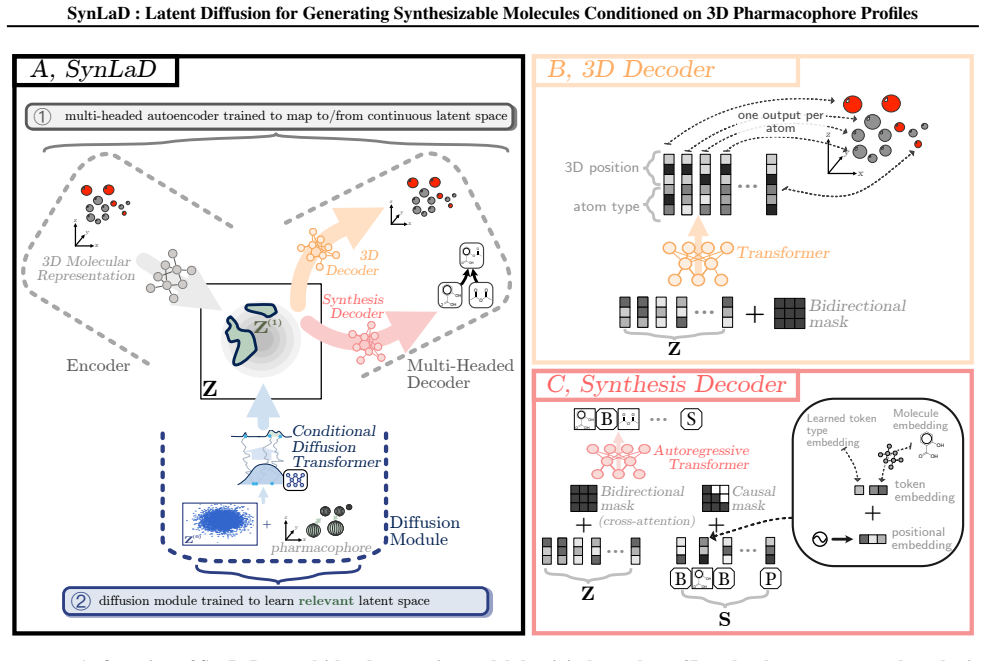
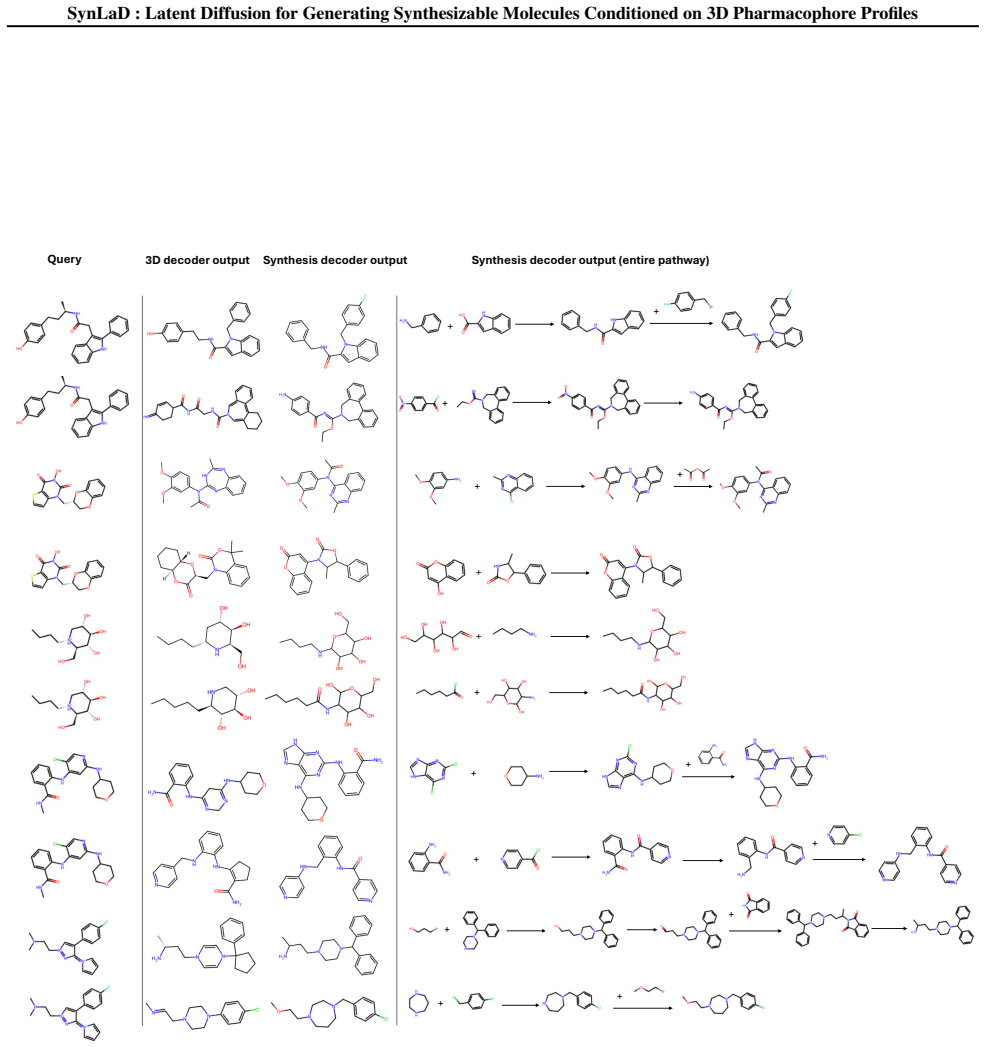
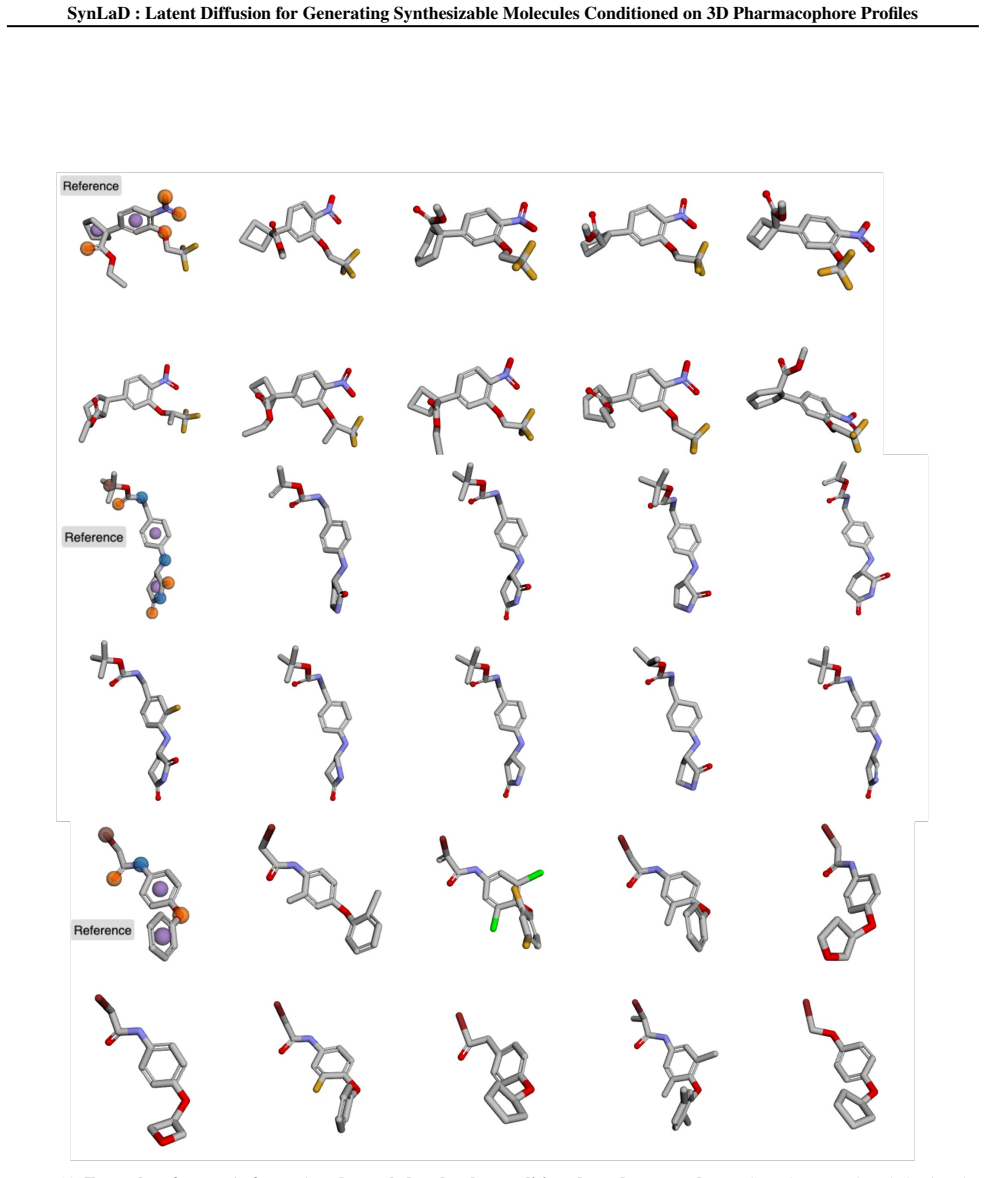
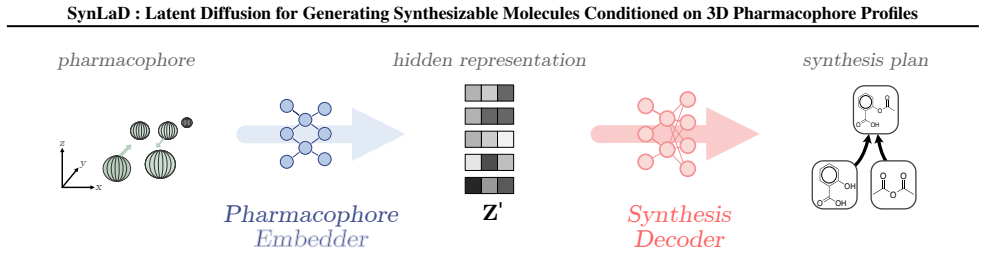
SynLaD learns a latent space in which molecules are represented so that a geometric decoder head can reconstruct atom types and coordinates while an autoregressive decoder head can output valid synthesis routes in serialized reaction notation; a diffusion transformer then samples new latent vectors conditioned on pharmacophore profiles, allowing the same model to produce molecules that are both shape-aligned and synthetically accessible.
What carries the argument
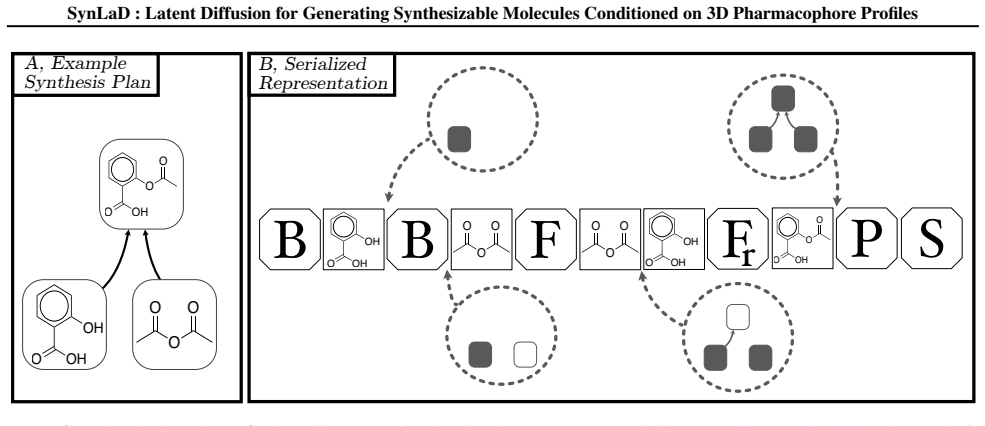
Dual-head decoder attached to a shared latent space, where one head reconstructs 3D atom types and coordinates and the other generates autoregressive synthesis routes, so that diffusion sampling under pharmacophore conditioning satisfies both constraints at once.
If this is right
- Molecules are produced together with their synthesis plans, removing the need for separate post-hoc route planning.
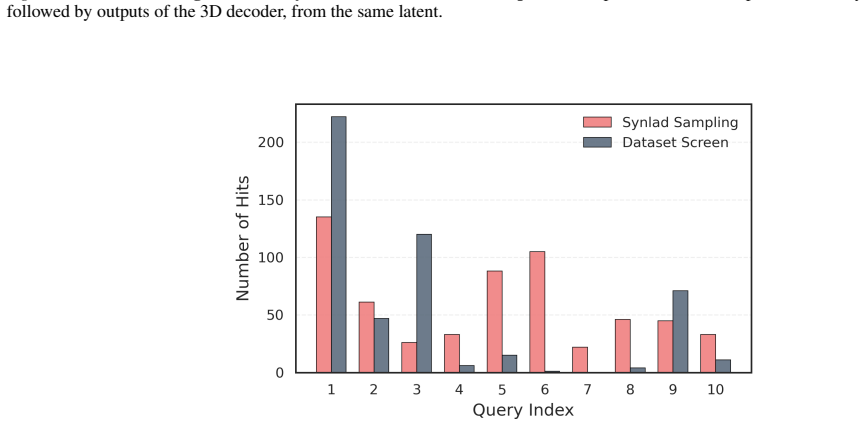
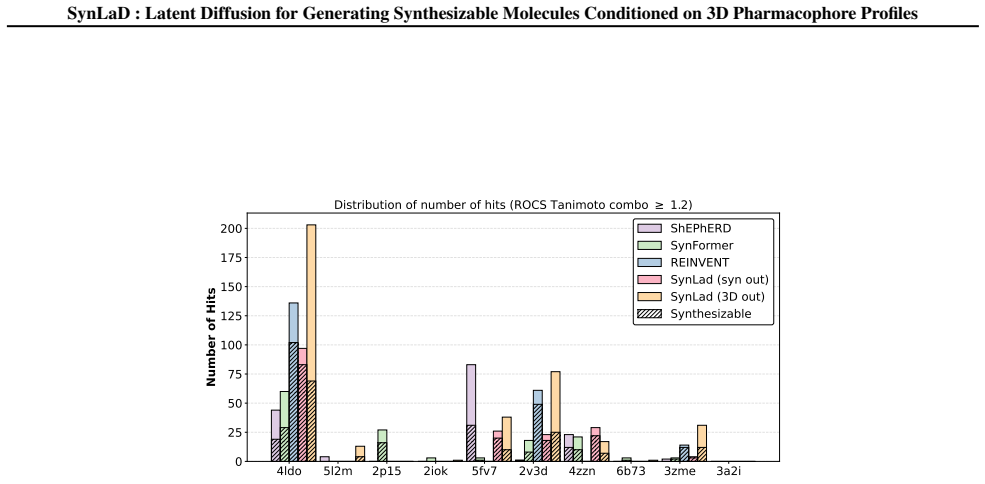
- The model achieves higher counts of synthesizable and diverse hits than existing baselines on analogue generation tasks.
- Pharmacophore conditioning directly controls 3D shape without requiring later adjustments that might break synthetic feasibility.
- Reaction constraints are enforced inside the generative model rather than applied after sampling.
Where Pith is reading between the lines
- The joint latent space could allow synthesis feasibility to influence shape choices during generation rather than after the fact.
- Replacing or adding other conditioning signals, such as predicted binding scores, would test whether the same architecture generalizes beyond pharmacophores.
- End-to-end training from profile to route might reduce the number of design-make-test cycles needed in practice.
- Checking whether the generated routes actually succeed in the laboratory would provide a direct test of real-world utility beyond in silico metrics.
Load-bearing premise
A single learned latent space can simultaneously support accurate 3D geometric reconstruction and valid autoregressive synthesis route generation when conditioned on pharmacophore profiles.
What would settle it
If generated analogues for a benchmark set of bioactive ligands show lower rates of both pharmacophore shape match and successful synthesis-route validity than the strongest baseline methods, the performance advantage would not hold.
Figures
read the original abstract
We present SynLaD, a latent diffusion framework for small-molecule generation that unifies ligand-based drug design objectives (what to make) with synthetic accessibility (how to make it). Current models typically optimize one objective at the expense of the other, creating a bottleneck for discovering high-scoring and synthesizable molecules. SynLaD combines reaction-constrained generation with pharmacophore-conditioned 3D design by learning a latent space that decodes to both 3D structures and synthesis pathways. An encoder maps molecules to a latent representation used by two decoder heads: (i) a geometric head that reconstructs atom types and coordinates and (ii) an autoregressive synthesis head that outputs synthetic routes in a serialized, reaction-based notation. A diffusion transformer generates novel latents in the learned space, conditioned on pharmacophore profiles. Across analogue generation tasks for bioactive ligands, SynLaD outperforms existing baselines in synthesizable and diverse hit generation, demonstrating that a single model can produce shape-aligned molecules with feasible synthesis plans.
Editorial analysis
A structured set of objections, weighed in public.
Referee Report
Summary. The manuscript introduces SynLaD, a latent diffusion framework that unifies 3D pharmacophore-conditioned molecule generation with synthetic accessibility. An encoder produces a shared latent representation decoded by a geometric head (atom types and coordinates) and an autoregressive synthesis head (serialized reaction routes); a diffusion transformer then samples novel latents conditioned on pharmacophore profiles. The central empirical claim is that this single model outperforms existing baselines on analogue generation tasks for bioactive ligands by producing more synthesizable and diverse hits.
Significance. If the reported outperformance is robustly supported, the work would be significant for ligand-based drug design by removing the typical trade-off between 3D shape matching and synthetic feasibility. The dual-decoder architecture in a conditioned latent diffusion setting is a substantive architectural proposal that could influence subsequent generative models if the joint training objectives are shown to be compatible.
major comments (2)
- [Abstract] Abstract: the claim that SynLaD 'outperforms existing baselines in synthesizable and diverse hit generation' is presented without any quantitative metrics, error bars, dataset sizes, or baseline names, which is load-bearing for the central empirical contribution and leaves the performance assertion unverifiable from the provided text.
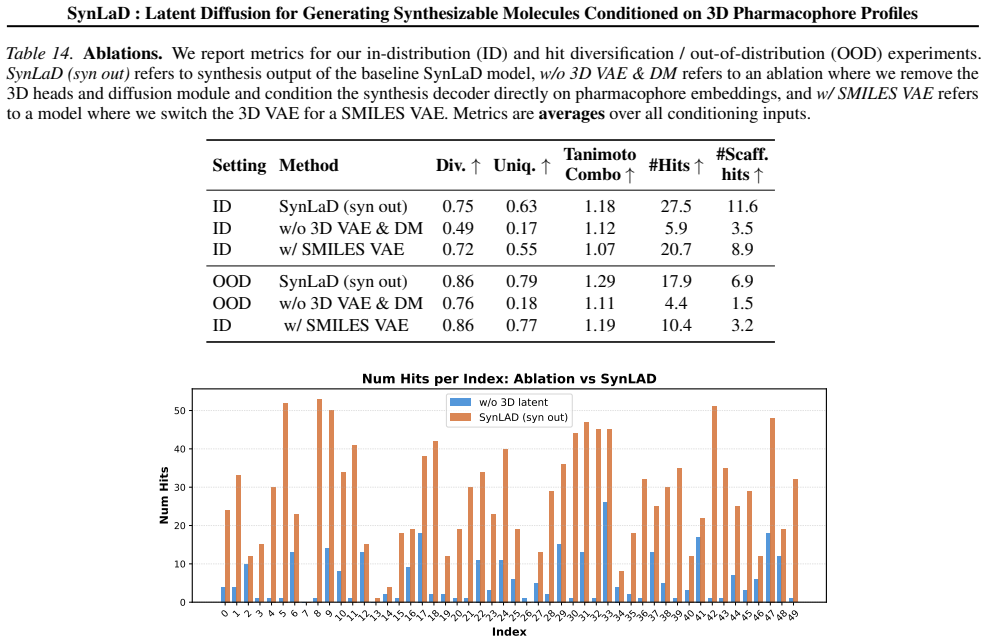
- [Abstract] Abstract: the core modeling assumption that a single learned latent space can simultaneously support accurate 3D geometric reconstruction and valid autoregressive synthesis-route generation under pharmacophore conditioning is stated without reference to any ablation, conflict analysis, or reconstruction metrics that would demonstrate compatibility of the two decoder heads.
minor comments (1)
- [Abstract] Abstract: the phrase 'reaction-constrained generation' is introduced without a brief definition or citation, reducing immediate clarity for readers unfamiliar with the notation.
Simulated Author's Rebuttal
We thank the referee for the detailed and constructive comments. We address each major comment below and will revise the abstract accordingly to improve clarity and verifiability.
read point-by-point responses
-
Referee: [Abstract] Abstract: the claim that SynLaD 'outperforms existing baselines in synthesizable and diverse hit generation' is presented without any quantitative metrics, error bars, dataset sizes, or baseline names, which is load-bearing for the central empirical contribution and leaves the performance assertion unverifiable from the provided text.
Authors: We agree that the abstract should include specific supporting details for the performance claim. In the revised manuscript we will update the abstract to report key quantitative results from the analogue generation experiments (e.g., improvement in synthesizability and diversity metrics with error bars), the dataset sizes used, and the names of the compared baselines. revision: yes
-
Referee: [Abstract] Abstract: the core modeling assumption that a single learned latent space can simultaneously support accurate 3D geometric reconstruction and valid autoregressive synthesis-route generation under pharmacophore conditioning is stated without reference to any ablation, conflict analysis, or reconstruction metrics that would demonstrate compatibility of the two decoder heads.
Authors: The abstract currently does not reference supporting analyses. While the manuscript body contains ablation studies and reconstruction metrics for the dual-decoder setup, we will revise the abstract to briefly cite the empirical evidence of compatibility (low joint reconstruction error and absence of objective conflicts) so that the modeling assumption is grounded in the abstract itself. revision: yes
Circularity Check
No significant circularity; empirical model with external baselines
full rationale
The paper describes a latent diffusion model with an encoder producing a shared latent space, two decoder heads (geometric reconstruction and autoregressive synthesis route generation), and a diffusion transformer conditioned on pharmacophore profiles. All performance claims rest on empirical comparisons to external baselines on analogue generation tasks for bioactive ligands, with no equations, fitted parameters renamed as predictions, self-definitional loops, or load-bearing self-citations visible in the architecture or results description. The derivation chain is self-contained as a standard trained generative model evaluated against independent benchmarks.
Axiom & Free-Parameter Ledger
Reference graph
Works this paper leans on
-
[1]
URL https://openreview.net/forum ?id=KSLkFYHlYg. Bemis, G. W. and Murcko, M. A. The properties of known drugs. 1. Molecular frameworks.Journal of Medicinal Chemistry, 39(15):2887–2893, 1996. URL https:// doi.org/10.1021/jm9602928. Bengio, Y ., Ducharme, R., Vincent, P., and Jauvin, C. A neural probabilistic language model.Journal of Machine Learning Resea...
-
[3]
Genheden, S., Thakkar, A., Chadimová, V ., Reymond, J
URL https://www.pnas.org/doi/abs /10.1073/pnas.2415665122. Genheden, S., Thakkar, A., Chadimová, V ., Reymond, J. L., Engkvist, O., and Bjerrum, E. AiZynthFinder: a fast, ro- bust and flexible open-source software for retrosynthetic planning.Journal of Cheminformatics, 12:70, 2020. URL https://doi.org/10.1186/s13321-020-0 0472-1. Gobbi, A. and Poppinger, ...
-
[4]
URL https://doi.org/10.1016/S007 9-6468(06)45501-6. Gottipati, S. K., Sattarov, B., Niu, S., Pathak, Y ., Wei, H., Liu, S., Liu, S., Blackburn, S., Thomas, K., Coley, C., Tang, J., Chandar, S., and Bengio, Y . Learning to nav- igate the synthetically accessible chemical space using reinforcement learning. In Daumé III, H. and Singh, A. (eds.),Proceedings ...
-
[5]
URL https://doi.org/10.1371/jour nal.pcbi.1002380. Hawkins, P. C. D., Skillman, A. G., and Nicholls, A. Com- parison of shape-matching and docking as virtual screen- ing tools.Journal of Medicinal Chemistry, 50(1):74–82,
-
[6]
URL https://doi.org/10.1021/jm06 03365. Hawkins, P. C. D., Skillman, A. G., Warren, G. L., Elling- son, B. A., and Stahl, M. T. Conformer generation with OMEGA: Algorithm and validation using high quality structures from the protein databank and cam- bridge structural database.Journal of Chemical In- formation and Modeling, 50(4):572–584, 2010. URL https:...
-
[7]
URL https://openaccess.thecvf.co m/content/CVPR2025/papers/Huang_MIDI _Multi-Instance_Diffusion_for_Single _Image_to_3D_Scene_Generation_CVPR_2 025_paper.pdf. Imrie, F., Hadfield, T. E., Bradley, A. R., and Deane, C. M. Deep generative design with 3D pharmacophoric con- straints.Chemical Science, 12:14577–14589, 2021. URL http://dx.doi.org/10.1039/D1SC024...
-
[8]
URL https://doi.org/10.1021/ci20 0207y. Kingma, D. P. and Welling, M. Auto-encoding variational Bayes, 2013. URL https://arxiv.org/abs/13 12.6114. Korovina, K., Xu, S., Kandasamy, K., Neiswanger, W., Poc- zos, B., Schneider, J., and Xing, E. ChemBO: Bayesian optimization of small organic molecules with synthe- sizable recommendations. In Chiappa, S. and C...
-
[9]
Le, T., Cremer, J., Noe, F., Clevert, D.-A., and Schütt, K
URL https://doi.org/10.1002/wcms .1678. Le, T., Cremer, J., Noe, F., Clevert, D.-A., and Schütt, K. T. Navigating the design space of equivariant diffusion- based generative models for de novo 3D molecule gener- ation. InThe Twelfth International Conference on Learn- ing Representations, 2024. URL https://openre view.net/forum?id=kzGuiRXZrQ. Lee, S., Krei...
-
[10]
Rekesh, A., Cretu, M., Shevchuk, D., Somnath, V
URL https://openreview.net/forum ?id=KPRIwWhqAZ. Rekesh, A., Cretu, M., Shevchuk, D., Somnath, V . R., Liò, P., Batey, R. A., Tyers, M., Koziarski, M., and Liu, C.- H. SynCoGen: Synthesizable 3D molecule generation via joint reaction and coordinate modeling, 2025. URL https://arxiv.org/abs/2507.11818. Rezende, D. and Mohamed, S. Variational inference with...
-
[11]
Found in Translation
URL https://openreview.net/forum ?id=g3VCIM94ke. Schwaller, P., Gaudin, T., Lanyi, D., Bekas, C., and Laino, T. “Found in Translation”: predicting outcomes of complex organic chemistry reactions using neural sequence-to- sequence models.Chemical Science, 9(28):6091–6098,
-
[12]
Schwaller, P., Laino, T., Gaudin, T., Bolgar, P., Hunter, C
URL https://doi.org/10.1039/C8SC 02339E. Schwaller, P., Laino, T., Gaudin, T., Bolgar, P., Hunter, C. A., Bekas, C., and Lee, A. A. Molecular Transformer: A model for uncertainty-calibrated chemical reaction pre- diction.ACS Central Science, 5(9):1572–1583, 2019. URL https://doi.org/10.1021/acscents ci.9b00576. Segler, M. H., Kogej, T., Tyrchan, C., and W...
-
[13]
URL https://doi.org/10.1021/acs. jcim.1c01065. Seo, S., Kim, M., Shen, T., Ester, M., Park, J., Ahn, S., and Kim, W. Y . Generative flows on synthetic pathway for drug design. InThe Thirteenth International Conference on Learning Representations, 2025. URL https://op enreview.net/forum?id=pB1XSj2y4X. 14 SynLaD : Latent Diffusion for Generating Synthesizab...
work page doi:10.1021/acs 2025
discussion (0)
Sign in with ORCID, Apple, or X to comment. Anyone can read and Pith papers without signing in.