REVIEW 1 cited by
New Physics effects with right-handed neutrinos in semileptonic decay $B_c^+ \to B_s \mu^+ \nu_{\mu}$
T0 review · reviewed 2026-08-12 · deepseek-v4-flash
Pith's one-line read Right-handed neutrino operators constrained by charm data are predicted to shift the lepton polarization asymmetry and convexity in B_c -> B_s mu nu away from the Standard Model, offering a way to distinguish new physics scenarios.
The pith
A machine-rendered reading of the paper's core claim, the machinery that carries it, and where it could break.
The reading
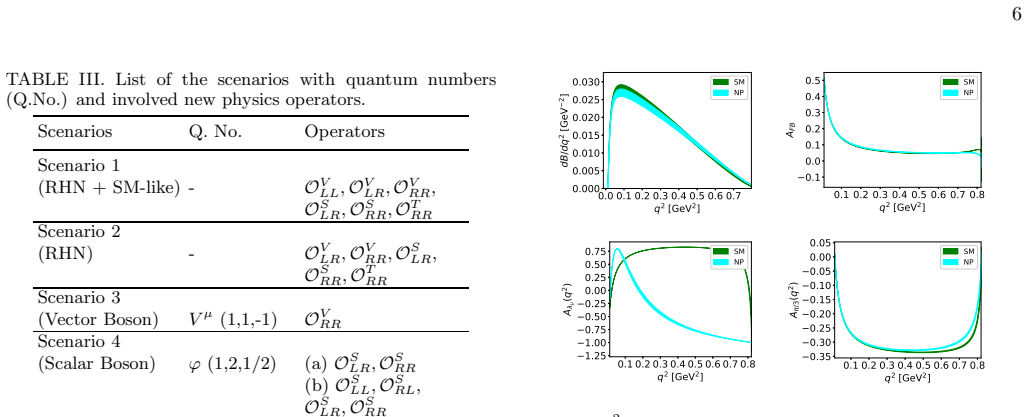
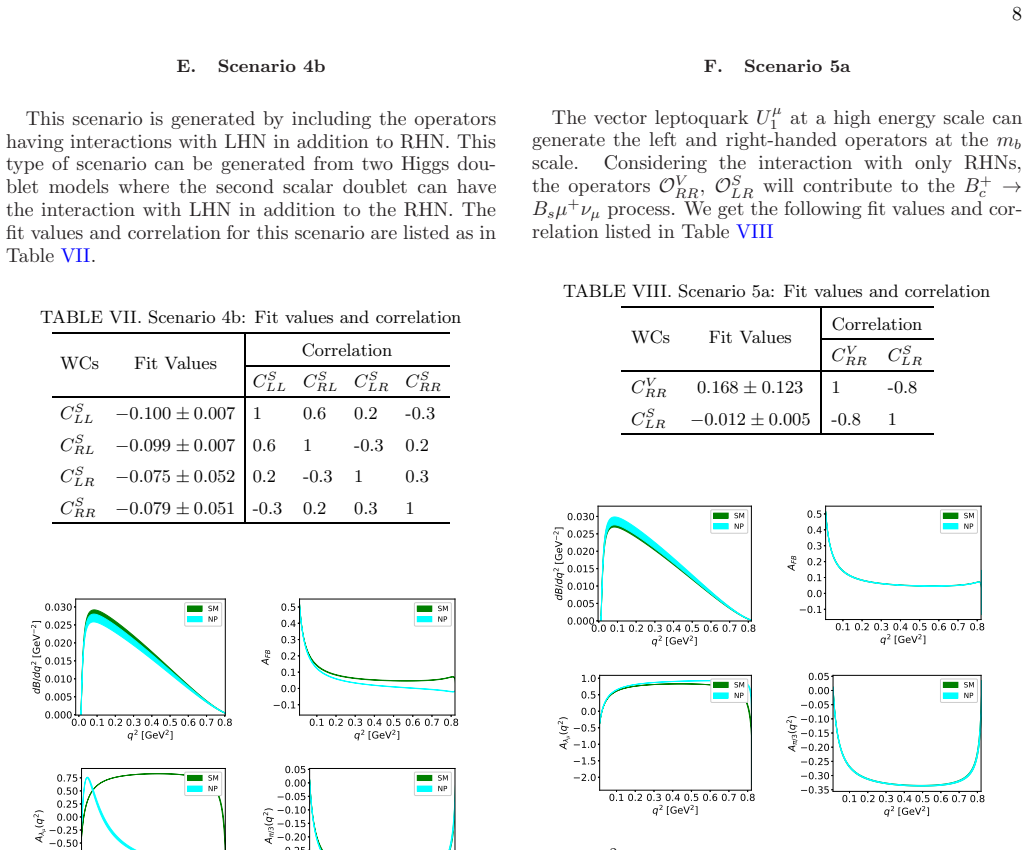
The paper examines ten different new physics scenarios, each corresponding to a different heavy mediator that could generate the operators. In most scenarios, the lepton polarization asymmetry shows the largest deviation from the Standard Model, and in several cases the location of its zero crossing shifts. The differential branching fraction and forward-backward asymmetry are less sensitive.
The main caveat is that the new physics parameters are not tightly constrained: several fits use as many parameters as data points, and the quoted uncertainties are large. The prediction bands shown in the figures do not include those parameter uncertainties, only the form-factor uncertainties. If the parameter errors are propagated, the deviations may shrink. The authors acknowledge this and say it is premature to make definitive statements. The value of the paper is that it provides concrete, testable predictions for a decay that LHCb may measure after its upgrade.
Extended reading notes
Core claim
The paper claims that, after constraining the Wilson coefficients of right-handed neutrino operators with existing c -> s mu nu data, several observables in B_c+ -> B_s mu+ nu_mu, especially the lepton polarization asymmetry A_lambda_mu and convexity A_pi/3, deviate significantly from the Standard Model and can disentangle different new physics scenarios. Concretely, Table XII marks A_lambda_mu as sensitive in nine of ten scenarios, with zero-crossing shifts reported for scenarios 1, 2, 4a, 4b, 6, 7a and 7b. If correct, future measurements of this decay could distinguish among vector, scalar and leptoquark mediators.
Load-bearing premise
The predictions rest on the assumption that the best-fit values of the NP Wilson coefficients are meaningful representatives of the allowed parameter space. The six WCs in Scenario 1 are fit to only six total branching ratios (Table I), producing errors as large as C_V^LR = -0.367 ± 0.380, C_V^RR = 0.283 ± 3.088 (Scenario 5b), and strong correlations (Tables IV-XI). The plotted NP bands include only form-factor uncertainties and not these WC uncertainties, so the claimed deviations could disappear once WC errors are propagated. A structurally separate premise is the massless right-handed neutrino assumption (Sec. II), which removes left-right interference terms; a massive RHN would change the angular distributions.
Editorial analysis
A structured set of objections, weighed in public.
Assumptions & free parameters
free parameters (9)
- C_V^LL =
-0.066 ± 0.141 (Scenario 1); -0.092 ± 0.208 (Scenario 7b)
- C_V^LR =
-0.367 ± 0.380 (Scenario 1); -0.193 ± 0.207 (Scenario 2)
- C_V^RR =
0.116 ± 0.119 (S1); -0.166 ± 0.077 (S3); 0.283 ± 3.088 (S5b)
- C_S^LL =
-0.100 ± 0.007 (S4b)
- C_S^RL =
-0.099 ± 0.007 (S4b); -0.069 ± 0.023 (S5b)
- C_S^LR =
-0.097 ± 0.017 (S1); -0.029 ± 0.128 (S4a); -0.006 ± 0.003 (S8)
- C_S^RR =
-0.094 ± 0.017 (S1); -0.035 ± 0.128 (S4a)
- C_T^LL =
-0.026 ± 0.092 (S7b)
- C_T^RR =
0.017 ± 0.332 (S1); -0.070 ± 0.032 (S6); -0.067 ± 0.039 (S7a)
assumptions (6)
- domain assumption The low-energy NP is described by the dimension-six operator basis in Eq. (1) with no higher-dimensional contributions.
- domain assumption Right-handed neutrinos are massless, so left- and right-chirality amplitudes do not interfere.
- domain assumption The B_c -> B_s form factors f+, f0, fT from HPQCD lattice QCD (ref [54]) are accurate over the full q2 range, using the z-expansion coefficients in Table XIII.
- domain assumption The Fierz relations C_S = 4r C_T with r ~ 2 at the b-quark scale (from ref [37]) relate scalar and tensor operators in scenarios 6, 7a and 7b.
- domain assumption The same hadronic form factors apply to right-handed neutrino operators as to left-handed ones because the hadronic current is unchanged.
- standard math Experimental branching fractions in Table I are treated as Gaussian measurements with quoted errors.
Cite this review
Pith. "Pith review of New Physics effects with right-handed neutrinos in semileptonic decay $B_c^+ \to B_s \mu^+ \nu_{\mu}$." pith.science (2026). https://pith.science/paper/YFJG4JLF
@misc{pith2026241107987,
  author       = {Pith},
  title        = {Pith review of: New Physics effects with right-handed neutrinos in semileptonic decay $B_c^+ \to B_s \mu^+ \nu_\mu$},
  year         = {2026},
  howpublished = {\url{https://pith.science/paper/YFJG4JLF}},
  note         = {Machine review of arXiv:2411.07987}
}
abstract
We extend the Standard Model with the general effective Hamiltonian for the quark level transition $c \to s \ell \nu$ with a complete set of four fermion operators including right-handed neutrinos. The current experimental measurements in charm decays are compatible with the Standard Model predictions and are used to constrain the new physics. With the available experimental data, we fit a $\chi^2$ function to get the best-fit values of the NP WCs. We investigate the impact of allowed new physics in the observables such as differential branching fraction, forward-backward asymmetry, lepton polarization asymmetry, and convexity parameter in the semileptonic decay $B_c^+ \to B_s \mu^+ \nu_{\mu}$. The different types of new physics scenarios have significant effects on these considered observables. The future experimental information of these observables can help to disentangle the structure of new physics.
Figures


Figures from the paper (5 more)


Forward citations
Cited by 1 Pith paper
-
The effects of polarization on the observables in the decay $\Xi_{cc}^{++} \rightarrow \Xi_{c}^{+} \bar{\ell}\nu_{\ell}$
Polarization of the parent baryon, daughter baryon, and muon strongly reshapes branching ratios, forward-backward asymmetries, and newly defined polarization ratios in Ξ_cc++ → Ξ_c+ ℓ ν, while the μ/e LFU ratio stays ...
Reference graph
Works this paper leans on
-
[1]
D → P µ+νµ We consider the semileptonic decays D → Pµ +νµ, where D are the D0,D+ mesons and P denotes the pseu- doscalar K − and ¯K 0 mesons respectively[ 43]. The dif- ferential branching fraction, including right-handed neu- trinos, is given by dB dq2 (D →Pµ +νµ) = G2 FV 2 cs 192m3 Dπ3q2√ λP (q2) ( 1 − m2 µ q2 )2 τD × {( ⏐ ⏐1 +CV LL +CV RL ⏐ ⏐2 + ⏐ ⏐CV ...
-
[2]
D → V µ+νµ We continue to constrain the new physics operators further by considering semileptonic D → V decays, where D are D0, D+ and D+ s mesons and V are the K ∗−, ¯K ∗0 and φ mesons [ 43, 46]. The differential branching fraction for this semileptonic decay with right-handed neutrinos can be given by: dB dq2 (D →Vµ +νµ) = G2 FV 2 cs 192m3 Dπ3q2√ λV (q2)...
work page 1968
-
[3]
The lepton polarization asymmetry is the most sensitive observable with a zero crossing symmetry at q2 ∼ 0.18 GeV 2 and on the other hand NP convexity is deviating from SM for q2 > 0.35 GeV 2 values. However, the differential branching frac- tion and forward-backward asymmetry do not show any significant deviation from the SM. 0.0 0.1 0.2 0.3 0.4 0.5 0.6 0....
-
[4]
The fit value for this scenario are as follows: CT RR = −0.070 ± 0.032 (15) For this scenario as shown in figure 8, the differential branching fraction provides a deviation from SM above q2 ∼ 0.2 GeV 2. The lepton polarization asymmetry and convexity parameters give a large deviation from the SM almost for the full q2 region. The zero crossing for lepton pol...
-
[5]
Scenario 4a × × ✓ × 4b × ✓ ✓ ✓
-
[6]
Scenario 5a × × ✓ × 5b × ✓ ✓ ✓
-
[7]
Scenario 7a ✓ ✓ ✓ ✓ 7b ✓ ✓ ✓ ✓
-
[8]
Scenario 8 × × ✓ × asymmetry, lepton polarization asymmetry, and convex- ity parameter in the decay B+ c →Bsµ+νµ which is gov- erned by the quark level transition c →sℓν. In our numerical analysis, we work in the general effective field theory considering low energy effective Hamiltonian for c → sµ+νµ with right-handed neutrino. We con- strained the allowed ...
work page 2021
Show all 65 references
-
[9]
D → P The hadronic helicity amplitudes following from [ 55] are given by HP V,0(q2) = √ λP (q2) q2 f+(q2), HP V,s(q2) = m2 D −m2 P √ q2 f0(q2), HP S,s(q2) = m2 D −m2 P mc −ms f0(q2), HP T (q2) = − √ λP (q2) mD +mP fT (q2), HP P,s(q2) = 0, H P V,±(q2) = 0 (B1) For form factor i...
-
[10]
D → V The Hadronic helicity amplitude for D →V decays is defined as follows [ 55]. HV V,± = (mD +mV )A1(q2) ∓ √ λV (q2) (mD +mV )V (q2) HV V,0 = (mD +mV ) 2mV √ q2 [−(m2 D −m2 V −q2)A1(q2) + √ λV (q2) (mD +mV )2A2(q2)], HV V,t = √ λV (q2) q2 A0(q2), HV P = − √ λV (q2) mc +ms A0...
-
[11]
https://hflav-eos.web.cern.ch/hflav eos/semi/moriond24/html/RDsDsstar/RDRDs.html,
-
[12]
Aaij et al
R. Aaij et al. (LHCb), Phys. Rev. Lett. 120, 121801 (2018) , arXiv:1711.05623 [hep-ex]
2018 arXiv
-
[13]
A. Y. Anisimov, I. M. Narodetsky, C. Semay, and B. Silvestre-Brac, Phys. Lett. B 452, 129 (1999) , arXiv:hep-ph/9812514
1999 arXiv
-
[14]
M. A. Ivanov, J. G. Korner, and P. Santorelli, Phys. Rev. D 73, 054024 (2006) , arXiv:hep-ph/0602050
2006 arXiv
-
[15]
Hernandez, J
E. Hernandez, J. Nieves, and J. M. Verde-Velasco, Phys. Rev. D 74, 074008 (2006) , arXiv:hep-ph/0607150
2006 arXiv
- [16]
-
[17]
Wang, Y.-L
W. Wang, Y.-L. Shen, and C.- D. Lu, Phys. Rev. D 79, 054012 (2009) , 14 arXiv:0811.3748 [hep-ph]
2009 arXiv
-
[18]
Wang, Y.-Y
W.-F. Wang, Y.-Y. Fan, and Z.-J. Xiao, Chin. Phys. C 37, 093102 (2013) , arXiv:1212.5903 [hep-ph]
2013 arXiv
- [19]
-
[20]
Issadykov and M
A. Issadykov and M. A. Ivanov, Phys. Lett. B 783, 178 (2018) , arXiv:1804.00472 [hep-ph]
2018 arXiv
-
[21]
C.-T. Tran, M. A. Ivanov, J. G. K¨ orner, and P. Santorelli, Phys. Rev. D 97, 054014 (2018) , arXiv:1801.06927 [hep-ph]
2018 arXiv
-
[22]
Hu, X.-Q
Q.-Y. Hu, X.-Q. Li, and Y.-D. Yang, Eur. Phys. J. C 79, 264 (2019) , arXiv:1810.04939 [hep-ph]
2019 arXiv
-
[23]
Wang and R
W. Wang and R. Zhu, Int. J. Mod. Phys. A 34, 1950195 (2019) , arXiv:1808.10830 [hep-ph]
2019 arXiv
-
[24]
Hu, S.-P
X.-Q. Hu, S.-P. Jin, and Z.-J. Xiao, Chin. Phys. C 44, 023104 (2020) , arXiv:1904.07530 [hep-ph]
2020 arXiv
- [25]
-
[26]
Azizi, Y
K. Azizi, Y. Sarac, and H. Sundu, Phys. Rev. D 99, 113004 (2019) , arXiv:1904.08267 [hep-ph]
2019 arXiv
-
[27]
M. Y. Khlopov, SOVIET JOURNAL OF NUCLEAR PHYSICS-USSR 28, 583 (1978)
1978
-
[28]
Gershtein and M
S. Gershtein and M. Y. Khlopov, JETP Lett 23, 338 (1976)
1976
- [29]
-
[30]
Elahi, G
F. Elahi, G. Elor, and R. McGe- hee, Phys. Rev. D 105, 055024 (2022) , arXiv:2109.09751 [hep-ph]
2022 arXiv
-
[31]
Elor and R
G. Elor and R. McGehee, Phys. Rev. D 103, 035005 (2021) , arXiv:2011.06115 [hep-ph]
2021 arXiv
-
[32]
Colangelo, G
P. Colangelo, G. Nardulli, and N. Paver, Zeitschrift f¨ ur Physik C Particles and Fields 57, 43 (1993)
1993
-
[33]
Beneke and G
M. Beneke and G. Buchalla, Phys. Rev. D 53, 4991 (1996) , arXiv:hep-ph/9601249
1996 arXiv
-
[34]
V. V. Kiselev, A. E. Kovalsky, and A. K. Likhoded, Nucl. Phys. B 585, 353 (2000) , arXiv:hep-ph/0002127
2000 arXiv
-
[35]
Beltr´ an, G
R. Beltr´ an, G. Cottin, J. C. Helo, M. Hirsch, A. Titov, and Z. S. Wang, JHEP 01, 015 , arXiv:2210.02461 [hep-ph]
- [36]
- [37]
-
[38]
Greljo, D
A. Greljo, D. J. Robinson, B. Shakya, and J. Zupan, JHEP 09, 169 , arXiv:1804.04642 [hep-ph]
-
[39]
D. J. Robinson, B. Shakya, and J. Zupan, JHEP 02, 119 , arXiv:1807.04753 [hep-ph]
-
[40]
Azatov, D
A. Azatov, D. Barducci, D. Ghosh, D. Marzocca, and L. Ubaldi, JHEP 10, 092 , arXiv:1807.10745 [hep-ph]
-
[41]
K. S. Babu, B. Dutta, and R. N. Mohapatra, JHEP 01, 168 , arXiv:1811.04496 [hep-ph]
- [42]
-
[43]
Asadi, M
P. Asadi, M. R. Buckley, and D. Shih, Phys. Rev. D 99, 035015 (2019) , arXiv:1810.06597 [hep-ph]
2019 arXiv
-
[44]
Bardhan and D
D. Bardhan and D. Ghosh, Phys. Rev. D 100, 011701 (2019) , arXiv:1904.10432 [hep-ph]
2019 arXiv
-
[45]
Shi, L.-S
R.-X. Shi, L.-S. Geng, B. Grinstein, S. J¨ ager, and J. Mar- tin Camalich, JHEP 12, 065 , arXiv:1905.08498 [hep-ph]
1905 arXiv
-
[46]
J. D. G´ omez, N. Quintero, and E. Ro- jas, Phys. Rev. D 100, 093003 (2019) , arXiv:1907.08357 [hep-ph]
2019 arXiv
-
[47]
Mandal, C
R. Mandal, C. Murgui, A. Pe˜ nuelas, and A. Pich, JHEP 08 (08), 022, arXiv:2004.06726 [hep-ph]
2004 arXiv
-
[48]
Colangelo, F
P. Colangelo, F. De Fazio, and F. Loparco, Phys. Rev. D 103, 075019 (2021) , arXiv:2102.05365 [hep-ph]
2021 arXiv
- [49]
-
[50]
Datta, H
A. Datta, H. Liu, and D. Marfa- tia, Phys. Rev. D 106, L011702 (2022) , arXiv:2204.01818 [hep-ph]
2022 arXiv
-
[51]
Alvarado, L
F. Alvarado, L. Alvarez-Ruso, E. Hernandez, J. Nieves, and N. Penalva, (2024), arXiv:2407.09325 [hep-ph]
2024 arXiv
-
[52]
Y. Aoki, T. Blum, G. Colangelo, S. Collins, M. D. Morte, P. Dimopoulos, S. D¨ urr, X. Feng, H. Fukaya, M. Golter- man, et al. , The European Physical Journal C 82, 869 (2022)
2022
-
[53]
Fleischer, R
R. Fleischer, R. Jaarsma, and G. Koole, Eur. Phys. J. C 80, 153 (2020) , arXiv:1912.08641 [hep-ph]
2020 arXiv
-
[54]
Lubicz, L
V. Lubicz, L. Riggio, G. Salerno, S. Simula, and C. Tarantino (ETM), Phys. Rev. D 96, 054514 (2017) , [Erratum: Phys.Rev.D 99, 099902 (2019), Erratum: Phys.Rev.D 100, 079901 (2019)], arXiv:1706.03017 [hep-lat]
2017 arXiv
-
[55]
Lubicz, L
V. Lubicz, L. Riggio, G. Salerno, S. Simula, and C. Tarantino (ETM), Phys. Rev. D 98, 014516 (2018) , arXiv:1803.04807 [hep-lat]
2018 arXiv
-
[56]
Leng, X.-L
X. Leng, X.-L. Mu, Z.-T. Zou, and Y. Li, Chin. Phys. C 45, 063107 (2021) , arXiv:2011.01061 [hep-ph]
2021 arXiv
-
[57]
Y.-L. Wu, M. Zhong, and Y.-B. Zuo, Int. J. Mod. Phys. A 21, 6125 (2006) , arXiv:hep-ph/0604007
2006 arXiv
-
[58]
K. C. Bowler, N. Hazel, H. Hoeber, R. D. Kenway, D. Richards, L. Lellouch, J. Nieves, C. T. Sachrajda, and H. Wittig, Physical Review D 51, 4905 (1995)
1995
-
[59]
P. D. Group, P. Zyla, R. Barnett, J. Beringer, O. Dahl, D. Dwyer, D. Groom, C.-J. Lin, K. Lugovsky, E. Pianori, et al. , Progress of Theoretical and Experimental Physics 2020, 083C01 (2020)
2020
-
[60]
James and M
F. James and M. Roos, Comput. Phys. Commun. 10, 343 (1975)
1975
-
[61]
James, MINUIT: function minimization and error analysis reference manual , Tech
F. James, MINUIT: function minimization and error analysis reference manual , Tech. Rep. (CERN, 1998)
1998
-
[62]
Beˇ cirevi´ c, M
D. Beˇ cirevi´ c, M. Fedele, I. Niˇ sandˇ zi´ c, and A. Tay- duganov, (2019), arXiv:1907.02257 [hep-ph] . 15
2019 arXiv
-
[63]
Beˇ cirevi´ c, F
D. Beˇ cirevi´ c, F. Jaffredo, A. Pe˜ nuelas, and O. Sumensari, JHEP 05, 175 , arXiv:2012.09872 [hep-ph]
2012 arXiv
-
[64]
L. J. Cooper, C. T. H. Davies, J. Harri- son, J. Komijani, and M. Wingate (HPQCD), Phys. Rev. D 102, 014513 (2020) , [Erra- tum: Phys.Rev.D 103, 099901 (2021)], arXiv:2003.00914 [hep-lat]
2020 arXiv
-
[65]
Sakaki, M
Y. Sakaki, M. Tanaka, A. Tayduganov, and R. Watanabe, Phys. Rev. D 88, 094012 (2013) , arXiv:1309.0301 [hep-ph]
2013 arXiv
Reviewed August 12, 2026 · model on record in the stance chip above.
Discussion (0). Continue with ORCID to comment.