REVIEW 4 major objections 5 minor 107 references
This paper claims that P-wave one-boson-exchange forces between ground-state bottom baryons and antibottom mesons generate a spectrum of positive-parity hidden-bottom molecular pentaquark candidates—loosely bound states and resonances in ne
Reviewed by Pith at T0; open to challenge. T0 means a machine referee read the full paper against a public rubric. the ladder, T0–T4 →
T0 review · deepseek-v4-flash
2026-08-02 00:41 UTC pith:YFVIC5MI
load-bearing objection Systematic OBE survey of P-wave hidden-bottom pentaquarks: new predictions, standard method, but the 'loose molecule' label is applied inconsistently and the headline candidates need a clarity pass between single-channel and full coupled-channel results. the 4 major comments →
Possible hidden-bottom molecular pentaquarks from P-wave Λ_bB^((*))/Sigma_b^((*))B^((*)) interactions
The pith
A machine-rendered reading of the paper's core claim, the machinery that carries it, and where it could break.
Core claim
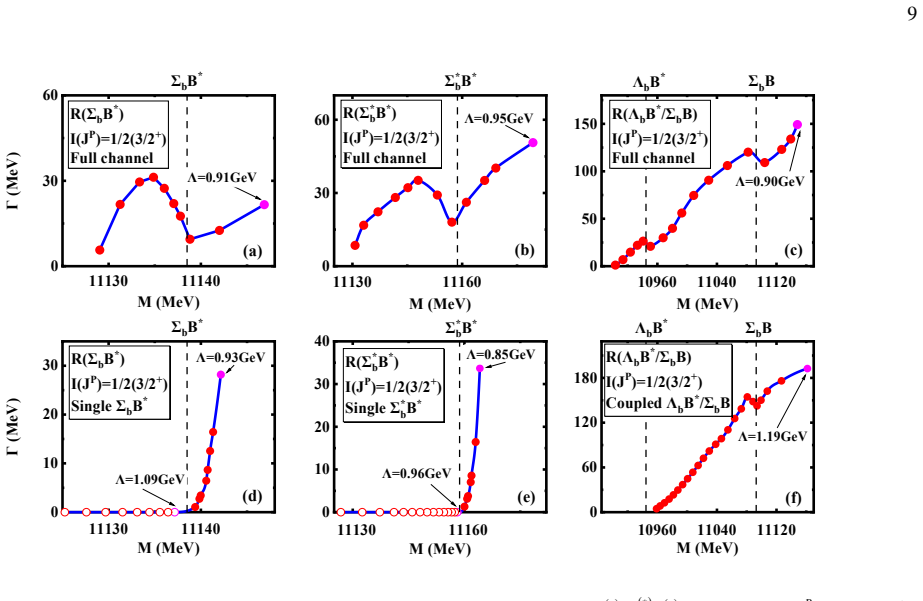
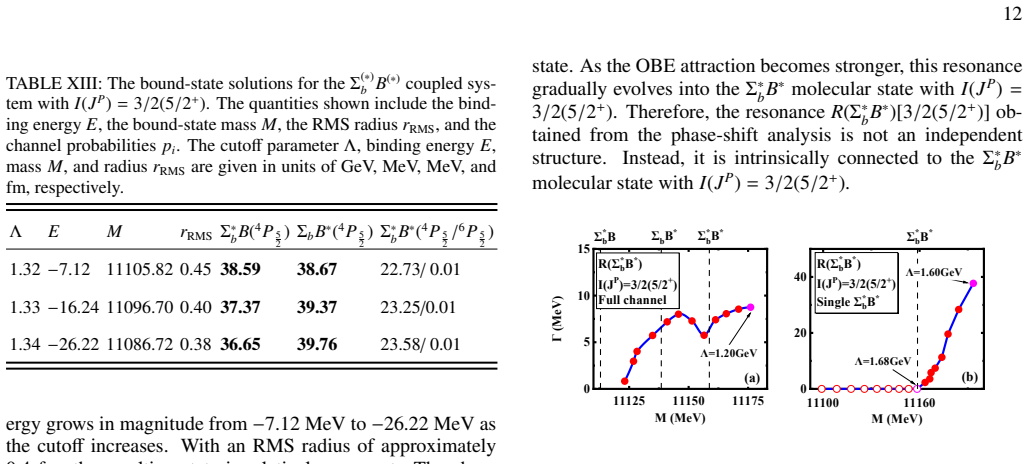
Within the one-boson-exchange model with coupled channels, the P-wave Lambda_b B^(*)/Sigma_b^(*) B^(*) interactions are attractive enough to create positive-parity hidden-bottom molecular pentaquarks. The paper finds shallow bound states with binding energies of a few to tens of MeV and radii near 1 fm in the Sigma_b B* and Sigma_b^* B* channels for I=1/2 (J^P=1/2^+ and 3/2^+) and in Sigma_b^* B* for I=1/2 (5/2^+); in the I=3/2 sector, where the isospin factor weakens the attraction, it still obtains bound states and resonances, notably Sigma_b^* B* states with J^P=3/2^+,5/2^+ and a 7/2^+ resonance. Coupled-channel mixing is essential: it lowers the cutoff at which states appear and produces
What carries the argument
The carrying mechanism is the one-boson-exchange (OBE) effective potential, with sigma, pi, eta, rho, and omega exchange and a monopole form factor, evaluated for all allowed P-wave channels. The potential contains central, spin-spin, spin-orbit, and tensor operators whose matrix elements are tabulated; solving the coupled-channel Schrödinger equation for each I(J^P) sector yields bound states, and phase-shift analysis identifies resonances where the phase crosses pi/2 with positive slope. The cutoff Lambda (varied around 1 GeV) is the dial that tunes the attraction strength.
Load-bearing premise
The load-bearing premise is that the OBE potentials with their coupling constants and a monopole form factor, with the cutoff tuned near 1 GeV, faithfully approximate the real bottom-baryon–antibottom-meson interaction; if the true short-distance force is weaker or the physical cutoff falls outside this window, most of the predicted states disappear.
What would settle it
Look for narrow positive-parity structures in the approximately 11.1 GeV invariant-mass region of bottomonium-plus-baryon systems; if the predicted Sigma_b^* B* 7/2^+ I=3/2 resonance and the I=1/2 Sigma_b B* molecules are absent with widths below tens of MeV, the central claim is falsified.
If this is right
- A whole family of positive-parity hidden-bottom pentaquark candidates is predicted, not just one state; the I=1/2 sector alone has loosely bound Sigma_b B* and Sigma_b^* B* molecules for several J^P values.
- Most resonances are threshold companions: as the cutoff grows they evolve smoothly into bound states, so observing a resonance above threshold and its bound partner below would confirm the picture.
- Coupled-channel dynamics is essential, so single-channel treatments that drop the Lambda_b B^(*) channels are insufficient; any future calculation should keep the full channel set.
- The I=3/2 Sigma_b^* B* states with J^P=3/2^+,5/2^+,7/2^+ are clean predictions in the sense that they are dominated by a single partial wave (6P_J), giving sharp quantum-number assignments for experimental checks.
Where Pith is reading between the lines
- If confirmed, these P-wave states would show that the hadronic-molecule phenomenon is not confined to S-wave shallow binding but extends to orbital excitations, where centrifugal barriers usually suppress binding.
- The predicted absence of an I=1/2 7/2^+ bound state or resonance even up to a 2 GeV cutoff is a sharp discriminator: a positive-parity I=1/2 7/2^+ peak seen by experiments would directly contradict this OBE realization.
- The compact states with rms radii below 0.5 fm and binding energies shifted by hundreds of MeV relative to their dominant channel are better reinterpreted as compact pentaquarks rather than molecules; the paper's own criterion flags only the shallow states as genuine molecular candidates.
- A natural testable extension is to check heavy-quark-spin-symmetry multiplets: if the 1/2^+, 3/2^+, 5/2^+ bottom molecules form the predicted spin partners, analogous states in the charm sector should appear at scaled masses.
Editorial analysis
A structured set of objections, weighed in public.
Referee Report
Summary. This paper studies P-wave interactions between ground-state bottom baryons (Λ_b, Σ_b^(*)) and antibottom mesons (B^(*)) in the one-boson-exchange (OBE) model, with a monopole form factor and cutoff Λ. The authors construct explicit coupled-channel potentials for isospin I=1/2 and 3/2 and all J^P = 1/2^+, 3/2^+, 5/2^+, 7/2^+, solve coupled-channel Schrödinger equations for bound states, and perform phase-shift analyses for resonances. They report a rich spectrum of positive-parity hidden-bottom molecular pentaquark candidates, including loosely bound states in the Σ_bB^* and Σ_b^*B^* channels, especially for I=1/2(1/2^+, 3/2^+), and Σ_b^*B^* states for I=3/2(3/2^+, 5/2^+, 7/2^+). The paper emphasizes that coupled-channel effects reduce the cutoff needed to form resonances and that high-spin 6P_J components play a significant role.
Significance. If the predictions were robust, a systematic OBE-based study of P-wave hidden-bottom pentaquarks would be a useful guide for LHCb and Belle II searches. The paper has strengths: it covers all allowed quantum numbers in the chosen model space, provides explicit potential tables, and includes both bound-state and resonance analyses. It does not fit to data, and the OBE framework is standard. However, the central claim that the spectrum contains 'loosely bound molecular pentaquark candidates' is not supported by the full coupled-channel solutions as presented. The inconsistency in applying the paper's own compactness criterion, the reliance on single-channel bound states for some headline candidates, and the cutoff-window dependence of the predictions are load-bearing issues. The manuscript is suitable for major revision rather than acceptance in its current form.
major comments (4)
- [Sec. III.A.a, Tables VI and VIII] The criterion introduced in Sec. III.A.a is applied only to the I=1/2(1/2^+) coupled-channel bound state. There the authors reject the state because the dominant channel is not the lowest threshold and because E_tilde = E + (M_low - M_dom) gives hundreds of MeV of binding with r_RMS well below 1 fm. The same test is not applied to the I=1/2(3/2^+) and I=1/2(5/2^+) coupled states. In Table VI at Λ=1.07 GeV, E=-5.50 MeV, r_RMS=0.49 fm, and the dominant Σ_b^*B^* component has probability ~37% while its threshold is roughly 260 MeV above Λ_bB; thus E_tilde ≈ -266 MeV. In Table VIII at Λ=1.10 GeV, E=-2.38 MeV, r_RMS=0.69 fm, with dominant Λ_bB^* probability ~57%; the Σ_b^*B^* component is again far above threshold. These states are compact by the paper's own standard. Either the E_tilde criterion should be applied uniformly, or the distinction needs an explicit physical justification. Without
- [Secs. III.A.b, III.B.a, III.B.b; Tables V, VII, IX] Several of the headline molecular candidates are obtained from single-channel calculations at cutoff values where the full coupled-channel eigenstate is not the same near-threshold state. For example, the Σ_bB^* and Σ_b^*B^* states in Tables V and VII appear as single-channel bound states at Λ ≈ 1.08-1.15 GeV, but the full coupled-channel solutions in Tables IV and VI at comparable cutoffs are compact mixed states dominated by higher thresholds. The paper argues that resonances evolve into single-channel molecular states as Λ increases, but it does not demonstrate that the single-channel bound-state poles survive as poles of the full coupled-channel S-matrix. Coupling to lower Λ_bB and Λ_bB^* channels can shift the state into a resonance or move the pole off the physical sheet. The central spectrum of loosely bound states therefore rests on truncated dynamics. The authors should show exp
- [Sec. III, especially D-G] The 'reasonable cutoff' criterion is applied inconsistently. The text repeatedly states that promising states should appear for Λ ∼ 1 GeV, but many of the I=3/2 candidates require Λ ≈ 1.3-1.8 GeV (Tables X-XV), and the I=3/2(3/2^+, 5/2^+, 7/2^+) single-channel and coupled states are obtained only at such larger cutoffs. The paper notes in places that I=3/2 needs larger Λ, but then still labels these as promising molecular candidates. Since Λ is the only free parameter and states are selected by whether they appear in the chosen window, the classification is partly circular. A quantitative sensitivity analysis over the full 1-2 GeV range, with clear criteria for what constitutes a 'promising' prediction, is needed.
- [Table III and Appendix A] The effective potentials in Table III are presented as final expressions, but the derivation is not shown. Given that the signs and relative strengths of the OBE terms are decisive for the existence of bound states, the manuscript should at least provide a representative derivation of one class of potentials (e.g., Λ_bB → Λ_bB and Λ_bB → Σ_bB^*) and state explicitly how the isospin factors G=−1 and G=1/2 enter. The current presentation makes independent verification difficult.
minor comments (5)
- [Sec. III.A.a] There are unprocessed placeholder markers '[?]' in the text after the discussion of E_tilde and the RMS radius. These should be resolved before submission.
- [Tables IV-XV] The captions state 'unites' instead of 'units'. While not substantive, the repeated typo should be corrected.
- [References] Reference [78] appears twice, with the second entry repeating the first. This should be cleaned up.
- [Table XVI] The matrix-element table contains ellipses for several J^P rows, especially 5/2^+ and 7/2^+. Since the potentials are central to the numerical results, the full set of matrix elements should be provided or referenced to a repository.
- [Sec. III.D-G] The paper would benefit from a quantitative definition of 'loosely bound' (e.g., r_RMS ≥ 1 fm and E_tilde of order a few to tens of MeV). Currently the criterion is stated qualitatively, which contributes to the inconsistent classifications noted above.
Circularity Check
No load-bearing circularity: the spectrum is a parameter-dependent OBE calculation, not a fit to the predicted states; self-citations are present but not central.
full rationale
The paper's derivation chain is a standard model calculation: effective Lagrangians (Eqs. 4–7) with couplings taken from Refs. [51,102–104] yield OBE potentials (Table III), which are inserted into coupled-channel Schrödinger equations to produce bound states and phase-shift resonances. No parameter is fitted to the pentaquark states being 'predicted'; masses and thresholds are external inputs, and the cutoff Λ is scanned over a range justified by NN-scattering phenomenology (Ref. [106]). The channel-dependent output, e.g., no I(J^P)=1/2(7/2^+) state even up to Λ=2 GeV, shows the calculation has falsifiable content rather than being forced by construction. The 'promising molecular candidate' criterion (Sec. III: 'The discussed systems that satisfy the characteristics of shallow bound states within the reasonable cutoff range can be considered as the promising molecular candidates') is a selection rule, not an equation-level reduction; the model would still produce a specific spectrum even if one changed the criterion. The main weaknesses are model dependence and internal inconsistency: the paper rejects the I=1/2(1/2^+) coupled state using the shifted binding energy E_tilde=E+(M_low−M_dom), yet does not apply the same test to the similarly compact I=1/2(3/2^+) and I=1/2(5/2^+) states (r_RMS ≈ 0.4–0.7 fm with dominant channels far above the lowest threshold). These are correctness/robustness concerns, not circularity. Self-citations to the authors' prior OBE/P-wave works (e.g., Refs. [30,93,96,97]) are used as motivation and are accompanied by independent references ([82,94,95,98,99]); they do not supply a uniqueness theorem, ansatz, or fitted input on which the central derivation depends. Therefore no circular step meets the evidentiary bar; the honest finding is no significant circularity, with a low score reflecting minor self-citation rather than a circular derivation.
Axiom & Free-Parameter Ledger
free parameters (1)
- monopole form-factor cutoff Λ =
varied; promising states found near Λ ~ 1 GeV, up to ~2 GeV for I=3/2
axioms (4)
- domain assumption OBE model with σ, π, η, ρ, ω exchange describes the low-energy P-wave Lambda_b B(*)/Sigma_b(*) B(*) interaction.
- domain assumption Heavy-quark symmetry and chiral effective Lagrangians, Eqs. (4)–(7), with coupling constants from Refs. [51, 102–104].
- ad hoc to paper The cutoff interval Λ ~ 1–2 GeV and the criterion Λ ~ 1 GeV for “promising” candidates are physically appropriate for these systems.
- standard math Coupled-channel Schrödinger equation with regular boundary conditions and phase-shift crossing π/2 identifies resonance poles.
invented entities (1)
-
Hidden-bottom molecular pentaquark candidates (e.g., Sigma_b B* and Sigma_b* B* bound states and resonances)
independent evidence
read the original abstract
In this work, we perform a systematic investigation of the hidden-bottom molecular pentaquark states, encompassing both bound states and resonances, which originate from the $P$-wave interactions between ground-state bottom baryons ($\Lambda_b$, $\Sigma_b^{(*)}$) and ground-state antibottom mesons ($B^{(*)}$). Adopting the one-boson-exchange model and including the coupled-channel effects, we derive the effective potentials for all allowed quantum numbers $I(J^P) = 1/2(1/2^+)$, $1/2(3/2^+)$, $1/2(5/2^+)$, $1/2(7/2^+)$, $3/2(1/2^+)$, $3/2(3/2^+)$, $3/2(5/2^+)$, and $3/2(7/2^+)$. We then solve the coupled-channel Schr\"odinger equations to search for the bound-state solutions and perform the phase-shift analyses to identify resonance poles. Our results reveal a rich spectrum of positive-parity hidden-bottom molecular pentaquark candidates. In the isospin $I=1/2$ sector, we find several loosely bound states and associated resonances, particularly in the $\Sigma_b B^*$ and $\Sigma_b^* B^*$ channels, where the coupled-channel dynamics plays an essential role in their formation. In the isospin $I=3/2$ sector, the attraction is generally weaker because of the isospin factors. Nevertheless, we still obtain the loosely bound states and resonances, such as the $\Sigma_b^* B^*$ states with $J^P=3/2^+$, $5/2^+$, and $7/2^+$. The prominence of high-spin partial waves, for instance the $^6P_J$ components, underscores the importance of the spin-spin and tensor interactions. Our predictions provide a comprehensive and systematic spectrum of the $P$-wave hidden-bottom molecular pentaquark states and offer clear guidance for future experimental searches at LHCb and Belle~II.
Figures






Reference graph
Works this paper leans on
-
[1]
Liu, An overview ofXYZnew particles, Chin
X. Liu, An overview ofXYZnew particles, Chin. Sci. Bull. 59, 3815-3830 (2014)
2014
-
[2]
Hosaka, T
A. Hosaka, T. Iijima, K. Miyabayashi, Y . Sakai and S. Yasui, Exotic hadrons with heavy flavors: X, Y , Z, and related states, PTEP2016no.6, 062C01 (2016)
2016
-
[3]
H. X. Chen, W. Chen, X. Liu and S. L. Zhu, The hidden- charm pentaquark and tetraquark states, Phys. Rept.639, 1- 121 (2016)
2016
-
[4]
J. M. Richard, Exotic hadrons: review and perspectives, Few Body Syst.57no.12, 1185-1212 (2016)
2016
-
[5]
R. F. Lebed, R. E. Mitchell and E. S. Swanson, Heavy-Quark QCD Exotica, Prog. Part. Nucl. Phys.93, 143-194 (2017)
2017
-
[6]
S. L. Olsen, T. Skwarnicki and D. Zieminska, Nonstandard heavy mesons and baryons: Experimental evidence, Rev. Mod. Phys.90no.1, 015003 (2018)
2018
-
[7]
F. K. Guo, C. Hanhart, U. G. Meißner, Q. Wang, Q. Zhao and B. S. Zou, Hadronic molecules, Rev. Mod. Phys.90no.1, 015004 (2018)
2018
-
[8]
Y . R. Liu, H. X. Chen, W. Chen, X. Liu and S. L. Zhu, Pen- taquark and Tetraquark states, Prog. Part. Nucl. Phys.107, 237-320 (2019)
2019
-
[9]
Brambilla, S
N. Brambilla, S. Eidelman, C. Hanhart, A. Nefediev, C. P. Shen, C. E. Thomas, A. Vairo and C. Z. Yuan, TheXYZ states: experimental and theoretical status and perspectives, Phys. Rept.873, 1-154 (2020)
2020
-
[10]
L. Meng, B. Wang, G. J. Wang and S. L. Zhu, Chiral perturba- tion theory for heavy hadrons and chiral effective field theory for heavy hadronic molecules, Phys. Rept.1019, 1-149 (2023)
2023
-
[11]
H. X. Chen, W. Chen, X. Liu, Y . R. Liu and S. L. Zhu, An updated review of the new hadron states, Rept. Prog. Phys.86 no.2, 026201 (2023)
2023
-
[12]
X. Wang, X. Liu and Y . Gao, Colloquium: Hadron production in open-charm meson pairs ate +e− colliders, Rev. Mod. Phys. 98(2026) no.2, 021001 (2026)
2026
-
[13]
Z. Y . Bai, D. Y . Chen, Qi-Huang, X. Liu, S. Q. Luo, and J. Z. Wang, Unquenched charmonium and beyond, arXiv:2602.19887
-
[14]
and theT + cc(3875) [15, 16] are frequently interpreted as D ¯D∗ [17–29] andDD∗ [30–48] molecules, respectively. Sim- ilarly, theP c(4312),P c(4440), andP c(4457) states [49] have often been assigned asΣ c ¯D(∗) molecular pentaquarks [50–67]. ∗Electronic address: chenrui@hunnu.edu.cn The extensive investigation of the hadronic molecules in the charm secto...
Pith/arXiv arXiv 2011
-
[15]
S. K. Choiet al.[Belle], Observation of a narrow charmonium-like state in exclusiveB±→K ±π+π− J/ψdecays, Phys. Rev. Lett.91, 262001 (2003)
2003
-
[16]
Aaijet al.[LHCb], Observation of an exotic narrow doubly charmed tetraquark, Nature Phys.18, 751-754 (2022)
R. Aaijet al.[LHCb], Observation of an exotic narrow doubly charmed tetraquark, Nature Phys.18, 751-754 (2022)
2022
-
[17]
Aaijet al.[LHCb], Study of the doubly charmed tetraquark T + cc, Nature Commun.13, 3351 (2022)
R. Aaijet al.[LHCb], Study of the doubly charmed tetraquark T + cc, Nature Commun.13, 3351 (2022)
2022
-
[18]
Y . R. Liu, X. Liu, W. Z. Deng and S. L. Zhu, IsX(3872) Really a Molecular State?, Eur. Phys. J. C56, 63-73 (2008)
2008
-
[19]
C. E. Thomas and F. E. Close, Is X(3872) a molecule?, Phys. Rev. D78, 034007 (2008)
2008
-
[20]
I. W. Lee, A. Faessler, T. Gutsche and V . E. Lyubovitskij, X(3872) as a molecular DD* state in a potential model, Phys. Rev. D80, 094005 (2009)
2009
-
[21]
Li and S
N. Li and S. L. Zhu, Isospin breaking, Coupled-channel effects 15 TABLE XVI: Matrix elements⟨f|O|i⟩for all the operatorsO. JP E15 F15 E16 F16 E23 F23 1/2+ √ 3 0 0− √ 6 − √ 2 0 0− r 2 5 ! √ 3 0 0 − √ 6 3/2+ √ 3 0 0 r 3 5 ! − √ 2 0 0 0 1 5 − 3 √ 6 5 ! √ 3 0 0r 3 5 ...
2012
-
[22]
Z. F. Sun, Z. G. Luo, J. He, X. Liu and S. L. Zhu, A note on the B* anti-B, B* anti-B*, D* anti-D, D* anti-D*, molecular states, Chin. Phys. C36, 194-204(2012)
2012
-
[23]
L. Zhao, L. Ma and S. L. Zhu, Spin-orbit force, recoil correc- tions, and possibleB ¯B∗ andD ¯D∗ molecular states, Phys. Rev. D89no.9, 094026 (2014)
2014
-
[24]
Z. Y . Lin, J. Z. Wang, J. B. Cheng, L. Meng and S. L. Zhu, Identification of theG(3900) as theP-waveD ¯D∗/ ¯DD∗ reso- nance, Phys. Rev. Lett.133no.24, 241903 (2024)
2024
-
[25]
J. L. Lu, M. Song, P. Wang, J. Y . Guo, G. Li and X. Luo, The bound and resonant states ofD(∗)D(∗) andD (∗) ¯D(∗) with the complex scaling method, Eur. Phys. J. C85no.8, 920 (2025)
2025
-
[26]
Aubertet al.[BaBar], Study of the Exclusive Initial-State Radiation Production of theD ¯DSystem, Phys
B. Aubertet al.[BaBar], Study of the Exclusive Initial-State Radiation Production of theD ¯DSystem, Phys. Rev. D76, 111105 (2007)
2007
-
[27]
Y . B. Shen, M. Z. Liu, Z. W. Liu and L. S. Geng, Implication of a negative effective range on theD ¯D∗ interaction and the nature ofX(3872), Phys. Rev. D111no.3, 034001 (2025)
2025
-
[28]
Esposito, L
A. Esposito, L. Maiani, A. Pilloni, A. D. Polosa and V . Riquer, From the line shape of theX(3872) to its structure, Phys. Rev. D105no.3, L031503 (2022)
2022
-
[29]
J. Z. Wang, Z. Y . Lin, Y . K. Chen, L. Meng and S. L. Zhu, Uncovering the mystery ofX(3872) with the coupled-channel dynamics, Phys. Rev. D111no.11, L111502 (2025)
2025
-
[30]
X. Liu, Z. G. Luo, Y . R. Liu and S. L. Zhu,X(3872) and Other Possible Heavy Molecular States, Eur. Phys. J. C61, 411-428 (2009)
2009
-
[31]
R. Chen, Q. Huang, X. Liu and S. L. Zhu, Predicting another doubly charmed molecular resonanceT cc ′+(3876), Phys. Rev. D104no.11, 114042 (2021)
2021
-
[32]
Albaladejo,T + cc coupled channel analysis and predictions, Phys
M. Albaladejo,T + cc coupled channel analysis and predictions, Phys. Lett. B829, 137052 (2022)
2022
-
[33]
Abolnikov, V
M. Abolnikov, V . Baru, E. Epelbaum, A. A. Filin, C. Han- hart and L. Meng, Internal structure of theT cc(3875)+ from its light-quark mass dependence, Phys. Lett. B860, 139188 (2025)
2025
-
[34]
M. L. Du, V . Baru, X. K. Dong, A. Filin, F. K. Guo, C. Han- hart, A. Nefediev, J. Nieves and Q. Wang, Coupled-channel approach toT + cc including three-body effects, Phys. Rev. D105 (2022) no.1, 014024 (2022)
2022
-
[35]
A. Moradpouri, The species scale and the refinedT cc bound in time-dependent backgrounds of string theory, arXiv:2512.22694
-
[36]
M. L. Du, F. K. Guo and B. Wu, Effective range expansion with the left-hand cut and its application to theT cc(3875), PoS CD2024, 062 (2026)
2026
-
[37]
Collins, A
S. Collins, A. Nefediev, M. Padmanath and S. Prelovsek, To- ward the quark mass dependence ofT + cc from lattice QCD, Phys. Rev. D109no.9, 9 (2024)
2024
-
[38]
N. Li, Z. F. Sun, X. Liu and S. L. Zhu, Coupled-channel anal- ysis of the possibleD (∗)D(∗), B (∗) B (∗) andD (∗)B (∗) molecular states, Phys. Rev. D88no.11, 114008 (2013)
2013
-
[39]
H. Xu, B. Wang, Z. W. Liu and X. Liu,DD∗ potentials in chiral perturbation theory and possible molecular states, Phys. Rev. D99no.1, 014027 (2019)
2019
-
[40]
X. Z. Ling, M. Z. Liu, L. S. Geng, E. Wang and J. J. Xie, Can we understand the decay width of the Tcc+state?, Phys. Lett. B826, 136897 (2022)
2022
-
[41]
X. K. Dong, F. K. Guo and B. S. Zou, A survey of heavy–heavy hadronic molecules, Commun. Theor. Phys.73 no.12, 125201 (2021)
2021
-
[42]
Feijoo, W
A. Feijoo, W. H. Liang and E. Oset,D 0D0π+ mass distribution in the production of theT cc exotic state, Phys. Rev. D104 no.11, 114015 (2021)
2021
-
[43]
H. Ren, F. Wu and R. Zhu, Hadronic Molecule Interpretation ofT + cc and Its Beauty Partners, Adv. High Energy Phys.2022, 9103031 (2022)
2022
-
[44]
K. Chen, R. Chen, L. Meng, B. Wang and S. L. Zhu, System- atics of the heavy flavor hadronic molecules, Eur. Phys. J. C 82no.7, 581 (2022)
2022
-
[45]
Santowsky and C
N. Santowsky and C. S. Fischer, Four-quark states with charm quarks in a two-body Bethe–Salpeter approach, Eur. Phys. J. C82no.4, 313 (2022)
2022
-
[46]
Deng and S
C. Deng and S. L. Zhu,T + cc and its partners, Phys. Rev. D105 no.5, 054015 (2022)
2022
-
[47]
Kamiya, T
Y . Kamiya, T. Hyodo and A. Ohnishi, Femtoscopic study on DD∗ andD ¯D∗ interactions forT cc and X(3872), Eur. Phys. J. A58no.7, 131 (2022)
2022
-
[48]
L. M. Abreu, A note on the possible boundD (∗)D(∗), ¯B(∗) ¯B(∗) andD (∗) ¯B(∗) states, Nucl. Phys. B985, 115994 (2022)
2022
-
[49]
S. Chen, C. Shi, Y . Chen, M. Gong, Z. Liu, W. Sun and R. Zhang,T + cc(3875) relevantDD∗ scattering fromN f =2 lat- tice QCD, Phys. Lett. B833, 137391 (2022)
2022
-
[50]
Aaijet al.[LHCb], Observation of a narrow pentaquark state,P c(4312)+, and of two-peak structure of theP c(4450)+, Phys
R. Aaijet al.[LHCb], Observation of a narrow pentaquark state,P c(4312)+, and of two-peak structure of theP c(4450)+, Phys. Rev. Lett.122, 222001 (2019)
2019
-
[51]
J. J. Wu, R. Molina, E. Oset and B. S. Zou, Prediction of nar- rowN ∗ andΛ ∗ resonances with hidden charm above 4 GeV , Phys. Rev. Lett.105, 232001 (2010)
2010
-
[52]
Z. C. Yang, Z. F. Sun, J. He, X. Liu and S. L. Zhu, The possible hidden-charm molecular baryons composed of anti-charmed meson and charmed baryon, Chin. Phys. C36, 6-13 (2012)
2012
-
[53]
W. L. Wang, F. Huang, Z. Y . Zhang and B. S. Zou,Σ c ¯Dand Λc ¯Dstates in a chiral quark model, Phys. Rev. C84, 015203 (2011)
2011
-
[54]
J. J. Wu, T. S. H. Lee and B. S. Zou, Nucleon Resonances with Hidden Charm in Coupled-Channel Models, Phys. Rev. C85, 044002 (2012)
2012
-
[55]
C. W. Shen, J. J. Wu and B. S. Zou, Decay behaviors of possi- bleΛ c¯cstates in hadronic molecule pictures, Phys. Rev. D100, 056006 (2019)
2019
-
[56]
F. K. Guo, H. J. Jing, U. G. Meißner and S. Sakai, Isospin breaking decays as a diagnosis of the hadronic molecular structure of theP c(4457), Phys. Rev. D99, 091501 (2019)
2019
-
[57]
C. J. Xiao, Y . Huang, Y . B. Dong, L. S. Geng and D. Y . Chen, Exploring the molecular scenario ofP c(4312),P c(4440), and Pc(4457), Phys. Rev. D100, 014022 (2019)
2019
-
[58]
He, Study ofP c(4457),P c(4440), andP c(4312) in a quasipotential Bethe-Salpeter equation approach, Eur
J. He, Study ofP c(4457),P c(4440), andP c(4312) in a quasipotential Bethe-Salpeter equation approach, Eur. Phys. J. C79, 393 (2019)
2019
-
[59]
Uchino, W
T. Uchino, W. H. Liang and E. Oset, Baryon states with hidden charm in the extended local hidden gauge approach, Eur. Phys. J. A52, 43 (2016)
2016
-
[60]
Yamaguchi, H
Y . Yamaguchi, H. Garc´ıa-Tecocoatzi, A. Giachino, A. Hosaka, E. Santopinto, S. Takeuchi and M. Takizawa,P c pentaquarks with chiral tensor and quark dynamics, Phys. Rev. D101, 091502 (2020)
2020
-
[61]
T. J. Burns and E. S. Swanson, Molecular interpretation of theP c(4440) andP c(4457) states, Phys. Rev. D100, 114033 (2019)
2019
-
[62]
H. X. Chen, W. Chen and S. L. Zhu, Possible interpretations of theP c(4312),P c(4440), andP c(4457), Phys. Rev. D100, 051501 (2019)
2019
-
[63]
L. Meng, B. Wang, G. J. Wang and S. L. Zhu, The hidden charm pentaquark states andΣ c ¯D(∗) interaction in chiral per- turbation theory, Phys. Rev. D100, 014031 (2019). 17
2019
-
[64]
Pavon Valderrama, One pion exchange and the quantum numbers of theP c(4440) andP c(4457) pentaquarks, Phys
M. Pavon Valderrama, One pion exchange and the quantum numbers of theP c(4440) andP c(4457) pentaquarks, Phys. Rev. D100, 094028 (2019)
2019
-
[65]
M. L. Du, V . Baru, F. K. Guo, C. Hanhart, U. G. Meißner, J. A. Oller and Q. Wang, Interpretation of the LHCbP c States as Hadronic Molecules and Hints of a NarrowPc(4380), Phys. Rev. Lett.124, 072001 (2020)
2020
-
[66]
B. Wang, L. Meng and S. L. Zhu, Hidden-charm and hidden- bottom molecular pentaquarks in chiral effective field theory, JHEP11, 108 (2019)
2019
-
[67]
R. Xu, L. Meng, H. X. Zhu, N. Li and W. Chen, Toward modeling the short-range interactions of hidden and open charm pentaquark molecular states, Phys. Rev. D111, 094015 (2025)
2025
-
[68]
R. Chen, Z. F. Sun, X. Liu and S. L. Zhu, Strong LHCb evi- dence supporting the existence of the hidden-charm molecular pentaquarks, Phys. Rev. D100, 011502 (2019)
2019
-
[69]
Bondaret al.[Belle], Observation of two charged bottomonium-like resonances inΥ(5S) decays, Phys
A. Bondaret al.[Belle], Observation of two charged bottomonium-like resonances inΥ(5S) decays, Phys. Rev. Lett.108, 122001 (2012)
2012
-
[70]
Prelovsek, H
S. Prelovsek, H. Bahtiyar and J. Petkovic, Zb tetraquark chan- nel from lattice QCD and Born-Oppenheimer approximation, Phys. Lett. B805, 135467 (2020)
2020
-
[71]
J. R. Zhang, M. Zhong and M. Q. Huang, CouldZ b(10610) be aB∗ ¯Bmolecular state?, Phys. Lett. B704, 312-315 (2011)
2011
-
[72]
Y . Yang, J. Ping, C. Deng and H. S. Zong, Possible interpreta- tion of theZ b(10610) andZ b(10650) in a chiral quark model, J. Phys. G39, 105001 (2012)
2012
-
[73]
Nieves and M
J. Nieves and M. P. Valderrama, Phys. Rev. D84, 056015 (2011)
2011
-
[74]
Z. F. Sun, J. He, X. Liu, Z. G. Luo and S. L. Zhu,Z b(10610)± andZ b(10650)± as theB ∗ ¯BandB ∗ ¯B∗ molecular states, Phys. Rev. D84, 054002 (2011)
2011
-
[75]
Cleven, F
M. Cleven, F. K. Guo, C. Hanhart and U. G. Meissner, Bound state nature of the exoticZ b states, Eur. Phys. J. A47, 120 (2011)
2011
-
[76]
Mehen and J
T. Mehen and J. W. Powell, Heavy Quark Symmetry Predic- tions for Weakly Bound B-Meson Molecules, Phys. Rev. D84, 114013 (2011)
2011
-
[77]
M. T. Li, W. L. Wang, Y . B. Dong and Z. Y . Zhang,Zb(10650) andZ b(10610) States in A Chiral Quark Model, J. Phys. G40, 015003 (2013)
2013
-
[78]
M. Z. Liu, D. J. Jia and D. Y . Chen, Possible hadronic molec- ular states composed ofS-wave heavy-light mesons, Chin. Phys. C41no.5, 053105 (2017). [78]
2017
-
[79]
W. Chen, T. G. Steele, H. X. Chen and S. L. Zhu, Mass spectra of Zc and Zb exotic states as hadron molecules, Phys. Rev. D 92no.5, 054002 (2015)
2015
-
[80]
Q. Wang, V . Baru, A. A. Filin, C. Hanhart, A. V . Nefediev and J. L. Wynen, Line shapes of theZ b(10610) andZ b(10650) in the elastic and inelastic channels revisited, Phys. Rev. D98 no.7, 074023 (2018)
2018
discussion (0)
Sign in with ORCID, Apple, or X to comment. Anyone can read and Pith papers without signing in.