Iterative Thermodynamic Augmentation of Spatially Resolved Analytic Microscopy for Fast-Diffusing Solutes
Pith reviewed 2026-06-28 13:59 UTC · model grok-4.3
The pith
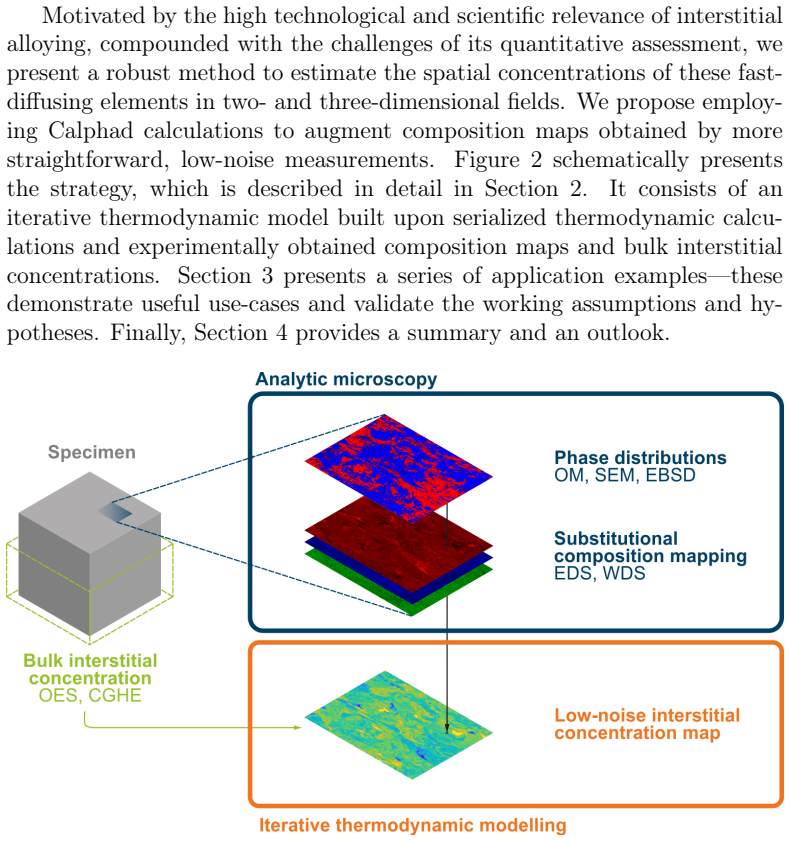
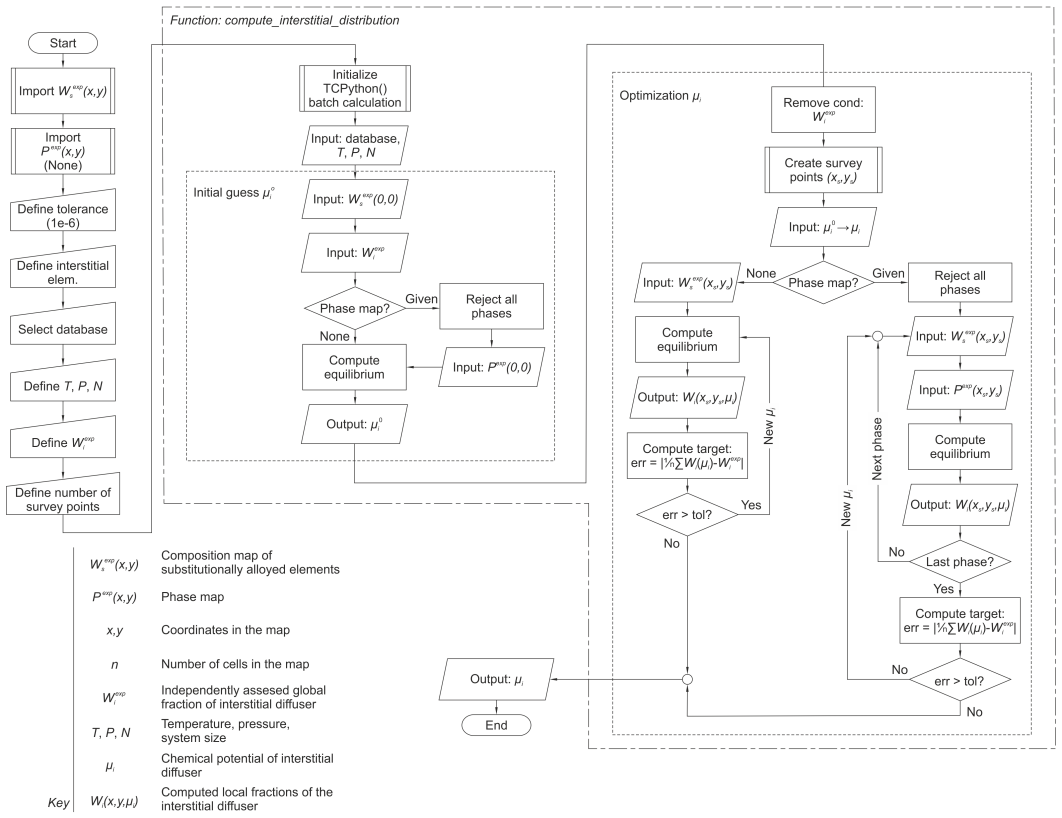
An iterative thermodynamic model derives interstitial solute maps from standard substitutional element microscopy data by enforcing partial equilibrium and bulk matching.
A machine-rendered reading of the paper's core claim, the machinery that carries it, and where it could break.
Core claim
The central claim is that an iterative thermodynamic model exploits differences in diffusion kinetics to assume partial chemical equilibrium only for the mobile interstitial species, then adjusts a uniform interstitial chemical potential across the microstructure until the integrated local concentrations converge to an independently measured bulk value, thereby extracting thermodynamically consistent interstitial concentration maps from spatially resolved composition data of substitutional elements.
What carries the argument
The iterative optimization scheme that adjusts a uniform interstitial chemical potential across the mapped microstructure until the integrated concentration matches the bulk measurement.
If this is right
- Produces quantitative spatial arrays of interstitial concentrations from robust low-noise microscopy data of substitutional elements.
- Yields maps that are otherwise time- and resource-intensive to obtain directly.
- Addresses the quantification challenges for fast-diffusing solutes in analytic microscopy.
- Generates thermodynamically consistent distributions by converging on the measured bulk value.
Where Pith is reading between the lines
- The same iterative scheme could be tested on alloys containing multiple interstitial species to check whether separate chemical potentials can be optimized independently.
- If the derived maps prove accurate, they could supply input data for simulations that predict how local interstitial levels affect diffusion paths or phase boundaries during processing.
- A direct comparison of the method's output against atom-probe tomography in selected regions would provide a concrete accuracy check beyond bulk matching.
Load-bearing premise
The interstitial species reaches a state of partial chemical equilibrium independently of the substitutional elements, so that a single uniform chemical potential can be optimized to match the bulk concentration.
What would settle it
Applying the model to a validation microstructure and then measuring local interstitial concentrations directly at multiple points would falsify the claim if those measured values deviate systematically from the computed maps.
Figures
read the original abstract
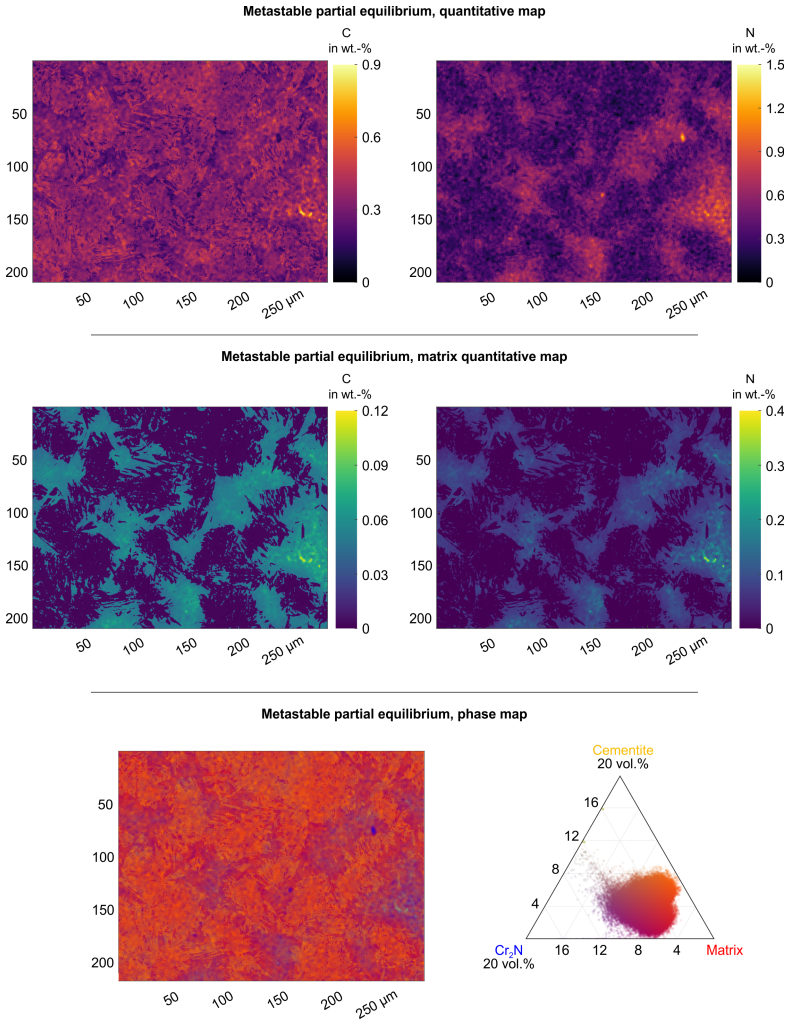
The spatially resolved quantification of fast-diffusing solutes presents several challenges in analytic microscopy. Given the critical role of interstitially alloyed elements in physical metallurgy, we propose a computational framework that addresses this limitation by augmenting spatially resolved composition maps of substitutional elements with computationally derived interstitial distributions. The underlying methodology is an iterative thermodynamic model: exploiting the stark differences in solid-state diffusion kinetics, the model assumes a state of partial chemical equilibrium exclusively for the mobile interstitial species. An optimization scheme iteratively adjusts an uniform interstitial chemical potential across the mapped microstructure until the integrated local concentration converges with an independently measured bulk value. Ultimately, this approach extracts thermodynamically consistent interstitial concentration maps from robust, low-noise microscopy data, yielding quantitative spatial arrays that are otherwise time- and resource-intensive to obtain at best.
Editorial analysis
A structured set of objections, weighed in public.
Referee Report
Summary. The paper presents a computational framework called Iterative Thermodynamic Augmentation for deriving spatially resolved interstitial concentration maps from analytic microscopy data on substitutional elements. It exploits differences in diffusion kinetics by assuming partial chemical equilibrium only for the mobile interstitial species and uses an optimization procedure to iteratively adjust a single uniform interstitial chemical potential across the microstructure until the integrated concentration matches an independently measured bulk value.
Significance. If the method is shown to be accurate through validation, it would enable quantitative interstitial mapping in alloy systems where direct high-resolution measurement of fast-diffusing species is impractical, providing a useful tool for microstructure analysis in physical metallurgy.
major comments (1)
- [Abstract] Abstract: the abstract outlines the method but offers no data, validation, or error analysis to support that the approach actually produces accurate maps; the claim is presented without evidence in the provided text.
minor comments (1)
- The description of the specific thermodynamic database or model employed for the chemical potential calculations is not provided, which would aid reproducibility.
Simulated Author's Rebuttal
We thank the referee for the constructive report and positive assessment of the method's potential significance. We address the single major comment below.
read point-by-point responses
-
Referee: [Abstract] Abstract: the abstract outlines the method but offers no data, validation, or error analysis to support that the approach actually produces accurate maps; the claim is presented without evidence in the provided text.
Authors: The referee is correct that the abstract, in its current form, describes the method without referencing validation results or error metrics. The full manuscript includes such validation (comparisons against direct interstitial measurements and error quantification in the results section). We will revise the abstract to include a concise statement on the validation performed and the accuracy achieved. revision: yes
Circularity Check
No significant circularity identified
full rationale
The paper describes an iterative optimization that adjusts a single uniform interstitial chemical potential parameter until the spatially integrated concentration matches an independent bulk measurement. This is a calibration step using external data, not a claim that the local maps independently predict or derive the bulk value. The thermodynamic consistency is enforced by construction within the model, but the paper does not present the bulk match as a 'prediction' or first-principles result; the bulk measurement is an explicit input. No self-definitional loops, fitted inputs renamed as predictions, or load-bearing self-citations appear in the provided description. The derivation chain remains self-contained against the stated external benchmark.
Axiom & Free-Parameter Ledger
free parameters (1)
- uniform interstitial chemical potential
axioms (1)
- domain assumption partial chemical equilibrium exclusively for the mobile interstitial species due to differences in diffusion kinetics
Reference graph
Works this paper leans on
-
[1]
G. E. Dieter, D. Bacon, Mechanical Metallurgy, 3rd Edition, McGraw- Hill, New York, NY, 1988
1988
-
[2]
D. Hull, D. J. Bacon, Introduction to Dislocations, 5th Edi- tion, Butterworth-Heinemann, Oxford, UK, 2011.doi:10.1016/ C2009-0-64358-0. 31
2011
-
[3]
J. W. Christian, S. Mahajan, Deformation twinning, Progress in Ma- terials Science 39 (1-2) (1995) 1–157.doi:10.1016/0079-6425(94) 00007-7
-
[4]
Pepperhoff, M
W. Pepperhoff, M. Acet, Constitution and Magnetism of Iron and its Alloys, Springer, Berlin, Heidelberg, 2001.doi:10.1007/ 978-3-662-04345-5
2001
-
[5]
G. Krauss, Steels: Processing, Structure, and Performance, 2nd Edition, ASM International, Materials Park, OH, 2015.doi:10.31399/asm.tb. spsp2.9781627082655
-
[6]
V. G. Gavriljuk, H. Berns, High Nitrogen Steels: Structure, Properties, Manufacture, Applications, Springer, Berlin, Heidelberg, 1999.doi: https://doi.org/10.1007/978-3-662-03760-7
-
[7]
Lütjering, J
G. Lütjering, J. C. Williams, Titanium, 2nd Edition, Springer, Berlin, Heidelberg, 2007.doi:https://doi.org/10.1007/ 978-3-540-73036-1
2007
-
[8]
T.E.Tietz, J.W.Wilson, BehaviorandPropertiesofRefractoryMetals, Stanford University Press, Stanford, CA, 1965
1965
-
[9]
Y. Zhao, M. Rajkowski, Y. Gong, S. Laube, L. Perrière, A. Kauffmann, J.-P.Couzinié, G.Laplanche, T.Li, Roleofoxygeninphasestabilityand mechanical behavior of the bcc HfNbTaTiZr high-entropy alloy during aging, Acta Materialia 298 (2025) 121400.doi:10.1016/j.actamat. 2025.121400
-
[10]
Z. Li, C. C. Tasan, H. Springer, B. Gault, D. Raabe, Interstitial atoms enable joint twinning and transformation induced plasticity in strong and ductile high-entropy alloys, Scientific reports 7 (2017) 40704.doi: 10.1038/srep40704
-
[11]
G. F. Bastin, H. J. M. Heijligers, Quantitative electron probe microanal- ysis of Nitrogen, Eindhoven, The Netherlands: University of Technology, Laboratory of Solid State Chemistry and Material Science, 1988
1988
-
[12]
G. F. Bastin, H. J. M. Heijligers, Quantitative electron probe micro- analysis of ultralight elements (boron-oxygen), Scanning 12 (4) (1990) 225–236.doi:https://doi.org/10.1002/sca.4950120408. 32
-
[13]
X. Llovet, A. Moy, P. T. Pinard, J. H. Fournelle, Electron probe mi- croanalysis: A review of recent developments and applications in mate- rials science and engineering, Progress in Materials Science 116 (2021) 100673.doi:https://doi.org/10.1016/j.pmatsci.2020.100673
-
[14]
P. Schweizer, E. Brackx, P. Jonnard, Electron probe microanalysis of light elements: Improvements in the measurement and signal extraction methods, X-ray Spectrometry 51 (2022) 403–412.doi:https://doi. org/10.1002/xrs.3290
-
[15]
Balogh, G
Z. Balogh, G. Schmitz, Diffusion in metals and alloys, in: Phys- ical Metallurgy, Elsevier, 2014, pp. 387–559.doi:10.1016/ B978-0-444-53770-6.00005-8
2014
-
[16]
Z. Yang, L. Yang, L. Zhao, D. Huang, J. Li, X. Chen, X. Shen, H. Wang, Micro x-ray fluorescence (µ-xrf) methodology for quantitative elemental imaging of al–zn–mg–cu alloys with varying chemical compositions, Ta- lanta 269 (2024) 125407.doi:https://doi.org/10.1016/j.talanta. 2023.125407
-
[17]
Hillert, Phase Equilibria, Phase Diagrams and Phase Trans- formations, Cambridge University Press, 2012.doi:10.1017/ CBO9780511812781
M. Hillert, Phase Equilibria, Phase Diagrams and Phase Trans- formations, Cambridge University Press, 2012.doi:10.1017/ CBO9780511812781
2012
-
[19]
Thermo-Calc Software AB, paraf.m (TC-Toolbox V7 for MATLAB®),https://thermocalc.com/support/documentation/ tc-toolbox-for-matlab-help/, release compatible with Thermo-Calc 4.1; accessed 2025-08-20 (Nov. 2014)
2025
-
[20]
Hillert, Some viewpoints on the use of a computer for calculating phase diagrams, Physica B+C 103 (1) (1981) 31–40.doi:10.1016/ 0378-4363(81)91000-7
M. Hillert, Some viewpoints on the use of a computer for calculating phase diagrams, Physica B+C 103 (1) (1981) 31–40.doi:10.1016/ 0378-4363(81)91000-7
1981
-
[21]
H. Lukas, S. G. Fries, B. Sundman, Computational Thermodynamics, Cambridge University Press, 2011.doi:10.1017/CBO9780511804137. 33
-
[22]
URLhttps://help.thermocalc.com/2025b/content/thermo-calc_ commands/poly_module/adv_opt-equilibrium_calcul.htm
Thermo-calc 2025b documentation: Advanced options (2025). URLhttps://help.thermocalc.com/2025b/content/thermo-calc_ commands/poly_module/adv_opt-equilibrium_calcul.htm
2025
-
[23]
URLhttps://www.crct.polymtl.ca/fact/factsage/Intrsage.pdf
The theoretical background of FactSage (2020). URLhttps://www.crct.polymtl.ca/fact/factsage/Intrsage.pdf
2020
-
[24]
M. S. Ghiorso, M. M. Hirschmann, P. W. Reiners, V. C. Kress, The pMELTS: A revision of MELTS for improved calculation of phase rela- tions and major element partitioning related to partial melting of the mantle to 3 GPa, Geochemistry, Geophysics, Geosystems 3 (5) (2002) 1–35.doi:10.1029/2001GC000217
-
[25]
URLhttps://www.opencalphad.com/downloads/Sundman-TMS2019
OpenCalphad, thermodynamics for phase diagrams and simulations (2019). URLhttps://www.opencalphad.com/downloads/Sundman-TMS2019. pdf
2019
-
[26]
A. G. Kusne, H. Yu, C. Wu, H. Zhang, J. Hattrick-Simpers, B. DeCost, S. Sarker, C. Oses, C. Toher, S. Curtarolo, A. V. Davydov, R. Agarwal, L. A. Bendersky, M. Li, A. Mehta, I. Takeuchi, On-the-fly closed-loop materials discovery via bayesian active learning, Nature communications 11 (1) (2020) 5966.doi:10.1038/s41467-020-19597-w
-
[27]
A. Sundar, X. Tan, S. Hu, M. C. Gao, Calphad-based bayesian op- timization to accelerate alloy discovery for high-temperature applica- tions, Journal of Materials Research 40 (1) (2025) 112–122.doi: 10.1557/s43578-024-01489-0
-
[28]
H. Liang, C. Wang, H. Yu, D. Kirsch, R. Pant, A. McDannald, A. G. Kusne, J.-C.Zhao, I.Takeuchi, Real-timeexperiment-theoryclosed-loop interaction for autonomous materials science, Science advances 11 (27) (2025) eadu7426.doi:10.1126/sciadv.adu7426
-
[29]
G. Egels, N. Wulbieter, S. Weber, W. Theisen, A computational ap- proach to the microstructural design of high–speed steels, steel research international 91 (5) (2020).doi:10.1002/srin.201900455
-
[30]
Z. Liang, U. Kattner, C. Campbell, Design strategy for additive man- ufacturing ti-al-fe alloys with calculation of phase diagram method, In- 34 tegrating materials and manufacturing innovation 10 (4) (2021).doi: 10.1007/s40192-021-00237-0
-
[31]
J. R. Howard, K. Carlson, L. T. Mushongera, Predicting multi- component, high-temperature metallic glasses by coupling empirical models, calphad, and a genetic algorithm, Modelling and Simulation in Materials Science and Engineering 32 (1) (2024) 015013.doi: 10.1088/1361-651X/ad15a9
-
[32]
C. Shen, The synergy of machine learning and calphad: Revitalizing traditional approaches, Computational Materials Science 258 (2025) 113970.doi:10.1016/j.commatsci.2025.113970
-
[33]
G. Li, K. Traka, K. Kwarkernaak, Y. Gonzalez-Garcia, M. J. Santofimia, Modelling the evolution of microstructural bands in a martensite/austenite q&p-processed stainless steel, Scripta Materialia 257 (2025) 116457.doi:10.1016/j.scriptamat.2024.116457
-
[34]
E. Duesterhoeft, P. Lanari, Iterative thermodynamic modelling—part 1: A theoretical scoring technique and a computer program ( bingo– antidote ), Journal of Metamorphic Geology 38 (5) (2020) 527–551.doi: 10.1111/jmg.12538
-
[35]
P. Lanari, J. Hermann, Iterative thermodynamic modelling—part 2: Tracing equilibrium relationships between minerals in metamorphic rocks, Journal of Metamorphic Geology 39 (6) (2021) 651–674.doi: 10.1111/jmg.12575
-
[36]
on the definitions of paraequilibrium and orthoequilibrium
J. Speer, D. Matlock, B. DeCooman, J. Schroth, Comments on “on the definitions of paraequilibrium and orthoequilibrium” by m. hillert and j. Ågren, scripta materialia, 50, 697–9 (2004), Scripta Materialia 52 (1) (2005) 83–85.doi:10.1016/j.scriptamat.2004.08.029
-
[37]
on the definition of parae- quilibrium and orthoequilibrium
M. Hillert, J. Ågren, Reply to comments on “on the definition of parae- quilibrium and orthoequilibrium”, Scripta Materialia 52 (1) (2005) 87– 88.doi:10.1016/j.scriptamat.2004.08.026
-
[38]
K.Traka, J.Sietsma, M.J.SantofimiaNavarro, Modelingtheinteraction of carbon segregation to defects and carbon partitioning in multiphase steels, Acta Materialia 277 (2024) 120204.doi:https://doi.org/10. 1016/j.actamat.2024.120204. 35
arXiv 2024
-
[39]
URLhttps://thermocalc.com/wp-content/ uploads/Documentation/Current_Static/ tc-python-api-programmer-guide.pdf
TC-Python API: Programmer guide (2025). URLhttps://thermocalc.com/wp-content/ uploads/Documentation/Current_Static/ tc-python-api-programmer-guide.pdf
2025
-
[40]
URLhttps://docs.python.org/3/library/concurrent.futures
Brian Quinlan, concurrent.futures: Launching parallel tasks (2025). URLhttps://docs.python.org/3/library/concurrent.futures. html
2025
-
[41]
P. Virtanen, R. Gommers, T. E. Oliphant, M. Haberland, T. Reddy, D. Cournapeau, E. Burovski, P. Peterson, W. Weckesser, J. Bright, S. J. van der Walt, M. Brett, J. Wilson, K. J. Millman, N. Mayorov, A. R. J. Nelson, E. Jones, R. Kern, E. Larson, C. J. Carey, İ. Polat, Y. Feng, E. W. Moore, J. VanderPlas, D. Laxalde, J. Perktold, R. Cimrman, I. Henriksen, ...
-
[42]
L. Mújica Roncery, S. Weber, W. Theisen, Development of Mn-Cr- (C-N) corrosion resistant twinning induced plasticity steels: Thermo- dynamic and diffusion calculations, production, and characterization, Metallurgical and Materials Transactions A 41 (10) (2010) 2471–2479. doi:10.1007/s11661-010-0334-z
-
[43]
L. Becker, F. Radtke, J. Lentz, S. Herzog, C. Broeckmann, S. Weber, A new approach to the powder metallurgical production of high nitrogen steels by integrated diffusion alloying in a hot isostatic press, Materials Letters 352 (2023) 135119.doi:10.1016/j.matlet.2023.135119
-
[44]
A. Borgenstam, L. Höglund, J. Ågren, A. Engström, DICTRA, a tool for simulation of diffusional transformations in alloys, Journal of Phase Equilibria 21 (3) (2000) 269–280.doi:10.1361/105497100770340057
-
[45]
D. E. Coates, Diffusional growth limitation and hardenability, Metallur- gical Transactions 4 (10) (1973) 2313–2325.doi:10.1007/BF02669370
- [46]
-
[47]
C. Merlet, An accurate computer correction program for quantitative electron probe microanalysis, Microchimica Acta 114 (1994) 363–376. doi:https://doi.org/10.1007/BF01244563
-
[48]
L. Becker, F. Radtke, J. Lentz, S. Benito, C. Broeckmann, S. We- ber, Powder metallurgy and additive manufacturing of high–nitrogen al- loyed FeCr(Si)N stainless steel, Advanced Engineering Materials 27 (14) (2025).doi:10.1002/adem.202402293
-
[49]
S. Benito, G. Egels, A. Hartmaier, S. Weber, Statistical characteriza- tion of segregation-driven inhomogeneities in metallic microstructures employing fast first-order variograms, Materials Today Communications 34 (2023) 105016.doi:10.1016/j.mtcomm.2022.105016
-
[50]
D. Marcotte, Fast variogram computation with FFT, Computers & Geosciences 22 (10) (1996) 1175–1186.doi:10.1016/S0098-3004(96) 00026-X
-
[51]
Y. Pachaury, T. Kumagai, J. P. Wharry, A. El-Azab, A data science approach for analysis and reconstruction of spinodal-like composition fields in irradiated FeCrAl alloys, Acta Materialia 234 (2022) 118019. doi:10.1016/j.actamat.2022.118019
-
[52]
J. I. Goldstein, D. E. Newbury, J. R. Michael, N. W. Ritchie, J. H. J. Scott, D. C. Joy, Scanning Electron Microscopy and X-Ray Micro- analysis, Springer New York, New York, NY, 2018.doi:10.1007/ 978-1-4939-6676-9
2018
-
[53]
R. B. Marinenko, S. Leigh, Uncertainties in electron probe microanaly- sis, IOP Conference Series: Materials Science and Engineering 7 (2010) 012017.doi:10.1088/1757-899X/7/1/012017
-
[54]
doi: https://doi.org/10.1016/j
T. Pinomaa, M. Lindroos, M. Walbrühl, N. Provatas, A. Laukka- nen, The significance of spatial length scales and solute segregation in strengthening rapid solidification microstructures of 316l stainless steel, Acta Materialia 184 (2020) 1–16.doi:https://doi.org/10.1016/j. actamat.2019.10.044. 37
work page doi:10.1016/j 2020
-
[55]
Horbach, C
L. Horbach, C. Gebhardt, J. Zhang, B. D. Joseph, A. Bührig-Polaczek, C. Broeckmann, The effect of silicon microsegregation on the mechanical properties of high silicon alloyed ductile cast iron under monotonous loading, Heliyon10(1)(2024)e23904.doi:https://doi.org/10.1016/ j.heliyon.2023.e23904
2024
-
[56]
Y. Wu, S. Xu, R. Wu, T. Wang, H. S. Kim, H. Zhang, Microstructure- informed crystal plasticity modeling incorporating initial intragran- ular heterogeneities: insights into deformation mechanisms of addi- tively manufactured alloy, International Journal of Plasticity 195 (2025) 104537.doi:https://doi.org/10.1016/j.ijplas.2025.104537
-
[57]
P. König, J. Lentz, S. Weber, Isothermal bainitic transformation in high- alloyed C + N steel: Influence of carbon and nitrogen on microstructure and mechanical properties, Metallurgical and Materials Transactions A 56 (2025) 3391–3403.doi:10.1007/s11661-025-07851-z
-
[58]
Berns, W
H. Berns, W. Theisen, Ferrous Materials: Steels and Cast Irons, Springer Berlin Heidelberg, Berlin, Heidelberg, 2008.doi:10.1007/ 978-3-540-71848-2
2008
-
[59]
X. Tao, J. Gu, L. Han, Carbonitride dissolution and austenite grain growth in a high cr ferritic heat-resistant steel, ISIJ International 54 (7) (2014) 1705–1714.doi:10.2355/isijinternational.54.1705
-
[60]
van gen Hassend, S
F. van gen Hassend, S. Weber, Influence of chemical inhomogeneities on local phase stabilities and material properties in cast martensitic stainless steel, steel research international 91 (5) (2020).doi:10.1002/ srin.201900481
2020
-
[61]
D. Raabe, M. Herbig, S. Sandlöbes, Y. Li, D. Tytko, M. Kuzmina, D. Ponge, P.-P. Choi, Grain boundary segregation engineering in metal- lic alloys: A pathway to the design of interfaces, Current Opinion in Solid State and Materials Science 18 (4) (2014) 253–261, slip Lo- calization and Transfer in Deformation and Fatigue of Polycrystals. doi:10.1016/j.coss...
-
[62]
Lejcek, Grain Boundary Segregation in Metals, Springer Series in Materials Science, Springer Berlin Heidelberg, 2010.doi:10.1007/ 978-3-642-12505-8
P. Lejcek, Grain Boundary Segregation in Metals, Springer Series in Materials Science, Springer Berlin Heidelberg, 2010.doi:10.1007/ 978-3-642-12505-8. 38
2010
-
[63]
Seibert, A
P. Seibert, A. Raßloff, K. Kalina, et al., Microstructure character- ization and reconstruction in python: MCRpy, Integrative Materi- als and Manufacturing Innovation 11 (2022) 450–466.doi:10.1007/ s40192-022-00273-4
2022
-
[64]
M. R. Prasad, N. Vajragupta, A. Hartmaier, Kanapy: A python package for generating complex synthetic polycrystalline microstructures, Jour- nal of Open Source Software 4 (43) (2019) 1732.doi:10.21105/joss. 01732. 39 Supplementary Data for: Iterative Thermodynamic Augmentation of Spatially Resolved Analytic Microscopy for Fast-Diffusing Solutes Santiago Be...
discussion (0)
Sign in with ORCID, Apple, or X to comment. Anyone can read and Pith papers without signing in.