REVIEW 3 major objections 5 minor 58 references
Heterogeneous Graph Prompt Learning via Adaptive Weight Pruning
T0 review · 3 major / 5 minor · reviewed 2026-08-06 · deepseek-v4-flash
Pith's one-line read GPAWP prunes low-importance semantic tokens and feature blocks from graph prompts, retunes the survivors, and beats full-prompt tuning on three heterogeneous benchmarks while shrinking prompt parameters from 67 to 12 on ACM.
desk verdict Useful empirical recipe for pruning heterogeneous graph prompts, but the semantic-prompt branch neutralizes rather than eliminates, so the headline mechanism claim needs correction before this is publishable. read the letter →
The pith
A machine-rendered reading of the paper's core claim, the machinery that carries it, and where it could break.
The reading
What carries the argument
The machinery has three layers. First, a heterogeneous graph template splits a graph into $|A|+1$ homogeneous subgraphs, one per node type plus the complete topology; the semantic prompt $P_s = [p_s^0, \dots, p_s^{|A|}]$ weights each subgraph during ReadOut aggregation, while the feature prompt $P_f$ is multiplied elementwise into node embeddings before pooling. Second, importance scoring attaches a binary mask $\lambda_i$ to each semantic token and computes $I_{p^i_s} = \mathbb{E}_x |\partial L_{\mathrm{down}}(x)/\partial \lambda_i|$; the feature prompt is split into $t$ equal blocks, each with mask $\eta_j$, scored as $I_{p^j_f} = \mathbb{E}_x |\partial L_{\mathrm{down}}(x)/\partial \eta_j|$. Third, after z-score normalization, tokens with scores below $\delta=0.6$ and blocks with scores below $\beta=0.4$ are masked out, and the surviving prompts are re-tuned from their pruned initialization, following the lottery-ticket retraining idea that sparse subnetworks can match full networks when retrained.
What would settle it
Take the prompts pruned by GPAWP and re-insert each one individually into the retuned model, then measure downstream validation loss: if re-adding a so-called negative semantic token or feature block improves the loss for many tasks, the importance score is not identifying harmful prompts. Alternatively, compare GPAWP against retuning the same number of randomly chosen prompt components over many random seeds; if the random subsets match or beat the importance-selected subsets, the gradient-based scoring is not the source of the gain.
Extended reading notes
Core claim
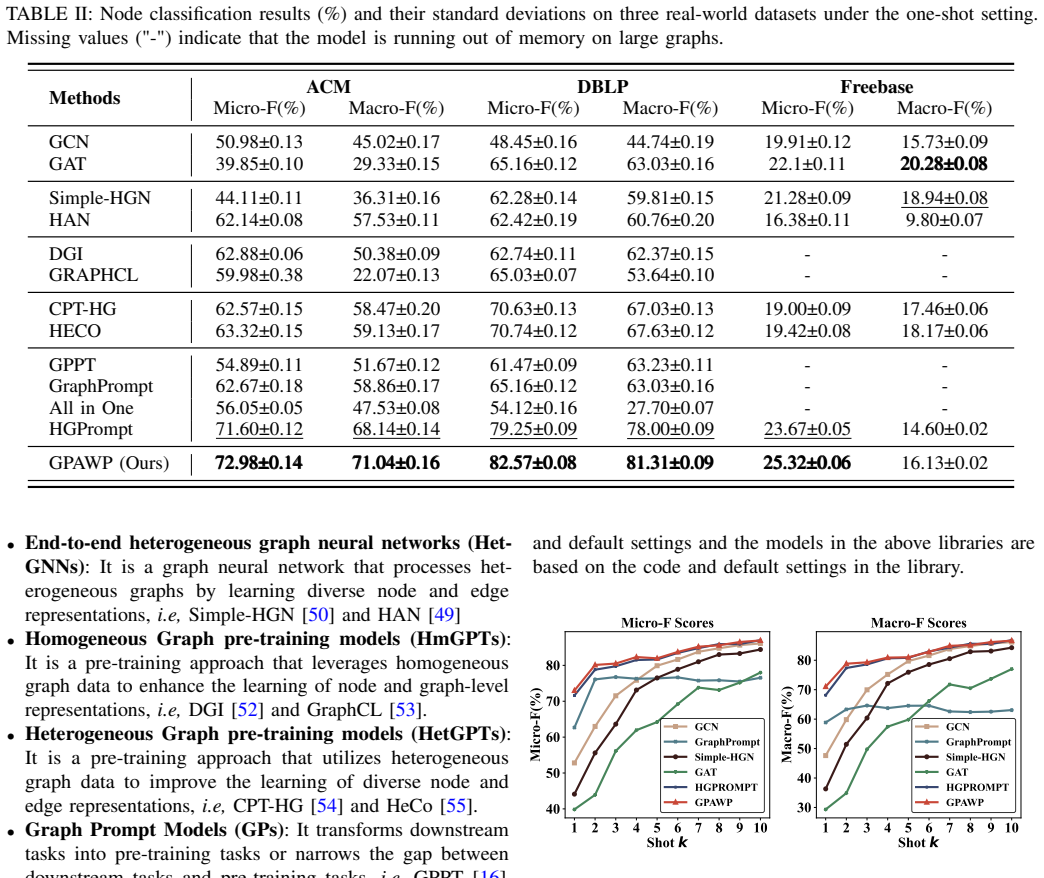
The paper's central claim is that hierarchical pruning of graph prompts is both feasible and beneficial: after training full semantic and feature prompts on the downstream task, one can measure each component's importance as the expected absolute gradient of the downstream loss with respect to a binary mask on that component, prune every component whose normalized score falls below a granularity-specific threshold, and then retrain the remaining prompts initialized from the pruned values. The authors report that this removes what they call negative prompt labels and yields a model that in one-shot node classification outperforms the previous heterogeneous graph prompt method HGPrompt on ACM (Micro-F 72.98 vs 71.60, Macro-F 71.04 vs 68.14), DBLP (82.57 vs 79.25, 81.31 vs 78.00), and Freebase (25.32 vs 23.67, 16.13 vs 14.60), while reducing downstream prompt parameters from 67 to 12 on ACM, 68 to 24 on DBLP, and 71 to 58 on Freebase. The ablation results show that both evaluation-and-pruning and the subsequent retuning stage contribute to the gain, with feature-prompt pruning contributing more than semantic-prompt pruning.
Load-bearing premise
The method assumes that a prompt part which barely changes the prediction loss when switched off is a harmful 'negative' prompt that can be removed, and that the two score thresholds (0.6 and 0.4) correctly separate negatives from positives; low sensitivity does not by itself prove harm.
Editorial extensions
If this is right
- Prompt tuning on heterogeneous graphs can be made parameter-efficient without sacrificing accuracy: GPAWP reports better one-shot Micro-F and Macro-F than HGPrompt on ACM, DBLP, and Freebase while shrinking prompt parameters, for example from 67 to 12 on ACM.
- Pruning alone is not enough: the retuning stage is necessary, since removing it lowers ACM Micro-F from 74.07 to 71.07 in the ablation study.
- Prompt importance is distributed unevenly and differs by granularity: feature prompt blocks show a left-skewed importance distribution while semantic prompt tokens show a right-skewed one on ACM, so treating all prompts as equally important is a real miss.
- The framework also saves tuning time: per-epoch training on DBLP drops from 0.0521 seconds for HGPrompt to 0.0460 seconds for GPAWP, with test time down from 0.0458 to 0.0339 seconds.
- The efficiency gains are largest in low-shot regimes: GPAWP holds the best Micro-F and Macro-F from 1 to 5 shots on ACM, which fits the label-scarce setting that motivates graph prompt learning.
Reading between the lines
- My inference: because the paper's importance score is an absolute gradient, the method is better interpreted as pruning uninformative components than as proving those components have a negative effect; a signed influence measure or a re-insertion test would be needed to identify true negatives.
- My inference: the calibrated thresholds ($\delta=0.6$, $\beta=0.4$) are likely dataset- and score-distribution-dependent; applying GPAWP to a new graph would probably require re-calibrating them rather than carrying them over, since the paper ties threshold choice to the observed distribution.
- My inference: the same masked-gradient scoring could be extended to continuous soft masks or per-relation prompt tokens, allowing pruning to become differentiable and done jointly with training, whereas the paper only prunes after full tuning.
- My inference: because feature-prompt pruning contributed more than semantic-prompt pruning in the ablation, the largest redundancy on these benchmarks may lie in node feature dimensions rather than subgraph structure, suggesting future heterogeneous graph prompt designs should consider input-feature compression.
Editorial analysis
A structured set of objections, weighed in public.
Referee Report
Summary. The paper proposes GPAWP, a framework for heterogeneous graph prompt learning that first tunes feature prompts (Pf) and semantic prompts (Ps) on a downstream node-classification task, then evaluates the importance of each semantic prompt token and each feature prompt block via the expected absolute gradient of the downstream loss with respect to associated mask variables (Eqs. 9 and 11), prunes low-importance tokens/blocks using thresholds δ and β, and finally retunes the surviving prompts. The authors report that this procedure eliminates negative prompts, improves one-shot node classification over HGPrompt on ACM, DBLP, and Freebase, and reduces optimized prompt parameters from 67 to 12 on ACM. The paper includes an ablation study (Table III), a random-pruning comparison, and parameter/time-efficiency comparisons.
Significance. If the mechanism worked as claimed, the paper would provide a modest but useful efficiency lever: using importance scores to prune uninformative prompt components before retuning, with consistent gains across three heterogeneous graphs. The paper deserves credit for including a component ablation (Table III) showing that evaluation-and-pruning plus retuning beats tuning-only, for comparing against random pruning, and for reporting parameter savings in Table IV. However, the semantic-pruning operation is misdescribed, and the importance metric does not actually measure whether a prompt is positive or negative; these issues bear directly on the central claim. The contribution is incremental, but the empirical evidence suggests the underlying retuning-after-pruning idea has value if the mechanism is clarified and the claims are adjusted.
major comments (3)
- [V-B, Eqs. (6), (8), (15)] Semantic prompt pruning does not eliminate the corresponding subgraph. When λ_i=0, Eq. (8) sets \hat{p}_i^s=0, but the aggregation in Eq. (6) and the retuning aggregation in Eq. (15) use (1+p_i^s)⊙ReadOut(S_i). A pruned token therefore becomes 1·ReadOut(S_i), so the subgraph S_i remains in the sum with a neutral weight; it is not removed from the computation. Consequently, the abstract's claim that GPAWP 'eliminate[s] negative prompt labels' and Section II's description of 'remov[ing] negative prompts' overstate what the semantic branch actually does. This can be fixed by changing the aggregation to multiply by λ_i directly (or by dropping the term from the ReadOut sum), or by revising the claims to say that low-importance semantic prompts are neutralized rather than eliminated.
- [V-B, Eqs. (9) and (11)] The importance score I_{p_i^s}=E|∂L_down/∂λ_i| is an absolute gradient magnitude. It measures the sensitivity of the loss to the mask, not the sign or direction of the prompt's effect, so it cannot by itself distinguish 'positive prompts' from 'negative prompts'. A prompt with a large gradient magnitude could be beneficial or harmful; a prompt with a small gradient magnitude is merely uninformative at the current operating point. In addition, the text says that to evaluate p_i^s one should 'set λ_i to 0 and all other λ values to 1,' but Eq. (9) computes the derivative of the loss with respect to λ_i, presumably at the current λ=1, which is not the same as the loss difference after setting λ_i=0. Please either use a sign-aware score (e.g., expected loss change when the mask is zeroed) or reframe the method as pruning uninformative prompt components rather than negative ones.
- [VI-A and VI-C, Eqs. (12)-(13)] The pruning thresholds δ=0.6 and β=0.4 are selected from the importance-score distributions and task-specific objectives on the same three datasets. The paper states that increasing β to 0.5 or decreasing it to 0.3 changes performance, and similarly for δ, but it does not report a validation procedure or a held-out criterion for choosing these values. Since the central 'adaptive' pruning claim depends on these thresholds, the authors should specify how the thresholds are set (e.g., on a validation split) and provide sensitivity results with standard deviations. Without this, the method is a dataset-calibrated heuristic rather than an adaptive algorithm whose thresholds transfer.
minor comments (5)
- [Algorithm 1, lines 7 and 9] The equation references in the pseudocode are swapped: the aggregation using Pf should refer to Eq. (5), and the aggregation using Ps should refer to Eq. (6).
- [Table II] The Freebase GAT cell contains a duplicated '20.28±0.08', and several GPAWP cells repeat the same value; these typographical artifacts should be cleaned up.
- [VI-A, hyperparameter paragraph] The sentence 'For Ps we set the threshold β=0.4 and for semantic prompt Ps we set the threshold δ=0.6' should read 'for feature prompt Pf' in the first clause; the names β and δ are also inconsistent with Eqs. (12) and (13).
- [VI-C] The statement about threshold sensitivity ('Increasing β to 0.5 ... lowering it to 0.3 ... δ>0.7 ... δ<0.5') is presented without a table or figure; please add the supporting results or remove the quantitative claims.
- [V-B, citation [30]] Eq. (9) is attributed to Michel et al. [30], but that work computes expected absolute gradients over input samples for attention heads; the adaptation to mask variables for graph prompts should be clarified so the relationship to [30] is precise.
Circularity Check
GPAWP's pruning thresholds are fit to the same one-shot tasks whose performance is reported, and semantic pruning as implemented reduces to weight-zeroing that leaves subgraphs in the forward pass; the central efficiency claim retains independent benchmark support.
-
fitted input called prediction
[Section VI-C, hyperparameter/threshold discussion around Fig. 5]
"The selection of thresholds ( beta = 0.4 for feature prompts, delta = 0.6 for semantic prompts) is driven by the distribution patterns of importance scores and task-specific objectives. These thresholds, validated by distribution alignment and robustness tests, optimally balance pruning efficiency and task performance."
The thresholds that decide which prompts are 'negative' are chosen by inspecting the importance-score distribution and by tuning against task objectives on the same one-shot benchmarks whose final Micro-F and Macro-F values are then reported. The importance scores themselves are gradients of Ldown, the loss minimized in Tuning and Retuning, so the label 'negative prompt' is a post hoc threshold on a quantity derived from the reported objective rather than an independent prediction. Random-pruning and ablation controls provide some external grounding, so the circularity is partial rather than total.
-
self definitional
[Section V-B Eq. (8) and Section V-C Eq. (15)]
"lambda_i = 0 indicates that the corresponding prompt token p_i^s is pruned. ... ReadOut{(1 + \hat{P}^i_s) \odot ReadOut(S_i) | S_i \in \hat{G}(S)}"
Under Eq. (8), a pruned semantic token is \hat{p}^i_s = 0. Substituted into Eq. (15), the summand becomes (1 + 0) times ReadOut(S_i) = ReadOut(S_i), so the subgraph remains in the aggregation with its default neutral weight. Thus the abstract's claim that GPAWP 'eliminate[s] negative prompt labels' is not implemented by the equations: pruning for semantic prompts is defined as zeroing a learned weight, which is equivalent by construction to leaving the subgraph in the forward pass at unit weight. The parameter reduction is real, but the claimed removal of negative prompts is a renaming of weight-zeroing as elimination.
full rationale
The paper is a self-contained empirical method built on HGPrompt; there are no load-bearing self-citations or imported uniqueness theorems. The central benchmark comparison (GPAWP vs HGPrompt and other baselines, Tables II and IV) is an external evaluation, and the ablation study (Table III, Fig. 6) provides independent evidence that pruning and retuning contribute beyond random pruning. Two issues create moderate self-reference. First, the pruning thresholds delta and beta are fit to the importance-score distribution and task objectives of the same one-shot tasks whose final scores are reported, so the 'negative prompt' classification is not an independent prediction; it is a calibrated threshold on gradients of the same loss being optimized. Second, and more severe as a terminology matter, the semantic-prompt branch defines pruning as lambda_i = 0, yet the aggregation in Eq. (15) uses (1 + p-hat_s^i), so a 'pruned' token leaves its subgraph in the computation with weight 1; the claimed elimination of negative prompt labels is therefore not what the equations do. This is a definitional issue rather than a statistical fit, but it makes the abstract's mechanism statement circular in the sense that 'eliminated' is defined as 'zeroed' while the forward pass treats zero as identity. The parameter-efficiency contribution (67 to 12 parameters on ACM) survives, so the score is moderate, not extreme.
Assumptions & free parameters
free parameters (3)
- delta (semantic prompt pruning threshold) =
0.6
- beta (feature prompt block pruning threshold) =
0.4
- t (number of feature prompt blocks) =
16
assumptions (5)
- domain assumption Pre-training via link prediction (Eq. 2) yields node embeddings transferable to node classification under prompt tuning.
- domain assumption Heterogeneous graph template decomposition into |A|+1 homogeneous subgraphs preserves task-relevant structure.
- ad hoc to paper Expected absolute gradient of downstream loss with respect to prompt mask (Eqs. 9, 11) is a valid importance measure for prompts.
- domain assumption Lottery Ticket Hypothesis applies to graph prompt parameters: retraining pruned prompts recovers or improves performance.
- ad hoc to paper Pruning thresholds delta and beta set from score distributions transfer to test tasks.
Cite this review
Pith. "Pith review of Heterogeneous Graph Prompt Learning via Adaptive Weight Pruning." pith.science (2026). https://pith.science/paper/YGLVYZTV
@misc{pith2026250709132,
  author       = {Pith},
  title        = {Pith review of: Heterogeneous Graph Prompt Learning via Adaptive Weight Pruning},
  year         = {2026},
  howpublished = {\url{https://pith.science/paper/YGLVYZTV}},
  note         = {Machine review of arXiv:2507.09132}
}
read the original abstract
Graph Neural Networks (GNNs) have achieved remarkable success in various graph-based tasks (e.g., node classification or link prediction). Despite their triumphs, GNNs still face challenges such as long training and inference times, difficulty in capturing complex relationships, and insufficient feature extraction. To tackle these issues, graph pre-training and graph prompt methods have garnered increasing attention for their ability to leverage large-scale datasets for initial learning and task-specific adaptation, offering potential improvements in GNN performance. However, previous research has overlooked the potential of graph prompts in optimizing models, as well as the impact of both positive and negative graph prompts on model stability and efficiency. To bridge this gap, we propose a novel framework combining graph prompts with weight pruning, called GPAWP, which aims to enhance the performance and efficiency of graph prompts by using fewer of them. We evaluate the importance of graph prompts using an importance assessment function to determine positive and negative weights at different granularities. Through hierarchically structured pruning, we eliminate negative prompt labels, resulting in more parameter-efficient and competitively performing prompts. Extensive experiments on three benchmark datasets demonstrate the superiority of GPAWP, leading to a significant reduction in parameters in node classification tasks.
Figures


Figures from the paper (4 more)


Reference graph
Works this paper leans on
-
[1]
A survey of graph neural network based recommendation in social networks,
X. Li, L. Sun, M. Ling, and Y . Peng, “A survey of graph neural network based recommendation in social networks,” Neurocomputing, vol. 549, p. 126441, 2023
work page 2023
-
[2]
Multi-behavior graph neural networks for recommender system,
L. Xia, C. Huang, Y . Xu, P. Dai, and L. Bo, “Multi-behavior graph neural networks for recommender system,” in IEEE TNNLS , vol. 35, no. 4, pp. 5473–5487, 2022
work page 2022
-
[3]
Deeprank-gnn: a graph neural network framework to learn patterns in protein–protein interfaces,
M. Réau, N. Renaud, L. C. Xue, and A. M. Bonvin, “Deeprank-gnn: a graph neural network framework to learn patterns in protein–protein interfaces,” Bioinformatics, vol. 39, no. 1, p. btac759, 2023
work page 2023
-
[4]
Illuminati: Towards explaining graph neural networks for cybersecurity analysis,
H. He, Y . Ji, and H. H. Huang, “Illuminati: Towards explaining graph neural networks for cybersecurity analysis,” in IEEE EuroS&P, 2022, pp. 74–89
work page 2022
-
[5]
A comprehensive survey on graph neural networks,
Z. Wu, S. Pan, F. Chen, G. Long, C. Zhang, and S. Y . Philip, “A comprehensive survey on graph neural networks,” in IEEE TNNLS , vol. 32, no. 1, pp. 4–24, 2020
work page 2020
-
[6]
Smoothing adversarial training for gnn,
J. Chen, X. Lin, H. Xiong, Y . Wu, H. Zheng, and Q. Xuan, “Smoothing adversarial training for gnn,” in IEEE TCSS , 2020
work page 2020
-
[7]
Cost-sensitive gnn-based imbalanced learning for mobile social network fraud detection,
X. Hu, H. Chen, H. Chen, S. Liu, X. Li, S. Zhang, Y . Wang, and X. Xue, “Cost-sensitive gnn-based imbalanced learning for mobile social network fraud detection,” in IEEE TCSS , 2023
work page 2023
-
[8]
Label-dependent graph neural network,
Y . He, Y . Zhang, F. Yang, D. Yan, and V . S. Sheng, “Label-dependent graph neural network,” in IEEE TCSS , 2023
work page 2023
Show all 58 references
-
[9]
Wiener graph deconvolutional network improves graph self-supervised learning,
J. Cheng, M. Li, J. Li, and F. Tsung, “Wiener graph deconvolutional network improves graph self-supervised learning,” in AAAI, vol. 37, no. 6, 2023, pp. 7131–7139
2023
-
[10]
Pre-training on large-scale heterogeneous graph,
X. Jiang, T. Jia, Y . Fang, C. Shi, Z. Lin, and H. Wang, “Pre-training on large-scale heterogeneous graph,” in SIGKDD, 2021, pp. 756–766
2021
-
[11]
Node similarity preserving graph convolutional networks,
W. Jin, T. Derr, Y . Wang, Y . Ma, Z. Liu, and J. Tang, “Node similarity preserving graph convolutional networks,” in WSDM, 2021, pp. 148–156
2021
-
[12]
Generative pretraining from pixels,
M. Chen, A. Radford, R. Child, J. Wu, H. Jun, D. Luan, and I. Sutskever, “Generative pretraining from pixels,” in ICML, 2020, pp. 1691–1703
2020
-
[13]
Unified language model pre-training for natural language understanding and generation,
L. Dong, N. Yang, W. Wang, F. Wei, X. Liu, Y . Wang, J. Gao, M. Zhou, and H.-W. Hon, “Unified language model pre-training for natural language understanding and generation,” in NeurIPS, vol. 32, 2019
2019
-
[14]
Language models are few-shot learners,
T. Brown, B. Mann, N. Ryder, M. Subbiah, J. D. Kaplan, P. Dhariwal, A. Neelakantan, P. Shyam, G. Sastry, A. Askell et al., “Language models are few-shot learners,” in NeurIPS, vol. 33, pp. 1877–1901, 2020
1901
-
[15]
P-tuning v2: Prompt tuning can be comparable to fine-tuning universally across scales and tasks,
X. Liu, K. Ji, Y . Fu, W. L. Tam, Z. Du, Z. Yang, and J. Tang, “P-tuning v2: Prompt tuning can be comparable to fine-tuning universally across scales and tasks,” arXiv preprint arXiv:2110.07602 , 2021
2021 arXiv
-
[16]
Gppt: Graph pre- training and prompt tuning to generalize graph neural networks,
M. Sun, K. Zhou, X. He, Y . Wang, and X. Wang, “Gppt: Graph pre- training and prompt tuning to generalize graph neural networks,” in SIGKDD, 2022, pp. 1717–1727
2022
-
[17]
Graphprompt: Unifying pre- training and downstream tasks for graph neural networks,
Z. Liu, X. Yu, Y . Fang, and X. Zhang, “Graphprompt: Unifying pre- training and downstream tasks for graph neural networks,” in WWW, 2023, pp. 417–428
2023
-
[18]
Domain adaptation via prompt learning,
C. Ge, R. Huang, M. Xie, Z. Lai, S. Song, S. Li, and G. Huang, “Domain adaptation via prompt learning,” in IEEE TNNLS , 2023
2023
-
[19]
Hgprompt: Bridging homogeneous and heterogeneous graphs for few-shot prompt learning,
X. Yu, Y . Fang, Z. Liu, and X. Zhang, “Hgprompt: Bridging homogeneous and heterogeneous graphs for few-shot prompt learning,” in AAAI, vol. 38, no. 15, 2024, pp. 16 578–16 586
2024
-
[20]
Hetgpt: Harnessing the power of prompt tuning in pre-trained heterogeneous graph neural networks,
Y . Ma, N. Yan, J. Li, M. Mortazavi, and N. V . Chawla, “Hetgpt: Harnessing the power of prompt tuning in pre-trained heterogeneous graph neural networks,” arXiv preprint arXiv:2310.15318 , 2023
2023 arXiv
-
[21]
Graphprompter: Multi-stage adaptive prompt optimization for graph in-context learning,
R. Lv, Z. Zhang, K. Zhang, Q. Liu, W. Gao, J. Liu, J. Yan, L. Yue, and F. Yao, “Graphprompter: Multi-stage adaptive prompt optimization for graph in-context learning,” arXiv preprint arXiv:2505.02027 , 2025
2025 arXiv
-
[22]
Prompt tuning for graph neural networks,
T. Fang, Y . M. Zhang, Y . Yang, and C. Wang, “Prompt tuning for graph neural networks,” 2022
2022
-
[23]
Virtual node tuning for few-shot node classification,
Z. Tan, R. Guo, K. Ding, and H. Liu, “Virtual node tuning for few-shot node classification,” in SIGKDD, 2023, pp. 2177–2188
2023
-
[24]
Lvm-med: Learning large-scale self-supervised vision models for medical imaging via second- order graph matching,
D. MH Nguyen, H. Nguyen, N. Diep, T. N. Pham, T. Cao, B. Nguyen, P. Swoboda, N. Ho, S. Albarqouni, P. Xie et al., “Lvm-med: Learning large-scale self-supervised vision models for medical imaging via second- order graph matching,” in NeurIPS, vol. 36, 2024
2024
-
[25]
Scigraphqa: A large-scale synthetic multi- turn question-answering dataset for scientific graphs,
S. Li and N. Tajbakhsh, “Scigraphqa: A large-scale synthetic multi- turn question-answering dataset for scientific graphs,” arXiv preprint arXiv:2308.03349, 2023
2023 arXiv
-
[26]
Protein multimer structure prediction via PPI-guided prompt learning,
Z. Gao, X. Sun, Z. Liu, Y . Li, H. Cheng, and J. Li, “Protein multimer structure prediction via PPI-guided prompt learning,” in ICLR, 2024
2024
-
[27]
XPrompt: Exploring the extreme of prompt tuning,
F. Ma, C. Zhang, L. Ren, J. Wang, Q. Wang, W. Wu, X. Quan, and D. Song, “XPrompt: Exploring the extreme of prompt tuning,” in EMNLP, 2022, pp. 11 033–11 047
2022
-
[28]
Towards locality- aware meta-learning of tail node embeddings on networks,
Z. Liu, W. Zhang, Y . Fang, X. Zhang, and S. C. Hoi, “Towards locality- aware meta-learning of tail node embeddings on networks,” in CIKM, 2020, pp. 975–984
2020
-
[29]
Universal prompt tuning for graph neural networks,
T. Fang, Y . Zhang, Y . Yang, C. Wang, and L. Chen, “Universal prompt tuning for graph neural networks,” in NeurIPS, vol. 36, 2024
2024
-
[30]
Are sixteen heads really better than one?
P. Michel, O. Levy, and G. Neubig, “Are sixteen heads really better than one?” in NeurIPS, vol. 32, 2019
2019
-
[31]
Network together: Node classification via cross-network deep network embedding,
X. Shen, Q. Dai, S. Mao, F.-l. Chung, and K.-S. Choi, “Network together: Node classification via cross-network deep network embedding,” in IEEE TNNLS, vol. 32, no. 5, pp. 1935–1948, 2020
1935
-
[32]
Neighborhood attention networks with adversarial learning for link prediction,
Z. Wang, Y . Lei, and W. Li, “Neighborhood attention networks with adversarial learning for link prediction,” in IEEE TNNLS , vol. 32, no. 8, pp. 3653–3663, 2020
2020
-
[33]
The lottery ticket hypothesis: Finding sparse, trainable neural networks,
J. Frankle and M. Carbin, “The lottery ticket hypothesis: Finding sparse, trainable neural networks,” in ICLR, 2019
2019
-
[34]
Semi-supervised classification with graph convolutional networks,
T. N. Kipf and M. Welling, “Semi-supervised classification with graph convolutional networks,” arXiv preprint arXiv:1609.02907 , 2016
2016 arXiv
-
[35]
Graph attention networks,
P. Velickovic, G. Cucurull, A. Casanova, A. Romero, P. Lio, Y . Bengio et al., “Graph attention networks,” stat, vol. 1050, no. 20, pp. 10–48 550, 2017
2017
-
[36]
Graph contrastive learning with augmentations,
Y . You, T. Chen, Y . Sui, T. Chen, Z. Wang, and Y . Shen, “Graph contrastive learning with augmentations,” in NeurIPS, vol. 33, pp. 5812– 5823, 2020
2020
-
[37]
Commonsense knowledge base completion with relational graph attention network and pre-trained language model,
J. Ju, D. Yang, and J. Liu, “Commonsense knowledge base completion with relational graph attention network and pre-trained language model,” in CIKM, 2022, pp. 4104–4108
2022
-
[38]
Graph neural network with curriculum learning for imbalanced node classification,
X. Li, Z. Fan, F. Huang, X. Hu, Y . Deng, L. Wang, and X. Zhao, “Graph neural network with curriculum learning for imbalanced node classification,” Neurocomputing, vol. 574, p. 127229, 2024
2024
-
[39]
Pooling architecture search for graph classification,
L. Wei, H. Zhao, Q. Yao, and Z. He, “Pooling architecture search for graph classification,” in CIKM, 2021, pp. 2091–2100
2021
-
[40]
Bring your own view: Graph neural networks for link prediction with personalized subgraph selection,
Q. Tan, X. Zhang, N. Liu, D. Zha, L. Li, R. Chen, S.-H. Choi, and X. Hu, “Bring your own view: Graph neural networks for link prediction with personalized subgraph selection,” in WSDM, 2023, pp. 625–633
2023
-
[41]
Bert: Pre-training of deep bidirectional transformers for language understanding,
J. Devlin, M.-W. Chang, K. Lee, and K. Toutanova, “Bert: Pre-training of deep bidirectional transformers for language understanding,” arXiv preprint arXiv:1810.04805, 2018
2018 arXiv
-
[42]
Learning representations of inactive users: A cross domain approach with graph neural networks,
Z. Liu, Y . Shen, X. Cheng, Q. Li, J. Wei, Z. Zhang, D. Wang, X. Zeng, J. Gu, and J. Zhou, “Learning representations of inactive users: A cross domain approach with graph neural networks,” in CIKM, 2021, pp. 3278–3282
2021
-
[43]
Cross- domain few-shot classification based on lightweight res2net and flexible gnn,
Y . Chen, Y . Zheng, Z. Xu, T. Tang, Z. Tang, J. Chen, and Y . Liu, “Cross- domain few-shot classification based on lightweight res2net and flexible gnn,” Knowledge-based systems, vol. 247, p. 108623, 2022
2022
-
[44]
Does gnn pretraining help molecular representation?
R. Sun, H. Dai, and A. W. Yu, “Does gnn pretraining help molecular representation?” in NeurIPS, vol. 35, pp. 12 096–12 109, 2022
2022
-
[45]
Robust self-supervised structural graph neural network for social network prediction,
Y . Zhang, H. Gao, J. Pei, and H. Huang, “Robust self-supervised structural graph neural network for social network prediction,” in WWW, 2022, pp. 1352–1361
2022
-
[46]
All in one: Multi-task prompting for graph neural networks,
X. Sun, H. Cheng, J. Li, B. Liu, and J. Guan, “All in one: Multi-task prompting for graph neural networks,” in SIGKDD, 2023, pp. 2120–2131
2023
-
[47]
Prodigy: Enabling in-context learning over graphs,
Q. Huang, H. Ren, P. Chen, G. Kržmanc, D. Zeng, P. S. Liang, and J. Leskovec, “Prodigy: Enabling in-context learning over graphs,” in NeurIPS, vol. 36, 2024
2024
-
[48]
Ultra-dp: Unifying graph pre-training with multi-task graph dual prompt,
M. Chen, Z. Liu, C. Liu, J. Li, Q. Mao, and J. Sun, “Ultra-dp: Unifying graph pre-training with multi-task graph dual prompt,” arXiv preprint arXiv:2310.14845, 2023
2023 arXiv
-
[49]
Heterogeneous graph attention network,
X. Wang, H. Ji, C. Shi, B. Wang, Y . Ye, P. Cui, and P. S. Yu, “Heterogeneous graph attention network,” in WWW, 2019, pp. 2022– 2032
2019
-
[50]
Are we really making much progress? revisiting, benchmarking and refining heterogeneous graph neural networks,
Q. Lv, M. Ding, Q. Liu, Y . Chen, W. Feng, S. He, C. Zhou, J. Jiang, Y . Dong, and J. Tang, “Are we really making much progress? revisiting, benchmarking and refining heterogeneous graph neural networks,” in SIGKDD, 2021, pp. 1150–1160
2021
-
[51]
Freebase: a collaboratively created graph database for structuring human knowledge,
K. Bollacker, C. Evans, P. Paritosh, T. Sturge, and J. Taylor, “Freebase: a collaboratively created graph database for structuring human knowledge,” in SIGMOD, 2008, pp. 1247–1250
2008
-
[52]
Deep graph infomax,
P. Veliˇckovi´c, W. Fedus, W. L. Hamilton, P. Liò, Y . Bengio, and R. D. Hjelm, “Deep graph infomax,” arXiv preprint arXiv:1809.10341 , 2018
2018 arXiv
-
[53]
Graph contrastive learning automated,
Y . You, T. Chen, Y . Shen, and Z. Wang, “Graph contrastive learning automated,” in ICML, 2021, pp. 12 121–12 132
2021
-
[54]
Contrastive pre-training of gnns on heterogeneous graphs,
X. Jiang, Y . Lu, Y . Fang, and C. Shi, “Contrastive pre-training of gnns on heterogeneous graphs,” in CIKM, 2021, pp. 803–812
2021
-
[55]
Self-supervised heterogeneous graph neural network with co-contrastive learning,
X. Wang, N. Liu, H. Han, and C. Shi, “Self-supervised heterogeneous graph neural network with co-contrastive learning,” in SIGKDD, 2021, pp. 1726–1736
2021
-
[56]
Graph few- shot learning with attribute matching,
N. Wang, M. Luo, K. Ding, L. Zhang, J. Li, and Q. Zheng, “Graph few- shot learning with attribute matching,” in CIKM, 2020, pp. 1545–1554
2020
-
[57]
Graph prompt learning: A comprehensive survey and beyond,
X. Sun, J. Zhang, X. Wu, H. Cheng, Y . Xiong, and J. Li, “Graph prompt learning: A comprehensive survey and beyond,” arXiv preprint arXiv:2311.16534, 2023
2023 arXiv
-
[58]
Relative and absolute location embedding for few-shot node classification on graph,
Z. Liu, Y . Fang, C. Liu, and S. C. Hoi, “Relative and absolute location embedding for few-shot node classification on graph,” in AAAI, vol. 35, no. 5, 2021, pp. 4267–4275
2021
Reviewed August 6, 2026 · model on record in the stance chip above.
Discussion (0). Sign in to comment.