Unconventional superconductivity in AV₂X₂O family of surface altermagnets
Pith reviewed 2026-07-01 01:45 UTC · model grok-4.3
The pith
The AV2X2O family of surface altermagnets hosts dominant equal-spin triplet superconductivity because their magnetic and sublattice structure rules out conventional spin-singlet pairing.
A machine-rendered reading of the paper's core claim, the machinery that carries it, and where it could break.
Core claim
Our analysis predicts exotic equal-spin triplet superconductivity as the dominant pairing instability in these materials. This is a consequence of their unique magnetic and sublattice structure that renders electron bands incompatible with conventional spin-singlet pairing. The predicted triplet superconducting phases are topologically non-trivial and capable of supporting spin-polarized persistent currents, properties potentially useful in technological applications.
What carries the argument
The unique magnetic and sublattice structure of the AV2X2O materials that renders electron bands incompatible with conventional spin-singlet pairing.
If this is right
- Equal-spin triplet superconductivity becomes the dominant pairing channel.
- The superconducting phases are topologically non-trivial.
- These phases support spin-polarized persistent currents.
- Properties may be useful in technological applications.
Where Pith is reading between the lines
- Similar surface altermagnetism in other layered materials could also favor triplet pairing over singlet.
- Experimental probes of surface states might confirm the altermagnetic order driving this effect.
- Engineering the surface or doping could tune the transition temperature or topological properties.
Load-bearing premise
The bulk materials KV2Se2O and Rb1-δV2Te2O are conventional antiferromagnets that exhibit altermagnetism only at their surfaces.
What would settle it
Direct measurement of the superconducting gap symmetry revealing spin-singlet pairing instead of equal-spin triplet pairing would contradict the predicted dominant instability.
Figures
read the original abstract
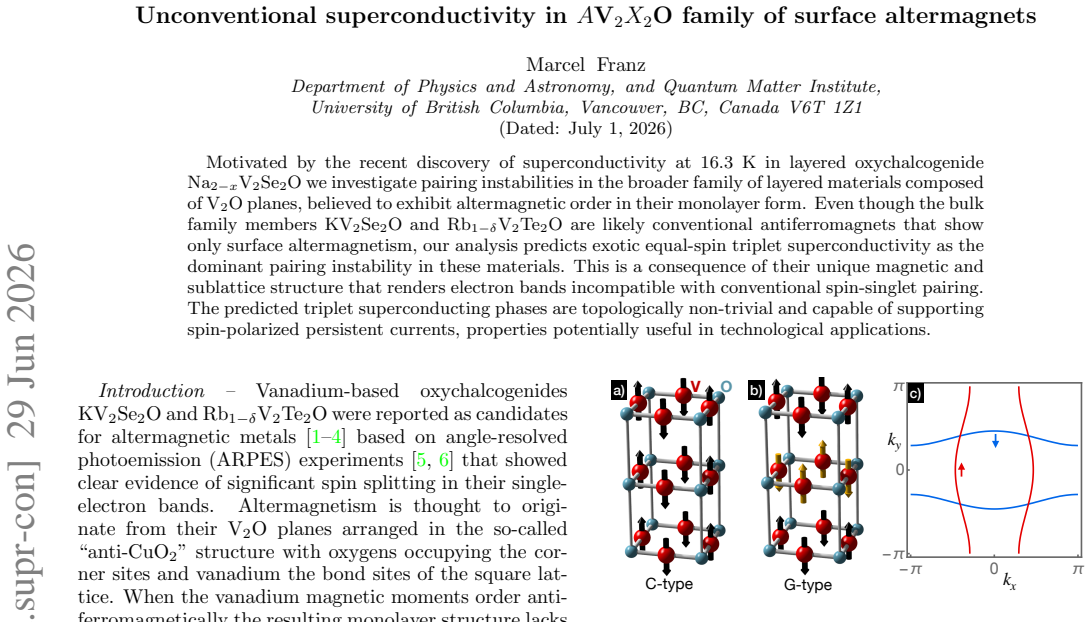
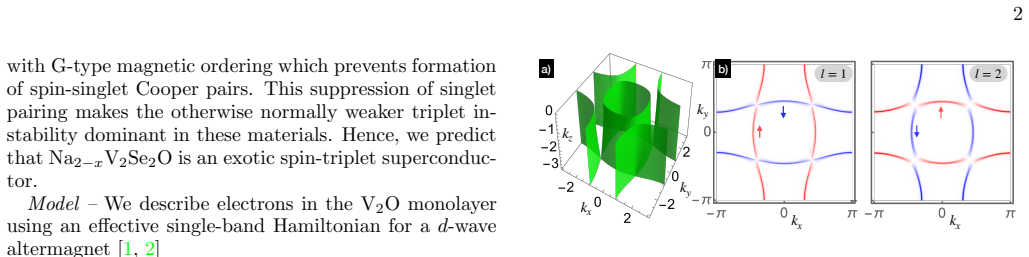
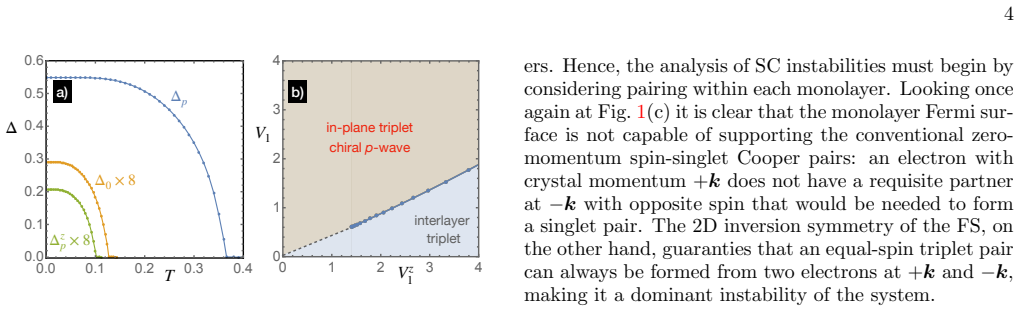
Motivated by the recent discovery of superconductivity at 16.3 K in layered oxychalcogenide Na$_{2-x}$V$_2$Se$_2$O we investigate pairing instabilities in the broader family of layered materials composed of V$_2$O planes, believed to exhibit altermagnetic order in their monolayer form. Even though the bulk family members KV$_2$Se$_2$O and Rb$_{1-\delta}$V$_{2}$Te$_{2}$O are likely conventional antiferromagnets that show only surface altermagnetism, our analysis predicts exotic equal-spin triplet superconductivity as the dominant pairing instability in these materials. This is a consequence of their unique magnetic and sublattice structure that renders electron bands incompatible with conventional spin-singlet pairing. The predicted triplet superconducting phases are topologically non-trivial and capable of supporting spin-polarized persistent currents, properties potentially useful in technological applications.
Editorial analysis
A structured set of objections, weighed in public.
Referee Report
Summary. The manuscript investigates pairing instabilities in the AV₂X₂O family of layered oxychalcogenides with V₂O planes. Motivated by superconductivity at 16.3 K in Na_{2-x}V₂Se₂O, it claims that the magnetic and sublattice structure of these materials (with bulk members KV₂Se₂O and Rb_{1-δ}V₂Te₂O as conventional antiferromagnets showing only surface altermagnetism) renders electron bands incompatible with spin-singlet pairing, making equal-spin triplet superconductivity the dominant instability; the resulting phases are predicted to be topologically non-trivial and support spin-polarized persistent currents.
Significance. If the central claim holds after verification of the magnetic order and explicit pairing calculations, the result would be significant for the field of unconventional superconductivity in altermagnets, providing a symmetry-based route to triplet pairing without fine-tuning and suggesting applications in spintronics via topologically protected currents.
major comments (2)
- [Abstract / Introduction (premise statement)] The central claim that the V₂O-plane magnetic + sublattice structure renders all electron bands incompatible with spin-singlet pairing (forcing triplet dominance) rests on the unverified premise that bulk KV₂Se₂O and Rb_{1-δ}V₂Te₂O are conventional antiferromagnets with altermagnetism only at surfaces. This premise is load-bearing; the manuscript must supply or cite explicit experimental or DFT evidence for the bulk magnetic order and demonstrate via symmetry analysis or gap-equation solution that singlet channels are strictly forbidden.
- [Methods / Results (pairing analysis)] No model Hamiltonian, interaction parameters, or explicit pairing kernel is referenced to show how the incompatibility with singlet pairing is derived or that the triplet instability is dominant rather than an artifact of the assumed order. The full text must include the band-structure calculation and pairing instability analysis (e.g., RPA or mean-field gap equation) to substantiate the prediction.
minor comments (1)
- [Abstract] The abstract states the prediction follows from 'unique magnetic and sublattice structure' but does not name the computational method (e.g., tight-binding model, DFT+U) used to obtain the bands.
Simulated Author's Rebuttal
We thank the referee for the careful and constructive review. We address each major comment below and will revise the manuscript to strengthen the presentation of our claims.
read point-by-point responses
-
Referee: [Abstract / Introduction (premise statement)] The central claim that the V₂O-plane magnetic + sublattice structure renders all electron bands incompatible with spin-singlet pairing (forcing triplet dominance) rests on the unverified premise that bulk KV₂Se₂O and Rb_{1-δ}V₂Te₂O are conventional antiferromagnets with altermagnetism only at surfaces. This premise is load-bearing; the manuscript must supply or cite explicit experimental or DFT evidence for the bulk magnetic order and demonstrate via symmetry analysis or gap-equation solution that singlet channels are strictly forbidden.
Authors: We agree the bulk magnetic order is a key assumption underlying the symmetry argument. The manuscript describes these compounds as 'likely conventional antiferromagnets' on the basis of existing literature. In revision we will add explicit citations to experimental and DFT studies establishing the bulk antiferromagnetic order, together with a dedicated symmetry-analysis subsection that shows why the combined magnetic and sublattice structure forbids spin-singlet pairing on all bands. revision: yes
-
Referee: [Methods / Results (pairing analysis)] No model Hamiltonian, interaction parameters, or explicit pairing kernel is referenced to show how the incompatibility with singlet pairing is derived or that the triplet instability is dominant rather than an artifact of the assumed order. The full text must include the band-structure calculation and pairing instability analysis (e.g., RPA or mean-field gap equation) to substantiate the prediction.
Authors: The central result follows from a symmetry-based incompatibility between the altermagnetic order and singlet pairing, followed by an explicit mean-field treatment of the dominant triplet channel. We acknowledge that the model Hamiltonian, interaction parameters, and numerical details of the gap-equation solution were not presented with sufficient clarity. In the revised manuscript we will add the tight-binding Hamiltonian, the interaction kernel, and the results of the pairing instability calculation demonstrating triplet dominance. revision: yes
Circularity Check
No significant circularity; central prediction follows from symmetry analysis of assumed bulk AF order rather than self-referential fit or definition.
full rationale
The provided abstract and description contain no equations, fitted parameters, or self-citations that reduce the triplet superconductivity claim to its inputs by construction. The incompatibility with singlet pairing is asserted to follow from the unique magnetic/sublattice structure under the stated assumption of conventional bulk antiferromagnetism (with surface altermagnetism only). This is a standard symmetry argument, not a self-definitional loop, fitted-input prediction, or load-bearing self-citation chain. The derivation is therefore self-contained against external benchmarks, consistent with the default expectation that most papers exhibit no circularity.
Axiom & Free-Parameter Ledger
axioms (1)
- domain assumption Bulk members are conventional antiferromagnets that exhibit only surface altermagnetism
Reference graph
Works this paper leans on
-
[1]
Beyond conventional ferromagnetism and antiferromag- netism: A phase with nonrelativistic spin and crystal rotation symmetry,
Libor ˇSmejkal, Jairo Sinova, and Tomas Jungwirth, “Beyond conventional ferromagnetism and antiferromag- netism: A phase with nonrelativistic spin and crystal rotation symmetry,” Phys. Rev. X12, 031042 (2022)
2022
-
[2]
Emerging research landscape of altermagnetism,
Libor ˇSmejkal, Jairo Sinova, and Tomas Jungwirth, “Emerging research landscape of altermagnetism,” Phys. Rev. X12, 040501 (2022)
2022
-
[3]
Editorial: Altermagnetism—a new punch line of fundamental magnetism,
Igor Mazin (The PRX Editors), “Editorial: Altermagnetism—a new punch line of fundamental magnetism,” Phys. Rev. X12, 040002 (2022)
2022
-
[4]
Altermagnetism: An unconventional spin- ordered phase of matter,
Tom´ aˇ s Jungwirth, Rafael M. Fernandes, Eduardo Frad- kin, Allan H. MacDonald, Jairo Sinova, and Libor ˇSmejkal, “Altermagnetism: An unconventional spin- ordered phase of matter,”Newton, Newton1(2025), 10.1016/j.newton.2025.100162
-
[5]
A metallic room-temperature d-wave alter- magnet,
Bei Jiang, Mingzhe Hu, Jianli Bai, Ziyin Song, Chao Mu, Gexing Qu, Wan Li, Wenliang Zhu, Hanqi Pi, Zhongxu Wei,et al., “A metallic room-temperature d-wave alter- magnet,” Nature Physics , 1–6 (2025)
2025
-
[6]
Crystal- symmetry-paired spin–valley locking in a layered room- temperature metallic altermagnet candidate,
Fayuan Zhang, Xingkai Cheng, Zhouyi Yin, Changchao Liu, Liwei Deng, Yuxi Qiao, Zheng Shi, Shuxuan Zhang, Junhao Lin, Zhengtai Liu, Mao Ye, Yaobo Huang, Xiangyu Meng, Cheng Zhang, Taichi Okuda, Kenya Shimada, Shengtao Cui, Yue Zhao, Guang-Han Cao, Shan Qiao, Junwei Liu, and Chaoyu Chen, “Crystal- symmetry-paired spin–valley locking in a layered room- tempe...
2025
-
[7]
Two- dimensional altermagnets: Superconductivity in a min- imal microscopic model,
Bjørnulf Brekke, Arne Brataas, and Asle Sudbø, “Two- dimensional altermagnets: Superconductivity in a min- imal microscopic model,” Phys. Rev. B108, 224421 (2023)
2023
-
[8]
Mirror chern bands and weyl nodal loops in altermagnets,
Daniil S. Antonenko, Rafael M. Fernandes, and J¨ orn W. F. Venderbos, “Mirror chern bands and weyl nodal loops in altermagnets,” Phys. Rev. Lett.134, 096703 (2025)
2025
-
[9]
Altermagnetism in modified lieb lattice hubbard model,
Nitin Kaushal and Marcel Franz, “Altermagnetism in modified lieb lattice hubbard model,” Phys. Rev. Lett. 135, 156502 (2025)
2025
-
[10]
Antiferromag- netic structure of kv2se2O: A neutron diffraction study,
Yili Sun, Yu Huang, Jingwen Cheng, Shanshan Zhang, Zezhong Li, Huiqian Luo, Xiaobai Ma, Wenyun Yang, Jinbo Yang, Dongfeng Chen, Kai Sun, Matthias Gut- mann, Silvia C. Capelli, Feiran Shen, Jiazheng Hao, Lun- hua He, Genfu Chen, and Shiliang Li, “Antiferromag- netic structure of kv2se2O: A neutron diffraction study,” Phys. Rev. B112, 184416 (2025)
2025
-
[11]
Observation of hidden altermagnetism in Cs$_{1-\delta}$V$_2$Te$_2$O
Guowei Yang, Ruihan Chen, Changchao Liu, Jing Li, Ze Pan, Teng Hua, Pengyue Xiong, Liwei Deng, Naifu Zheng, Yu Tang, Hao Zheng, Weifan Zhu, Yifu Xu, Xiny- ing Zheng, Xin Ma, Xiaoping Wang, Shengtao Cui, Zhe Sun, Zhengtai Liu, Mao Ye, Chao Cao, Ming Shi, Lun- hui Hu, Qihang Liu, Shan Qiao, Guanghan Cao, Yu Song, and Yang Liu, “Observation of hidden alterma...
work page internal anchor Pith review Pith/arXiv arXiv 2026
-
[12]
G-type antiferromagnetic structure in Rb1-xV2Te2O
Wu Xie, Changchao Liu, Fayuan Zhang, Zhenhong Tan, Wenhai Ji, Nan Zhao, Lingxiang Bao, Dong Zhang, Feiran Shen, Lunhua He, Hao Wang, Rong Du, Guang- han Cao, Chaoyu Chen, and Ping Miao, “G-type antiferromagnetic structure in rb1-xv2te2o,” (2026), arXiv:2604.17365 [cond-mat.mtrl-sci]
work page internal anchor Pith review Pith/arXiv arXiv 2026
-
[13]
Is altermagnetism in vanadium oxychalco- genides a lost cause?
Bishal Thapa, Po-Hao Chang, Kirill Belashchenko, and Igor I. Mazin, “Is altermagnetism in vanadium oxychalco- genides a lost cause?” (2026), arXiv:2602.18672 [cond- mat.str-el]
-
[14]
Colin Lange, Rodrigo Jaeschke-Ubiergo, Atasi Chakraborty, Xanthe H. Verbeek, Libor ˇSmejkal, Jairo Sinova, and Alexander Mook, “Emergent al- termagnetism at surfaces of antiferromagnets: full symmetry classification and material identification,” (2026), arXiv:2602.08773 [cond-mat.mtrl-sci]
work page internal anchor Pith review Pith/arXiv arXiv 2026
-
[15]
Topologically protected sur- face altermagnetism on antiferromagnets,
Valentin Leeb, Peru d’Ornellas, Fernando de Juan, and Adolfo G. Grushin, “Topologically protected sur- face altermagnetism on antiferromagnets,” (2026), arXiv:2602.10108 [cond-mat.str-el]
-
[16]
Y. Sun, Z. Yin, T. Zhang, L. Wang, B. Ruan, Y. Huang, J. He, W. Zhu, M. Ma, J. Bai, J. Cheng, Q. Dong, C. Li, P. Liu, Q. Liu, C. Zhang, and G. Chen, “Emergent su- perconductivity at 16.3 k in an altermagnetic candidate na2−xv2se2o with broken inversion symmetry,” (2026), arXiv:2604.00838 [cond-mat.supr-con]
-
[17]
Topological superconductivity in two-dimensional altermagnetic metals,
Di Zhu, Zheng-Yang Zhuang, Zhigang Wu, and Zhongbo Yan, “Topological superconductivity in two-dimensional altermagnetic metals,” Phys. Rev. B108, 184505 (2023)
2023
-
[18]
Probing topological degeneracy on a torus using superconducting altermag- nets,
Tsz Fung Heung and Marcel Franz, “Probing topological degeneracy on a torus using superconducting altermag- nets,” Phys. Rev. B111, 205145 (2025)
2025
-
[19]
Phonon-mediated spin-polarized superconductivity in altermagnets,
Kristoffer Leraand, Kristian Mæland, and Asle Sudbø, “Phonon-mediated spin-polarized superconductivity in altermagnets,” Phys. Rev. B112, 104510 (2025)
2025
-
[20]
Persistent spin currents in superconducting altermagnets,
Kyle Monkman, Joan Weng, Niclas Heinsdorf, Alberto Nocera, Yafis Barlas, and Marcel Franz, “Persistent spin currents in superconducting altermagnets,” Phys. Rev. X 16, 011057 (2026)
2026
-
[21]
Superconducting states and intertwined orders in metallic altermagnets,
Xuan Zou, Rafael M. Fernandes, and Eduardo Frad- kin, “Superconducting states and intertwined orders in metallic altermagnets,” (2026), arXiv:2603.04503 [cond- mat.supr-con]
-
[22]
Supplementary material,
Marcel Franz, “Supplementary material,” (2026)
2026
-
[23]
Chiral supercon- ductors,
Catherine Kallin and John Berlinsky, “Chiral supercon- ductors,” Reports on Progress in Physics79, 054502 (2016)
2016
-
[24]
Paired states of fermions in two dimensions with breaking of parity and time- reversal symmetries and the fractional quantum hall ef- fect,
N. Read and Dmitry Green, “Paired states of fermions in two dimensions with breaking of parity and time- reversal symmetries and the fractional quantum hall ef- fect,” Phys. Rev. B61, 10267–10297 (2000)
2000
-
[25]
Yuanzhe Li, Yilin Han, Liu Yang, Wanli He, Pengda Ye, Wencheng Huang, Jiabin Qiao, Yuemei Li, Xiaodong Sun, Tingli He, Jiayi Han, Yuxiang Chen, Ruifeng Tian, Hao Sun, Yuwei Liu, Feng Wu, Baoshan Song, Zheng- tai Liu, Mao Ye, Yaobo Huang, Kenichi Ozawa, Ji Dai, Massimo Tallarida, Shengtao Cui, Jie Chen, Meiling 6 Jin, Wayne Zheng, Chaoyu Chen, Zhiwei Wang,...
work page internal anchor Pith review Pith/arXiv arXiv 2026
discussion (0)
Sign in with ORCID, Apple, or X to comment. Anyone can read and Pith papers without signing in.