REVIEW 4 major objections 5 minor 52 references
Pursuing Better Decision Boundaries for Long-Tailed Object Detection via Category Information Amount
T0 review · 4 major / 5 minor · reviewed 2026-08-09 · deepseek-v4-flash
Pith's one-line read Category information amount — the volume of a category's embedding manifold — predicts detection difficulty better than instance count, and an angular-margin loss tuned by it reduces category bias in long-tailed and balanced object…
desk verdict A strong empirical long-tail detection paper whose 'information amount beats instance count' claim is undercut by a covariance shrinkage confound for rare classes. read the letter →
The pith
A machine-rendered reading of the paper's core claim, the machinery that carries it, and where it could break.
The reading
What carries the argument
The engine of the method is category information amount $I_i$, the log volume of the perceptual manifold that a category occupies, estimated as $I_i = \frac{1}{2}\log_2\det(\Sigma_i + I)$ from classification-module embeddings, after a nonlinear shrinkage step that stabilizes the covariance estimate in high dimensions. This single scalar carries the whole argument: it explains why balanced datasets still show bias, and it supplies the margin schedule. IGAM loss converts the information amount into a normalized score $I'_i$ and sets pairwise margins $m_{ij} = \max(0, \frac{1}{\pi}\log(I'_i/I'_j))$ in a cosine classifier, so the decision region of each category scales with its measured complexity. To keep the measurement current, the paper stores embeddings in a bounded queue and merges local covariance matrices into a global covariance at each epoch, making dynamic updates affordable.
What would settle it
Take one detector and compute category information amounts from a randomly initialized feature extractor and from the same extractor after full training, then compare how each set correlates with per-class accuracy. If the random-initialization correlation is near zero while the trained correlation is strongly negative, the measurement is tracking the model's learning state rather than an intrinsic property of the category; a synthetic dataset with controlled intra-class diversity could then settle whether margins actually track difficulty.
Extended reading notes
Core claim
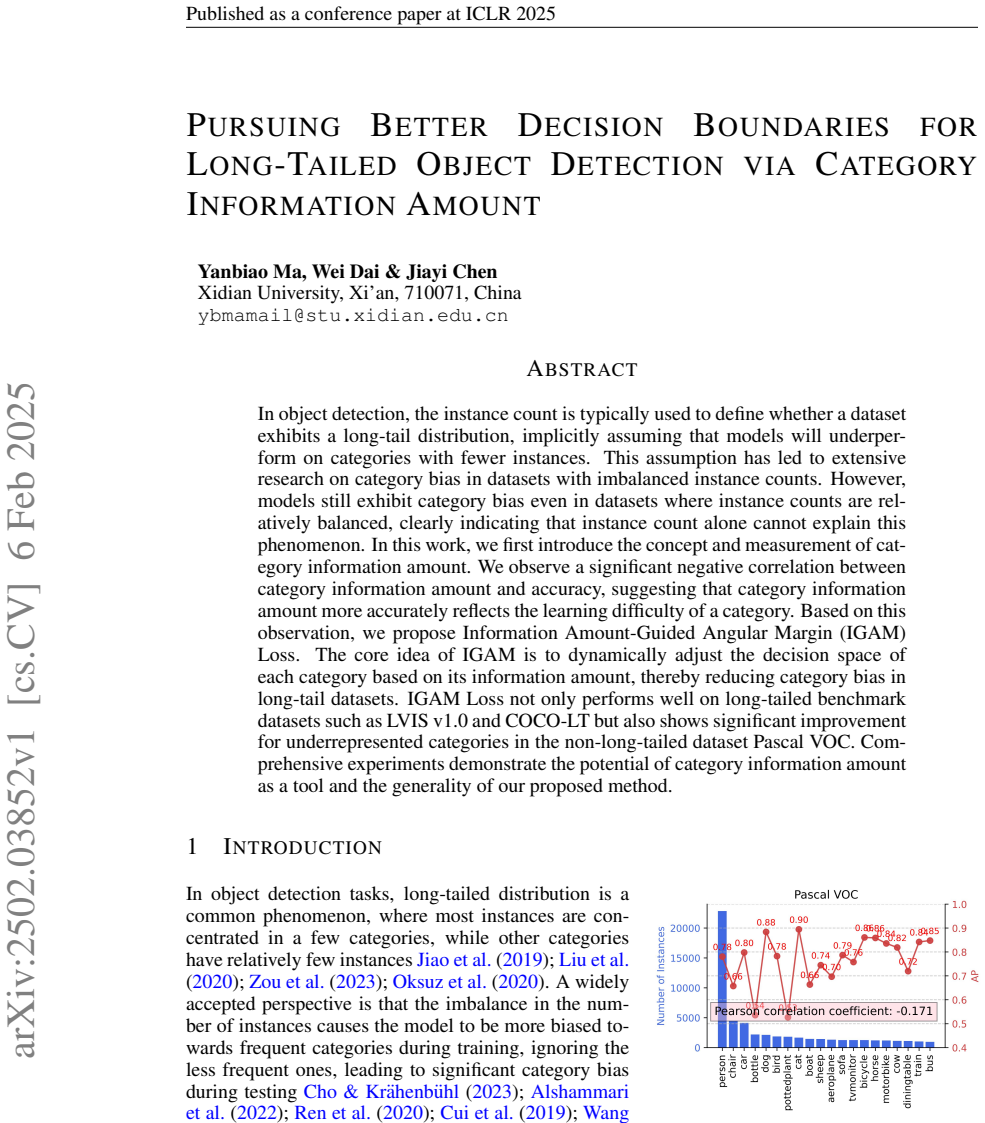
The central claim is that category informativeness, defined as $I_i = \frac{1}{2}\log_2 \det(\Sigma_i + I)$ from the covariance of a category's classification embeddings after nonlinear shrinkage, tracks category learning difficulty in object detection. The paper reports correlations around $-0.66$ to $-0.70$ between this information amount and category average precision on long-tailed datasets, and a near-zero correlation between instance count and accuracy on the relatively balanced PASCAL VOC set. From that observation it constructs IGAM loss, which inserts an angular margin $m_{ij} = \max(0, \frac{1}{\pi}\log(I'_i/I'_j))$ into a cosine cross-entropy objective to enlarge the decision space of high-information categories. Experiments with Faster R-CNN, Cascade Mask R-CNN, and DETR show that the loss improves overall mAP and rare-category AP on LVIS v1.0 and COCO-LT, reduces the variance of class-wise AP, and improves the hardest categories on PASCAL VOC, which the paper takes as evidence that the mechanism is not simply frequency rebalancing.
Load-bearing premise
The claim depends on treating the spread of a category's learned embeddings as its true information content, rather than as a side effect of how well the model has learned that category; if the spread mostly reflects poor current performance, the correlation with accuracy is partly circular.
Editorial extensions
If this is right
- On LVIS v1.0, replacing cross-entropy with IGAM raises mAP by 5.2–7.5 points and rare-class AP by about 15–20 points across Faster R-CNN, Cascade Mask R-CNN, and DETR with ResNet-50, ResNet-101, and Swin-T backbones.
- On COCO-LT, IGAM improves the rarest AP group by 2.3–3.0 points over the second-best method while keeping the frequent group's AP close to the cross-entropy baseline.
- On PASCAL VOC, despite near-balanced instance counts, IGAM lifts overall mAP by about one point and delivers its biggest gains on the five hardest categories, including bottle and potted plant.
- IGAM lowers model bias, measured as the variance of class-wise AP, by roughly half relative to Seesaw on LVIS v1.0.
- Because IGAM changes only the classification loss, it can be applied to any detector that uses cosine-based classification on pooled embeddings, without extra modules or test-time changes.
Reading between the lines
- An implication left implicit: because information amount is computed from the model's own embeddings, it could be re-estimated on a labeled validation set and used at deployment time to predict which categories a detector will struggle with, independent of the training set's frequency counts.
- A testable extension: if the negative correlation is driven partly by label noise and intra-class heterogeneity rather than by intrinsic geometry, the same $I_i$ could double as a data-quality score, pointing to categories that need cleaning or extra collection.
- An alternative implementation worth probing: replacing the fixed log-ratio margin $m_{ij}$ with a learned monotonic map from information amount to margin would show whether the gain comes from the proportionality principle or from the specific normalization.
Editorial analysis
A structured set of objections, weighed in public.
Referee Report
Summary. The paper introduces a per-category 'information amount' (IA), defined as half the log-determinant of (the Ledoit-Péché-shrunk covariance matrix of a category's classification embeddings plus identity), and argues that IA reflects category learning difficulty more accurately than instance count. Based on observed negative correlations between IA and class-wise average precision, the authors propose IGAM Loss, which adds an angular margin derived from IA ratios to a cosine-normalized softmax classifier. Experiments on LVIS v1.0, COCO-LT, and Pascal VOC across several detectors and backbones show substantial improvements, particularly on rare categories, and the authors report reduced variance of class-wise AP.
Significance. If the central claim were established—that category information amount is a better guide than instance count for allocating decision space—the paper would provide a conceptually new tool for diagnosing and mitigating category bias in object detection, with potential extension to balanced datasets. The experimental scope is broad (three datasets, four detection frameworks, multiple backbones) and the gains on rare classes are large, which makes the approach practically interesting. The paper also ships a reproducible low-storage update strategy for dynamic IA computation. However, the conceptual contribution is currently under-supported: the missing comparison to the plain cosine loss, the endogeneity of IA with respect to the trained model, and the shrinkage-floor behavior for small-sample classes all leave the specific role of IA uncertain.
major comments (4)
- [Section 3.2, Eq. (6)] The margin is defined as m_ij = max(0, (1/π) log(I'_i/I'_j)), which is always nonnegative. The text immediately after the equation states that if I_i < I_j, then m_ij is negative and the decision space for class i is compressed. This is not what the formula implements: when the positive class i has a smaller IA than a negative class j, the margin is zero, so the decision space of the low-IA class is not actively compressed. Only categories with larger IA than their competitors receive an expansion. The paper's stated mechanism of dynamically adjusting decision spaces in both directions is therefore not realized by the loss, and the authors should either correct the text or modify the margin formula, and report which version was used in the experiments.
- [Section 4.3, Tables 3–5] The baseline compared against IGAM is the unnormalized cross-entropy loss (Eq. 3), not the cosine-normalized loss of Eq. (5). Because IGAM includes angular normalization, the observed gains could stem entirely from that standard technique, independent of the information-amount-based margin. To support the paper's central claim that IA, rather than angular normalization, drives the improvement, the authors should add an ablation comparing IGAM to the plain cosine loss of Eq. (5), and ideally also to a version with margins based on instance count or on random margins.
- [Section 3.1, Listing 1 and Eq. (2)] The Ledoit-Péché shrinkage in Listing 1 replaces every eigenvalue of the sample covariance below lambda_minus = (1 - sqrt(p/m))^2 with lambda_minus. For classes with m < p—which includes essentially all LVIS rare classes (1–10 instances) and many COCO-LT tail classes—the covariance matrix is rank-deficient, and after flooring, the determinant is approximately (1 + lambda_minus)^p. The IA then equals approximately 0.5 p log2(1 + lambda_minus), a deterministic monotonically decreasing function of m. Hence, the reported negative correlation between IA and AP may simply be a nonlinear re-encoding of instance count. The paper compares IA only against the raw instance count, not against a monotone transform such as -log m, so the claim that IA 'more accurately reflects learning difficulty' is not established. A partial-correlation analysis controlling for m, or an evaluation on classes with matched instance counts, is needed.
- [Section 3.3 and Section 4] IA is computed from the embeddings of the model being trained and is updated during training. Since the loss reshapes those embeddings, IA is endogenous: it may reflect the model's current proficiency at a category rather than an intrinsic property of the category. This creates a feedback loop (embeddings affect margins, margins affect embeddings) that is not analyzed. A control experiment that computes IA from a fixed pretrained encoder, or from a separate model, and uses those values to set margins without updating, would clarify whether the margin mechanism relies on a stable external property or on the model's own failure signal.
minor comments (5)
- [Section 4.2] The sentence 'We did not use any test-time augmentations.' appears twice in the implementation details; please remove the duplicate.
- [Section 3.3.2, Eq. (10)] The formula for the storage-space ratio R as printed is dimensionally inconsistent. The correct expression should be R = (d + C * (floor(N/d) + 1) * p) / N, which matches the numerical examples given (e.g., saving approximately 56.44% memory for Pascal VOC). Please correct the displayed equation.
- [Table 1 and Figure 2] The tables and figures report Pearson correlations between IA and AP, and between instance count and AP, but do not provide confidence intervals or significance tests. Given the small number of categories in some settings (e.g., 20 on Pascal VOC), reporting uncertainty would make the claimed advantage of IA over instance count more convincing.
- [Section 3.2] The definition of normalized information amount I'_i = exp(I_i/(Ibar*sqrt(C))) / sum_j exp(I_j/(Ibar*sqrt(C))) * C + 1 is introduced without explaining the role of the '+1' term; please clarify why this offset is needed and how it affects the margin range.
- [Section 1 and Section 2.2] The claim that this is 'the first to directly report on widespread bias present in object detection models' is overstated given the long-tailed detection literature; please soften to 'the first to directly investigate the role of intra-class feature diversity as a cause of such bias in detection' or similar.
Circularity Check
In the long-tail regime the information-amount estimator is, by construction, a deterministic transform of instance count: the eigenvalue floor of Listing 1/Eq. (1) makes I_i approx 0.5 p log2(1+(1-sqrt(p/m))^2) for LVIS rare/common and COCO-LT tail classes (m<p), so the Table 1 correlations and Eq.
-
renaming known result
[Section 3.1, Eq. (1)-(2) and Listing 1; applied in Table 1 and Section 3.2, Eq. (6)]
"lambda_i = max(lambda_i, lambda_-), with lambda_- = (1 - sqrt(p/m))^2 as the nonlinearly transformed minimum eigenvalue. Finally, the information amount of category i is formally defined as: I_i = 1/2 log2 det(Sigma(X_i) + I), (2)."
For a category with m <= p instances (all LVIS rare classes with 1-10 instances and most common classes, at the paper's own p=128 storage example), the centered covariance has rank at most m-1, so at least p-m+1 sample eigenvalues are exactly zero. Listing 1's 'd = np.maximum(eigvals, lambda_minus)' replaces every such eigenvalue with lambda_- = (1-sqrt(p/m))^2, so I_i ~ 0.5 p log2(1+lambda_-), a deterministic, monotonically decreasing function of m alone. The negative IA-AP correlations in Table 1 (-0.68, -0.66, -0.70) and the margins m_ij = max(0, (1/pi) log(I'_i/I'_j)) in Eq. (6) therefore re-encode the known instance-count-performance relationship through a nonlinear transform.
-
other
[Section 3.2, Eq. (6), with Section 3.3 dynamic update and Eq. (2)]
"In practical training, we face an engineering challenge: the information amount of categories changes as the model parameters evolve, necessitating dynamic updates. ... we propose using each category's information amount to dynamically adjust the decision boundaries, allowing categories with larger information amounts to have larger decision spaces."
The margin m_ij in Eq. (6) is a function of I_i from Eq. (2), which is computed from the classification embeddings of the very model being trained by that loss; the loss then reshapes those embeddings, changing I_i, which changes the margins again. Section 3.3 makes this loop an explicit design feature (embeddings stored in a queue and refreshed each epoch). The difficulty signal is therefore not an independent property of the category but a function of the model's own state, and observed embedding spread partly measures how poorly a class is currently learned. This makes the Table 1 negative IA-AP correlation partly self-referential (both quantities are read off the same model) and makes the margin allocation partly chase the model's own failure signal.
full rationale
The paper's central claim is that category information amount (Eq. 2) reflects intrinsic learning difficulty better than instance count, and that margins set by its ratios (Eq. 6) improve long-tailed detection. The honest finding is partial circularity, not full. On one side, the shrinkage floor in Listing 1/Eq. (1) makes the estimate degenerate: for the m < p categories that dominate LVIS (rare 1-10, common 11-100) and COCO-LT (groups with <20 and 20-400 instances, at p=128 used in Section 3.3.2), essentially all eigenvalues are floored at lambda_- = (1-sqrt(p/m))^2 and I_i ~ 0.5 p log2(1+lambda_-) is a deterministic function of m. The reported correlations (Table 1) and margins (Eq. 6) therefore partly rename instance count under a nonlinear map, and the comparison against raw count (not -log m or another monotone baseline) does not establish a genuinely new signal in the tail. This is concrete and exhibit-able, and it directly affects the motivating observation. On the other side, the Pascal VOC experiments supply independent content: per-class counts there are far above p, the floor is negligible, IA still correlates with AP (Figure 2), and IGAM improves balanced-dataset classes; this part is self-contained measurement, not a by-construction identity. The self-referential training loop (margins reshape the embeddings that define I_i) is real but is not an equation-level equivalence of prediction and input, and the authors' self-citations (Ma et al. 2023a and related) are peer-reviewed, externally falsifiable support supplemented by fresh experiments here, so they do not by themselves raise the score. Net: the long-tail 'better than instance count' claim is substantially degraded by construction, while the balanced-dataset evidence remains independent - a 5 on the 0-10 scale.
Assumptions & free parameters
free parameters (2)
- s (angular margin scale) =
30 (tuned on LVIS v1.0, Table 2)
- Margin formula constants (1/pi, sqrt(C)) =
1/pi and sqrt(C), chosen by hand
assumptions (4)
- domain assumption Feature slow drift: embeddings of a sample change slowly during training, so previously stored embeddings approximate current ones.
- domain assumption The embeddings of a category lie near a low-dimensional perceptual manifold, so the volume of the manifold can be estimated by the determinant of the embedding covariance matrix.
- standard math The Ledoit-Peche nonlinear shrinkage with lambda_minus = (1 - sqrt(p/m))^2 correctly estimates the covariance in the high-dimensional embedding space.
- ad hoc to paper The normalization I'_i = e^{I_i/(Ibar*sqrt(C))}/sum * C + 1, adopted from Ma et al. (2023a), scales information amounts appropriately for margin computation.
Cite this review
Pith. "Pith review of Pursuing Better Decision Boundaries for Long-Tailed Object Detection via Category Information Amount." pith.science (2026). https://pith.science/paper/YITPRE4Q
@misc{pith2026250203852,
  author       = {Pith},
  title        = {Pith review of: Pursuing Better Decision Boundaries for Long-Tailed Object Detection via Category Information Amount},
  year         = {2026},
  howpublished = {\url{https://pith.science/paper/YITPRE4Q}},
  note         = {Machine review of arXiv:2502.03852}
}
read the original abstract
In object detection, the instance count is typically used to define whether a dataset exhibits a long-tail distribution, implicitly assuming that models will underperform on categories with fewer instances. This assumption has led to extensive research on category bias in datasets with imbalanced instance counts. However, models still exhibit category bias even in datasets where instance counts are relatively balanced, clearly indicating that instance count alone cannot explain this phenomenon. In this work, we first introduce the concept and measurement of category information amount. We observe a significant negative correlation between category information amount and accuracy, suggesting that category information amount more accurately reflects the learning difficulty of a category. Based on this observation, we propose Information Amount-Guided Angular Margin (IGAM) Loss. The core idea of IGAM is to dynamically adjust the decision space of each category based on its information amount, thereby reducing category bias in long-tail datasets. IGAM Loss not only performs well on long-tailed benchmark datasets such as LVIS v1.0 and COCO-LT but also shows significant improvement for underrepresented categories in the non-long-tailed dataset Pascal VOC. Comprehensive experiments demonstrate the potential of category information amount as a tool and the generality of our proposed method.
Figures


Figures from the paper (1 more)

Reference graph
Works this paper leans on
-
[1]
Long-tailed recognition via weight balancing
Shaden Alshammari, Yu-Xiong Wang, Deva Ramanan, and Shu Kong. Long-tailed recognition via weight balancing. In Proceedings of the IEEE/CVF conference on computer vision and pattern recognition, pp.\ 6897--6907, 2022
work page 2022
-
[2]
Cleaning large-dimensional covariance matrices for correlated samples
Zdzislaw Burda and Andrzej Jarosz. Cleaning large-dimensional covariance matrices for correlated samples. Physical Review E, 105 0 (3): 0 034136, 2022
work page 2022
-
[3]
Image-level or object-level? a tale of two resampling strategies for long-tailed detection
Nadine Chang, Zhiding Yu, Yu-Xiong Wang, Animashree Anandkumar, Sanja Fidler, and Jose M Alvarez. Image-level or object-level? a tale of two resampling strategies for long-tailed detection. In International conference on machine learning, pp.\ 1463--1472. PMLR, 2021
work page 2021
-
[4]
Mmdetection: Open mmlab detection toolbox and benchmark
Kai Chen, Jiaqi Wang, Jiangmiao Pang, Yuhang Cao, Yu Xiong, Xiaoxiao Li, Shuyang Sun, Wansen Feng, Ziwei Liu, Jiarui Xu, et al. Mmdetection: Open mmlab detection toolbox and benchmark. arXiv preprint arXiv:1906.07155, 2019
arXiv 1906
-
[5]
Long-tail Detection with Effective Class-Margins
Jang Hyun Cho and Philipp Kr \"a henb \"u hl. Long-tail detection with effective class-margins. arXiv preprint arXiv:2301.09724, 2023
work page Pith review arXiv 2023
-
[6]
Separability and geometry of object manifolds in deep neural networks
Uri Cohen, SueYeon Chung, Daniel D Lee, and Haim Sompolinsky. Separability and geometry of object manifolds in deep neural networks. Nature communications, 11 0 (1): 0 746, 2020
work page 2020
-
[7]
Class-balanced loss based on effective number of samples
Yin Cui, Menglin Jia, Tsung-Yi Lin, Yang Song, and Serge Belongie. Class-balanced loss based on effective number of samples. In Proceedings of the IEEE/CVF conference on computer vision and pattern recognition, pp.\ 9268--9277, 2019
2019
-
[8]
Boosting long-tailed object detection via step-wise learning on smooth-tail data
Na Dong, Yongqiang Zhang, Mingli Ding, and Gim Hee Lee. Boosting long-tailed object detection via step-wise learning on smooth-tail data. In Proceedings of the IEEE/CVF International Conference on Computer Vision, pp.\ 6940--6949, 2023
work page 2023
Show all 52 references
-
[9]
Everingham, S
M. Everingham, S. M. A. Eslami, L. Van Gool, C. K. I. Williams, J. Winn, and A. Zisserman. The pascal visual object classes challenge: A retrospective. International Journal of Computer Vision, 111 0 (1): 0 98--136, January 2015
2015
-
[10]
Exploring classification equilibrium in long-tailed object detection
Chengjian Feng, Yujie Zhong, and Weilin Huang. Exploring classification equilibrium in long-tailed object detection. In Proceedings of the IEEE/CVF International conference on computer vision, pp.\ 3417--3426, 2021
2021
-
[11]
Simple copy-paste is a strong data augmentation method for instance segmentation
Golnaz Ghiasi, Yin Cui, Aravind Srinivas, Rui Qian, Tsung-Yi Lin, Ekin D Cubuk, Quoc V Le, and Barret Zoph. Simple copy-paste is a strong data augmentation method for instance segmentation. In Proceedings of the IEEE/CVF conference on computer vision and pattern recognition, p...
2021
-
[12]
Lvis: A dataset for large vocabulary instance segmentation
Agrim Gupta, Piotr Dollar, and Ross Girshick. Lvis: A dataset for large vocabulary instance segmentation. In Proceedings of the IEEE/CVF conference on computer vision and pattern recognition, pp.\ 5356--5364, 2019
2019
-
[13]
Deep residual learning for image recognition
Kaiming He, Xiangyu Zhang, Shaoqing Ren, and Jian Sun. Deep residual learning for image recognition. In Proceedings of the IEEE conference on computer vision and pattern recognition, pp.\ 770--778, 2016
2016
-
[14]
Droploss for long-tail instance segmentation
Ting-I Hsieh, Esther Robb, Hwann-Tzong Chen, and Jia-Bin Huang. Droploss for long-tail instance segmentation. In Proceedings of the AAAI conference on artificial intelligence, volume 35, pp.\ 1549--1557, 2021
2021
-
[15]
A survey of deep learning-based object detection
Licheng Jiao, Fan Zhang, Fang Liu, Shuyuan Yang, Lingling Li, Zhixi Feng, and Rong Qu. A survey of deep learning-based object detection. IEEE access, 7: 0 128837--128868, 2019
2019
-
[16]
Decoupling representation and classifier for long-tailed recognition
Bingyi Kang, Saining Xie, Marcus Rohrbach, Zhicheng Yan, Albert Gordo, Jiashi Feng, and Yannis Kalantidis. Decoupling representation and classifier for long-tailed recognition. arXiv preprint arXiv:1910.09217, 2019
1910 arXiv
-
[17]
Balanced data, imbalanced spectra: Unveiling class disparities with spectral imbalance
Chiraag Kaushik, Ran Liu, Chi-Heng Lin, Amrit Khera, Matthew Y Jin, Wenrui Ma, Vidya Muthukumar, and Eva L Dyer. Balanced data, imbalanced spectra: Unveiling class disparities with spectral imbalance. arXiv preprint arXiv:2402.11742, 2024
2024 arXiv
-
[18]
Equalized focal loss for dense long-tailed object detection
Bo Li, Yongqiang Yao, Jingru Tan, Gang Zhang, Fengwei Yu, Jianwei Lu, and Ye Luo. Equalized focal loss for dense long-tailed object detection. In Proceedings of the IEEE/CVF conference on computer vision and pattern recognition, pp.\ 6990--6999, 2022
2022
-
[19]
Representations and generalization in artificial and brain neural networks
Qianyi Li, Ben Sorscher, and Haim Sompolinsky. Representations and generalization in artificial and brain neural networks. Proceedings of the National Academy of Sciences, 121 0 (27): 0 e2311805121, 2024
2024
-
[20]
Measuring the information of images (in chinese)
Xuelong Li and Rubin He. Measuring the information of images (in chinese). SCIENTIA SINICA Informationis, 2024
2024
-
[21]
Overcoming classifier imbalance for long-tail object detection with balanced group softmax
Yu Li, Tao Wang, Bingyi Kang, Sheng Tang, Chunfeng Wang, Jintao Li, and Jiashi Feng. Overcoming classifier imbalance for long-tail object detection with balanced group softmax. In Proceedings of the IEEE/CVF conference on computer vision and pattern recognition, pp.\ 10991--11...
2020
-
[22]
Microsoft coco: Common objects in context
Tsung-Yi Lin, Michael Maire, Serge Belongie, James Hays, Pietro Perona, Deva Ramanan, Piotr Doll \'a r, and C Lawrence Zitnick. Microsoft coco: Common objects in context. In Computer Vision--ECCV 2014: 13th European Conference, Zurich, Switzerland, September 6-12, 2014, Procee...
2014
-
[23]
Feature pyramid networks for object detection
Tsung-Yi Lin, Piotr Doll \'a r, Ross Girshick, Kaiming He, Bharath Hariharan, and Serge Belongie. Feature pyramid networks for object detection. In Proceedings of the IEEE conference on computer vision and pattern recognition, pp.\ 2117--2125, 2017 a
2017
-
[24]
Focal loss for dense object detection
Tsung-Yi Lin, Priya Goyal, Ross Girshick, Kaiming He, and Piotr Doll \'a r. Focal loss for dense object detection. In Proceedings of the IEEE international conference on computer vision, pp.\ 2980--2988, 2017 b
2017
-
[25]
Deep learning for generic object detection: A survey
Li Liu, Wanli Ouyang, Xiaogang Wang, Paul Fieguth, Jie Chen, Xinwang Liu, and Matti Pietik \"a inen. Deep learning for generic object detection: A survey. International journal of computer vision, 128: 0 261--318, 2020
2020
-
[26]
Delving into semantic scale imbalance
Yanbiao Ma, Licheng Jiao, Fang Liu, Yuxin Li, Shuyuan Yang, and Xu Liu. Delving into semantic scale imbalance. In The Eleventh International Conference on Learning Representations, 2023 a . URL https://openreview.net/forum?id=07tc5kKRIo
2023
-
[27]
Feature distribution representation learning based on knowledge transfer for long-tailed classification
Yanbiao Ma, Licheng Jiao, Fang Liu, Shuyuan Yang, Xu Liu, and Puhua Chen. Feature distribution representation learning based on knowledge transfer for long-tailed classification. IEEE Transactions on Multimedia, 2023 b
2023
-
[28]
Curvature-balanced feature manifold learning for long-tailed classification
Yanbiao Ma, Licheng Jiao, Fang Liu, Shuyuan Yang, Xu Liu, and Lingling Li. Curvature-balanced feature manifold learning for long-tailed classification. In Proceedings of the IEEE/CVF conference on computer vision and pattern recognition, pp.\ 15824--15835, 2023 c
2023
-
[30]
Geometric prior guided feature representation learning for long-tailed classification
Yanbiao Ma, Licheng Jiao, Fang Liu, Shuyuan Yang, Xu Liu, and Puhua Chen. Geometric prior guided feature representation learning for long-tailed classification. International Journal of Computer Vision, pp.\ 1--18, 2024 b
2024
-
[31]
Learning from rich semantics and coarse locations for long-tailed object detection
Lingchen Meng, Xiyang Dai, Jianwei Yang, Dongdong Chen, Yinpeng Chen, Mengchen Liu, Yi-Ling Chen, Zuxuan Wu, Lu Yuan, and Yu-Gang Jiang. Learning from rich semantics and coarse locations for long-tailed object detection. Advances in Neural Information Processing Systems, 36, 2024
2024
-
[32]
Imbalance problems in object detection: A review
Kemal Oksuz, Baris Can Cam, Sinan Kalkan, and Emre Akbas. Imbalance problems in object detection: A review. IEEE transactions on pattern analysis and machine intelligence, 43 0 (10): 0 3388--3415, 2020
2020
-
[33]
Balanced classification: A unified framework for long-tailed object detection
Tianhao Qi, Hongtao Xie, Pandeng Li, Jiannan Ge, and Yongdong Zhang. Balanced classification: A unified framework for long-tailed object detection. IEEE Transactions on Multimedia, 2023
2023
-
[34]
Balanced meta-softmax for long-tailed visual recognition
Jiawei Ren, Cunjun Yu, Xiao Ma, Haiyu Zhao, Shuai Yi, et al. Balanced meta-softmax for long-tailed visual recognition. Advances in neural information processing systems, 33: 0 4175--4186, 2020
2020
-
[35]
Faster r-cnn: Towards real-time object detection with region proposal networks
Shaoqing Ren, Kaiming He, Ross Girshick, and Jian Sun. Faster r-cnn: Towards real-time object detection with region proposal networks. Advances in neural information processing systems, 28, 2015
2015
-
[36]
Relay backpropagation for effective learning of deep convolutional neural networks
Li Shen, Zhouchen Lin, and Qingming Huang. Relay backpropagation for effective learning of deep convolutional neural networks. In Computer Vision--ECCV 2016: 14th European Conference, Amsterdam, The Netherlands, October 11--14, 2016, Proceedings, Part VII 14, pp.\ 467--482. Sp...
2016
-
[37]
Equalization loss for long-tailed object recognition
Jingru Tan, Changbao Wang, Buyu Li, Quanquan Li, Wanli Ouyang, Changqing Yin, and Junjie Yan. Equalization loss for long-tailed object recognition. In Proceedings of the IEEE/CVF conference on computer vision and pattern recognition, pp.\ 11662--11671, 2020
2020
-
[38]
Equalization loss v2: A new gradient balance approach for long-tailed object detection
Jingru Tan, Xin Lu, Gang Zhang, Changqing Yin, and Quanquan Li. Equalization loss v2: A new gradient balance approach for long-tailed object detection. In Proceedings of the IEEE/CVF conference on computer vision and pattern recognition, pp.\ 1685--1694, 2021
2021
-
[39]
Long-tailed classification by keeping the good and removing the bad momentum causal effect
Kaihua Tang, Jianqiang Huang, and Hanwang Zhang. Long-tailed classification by keeping the good and removing the bad momentum causal effect. NeurIPS, 2020
2020
-
[40]
Rethinking pascal-voc and ms-coco dataset for small object detection
Kang Tong and Yiquan Wu. Rethinking pascal-voc and ms-coco dataset for small object detection. Journal of Visual Communication and Image Representation, 93: 0 103830, 2023
2023
-
[41]
Seesaw loss for long-tailed instance segmentation
Jiaqi Wang, Wenwei Zhang, Yuhang Zang, Yuhang Cao, Jiangmiao Pang, Tao Gong, Kai Chen, Ziwei Liu, Chen Change Loy, and Dahua Lin. Seesaw loss for long-tailed instance segmentation. In Proceedings of the IEEE/CVF conference on computer vision and pattern recognition, pp.\ 9695-...
2021
-
[42]
The devil is in classification: A simple framework for long-tail instance segmentation
Tao Wang, Yu Li, Bingyi Kang, Junnan Li, Junhao Liew, Sheng Tang, Steven Hoi, and Jiashi Feng. The devil is in classification: A simple framework for long-tail instance segmentation. In Computer Vision--ECCV 2020: 16th European Conference, Glasgow, UK, August 23--28, 2020, Pro...
2020
-
[43]
Adaptive class suppression loss for long-tail object detection
Tong Wang, Yousong Zhu, Chaoyang Zhao, Wei Zeng, Jinqiao Wang, and Ming Tang. Adaptive class suppression loss for long-tail object detection. In Proceedings of the IEEE/CVF conference on computer vision and pattern recognition, pp.\ 3103--3112, 2021 b
2021
-
[44]
C2am loss: Chasing a better decision boundary for long-tail object detection
Tong Wang, Yousong Zhu, Yingying Chen, Chaoyang Zhao, Bin Yu, Jinqiao Wang, and Ming Tang. C2am loss: Chasing a better decision boundary for long-tail object detection. In Proceedings of the IEEE/CVF Conference on computer vision and pattern recognition, pp.\ 6980--6989, 2022
2022
-
[45]
Cross-batch memory for embedding learning
Xun Wang, Haozhi Zhang, Weilin Huang, and Matthew R Scott. Cross-batch memory for embedding learning. In Proceedings of the IEEE/CVF Conference on Computer Vision and Pattern Recognition, pp.\ 6388--6397, 2020 b
2020
-
[46]
Forest r-cnn: Large-vocabulary long-tailed object detection and instance segmentation
Jialian Wu, Liangchen Song, Tiancai Wang, Qian Zhang, and Junsong Yuan. Forest r-cnn: Large-vocabulary long-tailed object detection and instance segmentation. In Proceedings of the 28th ACM international conference on multimedia, pp.\ 1570--1578, 2020
2020
-
[47]
Fasa: Feature augmentation and sampling adaptation for long-tailed instance segmentation
Yuhang Zang, Chen Huang, and Chen Change Loy. Fasa: Feature augmentation and sampling adaptation for long-tailed instance segmentation. In Proceedings of the IEEE/CVF international conference on computer vision, pp.\ 3457--3466, 2021
2021
-
[48]
Distribution alignment: A unified framework for long-tail visual recognition
Songyang Zhang, Zeming Li, Shipeng Yan, Xuming He, and Jian Sun. Distribution alignment: A unified framework for long-tail visual recognition. In Proceedings of the IEEE/CVF conference on computer vision and pattern recognition, pp.\ 2361--2370, 2021
2021
-
[49]
Object detection in 20 years: A survey
Zhengxia Zou, Keyan Chen, Zhenwei Shi, Yuhong Guo, and Jieping Ye. Object detection in 20 years: A survey. Proceedings of the IEEE, 111 0 (3): 0 257--276, 2023
2023
-
[50]
write newline
" write newline "" before.all 'output.state := FUNCTION n.dashify 't := "" t empty not t #1 #1 substring "-" = t #1 #2 substring "--" = not "--" * t #2 global.max substring 't := t #1 #1 substring "-" = "-" * t #2 global.max substring 't := while if t #1 #1 substring * t #2 gl...
-
[51]
@esa (Ref
\@ifxundefined[1] #1\@undefined \@firstoftwo \@secondoftwo \@ifnum[1] #1 \@firstoftwo \@secondoftwo \@ifx[1] #1 \@firstoftwo \@secondoftwo [2] @ #1 \@temptokena #2 #1 @ \@temptokena \@ifclassloaded agu2001 natbib The agu2001 class already includes natbib coding, so you should ...
-
[52]
\@lbibitem[] @bibitem@first@sw\@secondoftwo \@lbibitem[#1]#2 \@extra@b@citeb \@ifundefined br@#2\@extra@b@citeb \@namedef br@#2 \@nameuse br@#2\@extra@b@citeb \@ifundefined b@#2\@extra@b@citeb @num @parse #2 @tmp #1 NAT@b@open@#2 NAT@b@shut@#2 \@ifnum @merge>\@ne @bibitem@firs...
-
[53]
a henb \
@open @close @open @close and [1] URL: #1 \@ifundefined chapter * \@mkboth \@ifxundefined @sectionbib * \@mkboth * \@mkboth\@gobbletwo \@ifclassloaded amsart * \@ifclassloaded amsbook * \@ifxundefined @heading @heading NAT@ctr thebibliography [1] @ \@biblabel @NAT@ctr \@bibset...
2023 arXiv
Reviewed August 9, 2026 · model on record in the stance chip above.
Discussion (0). Continue with ORCID to comment.