REVIEW 2 major objections 5 minor 1 cited by
FlowMamba: Learning Point Cloud Scene Flow with Global Motion Propagation
T0 review · 2 major / 5 minor · reviewed 2026-08-11 · deepseek-v4-flash
Pith's one-line read FlowMamba claims that replacing local recurrent updates with a bidirectional state-space model guided by a learned point ordering cuts point-cloud scene flow error by roughly a fifth and reaches sub-centimeter accuracy on standard…
desk verdict FlowMamba delivers strong scene flow gains via bidirectional Mamba, but the FIO ordering's gradient path is unspecified and Table 3 has a clear number bug. read the letter →
The pith
A machine-rendered reading of the paper's core claim, the machinery that carries it, and where it could break.
The reading
What carries the argument
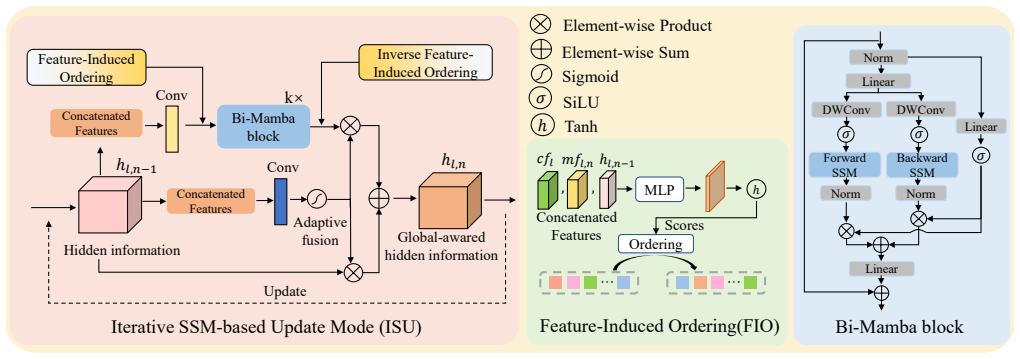
Two components carry the argument. The ISU (Iterative SSM-based Update) takes context, motion, and hidden features, orders the points according to a learned score, applies several bidirectional Mamba blocks to the sorted sequence, and adaptively fuses the output with the previous hidden state via a sigmoid gate—this is what propagates global motion patterns. The FIO (Feature-Induced Ordering) computes Score = tanh(MLP[cfl, mfl,n, hl,n-1]) for each point and sorts all points by that score, aiming to turn the irregular point cloud into a sequence with spatial continuity so that the SSM's causal dependencies are meaningful.
What would settle it
Train FlowMamba with FIO replaced by a fixed, non-learned ordering such as lexicographic sorting by 3D coordinates, or a random permutation, keeping all else fixed; if the EPE3D on FlyingThings3D remains at 0.0089 meters, the learned ordering is not the source of the improvement.
Extended reading notes
Core claim
The paper's core discovery, on its own terms, is that scene flow accuracy in ill-posed regions is limited by the local receptive field of the recurrent update cell, and that a bidirectional structured state space model with a learned ordering can supply the missing global context. FlowMamba replaces the GRU in a coarse-to-fine MSBRN-style architecture with an ISU that sorts points by a learned score, passes hidden states through bidirectional Mamba blocks, and fuses the globally refined hidden state with the previous iteration's state using a learned gate. This combination achieves state-of-the-art end-point error on both the synthetic FlyingThings3D and real-world KITTI benchmarks without fine-tuning on KITTI, and the ablation table attributes the gain specifically to the ISU and FIO components.
Load-bearing premise
The ordering is claimed to be learned, but the paper does not explain how gradients pass through the discrete sorting step to train the MLP that produces the scores, so the FIO may not actually be learning anything.
Editorial extensions
If this is right
- If correct, global sequence-based motion propagation is a viable fix for ill-posed scene flow regions, not just local cost volumes.
- Iterative scene flow methods can drop in the ISU in place of GRU and gain accuracy without retraining from scratch.
- Millimeter-level accuracy on KITTI without fine-tuning implies synthetic-to-real generalization is strong enough for practical deployment.
- Mamba's linear complexity makes the global receptive field affordable on 8k-point clouds.
- Fewer iterations reach baseline accuracy, suggesting faster inference options.
Reading between the lines
- We infer, though the paper does not test it, that the FIO style of learned ordering could transfer to other point-cloud sequence tasks such as object segmentation or completion, where spatial continuity in a scan order may similarly help SSMs.
- An implication left implicit is that any cheap spatial ordering that already encodes locality might capture part of FIO's gain; ablating against such orderings would isolate what the learned order adds.
- The claim that ISU propagates global information could be tested directly by probing how much the hidden state of a distant point changes after one ISU pass, a diagnostic the paper does not report.
- If the ordering is not trainable end-to-end, the observed gains might come from the Bi-Mamba block alone on a fixed order; the paper's own unidirectional-Mamba ablation suggests directionality matters more than the score.
Editorial analysis
A structured set of objections, weighed in public.
Referee Report
Summary. FlowMamba proposes a supervised point-cloud scene-flow network built on the MSBRN coarse-to-fine backbone, replacing the GRU update with an Iterative SSM-based Update (ISU) module that uses bidirectional Mamba blocks to propagate global motion information, and adding a Feature-Induced Ordering (FIO) strategy that sorts points by a learned score before sequence modeling. On FlyingThings3D and KITTI the method reports state-of-the-art EPE3D values (0.0089 and 0.0062 m, reductions of 21.9% and 20.5% over DifFlow3D), with additional experiments showing that ISU improves existing iterative methods and ablations of the ISU and FIO components.
Significance. If the results are reproducible, the paper makes a solid empirical contribution: it is, to my knowledge, the first application of bidirectional Mamba/SSM sequence modeling to point-cloud scene flow, and the reported gains are large and consistent across both synthetic and real-world benchmarks. The paper includes extensive comparisons (Tables 1 and 2), ablations (Tables 4 to 6), a runtime comparison (Table 7), and a plug-and-play study (Table 3). The arithmetic in the headline EPE3D reductions checks out. The two issues below -- the unspecified gradient path for the learned ordering and the inconsistent Outliers values in Table 3 -- are load-bearing and need to be fixed before the claims can be fully trusted.
major comments (2)
- [Section 3, 'Feature-induced Ordering Strategy', Eq. (6)] The FIO strategy computes Score = tanh(MLP([cfl, mfl,n, hl,n-1])) and then sorts all points by this score to define the sequence fed into the bidirectional Mamba blocks. Sorting is a discrete, non-differentiable operation: a naive implementation (e.g., torch.argsort) gives zero gradient to the score MLP. The paper does not describe any differentiable surrogate such as a soft sort, a perturbed optimizer, or a straight-through estimator, nor does it state that gradients are stopped or that the permutation is treated as a fixed preprocessing step. This matters because the FIO ablations in Table 5 are interpreted as evidence that the ordering is learned from the three features; with an untrained score MLP, the differences between ablations would reflect fixed random permutations rather than a learned feature-induced ordering. The authors must specify the exact gradient path used in training, or present evidence (e.g., before/after training analysis of the scores) that the ordering is actually learned.
- [Table 3 (Universality of proposed modules)] The reported Outliers value for MSBRN on FlyingThings3D, 0.0243, duplicates the Ours value in Table 1 for the same metric and contradicts Table 1's MSBRN Outliers value of 0.0560. Moreover, MSBRN(w/ISU) shows Outliers 0.0892 on FlyingThings3D, which is worse than both possible baselines (0.0560 or 0.0243), even though the same row reports a 28.6% EPE3D improvement. This inconsistency directly undermines the claim that ISU improves baseline accuracy across all metrics. Please correct the table and re-evaluate the plug-and-play claim for the Outliers metric on FlyingThings3D; if the improvement is not consistent, the claim should be qualified accordingly.
minor comments (5)
- [Conclusion] The conclusion states that the proposed method shows 'a strong university'; this should read 'universality'.
- [Preliminaries, Eq. (2)] In Eq. (2), the symbol B is used both for the continuous projection matrix and for the discretized matrix; using \bar{B} or another symbol for the discretized version would avoid confusion.
- [Abstract and Introduction] There are several grammatical issues, for example 'There has been a significantly increasing focus' and 'the same number of iterations as reporting in (Cheng and Ko 2023)'; these should be fixed in a polish pass.
- [Table 5] The FIO ablation differences are small (EPE3D ranging from 0.0096 to 0.0089); reporting error bars or multiple seeds would make the conclusions more robust.
- [Implementation Details] Since the FIO gradient path is central to the method, a short pseudocode block or a statement about the differentiable sorting mechanism would improve reproducibility.
Circularity Check
No circularity: FlowMamba's SOTA claims are supervised benchmark evaluations against external baselines; the FIO differentiability concern is an implementation/specification issue, not a circular derivation.
full rationale
FlowMamba's derivation chain is self-contained in the relevant sense: the central claims are empirical state-of-the-art comparisons and ablations on held-out FlyingThings3D and KITTI test sets against external published baselines (DifFlow3D, MSBRN, PV-RAFT, PT-FlowNet, etc.), and the ISU/FIO modules are trained by a supervised L2 loss against ground-truth flow (Eq. 7). No fitted parameter is relabeled as a prediction, and no load-bearing premise is justified solely by a self-citation: references to the authors' earlier papers appear only as related work or component-level citations, while the architectural template (MSBRN) and the SSM machinery (Mamba) are external and reproducible. The concern that the sorting step in Eq. (6) is non-differentiable and may leave the FIO score MLP untrained is a correctness/implementation caveat about whether the claimed causal mechanism is actually learned; it does not reduce any claimed result to its own input, and even if true it would weaken the FIO interpretation without making the benchmark evaluation circular. No specific reduction of the kind required for a circularity finding can be exhibited from the paper's equations or citation chain.
Assumptions & free parameters
free parameters (3)
- alpha(l) loss weights =
[0.16, 0.08, 0.04, 0.02]
- Number of update iterations per layer =
4 during training and evaluation
- Architecture dimensions =
Not reported
assumptions (4)
- domain assumption FlyingThings3D ground-truth scene flow labels are accurate enough for supervised training.
- domain assumption Zero-shot evaluation on KITTI (without fine-tuning) is a valid measure of real-world generalization.
- domain assumption Uniform random sampling of 8192 points preserves the motion field and correspondences.
- standard math The zero-order hold discretization of the continuous SSM (Eq. 2) is valid.
Cite this review
Pith. "Pith review of FlowMamba: Learning Point Cloud Scene Flow with Global Motion Propagation." pith.science (2026). https://pith.science/paper/YIXI5K3P
@misc{pith2026241217366,
  author       = {Pith},
  title        = {Pith review of: FlowMamba: Learning Point Cloud Scene Flow with Global Motion Propagation},
  year         = {2026},
  howpublished = {\url{https://pith.science/paper/YIXI5K3P}},
  note         = {Machine review of arXiv:2412.17366}
}
read the original abstract
Scene flow methods based on deep learning have achieved impressive performance. However, current top-performing methods still struggle with ill-posed regions, such as extensive flat regions or occlusions, due to insufficient local evidence. In this paper, we propose a novel global-aware scene flow estimation network with global motion propagation, named FlowMamba. The core idea of FlowMamba is a novel Iterative Unit based on the State Space Model (ISU), which first propagates global motion patterns and then adaptively integrates the global motion information with previously hidden states. As the irregular nature of point clouds limits the performance of ISU in global motion propagation, we propose a feature-induced ordering strategy (FIO). The FIO leverages semantic-related and motion-related features to order points into a sequence characterized by spatial continuity. Extensive experiments demonstrate the effectiveness of FlowMamba, with 21.9\% and 20.5\% EPE3D reduction from the best published results on FlyingThings3D and KITTI datasets. Specifically, our FlowMamba is the first method to achieve millimeter-level prediction accuracy in FlyingThings3D and KITTI. Furthermore, the proposed ISU can be seamlessly embedded into existing iterative networks as a plug-and-play module, improving their estimation accuracy significantly.
Figures


Figures from the paper (1 more)

Forward citations
Cited by 1 Pith paper
-
A Survey on Mamba Architecture for Vision Applications
A survey of Mamba-based vision models that summarizes scanning mechanisms, key architectures, and benchmark results, contributing no new experimental findings.
Reference graph
Works this paper leans on
-
[1]
Battrawy, R.; Schuster, R.; Mahani, M.-A. N.; and Stricker, D. 2022. Rms-flownet: Efficient and robust multi-scale scene flow estimation for large-scale point clouds. In 2022 International Conference on Robotics and Automation (ICRA), 883--889. IEEE
work page 2022
-
[2]
Cheng, W.; and Ko, J. H. 2022. Bi-pointflownet: Bidirectional learning for point cloud based scene flow estimation. In European Conference on Computer Vision, 108--124. Springer
work page 2022
-
[3]
Cheng, W.; and Ko, J. H. 2023. Multi-scale bidirectional recurrent network with hybrid correlation for point cloud based scene flow estimation. In Proceedings of the IEEE/CVF International Conference on Computer Vision, 10041--10050
work page 2023
-
[4]
Chollet, F. 2017. Xception: Deep learning with depthwise separable convolutions. In Proceedings of the IEEE conference on computer vision and pattern recognition, 1251--1258
2017
-
[5]
Fu, J.; Xiang, Z.; Qiao, C.; and Bai, T. 2023. PT-FlowNet: Scene Flow Estimation on Point Clouds With Point Transformer. IEEE Robotics and Automation Letters, 8(5): 2566--2573
work page 2023
-
[6]
Geiger, A.; Lenz, P.; Stiller, C.; and Urtasun, R. 2013. Vision meets robotics: The kitti dataset. The International Journal of Robotics Research, 32(11): 1231--1237
2013
-
[7]
Gu, A.; and Dao, T. 2023. Mamba: Linear-time sequence modeling with selective state spaces. arXiv preprint arXiv:2312.00752
arXiv 2023
-
[8]
Gu, A.; Goel, K.; and R \'e , C. 2021. Efficiently modeling long sequences with structured state spaces. arXiv preprint arXiv:2111.00396
arXiv 2021
Show all 50 references
-
[9]
Gu, X.; Tang, C.; Yuan, W.; Dai, Z.; Zhu, S.; and Tan, P. 2022. Rcp: Recurrent closest point for point cloud. In Proceedings of the IEEE/CVF Conference on Computer Vision and Pattern Recognition, 8216--8226
2022
-
[10]
J.; and Wang, P
Gu, X.; Wang, Y.; Wu, C.; Lee, Y. J.; and Wang, P. 2019. Hplflownet: Hierarchical permutohedral lattice flownet for scene flow estimation on large-scale point clouds. In Proceedings of the IEEE/CVF conference on computer vision and pattern recognition, 3254--3263
2019
-
[11]
Hendrycks, D.; and Gimpel, K. 2016. Gaussian error linear units (gelus). arXiv preprint arXiv:1606.08415
2016 arXiv
-
[12]
P.; and Ba, J
Kingma, D. P.; and Ba, J. 2014. Adam: A method for stochastic optimization. arXiv preprint arXiv:1412.6980
2014 arXiv
-
[13]
C.; and Raviv, D
Kittenplon, Y.; Eldar, Y. C.; and Raviv, D. 2021. Flowstep3d: Model unrolling for self-supervised scene flow estimation. In Proceedings of the IEEE/CVF Conference on Computer Vision and Pattern Recognition, 4114--4123
2021
-
[14]
Li, R.; Lin, G.; He, T.; Liu, F.; and Shen, C. 2021. Hcrf-flow: Scene flow from point clouds with continuous high-order crfs and position-aware flow embedding. In Proceedings of the IEEE/CVF Conference on Computer Vision and Pattern Recognition, 364--373
2021
-
[15]
Li, Y.; Yang, W.; and Fei, B. 2024. 3dmambacomplete: Exploring structured state space model for point cloud completion. arXiv preprint arXiv:2404.07106
2024 arXiv
-
[16]
Liang, D.; Zhou, X.; Wang, X.; Zhu, X.; Xu, W.; Zou, Z.; Ye, X.; and Bai, X. 2024. Pointmamba: A simple state space model for point cloud analysis. arXiv preprint arXiv:2402.10739
2024 arXiv
-
[17]
Liu, J.; Wang, G.; Ye, W.; Jiang, C.; Han, J.; Liu, Z.; Zhang, G.; Du, D.; and Wang, H. 2023. DifFlow3D: Toward Robust Uncertainty-Aware Scene Flow Estimation with Diffusion Model. arXiv preprint arXiv:2311.17456
2023 arXiv
-
[18]
Liu, J.; Wang, G.; Ye, W.; Jiang, C.; Han, J.; Liu, Z.; Zhang, G.; Du, D.; and Wang, H. 2024 a . DifFlow3D: Toward Robust Uncertainty-Aware Scene Flow Estimation with Iterative Diffusion-Based Refinement. In Proceedings of the IEEE/CVF Conference on Computer Vision and Pattern...
2024
-
[19]
Liu, J.; Yu, R.; Wang, Y.; Zheng, Y.; Deng, T.; Ye, W.; and Wang, H. 2024 b . Point mamba: A novel point cloud backbone based on state space model with octree-based ordering strategy. arXiv preprint arXiv:2403.06467
2024 arXiv
-
[20]
R.; and Guibas, L
Liu, X.; Qi, C. R.; and Guibas, L. J. 2019. Flownet3d: Learning scene flow in 3d point clouds. In Proceedings of the IEEE/CVF conference on computer vision and pattern recognition, 529--537
2019
-
[21]
Loshchilov, I.; and Hutter, F. 2017. Decoupled weight decay regularization. arXiv preprint arXiv:1711.05101
2017 arXiv
-
[22]
Lu, Z.; and Cheng, M. 2023. GMA3D: Local-global attention learning to estimate occluded motions of scene flow. In Chinese Conference on Pattern Recognition and Computer Vision (PRCV), 16--27. Springer
2023
-
[23]
Mayer, N.; Ilg, E.; Hausser, P.; Fischer, P.; Cremers, D.; Dosovitskiy, A.; and Brox, T. 2016. A large dataset to train convolutional networks for disparity, optical flow, and scene flow estimation. In Proceedings of the IEEE conference on computer vision and pattern recogniti...
2016
-
[24]
Mo, S. 2024. Efficient 3D Shape Generation via Diffusion Mamba with Bidirectional SSMs. arXiv preprint arXiv:2406.05038
2024 arXiv
-
[25]
Paszke, A.; Gross, S.; Massa, F.; Lerer, A.; Bradbury, J.; Chanan, G.; Killeen, T.; Lin, Z.; Gimelshein, N.; Antiga, L.; et al. 2019. Pytorch: An imperative style, high-performance deep learning library. Advances in neural information processing systems, 32
2019
-
[26]
R.; Su, H.; Mo, K.; and Guibas, L
Qi, C. R.; Su, H.; Mo, K.; and Guibas, L. J. 2017 a . Pointnet: Deep learning on point sets for 3d classification and segmentation. In Proceedings of the IEEE conference on computer vision and pattern recognition, 652--660
2017
-
[27]
R.; Yi, L.; Su, H.; and Guibas, L
Qi, C. R.; Yi, L.; Su, H.; and Guibas, L. J. 2017 b . Pointnet++: Deep hierarchical feature learning on point sets in a metric space. Advances in neural information processing systems, 30
2017
-
[28]
J.; Li, E
Seita, D.; Wang, Y.; Shetty, S. J.; Li, E. Y.; Erickson, Z.; and Held, D. 2023. Toolflownet: Robotic manipulation with tools via predicting tool flow from point clouds. In Conference on Robot Learning, 1038--1049. PMLR
2023
-
[29]
Teng, S.; Hu, X.; Deng, P.; Li, B.; Li, Y.; Ai, Y.; Yang, D.; Li, L.; Xuanyuan, Z.; Zhu, F.; et al. 2023. Motion planning for autonomous driving: The state of the art and future perspectives. IEEE Transactions on Intelligent Vehicles
2023
-
[30]
Wang, G.; Hu, Y.; Liu, Z.; Zhou, Y.; Tomizuka, M.; Zhan, W.; and Wang, H. 2022. What matters for 3d scene flow network. In European Conference on Computer Vision, 38--55. Springer
2022
-
[31]
Wang, G.; Wu, X.; Liu, Z.; and Wang, H. 2021. Hierarchical attention learning of scene flow in 3d point clouds. IEEE Transactions on Image Processing, 30: 5168--5181
2021
-
[32]
Wang, X.; Xu, G.; Jia, H.; and Yang, X. 2024. Selective-stereo: Adaptive frequency information selection for stereo matching. In Proceedings of the IEEE/CVF Conference on Computer Vision and Pattern Recognition, 19701--19710
2024
-
[33]
Wang, Y.; Chi, C.; Lin, M.; and Yang, X. 2023 a . Ihnet: Iterative hierarchical network guided by high-resolution estimated information for scene flow estimation. In Proceedings of the IEEE/CVF International Conference on Computer Vision, 10073--10082
2023
-
[34]
Wang, Z.; Nguyen, C.; Asente, P.; and Dorsey, J. 2023 b . PointShopAR: Supporting Environmental Design Prototyping Using Point Cloud in Augmented Reality. In Proceedings of the 2023 CHI Conference on Human Factors in Computing Systems, 1--15
2023
-
[35]
Wei, Y.; Wang, Z.; Rao, Y.; Lu, J.; and Zhou, J. 2021. Pv-raft: Point-voxel correlation fields for scene flow estimation of point clouds. In Proceedings of the IEEE/CVF conference on computer vision and pattern recognition, 6954--6963
2021
-
[36]
Wu, W.; Fuxin, L.; and Shan, Q. 2023. Pointconvformer: Revenge of the point-based convolution. In Proceedings of the IEEE/CVF Conference on Computer Vision and Pattern Recognition, 21802--21813
2023
-
[37]
Wu, W.; Qi, Z.; and Fuxin, L. 2019. Pointconv: Deep convolutional networks on 3d point clouds. In Proceedings of the IEEE/CVF Conference on computer vision and pattern recognition, 9621--9630
2019
-
[38]
Y.; Li, Z.; Liu, W.; and Fuxin, L
Wu, W.; Wang, Z. Y.; Li, Z.; Liu, W.; and Fuxin, L. 2020. Pointpwc-net: Cost volume on point clouds for (self-) supervised scene flow estimation. In Computer Vision--ECCV 2020: 16th European Conference, Glasgow, UK, August 23--28, 2020, Proceedings, Part V 16, 88--107. Springer
2020
-
[39]
Xu, G.; Cheng, J.; Guo, P.; and Yang, X. 2022. Attention concatenation volume for accurate and efficient stereo matching. In Proceedings of the IEEE/CVF conference on computer vision and pattern recognition, 12981--12990
2022
-
[40]
Xu, G.; Wang, X.; Ding, X.; and Yang, X. 2023 a . Iterative geometry encoding volume for stereo matching. In Proceedings of the IEEE/CVF Conference on Computer Vision and Pattern Recognition, 21919--21928
2023
-
[41]
Xu, G.; Wang, X.; Zhang, Z.; Cheng, J.; Liao, C.; and Yang, X. 2024 a . Igev++: Iterative multi-range geometry encoding volumes for stereo matching. arXiv preprint arXiv:2409.00638
2024 arXiv
-
[42]
Xu, G.; Wang, Y.; Cheng, J.; Tang, J.; and Yang, X. 2023 b . Accurate and efficient stereo matching via attention concatenation volume. IEEE Transactions on Pattern Analysis and Machine Intelligence
2023
-
[43]
Xu, G.; Wang, Y.; Gu, J.; Xue, T.; and Yang, X. 2024 b . HDRFlow: Real-Time HDR Video Reconstruction with Large Motions. In Proceedings of the IEEE/CVF Conference on Computer Vision and Pattern Recognition, 24851--24860
2024
-
[44]
Zhang, D.; Zhang, H.; Tang, J.; Wang, M.; Hua, X.; and Sun, Q. 2020. Feature pyramid transformer. In Computer Vision--ECCV 2020: 16th European Conference, Glasgow, UK, August 23--28, 2020, Proceedings, Part XXVIII 16, 323--339. Springer
2020
-
[45]
Zhang, T.; Li, X.; Yuan, H.; Ji, S.; and Yan, S. 2024 a . Point could mamba: Point cloud learning via state space model. arXiv preprint arXiv:2403.00762
2024 arXiv
-
[46]
Zhang, Y.; Edstedt, J.; Wandt, B.; Forss \'e n, P.-E.; Magnusson, M.; and Felsberg, M. 2024 b . Gmsf: Global matching scene flow. Advances in Neural Information Processing Systems, 36
2024
-
[47]
H.; and Koltun, V
Zhao, H.; Jiang, L.; Jia, J.; Torr, P. H.; and Koltun, V. 2021. Point transformer. In Proceedings of the IEEE/CVF international conference on computer vision, 16259--16268
2021
-
[48]
Zhu, L.; Liao, B.; Zhang, Q.; Wang, X.; Liu, W.; and Wang, X. 2024. Vision mamba: Efficient visual representation learning with bidirectional state space model. arXiv preprint arXiv:2401.09417
2024 arXiv
-
[49]
, " * write output.state after.block = add.period write newline
ENTRY address archivePrefix author booktitle chapter edition editor eid eprint howpublished institution isbn journal key month note number organization pages publisher school series title type volume year label extra.label sort.label short.list INTEGERS output.state before.all...
-
[50]
write newline
" write newline "" before.all 'output.state := FUNCTION n.dashify 't := "" t empty not t #1 #1 substring "-" = t #1 #2 substring "--" = not "--" * t #2 global.max substring 't := t #1 #1 substring "-" = "-" * t #2 global.max substring 't := while if t #1 #1 substring * t #2 gl...
Reviewed August 11, 2026 · model on record in the stance chip above.
Discussion (0). Continue with ORCID to comment.