REVIEW 3 major objections 6 minor 24 references
A 4D Radar Camera Extrinsic Calibration Tool Based on 3D Uncertainty Perspective N Points
T0 review · 3 major / 6 minor · reviewed 2026-08-06 · deepseek-v4-flash
Pith's one-line read A PnP solver that treats radar noise as a systematic bias improves radar-camera extrinsic calibration.
desk verdict Real gap, correct bias derivation, but Eq. (14)'s scale factor is in the wrong frame, so the central claim isn't supported as written; still worth refereeing if the authors can fix it. read the letter →
The pith
A machine-rendered reading of the paper's core claim, the machinery that carries it, and where it could break.
The reading
What carries the argument
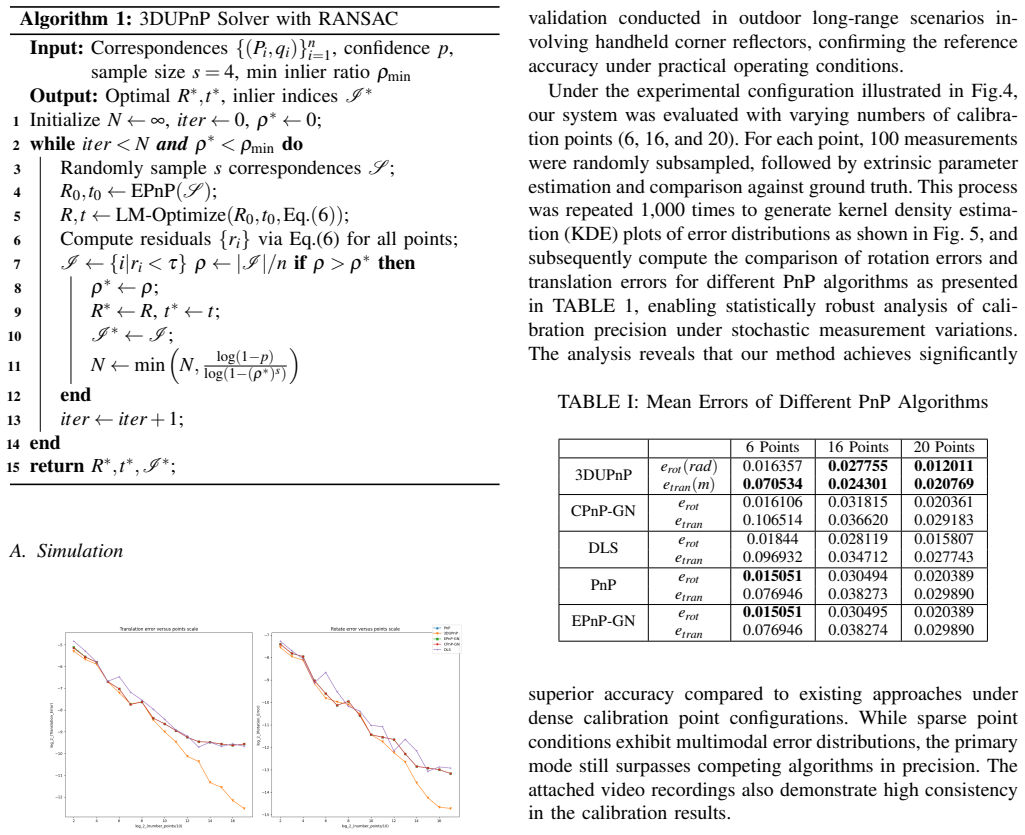
The central object is the spherical-noise bias-compensation model. For each radar point $(\rho_i,\theta_i,\phi_i)$ with independent Gaussian noise of variances $\varepsilon_\rho,\varepsilon_\theta,\varepsilon_\varphi$, the coordinate map to Cartesian coordinates produces a noise vector whose expectation is nonzero; the identities $E[\cos\delta_\theta] = e^{-\varepsilon_\theta^2/2}$ and $E[\sin\delta_\theta] = 0$ give a closed-form bias $E[\delta p_i]$, and the Jacobian $J_i$ of the spherical-to-Cartesian map gives the propagated covariance $\Sigma_C = J_i \Sigma_S J_i^\top$. The 3DUPnP optimization minimizes the sum of squared covariance-weighted residuals $\tilde p_i - R^{-1}(s_i K^{-1}[q_i^\top,1]^\top - t) - E[\delta p_i]$, weighted by $\Sigma_C^{-1}$, with RANSAC filtering to remove multipath outliers. This mechanism converts sensor-specific noise knowledge into a pose estimate, which is what lets the calibration tool work with a single corner reflector observed over time.
What would settle it
Run the simulator with spherical noise drawn from a Gaussian mixture containing a few percent of multipath-like outliers: if 3DUPnP's translation-error advantage over CPnP disappears or reverses, then the claimed gain depends on the zero-mean Gaussian assumption rather than on the bias-compensation mechanism itself.
Extended reading notes
Core claim
On the paper's own terms, the discovery is that the noise of a 4D radar measurement should be treated in the spherical coordinates where the sensor actually measures it, not in the Cartesian coordinates where the calibration problem is posed. If the spherical noise is zero-mean Gaussian with variances $\varepsilon_\rho, \varepsilon_\theta, \varepsilon_\varphi$, the transformed Cartesian noise has expectation \[ E[\delta p_i] = \begin{bmatrix} \rho_i \sin\theta_i \cos\phi_i ($e^{{-(\varepsilon_\theta^2+\varepsilon_\varphi^2)/2}}$ - 1) \\ \rho_i \sin\theta_i \sin\phi_i ($e^{{-(\varepsilon_\theta^2+\varepsilon_\varphi^2)/2}}$ - 1) \\ \rho_i \cos\theta_i ($e^{{-\varepsilon_\theta^2/2}}$ - 1) \end{bmatrix}, \] which is nonzero whenever the angular variances are positive. The 3DUPnP solver subtracts this bias and weights each reprojection residual by the inverse of the propagated covariance $J_i \Sigma_S J_i^\top$, obtaining a maximum-likelihood pose by nonlinear least-squares optimization inside a RANSAC loop. The paper reports that this bias-aware formulation gives more accurate and more consistent extrinsic parameters than CPnP, DLS, EPnP, and a plain PnP baseline, both in synthetic consistency tests and on a physical wheelchair-mounted sensor rig with calibration points from 6 to 20.
Load-bearing premise
The entire bias-compensation model assumes radar measurement noise in range, azimuth, and elevation is zero-mean, independent, Gaussian noise with variances known from the manufacturer; if real radar noise is multipath-rich or otherwise non-Gaussian, the compensation term will point the solver in the wrong direction.
Editorial extensions
If this is right
- Radar-camera extrinsic calibration becomes a maximum-likelihood estimation problem rather than a plain least-squares reprojection problem, so adding more matched points should reduce error more consistently than standard PnP solvers.
- The bias term grows with range and with angular noise variance, so calibration accuracy at longer operating distances should improve more noticeably than close-range accuracy.
- The same solver can be initialized with any ordinary PnP method (the paper uses EPnP inside RANSAC), making it a drop-in backend for existing calibration pipelines.
- With temporal accumulation of single-reflector observations, the physical system needs only one corner reflector instead of a large multi-target fixture, lowering the barrier to field recalibration.
Reading between the lines
- Beyond the tested corner-reflector setup, the spherical-bias correction should transfer to any calibration target that produces radar points with known angular variances, including natural reflectors such as traffic poles, because the model depends only on the sensor noise model, not on a specific marker.
- Because the bias scales linearly with range, the method's advantage over CPnP should be most visible in long-range outdoor scenes; the paper's physical tests at 2-15 m may understate that advantage, and a direct range-stratified comparison would test this prediction.
- The same nonzero-expectation argument applies to any sensor whose native coordinates are spherical with independent angular noise, so the estimator could be adapted to lidar-camera calibration or to joint radar-lidar-camera optimization without changing the core derivation.
Editorial analysis
A structured set of objections, weighed in public.
Referee Report
Summary. This paper proposes 3DUPnP, an extrinsic calibration method for 4D millimeter-wave radar and camera systems. The method treats radar measurements as Gaussian noise in spherical coordinates, derives the induced bias and covariance in Cartesian coordinates (Eqs. (7)-(12)), and solves a Mahalanobis-weighted PnP objective with RANSAC-based initialization and LM refinement. The framework includes a corner-reflector target detector and two synchronization schemes. Validation is performed in simulation under the assumed noise model and on a physical smart-wheelchair platform, with comparisons to CPnP, DLS, PnP, and EPnP-GN.
Significance. Radar-camera extrinsic calibration is an important practical problem, and explicitly modeling spherical-coordinate noise is a sensible direction. The first-order bias expression in Eq. (10) is a useful analytic result under the stated Gaussian assumptions. The engineering contributions, including single-reflector temporal accumulation, the YOLO-based detector, and the RANSAC stage, make the tool potentially usable. However, the current manuscript contains an internal inconsistency in the central optimization objective (Eq. (14)) and an ambiguity in the variance notation in Eqs. (6) and (10). Because the reported simulation and physical results are generated with the inconsistent objective, the claimed accuracy improvement over CPnP is not yet supported. The simulation also injects exactly the noise model assumed by the algorithm, so it does not test robustness to realistic radar noise.
major comments (3)
- [Section III-B, Eq. (14)] The scale factor s_i is set to the third component of the measured radar-frame point (the z-coordinate in the radar/world frame). In the projection model of Eq. (2), however, s_i is the homogeneous scale in the camera frame and must equal the camera-frame depth (R p_i + t)_3. These two quantities differ under the 30-degree rotation used in the simulation, where the radar z-coordinate is a mixture of camera-frame x, y, and z components. As a result, the inverse projection R^{-1}(s_i K^{-1}[q_i;1] - t) in Eq. (14) does not reconstruct the measured radar point, and the Mahalanobis objective is not minimizing the reprojection error the paper claims. The numerical gains over CPnP in Fig. 3 and Table 1 are therefore not attributable to correct spherical-noise bias compensation; they may be artifacts of the inconsistent objective.
- [Section III-B, Eqs. (6) and (10)] There is a notational inconsistency in the definition of the noise covariance. Eq. (6) defines Sigma_S = diag(epsilon_rho, epsilon_theta, epsilon_phi) as the covariance of the Gaussian noise vector, which makes the epsilon quantities variances. Eq. (10) then uses exponents such as exp(-epsilon_theta^2/2) and exp(-epsilon_phi^2/2), which are the characteristic-function results only if epsilon_theta and epsilon_phi are standard deviations, not variances. The two conventions give quantitatively different bias corrections (for example, a variance of 0.005 rad^2 corresponds to a standard deviation of about 0.0707 rad, whereas the simulation reports sigma_theta = sigma_phi = 0.005 rad). As written, the magnitude of the bias term, which is the core novelty of the algorithm, is not well defined.
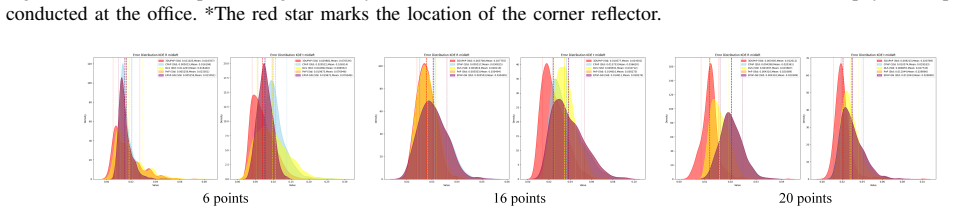
- [Section IV, Table 1 and Fig. 3] The experimental evidence is not as strong as the text claims. The simulation uses exactly the zero-mean independent Gaussian spherical noise assumed in Eqs. (5)-(6), so it is self-validating and cannot reveal misspecification of the noise model. In the physical experiments, Table 1 reports only means, without variances, confidence intervals, or statistical tests, despite the KDE plots in Fig. 5. Moreover, in the 6-point condition, 3DUPnP has a larger rotation error (0.016357 rad) than CPnP-GN (0.016106 rad) and PnP (0.015051 rad), which contradicts the statement that the method achieves 'significantly superior accuracy' across configurations. The reader cannot assess whether the reported improvements are significant or robust.
minor comments (6)
- [Algorithm 1, lines 5 and 7] Lines 5 and 7 reference 'Eq.(6)' as the optimization objective and residual function, but Eq. (6) is the diagonal covariance assumption; the objective is Eq. (14). Please correct the cross-references.
- [Section II-B] The text attributes the point residual of Eq. (3) to 'Alexander[6]', but reference [6] is the paper by Domhof et al.; the citation is misattributed and should be corrected.
- [Section III-C] The description of the two time synchronizers is difficult to follow: it is unclear what 'M data pairs within N sliding windows' and 'N sets of distributions' mean, and no equations or pseudocode are given. Please clarify.
- [Section IV-A] The simulation section says noise parameters are chosen 'according to the parameters zf provided', but the actual ZF FRGen21 noise parameter values and their source are not given; please state the numbers and provide a reference or datasheet.
- [Section IV-B] The physical ground truth is obtained from CAD-designed fixtures and manual refinement with OpenCalib; given that the claimed differences between methods are on the order of 0.005-0.01 rad and 0.01-0.03 m, the paper should discuss the accuracy of this reference and its potential impact on the comparisons.
- [Section III-B, Eqs. (13)-(14)] Eq. (13) writes the observed image point as q_i with a tilde, but Eq. (14) uses q_i without a tilde; please clarify whether q_i denotes the observed or the noise-free image coordinate in the objective.
Circularity Check
No circular derivation: the bias-correction terms are closed-form consequences of an externally sourced spherical Gaussian noise model, and no fitted parameter is renamed as a prediction.
full rationale
I walked the derivation chain from the spherical-coordinate noise model (Eqs. 4-6) through the expectation E[δp] (Eqs. 7-10) and the first-order Jacobian covariance ΣC (Eqs. 11-12) to the Mahalanobis objective (Eq. 14). The noise variances are taken from the radar manufacturer's technical specifications, not fitted to the calibration data, and the pose is optimized against independent baselines (CPnP, DLS, EPnP) plus CAD/OpenCalib-derived ground truth. The self-citations in the references ([9], [19], [24]) are background work and are not load-bearing premises of the calibration algorithm. The one evaluation bias is that the simulation injects exactly the Gaussian spherical noise the method assumes (σρ=0.02 m, σθ=σφ=0.005 rad), so the simulation confirms consistency under the model rather than validating the model itself; that is a testing limitation, not a circular step in the derivation. The suspicious scale-factor choice s_i = \tilde p_(3) in Eq. (14) is an algebraic consistency concern, but it does not make the result equivalent to its inputs. No equation reduces to its own inputs, and no fitted parameter is renamed as a prediction.
Assumptions & free parameters
free parameters (1)
- Spherical noise standard deviations (σρ, σθ, σφ) =
0.02 m, 0.005 rad, 0.005 rad
assumptions (3)
- domain assumption Radar measurement noise in spherical coordinates is zero-mean, independent Gaussian with known variances (Eq. 5-6).
- standard math First-order Jacobian propagation adequately represents the Cartesian covariance (Eq. 12).
- domain assumption The pinhole camera model and intrinsics K are calibrated and correct (Eq. 1-2).
Cite this review
Pith. "Pith review of A 4D Radar Camera Extrinsic Calibration Tool Based on 3D Uncertainty Perspective N Points." pith.science (2026). https://pith.science/paper/YKUOESSJ
@misc{pith2026250719829,
  author       = {Pith},
  title        = {Pith review of: A 4D Radar Camera Extrinsic Calibration Tool Based on 3D Uncertainty Perspective N Points},
  year         = {2026},
  howpublished = {\url{https://pith.science/paper/YKUOESSJ}},
  note         = {Machine review of arXiv:2507.19829}
}
abstract
4D imaging radar is a type of low-cost millimeter-wave radar(costing merely 10-20$\%$ of lidar systems) capable of providing range, azimuth, elevation, and Doppler velocity information. Accurate extrinsic calibration between millimeter-wave radar and camera systems is critical for robust multimodal perception in robotics, yet remains challenging due to inherent sensor noise characteristics and complex error propagation. This paper presents a systematic calibration framework to address critical challenges through a spatial 3d uncertainty-aware PnP algorithm (3DUPnP) that explicitly models spherical coordinate noise propagation in radar measurements, then compensating for non-zero error expectations during coordinate transformations. Finally, experimental validation demonstrates significant performance improvements over state-of-the-art CPnP baseline, including improved consistency in simulations and enhanced precision in physical experiments. This study provides a robust calibration solution for robotic systems equipped with millimeter-wave radar and cameras, tailored specifically for autonomous driving and robotic perception applications.
Figures


Figures from the paper (2 more)

Reference graph
Works this paper leans on
- [1]
-
[2]
Review on Millimeter-Wave Radar and Camera Fusion Technology
Zhou, Y .; Dong, Y .; Hou, F.; Wu, J. Review on Millimeter-Wave Radar and Camera Fusion Technology. Sustainability 2022, 14, 5114. https://doi.org/10.3390/su14095114
-
[3]
MLPnP - A Real-Time Maximum Likelihood Solution to the Perspective-n-Point Problem
S. Urban, J. Leitloff, and S. Hinz, “Mlpnp-a real-time maximum likelihood solution to the perspective-n-point problem,” arXiv preprint arXiv:1607.08112, 2016
work page Pith review arXiv 2016
-
[4]
G. Yan, L. Zhuochun, C. Wang, C. Shi, P. Wei, X. Cai, T. Ma, Z. Liu, Z. Zhong, Y . Liu, M. Zhao, Z. Ma, and Y . Li, ”OpenCalib: A Multi- sensor Calibration Toolbox for Autonomous Driving,” arXiv, 2022. [Online]. Available: https://arxiv.org/abs/2205.14087. Fig. 4: Corner reflector provide high-intensity feature, the sensors installed on our smart wheelcha...
work page Pith review arXiv 2022
-
[5]
J. Per ˇsi´c, I. Markovi ´c, and I. Petrovi ´c, ”Extrinsic 6DoF calibration of a radar–LiDAR–camera system enhanced by radar cross section estimates evaluation,” Robotics and Autonomous Systems, vol. 114, pp. 217-230, 2019
work page 2019
- [6]
- [7]
-
[8]
J. Zhang et al., ”LB-R2R-Calib: Accurate and Robust Extrinsic Calibration of Multiple Long Baseline 4D Imaging Radars for V2X,” 2024 IEEE International Conference on Robotics and Au- tomation (ICRA), Yokohama, Japan, 2024, pp. 16729-16735, doi: 10.1109/ICRA57147.2024.10611470
arXiv 2024
Show all 24 references
-
[9]
SFPNet: Sparse Focal Point Network for Semantic Segmentation on General LiDAR Point Clouds,
Y . Wang, W. Zhao, C. Cao, T. Deng, J. Wang, and W. Chen, “SFPNet: Sparse Focal Point Network for Semantic Segmentation on General LiDAR Point Clouds,” in Computer Vision – ECCV 2024: 18th European Conference on Computer Vision, Proceedings, 2025, vol. 14851, pp. 403–421. doi:...
2024 doi
-
[10]
E. Wise, Q. Cheng and J. Kelly, ”Spatiotemporal Calibration of 3- D Millimetre-Wavelength Radar-Camera Pairs,” in IEEE Transac- tions on Robotics, vol. 39, no. 6, pp. 4552-4566, Dec. 2023, doi: 10.1109/TRO.2023.3311680
2023
-
[11]
E. Wise, J. Per ˇsi´c, C. Grebe, I. Petrovi ´c and J. Kelly, ”A Continuous-Time Approach for 3D Radar-to-Camera Extrinsic Cal- ibration,” 2021 IEEE International Conference on Robotics and Automation (ICRA), Xi’an, China, 2021, pp. 13164-13170, doi: 10.1109/ICRA48506.2021.9561938
2021
-
[12]
Per ˇsi´c, L
J. Per ˇsi´c, L. Petrovi ´c, I. Markovi ´c and I. Petrovi ´c, ”Spatiotemporal Multisensor Calibration via Gaussian Processes Moving Target Track- ing,” in IEEE Transactions on Robotics, vol. 37, no. 5, pp. 1401-1415, Oct. 2021, doi: 10.1109/TRO.2021.3061364
2021
-
[13]
Sch ¨oller, M
C. Sch ¨oller, M. Schnettler, A. Kr ¨ammer, G. Hinz, M. Bakovic, M. G ¨uzet, and A. Knoll, ”Targetless rotational auto-calibration of radar and camera for intelligent transportation systems,” arXiv, 2019. [Online]
2019
-
[14]
Vakhitov, L
A. Vakhitov, L. F. Colomina, A. Agudo, and F. Moreno-Noguer, ”Uncertainty-aware camera pose estimation from points and lines,” arXiv, 2021. [Online]
2021
-
[15]
J. A. Hesch and S. I. Roumeliotis, ”A Direct Least-Squares (DLS) method for PnP,” 2011 International Conference on Computer Vision, Barcelona, Spain, 2011, pp. 383-390, doi: 10.1109/ICCV .2011.6126266
2011
-
[16]
S. Li, C. Xu and M. Xie, ”A Robust O(n) Solution to the Perspective- n-Point Problem,” in IEEE Transactions on Pattern Analysis and Machine Intelligence, vol. 34, no. 7, pp. 1444-1450, July 2012, doi: 10.1109/TPAMI.2012.41
2012 doi
-
[17]
G. Zeng, S. Chen, B. Mu, G. Shi and J. Wu, ”CPnP: Consistent Pose Estimator for Perspective-n-Point Problem with Bias Elimina- tion,” 2023 IEEE International Conference on Robotics and Automa- tion (ICRA), London, United Kingdom, 2023, pp. 1940-1946, doi: 10.1109/ICRA48891.202...
2023
-
[18]
Epnp: An accurate o (n)solution to the pnp problem,
V . Lepetit, F. Moreno-Noguer, and P. Fua, “Epnp: An accurate o (n)solution to the pnp problem,” International Journal of Computer Vision,vol. 81, no. 2, pp. 155–166, 2009
2009
-
[19]
X. Li, H. Zhang and W. Chen, ”4D Radar-Based Pose Graph SLAM With Ego-Velocity Pre-Integration Factor,” in IEEE Robotics and Automation Letters, vol. 8, no. 8, pp. 5124-5131, Aug. 2023, doi: 10.1109/LRA.2023.3292574
2023
-
[20]
Xiao-Shan Gao, Xiao-Rong Hou, Jianliang Tang and Hang-Fei Cheng, ”Complete solution classification for the perspective-three- point problem,” in IEEE Transactions on Pattern Analysis and Ma- chine Intelligence, vol. 25, no. 8, pp. 930-943, Aug. 2003, doi: 10.1109/TPAMI.2003.1217599
2003 arXiv
-
[21]
Online multi-sensor calibration based on moving object tracking[J]
Per ˇsi´c J, Petrovi ´c L, Markovi ´c I, et al. Online multi-sensor calibration based on moving object tracking[J]. Advanced Robotics, 2021, 35(3- 4): 130-140
2021
-
[22]
Varghese and S
R. Varghese and S. M., ”YOLOv8: A Novel Object Detection Al- gorithm with Enhanced Performance and Robustness,” 2024 Interna- tional Conference on Advances in Data Engineering and Intelligent Computing Systems (ADICS), Chennai, India, 2024, pp. 1-6, doi: 10.1109/ADICS58448.202...
2024
-
[23]
Exhaustive linearization for robust camera pose and focal length estimation
Adrian Penate-Sanchez, Juan Andrade-Cetto, and Francesc Moreno- Noguer. Exhaustive linearization for robust camera pose and focal length estimation. Pattern Analysis and Machine Intelligence, IEEE Transactions on, 35(10):2387–2400, 2013
2013
-
[24]
Deng et al., ”MNE-SLAM: Multi-agent neural SLAM for mobile robots,” in Proc
T. Deng et al., ”MNE-SLAM: Multi-agent neural SLAM for mobile robots,” in Proc. IEEE/CVF Conf. Comput. Vis. Pattern Recognit. (CVPR), 2025, pp. 1485-1494
2025
Reviewed August 6, 2026 · model on record in the stance chip above.
Discussion (0). Continue with ORCID to comment.