REVIEW 4 major objections 10 minor 1 cited by
Uni-SLAM: Uncertainty-Aware Neural Implicit SLAM for Real-Time Dense Indoor Scene Reconstruction
T0 review · 4 major / 10 minor · reviewed 2026-08-12 · deepseek-v4-flash
Pith's one-line read Uni-SLAM shows that weighting each pixel by a volume-rendering confidence score improves neural implicit SLAM tracking and mapping without giving up real-time operation.
desk verdict Solid, well-engineered SLAM systems paper with a genuinely new uncertainty heuristic; the main gap is that the heuristic is never stress-tested under pose failure. read the letter →
The pith
A machine-rendered reading of the paper's core claim, the machinery that carries it, and where it could break.
The reading
What carries the argument
Central machinery is the termination-probability confidence signal. Along a ray with sample weights $w_i = T_i(1-\exp(-\sigma(x_i)))$, the accumulated value $p(r)=\sum_{i=1}^N w_i$ telescopes to $1-\exp(-\sum_i\sigma(x_i))$, bounding it in $(0,1)$ by construction. The paper treats $p(r)$ as the probability that the ray terminates on a known surface, defines $\beta_m=(1-p(r_m))^2$ for each pixel and $\beta=\frac{1}{M}\sum_m\beta_m$ per image, and converts $\beta_m$ into a binary mask $CF_m=\mathbf 1[\beta_m\le \beta^\text{unc}_m]$ that multiplies the SDF, depth, and tracking color losses. This is what lets the system discard outliers and emphasize reliable data during pose optimization. The second load-bearing mechanism is decoupled geometry and appearance hash grids, which allow high-frequency color and geometry to be sampled at different resolutions, plus the uncertainty-gated local-to-global bundle adjustment schedule that adds local BA when $\beta>\beta^\text{unc}$ and LLCO when co-visibility exceeds 0.95.
What would settle it
Use a Replica or ScanNet sequence with known invalid-depth regions, run Uni-SLAM, and record per-pixel $p(r)$, $\beta_m$, and depth error against the sensor depth. The claim predicts that pixels with $\beta_m$ below threshold have small depth error and that high-$\beta_m$ pixels coincide with invalid or unobserved depth; if any low-uncertainty pixel shows depth error larger than the truncation distance, or if the uncertainty map does not flag deliberately corrupted depth regions, the confidence proxy is falsified.
Extended reading notes
Core claim
The paper's claim is that the accumulated termination probability of a sampled ray, $p(r)=\sum_i w_i = 1-\exp(-\sum_i \sigma(x_i))$, is a usable online measure of how well the current model knows the observed surface: near 1 for well-observed, accurately tracked pixels and near 0 for invalid-depth, occluded, or never-seen regions. From it Uni-SLAM derives pixel-level uncertainty $\beta_m=(1-p(r_m))^2$ and image-level uncertainty $\beta=\frac{1}{M}\sum_m \beta_m$, uses a thresholded confidence mask $CF_m$ to reweight SDF, depth, and tracking color losses, and leaves the mapping color loss unweighted so RGB can compensate for invalid depth. A decoupled pair of multiresolution hash grids represents geometry and appearance separately, and image-level uncertainty plus a co-visibility check activates local bundle adjustment and loop-closure optimization on top of constant global BA. The reported outcome is improved pose estimation in every Replica scene, lower ATE on ScanNet and TUM RGB-D than the compared neural implicit SLAM systems, thinner structures in the reconstructed meshes, and real-time operation at roughly 8.4 FPS.
Load-bearing premise
The system trusts that the accumulated termination probability is near 1 precisely for well-observed, accurately posed pixels and near 0 for invalid or unseen regions, so a confidently wrong model could be reweighted up instead of filtered.
Editorial extensions
If this is right
- If the results hold, a neural implicit SLAM system can gain accuracy by computing a per-pixel confidence from the model's own rendering weights, with no extra uncertainty network and no additional training cost.
- Tracking on Replica improves to a 0.45 cm average ATE RMSE, with ScanNet and TUM RGB-D averages of 7.01 cm and 2.05 cm, both best among the neural implicit baselines compared.
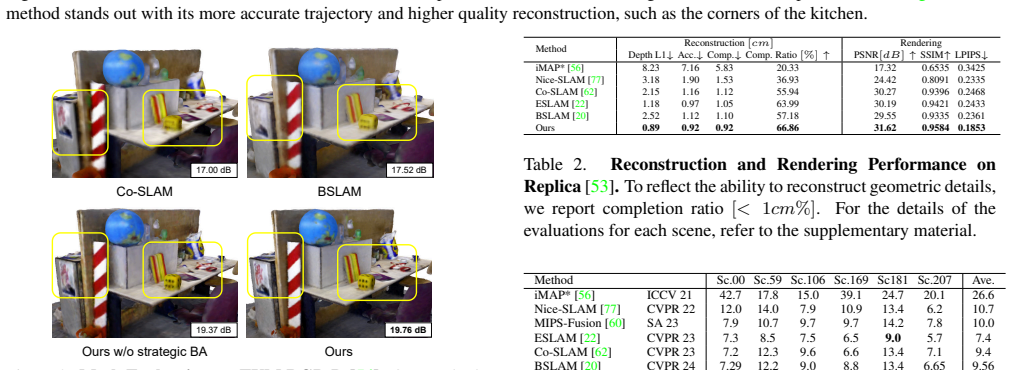
- Mapping quality on Replica improves to 0.89 cm depth L1, 0.92 cm accuracy and completion, and 66.86% completion within 1 cm, corresponding to thinner structures such as chair legs and table edges.
- The uncertainty-driven mapping trigger is not tied to Uni-SLAM's own representation: applying it to BSLAM improves that system's ATE from 1.19 cm to 1.07 cm and its completion ratio from 57.18% to 58.36%.
- Real-time operation is preserved: roughly 8.4 FPS on Replica with an RTX 4090, comparable to Co-SLAM and faster than ESLAM, Nice-SLAM, and BSLAM in the reported setup.
Reading between the lines
- Editorial extension: because $\beta$ is computed from the current model state, it could double as an online alarm for motion blur, sensor dropout, or aggressive camera motion, enabling the SLAM system to slow down, request new views, or refuse bad poses before drift accumulates.
- Editorial extension: the same uncertainty could drive active next-best-view selection, since high-$\beta$ rays mark regions the model has not yet observed; the paper mentions active sampling as future work but does not test it.
- Editorial extension: the hand-set thresholds $\beta^\text{unc}_m$ and $\beta^\text{unc}$ vary across datasets, so a principled automatic calibration, such as normalizing by the per-image uncertainty distribution, would be needed for deployment outside the tuned benchmarks.
- Editorial extension: the decision not to reweight color during mapping rests on RGB compensating for invalid depth; in a sensor with reliable depth, reweighting color in mapping might become beneficial, which could be tested directly.
Editorial analysis
A structured set of objections, weighed in public.
Referee Report
Summary. The manuscript proposes Uni-SLAM, a real-time dense neural implicit RGB-D SLAM system with three main components: (i) a decoupled representation with separate multiresolution hash grids for geometry (SDF) and appearance, both decoded by tiny MLPs and rendered by standard volume rendering; (ii) a model-free "predictive uncertainty" defined per pixel as beta_m = (1 - p(r))^2, where p(r) is the accumulated termination probability along the depth-guided sampling ray, used to hard-mask and reweight the SDF, depth, and (during tracking only) color loss terms; and (iii) an uncertainty-triggered mapping schedule combining fixed-frequency global bundle adjustment, image-level-uncertainty-activated local BA, and a co-visibility-based local loop closure optimization (LLCO). The system is evaluated on Replica, ScanNet, and TUM RGB-D against Nice-SLAM, Co-SLAM, ESLAM, BSLAM, and others, reporting average ATE RMSE of 0.45 cm on Replica (vs. 0.63 cm for ESLAM), Depth L1 of 0.89 cm, 66.86% completion within 1 cm, and PSNR of 31.62 dB, with a claimed 25% reduction in depth L1 error over the prior state of the art, together with a runtime of about 8.4 FPS on Replica. The supplement includes per-scene tables, ablations (representation choice, reweighting terms, BA components, hash grid sizes, Gaussian-assumption uncertainty), a telescoping-sum proof for the termination probability, and a plug-in experiment showing the strategic BA transfers to BSLAM.
Significance. If the reported results hold up, Uni-SLAM is a meaningful advance: it is the first dense implicit RGB-D SLAM system to use the rendering termination probability as a free, model-free confidence signal, and its benchmark numbers (best average ATE on all three datasets among the compared implicit methods) support the headline claims. Strengths worth crediting explicitly: baseline results are reproduced from open-source code with five runs (median reported) under a consistent mesh-culling protocol; the termination-probability identity is derived correctly as a telescoping sum; ablations substantiate the decoupled representation, the choice of reweighting terms, and the value of LLCO; and the BSLAM plug-in experiment demonstrates transfer of the BA strategy.
major comments (4)
- [Sec. 3.2, Eqs. (4)-(7); Fig. 3; Sec. 4.3] The central mechanism claim -- that beta_m = (1 - p(r))^2 identifies unreliable observations and that hard masking via Eq. (7) "progressively filters out outliers" -- is validated only in the regime where the model is uncertain because of missing coverage (invalid depth in Fig. 3, unseen areas in Supp. Fig. 10). The complementary regime is untested: after a pose perturbation, depth-guided samples can land on a previously learned surface, giving p(r) near 1 and CF_m = 1, so the inconsistent observation is up-weighted instead of filtered, which can amplify drift in the joint tracking/mapping loop. The supplement proof (Sec. A.2) establishes only the identity p(r) = 1 - exp(-sum sigma); it does not establish the semantic claim that p(r) is large exactly when the observation is reliable under pose error. I request a controlled experiment: inject pose perturbations of increasing magnitude during tracking (with the map frozen), report the resulting distribution of beta_m and the post-optimization tracking error, and compare against a baseline that masks only pixels with explicitly invalid depth. This would show whether the reweighting provides information beyond a standard depth-validity mask and whether the aggregate gains in Fig. 9 arise from the proposed mechanism.
- [Supp. Tab. 14; Tab. 2; Fig. 6] Several main-text numbers do not reconcile with the per-scene supplement tables. (i) The per-scene Depth L1 values for Ours in Tab. 14 (0.81, 0.77, 1.13, 0.70, 1.11, 1.52, 1.15, 0.99) average to 1.02 cm, yet both Tab. 14 and Tab. 2 report 0.89 cm; the headline claim of a 25% reduction in Depth L1 over ESLAM (1.18 cm) depends on this figure. (ii) The ESLAM completion ratio at 1 cm is 62.25% as the mean of the Tab. 14 per-scene values but is reported as 63.99% in Tab. 2. (iii) For Ours on office-3, Fig. 6 reports a 50.19% completion ratio at 1 cm while Tab. 14 lists 50.91%. Please reconcile these numbers or state clearly which runs or configurations each table refers to.
- [Sec. 4.1, Tabs. 1-4] The quantitative comparison is statistically asymmetric: for the baselines the paper reports the median of five runs, while the proposed method is reported as a single run without error bars. Some of the claimed margins are modest (TUM average ATE: 2.05 vs. 2.14 for ESLAM; completion ratio at 1 cm on Replica: 66.86 vs. 63.99), so the claim that Uni-SLAM "significantly improves" over current methods is not yet substantiated. Please report mean +/- std (or per-run values) for the proposed method over multiple runs for the main tables, and mark which differences are robust to run-to-run variation.
- [Supp. Sec. A.1; Sec. 3.4] The uncertainty pipeline relies on several hand-set, dataset-specific thresholds: beta_unc_m = 1e-2 for pixel masking, beta_unc = 1e-3 (2e-3 on TUM) for activating local BA, mapping frequency n = 4 (Replica, TUM) or 5 (ScanNet), and tau_cov = 0.95 for loop closure. Because Eq. (7) is a hard 0/1 mask, behavior is discontinuous in beta_unc_m, and no sensitivity analysis is provided. I ask for a sweep over these thresholds (at least beta_unc_m and beta_unc) on one Replica and one TUM sequence, and for a statement of which thresholds were used in the BSLAM plug-in experiment (Tab. 10), to establish that the reported gains do not depend critically on tuning.
minor comments (10)
- [Tab. 1] In the MIPS-Fusion row, the Off-2 entry reads "2020", which appears to be a typo (likely 2.02 or 20.20); please correct it.
- [Tabs. 5 and 12] The tables label the BSLAM baseline as "BSLAM [47]" in several places (e.g., Tab. 5 and Tab. 12); BSLAM is reference [20], while [47] is Point-SLAM.
- [Supp. Tab. 12] In the Replica block, the Nice-SLAM mapping column reads "29.3 x 0", which appears to be a typo for "29.3 x 60" (cf. Tab. 5).
- [Eq. (7)] The notation CF_m = 1(1 - beta_m) is confusing; write the indicator function explicitly, e.g., CF_m = 1{beta_m <= beta_unc_m}.
- [Sec. 3.2] "never unobserved regions" should read "never observed regions".
- [Supp. Figs. 17 and 19] The figure legends contain a leftover template string ("SA T [8] BUTD-DETR [8] ViewRefer [8]") that should be removed.
- [Algorithm 1] The comment "Optimazation" should be corrected to "Optimization".
- [Abstract and Conclusion] The claims of "real-time performance" should be qualified: per Supp. Tab. 12 the method runs at 8.37 FPS on Replica, 4.88 FPS on ScanNet, and only 2.7 FPS on TUM RGB-D, which is below the real-time threshold.
- [Abstract and Related Work] The abstract's statement that previous methods "do not consider varying quality of input RGB-D data" is too strong given that UNCLE-SLAM [48] is cited in the related work; please soften or qualify it.
- [Fig. 9] The reweighting ablation reports results on "TUM RGB-D" without identifying the specific sequence; please specify which sequence(s) were used.
Circularity Check
No significant circularity: the uncertainty-guided reweighting is an empirically tested heuristic, and the headline SLAM claims are measured against external benchmarks.
full rationale
Uni-SLAM's central claims are tracking and reconstruction accuracy on Replica, ScanNet, and TUM RGB-D, measured against independent baselines with standard metrics (ATE RMSE, Depth L1, accuracy, completion ratio, PSNR). These claims do not reduce to the paper's own definitions or fitted values. The pixel-level uncertainty beta_m = (1-p(r))^2 is not fitted to the target metrics; it is a deterministic function of the volume-rendering termination probability p(r), an existing quantity in NeRF-style rendering. The paper explicitly labels the link between beta_m and data quality as a hypothesis: 'We hypothesize that pixels with invalid depth or motion blur, caused by sensor issues or sudden motion changes, should exhibit high uncertainty, while well-observed regions should display low uncertainty.' It then tests this hypothesis through ablations (Fig. 9, Tab. 6, Tab. 7) and a plug-in experiment on BSLAM (Tab. 10), which provides an independent check that the strategy transfers. Using a model-derived confidence to reweight that same model's loss is self-referential as a training mechanism, but it is not definitional circularity: the final benchmark numbers come from ground-truth poses and meshes, not from beta_m, and the reweighting could have degraded rather than improved performance. The per-dataset thresholds (beta_unc_m=1e-2, beta_unc=1e-3 or 2e-3 on TUM) are hand-set hyperparameters, not parameters fitted to a subset of data and then renamed as predictions. No load-bearing self-citations or imported uniqueness theorems appear; cited works such as NeRF, DENS, and BayesRays are external prior art. The proof in Supp. A.2 only establishes the telescoping identity sum w_n = 1 - exp(-sum sigma), which is a mathematical property of the rendering weights, not a validation that the uncertainty measure tracks ground-truth data quality. The derivation chain is therefore self-contained; the main vulnerability is an empirical assumption about what p(r) indicates, which is a correctness or robustness concern rather than circularity.
Assumptions & free parameters
free parameters (7)
- Pixel-level uncertainty threshold β_unc_m =
1e-2
- Image-level uncertainty threshold β_unc =
1e-3 (Replica), 2e-3 (TUM)
- Mapping frequency n =
4 frames (Replica/TUM), 5 frames (ScanNet)
- Co-visibility threshold τ_cov =
0.95
- Truncation distance τ_tr =
6 cm
- Loss weights λ_rgb, λ_dep, λ_sdf =
Various (e.g., λ_rgb=5, λ_dep=0.1..1, λ_sdf=5..200)
- Hash grid levels L =
16 geometry, 16 or 19 appearance
assumptions (5)
- standard math Telescoping sum identity: sum_i w_i = 1 - exp(-sum_i sigma_i)
- domain assumption Well-observed regions have cumulative density such that p(r) is near 1; unobserved or invalid-depth regions have p(r) near 0
- domain assumption Depth-guided sampling with approximate depth for invalid pixels still yields useful rays for uncertainty estimation
- domain assumption First camera pose is available (ground truth)
- domain assumption Co-visibility overlap computed from current pose estimates reliably detects loop closures
invented entities (1)
-
Predictive uncertainty β (pixel-level and image-level)
Cite this review
Pith. "Pith review of Uni-SLAM: Uncertainty-Aware Neural Implicit SLAM for Real-Time Dense Indoor Scene Reconstruction." pith.science (2026). https://pith.science/paper/YLD3FHIW
@misc{pith2026241200242,
  author       = {Pith},
  title        = {Pith review of: Uni-SLAM: Uncertainty-Aware Neural Implicit SLAM for Real-Time Dense Indoor Scene Reconstruction},
  year         = {2026},
  howpublished = {\url{https://pith.science/paper/YLD3FHIW}},
  note         = {Machine review of arXiv:2412.00242}
}
read the original abstract
Neural implicit fields have recently emerged as a powerful representation method for multi-view surface reconstruction due to their simplicity and state-of-the-art performance. However, reconstructing thin structures of indoor scenes while ensuring real-time performance remains a challenge for dense visual SLAM systems. Previous methods do not consider varying quality of input RGB-D data and employ fixed-frequency mapping process to reconstruct the scene, which could result in the loss of valuable information in some frames. In this paper, we propose Uni-SLAM, a decoupled 3D spatial representation based on hash grids for indoor reconstruction. We introduce a novel defined predictive uncertainty to reweight the loss function, along with strategic local-to-global bundle adjustment. Experiments on synthetic and real-world datasets demonstrate that our system achieves state-of-the-art tracking and mapping accuracy while maintaining real-time performance. It significantly improves over current methods with a 25% reduction in depth L1 error and a 66.86% completion rate within 1 cm on the Replica dataset, reflecting a more accurate reconstruction of thin structures. Project page: https://shaoxiang777.github.io/project/uni-slam/
Figures


Figures from the paper (22 more)




Forward citations
Cited by 1 Pith paper
-
3D Spatial Understanding in MLLMs: Disambiguation and Evaluation
A pipeline that adds explicit distractor and relative-position information to an MLLM improves generation of target-exclusive 3D referring instructions, validated partly by training 3D grounding models on the generated text.
Reference graph
Works this paper leans on
-
[1]
Uncertainty in Contrastive Learning: On the Predictability of Downstream Performance
Shervin Ardeshir and Navid Azizan. Uncertainty in contrastive learning: On the predictability of downstream performance. arXiv preprint arXiv:2207.09336, 2022. 2
work page Pith review arXiv 2022
-
[2]
Neural rgb-d surface reconstruction
Dejan Azinovi ´c, Ricardo Martin-Brualla, Dan B Goldman, Matthias Nießner, and Justus Thies. Neural rgb-d surface reconstruction. In Proceedings of the IEEE/CVF Conference on Computer Vision and Pattern Recognition , pages 6290–6301, 2022. 2, 6, 1
2022
-
[3]
On the comparison of uncertainty criteria for active slam
Henry Carrillo, Ian Reid, and Jos ´e A Castellanos. On the comparison of uncertainty criteria for active slam. In 2012 IEEE International Conference on Robotics and Automation, pages 2080–2087. IEEE, 2012. 2
2012
-
[4]
Efficient geometry-aware 3d generative adversarial networks
Eric R Chan, Connor Z Lin, Matthew A Chan, Koki Nagano, Boxiao Pan, Shalini De Mello, Orazio Gallo, Leonidas J Guibas, Jonathan Tremblay, Sameh Khamis, et al. Efficient geometry-aware 3d generative adversarial networks. In Proceedings of the IEEE/CVF conference on computer vision and pattern recognition , pages 16123–16133, 2022. 2, 8, 6
work page 2022
-
[5]
Pixel-wise prediction based visual odometry via uncertainty estimation
Hao-Wei Chen, Ting-Hsuan Liao, Hsuan-Kung Yang, and Chun-Yi Lee. Pixel-wise prediction based visual odometry via uncertainty estimation. In Proceedings of the IEEE/CVF Winter Conference on Applications of Computer Vision , pages 2518–2528, 2023. 2
work page 2023
-
[6]
Sp-slam: Surfel-point simultaneous localization and mapping
Hae Min Cho, HyungGi Jo, and Euntai Kim. Sp-slam: Surfel-point simultaneous localization and mapping. IEEE/ASME Transactions on Mechatronics , 27(5):2568–2579, 2021. 2
work page 2021
-
[7]
Orbeez-slam: A real-time monocular visual slam with orb features and nerf-realized mapping
Chi-Ming Chung, Yang-Che Tseng, Ya-Ching Hsu, Xiang-Qian Shi, Yun-Hung Hua, Jia-Fong Yeh, Wen-Chin Chen, Yi-Ting Chen, and Winston H Hsu. Orbeez-slam: A real-time monocular visual slam with orb features and nerf-realized mapping. In 2023 IEEE International Conference on Robotics and Automation (ICRA) , pages 9400–9406. IEEE, 2023. 2
work page 2023
-
[8]
A volumetric method for building complex models from range images
Brian Curless and Marc Levoy. A volumetric method for building complex models from range images. InProceedings of the 23rd annual conference on Computer graphics and interactive techniques, pages 303–312, 1996. 2, 7
work page 1996
Show all 82 references
-
[9]
Scannet: Richly-annotated 3d reconstructions of indoor scenes
Angela Dai, Angel X Chang, Manolis Savva, Maciej Halber, Thomas Funkhouser, and Matthias Nießner. Scannet: Richly-annotated 3d reconstructions of indoor scenes. In Proceedings of the IEEE conference on computer vision and pattern recognition, pages 5828–5839, 2017. 2, 6, 7, 1,...
2017
-
[10]
Bundlefusion: Real-time globally consistent 3d reconstruction using on-the-fly surface reintegration
Angela Dai, Matthias Nießner, Michael Zollh ¨ofer, Shahram Izadi, and Christian Theobalt. Bundlefusion: Real-time globally consistent 3d reconstruction using on-the-fly surface reintegration. ACM Transactions on Graphics (ToG) , 36(4):1, 2017. 8
2017
-
[11]
Plgslam: Progressive neural scene represenation with local to global bundle adjustment
Tianchen Deng, Guole Shen, Tong Qin, Jianyu Wang, Wentao Zhao, Jingchuan Wang, Danwei Wang, and Weidong Chen. Plgslam: Progressive neural scene represenation with local to global bundle adjustment. In Proceedings of the IEEE/CVF Conference on Computer Vision and Pattern Recogn...
2024
-
[12]
Lsd-slam: Large-scale direct monocular slam
Jakob Engel, Thomas Sch ¨ops, and Daniel Cremers. Lsd-slam: Large-scale direct monocular slam. In European conference on computer vision , pages 834–849. Springer,
-
[13]
Naruto: Neural active reconstruction from uncertain target observations
Ziyue Feng, Huangying Zhan, Zheng Chen, Qingan Yan, Xiangyu Xu, Changjiang Cai, Bing Li, Qilun Zhu, and Yi Xu. Naruto: Neural active reconstruction from uncertain target observations. In Proceedings of the IEEE/CVF Conference on Computer Vision and Pattern Recognition , pages ...
2024
-
[14]
Svo: Fast semi-direct monocular visual odometry
Christian Forster, Matia Pizzoli, and Davide Scaramuzza. Svo: Fast semi-direct monocular visual odometry. In 2014 IEEE international conference on robotics and automation (ICRA), pages 15–22. IEEE, 2014. 1
2014
-
[15]
Bayes’ rays: Uncertainty quantification for neural radiance fields
Lily Goli, Cody Reading, Silvia Sell ´an, Alec Jacobson, and Andrea Tagliasacchi. Bayes’ rays: Uncertainty quantification for neural radiance fields. In Proceedings of the IEEE/CVF Conference on Computer Vision and Pattern Recognition, pages 20061–20070, 2024. 2
2024
-
[16]
Bayes’ rays: Uncertainty quantification for neural radiance fields
Lily Goli, Cody Reading, Silvia Sell ´an, Alec Jacobson, and Andrea Tagliasacchi. Bayes’ rays: Uncertainty quantification for neural radiance fields. In Proceedings of the IEEE/CVF Conference on Computer Vision and Pattern Recognition, pages 20061–20070, 2024. 4
2024
-
[17]
Efficient uncertainty estimation in semantic segmentation via distillation
Christopher J Holder and Muhammad Shafique. Efficient uncertainty estimation in semantic segmentation via distillation. In Proceedings of the IEEE/CVF International Conference on Computer Vision, pages 3087–3094, 2021. 2
2021
-
[18]
Gradient-based uncertainty for monocular depth estimation
Julia Hornauer and Vasileios Belagiannis. Gradient-based uncertainty for monocular depth estimation. In European Conference on Computer Vision , pages 613–630. Springer,
-
[19]
Out-of-distribution detection for monocular depth estimation
Julia Hornauer, Adrian Holzbock, and Vasileios Belagiannis. Out-of-distribution detection for monocular depth estimation. In Proceedings of the IEEE/CVF International Conference on Computer Vision, pages 1911–1921, 2023. 2
1911
-
[20]
Benchmarking implicit neural representation and geometric rendering in real-time rgb-d slam
Tongyan Hua and Lin Wang. Benchmarking implicit neural representation and geometric rendering in real-time rgb-d slam. In Proceedings of the IEEE/CVF Conference on Computer Vision and Pattern Recognition , pages 21346–21356, 2024. 1, 2, 5, 6, 7, 8, 4, 11, 12, 13, 18, 20
2024
-
[21]
Aleatoric and epistemic uncertainty in machine learning: An introduction to concepts and methods
Eyke H ¨ullermeier and Willem Waegeman. Aleatoric and epistemic uncertainty in machine learning: An introduction to concepts and methods. Machine learning, 110(3):457–506, 2021. 2
2021
-
[22]
Eslam: Efficient dense slam system based on hybrid representation of signed distance fields
Mohammad Mahdi Johari, Camilla Carta, and Franc ¸ois Fleuret. Eslam: Efficient dense slam system based on hybrid representation of signed distance fields. In Proceedings of the IEEE/CVF Conference on Computer Vision and Pattern Recognition, pages 17408–17419, 2023. 1, 2, 6, 7,...
2023
-
[23]
Values: A framework for systematic validation of uncertainty estimation in semantic segmentation
Kim-Celine Kahl, Carsten T L ¨uth, Maximilian Zenk, Klaus Maier-Hein, and Paul F Jaeger. Values: A framework for systematic validation of uncertainty estimation in semantic segmentation. arXiv preprint arXiv:2401.08501, 2024. 2
2024 arXiv
-
[24]
Splatam: Splat track & map 3d gaussians for dense rgb-d slam
Nikhil Keetha, Jay Karhade, Krishna Murthy Jatavallabhula, Gengshan Yang, Sebastian Scherer, Deva Ramanan, and 9 Jonathon Luiten. Splatam: Splat track & map 3d gaussians for dense rgb-d slam. In Proceedings of the IEEE/CVF Conference on Computer Vision and Pattern Recognition ...
2024
-
[25]
What uncertainties do we need in bayesian deep learning for computer vision? Advances in neural information processing systems, 30, 2017
Alex Kendall and Yarin Gal. What uncertainties do we need in bayesian deep learning for computer vision? Advances in neural information processing systems, 30, 2017. 2
2017
-
[26]
Parallel tracking and mapping for small ar workspaces
Georg Klein and David Murray. Parallel tracking and mapping for small ar workspaces. In 2007 6th IEEE and ACM international symposium on mixed and augmented reality, pages 225–234. IEEE, 2007. 2
2007
-
[27]
vmap: Vectorised object mapping for neural field slam
Xin Kong, Shikun Liu, Marwan Taher, and Andrew J Davison. vmap: Vectorised object mapping for neural field slam. In Proceedings of the IEEE/CVF Conference on Computer Vision and Pattern Recognition , pages 952–961,
-
[28]
Uncertainty guided policy for active robotic 3d reconstruction using neural radiance fields
Soomin Lee, Le Chen, Jiahao Wang, Alexander Liniger, Suryansh Kumar, and Fisher Yu. Uncertainty guided policy for active robotic 3d reconstruction using neural radiance fields. IEEE Robotics and Automation Letters , 7(4):12070–12077, 2022. 2
2022
-
[29]
Deepslam: A robust monocular slam system with unsupervised deep learning
Ruihao Li, Sen Wang, and Dongbing Gu. Deepslam: A robust monocular slam system with unsupervised deep learning. IEEE Transactions on Industrial Electronics , 68(4):3577–3587, 2020. 2
2020
-
[30]
Loopy-slam: Dense neural slam with loop closures
Lorenzo Liso, Erik Sandstr ¨om, Vladimir Yugay, Luc Van Gool, and Martin R Oswald. Loopy-slam: Dense neural slam with loop closures. In Proceedings of the IEEE/CVF Conference on Computer Vision and Pattern Recognition , pages 20363–20373, 2024. 2, 8, 13, 17, 18
2024
-
[31]
Marching cubes: A high resolution 3d surface construction algorithm
William E Lorensen and Harvey E Cline. Marching cubes: A high resolution 3d surface construction algorithm. ACM SIGGRAPH Computer Graphics, 21(4):163–169, 1987. 6, 1
1987
-
[32]
Uncertainty-weighted loss functions for improved adversarial attacks on semantic segmentation
Kira Maag and Asja Fischer. Uncertainty-weighted loss functions for improved adversarial attacks on semantic segmentation. In Proceedings of the IEEE/CVF Winter Conference on Applications of Computer Vision , pages 3906–3914, 2024. 2
2024
-
[33]
Ngel-slam: Neural implicit representation-based global consistent low-latency slam system
Yunxuan Mao, Xuan Yu, Kai Wang, Yue Wang, Rong Xiong, and Yiyi Liao. Ngel-slam: Neural implicit representation-based global consistent low-latency slam system. arXiv preprint arXiv:2311.09525, 2023. 2
2023 arXiv
-
[34]
Nerf in the wild: Neural radiance fields for unconstrained photo collections
Ricardo Martin-Brualla, Noha Radwan, Mehdi SM Sajjadi, Jonathan T Barron, Alexey Dosovitskiy, and Daniel Duckworth. Nerf in the wild: Neural radiance fields for unconstrained photo collections. In Proceedings of the IEEE/CVF conference on computer vision and pattern recognitio...
2021
-
[35]
Gaussian splatting slam
Hidenobu Matsuki, Riku Murai, Paul HJ Kelly, and Andrew J Davison. Gaussian splatting slam. In Proceedings of the IEEE/CVF Conference on Computer Vision and Pattern Recognition, pages 18039–18048, 2024. 2
2024
-
[36]
Nerf: Representing scenes as neural radiance fields for view synthesis
Ben Mildenhall, Pratul P Srinivasan, Matthew Tancik, Jonathan T Barron, Ravi Ramamoorthi, and Ren Ng. Nerf: Representing scenes as neural radiance fields for view synthesis. Communications of the ACM , 65(1):99–106,
-
[37]
Instant neural graphics primitives with a multiresolution hash encoding
Thomas M ¨uller, Alex Evans, Christoph Schied, and Alexander Keller. Instant neural graphics primitives with a multiresolution hash encoding. ACM Transactions on Graphics (ToG), 41(4):1–15, 2022. 2, 3, 8
2022
-
[38]
Orb-slam2: An open-source slam system for monocular, stereo, and rgb-d cameras
Raul Mur-Artal and Juan D Tard ´os. Orb-slam2: An open-source slam system for monocular, stereo, and rgb-d cameras. IEEE transactions on robotics , 33(5):1255–1262,
-
[39]
Kinectfusion: Real-time dense surface mapping and tracking
Richard A Newcombe, Shahram Izadi, Otmar Hilliges, David Molyneaux, David Kim, Andrew J Davison, Pushmeet Kohi, Jamie Shotton, Steve Hodges, and Andrew Fitzgibbon. Kinectfusion: Real-time dense surface mapping and tracking. In 2011 10th IEEE international symposium on mixed an...
2011
-
[40]
Dtam: Dense tracking and mapping in real-time
Richard A Newcombe, Steven J Lovegrove, and Andrew J Davison. Dtam: Dense tracking and mapping in real-time. In 2011 international conference on computer vision , pages 2320–2327. IEEE, 2011. 1, 2
2011
-
[41]
Real-time 3d reconstruction at scale using voxel hashing
Matthias Nießner, Michael Zollh ¨ofer, Shahram Izadi, and Marc Stamminger. Real-time 3d reconstruction at scale using voxel hashing. ACM Transactions on Graphics (ToG), 32(6):1–11, 2013. 2
2013
-
[42]
Stylesdf: High-resolution 3d-consistent image and geometry generation
Roy Or-El, Xuan Luo, Mengyi Shan, Eli Shechtman, Jeong Joon Park, and Ira Kemelmacher-Shlizerman. Stylesdf: High-resolution 3d-consistent image and geometry generation. In Proceedings of the IEEE/CVF Conference on Computer Vision and Pattern Recognition , pages 13503–13513, 2022. 3
2022
-
[43]
Activenerf: Learning where to see with uncertainty estimation
Xuran Pan, Zihang Lai, Shiji Song, and Gao Huang. Activenerf: Learning where to see with uncertainty estimation. In European Conference on Computer Vision , pages 230–246. Springer, 2022. 2
2022
-
[44]
Nerf on-the-go: Exploiting uncertainty for distractor-free nerfs in the wild
Weining Ren, Zihan Zhu, Boyang Sun, Jiaqi Chen, Marc Pollefeys, and Songyou Peng. Nerf on-the-go: Exploiting uncertainty for distractor-free nerfs in the wild. In Proceedings of the IEEE/CVF Conference on Computer Vision and Pattern Recognition, pages 8931–8940, 2024. 5
2024
-
[45]
Nerf-slam: Real-time dense monocular slam with neural radiance fields
Antoni Rosinol, John J Leonard, and Luca Carlone. Nerf-slam: Real-time dense monocular slam with neural radiance fields. In 2023 IEEE/RSJ International Conference on Intelligent Robots and Systems (IROS), pages 3437–3444. IEEE, 2023. 2
2023
-
[46]
Probabilistic volumetric fusion for dense monocular slam
Antoni Rosinol, John J Leonard, and Luca Carlone. Probabilistic volumetric fusion for dense monocular slam. In Proceedings of the IEEE/CVF Winter Conference on Applications of Computer Vision , pages 3097–3105, 2023. 2
2023
-
[47]
Point-slam: Dense neural point cloud-based slam
Erik Sandstr ¨om, Yue Li, Luc Van Gool, and Martin R Oswald. Point-slam: Dense neural point cloud-based slam. In Proceedings of the IEEE/CVF International Conference on Computer Vision, pages 18433–18444, 2023. 2, 8, 7
2023
-
[48]
Uncle-slam: Uncertainty learning for dense neural slam
Erik Sandstr ¨om, Kevin Ta, Luc Van Gool, and Martin R Oswald. Uncle-slam: Uncertainty learning for dense neural slam. In Proceedings of the International Conference on Computer Vision (ICCV) Workshops. IEEE, 2023. Available as arXiv preprint arXiv:2306.11048. 2
2023 arXiv
-
[49]
Deeptio: A deep thermal-inertial odometry with visual hallucination
Muhamad Risqi U Saputra, Pedro PB De Gusmao, Chris Xiaoxuan Lu, Yasin Almalioglu, Stefano Rosa, 10 Changhao Chen, Johan Wahlstr ¨om, Wei Wang, Andrew Markham, and Niki Trigoni. Deeptio: A deep thermal-inertial odometry with visual hallucination. IEEE Robotics and Automation Le...
2020
-
[50]
Bad slam: Bundle adjusted direct rgb-d slam
Thomas Schops, Torsten Sattler, and Marc Pollefeys. Bad slam: Bundle adjusted direct rgb-d slam. In Proceedings of the IEEE/CVF Conference on Computer Vision and Pattern Recognition, pages 134–144, 2019. 8
2019
-
[51]
Conditional-flow nerf: Accurate 3d modelling with reliable uncertainty quantification
Jianxiong Shen, Antonio Agudo, Francesc Moreno-Noguer, and Adria Ruiz. Conditional-flow nerf: Accurate 3d modelling with reliable uncertainty quantification. In European Conference on Computer Vision, pages 540–557. Springer, 2022. 2
2022
-
[52]
Stochastic neural radiance fields: Quantifying uncertainty in implicit 3d representations
Jianxiong Shen, Adria Ruiz, Antonio Agudo, and Francesc Moreno-Noguer. Stochastic neural radiance fields: Quantifying uncertainty in implicit 3d representations. In 2021 International Conference on 3D Vision (3DV) , pages 972–981. IEEE, 2021. 2
2021
-
[53]
The replica dataset: A digital replica of indoor spaces
Julian Straub, Thomas Whelan, Lingni Ma, Yufan Chen, Erik Wijmans, Simon Green, Jakob J Engel, Raul Mur-Artal, Carl Ren, Shobhit Verma, et al. The replica dataset: A digital replica of indoor spaces. arXiv preprint arXiv:1906.05797,
1906 arXiv
-
[54]
A benchmark for the evaluation of rgb-d slam systems
J ¨urgen Sturm, Nikolas Engelhard, Felix Endres, Wolfram Burgard, and Daniel Cremers. A benchmark for the evaluation of rgb-d slam systems. In 2012 IEEE/RSJ international conference on intelligent robots and systems , pages 573–580. IEEE, 2012. 1, 2, 6, 7, 8, 5, 18, 19, 20
2012
-
[55]
A benchmark for the evaluation of rgb-d slam systems
J ¨urgen Sturm, Nikolas Engelhard, Felix Endres, Wolfram Burgard, and Daniel Cremers. A benchmark for the evaluation of rgb-d slam systems. In 2012 IEEE/RSJ international conference on intelligent robots and systems , pages 573–580. IEEE, 2012. 6
2012
-
[56]
imap: Implicit mapping and positioning in real-time
Edgar Sucar, Shikun Liu, Joseph Ortiz, and Andrew J Davison. imap: Implicit mapping and positioning in real-time. In Proceedings of the IEEE/CVF International Conference on Computer Vision, pages 6229–6238, 2021. 1, 2, 5, 6, 7, 8
2021
-
[57]
Neuralrecon: Real-time coherent 3d reconstruction from monocular video
Jiaming Sun, Yiming Xie, Linghao Chen, Xiaowei Zhou, and Hujun Bao. Neuralrecon: Real-time coherent 3d reconstruction from monocular video. In Proceedings of the IEEE/CVF Conference on Computer Vision and Pattern Recognition, pages 15598–15607, 2021. 2
2021
-
[58]
Density-aware nerf ensembles: Quantifying predictive uncertainty in neural radiance fields
Niko S ¨underhauf, Jad Abou-Chakra, and Dimity Miller. Density-aware nerf ensembles: Quantifying predictive uncertainty in neural radiance fields. In 2023 IEEE International Conference on Robotics and Automation (ICRA), pages 9370–9376. IEEE, 2023. 2, 4
2023
-
[59]
Neural geometric level of detail: Real-time rendering with implicit 3d shapes
Towaki Takikawa, Joey Litalien, Kangxue Yin, Karsten Kreis, Charles Loop, Derek Nowrouzezahrai, Alec Jacobson, Morgan McGuire, and Sanja Fidler. Neural geometric level of detail: Real-time rendering with implicit 3d shapes. In Proceedings of the IEEE/CVF Conference on Computer...
2021
-
[60]
Mips-fusion: Multi-implicit-submaps for scalable and robust online neural rgb-d reconstruction.ACM Transactions on Graphics (TOG), 42(6):1–16, 2023
Yijie Tang, Jiazhao Zhang, Zhinan Yu, He Wang, and Kai Xu. Mips-fusion: Multi-implicit-submaps for scalable and robust online neural rgb-d reconstruction.ACM Transactions on Graphics (TOG), 42(6):1–16, 2023. 2, 6, 7, 8
2023
-
[61]
Droid-slam: Deep visual slam for monocular, stereo, and rgb-d cameras
Zachary Teed and Jia Deng. Droid-slam: Deep visual slam for monocular, stereo, and rgb-d cameras. Advances in neural information processing systems, 34:16558–16569,
-
[62]
Co-slam: Joint coordinate and sparse parametric encodings for neural real-time slam
Hengyi Wang, Jingwen Wang, and Lourdes Agapito. Co-slam: Joint coordinate and sparse parametric encodings for neural real-time slam. In Proceedings of the IEEE/CVF Conference on Computer Vision and Pattern Recognition , pages 13293–13302, 2023. 1, 2, 3, 4, 5, 6, 7, 8, 11, 12, ...
2023
-
[63]
Neus: Learning neural implicit surfaces by volume rendering for multi-view reconstruction
Peng Wang, Lingjie Liu, Yuan Liu, Christian Theobalt, Taku Komura, and Wenping Wang. Neus: Learning neural implicit surfaces by volume rendering for multi-view reconstruction. Advances in neural information processing systems, 2021. 3
2021
-
[64]
Image quality assessment: from error visibility to structural similarity
Zhou Wang, Alan C Bovik, Hamid R Sheikh, and Eero P Simoncelli. Image quality assessment: from error visibility to structural similarity. IEEE transactions on image processing, 13(4):600–612, 2004. 6
2004
-
[65]
Elasticfusion: Dense slam without a pose graph
Thomas Whelan, Stefan Leutenegger, Renato Salas-Moreno, Ben Glocker, and Andrew Davison. Elasticfusion: Dense slam without a pose graph. In Proceedings of the Robotics: Science and Systems. RSS, 2015. 2
2015
-
[66]
Comparison of uncertainty quantification methods for cnn-based regression
Kira Wursthorn, Markus Hillemann, and Markus Ulrich. Comparison of uncertainty quantification methods for cnn-based regression. The International Archives of the Photogrammetry, Remote Sensing and Spatial Information Sciences, 43:721–728, 2022. 2
2022
-
[67]
Debsdf: Delving into the details and bias of neural indoor scene reconstruction
Yuting Xiao, Jingwei Xu, Zehao Yu, and Shenghua Gao. Debsdf: Delving into the details and bias of neural indoor scene reconstruction. IEEE Transactions on Pattern Analysis and Machine Intelligence, 2024. 5
2024
-
[68]
Point-nerf: Point-based neural radiance fields
Qiangeng Xu, Zexiang Xu, Julien Philip, Sai Bi, Zhixin Shu, Kalyan Sunkavalli, and Ulrich Neumann. Point-nerf: Point-based neural radiance fields. In Proceedings of the IEEE/CVF Conference on Computer Vision and Pattern Recognition, pages 5438–5448, 2022. 2
2022
-
[69]
Neural visibility field for uncertainty-driven active mapping
Shangjie Xue, Jesse Dill, Pranay Mathur, Frank Dellaert, Panagiotis Tsiotra, and Danfei Xu. Neural visibility field for uncertainty-driven active mapping. In Proceedings of the IEEE/CVF Conference on Computer Vision and Pattern Recognition, pages 18122–18132, 2024. 2
2024
-
[70]
Gs-slam: Dense visual slam with 3d gaussian splatting
Chi Yan, Delin Qu, Dan Xu, Bin Zhao, Zhigang Wang, Dong Wang, and Xuelong Li. Gs-slam: Dense visual slam with 3d gaussian splatting. In Proceedings of the IEEE/CVF Conference on Computer Vision and Pattern Recognition , pages 19595–19604, 2024. 2
2024
-
[71]
V ox-fusion: Dense tracking and mapping with voxel-based neural implicit representation
Xingrui Yang, Hai Li, Hongjia Zhai, Yuhang Ming, Yuqian Liu, and Guofeng Zhang. V ox-fusion: Dense tracking and mapping with voxel-based neural implicit representation. In 2022 IEEE International Symposium on Mixed and Augmented Reality (ISMAR) , pages 499–507. IEEE, 2022. 2, 3, 12
2022
-
[72]
V olume rendering of neural implicit surfaces
Lior Yariv, Jiatao Gu, Yoni Kasten, and Yaron Lipman. V olume rendering of neural implicit surfaces. Advances in Neural Information Processing Systems , 34:4805–4815,
-
[73]
Vitamin-e: Visual tracking and mapping with extremely dense feature points
Masashi Yokozuka, Shuji Oishi, Simon Thompson, and Atsuhiko Banno. Vitamin-e: Visual tracking and mapping with extremely dense feature points. In Proceedings of the IEEE/CVF Conference on Computer Vision and Pattern Recognition, pages 9641–9650, 2019. 2
2019
-
[74]
The unreasonable effectiveness of deep features as a perceptual metric
Richard Zhang, Phillip Isola, Alexei A Efros, Eli Shechtman, and Oliver Wang. The unreasonable effectiveness of deep features as a perceptual metric. In Proceedings of the IEEE conference on computer vision and pattern recognition , pages 586–595, 2018. 6
2018
-
[75]
Go-slam: Global optimization for consistent 3d instant reconstruction
Youmin Zhang, Fabio Tosi, Stefano Mattoccia, and Matteo Poggi. Go-slam: Global optimization for consistent 3d instant reconstruction. In Proceedings of the IEEE/CVF International Conference on Computer Vision , pages 3727–3737, 2023. 2, 3
2023
-
[76]
Nicer-slam: Neural implicit scene encoding for rgb slam
Zihan Zhu, Songyou Peng, Viktor Larsson, Zhaopeng Cui, Martin R Oswald, Andreas Geiger, and Marc Pollefeys. Nicer-slam: Neural implicit scene encoding for rgb slam. In 2024 International Conference on 3D Vision (3DV) , pages 42–52. IEEE, 2024. 2, 5
2024
-
[77]
Nice-slam: Neural implicit scalable encoding for slam
Zihan Zhu, Songyou Peng, Viktor Larsson, Weiwei Xu, Hujun Bao, Zhaopeng Cui, Martin R Oswald, and Marc Pollefeys. Nice-slam: Neural implicit scalable encoding for slam. In Proceedings of the IEEE/CVF Conference on Computer Vision and Pattern Recognition , pages 12786–12796, 20...
2022
-
[79]
The learning rate of translation is set to 5e−4, and the learning rate of rotation is 3e−3
Because of invalid depth at the edge of the image of ScanNet, 75 pixels are culled at the edge of the image for tracking during data pre-processing. The learning rate of translation is set to 5e−4, and the learning rate of rotation is 3e−3. TUM RGB-D Dataset [54] The image-lev...
-
[80]
However, in unobserved regions where the density values σ(pk) are very small or zero, the exponential term will tend to 1, so NX n=1 wn = 1 − 1 = 0 Therefore, the termination probability is proven to lie within the range (0, 1). A.3. Co-visibility Check Loop detection is imple...
2000
-
[81]
3.4 in the main paper)
(Sec. 3.4 in the main paper). The experiment is conducted on Replica [53], and the metrics are ATE RMSE (cm), reconstruction accuracy (cm), reconstruction completion (cm), completion ratio and PSNR. BSLAM [20] can also benefit from our strategy. Method ATE Acc. Comp. Ratio PSN...
-
[82]
method for encoding geometry and appearance respectively. In Tab. 13, rows a) through d) provide quantitative results on the Replica dataset, while Fig. 21 presents the corresponding qualitative visualizations. The results show that using two hash grids for encoding provides t...
-
[2019]
2, 6, 7, 8, 1, 4, 5, 10, 11, 12, 13, 14, 15, 16
Reviewed August 12, 2026 · model on record in the stance chip above.
Discussion (0). Continue with ORCID to comment.