You Don't Need Attention: Gated Convolutional Modeling for Watch-Based Fall Detection
Pith reviewed 2026-05-21 08:07 UTC · model grok-4.3
The pith
Sigmoid gating in a convolutional model detects falls from smartwatch sensors more effectively than attention mechanisms.
A machine-rendered reading of the paper's core claim, the machinery that carries it, and where it could break.
Core claim
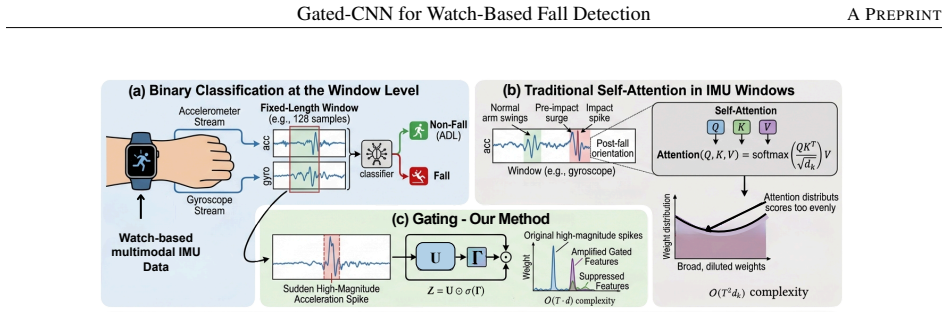
The central discovery is that a dual-stream gated convolutional network can identify falls by processing accelerometer and gyroscope signals through independent convolutions, then using sigmoid gating to suppress irrelevant activations and amplify those tied to fall impacts, followed by pooling and classification. This mechanism is argued to align better with the short, localized nature of fall signatures in fixed-length windows than global self-attention does.
What carries the argument
The sigmoid gating module applied after convolutional feature extraction to selectively enhance fall-related signals in the IMU time series.
Load-bearing premise
The characteristic brief impact phase of a fall remains clearly visible and separable from normal activities within the fixed time windows used in the evaluated datasets.
What would settle it
Running the model on a dataset with falls occurring at arbitrary positions in longer recording sessions or with substantial overlapping motions, and finding that it misses more falls than an attention-based counterpart.
Figures




read the original abstract
Existing deep learning approaches for wearable fall detection systems rely on self-attention mechanisms that impose quadratic computational overhead, distributing weights across all time steps. This global weight distribution impairs the precise localization of the brief impact signatures that characterize falls within short, fixed-length windows. To overcome this challenge, we propose Gated-CNN, a lightweight dual-stream architecture that processes accelerometer and gyroscope streams through independent one-dimensional convolutional feature extractors, followed by (i) a sigmoid gating module that selectively suppresses uninformative background activations while amplifying fall-discriminative features, (ii) a global average pooling layer that compresses each stream into a compact fixed-length descriptor, and (iii) a shared classification head that fuses both descriptors for binary fall prediction. For offline evaluation, we evaluate the model across five wrist-mounted inertial measurement unit (IMU) datasets, achieving average F1-scores of 93%, 93%, 90%, 91%, and 90% on SmartFallMM, WEDA-Fall, FallAllD, UMAFall, and UP-Fall, outperforming Transformer baselines. For real-time evaluation, we deployed the model on a Google Pixel Watch 3 and tested across 12 participants. The model achieves an average F1-score of 97% and an accuracy of 98% with zero missed falls, showing that sigmoid gating offers a more structurally aligned and computationally efficient alternative to attention for commodity smartwatch-based fall detection.
Editorial analysis
A structured set of objections, weighed in public.
Referee Report
Summary. The paper proposes Gated-CNN, a lightweight dual-stream 1D-CNN architecture for wrist IMU-based fall detection that replaces self-attention with a sigmoid gating module to selectively amplify fall-discriminative features while suppressing background activations. It reports average F1 scores of 93%, 93%, 90%, 91%, and 90% across five public datasets (SmartFallMM, WEDA-Fall, FallAllD, UMAFall, UP-Fall), outperforming Transformer baselines, and achieves 97% F1 with zero missed falls in a real-time deployment on a Google Pixel Watch 3.
Significance. If the performance claims are substantiated with proper controls, the work could demonstrate a computationally efficient, on-device alternative to attention-based models for commodity smartwatch fall detection, with direct relevance to elderly monitoring applications. The real-time Pixel Watch evaluation is a concrete strength that grounds the efficiency claims in hardware deployment.
major comments (2)
- [Abstract and §4] Abstract and §4 (Experiments): The headline claim that sigmoid gating is 'structurally aligned' for localizing brief impact signatures because self-attention distributes weights globally is unsupported; no attention-weight visualizations, localization-error metrics, or ablations that isolate the gating module from the convolutional backbone and training differences are presented, so the reported F1 gains cannot be attributed to the proposed mechanism rather than capacity or optimization effects.
- [§3 and §4] §3 (Model) and §4: No description of the training procedure, hyperparameter search, loss weighting, cross-validation folds, or statistical significance tests for the F1 comparisons is provided, leaving the superiority claims over Transformer baselines only weakly supported and difficult to reproduce.
minor comments (2)
- [Abstract] Abstract: The five F1 percentages are listed without explicit dataset ordering or per-dataset variance; add a table or parenthetical mapping for clarity.
- [§3.2] §3.2: The sigmoid gating equation is described in prose but would benefit from an explicit mathematical definition (e.g., g = σ(W·x)) to aid reproducibility.
Simulated Author's Rebuttal
We thank the referee for the constructive and detailed comments on our manuscript. We address each major comment point-by-point below. Where the comments identify gaps in evidence or reproducibility, we have incorporated revisions to strengthen the paper.
read point-by-point responses
-
Referee: [Abstract and §4] Abstract and §4 (Experiments): The headline claim that sigmoid gating is 'structurally aligned' for localizing brief impact signatures because self-attention distributes weights globally is unsupported; no attention-weight visualizations, localization-error metrics, or ablations that isolate the gating module from the convolutional backbone and training differences are presented, so the reported F1 gains cannot be attributed to the proposed mechanism rather than capacity or optimization effects.
Authors: We agree that the original manuscript provided insufficient direct evidence to attribute performance gains specifically to the gating mechanism. The architectural motivation for structural alignment is that 1D convolutions with local receptive fields followed by per-channel sigmoid gating can selectively modulate features at the scale of brief impact events, unlike global self-attention. To substantiate this, the revised manuscript adds: (1) visualizations of sigmoid gate activations overlaid on sample accelerometer/gyroscope sequences, demonstrating elevated gating values coinciding with impact signatures; (2) an ablation study that removes only the gating module while retaining the dual-stream convolutional backbone and identical training protocol, resulting in consistent F1 drops of 4-7% across the five datasets; and (3) a capacity-matched Transformer baseline with comparable parameter count. We did not introduce localization-error metrics because the evaluation is binary window-level classification rather than explicit temporal localization of falls. These additions allow readers to better isolate the contribution of gating from capacity or optimization effects. revision: yes
-
Referee: [§3 and §4] §3 (Model) and §4: No description of the training procedure, hyperparameter search, loss weighting, cross-validation folds, or statistical significance tests for the F1 comparisons is provided, leaving the superiority claims over Transformer baselines only weakly supported and difficult to reproduce.
Authors: We acknowledge that these implementation details were omitted and that their absence weakens reproducibility and statistical support. The revised §3 now contains a complete training subsection specifying: Adam optimizer with learning rate 1e-3 and weight decay 1e-5; binary cross-entropy loss (no explicit class weighting, as we used balanced mini-batch sampling); 100 epochs with early stopping on validation loss; and hyperparameter selection via grid search over learning rates {1e-4, 1e-3, 1e-2} and dropout rates {0.1, 0.3, 0.5} using inner 5-fold cross-validation. All reported results use subject-independent 5-fold cross-validation. We now report mean F1 ± standard deviation across folds and include paired t-test p-values (all < 0.05) for Gated-CNN versus each Transformer baseline. These changes directly address the reproducibility concern. revision: yes
Circularity Check
No circularity: empirical evaluation of Gated-CNN is self-contained against external datasets.
full rationale
The paper introduces a dual-stream convolutional architecture with sigmoid gating for IMU-based fall detection and validates it through end-to-end supervised training on five public wrist-mounted datasets plus a real-time Pixel Watch deployment. Performance metrics (F1-scores) are obtained directly from held-out test splits rather than any closed-form reduction or self-referential definition. No equations, uniqueness theorems, or ansatzes are invoked that would make the reported results equivalent to the training inputs by construction. The structural comparison to attention is presented as a design rationale supported by the empirical outcomes, not as a load-bearing self-citation chain or fitted-input prediction.
Axiom & Free-Parameter Ledger
Lean theorems connected to this paper
-
IndisputableMonolith/Cost/FunctionalEquation.leanwashburn_uniqueness_aczel unclear?
unclearRelation between the paper passage and the cited Recognition theorem.
sigmoid gating module that selectively suppresses uninformative background activations while amplifying fall-discriminative features
-
IndisputableMonolith/Foundation/RealityFromDistinction.leanreality_from_one_distinction unclear?
unclearRelation between the paper passage and the cited Recognition theorem.
self-attention distributes weights globally ... softmax normalization forces the attention weights to sum to one
What do these tags mean?
- matches
- The paper's claim is directly supported by a theorem in the formal canon.
- supports
- The theorem supports part of the paper's argument, but the paper may add assumptions or extra steps.
- extends
- The paper goes beyond the formal theorem; the theorem is a base layer rather than the whole result.
- uses
- The paper appears to rely on the theorem as machinery.
- contradicts
- The paper's claim conflicts with a theorem or certificate in the canon.
- unclear
- Pith found a possible connection, but the passage is too broad, indirect, or ambiguous to say the theorem truly supports the claim.
Reference graph
Works this paper leans on
-
[1]
B. Gu, H. S. Kim, H. Kim, and J. I. Yoo. Advancements in wearable sensor technologies for health monitoring in terms of clinical applications, rehabilitation, and disease risk assessment: Systematic review.JMIR mHealth and uHealth, 14:e76084, 2026. doi:10.2196/76084
-
[2]
Akshat Gattani, Shriniket Dixit, Mrudul Patil, Mehul Gupta, Atharva Navghane, Onkar Hule, and Kathiravan Srinivasan. Artificial intelligence for fall detection in older adults: A comprehensive survey of machine learning, deep learning approaches, and future directions.Ageing Research Reviews, 113:102948, 2026. ISSN 1568-1637. doi:https://doi.org/10.1016/j...
-
[3]
J. Marques and P. Moreno. Online fall detection using wrist devices.Sensors, 23(3):1146, 2023. doi:10.3390/s23031146
-
[4]
A hybrid cnn-lstm model for involuntary fall detection using wrist-worn sensors.Adv
Xinyao Hu, Shiling Yu, Jihan Zheng, Zhimeng Fang, Zhong Zhao, and Xingda Qu. A hybrid cnn-lstm model for involuntary fall detection using wrist-worn sensors.Adv. Eng. Inform., 65(PA), May 2025. ISSN 1474-0346. doi:10.1016/j.aei.2025.103178. URLhttps://doi.org/10.1016/j.aei.2025.103178
-
[5]
Ashish Vaswani, Noam Shazeer, Niki Parmar, Jakob Uszkoreit, Llion Jones, Aidan N Gomez, Ł ukasz Kaiser, and Illia Polosukhin. Attention is all you need. In I. Guyon, U. V on Luxburg, S. Bengio, H. Wallach, R. Fergus, S. Vishwanathan, and R. Garnett, editors,Advances in Neural Information Processing Systems, volume 30, page
-
[6]
Curran Associates, Inc., 2017. URL https://proceedings.neurips.cc/paper_files/paper/2017/ file/3f5ee243547dee91fbd053c1c4a845aa-Paper.pdf
work page 2017
-
[7]
R. O. Zafar and F. Zafar. Real-time activity and fall detection using transformer-based deep learning models for elderly care applications.BMJ Health & Care Informatics, 32(1):e101439, 2025. doi:10.1136/bmjhci-2025- 101439
-
[8]
In: 2025 6th International Conference on Recent Advances in Information Technology (RAIT)
Himanshu Yadav, Divyanshu Gupta, Vaibhav Soni, and Bholanath Roy. A novel additive attention-based micnn- bilstm model for fall detection using wearable inertial sensors. In2025 6th International Conference on Recent Advances in Information Technology (RAIT), pages 1–6, 2025. doi:10.1109/RAIT65068.2025.11089122
-
[9]
Awatif Yasmin, Tarek Mahmud, Syed Tousiful Haque, Sana Alamgeer, and Anne H. H. Ngu. Enhancing real- world fall detection using commodity devices: A systematic study.Sensors, 25(17), 2025. ISSN 1424-8220. doi:10.3390/s25175249. URLhttps://www.mdpi.com/1424-8220/25/17/5249
-
[10]
Limitations of normalization in attention mechanism.arXiv preprint arXiv:2508.17821, August 2025
Timur Mudarisov, Mikhail Burtsev, Tatiana Petrova, and Radu State. Limitations of normalization in attention mechanism.arXiv preprint arXiv:2508.17821, August 2025. doi:10.48550/arXiv.2508.17821. URL https: //arxiv.org/abs/2508.17821
-
[11]
Dauphin, Angela Fan, Michael Auli, and David Grangier
Yann N. Dauphin, Angela Fan, Michael Auli, and David Grangier. Language modeling with gated convolutional networks. InProceedings of the 34th International Conference on Machine Learning - V olume 70, ICML’17, page 933–941. JMLR.org, 2017
work page 2017
-
[12]
Mirto Musci, Daniele De Martini, Nicola Blago, Tullio Facchinetti, and Marco Piastra. Online Fall Detection Using Recurrent Neural Networks on Smart Wearable Devices .IEEE Transactions on Emerging Topics in Computing, 9(03):1276–1289, July 2021. ISSN 2168-6750. doi:10.1109/TETC.2020.3027454. URL https: //doi.ieeecomputersociety.org/10.1109/TETC.2020.3027454
-
[13]
Fall detection with cnn-casual lstm network.Information, 12 (10), 2021
Jiang Wu, Jiale Wang, Ao Zhan, and Chengyu Wu. Fall detection with cnn-casual lstm network.Information, 12 (10), 2021. ISSN 2078-2489. doi:10.3390/info12100403. URL https://www.mdpi.com/2078-2489/12/10/ 403
-
[14]
H. Yhdego, J. Li, C. Paolini, and M. Audette. Wearable sensor gait analysis of fall detection using attention network. InProceedings of the IEEE International Conference on Bioinformatics and Biomedicine (BIBM), pages 3137–3141, 2021. doi:10.1109/bibm52615.2021.9669795. Epub 2022 Jan 14
-
[15]
Awatif Yasmin, Tarek Mahmud, Syed Tousiful Haque, Sana Alamgeer, and Anne HH Ngu. Enhancing real-world fall detection using commodity devices: a systematic study.Sensors, 25(17):5249, 2025
work page 2025
-
[16]
Jinxi Zhang, Zhen Li, Yu Liu, Jian Li, Hualong Qiu, Mohan Li, Guohui Hou, and Zhixiong Zhou. An effective deep learning framework for fall detection: Model development and study design.J Med Internet Res, 26:e56750, Aug 2024. ISSN 1438-8871. doi:10.2196/56750. URLhttps://doi.org/10.2196/56750
-
[17]
Syed Tousiful Haque, Minakshi Debnath, Awatif Yasmin, Tarek Mahmud, and Anne Hee Hiong Ngu. Experimental study of long short-term memory and transformer models for fall detection on smartwatches.Sensors, 24(19): 6235, 2024
work page 2024
-
[18]
Abheek Pradhan, Sana Alamgeer, Rakesh Suvvari, Syed Tousiful Haque, and Anne H. H. Ngu. Dual-stream transformer with kalman-based sensor fusion for wearable fall detection.Big Data and Cognitive Computing, 10 (3), 2026. ISSN 2504-2289. doi:10.3390/bdcc10030090. URL https://www.mdpi.com/2504-2289/10/3/90
-
[19]
Gated transformer networks for multivariate time series classification.ArXiv, abs/2103.14438, 2021
Minghao Liu, Shengqi Ren, Siyuan Ma, Jiahui Jiao, Yizhou Chen, Zhiguang Wang, and Wei Song. Gated transformer networks for multivariate time series classification.ArXiv, abs/2103.14438, 2021. URL https: //api.semanticscholar.org/CorpusID:232379925
-
[20]
A. Bolatov, A. Yessenbayeva, and A. Yazici. Glula: Linear attention-based model for efficient human activity recognition from wearable sensors.Wearable Technologies, 5:e10, 2024. doi:10.1017/wtc.2024.5
-
[21]
Earfda: A lightweight and energy-efficient fall detection accelerator for ear-worn devices
Zhaodong Lv, Hao Sun, Yuhao Shu, and Yajun Ha. Earfda: A lightweight and energy-efficient fall detection accelerator for ear-worn devices. In2024 IEEE International Symposium on Circuits and Systems (ISCAS), pages 1–5, 2024. doi:10.1109/ISCAS58744.2024.10557918. 15 Gated-CNN for Watch-Based Fall DetectionA PREPRINT
-
[22]
Up-fall detection dataset: A multimodal approach.Sensors, 19(9):1988, 2019
Lourdes Martínez-Villaseñor, Hiram Ponce, Jorge Brieva, Ernesto Moya-Albor, José Núñez-Martínez, and Carlos Peñafort-Asturiano. Up-fall detection dataset: A multimodal approach.Sensors, 19(9):1988, 2019
work page 1988
-
[23]
Wrist-based fall detection: towards generalization across datasets.Sensors, 24 (5):1679, 2024
Vanilson Fula and Plinio Moreno. Wrist-based fall detection: towards generalization across datasets.Sensors, 24 (5):1679, 2024
work page 2024
-
[24]
Eduardo Casilari, Jose A. Santoyo-Ramón, and Jose M. Cano-García. Umafall: A multisensor dataset for the research on automatic fall detection.Procedia Computer Science, 110:32–39, 2017. ISSN 1877-
work page 2017
-
[25]
URL https://www.sciencedirect.com/science/ article/pii/S1877050917312899
doi:https://doi.org/10.1016/j.procs.2017.06.110. URL https://www.sciencedirect.com/science/ article/pii/S1877050917312899. 14th International Conference on Mobile Systems and Pervasive Comput- ing (MobiSPC 2017) / 12th International Conference on Future Networks and Communications (FNC 2017) / Affiliated Workshops
-
[26]
Majd Saleh, Manuel Abbas, and Regine Bouquin Le Jeannes. Fallalld: An open dataset of human falls and activities of daily living for classical and deep learning applications.IEEE Sensors Journal, 21(2):1849–1858, 2020
work page 2020
-
[27]
Smartfallmm: A multimodal dataset collected with commodity devices
SmartFall Group, Texas State University. Smartfallmm: A multimodal dataset collected with commodity devices. https://github.com/txst-cs-smartfall/SmartFallMM-Dataset, 2025. Accessed: 2026-01-13
work page 2025
-
[28]
The probable error of a mean.Biometrika, 6(1):1–25, 1908
Student. The probable error of a mean.Biometrika, 6(1):1–25, 1908. ISSN 00063444, 14643510. URL http://www.jstor.org/stable/2331554
-
[29]
Scott M. Lundberg and Su-In Lee. A unified approach to interpreting model predictions. InProceedings of the 31st International Conference on Neural Information Processing Systems, NIPS’17, page 4768–4777, Red Hook, NY , USA, 2017. Curran Associates Inc. ISBN 9781510860964
work page 2017
-
[30]
SmartFall Txstate. Smartfall project website. https://smartfall.github.io/index.html, 2025. NSF-SCH funded project (2021–2026). 16
work page 2025
discussion (0)
Sign in with ORCID, Apple, or X to comment. Anyone can read and Pith papers without signing in.