REVIEW 4 minor 3 cited by
Search for hadronic decays of feebly-interacting particles at NA62
T0 review · 0 major / 4 minor · reviewed 2026-08-08 · deepseek-v4-flash
Pith's one-line read Recording $1.4\times10^{17}$ protons on dump, NA62 observes zero events in seven hadronic final states and excludes new dark photon, dark scalar, and axion-like particle parameter space.
desk verdict Clean first NA62 hadronic beam-dump search; the null result is robust, and the exclusion contours carry an admitted but unquantified theory uncertainty in the meson-mixing channel. read the letter →
The pith
A machine-rendered reading of the paper's core claim, the machinery that carries it, and where it could break.
The reading
What carries the argument
The signal yield is governed by $N_{\rm exp} = N_{\rm POT}\,\chi^i_{pp\to X}(m_X)\,P^i_{\rm RD}(m_X,\tau_X)\,A^{ij}_{\rm acc}(m_X,\tau_X)$, where $\chi^i_{pp\to X}$ is the production probability per proton on dump for production process $i$ (B-meson decays, light-meson decays and mixing, bremsstrahlung, or Primakoff), $P^i_{\rm RD}$ is the probability that the particle traverses the dump and decays inside the 105–180 m fiducial volume, and $A^{ij}_{\rm acc}$ is the acceptance for decay channel $j$. The hadronic branching ratios are set to unity at the reference stage, making the measured event counts model-independent before interpretation; the model-dependent exclusion contours are then produced with a public signal-yield and likelihood tool [16] using the CLs method [23]. Signal and control regions in the $(Z_{\rm TAX},\mathrm{CDA}_{\rm TAX})$ plane, derived from the backward-extrapolated production vertex, are masked until the background estimates are validated.
What would settle it
Measure the inclusive B-meson production cross section in 400 GeV proton–nucleus collisions and carry out a complete meson-mixing calculation for dark-photon and axion production; if either lowers the expected signal counts by more than the 20% proton-on-target uncertainty, the quoted exclusion contours would move inward, and a future higher-statistics beam-dump run would be needed to restore them.
Extended reading notes
Core claim
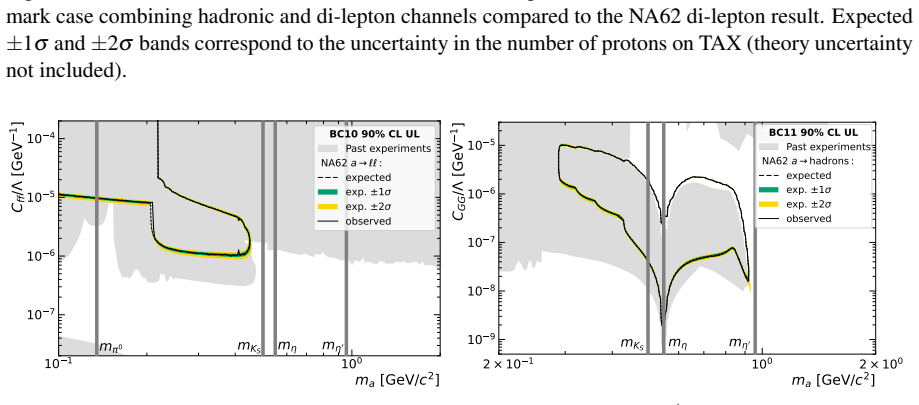
The central claim is that the NA62 beam-dump data contain no evidence of new particles decaying hadronically, and that this absence excludes parameter space that previous searches had left open. In the dark photon benchmark, the 90% CL observed contour in the $(m_{A'},\varepsilon)$ plane combines hadronic and di-lepton channels and reaches couplings below those probed by earlier proton and electron beam-dump experiments for sub-GeV masses. The dark scalar limit on $\sin^2\theta$ is similarly extended, and for axion-like particles new limits are set on fermion and gluon couplings assuming a UV scale $\Lambda=1$ TeV. In all benchmark cases the observed contours extend beyond the previous limits, with mass windows around the $\pi^0$, $\eta$, $\eta'$, $\rho$, $\omega$, and $\phi$ resonances excluded from the interpretation because the expected signal is not reliable there.
Load-bearing premise
The limits stand on how often the dump is assumed to produce dark photons, dark scalars, and axion-like particles; if the true production rates are lower than assumed, the excluded regions shrink, and the paper does not fold theory uncertainty into the contours.
Editorial extensions
If this is right
- Dark-photon and dark-scalar 90% CL contours now cover coupling values below the reach of earlier proton and electron beam-dump experiments for sub-GeV masses.
- The gluon-coupled axion-like-particle benchmark is constrained almost entirely through hadronic channels, since its di-lepton widths are small.
- The dominant background, $K^+\to\pi^+\pi^+\pi^-$, contributes only about 0.007 expected events in the signal region, so the search is not background-limited at the current sample size.
- Updating the light-meson production spectra and adding mixing and time-like form-factor production also strengthens the earlier NA62 di-lepton-only bounds.
Reading between the lines
- If the assumed production rates are accurate, the null result disfavors dark photons and dark scalars as the dominant dark-sector mediators over the newly excluded mass–coupling region, narrowing the parameter space for models that use these portals.
- Because the analysis is essentially background-free at $10^{18}$ protons on dump, a larger dataset would gain mainly from statistics; production-model uncertainties, which are not propagated into the contours, would then become the limiting systematic.
- A complete calculation of light-meson mixing kinematics for dark photons and axion-like particles could shift the contours, so the quoted excluded regions may need revision once such a treatment exists.
- The seven hadronic final states are defined model-independently, so the same event selection can be reused to constrain any new particle decaying to those final states, not only the three benchmark models considered here.
Signed reviews
Editorial analysis
A structured set of objections, weighed in public.
Referee Report
Summary. This paper reports a search for long-lived feebly-interacting particles (dark photons, dark scalars, and axion-like particles) decaying to hadronic final states in the NA62 beam-dump configuration. Using a 2021 dataset corresponding to (1.4±0.3)×10^17 protons on the TAX dump, the analysis selects events with two oppositely charged hadronic tracks and possible photons, reconstructing final states such as π+π−, π+π−γ, π+π−π0, π+π−π0π0, π+π−η, K+K−, and K+K−π0. The signal and control regions are kept masked until background estimates are validated. The expected background in the signal region is below 0.04 events for all channels, dominated by K+ → π+π+π− decays; zero events are observed after unmasking. The null result is interpreted with the public ALPINIST framework to set 90% CL exclusion limits for several benchmark models, combining the hadronic channels with previously published di-lepton results. The paper reports new excluded regions for dark scalars, dark photons, and axion-like particles.
Significance. The central experimental observation—zero candidates against a validated background expectation below 0.04 events—is robust and constitutes the paper's main result. The analysis is carefully blinded, the background is estimated with data-driven methods (notably via single-track Q1 samples and PUMAS+GEANT4 simulation), and the systematic budget is clearly presented. The exclusion limits improve on previous beam-dump searches in significant parts of the parameter space, and the use of the public ALPINIST framework makes the interpretation reproducible. The main limitation is that the limits inherit the theoretical uncertainties of the production models, and in particular the meson-mixing channel for dark photons and ALPs is treated with an approximation for which no complete literature treatment exists; this is explicitly acknowledged in Sec. 3.3. This limitation does not affect the null observation and is normal for model-dependent searches.
minor comments (4)
- [Section 3.3, Eq. (1)] The meson-mixing production channel for dark photons and ALPs uses an approximate treatment with no assigned systematic uncertainty; since the contours in the right panels of Figs. 7 and 10 include this channel, the authors should add a sentence in Section 5 or in the figure captions stating explicitly that those exclusion contours are subject to this approximation.
- [Figure 6, bottom panel] The mass axis is labelled 'mA′ [MeV/c2]' but the plotted range and context indicate that the label should be GeV/c2 rather than MeV/c2.
- [Figure 3] The axis labels are rendered inconsistently (e.g., ' [m] TAX Z' and ' [mm] TAX CDA'); please use the same notation as in the text, namely Z_TAX and CDA_TAX.
- [Section 5 and Abstract] The statement that 'new regions ... are excluded' would benefit from a brief reminder that the exclusions are model-dependent and do not include theory uncertainties in the production processes, as already acknowledged in Section 3.3 and in the figure captions.
Circularity Check
No significant circularity: the null observation is fully data-driven and the limit setting uses external, independently published production models.
full rationale
The paper's central result is an observed event count in a signal region. The selection, background estimation, and expected-signal calculation are laid out directly in Sections 3.1-3.3: no parameter is fitted to the unmasked signal-region data, and the zero observed events are not an input to Eq. (1). The expected number of signal events N_exp is the product of N_POT, a production probability, a decay-in-flight probability, and an acceptance, each evaluated from GEANT4-based simulation and published theoretical cross sections. The conversion to exclusion contours uses the public ALPINIST framework [16] and production calculations [12, 15, 18], several of which share authors with the NA62 collaboration, but those are published, parameter-free external calculations that do not embed the present paper's null result. The paper explicitly states an approximation in the meson-mixing production channel ('there is no complete treatment of this effect available in the literature. Therefore, the NP particle kinematics is approximately evaluated as discussed in Ref. [16]'), but this is an admitted modeling limitation affecting theory robustness, not a circular reduction: the approximate kinematics are not defined in terms of the observed hadronic decay counts. Likewise, the 20% N_POT uncertainty and 3.3% acceptance uncertainties are estimated from independent calibrations and simulation statistics. No equation in the paper is equivalent by construction to the claimed exclusion, and no fitted quantity is renamed as a prediction. Under the rule that self-citation is not circularity when the cited result is independent and falsifiable outside the present paper's fitted values, the derivation chain is self-contained.
Assumptions & free parameters
assumptions (4)
- domain assumption Monte Carlo generators (GEANT4, PYTHIA8, GENIE) accurately model detector response and particle production and interactions.
- domain assumption The benchmark models (dark photon, dark scalar, ALP) with their coupling Lagrangians are appropriate descriptions of hypothetical new physics.
- domain assumption The theoretical production cross sections and decay widths from Refs. [12,13,14,17,18,19,20,21,22] are correct within unspecified uncertainties.
- standard math The CLs method with a profile likelihood ratio provides valid statistical inference for setting upper limits.
Cite this review
Pith. "Pith review of Search for hadronic decays of feebly-interacting particles at NA62." pith.science (2026). https://pith.science/paper/YLLQG7FV
@misc{pith2026250204241,
  author       = {Pith},
  title        = {Pith review of: Search for hadronic decays of feebly-interacting particles at NA62},
  year         = {2026},
  howpublished = {\url{https://pith.science/paper/YLLQG7FV}},
  note         = {Machine review of arXiv:2502.04241}
}
abstract
The NA62 experiment at CERN has the capability to collect data in a beam-dump mode, where 400 GeV protons are dumped on an absorber. In this configuration, New Physics particles, including dark photons, dark scalars, and axion-like particles, may be produced in the absorber and decay in the instrumented volume beginning approximately 80 m downstream of the dump. A search for these particles decaying in flight to hadronic final states is reported, based on an analysis of a sample of $1.4 \times 10^{17}$ protons on dump collected in 2021. No evidence of a New Physics signal is observed, excluding new regions of parameter spaces of multiple models.
Figures


Figures from the paper (7 more)



Forward citations
Cited by 3 Pith papers
-
Long-lived Axion-Like Particles from Tau Decays
Leptophilic long-lived ALPs produced in tau decays are shown to yield new CHARM/BEBC constraints and improved future sensitivity, particularly at SHiP, extending reach to fa up to 10^8-10^9 GeV in LFV scenarios.
-
Axion-Like Particle Search with a Hybrid Cherenkov-Scintillation Detector
A beam-dump experiment using a 10-ton hybrid Cherenkov-scintillation detector found no axion-like particles, but demonstrated background rejection about six times stronger than its predecessor, yielding improved exclu...
-
Axion Searches at the CERN SPS: From Their Dawn to Current Prospects
A review of axion and ALP searches at the CERN SPS, covering Barbiellini's 1982 proposal, the CHARM experiment, NA62/NA64 results, and future directions.
Reference graph
Works this paper leans on
-
[16]
Jerhot, et al., JHEP07, 094 (2022)
J. Jerhot, et al., JHEP07, 094 (2022). DOI 10.1007/JHEP07(2022)094. URLhttps://doi.org/ 10.5281/zenodo.13167444
-
[1]
C. Antel, et al., Eur. Phys. J. C83(12), 1122 (2023). DOI 10.1140/epjc/s10052-023-12168-5
-
[2]
J. Beacham, et al., J. Phys. G47(1), 010501 (2020). DOI 10.1088/1361-6471/ab4cd2 11
-
[3]
Cortina Gil, et al., JHEP09, 035 (2023)
E. Cortina Gil, et al., JHEP09, 035 (2023). DOI 10.1007/JHEP09(2023)035
-
[4]
E. Cortina Gil, et al., Phys. Rev. Lett.133(11), 111802 (2024). DOI 10.1103/PhysRevLett.133. 111802
-
[5]
Cortina Gil, et al., JHEP02, 191 (2025)
E. Cortina Gil, et al., JHEP02, 191 (2025). DOI 10.1007/JHEP02(2025)191
-
[6]
M. Rosenthal, et al., Int. J. Mod. Phys. A34(36), 1942026 (2019). DOI 10.1142/ S0217751X19420260
work page 2019
-
[7]
Cortina Gil, et al., JINST12(05), P05025 (2017)
E. Cortina Gil, et al., JINST12(05), P05025 (2017). DOI 10.1088/1748-0221/12/05/P05025
Show all 41 references
-
[8]
Niess, A
V . Niess, A. Barnoud, C. Cârloganu, E. Le Ménédeu, Comput. Phys. Commun.229, 54 (2018). DOI 10.1016/j.cpc.2018.04.001
2018 doi
-
[9]
Agostinelli, et al., Nucl
S. Agostinelli, et al., Nucl. Instrum. Meth. A506, 250 (2003). DOI 10.1016/S0168-9002(03) 01368-8
2003 doi
-
[10]
Andreopoulos, et al., Nucl
C. Andreopoulos, et al., Nucl. Instrum. Meth. A614, 87 (2010). DOI 10.1016/j.nima.2009.12.009
2010 doi
-
[11]
Bierlich, et al., SciPost Phys
C. Bierlich, et al., SciPost Phys. Codeb.2022, 8 (2022). DOI 10.21468/SciPostPhysCodeb.8
2022 doi
-
[12]
Schubert, B
J.L. Schubert, B. Döbrich, J. Jerhot, T. Spadaro, JHEP01, 140 (2025). DOI 10.1007/JHEP02(2025) 140
2025 doi
-
[13]
Bauer, M
M. Bauer, M. Neubert, S. Renner, M. Schnubel, A. Thamm, JHEP09, 056 (2022). DOI 10.1007/ JHEP09(2022)056
2022
-
[14]
Boiarska, K
I. Boiarska, K. Bondarenko, A. Boyarsky, V . Gorkavenko, M. Ovchynnikov, A. Sokolenko, JHEP 11, 162 (2019). DOI 10.1007/JHEP11(2019)162
2019 doi
-
[15]
Döbrich, J
B. Döbrich, J. Jaeckel, T. Spadaro, JHEP05, 213 (2019). DOI 10.1007/JHEP05(2019)213. [Erra- tum: JHEP10, 046 (2020)]
2019 doi
-
[17]
Foroughi-Abari, A
S. Foroughi-Abari, A. Ritz, Phys. Rev. D105(9), 095045 (2022). DOI 10.1103/PhysRevD.105. 095045
2022 doi
-
[18]
Döbrich, J
B. Döbrich, J. Jaeckel, F. Kahlhoefer, A. Ringwald, K. Schmidt-Hoberg, JHEP02, 018 (2016). DOI 10.1007/JHEP02(2016)018
2016 doi
-
[19]
Ilten, Y
P. Ilten, Y . Soreq, M. Williams, W. Xue, JHEP06, 004 (2018). DOI 10.1007/JHEP06(2018)004
2018 doi
-
[20]
Aloni, Y
D. Aloni, Y . Soreq, M. Williams, Phys. Rev. Lett.123(3), 031803 (2019). DOI 10.1103/ PhysRevLett.123.031803
2019
-
[21]
Winkler, Phys
M.W. Winkler, Phys. Rev. D99(1), 015018 (2019). DOI 10.1103/PhysRevD.99.015018
2019 doi
-
[22]
Dalla Valle Garcia, F
G. Dalla Valle Garcia, F. Kahlhoefer, M. Ovchynnikov, A. Zaporozhchenko, Phys. Rev. D109(5), 055042 (2024). DOI 10.1103/PhysRevD.109.055042
2024 doi
-
[23]
Junk, Nucl
T. Junk, Nucl. Instrum. Meth. A434, 435 (1999). DOI 10.1016/S0168-9002(99)00498-2
1999 doi
-
[24]
Bergsma, et al., Phys
F. Bergsma, et al., Phys. Lett. B157, 458 (1985). DOI 10.1016/0370-2693(85)90400-9
1985 doi
-
[25]
Blumlein, et al., Z
J. Blumlein, et al., Z. Phys. C51, 341 (1991). DOI 10.1007/BF01548556 12
1991 doi
-
[26]
Blumlein, et al., Int
J. Blumlein, et al., Int. J. Mod. Phys. A7, 3835 (1992). DOI 10.1142/S0217751X9200171X
1992 doi
-
[27]
Blümlein, J
J. Blümlein, J. Brunner, Phys. Lett. B731, 320 (2014). DOI 10.1016/j.physletb.2014.02.029
2014 doi
-
[28]
Bjorken, S
J.D. Bjorken, S. Ecklund, W.R. Nelson, A. Abashian, C. Church, B. Lu, L.W. Mo, T.A. Nunamaker, P. Rassmann, Phys. Rev. D38, 3375 (1988). DOI 10.1103/PhysRevD.38.3375
1988 doi
-
[29]
Riordan, et al., Phys
E.M. Riordan, et al., Phys. Rev. Lett.59, 755 (1987). DOI 10.1103/PhysRevLett.59.755
1987 doi
-
[30]
Andreas, C
S. Andreas, C. Niebuhr, A. Ringwald, Phys. Rev. D86, 095019 (2012). DOI 10.1103/PhysRevD. 86.095019
2012 doi
-
[31]
Banerjee, et al., Phys
D. Banerjee, et al., Phys. Rev. Lett.125(8), 081801 (2020). DOI 10.1103/PhysRevLett.125.081801
2020 doi
-
[32]
Banerjee, et al., Phys
D. Banerjee, et al., Phys. Rev. D101(7), 071101 (2020). DOI 10.1103/PhysRevD.101.071101
2020 doi
-
[33]
Abreu, et al., Phys
H. Abreu, et al., Phys. Lett. B848, 138378 (2024). DOI 10.1016/j.physletb.2023.138378
2024
-
[34]
Mammen Abraham, et al., JHEP01, 199 (2025)
R. Mammen Abraham, et al., JHEP01, 199 (2025). DOI 10.1007/JHEP01(2025)199
2025 doi
-
[35]
Cortina Gil, et al., JHEP06, 093 (2021)
E. Cortina Gil, et al., JHEP06, 093 (2021). DOI 10.1007/JHEP06(2021)093
2021 doi
-
[36]
Y . Afik, B. Döbrich, J. Jerhot, Y . Soreq, K. Tobioka, Phys. Rev. D108(5), 055007 (2023). DOI 10.1103/PhysRevD.108.055007
2023 doi
-
[37]
Cortina Gil, et al., JHEP02, 201 (2021)
E. Cortina Gil, et al., JHEP02, 201 (2021). DOI 10.1007/JHEP02(2021)201
2021 doi
-
[38]
Cortina Gil, et al., Phys
E. Cortina Gil, et al., Phys. Lett. B850, 138513 (2024). DOI 10.1016/j.physletb.2024.138513
2024
-
[39]
Artamonov, et al., Phys
A.V . Artamonov, et al., Phys. Lett. B623, 192 (2005). DOI 10.1016/j.physletb.2005.07.057
2005 doi
-
[40]
Artamonov, et al., Phys
A.V . Artamonov, et al., Phys. Rev. D79, 092004 (2009). DOI 10.1103/PhysRevD.79.092004
2009 doi
-
[41]
Ettore Pancini
S. Gori, G. Perez, K. Tobioka, JHEP08, 110 (2020). DOI 10.1007/JHEP08(2020)110 13 The NA62 Collaboration Université Catholique de Louvain, Louvain-La-Neuve, Belgium E. Cortina Gil , J. Jerhot *,1 , N. Lurkin TRIUMF, Vancouver, British Columbia, Canada T. Numao , B. Velghe , V ...
2020 doi
Reviewed August 8, 2026 · model on record in the stance chip above.
Discussion (0). Continue with ORCID to comment.