REVIEW 3 major objections 3 minor
Post-failure routing with a conformal risk-control layer lets coding agents beat always-escalate on solve rate while spending about one-third of the recovery cost.
Reviewed by Pith at T0; open to challenge. T0 means a machine referee read the full paper against a public rubric. the ladder, T0–T4 →
T0 review · deepseek-v4-flash
2026-08-03 00:13 UTC pith:YMGTSDBU
load-bearing objection Recovery routing with CRC budget calibration is a genuinely new idea; the abstract is coherent and deserves referee time, though the empirical claims need full-text verification. the 3 major comments →
CodeRescue: Budget-Calibrated Recovery Routing for Coding Agents
The pith
A machine-rendered reading of the paper's core claim, the machinery that carries it, and where it could break.
Core claim
The paper establishes that a single supervised router over recovery actions (cheap retry versus escalation), combined with a Conformal Risk Control layer that selects a deployment cost penalty, yields a full frontier of cost/solve-rate trade-offs for post-failure decisions in coding agents. The calibrated frontier dominates fixed actions, prompt-only routers, and a binary cascade baseline across held-out failures from five coding benchmarks. In the main GPT-5.4-nano/GPT-5.4 setting, a CRC-calibrated point achieves a higher solve rate than always-escalate while spending only 35% of its mean recovery cost. Under exchangeability of held-out and deployment failures, the CRC layer provides margin
What carries the argument
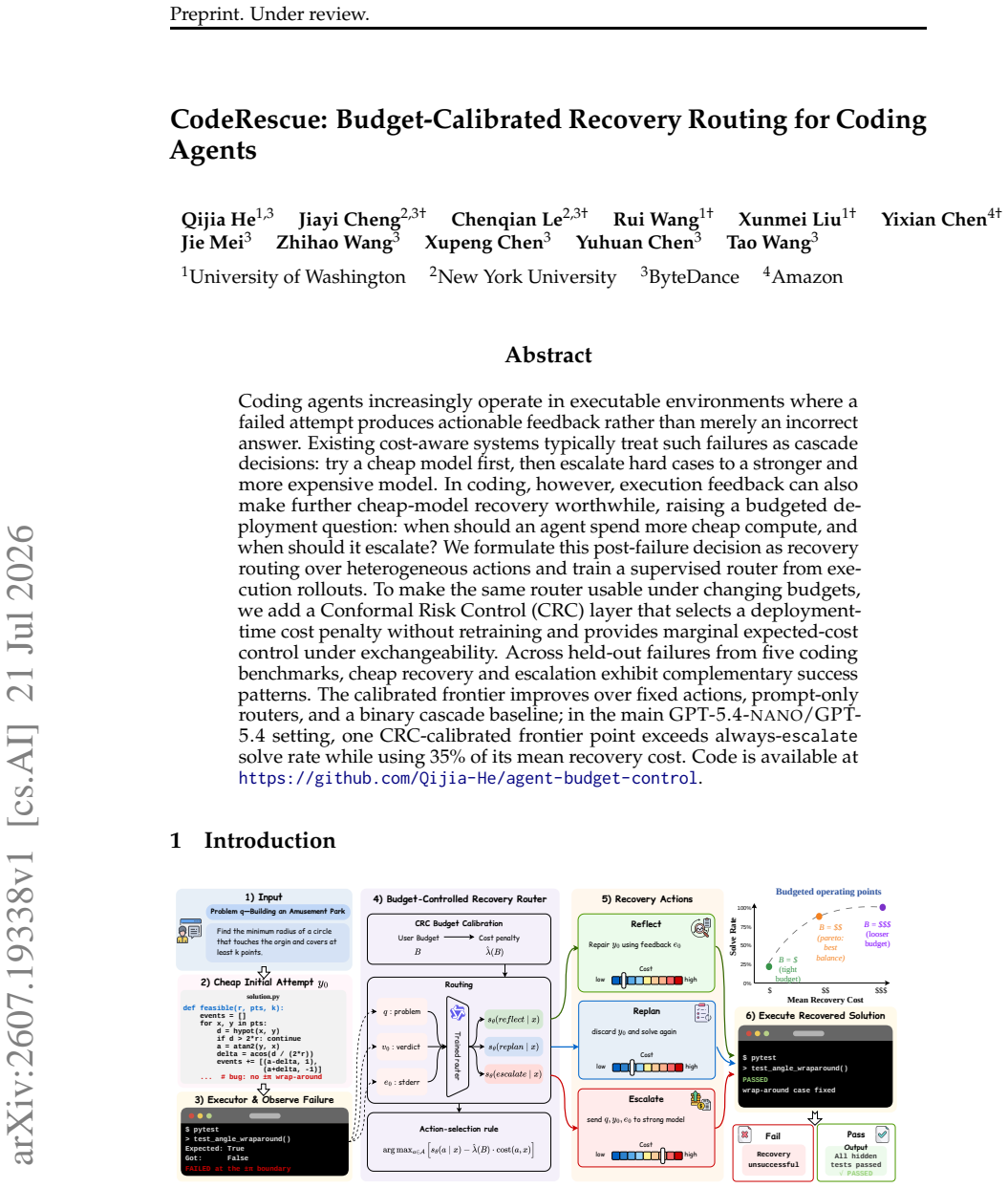
The central object is a recovery router over heterogeneous actions — cheap-model retry vs escalation to a stronger model — supervised on execution rollouts, together with a Conformal Risk Control (CRC) layer. The CRC layer selects a deployment-time cost penalty, converting the pretrained router into a spectrum of operating points on the cost/solve-rate frontier and attaching a formal marginal expected-cost guarantee under exchangeability. Its work is to make budget changes a choice of a penalty parameter rather than a retraining event, while preserving a statistical control on mean recovery cost.
Load-bearing premise
The marginal expected-cost guarantee holds only if deployment-time failures are exchangeable with the held-out failures used for calibration; if the real task distribution drifts, the guarantee and the calibrated frontier transfer break.
What would settle it
Run the CRC-calibrated router on a new coding benchmark whose failure mix differs from the five used for calibration (e.g., a different language, much longer traces, or adversarially selected failures) and compare the realized mean recovery cost to the calibrated marginal bound. If the realized cost repeatedly exceeds the bound, the exchangeability assumption failed; a single run under the bound would not settle it.
If this is right
- Cheap recovery and escalation find different failure modes, so the best deployment policy mixes them according to budget rather than following a strict escalation ladder.
- The CRC layer lets a single trained router adapt to new budgets at deployment time without retraining, with a formal bound on mean recovery cost under exchangeability.
- Under exchangeability, deployment teams get a statistical cost guarantee alongside a solve-rate target, making budget planning risk-aware.
- The main GPT-5.4-nano/GPT-5.4 result indicates that always-escalate is not optimal when cost matters; a calibrated mix achieves higher solve rate at one-third of the recovery cost.
- A router trained on execution rollouts transfers across five coding benchmarks, suggesting that recovery-routing policies generalize across coding task distributions.
Where Pith is reading between the lines
- The same routing-plus-CRC design could generalize to other agent settings with execution feedback and heterogeneous action costs — theorem proving, tool-use agents, or robotics retries — wherever a failed attempt yields actionable signal.
- An implicit policy claim worth testing: the escalation-ladder architecture is suboptimal because execution feedback carries information; a router that distinguishes retryable from escalate-only failures exploits that information, implying future systems should allocate compute based on feedback content, not just cost tiers.
- The guarantee is marginal expected cost, not per-task worst case; a deployment team needing a per-task cost cap would require a different control scheme — a boundary the paper leaves implicit.
- A testable extension: apply CRC to the router's confidence threshold for retry versus escalate instead of a cost penalty, and compare the resulting frontier shape and guarantee strength.
Editorial analysis
A structured set of objections, weighed in public.
Referee Report
Summary. The paper 'CodeRescue: Budget-Calibrated Recovery Routing for Coding Agents' proposes a supervised router that decides, after a failed coding-agent attempt, whether to spend more cheap compute or escalate to a stronger model. A Conformal Risk Control (CRC) layer selects a deployment-time cost penalty without retraining and is claimed to provide marginal expected-cost control under exchangeability. The authors report held-out evaluations across five coding benchmarks, asserting that the calibrated frontier beats fixed actions, prompt-only routers, and a binary cascade; in the main GPT-5.4-nano/GPT-5.4 setting, one frontier point claims a higher solve rate than always-escalate while using 35% of its mean recovery cost. Code is made available.
Significance. If the claims are substantiated, this is a practical contribution: it offers a principled way to tune cost/solve-rate trade-offs in coding agents after execution failures, with a formal risk-control layer. A reproducible code release is a strength. However, the paper as submitted is abstract-only; no methods, proofs, or experimental details are available. The formal guarantee is conditional on exchangeability, which is not tested, and the headline empirical claim lacks uncertainty quantification. The significance is therefore conditional on the full text providing the missing evidence.
major comments (3)
- [Abstract (entire manuscript)] The submission consists solely of an abstract; there is no full text, no methods section, no derivation of the CRC bound, and no experimental protocol. This is not a reviewable journal manuscript. The central claims about the calibrated frontier and the CRC guarantee cannot be evaluated. A full paper with methodology, proofs, and reproducibility details is required before any soundness assessment.
- [Abstract (CRC guarantee)] The abstract states that the CRC layer 'provides marginal expected-cost control under exchangeability.' Exchangeability is a load-bearing condition, but the paper gives no argument or experimental evidence that calibration-time failures and deployment-time failures are exchangeable. Five held-out benchmarks do not establish this; different repositories, bug distributions, and feedback quality could break the guarantee. Without a drift analysis or a formal weakening of the assumption, the cost-control claim is fragile and potentially vacuous in practical deployment.
- [Abstract (empirical claim)] The headline result — that one CRC-calibrated frontier point exceeds always-escalate solve rate while using 35% of its mean recovery cost — is reported without confidence intervals, number of held-out failures, or the protocol for selecting that point. The cost penalty is selected via CRC on calibration data, so we need to know whether this point is a cherry-picked extremum. The broader claim that the calibrated frontier improves over fixed actions, prompt-only routers, and a binary cascade also lacks any uncertainty quantification across benchmarks and repetitions. These are necessary to distinguish a robust effect from chance.
minor comments (3)
- [Abstract (benchmarks)] The five coding benchmarks are not named. In the full paper, identify them and specify which are used for training, calibration, and evaluation.
- [Abstract (models)] The GPT-5.4-nano/GPT-5.4 setting is unclear; clarify the model family, API costs, and why these two are the 'main' setting.
- [Abstract (code)] The GitHub link is useful, but for review the paper should include a reproducibility statement, data splits, and a specification of compute/API usage.
Circularity Check
No circularity identifiable from the abstract; the supervised router is evaluated on held-out failures and the CRC layer's guarantee rests on a stated exchangeability assumption, which is an external-validity condition rather than a reduction to inputs.
full rationale
This is an abstract-only review, so only the abstract's claims can be examined. The derivation chain described is: (1) train a supervised recovery router from execution rollouts, (2) add a Conformal Risk Control layer that selects a deployment-time cost penalty on calibration data, and (3) evaluate across held-out failures from five coding benchmarks. This is standard supervised evaluation plus conformal calibration: the router and penalty are fit on training/calibration data and assessed on held-out failures. The held-out step prevents the reported solve-rate and cost improvements from being forced by construction. The CRC guarantee is explicitly conditioned on exchangeability, which is a stated assumption about future data, not a circular definition of the target result. No equation is quoted that defines a predicted quantity in terms of the fitted parameter, and the abstract does not invoke any load-bearing self-citation or rename a known result. The main legitimate concern is external validity and possible selection of the headline 'one frontier point,' but that is a robustness/selection-bias issue, not circularity. Under the instruction to flag only circularity that can be exhibited by quote and specific reduction, no such step is present. Score 0.
Axiom & Free-Parameter Ledger
free parameters (2)
- supervised router parameters =
unknown
- cost penalty selected by CRC =
unknown
axioms (4)
- domain assumption Exchangeability of calibration rollouts and deployment-time failures
- domain assumption Execution feedback contains signal for recovery decisions
- domain assumption Benchmarks are representative of deployment workloads
- domain assumption Action costs are known and comparable
read the original abstract
Coding agents increasingly operate in executable environments where a failed attempt produces actionable feedback rather than merely an incorrect answer. Existing cost-aware systems typically treat such failures as cascade decisions: try a cheap model first, then escalate hard cases to a stronger and more expensive model. In coding, however, execution feedback can also make further cheap-model recovery worthwhile, raising a budgeted deployment question: when should an agent spend more cheap compute, and when should it escalate? We formulate this post-failure decision as recovery routing over heterogeneous actions and train a supervised router from execution rollouts. To make the same router usable under changing budgets, we add a Conformal Risk Control (CRC) layer that selects a deployment-time cost penalty without retraining and provides marginal expected-cost control under exchangeability. Across held-out failures from five coding benchmarks, cheap recovery and escalation exhibit complementary success patterns. The calibrated frontier improves over fixed actions, prompt-only routers, and a binary cascade baseline; in the main GPT-5.4-nano/GPT-5.4 setting, one CRC-calibrated frontier point exceeds always-escalate solve rate while using 35% of its mean recovery cost. Code is available at https://github.com/Qijia-He/agent-budget-control.
Figures


discussion (0)
Sign in with ORCID, Apple, or X to comment. Anyone can read and Pith papers without signing in.